
Cash Application Metrics That Move AR Performance
Learn the cash application metrics CFOs actually use — match rate, STP, unapplied cash, and cycle time — and how to benchmark and improve each one.
More than 90% of companies surveyed say cash application will be a finance priority in 2026, yet 70% report straight-through processing at no more than 50%, and 31% are at no more than 25%. Only 30% can apply cash in 30 minutes or less, while 22% take at least a day. The gap isn't a reporting detail. It tells you whether your AR ledger reflects usable cash or a delayed approximation of it. (Billtrust's cash application metrics guidance)
For CFOs, Controllers, and owners of professional services firms, the practical question isn't “What is our match rate?” It's “How mature is our cash application process, and what happens to the exceptions that automation doesn't clear?” A reliable answer requires a small set of cash application metrics tied to working capital, exception ownership, and the quality of the subledger.
Why Cash Application Quietly Runs Working Capital
A controller can look at the bank balance and still have an unreliable view of cash.
The bank shows that a client paid. The AR ledger may still show an overdue invoice because the payment arrived without remittance, landed under a parent company name, or covered several invoices with a short payment. Until someone applies it correctly, the collector sees an inaccurate balance, the aging report carries a false delinquency, and the cash forecast contains money that can't be confidently assigned.
That is why cash application is the operational choke point for working capital. Every receipt waiting in suspense or sitting on account is cash the AR subledger can't release to the right invoice. The business has received the money, but the finance team can't use the record cleanly for collections, credit decisions, dispute resolution, or forecasting.
A practical explanation of the process appears in this guide to cash application in accounting. The important point for an operator is simple: receipt of cash and application of cash are different events.
The professional services version of the problem
A mid-market professional services firm may receive wires, ACH payments, checks, card settlements, and portal remittances from the same client group. A single payment can cover retainers, milestone invoices, reimbursable expenses, and credit adjustments. The bank reconciliation can be perfectly clean while the AR ledger remains partially unresolved.
Consider a client that pays a consolidated amount for several engagements. Treasury confirms the deposit. The AR analyst searches email for the remittance, identifies the legal entity, checks open invoices, allocates the payment, and separates a short pay for a disputed expense. Until that work is complete, the firm's collection team may send a reminder for an invoice that has already been paid.
This is how slow application inflates DSO. The customer hasn't necessarily paid late, but the ledger still presents the receivable as open. A collector then spends time proving payment rather than pursuing a genuine balance.
Why the priority has changed
The survey data matters because it shows that finance leaders now treat application speed and automation percentage as operating metrics, not clerical details. More than 90% of surveyed companies identify cash application as a priority for 2026, while many still operate with low straight-through processing. (The survey data summarized by BILL)
Controller's rule: A clean bank reconciliation proves that money arrived. A clean AR subledger proves that the business knows what the money settled.
Applied cash supports accurate revenue and receivable records, gives collectors a defensible balance, and lets treasury distinguish available liquidity from unresolved activity. For firms with recurring retainers and project billing, that control affects client communication as much as it affects the balance sheet.
The Five Metrics That Define Performance
A useful dashboard doesn't need dozens of measures. It needs a shared vocabulary, consistent inclusion rules, and enough detail to show where work is accumulating.
The five core cash application metrics below cover automation, accuracy, workload, speed, and balance sheet exposure. Track them by payment type, legal entity, business unit, and customer where the volume justifies it.
The core definitions
Auto-apply rate measures the percentage of received payments posted without human intervention. It is usually expressed as STP, or straight-through processing:
Payments matched and posted without human touch ÷ total eligible payments
A clean data point excludes payments that were manually reviewed and then batch-posted. The common distortion is calling a payment “automated” because the final posting occurred in a system, even though an analyst supplied the match.
Match rate measures whether a payment was tied to the correct open invoice or account. Use:
Payments correctly matched ÷ total payments requiring an application decision
A payment matched to the right customer but the wrong invoice isn't a successful invoice match. Don't combine account-level identification with invoice-level accuracy.
Exceptions rate measures the share of payments requiring research, manual allocation, approval, or write-off review:
Payments requiring manual intervention ÷ total payments received
Define the denominator before reporting. A short pay may be correctly linked to an invoice but still require dispute handling. If you mix short pays, credit memos, and unmatched receipts into one category, the metric becomes a workload label rather than a diagnostic.
Days-to-apply is the elapsed time between receipt and posting to the AR subledger. Measure the average and the median, using a consistent timestamp for bank receipt and ledger posting. The average shows the total burden of delays, while the median prevents a small group of extreme items from obscuring normal performance.
Unapplied cash is the balance that remains in suspense, on account, or otherwise lacks a confirmed invoice allocation. Report the dollar balance with its age, source, and reason. A month-end balance without aging can hide whether the issue is a temporary processing queue or a structural failure in remittance capture.
The broader accounts receivable KPI framework is useful for connecting these operational measures to collections and credit outcomes. Keep the cash application view narrow enough that an analyst can act on it.
The Five Core Cash Application Metrics
Metric | Plain-English Meaning | How to Measure | Common Distortion to Avoid |
|---|---|---|---|
Auto-apply rate, or STP | The share of payments posted without human touch | Divide touchless matched and posted payments by eligible payments | Counting batch-posted or analyst-approved items as touchless |
Match rate | The share of payments tied to the correct invoice or account | Divide correctly matched payments by payments requiring a match | Treating customer-level identification as invoice-level accuracy |
Exceptions rate | The share requiring research, allocation, approval, or write-off review | Divide manually handled payments by total payments | Combining short pays and unmatched cash without separate reason codes |
Days-to-apply | The time between receipt and AR posting | Compare bank receipt timestamp with ledger posting timestamp | Using batch date instead of actual posting time |
Unapplied cash | Money received but not assigned to a confirmed invoice | Report the balance by age, payment type, entity, and cause | Looking only at the total and ignoring aging |
Review the first four measures daily when payment volume is material. Review unapplied cash daily as an operational queue and monthly as a balance sheet control. A dashboard that shows only the headline rate won't tell you whether the team is improving or just moving unresolved items into a different bucket.
Benchmarks That Separate Good From Great
Benchmarking cash application requires more judgment than copying a target into a spreadsheet. A professional services firm with clean remittance on recurring ACH payments should not accept the same operating profile as a firm dominated by checks, card settlements, or consolidated client payments.
Independent guidance places strong STP performance at 85–95% or higher, with leading implementations reporting 90–95% auto-match. (Billtrust's AR performance targets) Teams operating largely manually commonly sit around 40–60% STP, which makes exception volume and aging more useful than a broad claim that “automation is in place.” (Serrala's cash application automation guidance)
The wider adoption picture is uneven. An independent summary of Hackett Group research reports automated cash application use at 68% of AR departments, compared with 51% in 2022. Adoption reaches 79% among organizations above $500 million in annual revenue, compared with 47% for mid-market firms with revenue from $50 million to $500 million. (The Hackett Group research summary)
Those figures describe adoption, not quality. A firm can have software and still leave a large exception queue untouched.
What the tiers look like in practice
The table below uses the verified STP guidance and manual operating range as directional maturity markers. “Good” means the process is largely touchless for eligible payments. “Average” reflects partial automation and material manual work. “Bad” means the ledger depends on analysts to establish basic payment-to-invoice relationships.
Metric | Good, top quartile | Average, mid-market | Bad, bottom quartile |
|---|---|---|---|
STP or auto-apply rate | 85–95% or higher, with leading implementations at 90–95% | Often within the 40–60% manual operating range | Low touchless coverage with exceptions driving daily work |
Days-to-apply | Same day or next business day | Posting delay varies by payment type and remittance availability | Receipts remain unresolved for multiple business days |
Exception workload | Concentrated in unusual or disputed items | A recurring queue requires analyst research | Basic receipts frequently require manual matching |
Unapplied cash | Small, aged items are visible and assigned | Balance fluctuates without clear cause analysis | Backlog is treated as a month-end cleanup task |
Maturity state | True STP with controlled exception handling | Partial STP with rule and data gaps | Manual or semi-manual processing |
The 22% of surveyed companies that take at least a day to apply cash show why cycle time deserves its own measure, even when the match rate looks acceptable. (BILL's cash application metrics survey) A firm may match most payments eventually but still weaken collections visibility by posting too slowly.
Read the payment mix before judging the team
ACH and wire payments with structured remittance, including EDI 820 data, usually provide better matching inputs than checks or card settlements. Card payments may arrive through a processor with a settlement reference rather than an invoice reference. Checks may require lockbox images, OCR, and customer-level interpretation.
That doesn't make checks or cards bad. It means the dashboard should show STP, match rate, and days-to-apply by payment channel. Otherwise, a shift toward virtual cards can appear as a team-performance failure when the actual issue is remittance availability and fee-driven payment behavior.
A useful maturity ladder has three rungs:
- Partial STP: Rules clear common payments, but the team still handles recurring customer and payment-type exceptions manually.
- True STP: High-confidence payments post without intervention, with exceptions routed by cause, owner, and age.
- Predictive STP: The process identifies likely matches and exception causes before posting, while retaining approval controls for ambiguous allocations.
Before changing software, validate the input data. Teams that need better control over contact and remittance data can also review an Email Verification Benchmark as a reference for the quality of outbound and customer email records that support remittance collection.
How These Metrics Move DSO and Cash Flow
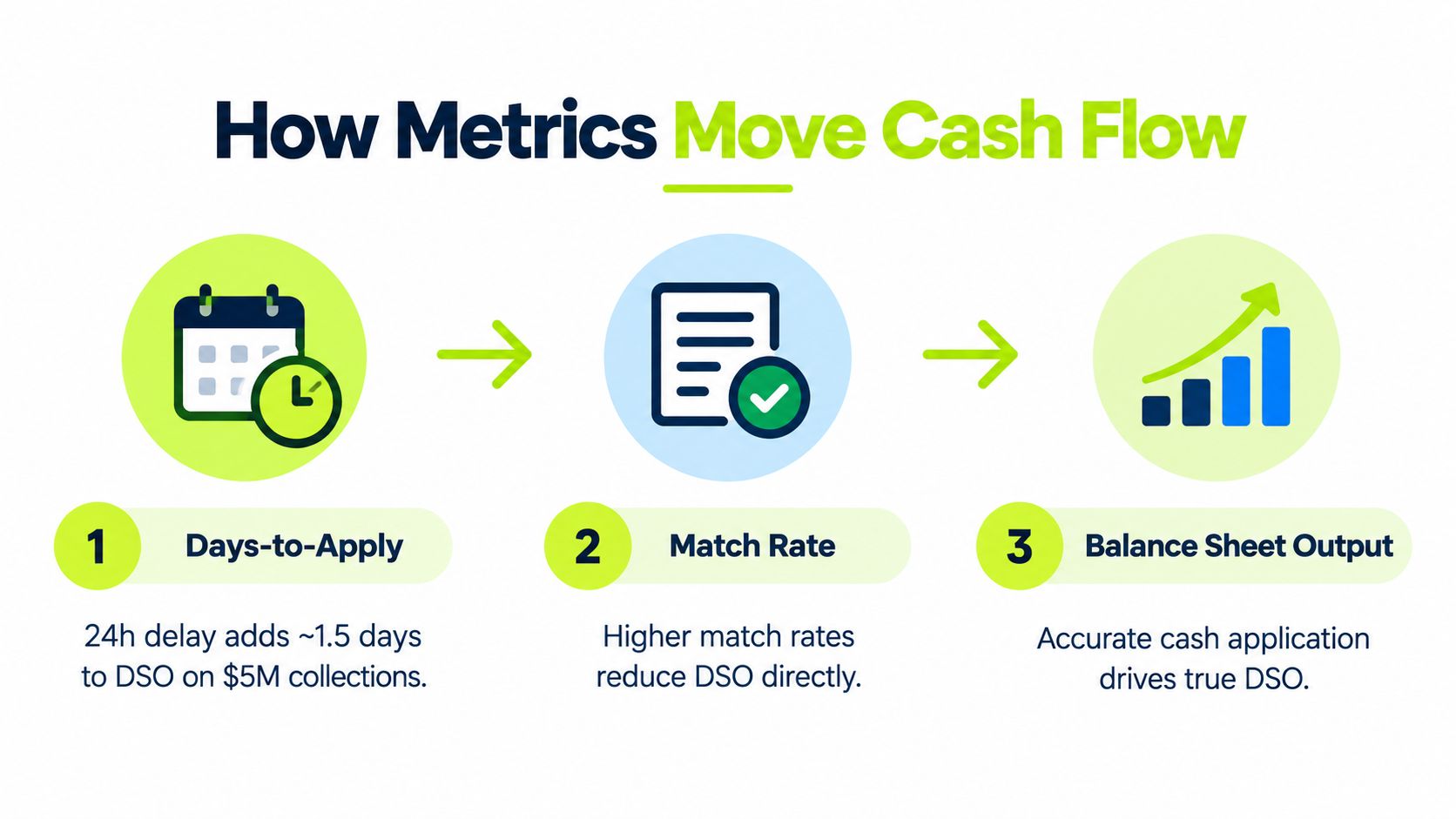
Cash application metrics matter because they determine how quickly finance can trust the ledger. A receipt left unapplied can sit in the wrong aging bucket. A payment matched to the wrong invoice can make one customer appear delinquent while another account carries an unexplained credit. Delayed posting also leaves collectors working from stale balances and makes short-term cash forecasts less reliable than the bank position suggests.
From receipt timing to DSO
A 24-hour application delay on $5 million in monthly collections adds roughly 1.5 days to DSO, according to Cleverence's walkthrough of the cash application process and its DSO implications. The calculation shows why cycle time matters, but it is not a universal forecast. Invoicing volume, payment terms, disputes, collection activity, and customer payment behavior also affect DSO.
The more useful management view is an operational maturity ladder. Partial STP may clear routine receipts while leaving analysts to resolve predictable exceptions. True STP posts high-confidence payments without intervention and routes the remaining work by cause, owner, and age. The gap between those states matters because a dashboard can report a strong match rate while a small, old exception population continues to distort customer balances and collection priorities.
Unapplied cash creates a separate forecasting problem. A 5% unapplied balance on $3 million equals $150,000 that cannot be confidently forecasted, based on the arithmetic of the stated balance. The money is in the bank, but finance cannot reliably connect it to a customer obligation, expected clearing date, or collection action.
The downstream operating effects
Higher match quality gives collectors a cleaner list of genuine open balances. Faster application keeps current and near-due aging accurate. Lower exception age reduces the risk of disputes, duplicate outreach, and avoidable account reviews.
Forecasting improves when the cash model uses applied receipts instead of bank activity alone. Teams responsible for regional operations can use forecasting cash flow for UAE firms to examine the relationship between receipt timing, ledger status, and forecast confidence.
The video below provides another visual explanation of the cash application workflow and its relationship to AR control.
The management question is whether the ledger becomes accurate quickly enough for collectors, controllers, and treasury to act on the same facts. A single match-rate score cannot answer that. Days-to-apply, exception age, and the transition from partial to true STP show whether the process is actually improving cash visibility.
Root Causes of a High Exception Backlog
A high exception backlog usually comes from process design, not headcount. Adding another analyst may buy time, but it will not fix missing remittance, inconsistent customer identifiers, or rules that no longer match how clients pay.
Start with the oldest and highest-value exceptions. Group them by cause. The pattern reveals which lever will reduce the queue.
Remittance-less payments
A wire or ACH receipt without payment advice forces the analyst to search email, customer portals, bank references, and open invoices. Hackett Group's research, as summarized by Nasdaq's coverage of the Hackett Group study on remittance-less matching and payment behavior, shows that many teams still rely on manual work because remittance is missing or incomplete.
Capture comes first, then matching logic. Route remittance mailboxes into a controlled intake, use lockbox OCR for checks, and preserve bank reference fields during file ingestion. If advice arrives separately, tie it to the payment with stable identifiers and keep the audit trail intact.
Fragmented customer identifiers
Professional services clients often pay through a parent entity, subsidiary, shared services center, or procurement platform. The invoice may use a project number while the payment uses a purchase order or legal entity name.
Clean the customer master and build cross-references for legal entity, trading name, account number, PO, project, and common remitter. This work is less visible than buying AI AR automation, but poor master data limits every matching engine.
Weak or stale rules
Rules that worked for one customer's old billing pattern can misroute payments after a merger, ERP change, new project structure, or shift in remittance format. Review rules based on false positives and repeated manual overrides, not on how many rules exist.
Use confidence thresholds. High-confidence matches can post automatically. Ambiguous matches should go to a queue with the evidence displayed, rather than forcing the system to guess.
Payment mix changes
Payment behavior changes the shape of the exception queue. Nasdaq's coverage of the Hackett Group study on remittance-less matching and consumer payment behavior notes that cash use remained high in recent consumer payment behavior research, while check usage persisted.
The response is not to assume digital payments will remove reconciliation work. Track performance by ACH, wire, check, card, virtual card, and any other relevant channel. Then work with customers to improve remittance quality or enable payment methods that carry usable references.
Credit memos and short pays
A short pay can be correctly linked to an invoice and still remain unresolved because nobody owns the difference. Credit memos create the same ambiguity when the application team parks them as unapplied cash instead of routing them to a dispute or billing owner.
Create separate reason codes and a dedicated short-pay workflow. Send the item to the person who can validate pricing, scope, tax, expense, or service delivery. Cash application should establish the relationship and route the decision, not absorb every commercial dispute.
Exception Root Causes and Remediation Levers
Root Cause | Symptom in the Data | Remediation Lever |
|---|---|---|
Remittance-less payment | Receipt has no usable invoice or customer reference | Centralized remittance capture, lockbox OCR, and preserved bank references |
Fragmented identifier | One client appears under several names, entities, projects, or POs | Customer master cleanup and cross-reference fields |
Weak matching rule | Repeated analyst overrides or false-positive matches | Rule refresh cadence, confidence thresholds, and override review |
Payment mix shift | A channel has slower posting or higher unmatched volume | Channel-level reporting and customer payment enablement |
Credit memo or short pay | Invoice is identified but the balance difference remains open | Dedicated dispute ownership and reason-coded workflow |
Practical rule: Do not measure exception volume without measuring exception age and cause. A large queue of newly received items is different from a small queue that has sat unresolved for weeks.
Reporting Templates and Dashboards That Stick
The dashboard that survives month-end is usually less elaborate than the one shown in a software demonstration. It has clear ownership, stable definitions, and a short path from a red metric to the transaction that caused it.
A mid-market team can build the first version in Excel or the existing ERP BI module. Dedicated AR software for professional services becomes easier to justify when maintenance consumes more than one analyst-day per week, or when the team can't preserve transaction-level auditability across entities and payment channels.
Run the report at three cadences
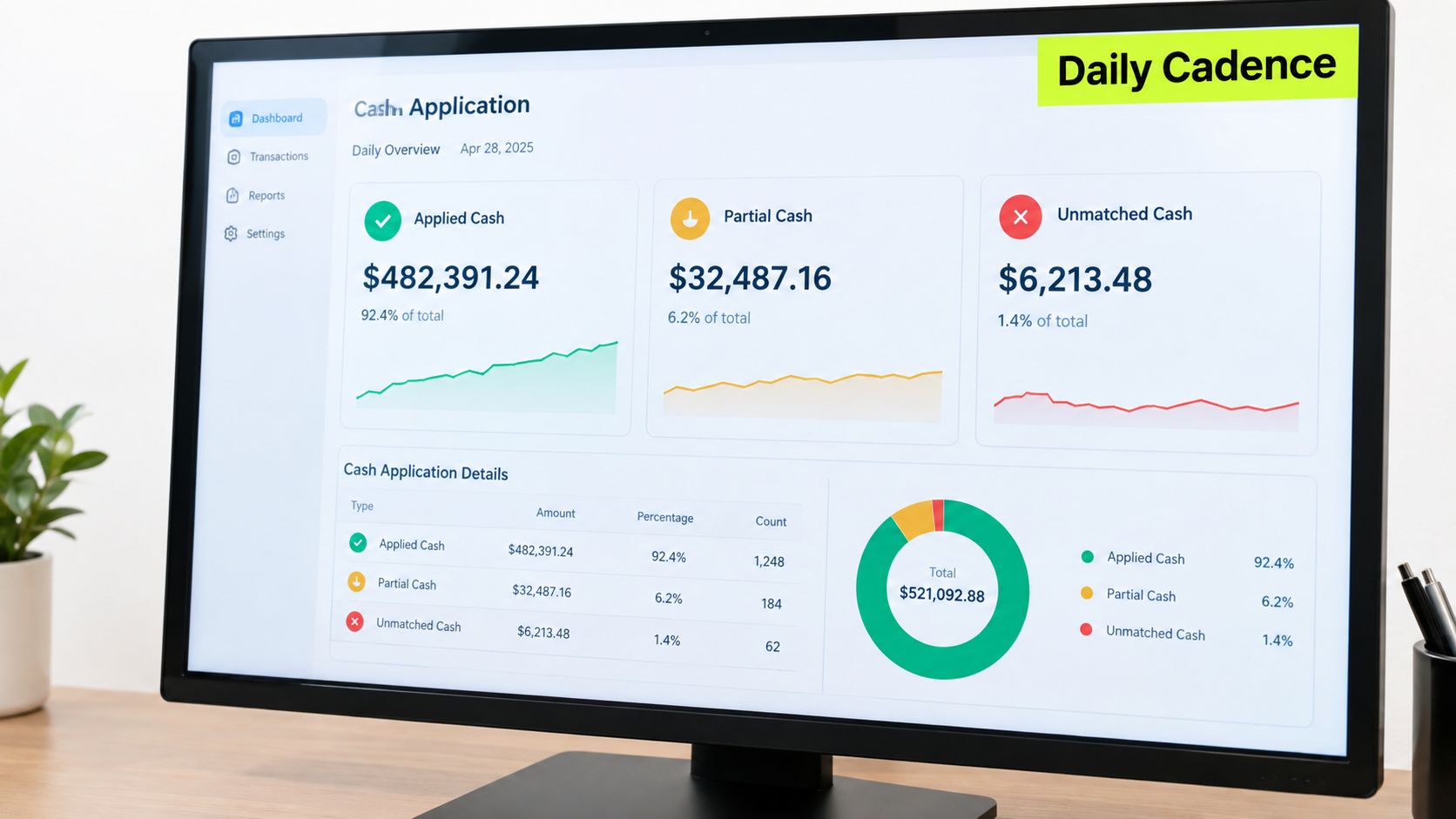
Daily: Use a one-page STP view. Show applied, partially applied, and unmatched cash by amount, with a list of exceptions older than 24 hours. The analyst should be able to open each item, see the payment evidence, and assign the next action.
Weekly: Run exception aging by cause and owner. Separate remittance-less items, short pays, credit memos, customer mismatches, and technical failures. A weekly view helps the AR analyst clear similar items in batches and gives the Controller a reason-based explanation for backlog movement.
Monthly: Build an unapplied cash cohort. Show how much of each month's unmatched volume clears by 7, 30, and 60 days, then compare the current result with the prior three months. This reveals whether the team is clearing the queue or merely replacing old items with new ones.
Keep one tab and several useful views
The front tab should contain a KPI strip at the top, aging tables in the middle, and a drillable exception list at the bottom. Add filters for entity, payment type, customer, collector, owner, and cause. Don't lead with decorative charts that can't answer who needs to act today.
A visual reference such as a vacation rental team dashboard can help non-finance stakeholders understand how a compact operational view differs from a month-end financial report. The content matters more than the design.
Use these controls in the first version:
- Definition control: Document the denominator for every rate and the timestamps used for cycle time.
- Ownership control: Assign every exception to a person or functional queue.
- Aging control: Show both count and amount, because many low-value items can consume more time than one large receipt.
- Audit control: Preserve the original payment, remittance, match decision, and adjustment history.
- Trend control: Compare current performance with the prior three months, not an arbitrary industry target alone.
A practical AR KPI dashboard structure should help a manager move from summary to transaction without exporting several disconnected reports. If the team can't explain a metric from the underlying payment records, the dashboard isn't ready for executive use.
Where Automation Fits and What to Do With It
Automation should solve a defined queue, not follow a persuasive product demonstration. Start by recording the baseline for STP, invoice match rate, exception rate, unapplied cash by age, and average days-to-apply. Segment each measure by payment channel and entity. Without that baseline, a team can report a higher automation rate only by redefining which receipts qualify.
Set outcome bands, not promises
Independent guidance indicates that well-implemented AI-powered cash application can reach 85–95% STP, reduce unapplied cash by 50–70%, reduce manual processing effort by 60–80%, and lower DSO by 15–25%. See Emagia's guidance on STP targets and unapplied-cash reduction ranges for AI-powered cash application.
These are outcome bands, not guarantees. Results depend on remittance quality, customer master data, payment mix, rule coverage, integration reliability, and how analysts review ambiguous matches. Use the ranges to frame a business case and test assumptions against your own ledger.
The stronger target is an operational maturity ladder:
- From partial STP to true STP: Increase touchless posting for repeatable, high-confidence payments while sending uncertain items to human review.
- From unresolved backlog to managed exceptions: Reduce unapplied balances and record whether each item is cleared, written off, disputed, or reassigned.
- From delayed ledger updates to operational posting: Move toward same-day or next-business-day posting, measuring minutes where the process supports it.
- From isolated cash application to AR control: Reconcile application results with the GL and send clean balances to collections, billing, and forecasting.
Sequence the implementation
The adoption path should follow the work, not the vendor's module map.
Capture payment and remittance data from banks, lockboxes, portals, email, and processors first. Then tune matching rules and confidence thresholds against the long tail of exceptions. Close the loop with GL reconciliation, adjustment approval, and exception reporting. This order exposes whether the constraint is data capture, matching logic, or control design.
Resolut can be evaluated as one option for automatic cash application, including payment-to-invoice matching and reporting for STP, time to apply, unapplied cash, unapplied-item aging, and exception rate. Test data lineage, approval controls, integration behavior, and whether analysts can resolve exceptions without leaving the workflow.
Before vs. After Automation: Metric Impact Bands
Metric | Manual Baseline | Post-Automation Band | Levers Behind the Move |
|---|---|---|---|
STP or auto-apply rate | Commonly 40–60% in largely manual operations | 85–95% when implementation quality supports it | Remittance capture, matching logic, confidence thresholds, and rule learning |
Unapplied cash | Recurring balance with manual aging and research | Potential reduction of 50–70% | Better identifiers, automated matching, reason-coded exceptions, and ownership |
Manual processing effort | High touch volume across routine receipts and exceptions | Potential reduction of 60–80% | Automated ingestion, suggested matches, workflow routing, and bulk resolution |
DSO | Influenced by the full order-to-cash process | Potential improvement of 15–25% in mature deployments | Faster posting, cleaner aging, better collections prioritization, and fewer false delinquencies |
Days-to-apply | Delays can extend beyond the receipt day | Same-day or next-business-day posting, with minutes possible in mature environments | Straight-through posting, reliable integrations, and controlled exception queues |
The first working session should review evidence, not repeat a generic demonstration. Bring recent payment records, unapplied cash aging, exception reasons, and posting timestamps. Map the roadmap to the specific causes preventing a trustworthy ledger.
Resolut automates AR for professional services through workflows for cash application metrics, exception ownership, and collection visibility. Visit Resolut to review the current process, establish a baseline, and select the next practical step toward faster posting and better cash flow.