Uncollectible vs Uncollectable: The Accounting Guide
Confused by uncollectible vs uncollectable? CFOs, learn the precise accounting implications, tax rules, and preferred language for professional services.
There are two valid spellings, but uncollectible is the correct term in U.S. accounting and finance. Uncollectable is an acceptable variant, though it's less standard in professional practice.
That answer is more useful than the usual “both are correct” advice. The spelling itself doesn't change the probability of recovery, the allowance, or the write-off. But the word your team uses in reports, policies, dashboards, and audit files can reveal whether finance is distinguishing a late invoice from a genuine credit loss.
For a professional services firm, that distinction protects more than grammar. It supports cleaner forecasting, stronger documentation, and more disciplined decisions about when to pursue payment, reserve for loss, or write off a balance.
The Tension in Your Receivables Process
A partner wants the client relationship protected. The controller wants the invoice paid. The accounts receivable team wants permission to escalate without turning a routine follow-up into a confrontation.
That tension often appears in small wording choices. A project manager calls an invoice “uncollectable” because it's late. The controller's aging report labels it “uncollectible.” A client-facing email uses one spelling, the accounting memo uses another, and the collections queue treats every overdue balance as if it carries the same risk.
The problem isn't that one spelling makes an entry invalid. The problem is that imprecise language can hide imprecise thinking.

Late is not the same as lost
Suppose a consulting client hasn't paid an invoice after its due date. The client may be waiting for procurement approval, disputing a line item, or paying according to a regional norm that differs from your contract terms. Calling the balance uncollectible too early can push the team toward an unnecessary reserve or write-off.
The opposite error is just as costly. A balance may remain in “past due” indefinitely even after insolvency indicators, failed collection attempts, and an unresolved dispute make recovery unrealistic. The accounts receivable ledger then presents an optimistic picture that management can't defend.
Practical rule: Use terminology to describe the evidence, not the emotion created by an overdue invoice.
Why the word matters to finance leaders
CFOs and Controllers need reports that different readers interpret consistently. Auditors, tax advisers, partners, and lenders should be able to trace how a balance moved from current, to overdue, to at risk, to doubtful, and eventually to uncollectible or written off.
That language discipline also supports better accounts receivable automation. A workflow can remind a client about a past-due invoice, route a disputed balance to an account owner, and flag a high-risk receivable for review. It shouldn't decide that every late invoice is uncollectible just because a date passed.
The right spelling is the starting point. The true control is separating collection activity from accounting judgment.
Understanding the Linguistic Difference
At a language level, uncollectible and uncollectable describe the same basic condition, something that cannot be collected. Both formations are grammatically valid, so using “uncollectable” doesn't turn a sentence into an error.
Professional convention is different from grammatical validity. Merriam-Webster defines uncollectible as “not capable of or suitable for being collected,” while dictionary sources identify its structure as un- + collectible. The spelling uses -ible, inherited through the adjective collectible, rather than the more general -able suffix.
That distinction is primarily one of register and established usage. In ordinary English, readers understand both words. In accounting, audit, and investor-facing materials, uncollectible is the established choice.
What each term signals in practice
Term | Practical use | Finance implication |
|---|---|---|
Uncollectible | Accounting policies, receivables reports, audit files, and U.S. finance materials | Preferred formal terminology |
Uncollectable | General English and mainly British usage | Understandable variant, but less conventional in U.S. reporting |
The distinction does not create two different risk categories. Neither spelling indicates a different recovery probability, accounting treatment, or legal status. A controller shouldn't create separate metrics for “uncollectible” and “uncollectable” just because both appear in source documents.
Choose convention deliberately
For a U.S.-oriented professional services firm, use uncollectible accounts, uncollectible receivables, and uncollectible debt. Keep the terminology consistent in the chart of accounts documentation, monthly close checklist, credit policy, and board reporting.
Teams reviewing the broader accounting context can also use this practical guide to understand bad debt and its treatment. The point isn't to police every client email. It's to ensure the formal record uses the term that accountants, auditors, and finance readers expect.
A client may write “uncollectable” in correspondence. That's fine. Translate the language into your canonical internal terminology when the balance enters a report or workflow.
The Accounting Treatment for Bad Debt
Uncollectible is an accounting assessment before it becomes a confirmed write-off. Treating every overdue invoice as uncollectible distorts receivables, accelerates expense recognition, and weakens the evidence supporting the close.
Under the allowance approach, the business estimates expected credit losses, records bad-debt expense, and creates an allowance that reduces reported accounts receivable to the amount expected to be collected. Historical loss experience and an aging schedule can support the estimate. Guidance on accounting for unpaid invoices helps document how the allowance relates to the receivable balance and to later write-offs.
A simple aging example
Consider a receivables portfolio divided into four aging buckets:
- 0 to 30 days overdue: 1% applied to $60,000, producing an estimated loss of $600.
- 31 to 60 days overdue: 5% applied to $25,000, producing an estimated loss of $1,250.
- 61 to 90 days overdue: 10% applied to $10,000, producing an estimated loss of $1,000.
- More than 90 days overdue: 20% applied to $5,000, producing an estimated loss of $1,000.
The resulting allowance is $3,850 on a $100,000 portfolio, or 3.85% of receivables. The calculation forecasts portfolio loss before a particular invoice is confirmed as unrecoverable.
That distinction matters for compliance and operating discipline. Uncollectible can describe an expected loss within a pool of receivables, not only a balance that has already been written off.
Keep the stages separate
A disciplined close process distinguishes three conditions:
- Overdue: Payment has not arrived by the contractual due date.
- Doubtful or at risk: Evidence indicates an increased risk of nonpayment, while recovery remains plausible.
- Uncollectible: Available evidence indicates that recovery is no longer reasonably expected.
Once an account is confirmed as unrecoverable, the receivable is generally removed against the allowance. The write-off should not create a second bad-debt expense, because doing so records the same loss twice.
The policy should specify what evidence supports escalation. Relevant factors include payment history, customer credit risk, insolvency indicators, active disputes, legal enforceability, and documented collection outcomes. Aging is a useful signal, but it cannot establish the conclusion by itself.
The allowance for uncollectible accounts process should connect the accounting entry with collection notes and dispute records. That record gives collections room to pursue a viable balance while giving the controller support for changing the allowance, approving a write-off, and answering audit questions.
Regional Conventions in Global Finance
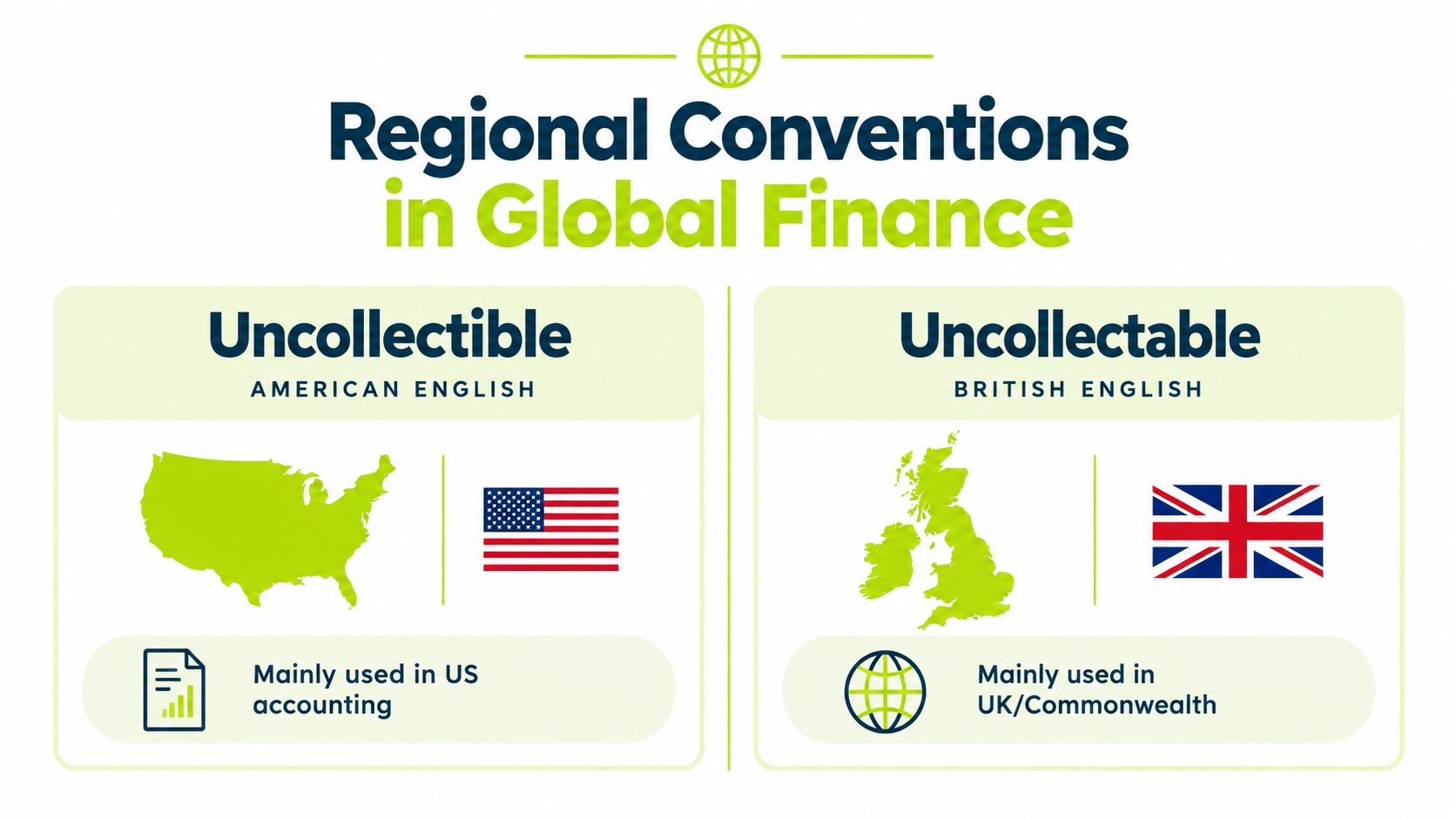
The spelling difference is largely regional. Cambridge lists uncollectable as mainly British English and uncollectible as the mainly American alternative, with both referring to money that cannot be collected.
That matters when a professional services firm serves clients across jurisdictions. A U.K. client may expect “uncollectable debt” in correspondence. A U.S. auditor or CFO will generally expect “uncollectible receivables” in formal financial material. Neither audience needs a lecture on spelling, but both need the underlying balance represented consistently.
Localize the presentation, standardize the data
A global AR platform shouldn't encode the spellings as separate risk states. That creates duplicate metrics, fragmented dashboards, and unnecessary reconciliation work.
A better model uses one canonical internal field, such as collectibility_status = uncollectible, while allowing localized labels at the presentation layer.
Layer | Recommended treatment |
|---|---|
Internal data model | One collectibility status |
U.S. reports | Uncollectible |
U.K. customer correspondence | Uncollectable may be retained |
Risk workflow | Same status logic across regions |
Audit trail | Evidence and decision date recorded consistently |
The same principle applies to international payment workflows. Currency, payment method, contract terms, and client communication can vary by market. The internal definition of a recoverability decision shouldn't vary just because the adjective does.
Teams should also configure search synonyms where needed. A user searching for “uncollectable invoices” should still find records stored under the canonical “uncollectible” value. That's a usability feature, not a reason to create two accounting classifications.
The cleanest policy is simple: preserve regional language where it helps the client, standardize internal financial language where it protects control.
Tax Implications and IRS Guidelines
The IRS doesn't determine deductibility by checking whether a memo uses “uncollectible” or “uncollectable.” The substantive question is whether the debt is worthless under the surrounding facts and circumstances, and whether the business meets the applicable requirements.
For a professional services firm, that distinction prevents a common mistake. An unpaid invoice may be operationally uncollectible, yet the tax treatment can depend on how the firm recognized the revenue and whether the debt was properly charged off.
Worthlessness drives the tax analysis
The IRS states that a debt becomes worthless when the facts and circumstances show there's no reasonable expectation of repayment. That requires more than a late payment notice. Controllers should retain evidence such as collection correspondence, dispute records, insolvency information, payment history, and management's decision-making.
For business bad debts, the receivable generally must have been created or acquired in the course of the trade or business and included in gross income in the current or a prior year before a deduction is generally available. That point matters to cash-basis professional services firms, which may not have included unpaid invoices in income.
Partial and total worthlessness
The tax distinction is between a debt that's partly worthless and one that's totally worthless. Under Section 166, a partially worthless debt is deductible only for the portion charged off on the books during the tax year, while a totally worthless debt is deductible in the year it becomes totally worthless, as explained by The Tax Adviser's discussion of business bad debts.
That rule has an important control implication. Don't treat a spelling choice as a policy distinction, and don't treat an allowance estimate as automatic proof of tax deductibility. Accounting reserves, write-offs, and tax deductions can involve related evidence but aren't interchangeable decisions.
Controller's checkpoint: Document why recovery is no longer reasonably expected, what amount was charged off, and how the entry aligns with the firm's accounting and tax policies.
A consistent use of uncollectible makes reports easier to read and review. It doesn't replace the evidence required to support the tax position.
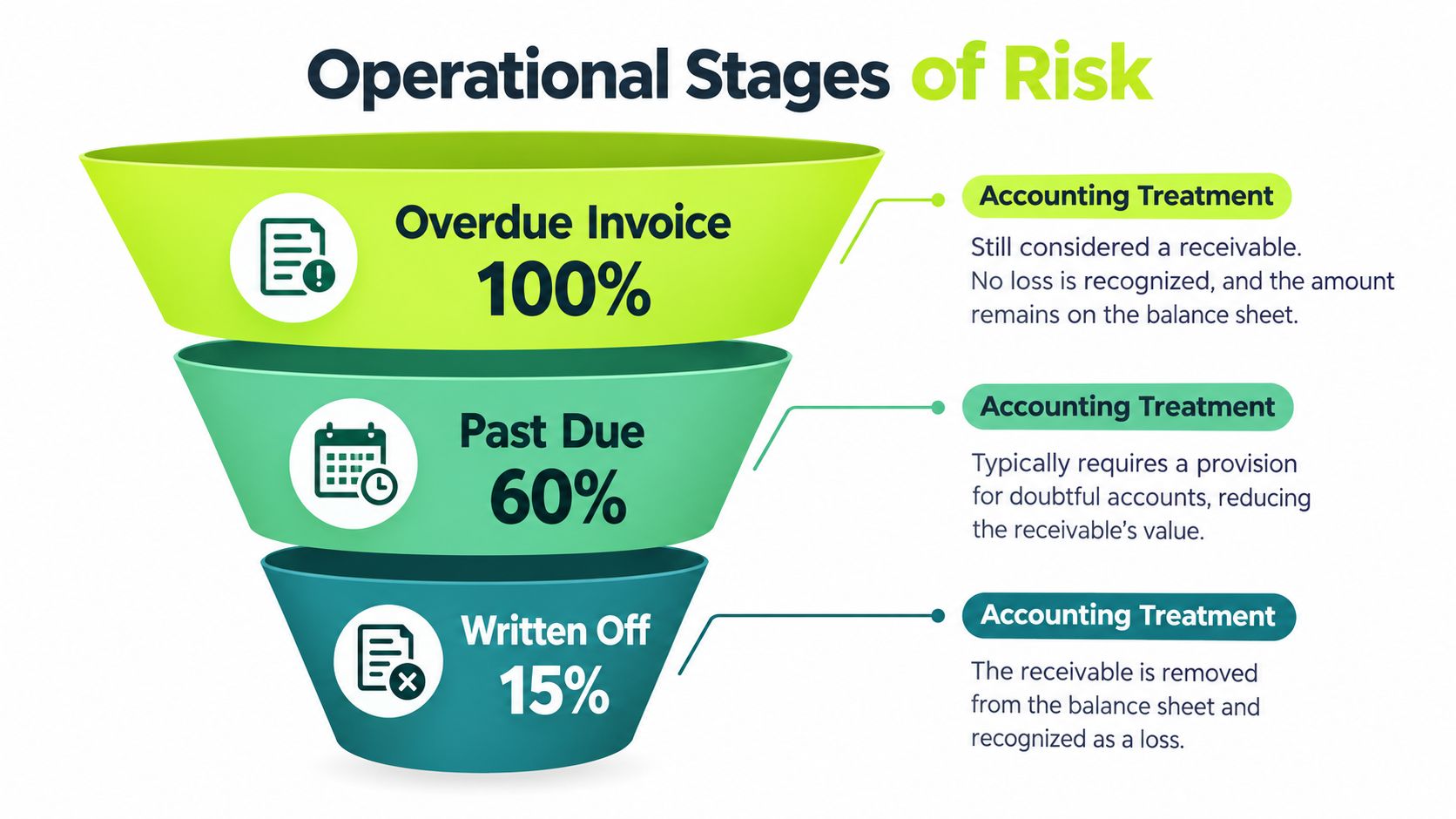
Beyond Spelling and Operational Stages of Risk
A payment delay tells you when money was expected. It doesn't, by itself, tell you whether the money can still be recovered.
Businesses globally took an average of 51 days to get paid in 2025, made up of 32 contractual days plus 19 days of delay, according to reported 2025 payment-cycle data. That finding challenges the lazy equation of late with uncollectible. A delayed invoice can still be collectible, especially when the delay reflects approval procedures, disputes, or established payment behavior.
Use separate labels for separate decisions
A disciplined dashboard should distinguish timing from risk and accounting conclusion:
- Past due: The contractual payment date has passed.
- At risk: Signals such as repeated delays, credit deterioration, or a dispute increase the chance of nonpayment.
- Doubtful: Recovery remains possible, but the evidence supports a higher allowance or closer review.
- Uncollectible: Recovery is no longer reasonably expected based on documented evidence.
- Written off: The accounting action has been recorded under the firm's policy.
The terms answer different questions. “Past due” supports collections prioritization. “Doubtful” supports risk assessment. “Uncollectible” supports the recoverability conclusion. “Written off” identifies an accounting entry.
Build intervention into the process
Your collections team should act before an invoice reaches the uncollectible stage. Send reminders before and after the due date, identify disputes quickly, and assign an owner when a client stops responding. A risk queue should rank accounts using evidence, not just sort by age.
That structure helps firms reduce DSO without damaging client relationships. It also makes AI AR automation more useful because the system can prioritize outreach and surface exceptions while finance professionals retain judgment over reserves and write-offs.
The best process doesn't wait for a write-off to reveal a problem. It creates a documented path from payment delay to recovery action to accounting conclusion.
Building a Consistent AR Language Policy
A terminology policy is inexpensive, but it only works if it appears where people make decisions. Put it in the close checklist, collections playbook, client-communications guidance, reporting definitions, and AR software configuration.
For formal finance use, adopt uncollectible as the default. Use it in “uncollectible accounts,” “uncollectible invoices,” “uncollectible receivables,” and “uncollectible debt.” Allow “uncollectable” in regional or stylistic contexts, especially when preserving a U.K. client's wording, but don't let it create a second status in the ledger.
Put the policy into workflows
A practical policy can include these rules:
- Reports: Use “uncollectible” in management accounts, financial statements, investor materials, and audit support.
- Client messages: Use plain language such as “overdue,” “past due,” or “under review” unless the formal conclusion has been reached.
- Data fields: Store one canonical collectibility status and map regional spellings to it.
- Review controls: Require evidence before moving a balance from past due to doubtful or uncollectible.
- Automation: Let reminders and dispute routing operate on payment status, while reserve and write-off workflows require finance review.
The policy should also define who can change a status and what documentation must accompany the change. That prevents a salesperson from relabeling a difficult balance to protect a client relationship, or a collections specialist from marking a balance uncollectible to clear a queue.
AR software for professional services and QuickBooks AR automation can support consistency here, provided the underlying status definitions are clear. Automation can enforce labels and routing. It can't repair a policy that confuses overdue timing with recoverability.
Frequently Asked Questions
Does the wrong spelling create an audit problem?
Usually, the spelling alone isn't the issue. An auditor will care more about whether the firm applied its policy consistently, supported the allowance, documented collection efforts, and recorded write-offs correctly. Use uncollectible in formal U.S. accounting materials to reduce ambiguity.
Should multinational teams use both spellings?
They can preserve local wording in customer-facing communication, but internal systems should use one canonical status. Map “uncollectable” to “uncollectible” for reporting and search rather than creating duplicate categories.
When should an overdue invoice become uncollectible?
Not on a fixed age threshold alone. Review the customer's payment history, disputes, credit condition, insolvency indicators, legal enforceability, collection attempts, and documented outcomes. “Past due” describes timing, while “uncollectible” describes a conclusion that recovery is no longer reasonably expected.
Should finance escalate every late invoice to legal?
No. Legal escalation should reflect the balance, contract, dispute position, jurisdiction, customer condition, and expected recovery economics. A late invoice may need a commercial conversation, a corrected invoice, or procurement support rather than legal action.
What should a policy checklist contain?
Define the preferred spelling, status labels, approval authority, evidence requirements, allowance methodology, write-off process, and treatment of recovered amounts. Review the policy with accounting, collections, client service, and tax advisers so each team uses the same vocabulary.
Resolut automates AR for professional services with consistent status handling, payment-risk prioritization, automated follow-ups, dispute tracking, and escalation workflows. Visit Resolut to see how a more disciplined receivables process can support cleaner reporting and help your team improve cash flow.