Is Accounts Receivable a Revenue? the Truth
Is accounts receivable a revenue? Learn the ASC 606 distinction, timing differences, and how AI AR automation helps professional services improve cash flow.
Accounts receivable is not revenue. It is a balance-sheet asset representing an unconditional right to collect cash, while revenue is recognized only when the firm satisfies its performance obligations. A completed $100,000 service can create $100,000 of revenue and $100,000 of accounts receivable before the customer pays.
That answer sounds straightforward, but the operational reality is harder. Professional services firms often manage invoices, unbilled work, retainers, milestone payments, and collections in separate workflows. When those records aren't aligned, a firm can report strong revenue while cash remains trapped in outstanding balances, or show rising billings without having earned the corresponding income.
The popular advice, “invoice the client and book the revenue,” is too blunt for firms with recurring engagements, time-based work, variable fees, or obligations delivered over several reporting periods. CFOs, Controllers, and owners need to distinguish earned revenue, billed receivables, contract assets, contract liabilities, and cash collected.
The Invoice Illusion in Professional Services
Issuing an invoice doesn't prove that a professional services firm has earned its fee. It proves that the firm has billed an amount, and the accounting treatment depends on what the contract requires, what work has been completed, and whether the firm has an unconditional right to payment.
Under Deloitte's summary of ASC 606 presentation requirements, accounts receivable is a balance-sheet asset representing an unconditional right to collect consideration from a customer. Revenue is recognized when the entity satisfies a performance obligation by transferring control of promised goods or services. The invoice date alone doesn't determine that outcome.
What the invoice proves, and what it doesn't
A bill may represent work already performed. In that case, the firm can recognize the appropriate revenue and record the unpaid amount as accounts receivable, provided the right to payment is unconditional.
But billing can also precede performance. A retainer collected before the firm performs the agreed work is generally a contract liability. The firm has cash, but it still owes services to the client. An invoice issued for work that hasn't been delivered may also require treatment as a contract liability or another contract-related balance, rather than immediate revenue.
The distinction matters because AR management converts an earned asset into cash. Collections don't create a second income event. When the client pays, cash increases and accounts receivable decreases. The firm has improved liquidity, but it hasn't generated new revenue from the payment itself.
Practical rule: Treat the invoice as evidence of a billing event. Treat the performance obligation and payment right as the basis for revenue and receivable classification.
Where professional services firms lose visibility
A firm that reports billed volume as earned revenue can overestimate profitability, misread pipeline quality, and make hiring or spending decisions from an inflated picture of performance. Owners may believe the business is growing because invoices are rising, while the underlying issue is delayed delivery, disputed scope, or aggressive billing ahead of work.
This is also where informal, low-context accounting practices create risk. Finance leaders evaluating lightweight workflows may find a useful perspective in this guide to vibe accounting, particularly when deciding where speed and automation must still yield to documented accounting rules.
The right dashboard separates earned revenue, invoiced AR, unbilled work, contract liabilities, and cash collections. Without that separation, an aging report can look like a sales report, and a billing forecast can be mistaken for a cash forecast. Neither conclusion is reliable.
Decoding the ASC 606 Revenue Framework
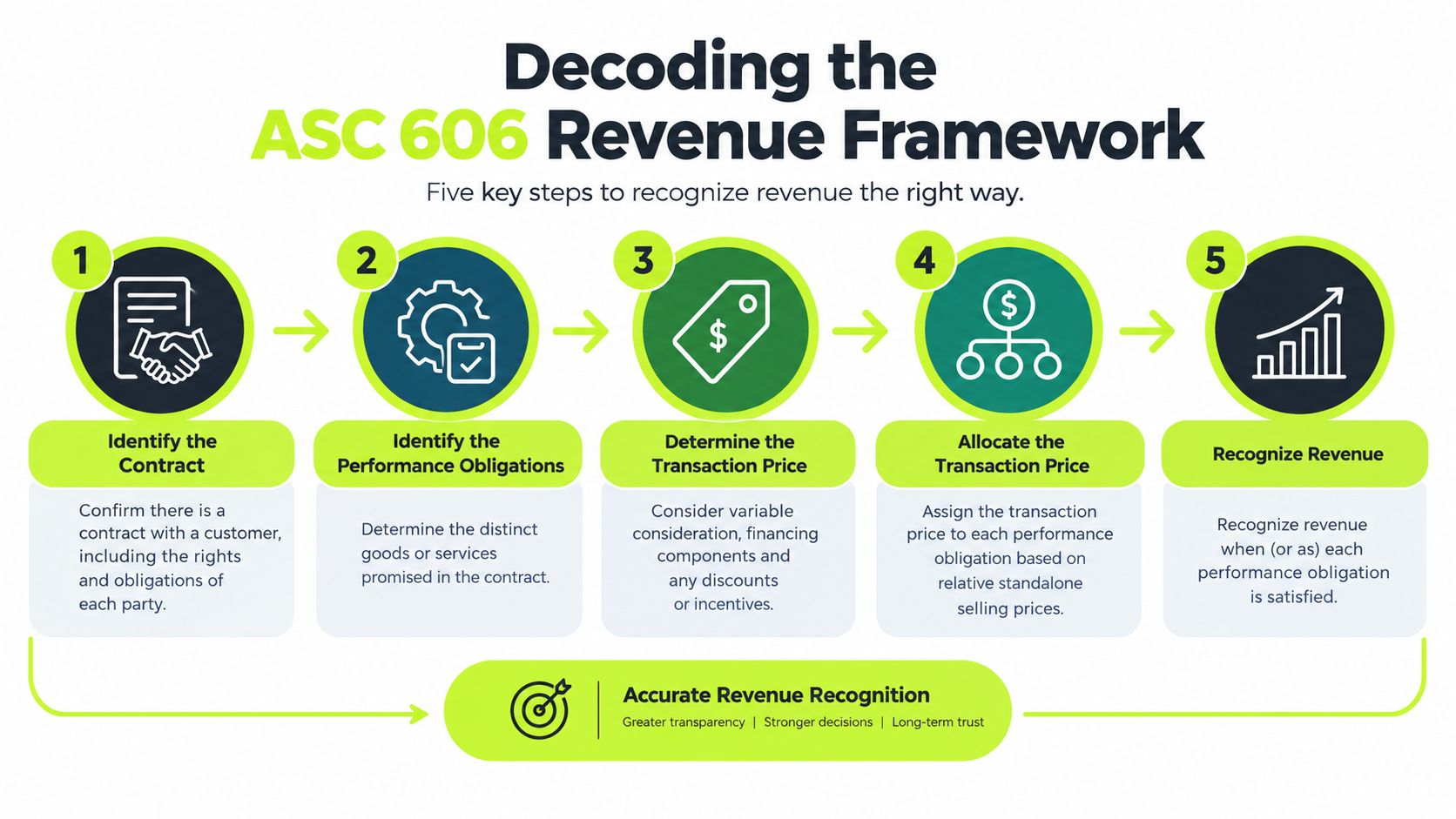
ASC 606 gives professional services firms a structured way to decide when revenue enters the income statement. The framework uses five steps: identify the customer contract, identify the performance obligations, determine the transaction price, allocate that price to the performance obligations, and recognize revenue when or as each obligation is satisfied. The SEC filing describing the five-step revenue model supports that sequence.
The five decisions behind the number
For a consulting, legal, accounting, or agency engagement, the first question is whether an enforceable customer contract exists. Next, the firm identifies what it has promised. A single engagement may include advisory work, implementation, reporting, support, or a defined deliverable, and those promises may not all be satisfied in the same way.
The firm then estimates the transaction price, including relevant variable consideration. That price is allocated across the performance obligations according to the contract and the value assigned to each obligation. Revenue follows delivery, not merely the date the firm sends an invoice.
For time-based or recurring services, the client may receive the benefits as the firm performs. Revenue can therefore be recognized over the performance period, even if billing occurs at the beginning, end, or another point in the engagement.
Contract assets and contract liabilities
A contract asset can arise when the firm has recognized revenue but doesn't yet have an unconditional right to invoice. For example, a professional services firm may complete billable work during a reporting period while the contract requires a later milestone before invoicing. The economic activity has been earned, but the billing right still depends on something beyond the passage of time.
The opposite situation creates a contract liability. If the firm bills or receives payment before satisfying its performance obligation, it has an obligation to provide future services. Calling that amount revenue would overstate current-period performance.
That is why an effective AR software for professional services needs more than an invoice register. It must understand the status of the contract, the work delivered, the billing right, and the collection status. Finance teams looking for a deeper explanation can use this revenue recognition principle resource alongside their accounting policies.
Timing Differences and the Cash Flow Gap
Revenue recognition, invoicing, and cash collection answer different questions. Revenue asks when the firm earned consideration. Invoicing asks when the firm requested payment. Cash collection asks when money reached the bank.
A milestone project makes the difference visible. The firm may perform substantial work before a contractual milestone permits billing. Revenue may be recognized as obligations are satisfied, while the related balance remains a contract asset until the right to payment becomes unconditional. If the firm bills at the milestone before completing the associated work, the billed amount may not yet qualify as revenue.
Three dates, three meanings
A retainer creates another timing pattern. If a client pays before the firm performs the contracted service, the payment is generally recorded as cash and a contract liability. As the firm delivers the service, the liability is released and revenue is recognized. The bank balance improves immediately, but the income statement follows performance.
A long-term consulting project can produce the reverse strain. The firm performs work and recognizes revenue, but invoices later under the contract. Revenue rises before cash, and the balance sheet carries an asset that still needs to be converted into collection.
A recurring engagement can show revenue recognized over time while the firm invoices on a different schedule. A monthly invoice may cover a service period that begins earlier or extends beyond the current reporting period. The finance team needs a schedule that maps service delivery to billing and collection rather than assuming the invoice represents one clean accounting event.
The IFRS 15 perspective
The same foundational separation applies under IFRS 15. The IFRS 15 standard recognizes revenue as control of a promised good or service transfers to the customer, either at a point in time or over time. A receivable exists when the entity has an unconditional right to consideration, meaning only the passage of time is required before payment becomes due.
This creates a useful management discipline. Faster collections improve cash flow and reduce receivable balances, but they don't increase reported revenue unless the firm has delivered additional goods or services. Finance teams that spend hours matching bank activity to invoices in spreadsheets often need a timing model, not just more reminders.
Cash collection improves liquidity. It doesn't rewrite the period in which the firm earned the revenue.
A practical cash forecast should therefore show expected collections from earned AR separately from revenue forecasts and future billings. That separation helps explain why a profitable month can still produce weak cash generation, and why a strong cash receipt may reflect earlier work rather than current-period sales.
When Uncollected AR Becomes a Revenue Problem
An unpaid invoice isn't automatically a revenue error. The firm may have completed the work correctly, recognized revenue properly, and still face a customer credit problem. But an unpaid balance can become a revenue issue when the underlying transaction price, performance, or customer obligation was never as firm as the invoice suggested.

Separate credit loss from performance failure
The first diagnostic question is why the customer hasn't paid. A credit loss means the customer may not be able to meet an otherwise valid obligation. A dispute may indicate that the work wasn't accepted, the scope was unclear, or the invoice doesn't match the contract. A refund, rebate, discount, return, or chargeback may reduce the amount the firm expects to be entitled to.
The SEC discussion of revenue measurement and receivable collectibility makes the distinction important. Revenue is measured at the amount the entity expects to be entitled to, with discounts, rebates, returns, and chargebacks reducing reported sales. Those adjustments may also appear as contra-assets against receivables. Separately, receivables must be assessed for collectibility, and an account can remain an asset even while its expected recovery declines.
A firm shouldn't use an allowance for doubtful accounts to conceal a revenue recognition problem. If the customer disputes whether the service was delivered or whether the fee is owed, the issue may involve performance or transaction price. If the service was delivered and the amount is valid but the client is unlikely to pay, the issue is more directly a credit-loss matter.
Track the quality of revenue
An aging report is useful, but it doesn't tell the whole story. CFOs should review the relationship among:
- Gross billings: What the firm has invoiced, before relevant adjustments.
- Earned revenue: What the firm has recognized after satisfying performance obligations.
- Collectible AR: The portion of receivables expected to convert into cash.
- Allowance coverage: The provision established for expected non-collection.
- Dispute status: Whether a balance is delayed by credit risk, service dissatisfaction, pricing, or administrative failure.
This view changes the interpretation of a large AR balance. It may show strong earned sales awaiting payment, but it may also reveal weak client screening, inaccurate time capture, inconsistent scoping, or poor invoice delivery. A growing balance isn't automatically a sign of commercial strength.
The practical value reaches beyond close accuracy. Buyers, lenders, and owners evaluate the reliability of reported earnings and the firm's ability to turn those earnings into cash. A portfolio weighted toward disputed or weakly collectible balances deserves a different valuation discussion from a portfolio of accepted invoices with predictable payment behavior.
The following video can help finance teams frame the difference between accounting recognition and collection execution:
For a deeper treatment of the accounting mechanics, finance leaders can review this allowance for uncollectible accounts explanation. The goal isn't to label every overdue invoice as bad debt. It's to identify the point at which collection delay, billing quality, and revenue measurement require different owners and different actions.
Aligning AR Automation with Accounting Reality
Automation works only when the underlying accounting states are clear. A reminder engine that sees every invoice as collectible may send a forceful message about an amount that is still subject to a milestone, a client approval, or a contract liability. That approach can reduce trust rather than reduce DSO.
A professional services firm should configure its accounts receivable automation around the status of each balance. The workflow needs to know whether the amount is earned, billed, unbilled, disputed, contractually deferred, or ready for collection.
Build the workflow around accounting status
Start by establishing a reliable data model for each engagement. Link the customer contract, performance obligation, service period, invoice, payment terms, dispute record, and cash application status. The system should preserve the distinction between a contract asset and an unconditional receivable.
Then create collection rules that respect those states:
- Hold outreach for future obligations. A prepaid amount or a bill tied to undelivered work shouldn't enter a standard overdue sequence.
- Route approval-dependent balances. If the client must approve a milestone or timesheet, assign the issue to the delivery or account team before escalating collection language.
- Prioritize valid, collectible AR. Once the firm has performed and the payment right is unconditional, reminders can focus on due dates, remittance details, and payment options.
- Record disputes as operational data. Capture the reason, owner, promised resolution, and expected payment impact rather than leaving the balance in a generic aging bucket.
- Reconcile cash to the invoice and engagement. Payment posting should close the receivable without creating a false revenue event.
A professional services firm can record revenue when consulting, legal, accounting, or other contracted services are performed while recording the related unpaid amount as a receivable. As PwC's guidance on contract-related assets and liabilities explains, the receivable is a claim to cash, not a second revenue event.
Why basic QuickBooks workflows can fall short
QuickBooks AR automation can help with invoice creation, payment tracking, and routine reminders. Those functions are useful for straightforward engagements with consistent terms. They become less sufficient when a firm needs to coordinate time-based revenue, milestone billing, retainers, contract assets, approval workflows, and client-specific communication rules.
The limitation isn't necessarily the accounting ledger. It's the missing operational context around the ledger. A finance team may need a collections layer that reads accounting data while also incorporating delivery status, dispute ownership, client relationships, and predicted payment behavior.
Review this AR automation guide when designing the operating model. The right system should help the team reduce DSO and improve cash flow without pursuing amounts that aren't yet collectible or treating billed volume as earned revenue.
Control point: Automate the next appropriate action, not merely the next reminder.
Protecting Margins Through Intelligent Collections
Collections affect more than cash. In a professional services firm, the person sending the reminder may also manage the client relationship, protect renewal potential, or resolve a scope disagreement. Generic follow-ups can create friction when the underlying issue is an approval delay, an incorrect purchase order, or an invoice that doesn't reflect the client's agreed process.
Manual work also produces inconsistency. One collector may follow up early and politely, another may wait too long, and a third may escalate a sensitive account before the engagement team has addressed the dispute. The result is a process that depends on individual judgment but doesn't preserve that judgment as a repeatable control.
Personalization is a control, not a flourish
Effective AI AR automation should use the available context to decide what message belongs in each situation. A routine reminder for an accepted invoice can be direct and concise. A message about a disputed consulting charge should acknowledge the issue, identify the internal owner, and avoid implying that the client is just refusing to pay.
The channel matters as well. Some clients respond to email, while others use a procurement portal, phone call, SMS, or a finance contact designated in the contract. A coordinated workflow can select the appropriate channel and timing without asking collectors to maintain separate manual lists.
Dynamic billing can help before collections begin. Clear descriptions, accurate supporting detail, client-specific delivery preferences, and payment options reduce avoidable questions. The finance team gets better results by removing friction from the invoice than by increasing the number of follow-ups after the due date.
Keep humans in the right decisions
Automation shouldn't erase judgment. It should reserve human attention for decisions that require context, such as whether to pause outreach, involve an account executive, adjust a disputed charge, or escalate a persistent nonpayment issue.
A useful operating design includes:
- Rules for routine accounts: Standard reminders, payment links, receipts, and reconciliation.
- Risk signals for attention: Changes in payment behavior, repeated disputes, or invoices approaching a collection threshold.
- Client-sensitive escalation: Approval from the responsible partner or account owner before stronger language reaches a strategic client.
- Audit visibility: A record of messages, decisions, promises to pay, disputes, and cash application.
The objective isn't to send more email. It's to send the right message, through the right channel, at the right time, while preserving the accounting status of the balance. That combination can support margin protection because finance staff spend less time on administrative repetition and more time resolving the issues that delay payment.
Transforming AR into a Strategic Advantage
Accounts receivable becomes strategic when the firm stops treating it as a static balance and starts treating it as a set of operating decisions. The revenue ledger tells management what the firm earned. The receivables ledger shows what customers still owe. The collections workflow explains what stands between those two facts and cash in the bank.
For a firm owner, that distinction improves planning. For a Controller, it supports a cleaner close and a defensible allowance process. For a CFO, it creates a more useful view of growth quality, working capital, client risk, and the reliability of reported earnings.
Use the right measures together
A finance team should review revenue and AR as connected but separate measures. Useful questions include:
- Which recognized revenue has not yet become an unconditional receivable?
- Which receivables are valid, accepted, and collectible?
- Which invoices are delayed by client credit versus internal billing quality?
- Which contract liabilities represent future delivery obligations?
- Which disputes require commercial or delivery action rather than collections pressure?
- How much cash is expected from earned AR, and when?
Resolut's stated operating model addresses the administrative burden of AR, where 1 in 10 invoices go unpaid and enterprises waste $200B annually. Those figures are provided as part of the product's stated positioning, not as a reason to collapse accounting categories. The finance case still depends on accurate classification, disciplined workflows, and measurable cash outcomes.
A unified platform can connect credit risk assessment, collections, omnichannel outreach, dynamic billing, and cash application. Its autopilot and co-pilot modes support different levels of automation, allowing a firm to automate routine work while keeping human review for sensitive accounts and exceptions.
Finance leaders building an AR operating model may also find practical background in these receivable resources from Kons Law. The most valuable system is the one that gives finance, sales, delivery, and collections the same account-level view without making any of them responsible for reconstructing the story from disconnected spreadsheets.
The answer to “is accounts receivable a revenue” remains no. Revenue is earned through satisfied performance obligations. AR is the resulting claim to payment when that claim is unconditional. The strategic opportunity lies in connecting those facts, then turning collectible receivables into cash with accuracy and judgment.
Resolut automates AR for professional services by connecting invoice follow-ups, risk signals, payment collection, and cash application while keeping accounting status visible. Visit Resolut to see how a consistent, accurate, and human collection process can help your firm improve cash flow without compromising client relationships.