10 Collection Agency Letter Templates for CFOs (2026)
A CFO's guide to collection agency letter templates. Get 10 templates with notes on compliance, sequencing, and AR automation to improve cash flow.
An unpaid invoice is a non-performing asset. In many firms, that problem sits inside accounts receivable until it starts constraining payroll timing, partner distributions, hiring plans, and the confidence behind your forecast. Structured follow-up matters because 1 in 10 invoices typically go unpaid without disciplined outreach, and that’s exactly where collection agency letter templates stop being a clerical tool and start becoming an operating control.
For professional services firms, the template itself isn’t the strategy. The strategy is the sequence, the timing, the audit trail, and the handoff points between AR, relationship owners, and legal. Firms that standardize collection letter strategies commonly report a 15-20% reduction in DSO, which is why finance leaders keep revisiting this part of the process even when billing is already “working.”
A good template also protects relationships. The wrong one escalates too early, sounds generic, or creates avoidable compliance risk. The right one says the same thing every time, with the right level of urgency, and gives the client a clean path to resolve the invoice without drama.
If your practice already uses billing software, this is the missing layer between invoice issuance and legal escalation. It also sits naturally beside other operational systems, including best legal tech tools for lawyers and law firms, because collections discipline is part of the same broader control stack.
What follows isn’t just a list of collection agency letter templates. It’s a practical playbook for choosing the right template source, building a controlled letter cadence, and connecting those letters to accounts receivable automation, AI AR automation, and the cash visibility a CFO needs.
1. CFPB Model Validation Notice

The CFPB model validation notice resources are the closest thing to a compliance-first starting point you’ll find for consumer debt communications. If you need a validation notice that aligns with Regulation F expectations, I’d start with these resources before touching any generic form builder.
That matters because FDCPA rules require validation notices within 5 days of initial contact. When a team improvises that document, risk creeps in fast. A regulator-published form removes a lot of interpretation work up front.
Where it fits operationally
This is not a full collection series. It’s a foundational notice.
If your firm handles consumer-facing receivables, the MVN belongs at the front of your workflow. After that, you still need your reminder, follow-up, firm demand, and final escalation letters. The CFPB materials help you lock down the most sensitive part first.
- Best use case: Consumer debt programs that need a defensible validation notice before broader sequencing.
- Strongest advantage: The form comes from the regulator, not a template marketplace.
- Main limitation: You still have to design the rest of your collection agency letter templates around it.
Practical rule: If consumer debt is involved, start with the required notice and build outward. Don’t start with the “final demand” letter and work backward.
What works and what doesn’t
What works is treating the MVN as a controlled document. Store one approved version. Route edits through finance and counsel. Keep mail, PDF, and digital variants aligned.
What doesn’t work is assuming this solves your whole AR communication system. It doesn’t. It handles the validation notice problem. It doesn’t build your cadence, connect to QuickBooks AR automation, or tell your staff when to pause, reset, or escalate an account.
For firms with mostly B2B receivables, this may be more compliance infrastructure than daily AR template. Still, it’s the benchmark. Even if you don’t use it directly, it sets the standard for how disciplined your letter library should be.
2. Rocket Lawyer Collection Letter
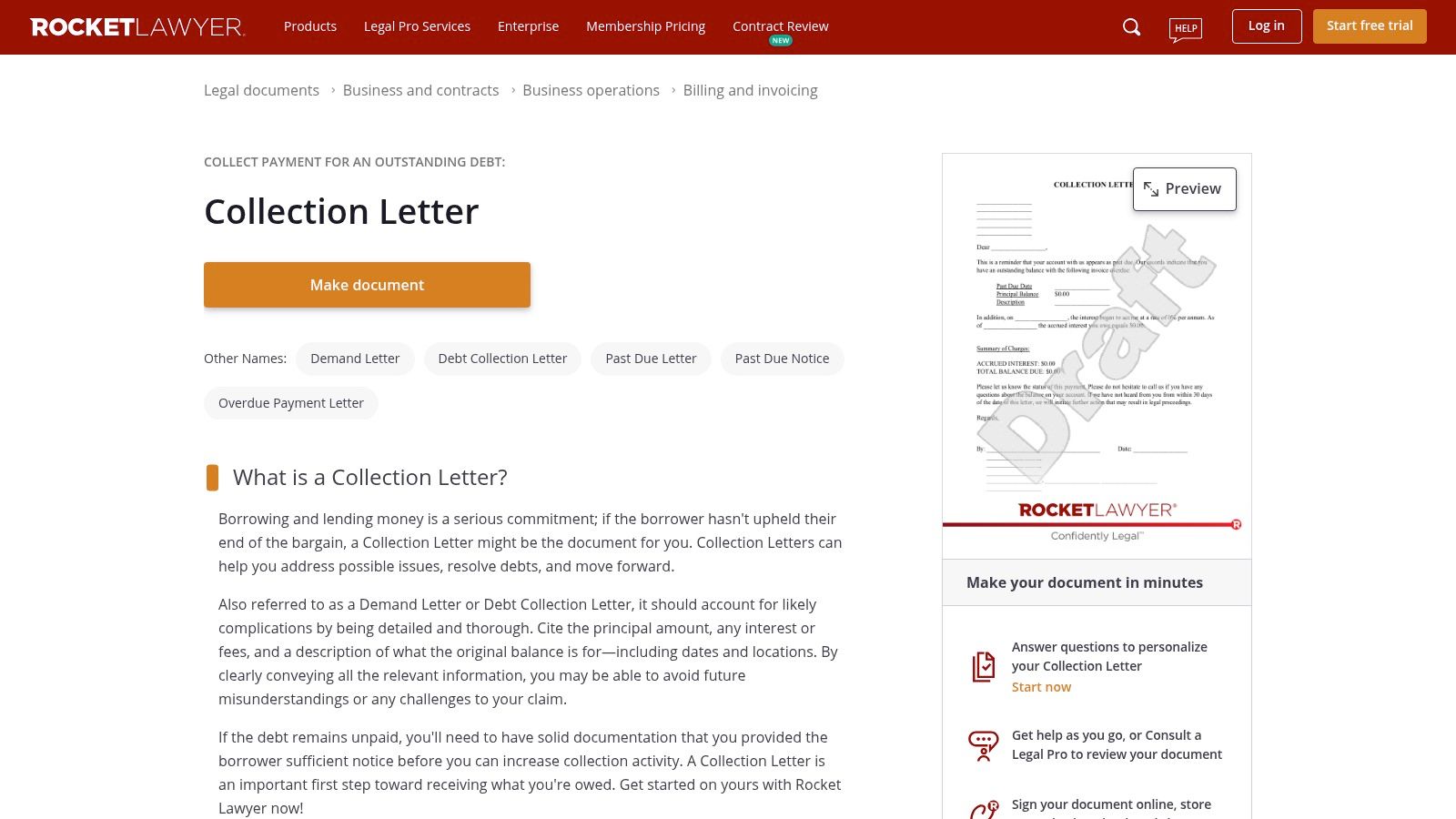
Rocket Lawyer’s collection letter builder is useful when you need a fast, guided demand letter and you don’t want AR staff formatting documents from scratch. It handles the practical basics well: amount owed, due date, escalation language, downloadable output, and e-sign support.
That makes it a decent fit for smaller firms or lean finance teams that need a repeatable letter without adopting a full collections platform. I’ve seen this type of tool work best in firms where the controller owns AR directly and wants a standard document that non-legal staff can produce without too much variance.
Good for speed, not for system design
Rocket Lawyer is strongest when the problem is document creation speed. It’s weaker when the problem is process control.
A template builder can produce a polished letter. It won’t tell you whether the account should receive a polite reminder, a firm demand, or a relationship-owner intervention. That sequencing discipline is where most firms either improve cash flow or create avoidable friction.
- Useful when: Your team needs a straightforward demand letter with minimal drafting time.
- Less useful when: You need multi-stage accounts receivable automation tied to invoice aging.
- Watch-out: Consumer debt compliance still needs separate scrutiny.
There’s also a practical trade-off with tools like this. The easier they are to use, the easier it is for different people to create slightly different versions. That’s fine for occasional use. It’s not fine if you want one collections voice across the business.
A polished letter isn’t the same as a controlled process.
For professional services firms, Rocket Lawyer is a serviceable starting point for ad hoc letters and low-volume disputes. It’s less compelling if your real objective is to reduce DSO at scale. In that case, a generic template builder usually becomes a stopgap, not a long-term AR software for professional services.
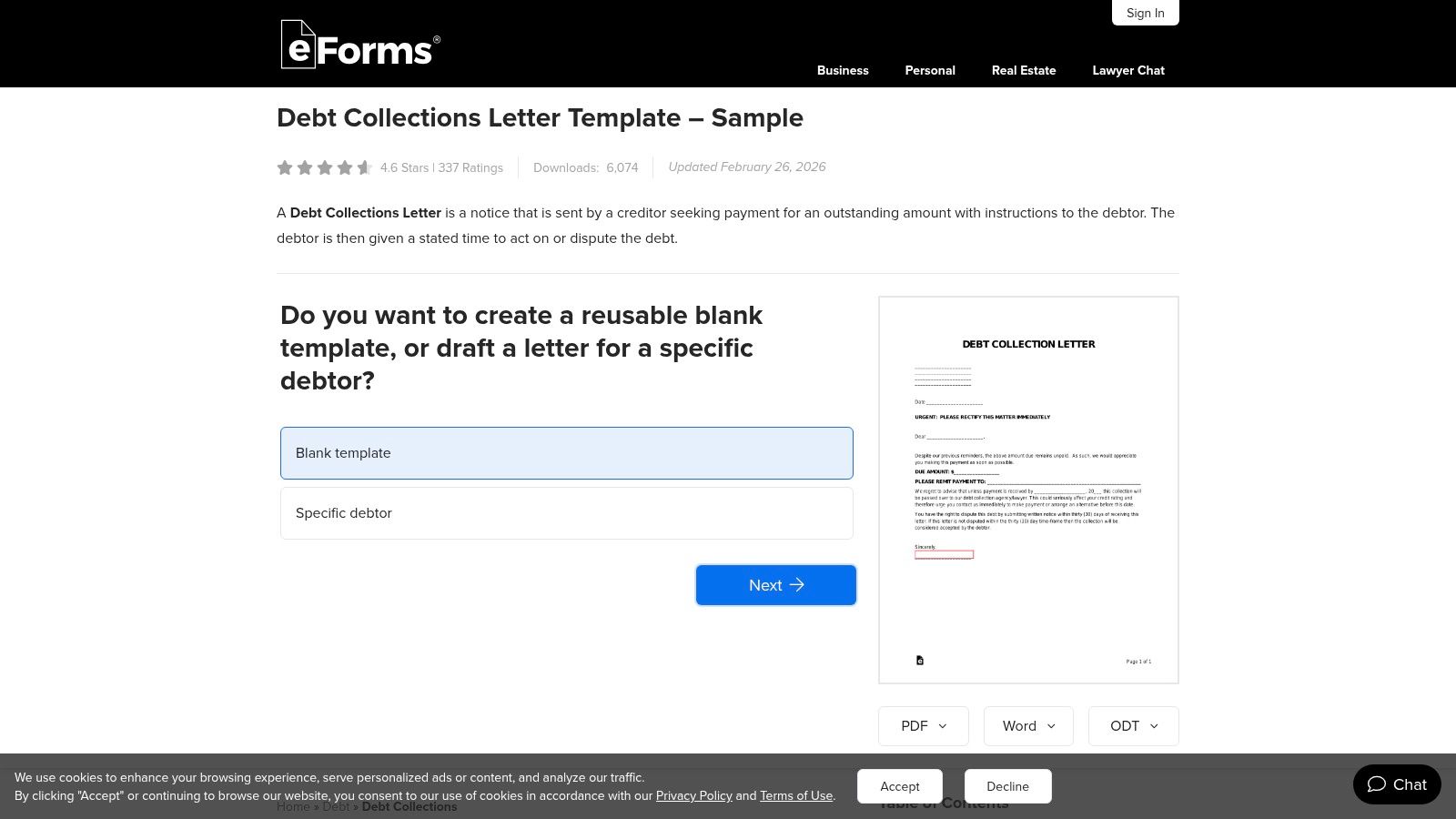
3. eForms Debt Collections Letter Template

eForms’ debt collections letter template is a good fit for firms that need to standardize letters before they standardize workflow. It gives AR teams editable files in familiar formats, which is often the fastest way to replace inconsistent Word documents and collector-by-collector phrasing.
That matters early in a collections buildout. If every overdue account gets a different letter, it becomes hard to control tone, document what was sent, and measure which stage moves cash.
Useful for building the first controlled letter set
I’d use eForms at the point where a firm is cleaning up process basics. The immediate job is not software selection. The job is to define which fields appear on every letter, which payment instructions are always included, and how the language changes from reminder to demand.
For professional services firms, that usually means turning one generic template into a small letter library tied to invoice age and account status. A 15-day reminder should read differently from a 45-day escalation. A client with an active project often needs different wording from a former client in dispute. eForms gives you a workable base for that kind of internal standardization.
If you need examples of staged messaging, Resolut’s guide to debt collection letters is useful for shaping tone by delinquency stage.
Where it stops helping
The limitation is operational, not editorial.
eForms helps you draft the letter. It does not control when it goes out, who approves exceptions, how replies are tracked, or whether the account should exit the sequence because a payment plan, dispute, or partner escalation is already in motion. Those controls are what protect client relationships while improving DSO.
- What it does well: Gives teams a clean starting template they can edit, save, and use right away.
- What it does not do: Manage sequencing, automate send rules, or maintain an audit trail across the account lifecycle.
- Best fit: Firms that need to clean up letter quality before they build automation and reporting around collections activity.
That trade-off is real. For a controller trying to get basic consistency into AR communications, eForms is often enough to get version one in place. For a finance leader trying to run collections as a controlled system tied to aging buckets, cash flow targets, and response tracking, it becomes one component of the playbook rather than the system itself.
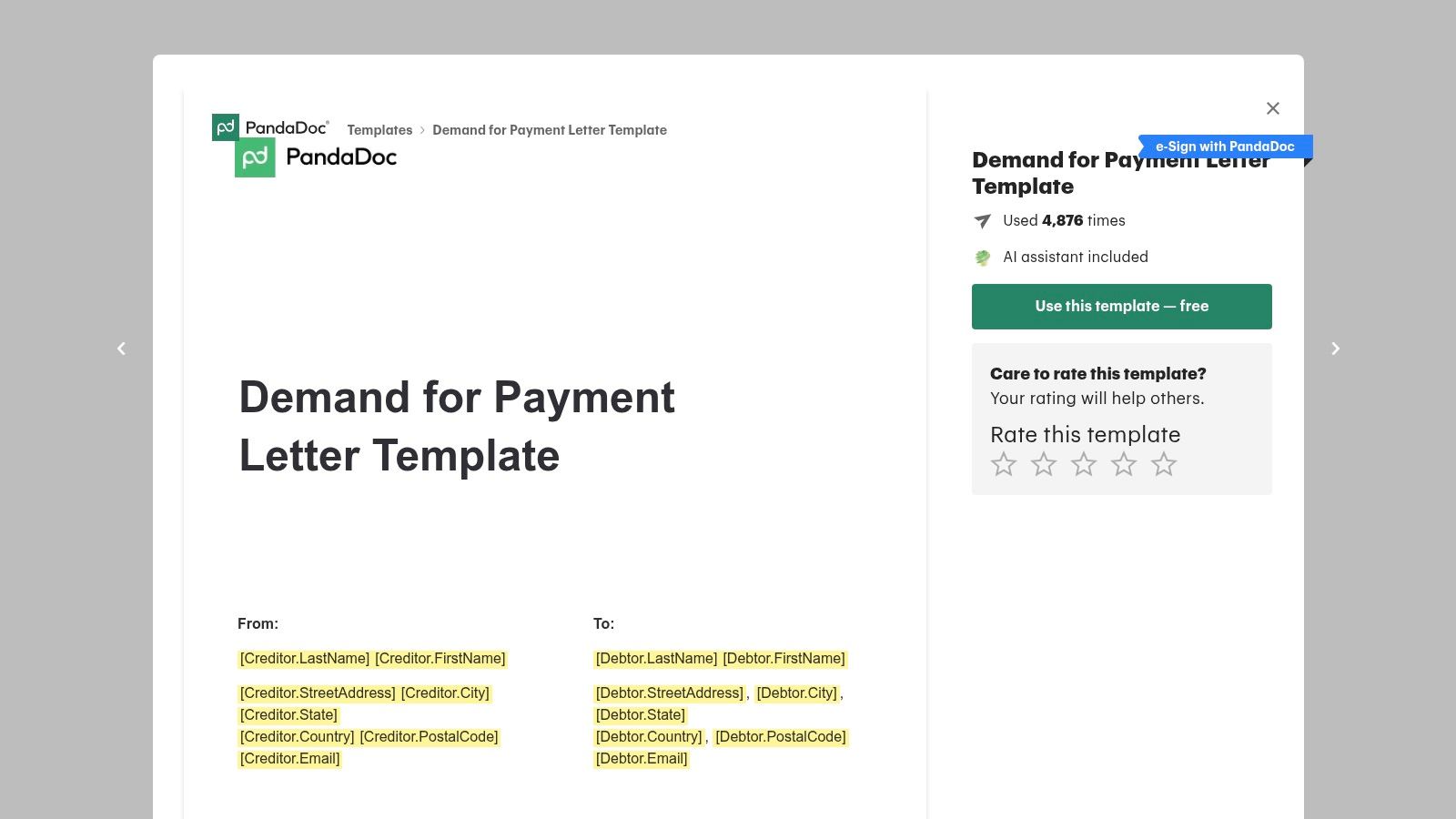
4. PandaDoc Demand for Payment Letter Template
PandaDoc’s demand for payment letter template fits firms that want business-facing demand letters with document tracking and e-signature built in. For B2B AR, that’s useful. You can brand the document, adjust tone by account stage, and see whether the recipient engaged with it.
That last point matters more than many teams realize. If a client opened the letter but didn’t pay, the next action is different from a client who never engaged at all. One needs follow-up with a clean payment path. The other may need a channel change.
Stronger for B2B than regulated consumer collections
PandaDoc works best for professional services firms chasing overdue commercial invoices, not heavily regulated consumer debt programs. If your receivables are mostly client invoices from legal, accounting, consulting, or agency work, that’s a better fit.
You can also pair it with email-based collections. Optimized collections emails used by Infobip customers achieved a 99.4% delivery rate, over 20% open rate, and more than 2% click-through rate. That reinforces the case for digital-first outreach when the underlying document and send environment are well managed.
What finance teams should like
The practical upside is visibility. PandaDoc gives you more operational signal than a static PDF attached to an email.
- Document tracking: Helpful for knowing whether silence is refusal or simple inattention.
- Editable workflow: Easy to adapt wording by aging bucket or client segment.
- Business fit: Better aligned to B2B demand letters than consumer validation requirements.
The trade-off is familiar. Tracking isn’t orchestration. PandaDoc can improve a letter process, but it won’t become your full accounts receivable automation layer on its own.
For firms already using digital contracts and proposals in PandaDoc, adding payment demand letters can be efficient. For firms trying to build a complete AR software for professional services stack, it’s one component, not the system.
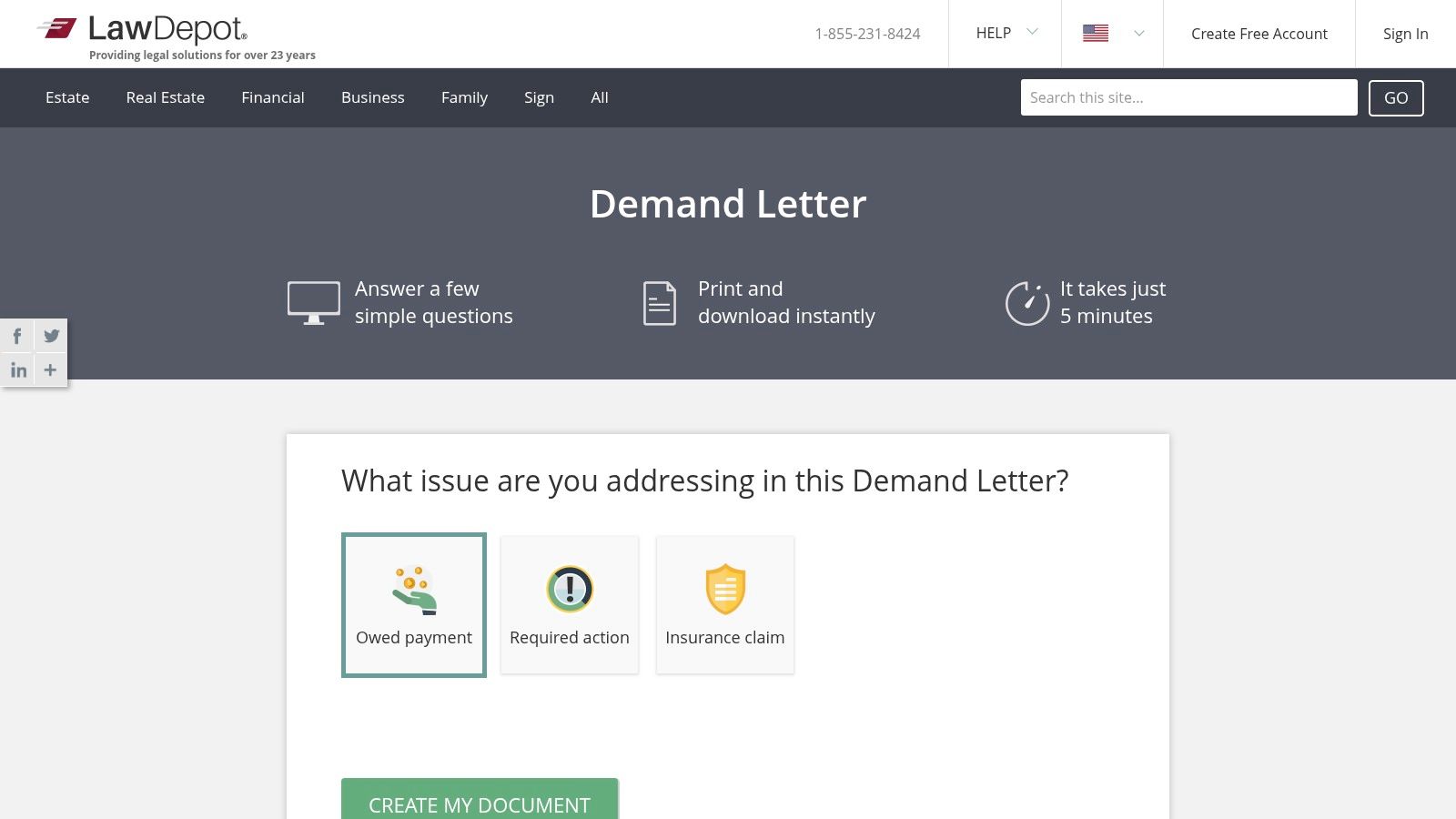
5. LawDepot Demand Letter US
LawDepot’s US demand letter workflow is useful when delivery method matters almost as much as letter wording. That’s common in older balances, pre-legal situations, and disputes where you want a clean record of notice.
Some templates help you write. LawDepot also helps you think about execution. Certified mail guidance, e-sign support, and optional notary features push it closer to formal escalation than a casual AR reminder tool.
Where it earns its keep
For finance teams, this becomes relevant around the point where normal reminders have failed and the file needs stronger process discipline. You may still want to preserve the client relationship, but you also need a documented path showing the business gave clear notice and a chance to cure.
That’s why I see LawDepot as more of a bridge between AR collections and legal escalation. If your team needs stronger language before counsel gets involved, this is a workable middle ground. Resolut’s article on a legal demand letter for payment is useful context for shaping that transition.
Trade-offs in practice
The upside is formality. The downside is volume.
- Best fit: Low-volume, higher-stakes overdue accounts.
- Operational strength: Better delivery discipline than lightweight template tools.
- Operational weakness: Not designed to run a large, automated letter cadence across the entire ledger.
Professional services firms often overuse formal demand letters too early. That usually backfires. A firm, documented letter should come after simpler outreach has failed, not as the opening move.
Use the strongest letter late enough to be credible, but early enough to avoid drift.
LawDepot is good at that late-middle stage. It’s less useful for day-to-day AR rhythm, where you need sequencing, automation, and better integration with billing systems like QuickBooks AR automation or ERP-led workflows.
6. Collect! Comtech Systems
Collect! by Comtech Systems fits teams that need collection letters to run as part of a controlled process, not as isolated documents. The system generates letters from account records, applies workflow rules, and keeps the communication history inside the platform.
That matters in practice. Once letter versions, account statuses, and send triggers are managed in one place, the process gets more predictable. Collectors spend less time rebuilding the same notice, and managers get a clearer view of whether the team is following policy.
Better control for multi-step workflows
Collect! stands out when a firm needs repeatable sequencing across a large group of overdue accounts. Letter series, status-based triggers, batch generation, and support for validation notice workflows are built into the operating model. Generic template libraries do not solve that problem.
For professional services firms, that difference shows up in execution. The goal is not just to send a stronger letter. The goal is to define which account gets which notice, after what delay, through which channel, with a record the team can audit later. That is how collections communication starts affecting DSO and cash flow instead of living as scattered admin work.
Teams building that kind of process usually pair letter logic with a broader automated debt collection software workflow so status changes, reminders, and exception handling stay coordinated.
The trade-off
Collect! gives managers tighter process control, but it also asks for more operational discipline. Someone has to define templates, trigger rules, user permissions, and review steps. If that setup work never happens, the software becomes an expensive mail merge.
- What works: Centralized letter rules, account-based document generation, batch output, stronger auditability.
- What does not: Ad hoc use by a small team that only sends occasional notices.
- Who benefits most: Firms with enough overdue volume, collector handoffs, or compliance requirements that manual drafting is slowing cash collection.
I would not put this into every small AR environment. I would study its workflow closely. It reflects how mature collections teams control communication at scale, especially when the objective is consistent follow-up, cleaner reporting, and less dependence on individual staff habits.
7. Simplicity Collection Software DocGen
Simplicity Collection Software handles letters through its DocGen engine and stage-based demand workflows. The practical advantage is speed with control. A collector can generate the right notice from the account record while balances, contacts, and account history are still in view.
That reduces a common source of collections drift. Staff do not have to copy data into a separate document, save local versions, or guess which template is current. In a professional services environment, where disputes often turn on engagement terms, billing milestones, or partial payments, that tighter connection between the account screen and the outbound letter helps keep communication accurate.
Why DocGen fits controlled operations
DocGen is useful when the goal is standard execution across a team, not unlimited document creativity.
Value is operational. Managers can define stages, align letter output to those stages, and keep collectors working from current system data instead of personal files. That makes it easier to audit what was sent, when it was sent, and whether the communication matched the account status at that moment. Those details matter when firms are trying to reduce DSO without creating avoidable customer friction.
Teams comparing tools at the process level should also look at how letters fit into a broader automated debt collection software workflow, including triggers, follow-up timing, exception handling, and reporting.
Where the trade-off shows up
Simplicity gives up some formatting freedom in exchange for process discipline. That is usually the right trade for firms that send enough notices to care about consistency, queue management, and audit trails. It is less attractive for small teams that send only occasional letters and want every document heavily customized outside the platform.
- Operational upside: Stage-based document generation tied to live account data and collector workflow.
- Operational downside: Custom design changes may require working within the software’s structure instead of editing an open document.
- Best fit: Professional services firms that need repeatable collection communications, cleaner records, and less manual drafting.
I would treat Simplicity as a workflow tool first and a template source second. That is why it belongs in this list. The letter matters, but the stronger outcome comes from sending it at the right point in the sequence, through the same process every time, with a record finance can review later.
8. insideARM MVN and Reg F Resources
insideARM serves a different purpose than the template libraries on this list. It is a reference source for Model Validation Notice requirements, Reg F interpretation, and vendor commentary. For teams building a controlled collections process, that matters. A letter can look polished and still create risk if timing, disclosures, channel use, or exception handling are off.
I would use insideARM upstream of deployment. It helps managers, compliance leads, and operations owners set the rules before templates go live in the workflow. That is a better fit for firms that need finance, legal, and service leadership aligned on how collection communications should work across account stages.
The practical benefit is judgment. Templates answer the formatting question. Resources like insideARM help teams decide approval standards, sequencing rules, and what should happen when an account falls outside the normal path.
Collection programs usually break at the handoff points, not in the body copy.
That makes insideARM useful in a playbook, even though it is not a production tool. Professional services firms often need to connect policy decisions to day-to-day execution, then document those decisions so collectors, AR staff, and managers handle accounts the same way every time.
Who should use it
insideARM fits teams that are formalizing a compliant communication strategy, reviewing vendor claims, or training staff on rule-sensitive workflows. It is less useful for a controller who needs a finished demand letter to send this afternoon.
- Use it for: Staff training, policy interpretation, implementation reviews, and vendor evaluation.
- Don’t use it for: Immediate document generation or automated letter delivery.
- Best role in your stack: Governance and reference support for the operating model behind your templates.
9. RevSpring MVN-aligned Letter Design and Delivery
RevSpring fits firms that have already outgrown ad hoc letter handling. Once notice design, print fulfillment, digital delivery, tracking, and audit requirements start consuming AR time, a managed communications partner can improve consistency and free the team to focus on account strategy.
That matters in professional services because collections performance usually slips through execution gaps, not weak wording alone. A good letter template helps. A controlled delivery process helps more. If notices are delayed, sent through the wrong channel, or changed without review, DSO rises and follow-up becomes harder to standardize.
Built for controlled delivery, not just document creation
RevSpring's value is operational. The model supports MVN-aligned communications with production and distribution handled through a vendor process instead of a patchwork of internal tools, printers, and manual handoffs. For teams managing high notice volume, that can tighten version control, improve delivery discipline, and create cleaner records for compliance review.
It also supports a more structured communication program. Professional services firms often need different notices by account stage, client type, balance size, and escalation path. At that point, the primary question is not which template looks best. The crucial question is whether the team can sequence the right notice, send it on time, and confirm what happened after delivery.
That is the trade-off.
You give up some speed in exchange for process control. Custom wording changes, exception handling, and workflow edits usually require coordination with the vendor. For a controller who wants to revise language in the morning and deploy it that afternoon, that can feel slow. For a finance leader trying to reduce variance across branches, collectors, or business units, that structure is often the point.
- Best fit: Higher-volume AR environments that need managed letter production, channel delivery, and compliance documentation.
- Less ideal for: Smaller firms that want to edit templates directly and keep every communication step in-house.
- Operational strength: Better control over approval, output, and delivery tracking across a multi-step collections program.
I would treat RevSpring as part of the execution layer, not the strategy layer. It helps firms put an approved notice program into production at scale. If your challenge is disciplined delivery, it can reduce operational drag. If your challenge is sequencing logic, automation, and follow-up orchestration across the full AR cycle, that usually needs a separate workflow system such as Resolut on top of the letter itself.
10. Resolut The Automation and Orchestration Layer
Resolut’s pricing and platform overview matters for one reason. Collections performance usually breaks at the workflow level, not the document level.
A well-written letter can set the right tone and meet policy requirements. It still does not decide which account gets a reminder today, which one should pause because of a dispute, which client should move from email to phone, or which promise-to-pay needs to feed back into the forecast. Finance teams feel that gap fast, especially in professional services where client relationships, payment terms, and escalation paths vary by account.
Resolut sits in that gap. It connects the template to the operating process around it.
Where templates stop and AR control begins
The practical problem is execution variance. One collector follows the sequence. Another waits too long. A partner asks for an exception. Billing sends a soft reminder while finance is preparing a firmer notice. Cash comes in, but the follow-up still goes out because the ledger has not caught up.
That is how firms end up with longer DSO even after standardizing their letters.
Resolut addresses that by treating collections communications as a controlled workflow tied to account status, risk signals, payment behavior, and ERP data. The value is not the message alone. The value is sending the approved message at the correct point in the cycle, through the right channel, with a clear next action and a record of what happened.
For professional services firms, that matters. AR teams need room for judgment, but they also need rules that hold up across offices, client managers, and billing teams.
Why this matters for finance leaders
Controllers usually want fewer manual handoffs, cleaner audit trails, and less rework between billing, collections, and cash application. CFOs care about forecast accuracy, cash conversion, and whether the team can reduce late-stage surprises. Firm leadership cares about preserving client relationships while still collecting on time.
An orchestration layer supports all three if it is configured well.
- Accounts receivable automation: Trigger reminders, escalations, and task routing based on invoice age, balance, dispute status, or prior payment behavior.
- AI AR automation: Adjust next-step recommendations and communication sequencing without rebuilding the workflow every month.
- QuickBooks AR automation and ERP alignment: Keep billed, contacted, promised, paid, and reconciled statuses closer together.
- Human-in-the-loop control: Route exceptions to finance, billing, or relationship owners when the account needs judgment instead of another automated touch.
The trade-off is straightforward. Teams get tighter control and better consistency, but they need to define rules up front. If aging buckets are sloppy, ownership is unclear, or exception handling lives in someone’s inbox, the software will expose those weaknesses quickly.
What works and what to watch
What works is running communications, payment capture, and reconciliation from the same operating logic. That reduces tool sprawl, limits stale-data errors, and gives finance a cleaner record of which actions changed payment outcomes.
What to watch is implementation discipline. Sequence design, approval rules, message ownership, dispute flags, and cash application status all need to be mapped before automation goes live. Resolut can enforce a process that already exists. It cannot supply policy, data hygiene, or escalation judgment on its own.
For firms focused on cash flow, that distinction matters. Templates improve wording. Orchestration improves timing, compliance, follow-up, and reporting. That is the layer that turns a letter library into a controlled AR program with measurable impact on DSO and forecast reliability.
Top 10 Collection Agency Letter Templates Comparison
Solution | Core Features ✨ | Compliance / Quality ★ | Value & Pricing 💰 | Target Audience 👥 |
|---|---|---|---|---|
CFPB Model Validation Notice (MVN) | Official MVN form (EN/ES), editable source files, regulator guidance ✨ | ★★★★★ Regulator-published safe‑harbor when followed | 💰 Free, authoritative template | 👥 US collectors, compliance/legal teams |
Rocket Lawyer - Collection Letter | Guided builder, downloadable Word/PDF, RocketSign e‑sign ✨ | ★★★ Useful templates; verify Reg F/FDCPA for consumer debt | 💰 Trial then subscription; paid Legal Pros | 👥 SMB finance & legal teams |
eForms - Debt Collections Letter Template | Free PDF/Word/ODT templates + FDCPA checklist ✨ | ★★★ References FDCPA (not regulator-issued) | 💰 Free download | 👥 DIY users, small creditors |
PandaDoc - Demand for Payment Letter Template | Online editor, e‑sign, tracking & branding ✨ | ★★★★ Strong for B2B AR; not Reg F compliant by default | 💰 Free template; subscription for full platform | 👥 B2B AR teams, billing teams |
LawDepot - Demand Letter (US) | Wizard-driven letters, e‑sign, optional online notary, delivery tips ✨ | ★★★★ Practical legal forms; adapt for consumer regs | 💰 Trial / pay-per-doc or subscription | 👥 SMBs, pre-collection & legal escalation |
Collect! (Comtech Systems) | ARM platform: template library, mail‑merge, MVN workflow ✨ | ★★★★ Built for US collections with Reg F/MVN support | 💰 Vendor subscription (enterprise pricing) | 👥 Collection agencies, large creditors |
Simplicity Collection Software (DocGen) | Central template mgmt, one‑click generate/email/print ✨ | ★★★★ Operationally consistent; software-bound templates | 💰 Subscription-based | 👥 Collection teams, agencies |
insideARM - MVN & Reg F Resources | Webinars, slide decks, practical implementation notes ✨ | ★★★★ Actionable guidance; not plug‑and‑play templates | 💰 Mostly free/gated; paid events or content | 👥 Compliance, ops, industry leaders |
RevSpring - MVN-aligned Design & Delivery | Design, print/digital production, delivery/tracking at scale ✨ | ★★★★ Vendor-managed compliance & production | 💰 Custom pricing; vendor engagement required | 👥 Large ARM & healthcare RCM |
🏆 Resolut: The Automation & Orchestration Layer | All‑in‑one AR OS: credit risk, omnichannel collections, dynamic billing, payment portal, automated cash application, legal escalation ✨ | ★★★★★ Enterprise-grade, ROI‑focused automation & controls | 💰 Outcome-aligned, scalable plans; implementation costs expected | 👥 Startups → Enterprise finance, sales & collections teams |
From Templates to an Automated AR Operating System
A template improves one task. An AR operating system controls the outcome.
Teams reduce DSO when collections activity runs on schedule, follows approved language, and records every touchpoint against the account. The difference is operational discipline. The first reminder goes out when the invoice hits the right aging bucket. The next notice is triggered by rules, not memory. Formal escalation happens because the account meets defined criteria, not because someone finally opened the aging report at month-end.
That matters more in professional services than in many other sectors. Client relationships carry future revenue, referrals, and project continuity. A message that is too aggressive can create avoidable friction. A process that is too loose leaves cash stuck in aging buckets and forces partners to finance working capital longer than they should. Good collections operations protect both the relationship and the balance sheet.
The sequence needs to be deliberate. Set the notice cadence by aging stage, define which template belongs to each stage, and tie the trigger to invoice status, dispute status, promise-to-pay activity, and prior contact history. Once those rules are in place, the team gets consistency without turning every account into a script. That is the trade-off worth managing. Standardize the workflow, then leave room for controlled exceptions.
Manual work is usually the first constraint. AR staff should not spend their day rekeying balances, attaching invoice copies one by one, or debating which letter comes next. Their time is better used on disputed invoices, payment-plan decisions, and accounts that need judgment. Automation handles timing, document assembly, delivery, and follow-up logging. People handle exceptions.
Three visuals tend to work well when presenting this model internally:
- Aging waterfall chart: Show how invoices move through aging buckets and which communication is triggered at each point.
- DSO trend line: Compare monthly DSO before and after standardized sequencing, automated outreach, and faster payment capture.
- Collections workflow storyboard: Map invoice issued, reminder sent, client engagement, payment portal use, and cash application back into the ERP.
Channel control matters too. Some clients respond to email within hours. Others need a mailed notice, a phone call, or a payment link sent to the billing contact instead of the project lead. A controlled system adjusts timing, channel, and escalation path while preserving compliance and a complete audit trail. If a client engages, the workflow should pause or reset based on policy. If the account stays silent, the workflow should escalate without the team chasing it manually.
Generic template libraries usually stop at document creation. They do not connect billing, collections, payment options, and reconciliation in one process. That gap is manageable for a small firm with low invoice volume and a hands-on controller. It becomes expensive when volume grows, partners want a reliable cash forecast, and AR performance starts affecting hiring plans or credit usage.
The operating model is simple. Use approved templates. Tie them to aging and account behavior. Automate delivery and tracking. Give clients a clear way to pay. Escalate by policy. Reconcile cash quickly. That is how a stack of letters turns into a controlled collections program.
Resolut automates AR for professional services with structured communications, billing coordination, payment workflows, and cash application in one operating layer.
If your firm is outgrowing manual follow-ups and static templates, Resolut gives you the operating layer behind them. It connects collections communications, billing, payment workflows, and cash application so your team can reduce DSO, improve cash flow, and keep client outreach consistent without sounding mechanical.