The CFO's Playbook for a Modern Collections Call Script
Transform your AR with a data-driven collections call script. This CFO guide covers scripting, objection handling, and integrating scripts into AR automation.
A collections call script is a financial control tool, not a cage. It's a flexible playbook that equips your team to navigate difficult payment conversations, improve cash flow, and preserve client relationships.
It provides a proven framework for staying in control, ensuring consistency, and handling common objections. This systematic approach is how you reduce Days Sales Outstanding (DSO).
Why Improvised Collections Calls Damage Cash Flow
Ad-hoc collections calls are a liability. For finance leaders at professional services firms, the objective isn't just making calls—it's having controlled, productive conversations that directly accelerate cash flow.
When calls are unscripted, you let inconsistency and emotion drive the process. This leads to unpredictable outcomes and a bloated DSO.
Every improvised call is a risk. One team member might offer unauthorized discounts, eroding margins. Another might be too aggressive, damaging a key client relationship over a single late invoice. Without a standard approach, you can't measure what works or improve it.

Shifting from Tactics to a System
Switching to a standardized collections script transforms a reactive task into a controlled financial operation. It provides a playbook, making every client interaction purposeful, repeatable, and tied to measurable financial outcomes.
- Reduce DSO: Firms that implement a standardized collections process typically see a DSO reduction of 5-10 days within two quarters. Consistency gets you paid faster.
- Improve Cash Flow Predictability: A scripted approach makes call outcomes more uniform. You can forecast cash flow based on operational data, not guesswork.
- Mitigate Risk: Pre-approved language reduces the legal and relational risks of saying the wrong thing. This is critical when discussing payment terms or potential service interruptions.
A collections script doesn't turn your team into robots. It provides a framework so they can focus on listening and problem-solving, not on what to say next.
Establishing a clear, consistent manual process is the foundation for a sophisticated accounts receivable automation strategy. It creates the blueprint for technology to scale your efforts. For a deeper dive, see our guide on how to collect unpaid invoices effectively.
The True Cost of Inconsistency
For a $10M firm with a 60-day DSO, each day represents over $27,000 in working capital locked in receivables. If inconsistent calls push your DSO out by just five days, that's nearly $140,000 unavailable for payroll, investment, or growth.
A collections script is your primary tool for reclaiming that capital. It builds the operational discipline needed to integrate more powerful tools like AI AR automation and seamless QuickBooks AR automation.
Building The Core Components Of Your Script
An effective collections call script is a playbook—a framework that provides structure and confidence for strategic conversations. It is built on three pillars: the opening, a clear statement of purpose, and the precise delivery of data.
The first few seconds of a call set the tone. Your immediate goals are to confirm you're speaking to the right person and establish a calm, professional demeanor. This is a professional financial check-in, not a sales call or an aggressive demand.

Nailing The First 15 Seconds
The tone for the entire call is established in the first 15 seconds. A weak, hesitant opening invites challenges and delays. Your team must sound confident and direct from the start.
Here is an example of a solid opening:
"Hi [Client Name], this is [Your Name] with [Your Firm]. I’m calling about invoice #1234. Is this a good time to discuss it?"
This approach confirms the contact, states the purpose directly, and respects their time by asking for permission to proceed. It frames the call as a routine business matter, which lowers client defensiveness.
Stating Your Purpose With Clarity
Once they agree to speak, state your purpose with absolute clarity. Vague language like "just calling to check in" undermines your position. Your objective is to state the facts of the situation without emotion.
The transition should be seamless. The language must be collaborative yet firm, as if you are both looking at the same data point that needs to be resolved.
Effective Phrasing:
- “I’m calling because our records show this invoice is now 15 days past due. I wanted to confirm there wasn't an issue on our end holding up payment.”
- “The purpose of my call is to get an updated timeline for settling invoice #1234, which was due on [Date].”
This avoids accusatory language ("you're late"). Instead, you present a shared data point requiring a resolution. This is a crucial principle of managing customer communication and preserving the business relationship.
Your script must be direct. Vague introductions give the client room to divert the conversation. A fact-based statement of purpose maintains control and focuses on the outstanding balance.
Delivering Invoice Details With Precision
The final component is delivering accurate financial data. If you provide the wrong invoice number or an incorrect amount, your credibility is compromised, giving the client a valid reason to end the call and delay payment.
This is where the right tools are critical. Effective AR software for professional services provides real-time, accurate information, eliminating fumbling for details.
Before any call, your team member must have this data on screen:
- Invoice Number and Amount: The specific invoice under discussion.
- Due Date and Days Overdue: The original terms and current status.
- Service Rendered: A brief description of the work completed (e.g., "Q3 strategy consultation").
Present this as a simple fact. "To confirm we're aligned, we're discussing invoice #1234 for $15,250, for the Q3 strategy consultation, which was due on October 1st." This level of detail demonstrates preparation and leaves no room for confusion.
These three components—a strong opening, a clear purpose, and precise data—form the foundation of a successful collections call script. They ensure every call starts from a position of control.
How To Adapt Scripts For Different Client Risk Profiles
A single collections script for all clients is ineffective. It can damage relationships and negatively impact cash flow. A new, high-risk account requires a different approach than a long-term strategic partner.
Effective collections operations depend on segmentation. Classify clients by their risk profile and tailor your communication accordingly. This focuses your team’s time on accounts with the greatest impact on cash flow. A low-risk client may need a simple reminder; a delinquent account requires a direct conversation about consequences.
Segmenting Clients For A Tiered Approach
Before a call is made, every client should be categorized by risk. This is a dynamic process; a client's risk profile can change. The right AR software for professional services can automate this segmentation based on payment history, contract size, and communication patterns.
A simple three-tier framework is highly effective:
- Low-Risk / Strategic: Top-tier clients who pay on time and are vital to your firm's growth.
- Medium-Risk / Inconsistent: Valued clients with unpredictable payment habits.
- High-Risk / Delinquent: Accounts consistently 60+ days past due, requiring frequent follow-up.
Once segmented, you can build scripts designed to achieve the specific goal for each call.
Here is a practical look at adapting your scripts for each profile.
***
Client Risk Profile Script Adaptations
This table outlines how key script components should vary based on client risk. The goal is to apply the appropriate level of pressure and partnership to each situation.
Script Component | Low-Risk Client (Proactive & Polite) | Medium-Risk Client (Firm & Solution-Oriented) | High-Risk Client (Direct & Consequence-Focused) |
|---|---|---|---|
Opening Tone | Collaborative and helpful. "Just checking in..." | Direct but professional. "I'm calling about..." | Urgent and serious. "We need to resolve..." |
Key Phrasing | "Wanted to ensure you had everything you needed..." | "We need to understand the timeline for payment..." | "To avoid service interruption..." |
Call Objective | Preserve the relationship; confirm no roadblocks exist. | Secure a firm payment date; diagnose the cause of delays. | Collect payment or establish a formal payment plan. |
Closing | "Let us know if there's anything else we can do." | "I'll expect payment by [Date]. Please confirm when sent." | "We need this resolved today to keep the account in good standing." |
***
This tiered model allows your team to move from generic reminders to strategic conversations, which improves both cash flow and client relationships.
Scripting For Low-Risk Strategic Clients
With your best clients, the primary goal is protecting the relationship. A call about a late payment should feel like a helpful, proactive check-in. The tone is collaborative, assuming the delay is a simple oversight.
The language should be non-confrontational, reinforcing your role as a partner.
Example Script Snippet (Low-Risk):"Hi [Client Name], it’s [Your Name] from [Firm]. I noticed invoice #5678 is a few days past its due date. I wanted to reach out to ensure you have everything you need from us and that the invoice wasn't held up for any reason."
This opening lowers defenses and protects goodwill. It also provides an easy opening for them to raise an unknown issue, like a missing PO number.
Scripting For Medium-Risk Inconsistent Clients
For this middle tier, the objective shifts. The relationship is still important, but the goal is securing a firm payment commitment and understanding the reason for recurring delays. The tone must be more direct but still solution-focused.
Shift from a gentle reminder to a clear request for action.
- Firm Opening: "I’m calling about invoice #5678, which is now 30 days past due. I need to understand your timeline for payment."
- Problem Diagnosis: "This is the second delayed payment in six months. Is there a recurring issue in your AP process we can help solve?"
- Securing Commitment: "To keep the account in good standing, can you commit to payment by this Friday?"
This approach signals that you are monitoring payment patterns and establishes accountability.
Scripting For High-Risk Delinquent Clients
With a high-risk account, the priority is cash recovery. The tone must be direct, firm, and focused on the consequences of non-payment. The script should leave no room for ambiguity and steer the conversation toward immediate payment or a formal plan.
Persistence is crucial. Data from B2B telemarketing script data shows that 80% of successful deals require up to five follow-ups, a principle that applies directly to collections.
Your language must be explicit about what happens if the invoice remains unpaid.
Example Script Snippet (High-Risk):"Hi [Client Name], I'm calling about invoice #5678, now 75 days delinquent. After several attempts to connect, we must agree on a resolution today to avoid service interruption or further escalation."
This approach creates urgency. It reframes the discussion from a reminder to a critical business decision, compelling the client to address the problem immediately. Building these tiered scripts into your accounts receivable automation platform ensures the right message is delivered at the right time to systematically reduce DSO.
Handling Common Objections With Precision
In collections, objections are predictable. An experienced collector knows the same handful of reasons for late payment will recur. A playbook for these moments differentiates a frustrating call from a successful one.
A well-crafted script provides control. It allows your team to navigate these conversations calmly, ensuring every response is consistent, legally sound, and focused on resolving the debt while preserving the relationship.
The Four Most Common Objections
Here is how to dismantle the most common roadblocks to payment.
1. "The check is in the mail."
This is a classic delay tactic. The key is to accept the statement at face value while immediately requesting details for verification.
Your Response: "That’s good to hear. So we can track it on our end, could you provide the check number and the date it was sent? That will help us apply it correctly upon arrival."
This question achieves two things. If they have the details, you now have concrete information. If they cannot provide them, you have gently called their bluff and can pivot to a more immediate payment method.
2. "I never received the invoice."
Whether genuine or an excuse, the goal is to solve the problem on the spot. A missing document should not cause another week of delay.
Your Response: "I apologize for that; let's resolve it now. What is the best email to send it to? I will send it while we are on the phone and wait for you to confirm you have received it."
Once they have the invoice, the follow-up is critical: "Great. Now that you have it, can we process the payment today to bring the account current?" This closes the loop and prevents them from using your solution as a new delay. Reviewing essential call handling best practices can keep your team's skills sharp.
Addressing Financial and Service Disputes
The next two objections are more sensitive, often touching on real business challenges or dissatisfaction. They require a response that balances empathy with the need to collect.
3. "We're having some cash flow problems."
Handle this with care. Acknowledge their situation without letting their financial problem become yours. The objective is to secure a partial payment and establish a concrete plan for the remainder.
Your Response: "I appreciate your transparency. I understand many businesses face challenges right now. While we can't alter the original payment terms, we can establish a formal payment plan. To start that process, what portion of the balance can you pay today?"
This positions you as a partner, not an adversary. It moves the conversation toward a tangible commitment and makes a payment plan the clear path forward.
4. "There's a dispute with the service/product."
A service dispute can halt the entire payment process. The strategy is to isolate the problem by separating the disputed amount from the undisputed balance.
Your Response: "Thank you for bringing this to my attention. I am documenting the issue and will have your account manager review it immediately. While they investigate, let's settle the undisputed portion of the invoice today. That allows us to focus on resolving this single item for you."
This is a powerful tactic. It keeps cash flowing and prevents a client from holding an entire invoice hostage over one issue.
These situations are more complex with international clients. According to this 2026 collection complexity report from Allianz Trade, 48% of international trade receivables are in countries with high collection difficulty, making culturally-aware scripts a necessity.
Mastering these responses transforms your call script from a document into a tool for accelerating cash flow.
Putting Your Script to Work in an Automated AR Workflow
A collections call script is a start, but its true value is realized when integrated into a larger, automated system. By connecting it to an accounts receivable automation platform, you turn a guide into a strategic tool that actively improves cash flow.
This approach makes every call a deliberate, well-timed escalation. It's triggered only after automated emails and reminders have failed. This conserves your team's time for accounts that genuinely require human intervention.
From Static Document to Dynamic Asset
The purpose of AI AR automation is to provide context. Before a call, the system should present the entire client history: every reminder sent, every email opened, every promise made. This eliminates the manual prep work that slows down traditional collections.
With the full communication history available, your team can use the collections call script with confidence. They are equipped with the facts.
When your script is part of an AR platform, you achieve consistency. The system ensures everyone uses the same playbook, language, and escalation rules. That is how you build a scalable collections process.
For a deeper dive, see our guide on how to automate accounts receivable.
Orchestrating an Omnichannel Approach
A phone call is just one tool. A multi-channel strategy is essential. A digital-first approach should precede manual calls. Data shows that for early-stage delinquency, increasing communication frequency by 60-80% can lead to a 25-35% higher payment rate.
A smart AR platform can execute this playbook:
- Days 1-45: A sequence of automated email and SMS reminders is sent, with timing and tone based on the client's risk profile.
- Day 46: If the invoice is unpaid, the system flags it and assigns a call task to a team member.
- The Call: The collector views the history and uses the approved script to guide the conversation.
- Post-Call: The outcome is logged. If a payment promise is made, the system schedules an automated follow-up.
This repeatable framework provides a structure for handling objections.
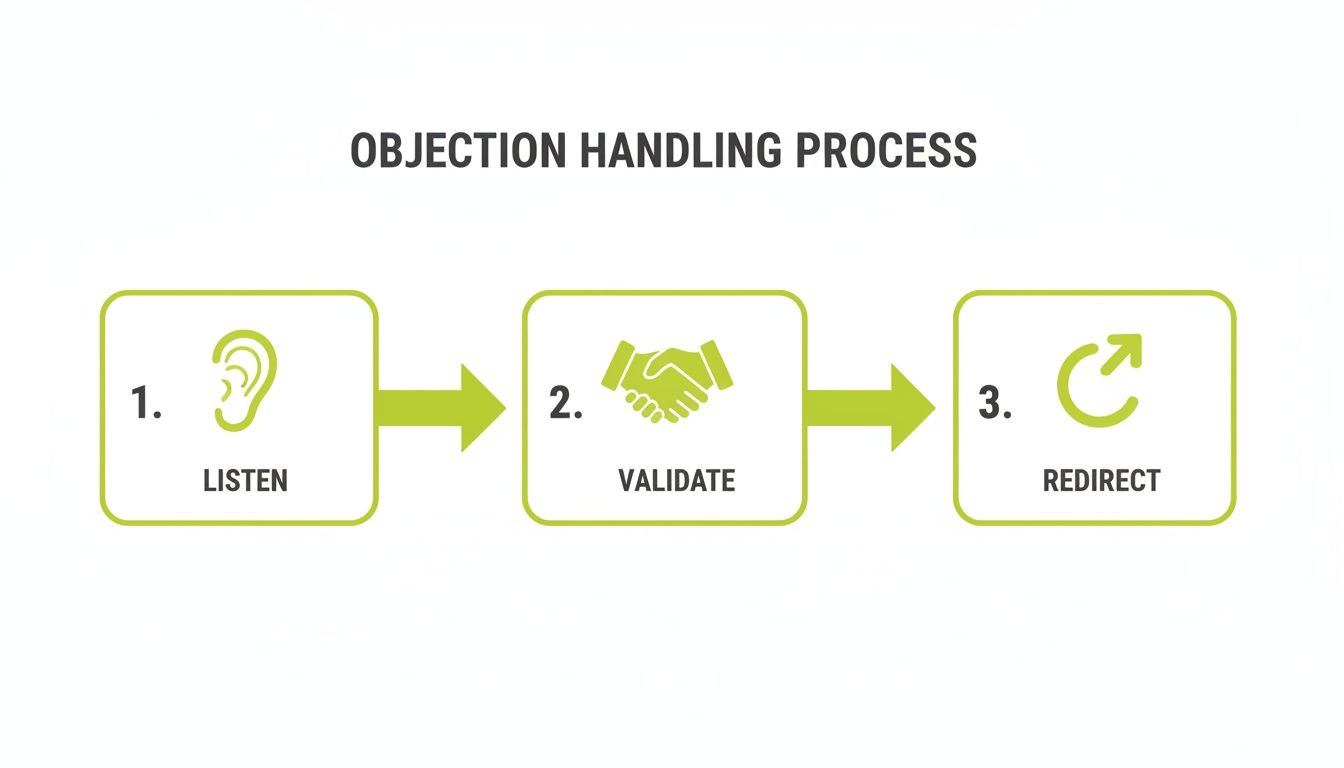
The Listen, Validate, and Redirect model keeps your team in control, turning difficult conversations into productive ones.
Measuring and Scaling Your Efforts
Integrating your script into an AR automation platform closes the performance loop. You can track which scripts lead to the fastest payments and identify top-performing collectors. This data allows for continuous refinement of your strategy.
To scale, consider using automated outbound calling software. These tools manage dialing, allowing your team to focus on high-value conversations that improve cash flow. This transforms the collections call from a manual chore into a data-driven, efficient part of a system designed to systematically reduce DSO.
Moving From Script To System: The Path To Control
Effective collections are about systematic control, not aggressive phone calls. For a CFO or Controller, the goal is to move from reactive, manual work to a proactive, scripted, and automated process that puts you in command of your cash flow.
A collections call script is a starting point, not the entire system.
The script’s power is unlocked when integrated into a larger accounts receivable automation strategy. The script provides consistency; the system provides the timing, context, and data to make every call effective. This transforms a collections call from a random event into a calculated, strategic action.
When you systematize the process, the results appear on the balance sheet.
- Reduce DSO: Integrating scripts into an automated workflow can reduce DSO by 5-20%, converting outstanding invoices into reliable cash.
- Stabilize Cash Flow: Systemization eliminates guesswork, making cash flow more predictable and enabling confident capital allocation.
- Protect Client Relationships: An automated, data-driven process ensures every communication is professional and timed correctly, protecting relationships from the friction of inconsistent collections.
The choice is between tolerating the chaos of manual work or implementing a system that guarantees control. An AI AR automation platform like Resolut embeds your script into a smart workflow, managing reminders, flagging high-risk accounts, and logging every interaction automatically.
This is how you move from managing operational drag to achieving financial precision.
Frequently Asked Questions
Here are common questions from finance leaders about implementing a collections call script.
How Often Should We Update Our Collections Call Script?
A script is a living document. Review it quarterly and plan a more thorough update annually.
Let data drive your changes. Analyze call outcomes in your AR software for professional services. If a script consistently fails with a specific client type, revise it. If new objections arise, build a proactive response into your script to maintain effectiveness and consistently reduce DSO.
Will A Script Make My Collections Team Sound Robotic?
No, if used correctly. A script is a framework for consistency, not a teleprompter. It provides key talking points and a logical path, but it should not eliminate the human element of the call.
The goal is to provide control and clarity. Accounts receivable automation is an asset here. When a collector has the full context—payment history, past communications, notes—they sound prepared and confident. They are guiding a strategic conversation, not just reading lines.
What Is The Single Biggest Mistake In A Collections Call?
The biggest mistake is ending the call without a firm, documented commitment. Vague promises like "I'll look into it" are delay tactics that hurt your ability to improve cash flow.
A successful call ends with specifics: the exact payment date, the precise amount, and the payment method. Your collections call script must push for these details, turning a fuzzy conversation into a measurable outcome.
How Does This Fit With QuickBooks AR Automation?
Native QuickBooks AR automation features are limited, primarily handling basic reminders. The real power comes from connecting QuickBooks to a specialized AR management platform.
An AI AR automation system like Resolut syncs with your QuickBooks data, allowing you to build smart workflows. Automated emails and texts can be sent for the first 45 days. At the 45-day mark, the system can assign a call task. The outcome is logged back into the system, creating a complete audit trail alongside your accounting records.
--- Resolut automates AR for professional services—consistent, accurate, and human. Learn more about Resolut.