
A B2B Collections Strategy That Actually Gets You Paid
Build a B2B collections strategy that cuts DSO and protects client trust. Practical playbook for CFOs at professional services firms.
The AR report is open before the first leadership meeting of the week. Three invoices have moved past 60 days, the client contacts say they're “working on it,” and the finance team is deciding whether another email will accelerate payment or damage a renewal.
That tension is familiar to CFOs, Controllers, and owners of professional services firms. A collections strategy built around identical reminders treats every overdue invoice as the same problem. It isn't. The right approach scores risk first, assigns each account a treatment path, and defines when automation, personal intervention, credit action, or legal review takes over.
The Monday Morning Problem Behind Every Collections Strategy
At a $15M professional services firm, Monday's cash review rarely starts with a clean decision. The controller highlights three invoices that have crossed 60 days. The AR clerk has notes saying each client is “working on it,” but none includes a confirmed payment date, an owner on the client side, or a documented reason for the delay.
The CFO has three choices. Push harder, wait another week, or involve the account partner. Each option carries a cost. Waiting allows the balance to age. Escalating carelessly can make the relationship feel transactional. Asking a partner to intervene may protect the renewal, but it also turns a routine process into an executive rescue.
That isn't a collections process. It's a queue of unresolved judgment calls.
The balance sheet cost is operational
Receivables aren't passive assets. Cash trapped in unpaid invoices is the budget for the next hire, the next software license, and the cushion that absorbs a major client slip. When collections depend on memory, spreadsheets, and scattered inboxes, leadership loses control before the aging report looks alarming.
The problem sits above the AR team. Sales owns expectations, delivery teams create acceptance evidence, account leaders protect relationships, and finance owns the cash conversion cycle. A clerk can send a reminder, but a clerk can't resolve unclear scope, approve revised terms, or decide whether continued service creates unacceptable exposure.
Build rules before volume rises
The operating model should make the next action obvious. Every invoice needs:
- A risk segment: The account's treatment should reflect aging, payment behavior, relationship context, and dispute status.
- An accountable owner: Someone must own the next conversation, not merely the account record.
- A defined exit condition: A payment, documented dispute, or approved payment plan should stop generic dunning.
- An escalation trigger: Broken promises, silence, and advanced aging should move the case to a higher authority.
A segmentation-first collections strategy protects both cash and client relationships. It prevents the firm from using aggressive outreach on healthy accounts while under-serving the invoices that threaten liquidity.
Operator's rule: If the team can't explain why an invoice is receiving its current treatment, the process is running on anecdotes.
Why Speed Beats Effort in B2B Collections
A past-due invoice loses recoverability as it ages. One benchmark summary places collection probability at about 70% at 90 days past due and roughly 50% at six months past due, while bad-debt write-offs average 1% to 3% of revenue across most industries. The figures appear in Eagle Rock CFO's accounts receivable collections benchmarks.
That changes the job. A late invoice is an asset with declining expected value, not a task that needs more reminders. Internal collection efforts can consume 5% to 10% of the amount owed, according to the same benchmark. Speed therefore protects both cash and collector capacity.
Turn the aging report into an exposure estimate
Use a basic expected-recovery calculation:
Receivables in each aging bucket × approximate recovery rate = expected recovery.
The gap between face value and expected recovery represents exposure created by delay. This is a management signal, not a forecast or provision policy. It gives the CFO a practical view of why earlier intervention matters.
Recovery Probability by Aging Bucket | Approx. Recovery Rate | Implied Exposure on $100K Bucket |
|---|---|---|
90 days past due | 70% | $30,000 |
Six months past due | 50% | $50,000 |
A $100,000 balance at 90 days past due implies approximately $30,000 of exposure under that benchmark. At six months, the same face value implies approximately $50,000. Waiting creates the difference, not a new service failure.
Apply the logic to your own book
Suppose a firm has $500,000 in receivables, with 40% past 60 days. That places $200,000 in an aging range where follow-up should no longer run as routine work. Apply the firm's historical recovery rates to each aging bucket, then compare expected recovery with a scenario in which most balances remain inside 30 days.
The response is not to chase every account harder. Intervene earlier, resolve disputes before they age, and reserve high-touch work for accounts where expected recovery justifies the effort. An AR automation survey benchmark reports that 65% of organizations have DSO between 31 and 60 days, with 35% in the 46 to 60 day range.
For professional services firms, DSO often falls in the 30 to 60 day range, according to CreditPulse's industry benchmark. Use that range as context, then investigate every unexplained aging exception. The operating model should trigger different actions by risk segment, from automated reminders to owner-led intervention and, when conditions warrant, escalation.
Segmenting Receivables Before You Touch a Single Invoice
Don't start with a reminder template. Start with a risk score.
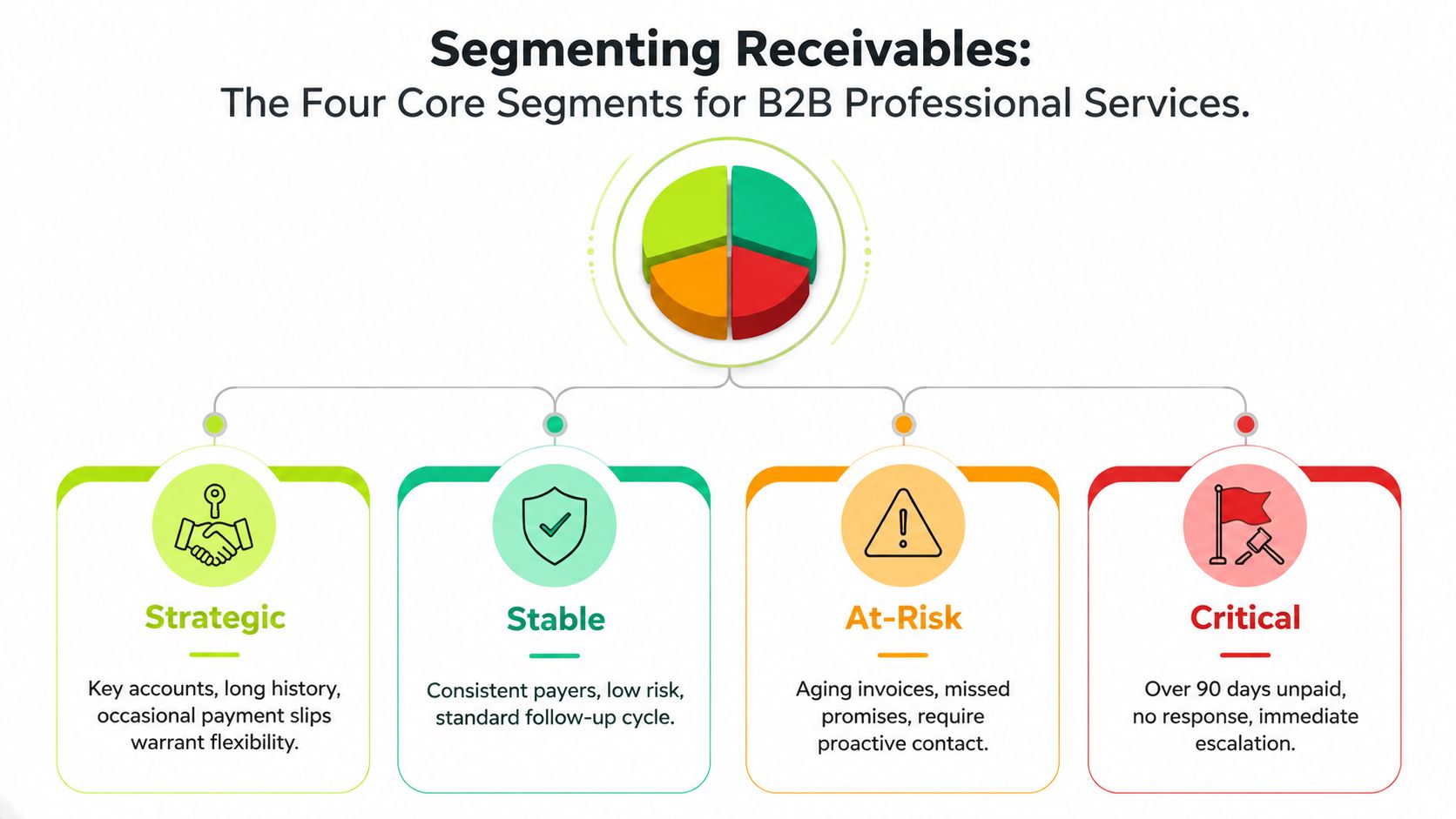
A professional services firm should maintain four operating segments. The names can vary, but the treatment logic must be clear enough that two people reviewing the same account reach the same conclusion.
Four segments with different jobs
- Strategic: A key account with a long history and occasional payment slips. The account gets flexibility, but a named finance or account owner must make personal contact when behavior changes.
- Stable: A consistent payer with low current risk. The account runs through a standard automated cadence, with a simple payment path and limited collector time.
- At-Risk: A recent slip, disputed invoice, concentration warning, or unusual change in behavior. The team contacts the client proactively and routes blockers to the right owner.
- Critical: A broken promise, no response, severe aging, or an account approaching write-off. The case receives executive visibility, credit controls, and possible legal review.
APQC notes that 47% of organizations use tolerance limits to avoid spending collector time on immaterial balances, and its guidance emphasizes stratifying past-due receivables to convert them into cash. See APQC's collections techniques guidance for the underlying process perspective.
Score three inputs
Build the score from three inputs, then document how each input changes the segment.
- Days past due: Aging is the immediate pressure signal. The longer the invoice remains unpaid, the more urgent the treatment.
- Payment history: Use a payment history score, such as median days to pay over the last 12 invoices. A client that normally pays quickly deserves different treatment from one that has always paid slowly.
- Relationship signal: Include account size, renewal timing, concentration, and an open dispute flag. These factors determine who should be involved and how carefully the conversation should be handled.
A client with one invoice at 45 days, a median days-to-pay figure of 28 days over the last 12 invoices, and a renewal in two months shouldn't remain in a generic overdue bucket. The current aging is outside the client's usual behavior, and the renewal creates a relationship-sensitive window. Move the account to At-Risk, assign a named owner, confirm whether the invoice is blocked, and set a dated follow-up.
Measure the score against outcomes
A score is useful only if it changes decisions. Compare predicted collectability with actual payment outcomes, then recalibrate thresholds. The CRF methodology summarized in the APQC material describes defining the item, standardizing measurement, identifying data sources, analyzing results, comparing benchmarks, and recalibrating the process.
That creates a closed loop. The model doesn't need to be perfect on day one. It needs to be visible, consistent, and improved with evidence.
Designing Outreach Cadence and Channels by Segment
Outreach should accomplish a task, not fill a calendar. The first contact confirms receipt. The next surfaces a blocker. A later conversation secures a payment date or proposes approved terms. Every touch should leave the account closer to resolution.
A Stable account might receive a pre-due reminder and a self-service payment link. An At-Risk account needs a structured email, a phone call when the delay becomes meaningful, and an owner who can resolve disputes. A Strategic account may need the account partner present, while a Critical account requires documented escalation rather than endless polite reminders.
Match the channel to the decision
Email creates an audit trail and carries invoice details. SMS can prompt a quick response when the client has opted into that channel. Phone calls uncover ambiguity faster. In-person or executive contact belongs on sensitive, high-value relationships where context matters.
Use channel health as part of the operating model. Before scaling outbound reminders, run a domain blacklist lookup to identify delivery risks that could make a well-designed cadence invisible. For copy and tone examples, keep a controlled library such as these collection email templates, then tailor the message to the invoice facts.
A 90-day operating calendar
Day Post-Invoice | Segment | Channel | Owner | Message Intent |
|---|---|---|---|---|
7 days before due | Stable | AR specialist | Confirm invoice receipt and provide payment route | |
Due date | Stable | AR automation | Restate terms and payment instructions | |
7 days past due | Stable | AR specialist | Ask whether an administrative blocker exists | |
14 days past due | At-Risk | Email and phone | Collector | Surface dispute, missing approval, or cash constraint |
30 days past due | At-Risk | Phone | Collector and account owner | Agree on a dated payment action |
45 days past due | Strategic | Phone or in-person | Account partner and Controller | Protect relationship while resolving exposure |
60 days past due | At-Risk | Phone and email | Controller | Confirm promise, terms, and internal escalation |
75 days past due | Critical | Phone | Controller and executive sponsor | State consequence, secure resolution, or credit decision |
90 days past due | Critical | Formal email and phone | Controller and counsel liaison | Complete documentation and decide legal handoff |
The calendar stops when a dispute is documented, a payment plan is approved, or payment is received. Don't continue generic dunning after the case has entered a resolution workflow.
Tone should become more direct as aging increases, not more hostile. State the amount, invoice, blocker, owner, and next date. Avoid accusations in email, and never promise concessions that the sender can't approve.
Log every touch, including attempted calls, client responses, dispute evidence, and broken promises. Weekly AR reviews should examine evidence, not “working on it” as a status.
Where Automation and AI AR Automation Actually Move the Numbers
Automation earns its place when it changes timing, prioritization, or execution quality. It doesn't earn its place because a vendor calls a workflow intelligent.
Three functions usually create the clearest operating impact. First, automated invoice delivery and confirmation can move the first touch from days toward hours. Second, promise-to-pay capture can turn a vague commitment into a date, amount, owner, and follow-up rule. Third, predictive next-action recommendations can rank accounts by likely payment behavior instead of sorting by invoice age.
Use verified automation benchmarks
Research cited in 2025 found that firms with little or no AR automation waited an average of 24 days outside payment terms to follow up with late-paying customers, compared with 16 days for firms with moderate to high automation. That 8-day difference was associated with an overall 23% DSO reduction, as reported in Cashbook's AR collections analysis.
Other independent guidance reports that modern AR platforms can cut DSO by 15 to 33 days across invoicing, tracking, collections, and cash application, while typical implementations reduce DSO by 5 to 10 days through faster delivery, automated reminders, and payment visibility. Those figures are summarized by Dost's accounts receivable automation guide.
These outcomes depend on clean adoption. A platform can't improve a process if invoice data is incomplete, disputes aren't logged, or staff bypass the workflow.
Keep humans at the exceptions
Automation should not approve a questionable concession, threaten a politically sensitive account, or reinterpret a complex statement of work. Contractual renegotiations, billing disputes, and relationship-critical accounts require human judgment.
Set review checkpoints before an automated action can:
- Change commercial terms: A Controller or authorized account owner approves payment plans and concessions.
- Escalate a relationship-sensitive account: The account partner reviews tone and timing.
- Move a case toward legal action: Finance confirms documentation and exposure.
- Send AI-generated copy: A human checks facts, recipients, commitments, and implied threats.
Sequence implementation in that order. Automate ingestion and basic reminders first. Add predictive scoring after payment history, dispute notes, and contact responsiveness are reliable. Reserve AI-generated messaging for last.
For a practical discussion of how predictive prioritization fits into AI for debt collection, focus on the inputs and review controls, not the label. AI AR automation should support a controlled operating model, not replace accountability.
Escalation Triggers and the Path to Legal Handoff
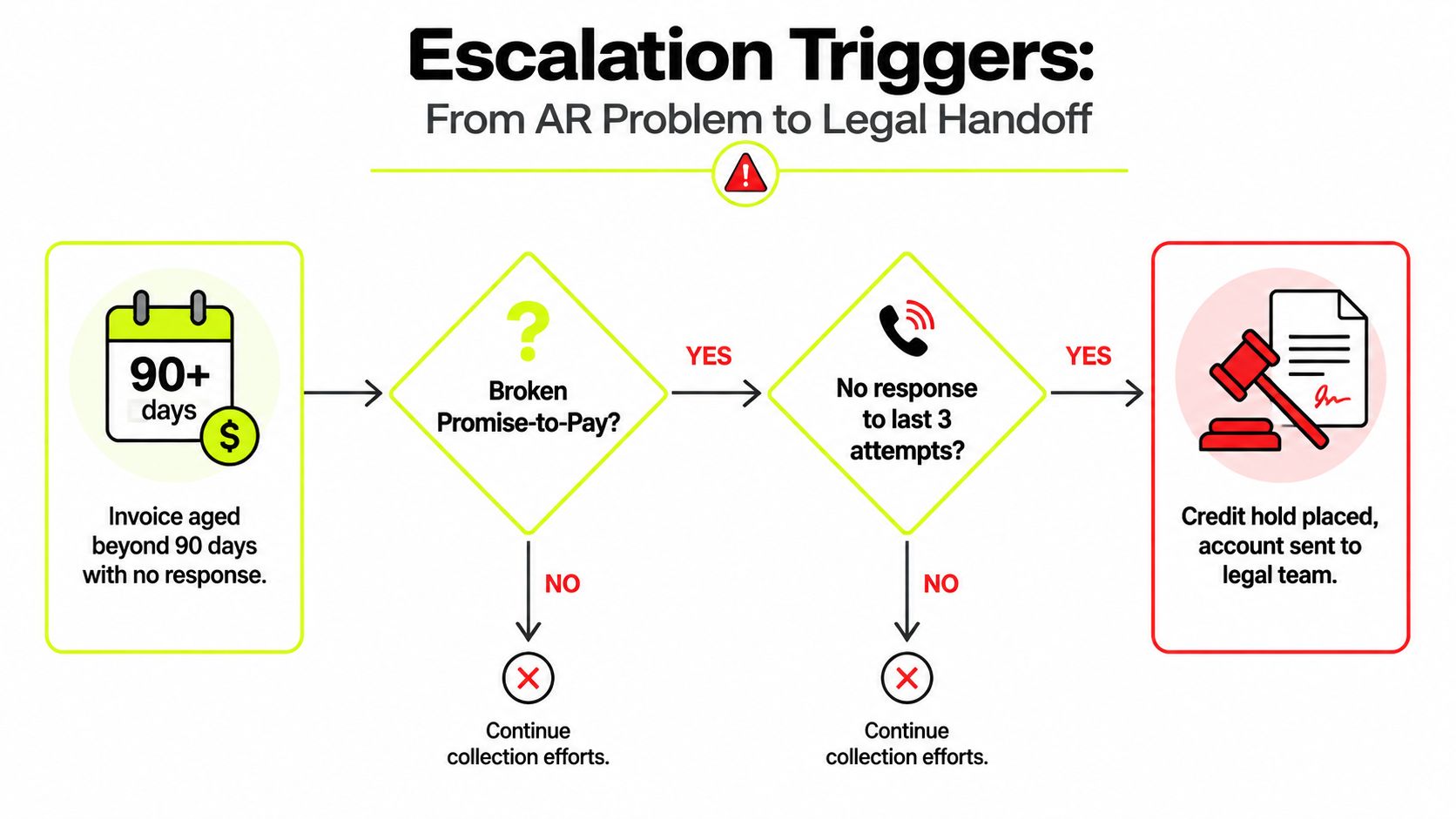
A collections strategy fails when an account stays in routine follow-up after the facts have changed. Set risk-based triggers before volume rises, then give each segment a defined path from outreach to credit hold, external collections, or legal review.
Use explicit triggers:
- Aged beyond 90 days with no response: Move from routine collections to documented escalation and reassess exposure.
- Broken promise to pay: Re-score the account and require a new decision. Do not send another informal reminder.
- Dispute without supporting documentation: Assign an owner and deadline for evidence. A “disputed” status does not suspend accountability.
- Known financial event: Layoffs, missed payroll, or refinancing should trigger credit review and a fresh recoverability assessment.
The 90-day threshold corresponds with a benchmarked recovery probability of about 70% at that age, but it does not mandate legal action. Review the balance, evidence, relationship value, jurisdiction, expected legal cost, and likely recovery. A small balance with weak documentation may warrant resolution or a policy-based write-off. A material balance with complete evidence and no client response may justify a credit hold and counsel review.
Build the handoff packet
The internal owner should assemble:
- The signed engagement agreement and applicable payment terms
- The invoice, delivery record, and supporting time or expense detail
- The complete communication log
- Dispute correspondence and client evidence
- Promise-to-pay records and missed dates
- A current statement of account and exposure summary
Use this guide to past due invoices to standardize the administrative record before counsel reviews the matter. If litigation is uneconomic or relationship risk is high, document the financial and commercial tradeoffs before selling debt to collection agencies.
Use a fact-based decision tree
Route credible disputes to the commercial owner before legal escalation. Place materially overdue, well-documented, unresponsive accounts on credit hold and request counsel's view. Resolve or write off smaller balances with weak evidence according to policy.
The right person should make the call, usually the Controller, account partner, or executive sponsor. State the facts, amount, agreed action, and consequence of inaction. Avoid speculation about insolvency or threats in email.
Internal memo format: Account, invoice, amount outstanding, aging, terms, payment history, dispute status, contacts attempted, promises made, evidence attached, recoverability assessment, recommended action, decision owner, review date.
Legal action is a tool, not a default. Escalation should produce a documented decision, not a louder threat.
KPIs, Targets, and a 60-Day Rollout Plan You Can Run
A useful CFO dashboard connects each metric to an operating decision. It should show whether invoices are moving, commitments are holding, exceptions are being resolved, and collection effort is proportionate to account value. Review changes inside the aging buckets, not just total AR.
Six metrics deserve monthly attention
- Days Sales Outstanding: Use the professional services benchmark of 30 to 60 days as context, then set an internal target from contract terms and billing structure. A rising median days-to-pay figure signals that billing, follow-up, or dispute handling needs review.
- Aging over 60 days: Set a downward internal target. Growth in this bucket should trigger an examination of delayed intervention, unresolved disputes, or weak escalation.
- Collections Effectiveness Index: Compare cash collected with collectible receivables. A decline points to missed follow-ups, poor prioritization, or unresolved balances.
- Promise-to-pay kept rate: Set a target for reliable commitments. A broken promise should raise the account's risk score and move it into the next defined treatment.
- Cost to collect: Compare labor and platform effort with recovered cash. High effort on low-value accounts requires tighter tolerance limits or more automation.
- Bad-debt write-off as a percentage of receivables: Review this measure against policy and the historical baseline. The benchmark summary places bad-debt write-offs at 1% to 3% of revenue across most industries. Billed's AR statistics summary provides additional context for AR performance comparisons.
Use external benchmarks to frame discussion, not to replace your own baseline. Large U.S. companies average around 40 days of DSO, many businesses operate in the 35 to 45 day range, and levels above 60 days are described as a warning sign in the same Billed AR statistics summary.
Execute the rollout in four blocks
Weeks | Focus | Owner | Deliverable | Exit Criteria |
|---|---|---|---|---|
1 to 2 | Baseline DSO and aging distribution | Controller | Current-state dashboard and data-quality log | Every open invoice has age, owner, terms, and status |
3 to 4 | Build segmentation and risk score | Controller and AR lead | Four segments, scoring rules, trigger matrix | Sample accounts receive consistent classifications |
5 to 6 | Load tiered cadences and templates | AR lead and account owners | Channel calendar, approved templates, dispute routes | Each segment has an owner, cadence, and exit condition |
7 to 8 | Turn on automation and train exceptions | AR lead and finance systems owner | Live workflows, review queue, weekly KPI pack | Team handles exceptions without reverting to spreadsheets |
No new hires or reorganization are required. The first objective is control: every account needs a risk score, treatment, owner, next action, and escalation trigger. Once those fields are reliable, managers can adjust automation, outreach intensity, and legal review based on evidence rather than volume or instinct.
Resolut automates AR for professional services with workflows for segmentation, outreach, payment follow-up, and exception handling. If your team needs to reduce DSO and improve cash flow without adding another manual queue, visit Resolut to review how the operating model fits your firm.