Credit Risk Management and Financial Performance in 2026
Explore how credit risk management and financial performance are linked in 2026. This guide offers CFOs actionable strategies to balance risk and growth.
A 1% increase in non-performing loans was associated with a 17.48% reduction in economic value added, while return on assets fell by 0.03%. Credit risk management therefore affects more than collections or compliance. It determines how much value a professional services firm generates after funding costs, working-capital pressure, and delivery costs are accounted for.
For firms with $3M–$50M in revenue, the danger usually appears before a default. A client pays a little later, disputes more invoices, reduces its order frequency, or repeatedly breaks payment promises. Revenue still looks healthy, but cash conversion weakens and risk-adjusted margins narrow. The finance team needs to identify that timing problem early, then connect each intervention to DSO, liquidity, bad-debt exposure, and client economics.
Why Credit Risk Management and Financial Performance Are Inseparable
The 17.48% reduction in economic value added is the part of the research that finance leaders should focus on. The 2022 empirical study also associated a 1% increase in non-performing loans with a 0.03% reduction in return on assets. The finding shows that credit deterioration affects both accounting profitability and value created after the cost of capital, not merely the expense of chasing overdue invoices. The underlying study examines banks, but the financial mechanism translates clearly to commercial receivables.
A professional services firm has already incurred much of its cost by the time an invoice becomes overdue. Staff have delivered the work, payroll has been paid, and overhead has been absorbed. If the client pays late, the firm has financed the engagement for longer. If the invoice becomes uncollectible, the firm loses the expected economic value of the sale while retaining much of the delivery cost.
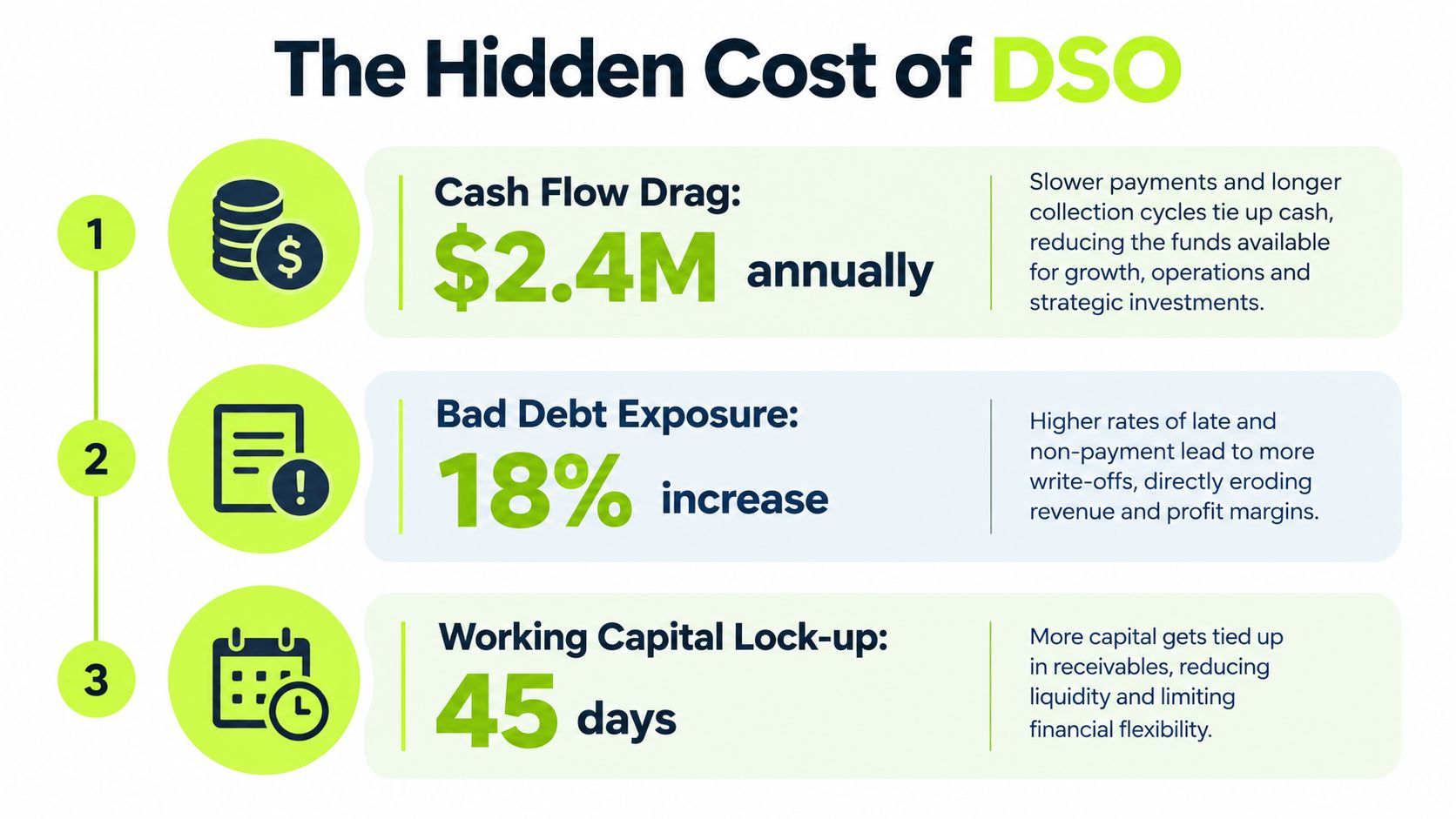
The cost extends beyond bad debt
Late receivables consume management time. Controllers review aging reports, account managers negotiate payment plans, delivery teams answer disputes, and finance staff reconcile partial payments. The firm may also draw more heavily on available liquidity or delay investment because cash remains tied up in invoices.
That makes credit risk management a cash and margin discipline, not a back-office control. A credit limit can protect delivery capacity. A timely escalation can prevent a balance from migrating into a more difficult aging bucket. A clear dispute process can separate a legitimate billing issue from a customer using disputes to delay payment.
Practical rule: Treat every material change in payment behavior as a change in exposure, even when the customer remains profitable on paper.
For CFOs and owners, the relevant question isn't just whether an account is overdue. It's whether the expected contribution from that client still justifies the capital, collection effort, financing cost, and operational attention required to serve it.
A strong policy protects growth rather than restricting it. Finance can preserve commercial flexibility for reliable clients while shortening terms, limiting new work, or requesting deposits from accounts whose risk is rising. That approach links credit decisions to risk-adjusted contribution margin, cash conversion, and the firm's ability to fund its next engagement.
How Late Payment Masks Real Credit Risk
Contractual terms describe when payment is supposed to arrive. Payment behavior shows when cash is likely to arrive. Those are different data points, and the second one is usually more useful for early intervention.
A 2024 UK government survey found that 52% of businesses with business customers said customers generally paid within agreed terms, while 36% said customers took longer and 12% said customers paid sooner. Among small businesses, 49% reported that customers paid later than typical agreed terms. The government survey findings make late payment look less like an isolated exception and more like a recurring operating condition.
A client that pays on day 35 against net-30 terms might still be manageable. A client that used to pay on day 30 and now pays on day 35, then day 42, is sending a different signal. The trend matters because it can reveal cash pressure before the account reaches a formal default stage.
Read the movement, not just the balance
Controllers should monitor aging migration, not just total overdue value. Other useful signals include:
- Broken payment promises: Repeated commitments without settlement indicate that the customer's stated payment plan isn't reliable.
- Invoice disputes: A rising dispute rate can indicate billing friction, procurement pressure, or an attempt to delay payment.
- Reduced order frequency: A decline in new work may suggest budget pressure before the customer communicates a problem.
- Concentration exposure: A large balance with one client can create a liquidity event even when the overall ledger looks healthy.
- Payment-pattern changes: Partial payments, unexplained deductions, and slower responses often deserve review before the due date passes.
Segment accounts by actual payment behavior, client profitability, strategic importance, and open exposure. Don't send the same sequence to a reliable client with one administrative delay and to a strategically important client whose payment pattern has deteriorated across several invoices.
For teams improving recovery workflows, the Chartsy prompt library for failed payments can help structure payment-failure analysis and follow-up ideas. The value comes from using those prompts alongside ledger data, not from replacing account judgment with a generic message.
The operating objective is simple: intervene while the relationship still has room for a commercial solution. That could mean confirming invoice acceptance, correcting a purchase-order mismatch, agreeing a deposit for new work, or involving the account owner before the balance becomes a collection dispute.
The KPIs and Assessment Framework Finance Leaders Should Track
A useful credit dashboard separates operational activity from economic risk. DSO and collection efficiency tell you what the team has processed. They don't, by themselves, tell you whether the portfolio is becoming harder to collect or whether a large client is consuming too much liquidity.
The most important metrics should be viewed together:
Metric | What it reveals | Financial decision |
|---|---|---|
Aging migration | Whether balances are moving into more severe delinquency | Escalate, revise terms, or pause exposure |
Probability of default | Likelihood that an account won't pay as expected | Set limits and prioritize review |
Exposure at default | Amount at risk if the customer fails | Measure concentration and liquidity impact |
Loss-given-default | Expected severity after recovery efforts | Compare intervention cost with loss avoided |
Customer or sector concentration | Dependence on a small number of counterparties | Protect resilience and funding capacity |
Liquidity buffer | Capacity to absorb worsening receivables | Adjust hiring, investment, and financing plans |
A panel study covering 175 banks across five Southeast Asian countries from 2014 to 2020 found that credit risk significantly affected bank performance, while capital adequacy mediated part of the relationship. The result connects asset quality with expected losses, capital consumption, and the funds available for profitable activity. The study is available through the journal publication.
Build an assessment rhythm
Start with a weekly operational view and a monthly management view. The weekly view should flag aging migration, broken promises, invoice disputes, and changes in open exposure. The monthly view should show expected loss, concentration, risk-adjusted margin, and the liquidity buffer required if selected accounts deteriorate.
Automated actions should attach to thresholds. A worsening risk score might trigger a credit-limit review. A second broken promise might route the account to a senior collector. A concentration breach might require CFO approval before additional work is accepted.
The accounts receivable KPI framework should serve decision-making, not dashboard decoration. Collection totals can rise while the team focuses on easy accounts and leaves difficult balances untouched. Risk-adjusted contribution margin corrects that distortion by subtracting expected loss, collection effort, financing cost, and relevant delivery exposure from client revenue.
A clean aging report isn't proof of a healthy book. It may only show that the team is measuring the past instead of monitoring the next payment event.
Manual Credit Controls Versus Automation and Orchestration
Manual credit control usually fails through timing. A spreadsheet is updated after a payment is missed. A collector reviews the account when a balance reaches a weekly queue. A standard reminder goes to every customer, regardless of payment history, relationship value, or dispute status.
That process can work for a small and stable ledger. It becomes unreliable when the firm has multiple service lines, recurring invoices, milestone billing, and account managers who hold different pieces of customer context. The finance team spends time assembling information instead of deciding what action the exposure requires.
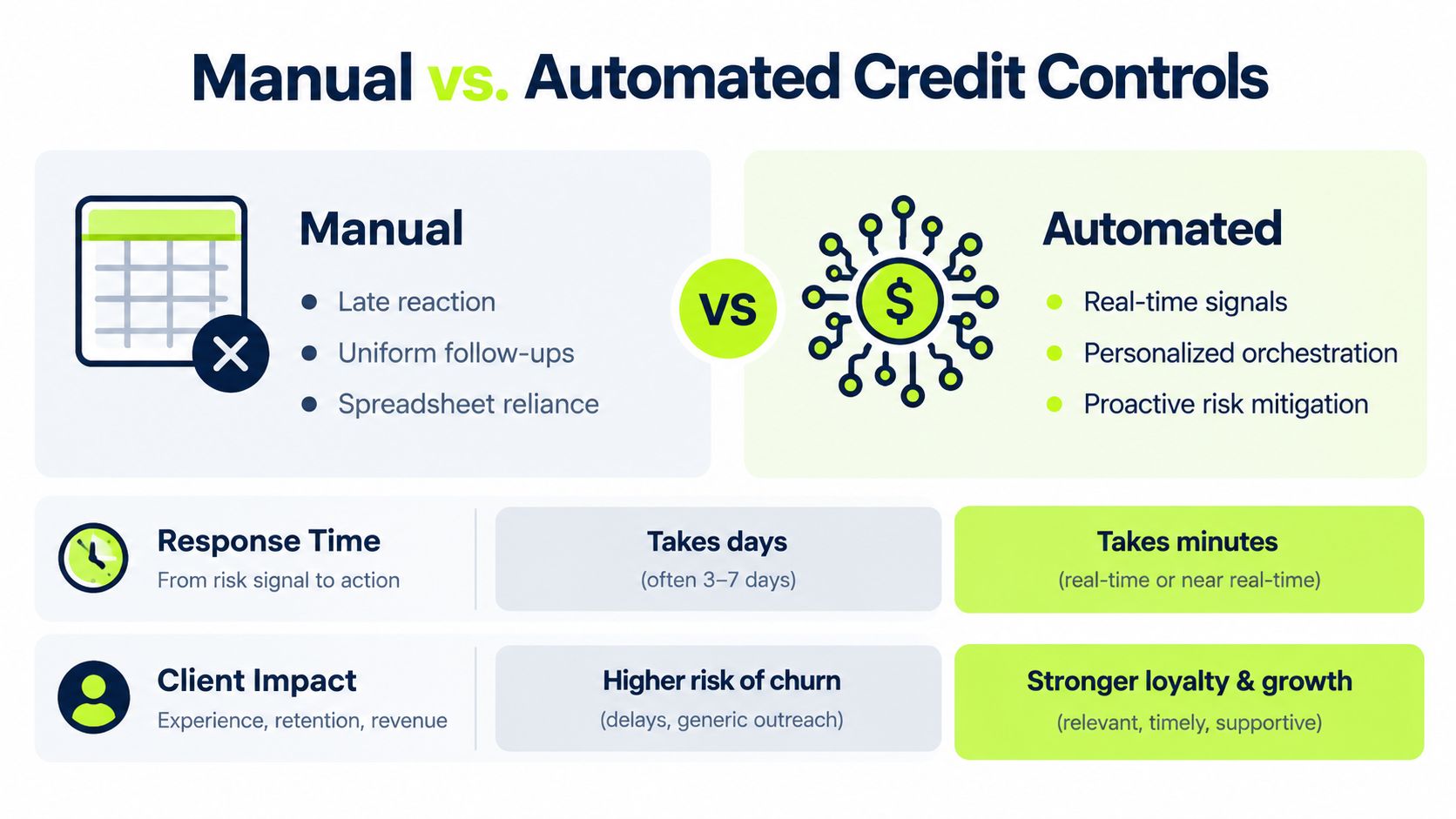
Automation changes the operating model
Accounts receivable automation should identify risk continuously, segment accounts, and orchestrate the next action. That can include a polite email for a first delay, a phone task for a broken promise, a billing correction for a disputed invoice, or a tighter approval path for new work.
AI AR automation adds pattern recognition across payment timing, disputes, invoice acceptance, open exposure, and account activity. It still needs governance. A model should support a controller's judgment, show the reasons for a risk flag, and preserve an audit trail of overrides and actions.
Forward-looking expected-credit-loss modeling illustrates the principle. Evidence from a cross-country sample of 666 banks in 61 countries over 2016 to 2019 indicated that the approach improved loss transparency, reduced surprise impairment shocks, and gave management time to adjust pricing, limits, collection intensity, and capital planning. The cross-country evidence concerns banks, but the discipline also applies to trade receivables.
For commercial invoices, finance can group customers by comparable risk characteristics, use historical aging cohorts, add forward-looking scenarios, and validate expected losses against realized write-offs. A provision matrix makes that approach practical when individual-account modeling would consume too much time.
The right comparison isn't manual versus automated in the abstract. It's late reaction versus timely intervention. A platform such as Resolut combines credit-risk assessment, collections workflows, billing orchestration, cash application, and human-in-the-loop controls for professional services receivables.
Finance leaders evaluating tools should test whether the system improves signal quality, not just message volume. Ask whether it identifies changing payment behavior, routes exceptions to the right person, reconciles cash accurately, and lets the team explain why a customer received a particular treatment. The guide to automating accounts receivable provides a useful operating reference for that evaluation.
How to Design Credit Terms That Protect Margins and Relationships
Credit terms are risk controls with commercial consequences. Academic research on trade-credit contracts identifies four core variables: credit amount, net payment period, shorter discount period, and discount rate. Each variable changes either the firm's exposure, the timing of cash, or the margin surrendered to obtain earlier payment. The trade-credit research provides a useful basis for treating terms as measurable economics rather than standard wording in a proposal.
Consider a policy of 2% off for payment within 10 days, net 30. The discount may accelerate cash, but it also reduces gross margin. The controller should compare actual payment behavior inside the discount window with the margin given away. If customers claim the discount but still pay late, the policy is functioning as a concession rather than a cash-conversion tool.
Match terms to customer economics
A reliable client with predictable payments may justify flexible billing or longer terms if the relationship produces strong risk-adjusted contribution. A client with inconsistent payment behavior may need a deposit, milestone billing, tighter approval of additional work, or a smaller open balance.
That doesn't mean using credit policy to punish customers. It means giving account managers a clear commercial explanation: the firm can continue supporting the relationship, but the payment structure must reflect the capital and delivery exposure.
AR software for professional services can compare the contractual promise with the actual payment event. It can show whether clients pay within the discount period, on the due date, after escalation, or only after service pressure. Those patterns help finance decide whether to keep, remove, or redesign a discount.
Research also supports a nonlinear relationship between trade credit and sustainable profitability. A 2025 study found that increasing trade credit with payment terms of up to one year improved sustainable profitability, while increasing the share of longer-term trade credit harmed it. The study also found that excessive credit volume and overly extended collection periods reduce profitability. The research on sustainable profitability reinforces a practical point: more generous terms aren't automatically more commercial.
Use a simple decision rule. Extend terms when the expected contribution and relationship value compensate for the funding and default risk. Tighten terms when additional exposure produces little incremental margin or threatens liquidity. Review the policy when behavior changes, not only when a contract renews.
The payment terms and conditions guide can support that review, particularly when finance and sales need a common language for deposits, milestones, discounts, and escalation rights.
Signals Controllers Should Act On Before DSO Deteriorates
A controller rarely receives a single notification saying that a customer has become risky. The warning usually arrives as a sequence of small changes.
An account manager mentions that procurement is delaying approval. The customer pays only part of an invoice. A dispute appears on work that was previously accepted without issue. New orders become less frequent, while the open balance remains high.
The OCC Spring 2025 risk assessment described increasing commercial credit risk in the context of higher interest rates, geopolitical risk, business caution, and macroeconomic uncertainty. For a professional services firm, the operational response is to translate external pressure into invoice-level and account-level monitoring.

Use proportionate interventions
Suppose a normally consistent client begins paying later and breaks a promise. The first action shouldn't necessarily be a service pause. Confirm invoice receipt, validate the purchase-order path, and ask the account owner to establish whether the delay is administrative or financial.
If the customer also disputes new invoices, reduces order frequency, and carries a growing balance, the response should become firmer. Shorten terms for new work, request a deposit, cap additional exposure, or escalate the account to executive review.
Customer profitability matters. A strategically important client may justify a coordinated recovery plan, while a low-margin account with repeated exceptions may not justify continued unsecured delivery. The right measure is the expected value after collection effort, funding cost, expected loss, and relationship impact.
Make models explainable
A 2025 study comparing AI credit-risk systems found that gradient boosting achieved an AUC of 0.84 on the German Credit dataset, while logistic regression remained more transparent and compliance-oriented. The study used SHAP to connect model performance with explainability. The comparison of AI credit-risk methods supports a balanced approach.
Predictive accuracy alone isn't enough. Controllers should monitor false positives, override rates, data drift, audit effort, and the economic result of each intervention. A human-in-the-loop process gives finance the ability to challenge a flag, record the reason, and preserve the client relationship when the data doesn't tell the full story.
Next Steps for Strengthening Credit Risk Management and Financial Performance
Start with measurement before purchasing technology. Build a customer-level view of open exposure, aging migration, actual payment timing, disputes, broken promises, concentration, and risk-adjusted contribution margin. If the team can't see those relationships in one place, it can't prove whether a policy change protected cash or merely reduced new work.
Next, define action thresholds. Decide who reviews a deteriorating account, when sales must be involved, when terms change, and what requires CFO approval. Keep the rules practical. A small number of meaningful triggers is more useful than a complex scoring model nobody trusts.
Then introduce orchestration. Automate routine reminders, payment links, cash application, exception routing, and follow-up tasks, while keeping human judgment for disputes, strategic accounts, and unusual risk signals. The aim isn't to remove the relationship from collections. It's to give the relationship owner better timing and better context.
Long-run evidence from U.S. community banking shows that loan-loss provisions as a percentage of total assets moved countercyclically with return on assets. In other words, provisions generally rose as profitability weakened and fell as profitability improved. The FDIC analysis of 31 years of community-banking data illustrates why weak receivables quality can compress earnings before losses are fully realized.
For a professional services firm, continuous monitoring creates room to act earlier. Finance can adjust limits, address disputes, protect cash conversion, and preserve delivery capacity before a late invoice becomes a material impairment. Review the results by customer segment, not only by total collections. A lower DSO is valuable, but the stronger outcome is more predictable cash flow at an acceptable risk-adjusted margin.
Resolut automates AR for professional services by combining credit-risk signals, collections orchestration, billing workflows, and cash application in one operating process. If you want to reduce DSO and improve cash flow without turning every client conversation into a confrontation, visit Resolut to assess a consistent, accurate, and human approach.