Invoice Paid in Full: What It Actually Means for AR
Invoice paid in full is more than a zero balance. Learn what it means, how to mark it correctly, and how automation closes the loop on AR.
The most popular advice about an invoice paid in full is also the least reliable: wait for the money, click “mark as paid,” and move on. That approach confuses a balance of zero with a controlled accounting outcome.
A controller needs stronger evidence. The funds must clear, the payment must be allocated to the right invoice, deductions must be explained and approved, disputes must be resolved, and the ledger must reconcile to the bank. Otherwise, the invoice may look closed while unapplied cash, credit notes, bank fees, or disputed balances remain somewhere else.
Late payment makes this distinction operationally important. A broader 2024 comparison found that 46% of invoice value was paid late across the reference markets, with 68.9% of Australian payments made on time compared with 41.6% of Canadian companies reporting on-time payment (late-payment comparison). “Paid in full” and “paid on time” are separate measures, and both belong in the AR close.
The Phrase Sounds Simple, but the Status Is Not
“Paid in full” is not a checkbox. It is an audit-grade conclusion about what happened to the cash, how it was applied, and whether every exception has been resolved or approved.
A zero balance proves only that the ledger currently shows no amount due. It does not prove that the bank settled the funds, that the payment belongs to the correct invoice, or that a deduction was handled correctly.
A payment may appear in the bank feed without an invoice match. One customer transfer may cover several invoices without usable remittance details. A bank fee may reduce the amount received, while the AR team closes the invoice without recording the fee or identifying who approved the difference. The customer account then looks clean while unapplied cash, unexplained deductions, or unresolved credits remain elsewhere.
What a weak status hides
The phrase invoice paid in full should describe a set of tested conditions, not a single system action. At minimum, the status should answer five questions:
- Did the funds clear the bank?
- Was the payment applied to the correct invoice?
- Is the remaining invoice balance zero?
- Were deductions, fees, taxes, and credits reviewed and approved?
- Can another reviewer locate the remittance and supporting evidence?
If any answer is unclear, “paid” is premature. The record may show payment received, while cash cleared or account reconciled remains unconfirmed.
That distinction affects management reporting. A false closure can understate aging, distort DSO, weaken cash forecasts, and leave credit memos unresolved. A customer may later challenge a short payment because the original deduction was never documented. Collections then reopens an invoice that the ledger treated as closed months earlier.
Controller's rule: A payment status should tell the next reviewer what happened, not merely which button someone pressed.
Measure timeliness separately
Settlement completeness and settlement speed answer different management questions. A professional services client might pay the exact invoice amount, yet settle after its internal approval cycle has extended well beyond the contractual due date. The invoice is complete from a balance perspective, but the delay has still required the firm to finance payroll, subcontractors, and delivery costs.
Record the due date, settlement date, and full-payment result separately. This preserves the difference between an invoice that was paid in full and one that was paid in full on time. The earlier payment timing data also shows why teams should not collapse those measures into one status.
The first measure tests whether the receivable was settled completely. The second tests collection performance and exposes pressure in billing terms, approval workflows, reminders, or payment channels. A clean AR close keeps both facts visible.
Treat the final status as a controlled conclusion, attach the evidence that supports it, and assign every unresolved exception to an owner. A tidy ledger is useful only when it remains accurate under review.
What “Paid in Full” Actually Requires to Be True
A defensible status rests on five conditions. They don't all happen at the same moment, and finance systems shouldn't pretend they do.
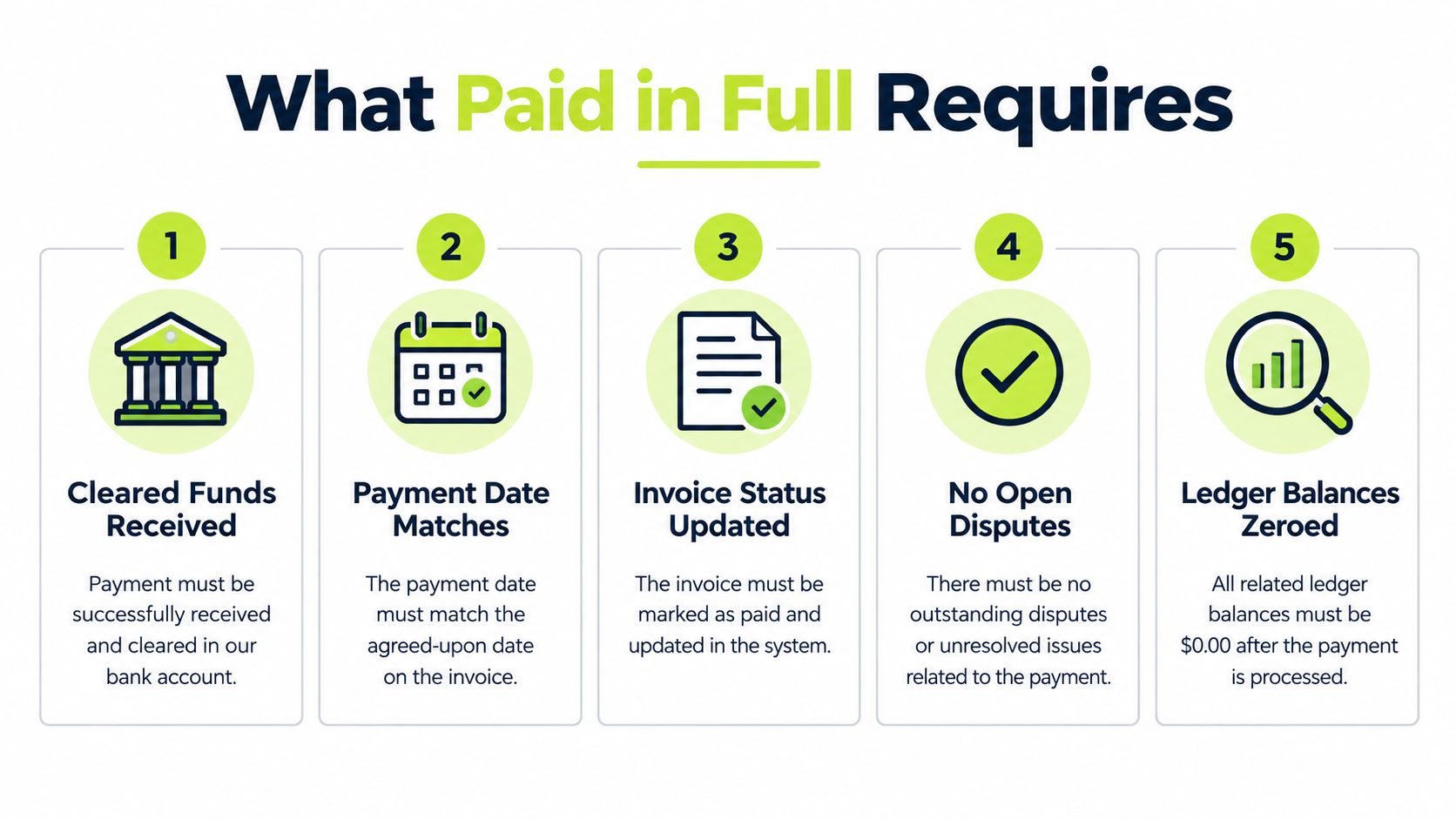
Cleared funds received
A payment notification isn't the same as cleared cash. An ACH, card settlement, wire, or check can appear in an operational feed before the bank has completed settlement. The AR record should distinguish an expected payment from money that is available and confirmed.
The evidence is usually a bank transaction, settlement record, or other controlled cash source. If the funds later reverse, the invoice status should be reopened or moved to an exception queue rather than left as paid.
Payment allocated to the correct invoice
The cash must point to the right customer and invoice. A customer reference, remittance advice, amount, currency, and payment date can support the match, but none should be treated as infallible.
A single transfer may cover multiple invoices. Split the receipt across those invoices and retain the remittance. If the customer hasn't identified the allocation, hold the money as unapplied cash while the team investigates. Closing the oldest invoice automatically may create a false payment history.
The remaining balance is zero
The ledger should show no residual principal, tax, fee, or other amount that belongs to the invoice. A small balance isn't harmless if it represents an unapproved deduction or an unresolved exchange difference.
Check the gross amount, applied amount, credit notes, write-offs, withholding tax, and bank charges. If the balance reaches zero only because someone posted an unexplained adjustment, the invoice is closed numerically but not defensibly.
Deductions are approved and documented
Customers may deduct withholding tax, service credits, chargebacks, bank fees, or agreed discounts. Each deduction needs a reason, an accounting treatment, and an owner who can confirm that the business accepted it.
A withholding-tax deduction can be legitimate, but it shouldn't disappear into a generic write-off account. A bank fee may belong to the payer, the supplier, or a contractual split. The treatment depends on the agreement and the accounting policy.
Supporting remittance is attached
A reviewer should be able to open the invoice and find the payment evidence without searching across mailboxes. Attach the remittance advice, bank reference, approval for deductions, credit memo, and any dispute resolution record that explains the settlement.
The control sequence is simple:
- Payment received: a payment signal exists.
- Cash cleared: the bank confirms settlement.
- Payment applied: the receipt is allocated to the correct invoice or invoices.
- Account reconciled: the balance, deductions, credits, and evidence agree.
Only the final stage supports an audit-grade “paid in full” status.
Accounting Entries and Reconciliation Mechanics
“Paid in full” becomes defensible only when the accounting entry, bank movement, invoice allocation, and exception treatment agree. For a straightforward settlement, debit cash and credit accounts receivable for the amount collected. The original invoice continues to carry its revenue and sales-tax postings. That receipt clears the receivable in the ledger, while invoice-level matching confirms that the cash reached the correct account.
Payments routed through undeposited funds require a second control point. Record the receipt in undeposited funds first, then move it to the bank account when the deposit clears during bank reconciliation. In QuickBooks, this distinction matters when one bank deposit combines several customer payments. Without it, the deposit can reconcile while individual invoice allocations remain unclear.
A professional services firm may receive one deposit covering multiple client invoices, a withholding-tax deduction, and a bank fee. Reconcile the total deposit to the bank, split the receipt across the relevant invoices, post the deduction to the appropriate account, and document any difference. Forcing every invoice to equal the net deposit hides the exception instead of resolving it.
A practical exception table
Exception | Typical Treatment | Routing Owner |
|---|---|---|
Bank fee deducted from payment | Post the fee according to the contract and approved policy, then clear the invoice balance | Controller or treasury owner |
Withholding tax deducted | Record the tax receivable or appropriate tax treatment, supported by customer documentation | Tax owner |
Short pay under dispute | Leave the disputed amount open and record the dispute reference | Account owner or collections |
Approved service credit | Issue and apply a credit memo against the invoice | Billing owner |
Unexplained residual balance | Keep the balance open and investigate before any write-off | AR manager |
Foreign-exchange difference | Post the exchange difference as realized, under the firm's accounting policy | Controller |
Invoice quality is the first control point in the paid-in-full chain, because billing errors create exceptions before cash arrives. Incorrect legal entities, missing references, wrong tax details, and undelivered invoices all interfere with clean application. A 2024 UK Department for Business and Trade study of 300 businesses reported that 24% attributed late customer payments to administrative errors, while 36% attributed late payment of supplier invoices to administrative errors (UK DBT late-payments research).
The month-end control
At close, reconcile the open-invoice report to the AR control account. Review unapplied cash, credit balances, stale disputes, and payments still held in undeposited funds. The open-invoice list should support control review, with each exception assigned to an owner and a documented next action.
A useful accounts receivable reconciliation process ties the sub-ledger to bank activity and the general ledger. Approving a clean aging report while unapplied cash and unresolved deductions sit outside it creates a false closure. The reconciliation file should show what was matched, what remains open, and why.
Marking Invoices Paid in Your AR System Without Creating False Closures
“Mark as paid” should be the final result of reconciliation, not the beginning of it.
In QuickBooks, the reliable pattern is to record the customer payment and apply it to the specific invoice. If the payment arrives through a deposit, use the appropriate undeposited-funds workflow so the deposit can be matched to the bank later. Don't create a generic income entry because it makes the invoice disappear from aging.
Mid-market ERPs follow the same principle, even when the screens differ. Apply the receipt to invoice identifiers, preserve the remittance, and use approved credit memos or write-offs for differences. An AR platform should add matching and workflow controls, not bypass them.
Paid versus applied
A general ledger can show cash received while the AR sub-ledger still lacks invoice-level allocation. Those are different states.
Use these statuses deliberately:
- Received: the payment is visible in a cash feed or bank account.
- Applied: the payment is linked to a specific invoice or approved set of invoices.
- Closed: the invoice balance is zero after approved deductions and credits.
- Reconciled: the invoice, sub-ledger, bank, and supporting evidence agree.
This structure prevents a common failure in QuickBooks AR automation. Teams automate the import of receipts but leave allocation, short pays, and bank deposits for later. The result is faster data movement without faster close.
A guide to AI-powered invoice processing is useful when evaluating systems that extract invoice data, match transactions, and preserve review steps. The key question isn't whether software can close an item. It's whether the software can show why the item was closed and route uncertainty to a person.
Approval before residual write-offs
Never use a write-off to hide a mismatch. Require a reason code, an authorized approver, and a link to the customer communication or commercial agreement. A small residual balance can reflect a legitimate fee, a tax treatment, a currency difference, or a customer dispute.
False closures make aging reports look healthier than the customer account. They can also lower reported DSO while leaving the firm with unresolved cash application work. A clean report is valuable only when it represents a clean ledger.
Overpayments, Credit Balances, and Refunds Done Right
Overpayments deserve the same discipline as underpayments. They change the customer balance, affect future application decisions, and can create obligations that don't belong in revenue.
Consider a client that pays the same invoice twice. The invoice should be closed once, while the second receipt remains as a documented credit balance. Confirm the duplicate payment, notify the client, and choose among three controlled outcomes: retain the credit for a future invoice, apply it with the client's instruction, or refund it through an approved process.
A courtesy discount applied after billing requires a different treatment. Do not reduce cash and write off the difference. Issue an approved credit memo, reference the commercial decision, and apply that memo to the invoice so the customer account explains why the full face value was not collected.
A tax adjustment may create a partial credit rather than a cash refund. In that case, preserve the tax support and apply the credit to the affected invoice or future balance. A credit memo should have a clear reason, date, approver, tax treatment, and link to the original transaction. For a concise explanation of the document and its accounting role, see this guide to the credit note.
Choose the treatment based on evidence
- Keep the credit on account when the customer confirms it can be used against a near-term invoice.
- Apply it to another invoice only when the customer's instruction and the allocation are recorded.
- Refund the amount when the customer requests it or the contract requires it, using a controlled approval and payment trail.
- Write it off only when policy permits and the balance has a documented reason and authorization.
Payment-channel design can shorten the path from invoice issuance to complete settlement. Australia's Treasury reported that correctly rendered invoices submitted to eligible agencies under its Commonwealth e-invoicing policy could receive five-day payment terms when both parties used e-invoicing, compared with 20-day terms when e-invoicing was not used (Australian Treasury e-invoicing policy). Faster settlement still requires correct allocation and credit handling.
Tell the client about an overpayment promptly and in plain language. State the amount, the invoice or invoices involved, the proposed treatment, and the action required. That approach protects the relationship while keeping the ledger from accumulating unexplained credits.
How Automation Closes the Loop on Invoice Paid in Full
Automation creates value only when it closes the gap between cash receipt and reconciled status. Importing a payment instantly but leaving it unapplied shifts the delay to a different screen.
A capable AI AR automation workflow reads remittance data, invoice references, customer identity, amount, currency, and payment history. It can match a multi-invoice payment, recognize partial references, and suggest an allocation. The system should then confirm the bank transaction and send mismatches to an exception queue.
Human review belongs at the boundary
Automation should handle repeatable matches. Controllers should handle ambiguity, disputed deductions, unusual credits, foreign-exchange differences, and customer-specific exceptions. That division improves control because people spend time deciding, not retyping.
The output should include an allocation record, match confidence or rule used, bank confirmation, exception reason, and approval history. A system that merely flips the status to paid doesn't provide enough evidence for an audit or a dependable month-end close.
Electronic invoicing provides an important historical example. On 1 February 2005, Denmark required all public institutions to accept supplier invoices in an electronic format that could be read directly by public-sector accounting systems (history of Denmark's e-invoicing milestone). The operational lesson remains relevant: structured invoice data gives validation, matching, and reconciliation systems something reliable to work with.
Watch the workflow in context:
For firms assessing AR software for professional services, the useful questions are practical. Can it connect payments to project or client invoices? Can it handle retainers, partial payments, credit memos, and multi-invoice remittances? Can it synchronize with QuickBooks Online or the firm's ERP without creating a second source of truth?
An automated payment reconciliation workflow should reduce manual allocation while preserving human control over exceptions. That combination supports efforts to reduce DSO and improve cash flow, but the operational test is whether the aging report becomes more trustworthy, not merely whether reminders go out faster.
A Defensible Control Framework and What to Do Next
A CFO or controller can establish the control without redesigning every finance process. Start with a written definition of “paid in full” and require evidence for each condition. Then make the following measures visible:
- First-pass match rate: how often receipts are applied correctly without rework.
- Invoice reissue rate: how often billing errors require corrected documents.
- Exception aging: how long disputed, unapplied, or partially paid items remain unresolved.
- Human-touch rate: how many payments require manual allocation or approval.
- Reconciliation completeness: whether closed invoices have bank, remittance, and ledger support.
Review those measures alongside DSO and the aging report. A faster reminder sequence won't compensate for inaccurate invoices, poor cash application, or indefinite dispute status. For owners who need a plain-language grounding in what your business owes and is owed, the same principle applies: balances matter only when the underlying transactions are supported and current.
Set dispute deadlines, preserve the undisputed balance for collection, and prevent resolved items from reopening without a documented reason. Use automation for matching and routing, while keeping approval authority with the finance team.
Resolut automates AR for professional services by connecting invoice follow-ups, payment status, cash application, and exception handling in one controlled workflow. Visit Resolut to see how consistent, accurate, and human AR automation can support a cleaner close and more dependable cash flow.