What Is Credit Risk Assessment: A Guide for CFOs
What Is Credit Risk Assessment. Learn what credit risk assessment is, how scoring models work, and how to integrate automated credit risk assessment into your
A client's invoices are overdue, but the relationship is strong, the work is ongoing, and the partner at the client company keeps promising payment next week. Meanwhile, payroll, subcontractors, tax obligations, and new project costs continue on schedule. The accounts receivable report shows a balance. The operating reality shows an unsecured loan.
That's the practical reason CFOs, Controllers, and firm owners need to understand what credit risk assessment is. It isn't a score for a bank file or a one-time approval form. For a professional services firm, it's a working discipline that connects customer information to payment terms, credit limits, invoice monitoring, escalation timing, and collections decisions.
A useful assessment answers two questions: How likely is this customer to pay on time, and what will the business be exposed to if they don't? The answer should change what your AR team does next.
The Hidden Cost of Uncollected Revenue
A valued client misses an invoice due date. The account manager says the client has always paid eventually. The partner doesn't want an awkward conversation because a renewal is under discussion. Your Controller moves the invoice into the next aging bucket and waits for an update.
That single decision can create a wider operating problem. The firm continues delivering work while its cash remains tied up, and the finance team spends time checking promises rather than managing exceptions. If the delay becomes a write-off, the margin on completed work may disappear long after the project team has moved on.

Credit terms are a business decision
When a firm agrees to net terms, it is financing a customer's use of its expertise. That may be commercially sensible, especially when the customer is strategically important. It still creates exposure that should be assessed before the team commits more delivery capacity.
Without a consistent process, firms often extend the same terms to very different customers. A long-standing enterprise account, a newly incorporated consultancy, and a thin-file international customer may all receive identical payment conditions because nobody has defined a better rule.
The cost goes beyond one late invoice:
- Financing gaps: The firm must fund salaries and delivery costs while waiting for customer cash.
- Capacity distortion: Teams continue serving accounts that consume resources but don't convert work into cash on schedule.
- Write-off exposure: A disputed or unpaid invoice can turn completed work into unrecovered revenue.
- Relationship strain: Late-stage collections feel more adversarial when expectations weren't established at onboarding.
- Management uncertainty: Forecasts become less reliable when invoice timing depends on informal promises.
Practical rule: Treat payment terms as part of the commercial model, not as a default courtesy.
A disciplined approach doesn't require aggressive collections. It requires clear thresholds, documented decisions, and an early response when behavior changes. Some firms also separate assessment from recovery mechanics by using dunning and intelligent retry tools for payment follow-up, while keeping customer-level exposure decisions with finance.
The objective is simple: protect cash flow without damaging a good client relationship. That starts before an invoice becomes overdue.
What Credit Risk Assessment Actually Means
Credit risk assessment is the process of estimating whether a customer will pay its obligations on time and determining the financial exposure if payment is delayed or never arrives. In a professional services firm, the obligation is usually an invoice for completed work, a recurring retainer, reimbursable costs, or a future commitment under agreed terms.
The assessment becomes useful only when it produces a decision. A rating of low, medium, or high risk is incomplete unless it changes how the firm manages the account.
From score to operating rule
A practical assessment has several connected parts:
- Collect relevant evidence. Review payment history, financial information, existing exposure, invoice disputes, customer concentration, and any signals that may affect the customer's ability or willingness to pay.
- Estimate payment risk. Assign a score, segment, or rating that reflects the likelihood of late payment or default.
- Set exposure boundaries. Define a credit limit, project deposit, milestone requirement, or approval threshold that matches the firm's tolerance.
- Trigger action. Decide how often invoices are monitored, when reminders begin, who handles escalation, and when delivery or new work requires review.
- Learn from outcomes. Compare the prediction with actual payment behavior and adjust rules when the signal stops working.
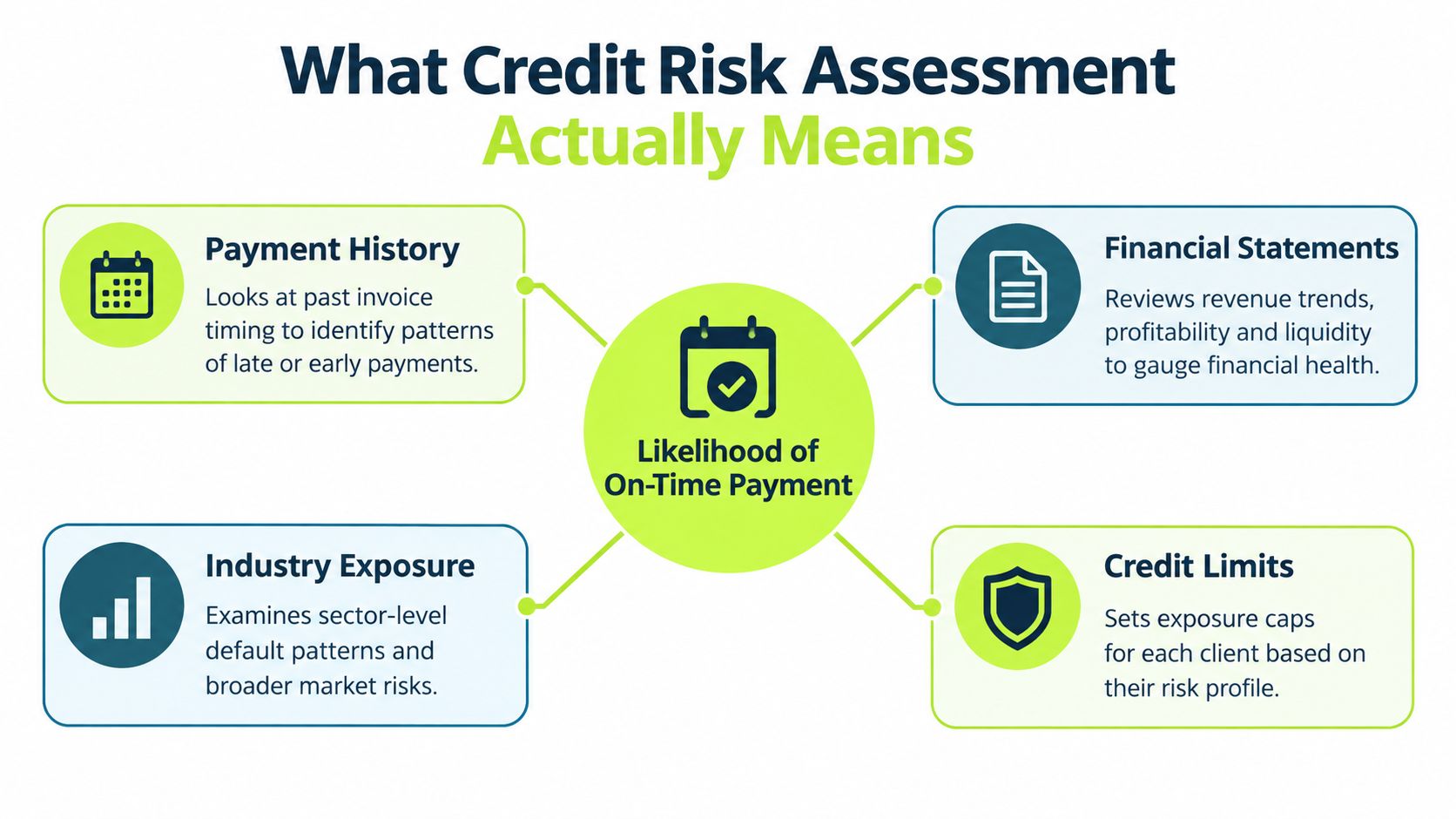
A lower-risk customer might receive standard terms, routine reminders, and a higher exposure ceiling. A customer with uncertain information or changed payment behavior might receive a smaller limit, milestone billing, closer invoice monitoring, or a required deposit. A high-risk account may need partner approval before additional work is accepted.
The score is not the decision
Finance leaders should ask what sits behind every rating. The output should include the factors that influenced it, the confidence level, the current exposure, and a recommended next action. That lets sales and delivery leaders understand why terms changed without turning finance into a black box.
A strong workflow also connects the score to accounts receivable automation. The same customer record should inform invoice reminders, escalation queues, payment options, and cash application. Practical context on counterparty exposure can also be found in CEFCore's practical risk guide, particularly when teams are formalizing their risk vocabulary.
The most important distinction is this: assessment is not a one-time underwriting exercise. Each payment outcome should improve the next decision.
Data Sources and Metrics That Drive Decisions
Traditional credit review still matters. Payment history, credit scores, debt ratios, financial statements, bank information, and trade references can help a firm judge both willingness to pay and ability to pay. For professional services, internal AR data is often the most immediately useful source because it shows how the customer behaves with your invoices, not only how it appears in an external file.
Start with the operating measures your team can explain:
- DSO: Track whether receivables are converting into cash in line with agreed terms.
- Invoice aging: Look for balances moving from current to overdue, not only the total overdue amount.
- Payment velocity: Watch for a customer who previously paid promptly but now needs repeated reminders.
- Exposure concentration: Identify how much unfinished work and outstanding billing depend on one customer.
- Dispute behavior: Separate genuine service disputes from recurring administrative delays.
- Data completeness: Mark accounts where missing information makes the assessment less reliable.
Alternative data needs a relevance test
Alternative data can add coverage for thin-file firms, new companies, informal businesses, or customers operating across countries with uneven reporting. It can also create a false sense of sophistication. A signal may improve prediction without being legitimately relevant to a customer's ability or willingness to pay.
World Bank research found that smartphone-activity data improved financial inclusion by 23.05% and profitability by 42% in one study, while online-shopping data could harm inclusion. The comparison appears in the World Bank research on alternative data and financial inclusion. The lesson for B2B AR is not to collect everything. It's to test whether a source is useful, relevant, consented, explainable, and consistently available across customer segments.
Data Source | Predictive Value | Availability | Governance Complexity |
|---|---|---|---|
Payment history | Direct view of customer behavior | Usually high internally | Moderate |
Financial statements | Useful view of liquidity and leverage | Uneven for private firms | Moderate |
Credit bureau data | External view of credit standing | Depends on country and entity | High |
Invoice and dispute activity | Strong operational signal | High inside the firm | Moderate |
Digital or behavioral data | May add coverage for thin-file customers | Uneven | High |
Finance teams should document provenance and consent, especially when data crosses jurisdictions. When reviewing external signals, focus on evidence-based signals for investors rather than attractive but weak proxies, as discussed in Artul.ai's evidence-based signals for investors.
For a practical internal starting point, map current fields and review rules with this credit risk analysis Excel template. The spreadsheet shouldn't become the final system, but it can expose where decisions depend on missing fields, personal judgment, or inconsistent definitions.
Scoring Methodologies and B2B Use Cases
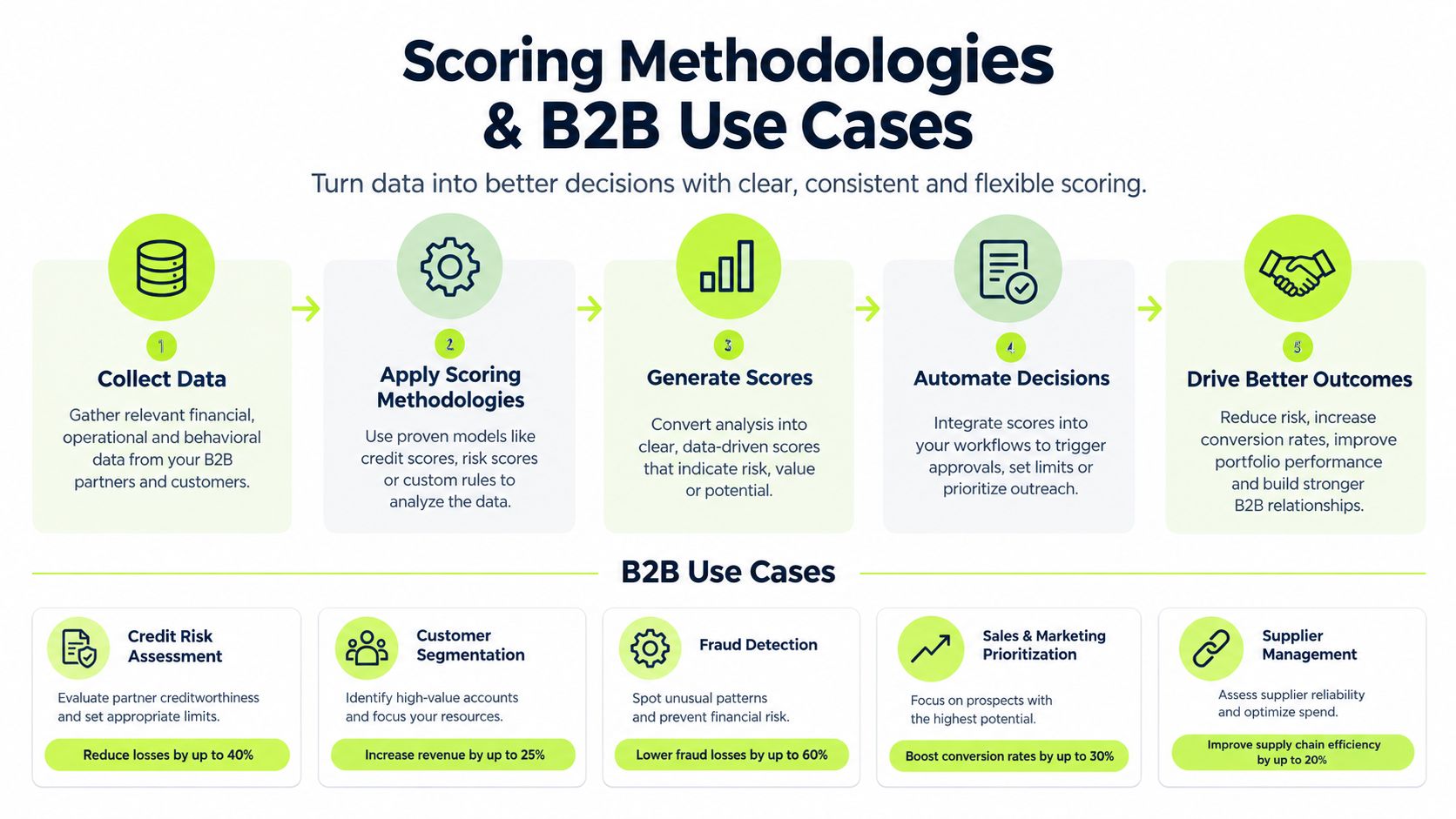
A scoring model converts customer information into an estimate of payment risk. The methodology matters less than the operating fit. A model that finance cannot explain, monitor, or connect to an action is not useful because it uses advanced mathematics.
Logistic regression remains valuable when the firm needs transparent relationships between inputs and outcomes. It can support clear reason codes and straightforward validation. Machine learning classifiers can detect nonlinear combinations across payment behavior, exposure, disputes, and external signals, but they require stronger monitoring and explanation. A hybrid model can use statistical scoring for the core decision and machine learning for anomaly detection or prioritization.
Use cases should define the model
Consider a professional services customer whose invoices were historically paid on time. The latest invoices are aging, the customer has started disputing routine charges, and outstanding work has increased. The model should not merely label the account risky. It should identify the change, show the current exposure, and recommend a proportionate response.
Useful outputs include:
- Probability estimate: How likely is late payment or default?
- Expected exposure: How much open billing and undelivered work are at risk?
- Reason codes: Which observable changes drove the result?
- Confidence level: How complete and reliable is the underlying information?
- Recommended action: Should the team monitor, contact, escalate, revise terms, or pause additional exposure?
A thin-file customer might receive a lower initial limit while the firm builds a payment record. A customer with stable payment behavior but a temporary invoice dispute might remain on standard terms while the dispute queue receives priority. These are different business decisions, even if both accounts receive a higher score.
Decision standard: A risk score earns its place when a Controller can tell the collections team what to do differently today.
Models also require post-deployment review. Customer mix changes, payment processes change, and signals lose relevance. Monitor false positives, missed late payments, segment outcomes, and drift in the relationship between inputs and actual results.
For a broader view of available capabilities, compare workflows in this guide to credit risk assessment tools. The right choice is the one that connects scoring to invoices, work queues, approvals, and documented human judgment.
Why Manual Assessment Falls Short
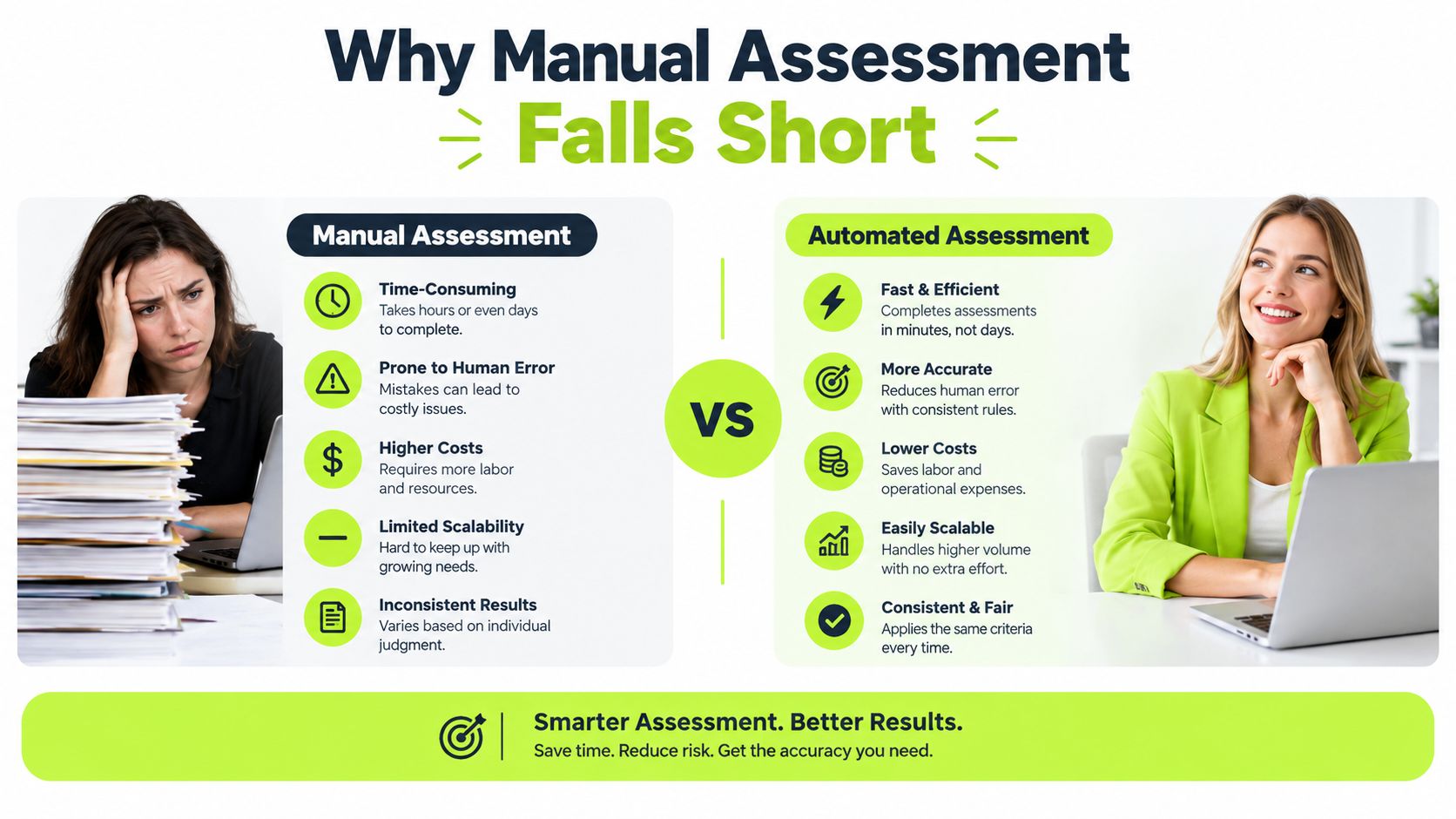
Spreadsheets are useful for analysis, but they are fragile as an operating system for credit decisions. A Controller may maintain a carefully designed workbook, while sales keeps a separate customer list and collections works from an aging report that updates on a different schedule. The firm then has several versions of exposure, risk, and next action.
Manual review also creates uneven treatment. One analyst may tighten terms after a missed payment, while another waits for a customer to become seriously overdue. A partner may override a limit through an email that never reaches the central record. When a dispute arises, the firm can't easily reconstruct what information supported the decision.
The operational failure points
Manual workflows commonly produce:
- Delayed decisions: New accounts wait for a review, or existing accounts remain unchanged after behavior shifts.
- Missed warning signals: A change in payment velocity gets buried in aging detail.
- Inconsistent escalation: Similar customers receive different follow-up because rules live in individual habits.
- Weak auditability: Overrides, approvals, and exceptions remain in inboxes rather than the customer record.
- Late intervention: Collections begins after exposure has already accumulated.
Automation doesn't remove judgment. It applies agreed rules consistently, routes exceptions to the right person, and creates a record of what happened. That can help finance teams reduce DSO and improve cash flow because they spend less time finding accounts and more time resolving the ones that need attention.
Dimension | Manual Approach | Automated Platform |
|---|---|---|
Decision consistency | Depends on individual review | Applies configured rules across accounts |
Monitoring | Periodic spreadsheet checks | Ongoing alerts and prioritized queues |
Escalation | Informal or calendar-driven | Triggered by defined thresholds |
Explainability | Notes may be scattered | Reason codes and decision history |
Human involvement | Required for routine steps | Focused on exceptions and judgment |
Automation still needs thoughtful configuration. Bad source data, poorly chosen thresholds, or unreviewed model outputs can create faster mistakes. The gain comes from combining consistent controls with accountable human review, not from switching finance off.
Building an AI-Driven Credit Risk Workflow
Implementation should begin with the AR process you already run. Document where customer data enters, who approves terms, how limits are recorded, when invoices are monitored, and what happens after the first missed commitment. This exposes the decisions an AI AR automation workflow needs to support.
Build around thresholds and exceptions
Define a small set of operational bands rather than starting with an elaborate model. For example, a routine account can move through standard reminders automatically, while an account with changed payment behavior or higher exposure routes to a Controller. High-value accounts and disputed decisions should retain a clear approval path.
A practical configuration includes:
- Data selection: Use payment history, invoice aging, exposure, disputes, and relevant external information.
- Threshold design: Set limits for terms, outstanding work, overdue balances, and escalation.
- Workflow mapping: Connect each threshold to reminders, review tasks, approvals, or delivery decisions.
- System integration: Sync customer, invoice, payment, and status information with the firm's accounting environment.
- Override controls: Allow a human to change a recommendation, but require a documented reason.
QuickBooks users should verify how customer records, invoices, credits, payments, and status changes move between the accounting system and the AR platform. A reliable QuickBooks AR automation setup should reduce duplicate entry without hiding the source of truth.
Use autopilot where the rules are stable
Low-risk, repeatable actions can run in autopilot. Exceptions should use co-pilot control, with finance reviewing the recommendation before it affects terms, delivery, or a significant client relationship.
Further technical context is available in this discussion of credit risk analysis using machine learning. The implementation question remains operational: can your team explain the recommendation, override it responsibly, and see whether the resulting action improved payment behavior?
AI should augment the Controller's judgment, not replace ownership of the credit policy.
Regulatory and Ethical Considerations
Broader data coverage can make a credit process look more complete while making its decisions less fair. The World Bank warns that alternative data may amplify vulnerability factors or misrepresent them, producing inaccurate assessments and harsher terms for affected groups. That warning applies to B2B environments where new companies, informal businesses, and international customers may have uneven data availability.
The core test is not whether a signal predicts behavior. It's whether the signal is legitimate, proportionate, explainable, and governed for the business decision being made.
Questions finance leaders should ask
- Provenance: Where did the data come from, and can the firm document how it was collected?
- Consent: Did the customer receive appropriate notice, and is the intended use permitted?
- Segment testing: Do outcomes differ materially across customer groups because of data availability or model behavior?
- Explainability: Can the system identify the customer-specific factors behind a recommendation?
- Human review: Can a customer or internal stakeholder challenge an anomalous decision?
- Monitoring: Does the firm check for drift, false positives, and disparate outcomes after deployment?
Explainability methods such as SHAP and LIME are useful because decision-makers need applicant-specific explanations, not only a system-wide statement that a model performs well. In accounts receivable, the explanation should be practical: payment behavior changed, invoice exposure increased, a dispute remains unresolved, or the available data is incomplete.
More data isn't automatically safer data. Poorly governed inputs can make an advanced assessment less reliable and less equitable.
This article isn't legal advice, and requirements vary by jurisdiction and use case. CFOs should involve legal, privacy, compliance, and security stakeholders before deploying alternative data or automated decisions that materially affect customer terms.
Next Steps for Smarter AR Risk Management
Start with the account that currently consumes the most attention. Review its payment history, open exposure, invoice disputes, agreed terms, and escalation record. Then ask whether a different decision earlier in the relationship would have reduced the exposure without damaging the client relationship.
That exercise usually reveals where intuition is carrying too much weight. A structured assessment gives finance a common language. Automation applies the policy consistently, surfaces changes earlier, and gives sales and collections a clear reason for the next conversation.
The practical sequence is manageable:
- Define the data you trust.
- Set exposure and escalation thresholds.
- Connect each risk outcome to an AR action.
- Keep human review for exceptions.
- Measure whether payment behavior and cash forecasting improve.
The aim isn't aggressive collections. It's predictable, respectful control over revenue that the firm has already earned.
Resolut automates AR for professional services by connecting credit risk assessment, invoice monitoring, collections workflows, and cash application in one operating process. If you're looking to reduce DSO and improve cash flow without losing human judgment, visit Resolut to see how the platform can fit your firm.