
How to Improve Cash Conversion Cycle: A CFO Playbook
Learn how to improve cash conversion cycle with actionable tactics for AR, inventory, and payables. Practical guide for professional services firms.
A client pays late, your team opens another spreadsheet, and the cash forecast moves in the wrong direction again. The work is complete, the invoice is technically correct, and nobody can explain why payment is still waiting on a purchase-order reference, an approval, or a reply buried in an inbox.
That's the operating problem behind a slow cash conversion cycle. For professional services firms, the answer usually isn't a harsher collections script. It's a cleaner customer-to-cash process, better ownership, and enough automation to make good habits repeatable.
Why the Cash Conversion Cycle Matters More Than DSO Alone
The cash conversion cycle measures the operating time between paying suppliers and collecting cash from customers. Its formula is inventory conversion days plus receivable collection days minus payable days. DSO matters, but it only measures one part of the cash tied up in the business.
A firm can reduce DSO and still struggle if it pays suppliers too early, carries unnecessary stock, delays billing, or allows disputes to sit unresolved. CFOs need the broader lens because working capital is affected by all three operating decisions, not just collections performance.
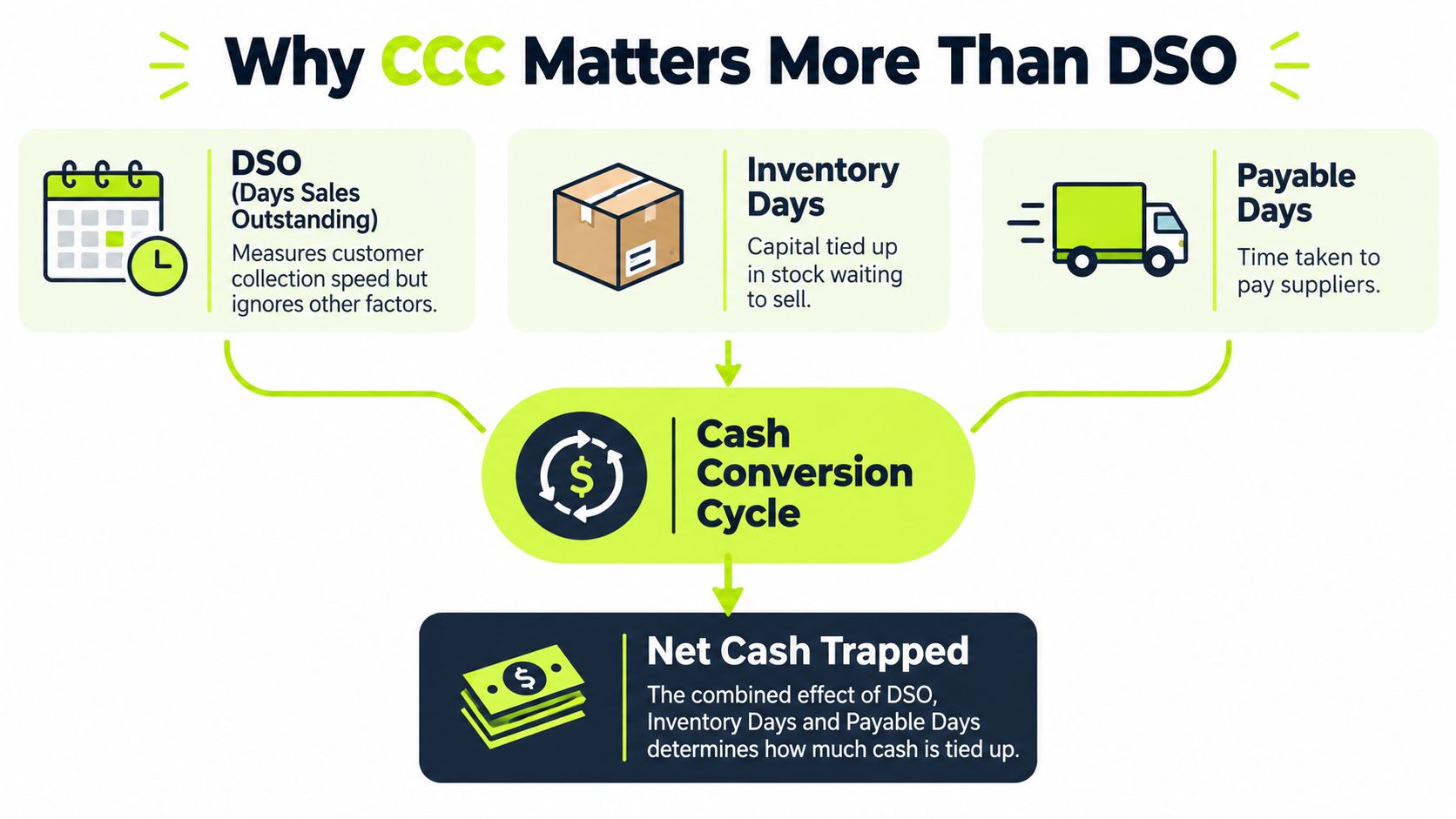
A 2024 meta-study combined 43 academic papers covering almost 62,000 enterprises in 35 countries over 1992–2017 and found a statistically significant negative relationship between CCC and profitability, indicating that inefficient receivables, inventory, and payment practices weaken financial performance. The evidence supports disciplined improvement, not a single-minded push to make every component as low or high as possible. The full study is available here.
Treat CCC as an operating dial
The useful question isn't, “How do we lower DSO?” It's, “Where is cash waiting, and which operational decision is making it wait?”
For a professional services firm, inventory may be limited, but project rework, unbilled work, prepaid subcontractor costs, and unapplied cash can still create working-capital drag. Payables also matter. Stretching a supplier may improve the reported number while weakening delivery capacity or increasing future costs.
Practical rule: Set separate targets for receivables, inventory or project-related working capital, and payables. A single CCC target without component ownership hides the cause of movement.
A sound working-capital framework connects finance metrics to the actions that release cash. The board should see the total cycle, while controllers and operating leaders should own the individual delays behind it.
The right target is a shorter, more predictable cycle that preserves client trust, service quality, and supplier resilience. Cash released through better billing data is durable. Cash released by withholding payment from a critical vendor may not be.
Measuring Your Current Cash Conversion Cycle and DSO Baseline
Before changing a process, establish a baseline that the controller trusts. Use average balances for the measurement period where possible, reconcile the source data to the general ledger, and document which revenue and receivables are included.
The core relationship is:
CCC = inventory days + DSO minus payable days
Professional services firms often have little physical inventory, so receivables usually deserve the first diagnostic. Days sales outstanding measures the average number of days required to collect credit sales and is calculated as accounts receivable divided by credit revenue times the number of days, making DSO a practical operating metric for firms with little inventory to offset slow collections. Review the DSO calculation and application.
Build the baseline from operating detail
Start with the total figure, then cut it by the dimensions that explain behavior:
- Client: Identify customers whose terms, approval process, or dispute history consistently delay payment.
- Partner or account owner: See whether billing quality or follow-up varies by relationship owner.
- Service line: Compare retainers, projects, milestones, and time-based billing.
- Aging bucket: Separate current invoices from overdue balances and identify where expected cash realization is deteriorating.
- Root cause: Classify delays as billing timing, missing documentation, dispute, weak follow-up, or credit risk.
For example, a blended DSO can look stable while one service line accumulates disputed invoices and another collects promptly. That average won't tell the controller where to intervene.
Record the opening receivables balance, credit revenue, invoice issue date, contractual due date, payment date, unapplied cash, dispute status, and write-offs. Also record payable balances and the supplier terms used in the calculation. If the firm has project-related inventory or material commitments, capture those separately rather than forcing them into a generic inventory number.
Choose a repeatable reporting routine
Use a consistent period and compare movement against the same definition each time. A weekly operational view can show overdue concentration, invoices awaiting client information, unresolved disputes, cash received but not applied, and payments approaching due date. The monthly close can then validate the trend against the ledger.
The baseline isn't a performance verdict. It's a map of where cash is waiting. Once the map is reliable, the firm can calculate DSO with a consistent method and assign an owner to each material bottleneck.
Shortening Receivable Days Without Sounding Like a Collections Agency
Late payment often begins before an invoice becomes overdue. A missing purchase-order number, an incorrect legal entity, unclear time entries, or a client approval that nobody owns can add friction long before a collector sends a reminder.
The practical way to reduce DSO is to redesign the customer-to-cash journey. Collections still matter, but they work better when the invoice is accurate, the payment route is convenient, and disputes have a visible owner.
Fix the invoice before chasing it
Use a pre-issuance checklist that validates the client entity, billing contact, purchase-order data, service dates, contract terms, tax treatment, and supporting documentation. For recurring work, use templates that preserve the required details without asking the billing team to rebuild each invoice manually.
Then make payment easy. Offer a clear payment portal, bank transfer instructions, card or digital-wallet options where appropriate, and a direct contact for billing questions. Clients shouldn't have to search through an old email thread to understand how to pay.
Disputes need their own workflow. Assign a reason code, responsible team, next action, and target resolution date. A dispute dashboard should distinguish a genuine scope disagreement from a missing document or a simple cash-application error.
Make follow-up consistent and proportionate
Use a sequence that begins before the due date, confirms receipt, offers help with approval requirements, and escalates only when the account's behavior warrants it. The message should change with the situation. A friendly status check suits an invoice awaiting approval. A firmer request is appropriate when a client has missed a confirmed promise to pay.
Research summarized in an accounts-receivable report found that businesses following up on all overdue invoices were seventy-six percent more likely to be paid within one week than businesses that didn't follow up on every overdue invoice. It also found that businesses combining SMS and email were forty-nine percent more likely to be paid within two weeks than those relying on email alone. The report details the follow-up findings.
Client experience matters: Consistency feels professional when the message is accurate, relevant, and easy to act on. Repetition without context feels like pressure.
Accounts receivable automation helps finance teams maintain that consistency. It can schedule reminders, surface missing information, route disputes, and record every contact while leaving relationship-sensitive conversations with the account owner or controller.
Optimizing Inventory and Payables Timing Without Harming Suppliers
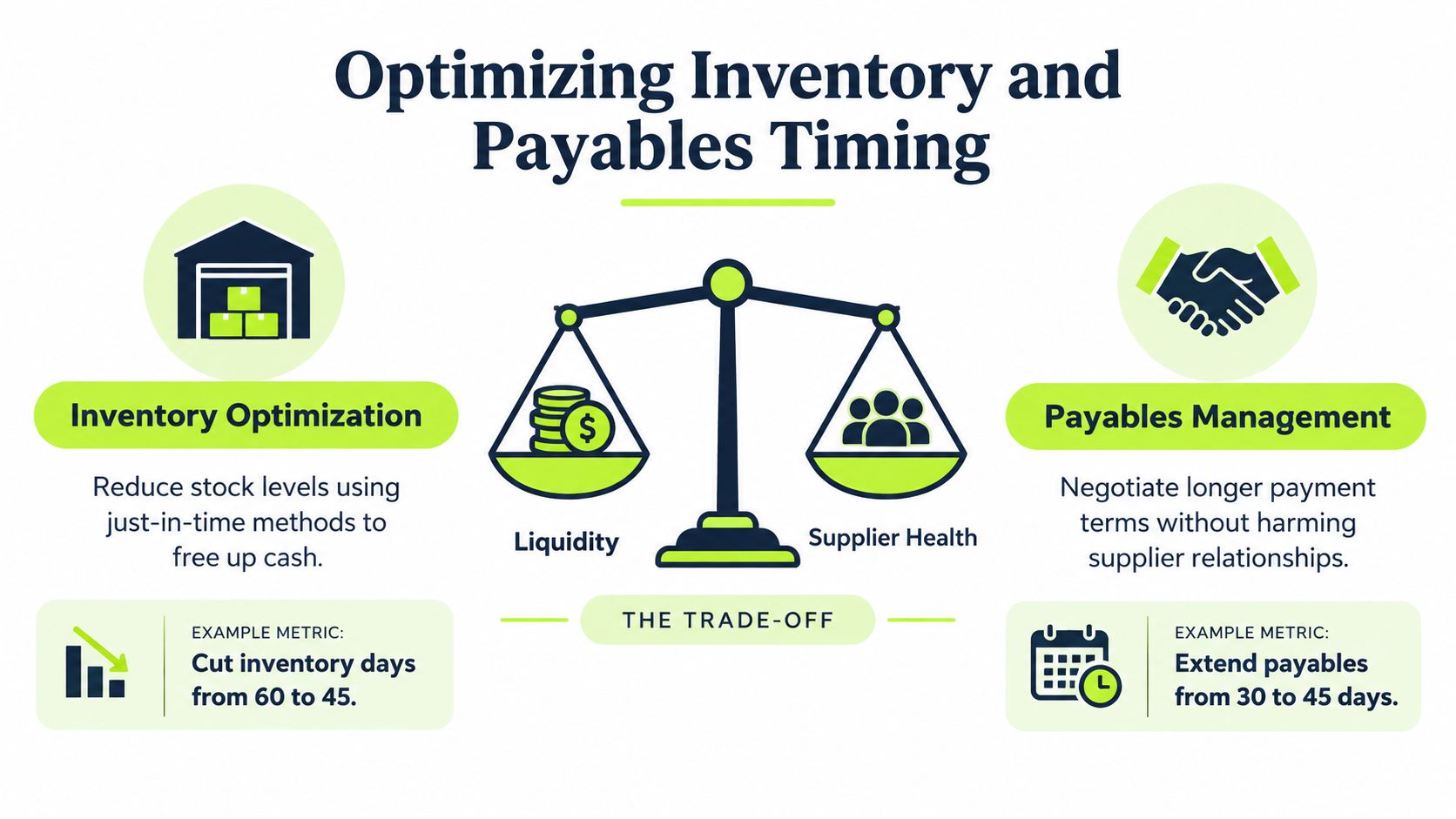
Payables is the easiest CCC lever to misuse. A firm can delay payments and show a better short-term cash position, but that doesn't mean it has improved the business.
Recent evidence shows U.S. CCC improvement was driven partly by DPO increasing to fifty-nine days while DSO and inventory performance worsened. The same source reports that about thirty-nine percent of EU SMEs identify payment delays as a top challenge, while average B2B payment periods exceed sixty days. See the discussion of this trade-off.
For professional services, inventory optimization usually has a different shape than it does in manufacturing. Look for unused project materials, avoidable rework, excessive subcontractor commitments, and cash received but not matched to the correct invoice. The principle is the same: remove idle working capital without weakening delivery.
Segment suppliers before changing terms
Group suppliers by strategic importance, substitutability, financial vulnerability, and effect on client delivery. A large, easily replaced vendor may tolerate standardized scheduling. A specialist subcontractor that supports a critical engagement may need reliable payment more than a nominally longer term.
Use negotiated terms where the supplier can support them. Consider dynamic discounting when early payment creates a genuine economic benefit, and use supply-chain finance where it gives the supplier earlier access to cash without forcing the buyer to pay prematurely. Whatever policy you choose, execute payments reliably. A promised date that slips damages trust faster than a shorter term handled consistently.
Lever | Cash Impact | Relationship Risk |
|---|---|---|
Improve billing and dispute resolution | Releases receivables without changing supplier behavior | Low, when communication improves |
Reduce excess project commitments | Limits cash tied up before delivery | Moderate, if service capacity is cut too far |
Negotiate payable terms | Retains cash for longer | Moderate to high, depending on supplier dependence |
Use early-payment discounts selectively | Converts available cash into a purchasing benefit | Low when the return exceeds financing cost |
Delay payments outside agreed terms | Creates immediate retention | High, with penalty and supply disruption risk |
The balanced approach is to improve receivables first, remove waste from project delivery, and use payables as a negotiated operating decision. Higher DPO is not automatically better. Supplier resilience is part of cash-flow resilience.
Setting Clear CCC KPIs and Weekly Cash Flow Dashboards
A weekly dashboard should answer three questions: what cash is stuck, why is it stuck, and who owns the next action? If it only reports a month-end DSO number, it arrives too late to manage the work.
Use the CCC as the executive indicator, then show the components and leading operational measures beneath it. Global evidence from more than thirty thousand companies showed an average industry-adjusted CCC of eighty-two point fourteen days and a negative relationship between CCC and profitability, while also showing that the benefit can weaken or reverse when firms push CCC to very low levels. The international study provides that context.
Build a dashboard people can act on
Track:
- DSO movement: Show the current trend, the target, and the largest client or service-line contributors.
- Invoices paid on time: Separate contractual performance from invoices blocked by disputes or missing data.
- Dispute-resolution time: Report open disputes by root cause and owner, not just total count.
- Unapplied-cash balance: Show payments received that haven't yet reduced the correct receivable.
- Supplier-payment compliance: Confirm that negotiated terms are being honored and exceptions are visible.
- Released cash: Connect resolved disputes, corrected invoices, and collected balances to actual cash received.
A staged target is safer than a universal mandate. For example, management may choose to reduce CCC by five to ten days while monitoring service levels and churn. That specific target is included in the operating plan as a controlled test, not a claim about what every firm can achieve.
Review the dashboard in a short weekly meeting. The controller should bring exceptions, the billing owner should bring invoice-quality issues, client leaders should address relationship-sensitive accounts, and the owner or CFO should remove obstacles that cross departments.
For finance teams formalizing this cadence, Spark's guide to fasi e KPI del ciclo can help connect operating stages with measurable indicators. The useful test is simple: every metric should lead to a decision, an owner, or a documented reason for no action.
Automating Accounts Receivable and Cash Application Workflows
Manual AR breaks under normal pressure. A controller may have a good policy, but billing deadlines, client questions, project work, and month-end close can push follow-up into inconsistent personal habits.

A practical AI AR automation workflow starts with risk identification. Flag invoices with unusual aging, broken promises, recurring disputes, changed contacts, or missing documentation. Next, automate the low-risk work: invoice delivery, reminders, payment links, status requests, and internal task creation.
Professional-services aging deserves attention because expected realization falls as invoices remain open. One industry analysis reports that invoices paid within thirty days are collected at ninety-seven to ninety-nine percent of face value, while invoices outstanding beyond ninety days collect at only fifty to seventy percent. The analysis explains why aging is a leading indicator.
Keep people in the right decisions
Autopilot is appropriate for routine reminders, receipt confirmations, payment instructions, and simple reconciliation. Co-pilot support is better when the system detects a dispute, a sensitive client relationship, or a promise-to-pay failure.
The workflow should escalate tone gradually. A normal reminder can become a direct escalation when risk increases, and a legal-style message should require appropriate controls and human review. The purpose is not to sound threatening. It's to make the seriousness of the balance clear when ordinary communication has failed.
AR software for professional services needs more than a reminder queue. It should connect billing data, client communication, dispute ownership, payment status, and accounting records. Guidance on triggers and actions explained is useful when designing those workflow rules.
Payment application is the other half of the process. A payment that has arrived but remains unmatched still creates reporting noise and delays the next customer decision. A documented cash-application automation workflow should match cleared payments to open invoices, route exceptions, and preserve an audit trail.
A finance leader should test automation against control questions: Can the team explain why a message was sent? Can a client reach a human? Can the controller override a sequence? Can the system show whether a payment was received, applied, promised, disputed, or escalated?
Putting It All Together Into a Practical CCC Improvement Playbook
Improving the cash conversion cycle is an operating redesign, not a collections campaign. The firm needs a reliable baseline, a small number of accountable owners, and workflows that remove friction before the invoice becomes overdue.
Start with the data. Reconcile receivables, payable terms, project-related commitments, disputes, and unapplied cash. Calculate the cycle consistently, then segment DSO by client, service line, partner, and aging. A blended number can identify the symptom, but segmentation usually identifies the work.
Sequence the work by cash bottleneck
Prioritize the invoices and processes that can release cash without damaging delivery:
- Correct issuance problems: Fix missing purchase orders, wrong entities, incomplete supporting detail, and late approvals.
- Resolve disputes by cause: Give each dispute an owner, action, and escalation date.
- Improve payment access: Offer clear instructions, digital options, and a visible route for billing questions.
- Automate consistent outreach: Use email, SMS, reminders, promises to pay, and internal tasks according to risk.
- Apply cash promptly: Match cleared payments and investigate exceptions before they distort the dashboard.
- Review supplier timing: Negotiate terms selectively and protect vendors that support critical client work.
- Run the weekly cadence: Connect each action to cash received, service quality, and relationship health.
The sequence matters. Extending supplier terms before fixing preventable billing errors just moves pressure around the system. Likewise, sending more reminders while disputes remain unresolved makes the collections team louder without making the process faster.
Make the control model durable
Choose a staged improvement target, monitor client churn and service levels, and review exceptions with the same discipline used for revenue forecasting. The CFO should be able to explain not only whether CCC moved, but why it moved and whether the change is sustainable.
For firms evaluating QuickBooks AR automation or broader AR software, integration quality matters more than a long feature list. The system should preserve accounting accuracy, support human review, and show the chain from invoice creation to payment application.
Resolut can serve as one option in that operating model, combining credit-risk identification, collections workflows, omnichannel outreach, dynamic billing, and cash application in a single AR orchestration platform. Used with clear ownership and sensible controls, automation helps the team get paid more predictably while keeping client communication accurate and human.
Resolut automates AR for professional services with consistent invoice follow-up, dispute workflows, payment outreach, and cash application support. If you're ready to reduce avoidable DSO delays and improve cash flow without weakening client relationships, visit Resolut to see how the platform fits your finance operation.