
Definition Of Invoice: Mastering AR for CFO Success
Definition of invoice - Beyond the definition of invoice, explore its structure, lifecycle, & automation for optimizing DSO & cash flow. Essential for CFOs
Small invoicing errors create expensive cash delays. In professional services, the invoice is the point where completed work either turns into collections or slips into AR aging.
A basic definition calls an invoice a commercial document. For a Controller, CFO, or firm owner, that definition is too narrow. The invoice is a control point in the cash flow cycle. Its structure, timing, and accuracy affect how quickly earned revenue becomes cash, how much follow-up AR has to do, and how much working capital stays tied up longer than planned.
In services firms, collection delays usually start well before the first reminder goes out. Time is entered late. Approvals are still pending. The billing contact changed and no one updated the file. The statement of work uses different language than the invoice. A partner delays billing because the client relationship feels sensitive. Each issue looks minor in isolation. Together, they push out billing dates, create disputes, and increase DSO.
That has real operating consequences.
Revenue can be recognized on schedule while cash lags behind it. Project leaders may assume a job is financially complete when finance is still waiting on backup, approvals, or corrected billing details. AR staff then spend time resolving preventable questions instead of collecting due balances. Month-end closes get harder, cash forecasting gets less reliable, and management starts making decisions with a weaker view of liquidity than the P&L suggests.
The practical definition of invoice is broader than the document itself. It is the handoff between delivery, client acceptance, billing discipline, and cash collection. Firms that treat invoicing as a control process usually collect faster. Firms that treat it as clerical output usually find the problem later, in aging reports and borrowing needs.
An Invoice Is More Than a Request for Payment
Research from the U.S. Bank cash flow survey has long shown that cash flow problems are a primary reason small businesses struggle. In professional services, invoicing sits close to the center of that problem because it determines how quickly completed work turns into collectible receivables.
An invoice is the formal bill issued after goods or services are provided. For a finance leader, that definition is too narrow to be useful. The invoice is a control point between delivery, client approval, accounts receivable, and cash receipt. If that control point is weak, DSO rises, working capital stays tied up, and finance spends more time cleaning up preventable errors.
That is why strong firms do not treat invoicing as a back-office formality. They treat it as part of revenue execution.
A good invoice confirms more than price and payment terms. It reflects whether the team captured time correctly, followed the statement of work, used the right billing contact, included the required backup, and issued the bill early enough to match the client's AP cycle. In firms with longer billing chains, one missed field or one vague line item can push payment into the next check run. That delay may look small on one account, but across a portfolio it weakens forecast accuracy and increases borrowing pressure.
The operational consequences are predictable:
- Revenue posts before cash is in motion, which creates a gap between reported performance and actual liquidity.
- Collections inherits upstream mistakes, including missing purchase orders, inconsistent descriptions, and unresolved approval questions.
- Project leaders lose visibility into what is complete, because delivery may be finished while billing is still blocked.
- Client confidence drops, especially with procurement teams that read invoice quality as a sign of internal discipline.
I have seen firms debate collections tactics when the actual problem was invoice design and timing. AR cannot collect efficiently on bills that were unclear, incomplete, or sent after the client's processing window closed.
The trade-off is practical. Teams can bill fast with loose controls and spend the next month answering questions, reissuing documents, and negotiating delays. Or they can standardize invoice requirements, align them to client payment rules, and issue cleaner bills that move through AP with less friction. The second approach usually lowers manual follow-up and improves cash conversion over the quarter.
That is the working definition that matters. An invoice is not only a request for payment. It is a financial control document that shapes DSO, cash forecasting, and the amount of working capital a services firm has available to operate. For firms tightening billing discipline, the right legal invoice format requirements are part of that control, not a compliance afterthought.
The Anatomy of a High-Performance Invoice
A high-performance invoice does more than state an amount due. It removes excuses for delay, gives AP what it needs to process the bill, and gives your team what it needs to reconcile payment cleanly.
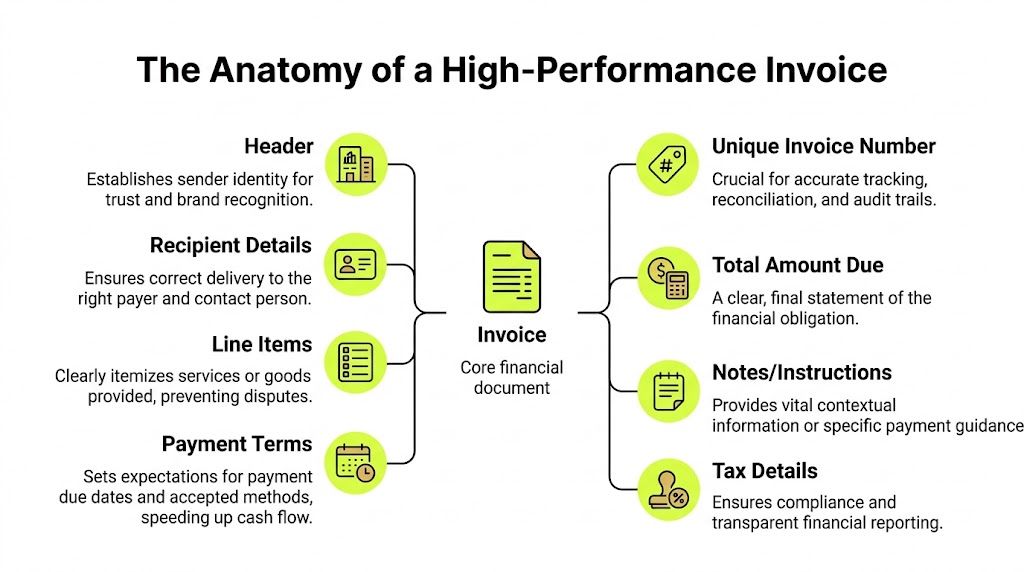
The underlying principle is data integrity. Invoices act as the authoritative source document for accounts receivable systems, cash application engines, and revenue recognition workflows under ASC 606, and incomplete or ambiguous invoices can delay payment processing by 5 to 7 business days on average in enterprise environments, according to Artsyl's explanation of standard invoice requirements.
Core fields that prevent operational failure
Some invoice elements look basic until they go missing.
- Unique invoice number. This is the primary key for tracking, dispute management, and cash application. If your numbering logic is inconsistent, reconciliation gets slower and credits get misapplied more easily.
- Invoice date and due date. These fields set the clock for collections activity. They also shape internal reporting on aging, expected receipts, and period close discipline.
- Buyer and seller identifiers. Legal entity names, addresses, and the correct billing contact reduce routing errors. “Sent to the client” means very little if it landed with the wrong AP mailbox.
- Line-item detail. In services, line-item detail is the origin of most preventable disputes. Vague labels like “consulting services” force the client to ask questions. Clear descriptions tied to milestones, hours, deliverables, or retainer periods answer those questions before they arise.
- Payment terms. If terms aren't explicit, each side fills in the gaps differently. That usually helps the payer, not the seller.
Enhancer fields that improve payment speed
These fields aren't decorative. They often decide whether an invoice moves straight through AP or stalls in exception handling.
Invoice element | Why it matters operationally |
|---|---|
PO number | Lets buyer systems match the invoice to an approved purchase |
Project code or matter ID | Helps the client route costs internally and reduces back-and-forth |
Named approver | Speeds internal review on the client side |
Remittance instructions | Removes payment friction and prevents avoidable outreach |
Support references | Timesheets, milestone acceptance, or statement-of-work language can preempt disputes |
In firms with cross-border activity or stricter procurement requirements, format matters as much as content. A useful practical reference is this guide to legal invoice format requirements, especially when finance needs a standard that works beyond “whatever QuickBooks printed.”
The best invoice is the one that gives the client's AP team nothing to interpret.
What works and what doesn't
What works is consistency. One invoice template. Clear billing rules by service line. Required fields enforced before release. Review logic based on account risk, not partner preference.
What doesn't work is heroic cleanup after invoices go out. If AR has to rewrite descriptions, search for missing POs, or ask project leads what was billed, the firm is paying twice for the same administrative failure.
Invoice Types and Their Strategic Application
Invoice type is a cash flow decision.
Professional services firms often default to one billing format across every engagement. That choice usually pushes avoidable risk into AR. The wrong invoice type delays approval, weakens collection timing, and forces the firm to finance delivery costs longer than necessary.
The better approach is to match invoice structure to how value is delivered and how the client approves spend. That decision affects DSO more than many teams realize.
Standard invoices
Standard invoices fit short engagements with defined scope and a clear handoff point. They work well for fixed-fee assessments, one-off advisory work, and small implementation projects where the client can confirm completion without much interpretation.
The trade-off is timing. If the work runs longer than expected or scope shifts during delivery, waiting to bill until the end concentrates all review risk into one event. I have seen small description issues turn into 45-day payment delays because there was no earlier billing checkpoint.
Recurring invoices
Recurring invoices support retainers, managed services, and ongoing monthly support. Their value is not just convenience. They create a billing cadence that finance can forecast against and clients can approve with less friction.
This structure is strongest when the service is stable, the monthly amount is predictable, and the contract defines what is in and out of scope. It breaks down when teams use a recurring invoice to hide variable project work inside a flat fee. That usually leads to disputes, write-downs, or margin erosion a quarter later.
Interim or progress invoices
Progress invoices are often the right choice for longer projects because they reduce working capital strain while the work is still being delivered. Instead of carrying payroll and subcontractor costs until final completion, the firm collects part of the cash along the way.
That only works if milestones are specific enough to bill cleanly. “Phase 2 complete” is weak billing language. “User acceptance testing completed and signed off” gives the client's approver something concrete to validate.
Teams that use estimates or pre-billing documents should also keep those separate from actual AR. This explanation of pro forma invoice meaning is useful when sales, delivery, and finance are not using the same definition.
Final invoices
A final invoice closes the engagement financially. It should tie back to prior billings, resolve any remaining holdbacks, and make the last payment decision easy for the client's AP team.
If the final invoice introduces surprises, collection slows down. If it confirms what the client already expects, cash usually comes in faster.
A practical framework:
- Use standard invoices for short, fixed-scope work with a clear completion event.
- Use recurring invoices for contractual services delivered on a predictable monthly cadence.
- Use progress invoices for projects with long timelines, meaningful delivery costs, or milestone approvals.
- Use final invoices to reconcile prior billing and close the account cleanly.
The strategic question is simple. Do you want billing to mirror operations, or do you want finance correcting operational ambiguity after the fact?
Firms that treat invoice type as a control point usually get better visibility into expected receipts and fewer end-of-project surprises. Teams reviewing new NetSuite capabilities for businesses can see why that matters. Better project and cash flow reporting only helps if the billing model reflects how revenue is earned and collected.
Mapping the Invoice Lifecycle to Cash Flow
A few days of billing delay can add weeks to cash conversion in a services firm. The invoice definition matters less here than what the invoice controls: when revenue turns into collectible receivables, when receivables turn into cash, and how much manual effort gets burned in between.
For finance leaders, the invoice sits at a control point in the cash flow cycle. Its structure, timing, and delivery method affect DSO, collections effort, and short-term working capital. If cash is arriving late, the useful question is not whether AR followed up enough. It is where the invoice lifecycle broke down.
Creation
Cash flow problems often start before the invoice is drafted.
Consultants have not submitted time. Project leads have not approved billable work. Change orders are sitting in email instead of the project record. Finance receives incomplete billing support, then spends days cleaning up issues that should have been resolved during delivery.
That delay has a cost. An invoice sent ten days late usually gets paid later, questioned more often, and forecast less reliably. In professional services, billing readiness needs to be part of project management, not a month-end rescue exercise.
Issuance
Sending an invoice is not the same as issuing one in a form the client can process.
A valid invoice can still stall if it goes to the wrong AP contact, misses a required PO number, lacks backup, or arrives by email when the client requires portal submission. Timing matters too. If the invoice misses the client's weekly or monthly payment run, terms on paper stop matching cash in the bank.
For firms running NetSuite or evaluating ERP visibility, these new NetSuite capabilities for businesses are worth reviewing because project dashboards and cash flow views can surface billing bottlenecks before they age into collection problems.
Client review and approval
This stage usually drives the longest delay.
The client is not debating payment in the abstract. They are checking whether the invoice matches the contract, whether the milestone was accepted, whether the hours were approved, and whether the charge can be coded internally. Those are delivery and billing control issues. AR inherits them after the invoice is already slowing down.
A disputed invoice is usually an unresolved project decision that reached the client too late.
Payment and cash application
Collection is not finished when the client sends money.
If the remittance is unclear, the invoice number is missing, or the payment covers several invoices without usable detail, AR has to match cash manually. That creates avoidable noise in aging, weakens forecast accuracy, and can make a current account look overdue during close.
I have seen firms focus heavily on collection calls while ignoring cash application discipline. That is backwards. If posted cash lags reality, finance loses visibility into who owes money and which clients paid poorly.
A lifecycle view finance can use
Stage | Common friction | Practical control |
|---|---|---|
Creation | Missing approvals, undocumented scope changes, weak support | Billing readiness checklist tied to project delivery and pre-bill review |
Issuance | Wrong contact, missing references, incorrect submission channel | Customer-specific billing rules stored in the ERP |
Client review | Scope questions, milestone disputes, coding issues | Clear line descriptions and documented acceptance before release |
Payment | Missed payment runs, limited payment options, unclear instructions | Defined payment methods and invoice timing aligned to client processes |
Cash application | Incomplete remittance, partial matches, unapplied cash | Standard invoice numbering and disciplined reconciliation routines |
Firms that map invoices this way stop treating DSO as a collections-only metric. They can see which handoff is slowing cash, assign ownership, and improve working capital with operational fixes instead of more chasing.
Preventing Common Invoice Disputes and Delays
Most invoice disputes are preventable. They usually don't come from a client deciding not to pay. They come from the firm making payment harder than it should be.
The control mindset is simple. Solve the dispute before it can be raised.
Unclear scope and vague descriptions
Problem: The invoice says “advisory services” or “monthly consulting” with no link to the actual engagement. The client's project lead understands it. Their AP team doesn't.
Prevention: Tie each line to a concrete unit of value. That might be a milestone, a retainer period, a workstream, approved hours, or a deliverable name already used in the statement of work. If the engagement changed, update both the project record and the billing basis before the invoice is generated.
Unapproved time or surprise charges
Problem: The invoice includes hours, expenses, or out-of-scope work the client never saw coming. AR gets dragged into a commercial discussion it can't resolve.
Prevention:
- Lock a pre-bill review step for matters with variable time billing.
- Require project lead signoff before release, especially on exceptions.
- Flag scope drift early so account leadership addresses it during delivery, not after invoicing.
Wrong billing contact or missing buyer requirements
Problem: The invoice is accurate but stalled because it went to the wrong person or lacks the buyer's required reference fields.
Prevention: Maintain a client billing profile with AP email, portal rules, PO requirements, tax treatment, and escalation contacts. This should live in the system of record, not in someone's inbox or memory.
Controller's check: If only one team member knows how a client wants to be billed, the process isn't controlled yet.
Cross-border compliance gaps
Problem: The invoice is valid enough to request payment but fails a tax or submission requirement in the client's jurisdiction.
Prevention: Treat invoice compliance as separate from invoice creation. In many major markets, invoices are tied to e-invoicing mandates and VAT or GST reporting, and an invoice can be legally valid for requesting payment yet still fail compliance rules if it lacks required fields or isn't transmitted through the mandated network, as explained in Billtrust's overview of invoice compliance and e-invoicing mandates.
For firms with international clients, that matters. A collections team can't fix a document that the tax or clearance framework rejects. Finance needs jurisdiction-specific billing rules before the invoice is sent.
How AR Automation Reduces DSO and Manual Work
Invoice discipline has existed for a very long time. The practice of invoicing goes back 5,000 years to ancient Mesopotamia, and the first documented handwritten invoice in modern history dates to 1504, when Hieronymus Bosch billed King Philip the Handsome of Castile for The Last Judgment, according to Nymus's history of invoice evolution. The medium has changed. The control problem hasn't.

A lot of firms hear “accounts receivable automation” and think of reminder emails. That's too narrow. Real AR automation coordinates invoice delivery, follow-up timing, exception handling, payment collection, and cash application as one operating system.
What automation actually fixes
Manual AR breaks down in familiar ways. Collectors work from aging reports that are already outdated. Partners intervene inconsistently. Clients receive the same message regardless of invoice type, dispute status, or payment behavior. Finance spends time chasing status instead of controlling outcomes.
Effective AR software for professional services changes the sequence:
- It issues invoices consistently through the right channel with the right data attached.
- It triggers follow-up based on behavior, not just due dates.
- It separates disputes from delinquency, so collectors don't pressure clients who are waiting on corrections.
- It supports easier payment, which matters more than most firms admit.
- It accelerates reconciliation, reducing the backlog after cash arrives.
If your billing data still lives in spreadsheets stitched together around the accounting system, this guide to optimizing Excel for business data is a useful reminder of where spreadsheet workflows help and where they become fragile.
Why AI AR automation matters
The value of AI AR automation isn't that it replaces judgment. It applies judgment more consistently than a busy team can do manually.
A good system can prioritize accounts by risk, sequence outreach across channels, adapt tone to the customer context, and identify where a billing issue needs human review instead of another collection touch. That's very different from blasting reminders every few days.
For firms using QuickBooks, the payoff is often operational rather than dramatic. QuickBooks AR automation helps reduce the gap between posted invoice and active follow-up. It also gives smaller finance teams a way to enforce process without adding headcount.
This walkthrough adds useful context on how accounts receivables automation works when finance wants less manual chasing and tighter control over the order-to-cash flow.
A short product demo can make the workflow difference easier to visualize.
What works in practice
The firms that reduce DSO usually do three things together, not separately.
First, they standardize invoice quality. Second, they automate routine follow-up so collectors can focus on exceptions. Third, they make payment easy once the client is ready.
One option in that category is Resolut, which combines dynamic billing, collections workflows, omnichannel outreach, and cash application in one AR operating layer. That matters when the goal isn't just sending invoices faster, but managing the full path from issue to collected cash with fewer manual handoffs.
Automation works best when it enforces a billing policy the firm has already defined. It won't rescue a process nobody owns.
The Invoice as a Tool for Financial Control
The basic definition of invoice is useful, but it's not enough for a finance operator. The practical definition is stronger. An invoice is the document that connects delivery, client approval, collections, compliance, and cash.
If that document is structured well, issued on time, and supported by a disciplined process, it improves cash flow and reduces avoidable work. If it's weak, finance sees the consequences everywhere else. Aging stretches, reconciliations slow down, project leaders argue with AR, and month-end reporting loses credibility.
For firms that want more control, the invoice should be managed as a policy-driven asset, not an accounting afterthought. That means standard fields, clear ownership, customer-specific billing rules, and systems that can carry the process without relying on memory.
A practical summary looks like this:
Final Words | Meaning for finance leaders |
|---|---|
Document quality matters | Clean invoices reduce dispute volume and manual intervention |
Timing matters | Late billing delays cash even when revenue is already recognized |
Structure matters | Strong identifiers, terms, and line detail support automation |
Process matters | Collections performance starts upstream in delivery and billing |
Control matters | Better invoicing supports tighter forecasting and stronger working capital management |
One area firms often overlook is outbound communication discipline once the invoice leaves the system. If you're reviewing how automated collections messages are sent with supporting files, this guide to simplifying agent-led email communication is a useful operational reference.
The bottom line is simple. Mastering invoicing means mastering one of the most controllable levers in the cash cycle.
Resolut automates AR for professional services, helping finance teams keep invoicing, follow-up, and cash application consistent, accurate, and human. If your goal is to reduce manual work and improve cash flow without creating a harsher client experience, Resolut is worth a look.