
Embedded Finance Solutions: 2026 Guide for Firms
Embedded finance solutions transform accounts receivable for professional services firms. Reduce DSO and automate collections in 2026.
Your client likes the work, the invoice goes out on time, and then payment drifts. Someone on your team sends a reminder, then another, then a careful follow-up that tries not to sound annoyed. The relationship stays intact, but cash sits in limbo, and for a firm in the $3M to $50M range, that delay can shape hiring, tax planning, and how much risk you can comfortably take on new work.
That's where embedded finance solutions stop being a buzzword and start becoming an operating decision. The point isn't to turn a consulting firm, law practice, or agency into a bank. The point is to put payment, credit, and reconciliation functions inside the workflow you already use, so clients can act the moment an invoice, retainer, or approval appears.
The market has clearly moved past experimentation. Global Market Insights estimates the embedded finance market at USD 149.1 billion in 2025, rising to USD 180.5 billion in 2026 and reaching USD 1.3 trillion by 2035 at a 24.2% CAGR (Global Market Insights). For finance leaders, that matters less as a headline and more as a signal that non-financial software is becoming a distribution layer for financial services.
The AR Friction That Embedded Finance Solves
A finance director at a ten-person consulting firm knows the pattern. The team sends the final invoice, the client approves the work, then payment slows because the next step lives in a different tab, a different portal, or a paper trail nobody wants to chase. The issue is rarely willingness to pay. It's friction at the exact moment the client should be able to act.
That's the operational gap embedded finance closes. It brings financial actions into the existing billing or collections flow, so the client can pay, split, store a method, or request terms without being sent away to another banking journey. In practice, that means fewer abandoned payment paths and fewer manual follow-ups from your AR team.
Practical rule: If the payment step takes your client out of the invoice, you've added avoidable friction.
For professional services firms, the impact shows up in day-to-day control. When an agency sends retainers, milestone invoices, or interim bills, the collections process has to be fast without becoming aggressive. Embedded payment options let the firm preserve tone while removing needless delay. That's especially useful when a partner or controller is trying to keep cash flow predictable without training the team to become full-time collectors.
The working logic is simple. If the client can pay inside the same workflow where they review the invoice, approve the scope, or manage their engagement, you've reduced the number of excuses and the amount of admin. The internal result is less time spent on manual reminders, cleaner cash application, and better visibility into what's likely to clear and what needs escalation.
For firms that still rely on QuickBooks or similar accounting workflows, this shift can feel incremental at first and then very material. A more useful view is to treat it as part of accounts receivable automation, not a separate payment feature. If you want a useful baseline on how that measurement works, the definition of days sales outstanding is a good place to anchor the discussion, and this explanation of DSO is worth keeping handy when you're modeling change.
For CFOs, the core question isn't whether embedded finance is modern. It's whether it shortens the path from invoice issued to cash in bank without damaging client experience. In a services business, that's the difference between liquidity that supports growth and liquidity that arrives too late to matter.
Core Components of Embedded Finance for AR
Embedded finance in AR is easiest to judge when you break it into working parts instead of abstract product labels. The five components that matter most are payments, lending, wallets, insurance, and risk or KYC controls. Each one removes a different bottleneck in billing, collections, or cash management, and each one creates its own operational trade-off.
Payments and wallets inside the invoice flow
Payments are the part clients notice first. They let clients pay by card, ACH, or a stored method directly in the invoice or client portal, which removes the usual redirects and follow-up friction. A wallet layer adds convenience by storing client preferences, payment credentials, or approved funding methods inside the same experience, so repeat payers do not have to start over every time.
That matters when a professional services firm bills the same client monthly, stages invoices across a project, or manages several entities under one parent account. A wallet reduces repetition, while embedded payments keep the financial action next to the work product. That is why QuickBooks AR automation and portal-based payment acceptance often overlap, because the accounting system remains the record while the payment experience becomes client-facing. A clear payment-gateway setup also matters, and payment gateways for business is a practical reference for how the client side connects to the back office.
Lending and credit control
Lending changes the conversation when a client needs time but the firm needs cash now. Invoice financing or pay-later options can bridge the gap between approved work and collected cash, but only if underwriting and trigger logic are tied to the invoicing process. Used well, this is less about giving clients more debt and more about avoiding unnecessary disputes that delay approval.
Clients often accept speed when the terms are clear, but they push back when credit feels disconnected from the actual invoice.
Insurance and risk controls
Insurance is the least discussed component, yet it matters in credit-heavy or high-value retainers. Credit risk protection can reduce the firm's exposure when a client's payment behavior changes unexpectedly. Risk and KYC controls sit underneath all of this, checking identity, eligibility, and transaction risk before money moves or terms are extended.
The value is governance as much as convenience. Strong designs do not bolt risk checks onto the end of the process. They use them to shape the invoice, the payment option, or the approval path before a collections issue begins.
One architecture, many jobs
A strong embedded finance setup should separate the core ledger from provider integrations, orchestration, and reconciliation, because transaction flow matters as much as feature choice (Formance architecture primer). In other words, the financial UI is not the system of record. The ledger is.
For a plain-English look at the payment layer, payment gateways for business helps frame how the client-side experience connects to the back office.
Real B2B Use Cases That Reduce DSO
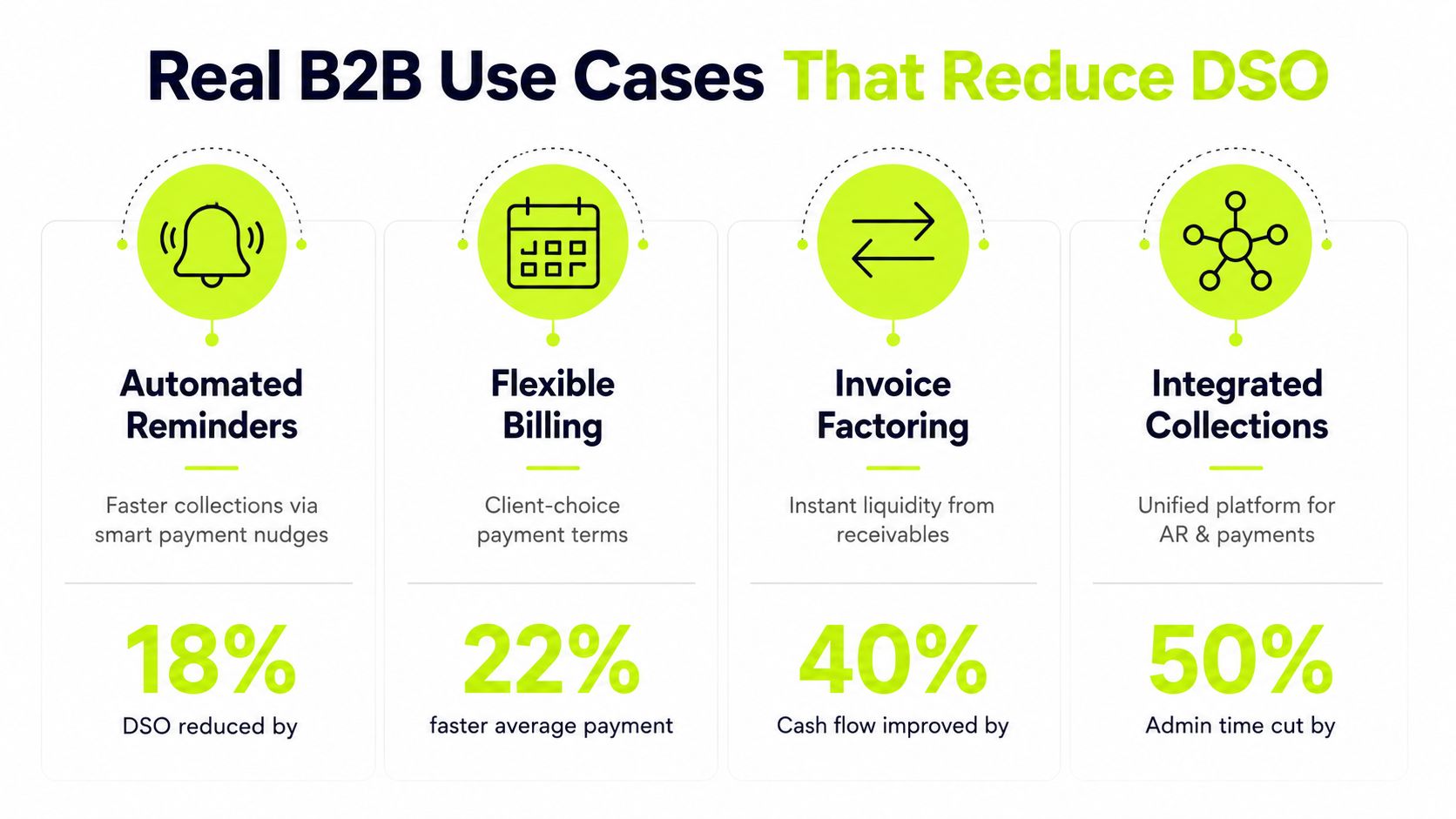
The most practical embedded finance use cases are the ones that help clients pay inside the workflow they already use. In professional services, that usually means invoice reminders that point straight to payment, billing options that fit how the client operates, and portal-based payment flows that remove avoidable steps.
Automated reminders with pay-now buttons
A law firm can send a reminder that reads like a normal invoice update, not a collection notice. The email includes a pay-now button, and the client lands on a payment screen that already has the invoice number and amount due. That removes the common delay of, “I'll take care of it when I get back to my desk.”
Timing matters more than volume. Reminders should follow invoice age and client behavior, not a rigid cadence that hits every account the same way. If the process feels robotic, trust erodes fast, so the work is sequencing reminders more intelligently instead of sending more of them.
Flexible billing and client-choice timing
Consultancies and agencies usually do better when clients can choose how and when to pay within approved terms. That may include card, ACH, or a scheduled bank transfer inside the portal. The billing rules stay firm, but the client experience is easier to complete.
Embedded finance also helps reduce disputes before they start. If the client can review deliverables, approve the bill, and pay in the same place, the payment step feels like part of the engagement instead of a separate vendor interaction. For firms with repeat clients, that often means fewer email threads and cleaner approval cycles.
Pay-later and contextual approval
Some invoices stall because the client's approver wants time to match the charge to a project, budget code, or purchase order before releasing payment. Pay-later options can give that person room to review without stopping the billing process. Used carefully, this can speed up approval while still protecting cash flow.
The trade-off is straightforward. If deferred payment is offered without a clear risk model, the firm can reduce DSO but increase exposure. That is why contextual credit decisions matter more than blanket terms. For firms evaluating whether receivables should sit in a funding structure or stay tied to direct collection, receivables financing basics is a useful reference point.
Operational takeaway: Use embedded finance to remove approval friction, not to weaken collection discipline.
In-portal payments that eliminate redirects
This is the cleanest fit for professional services. A client opens the invoice, pays in the portal, and the transaction posts without leaving the screen. No extra login. No separate bank site. No mail-in check.
The operational benefit is not just convenience. Fewer redirects mean fewer abandoned payments, fewer reconciliation gaps, and fewer support questions about whether the payment went through. For a finance team that already spends too much time chasing status updates, that matters.
Implementation Steps and Integration Patterns
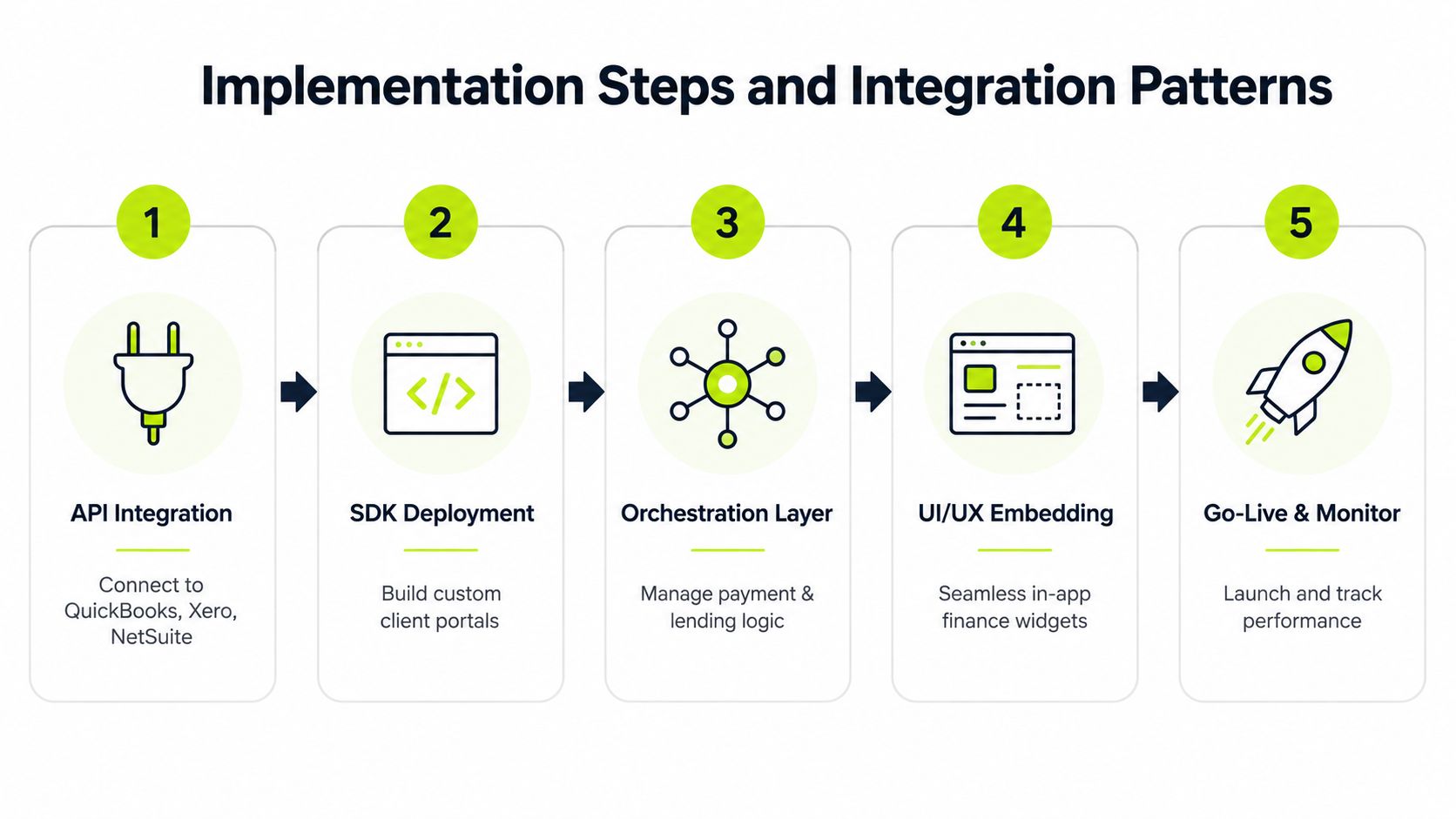
The cleanest implementations start with the accounting system, not the front end. If the firm runs on QuickBooks, Xero, or NetSuite, the first step is to connect invoice, payment, and status data through APIs so the billing record remains the source of truth. That prevents one of the most common failure modes, where the portal says paid but the ledger still shows open.
Build the orchestration layer first
An orchestration layer sits between the client experience and the financial providers. It decides what happens when a payment is initiated, a transaction fails, a refund is requested, or a matching issue appears in reconciliation. Without that layer, teams end up wiring each provider directly to the ledger, which creates brittle processes and hard-to-debug exceptions.
A modular API approach is usually better for mid-sized firms than trying to rebuild the entire stack. Full-stack platforms can be attractive when a firm wants one vendor to own more of the workflow, but they also concentrate dependency. Modular providers offer flexibility, though they ask more of the implementation team and create more responsibility for reconciliation.
Treat security and auditability as design requirements
Client payment data, approval records, and invoice changes all need a traceable path. That means access control, logging, and clear ownership of who can change terms or release funds. Finance teams should insist on audit trails that show when the invoice changed, who approved the payment method, and how the money posted to the ledger.
This is also where implementation teams need realistic resourcing. A basic deployment often takes 8 to 12 weeks when the scope is limited and internal stakeholders are responsive. If the firm wants custom portals, multiple payment rails, or complex approval rules, the timeline stretches because testing and reconciliation take longer than the sales demo suggests.
Keep the rollout narrow at first
The best first release is usually one client segment, one invoice type, and one payment flow. That gives the team a clean view of failed transactions, support tickets, and reconciliation gaps. It also helps surface whether the workflow reduces friction or just adds a more polished layer on top of the same bottlenecks.
The most common mistake is treating go-live as the finish line. In reality, it's the point where AR, finance ops, and IT start watching the process every day and tightening the logic until it behaves predictably.
For a deeper look at how liquidity tools fit alongside collections, receivables financing structures can help teams compare operational versus funding-based models before they commit.
Vendor Selection Criteria for Finance Leaders
Finance leaders should judge embedded finance vendors on control, not pitch quality. The right vendor protects the ledger, supports the compliance burden, and doesn't create a black box when something goes wrong. The wrong one makes the first implementation look easy and the second month of operations feel fragile.
What to ask before you sign
Start with the regulatory question. Who holds the money, who assumes risk, and who is responsible when a payment fails or a client disputes a charge? If the vendor can't answer that clearly, the contract probably shifts more liability back to your firm than you want.
Next, test the operational side. Ask about uptime expectations, reconciliation speed, failed payment handling, data ownership, and exit rights. A vendor that can't show how invoices, payments, and exceptions remain auditable will create more work than it removes.
The best demo is a messy one. Ask the vendor to show a failed transaction, a refund, and the reconciliation trail.
Compare the archetypes side by side
Vendor Archetype | Best For | Implementation Time | Typical Cost | Risk Level |
|---|---|---|---|---|
Full-stack platform | Firms that want one provider to cover most of the workflow | Faster initial launch | Usually higher total platform cost | Medium if governance is strong |
API aggregator | Firms that need flexibility across providers and payment rails | Moderate | Variable, often usage-based | Medium to high if reconciliation is weak |
Specialized AR automation tool with embedded finance features | Firms focused on collections, reminders, and cash application | Usually the fastest for AR-led rollout | Often easier to justify at mid-market scale | Lower if the platform keeps ledger controls clear |
Red flags that deserve attention
- Unclear liability terms: If the contract blurs who owns compliance or chargeback risk, you'll inherit the operational mess later.
- Weak data portability: If you can't export transaction and invoice history cleanly, switching costs will be artificial.
- No meaningful support path: AR teams need answers when payments fail, not a ticket queue that closes after go-live.
- Overbuilt promises: If the vendor sells every financial feature at once, ask which ones are live in production for firms like yours.
For many CFOs, the right question isn't “Which platform has the most features?” It's “Which one fits our billing reality without creating a new control problem?”
Measuring ROI and Planning Your Rollout
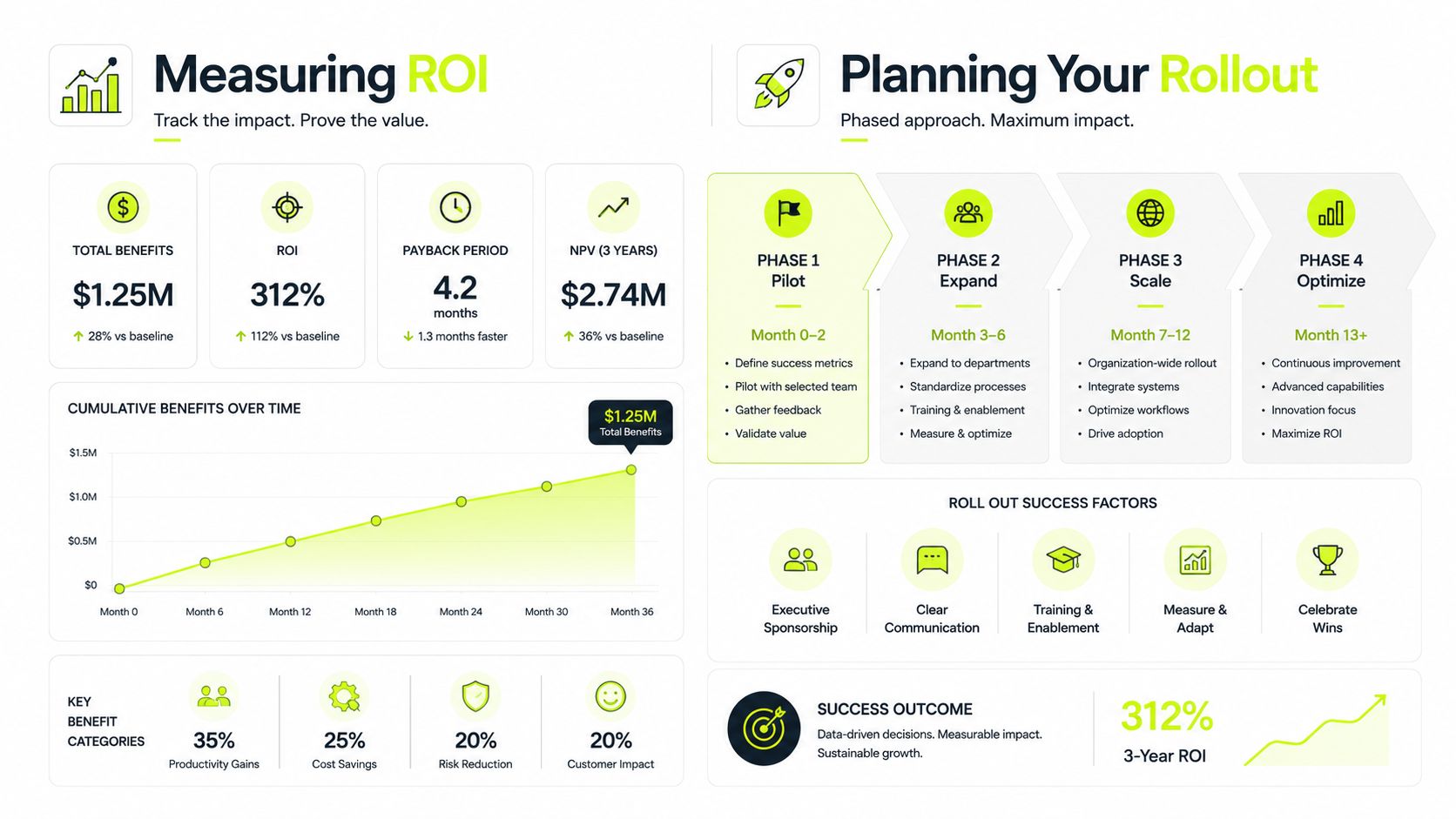
The ROI case for embedded finance should be built around cash and labor, not branding. That means tracking DSO reduction, recovery rate uplift, collection cost per invoice, and client satisfaction feedback from the first month of rollout. The goal is to make the operational win visible quickly enough that the team trusts the change.
The cleanest financial model starts with receivables already on the books. If a firm has $2 million in annual receivables and reduces DSO by 25 days, the working-capital effect is roughly $137K. That number is helpful because it translates billing improvement into liquidity the CFO can use.
Rollout in three phases
Phase 1, months 1 to 2. Pilot embedded payments with a small client group, usually 10 to 20 clients, and watch how they behave without altering every invoice path. This phase should confirm that invoices post correctly and that support can resolve issues quickly.
Phase 2, months 3 to 4. Expand to the broader client base and add automated reminders. This is usually where the finance team starts seeing whether the workflow improves collections or just changes where the follow-up happens.
Phase 3, months 5 to 6. Add lending, advanced routing, or more advanced approval logic. This should come only after the base payment flow is stable and reconciliation is clean.
For a useful method on evaluating the impact of pricing and mix changes inside a broader finance model, interpret price volume mix results is a practical reference when you're separating operational gains from commercial noise.
Make adoption a people problem, not just a system problem
The rollout succeeds when the AR team knows what changes, why it changes, and how to handle exceptions. Clients also need simple language, not a product tour. If the communication sounds like a software launch, it usually creates more questions than it answers.
The best results come when finance leads treat the rollout like a controlled operating change. That means a clear owner, daily review in the early weeks, and a willingness to refine the client experience after the first batch of invoices moves through.
Connecting Embedded Finance to AR Automation Strategy
Embedded finance works best when it sits inside a broader AR automation strategy, not as a standalone feature. Payments solve the final step, but cash flow still depends on how you assess risk, route outreach, reconcile cash, and escalate problem accounts. That's why the strongest setups connect embedded payment options with credit review, targeted collections, and automated posting.
The practical value shows up when these layers work together. AI-driven outreach can adjust tone and timing, while reconciliation software matches payments to invoices without waiting for manual review. If a balance goes stale, intelligent escalation can hand the account off to a more formal process without forcing the finance team to babysit every reminder.
That integrated approach is what makes the operating model durable. The finance team keeps control, clients keep a cleaner payment experience, and the firm gets fewer disconnected tools to manage. It's a better answer for professional services firms than stacking separate point solutions and hoping the handoffs stay clean.
Resolut fits that model by unifying credit risk assessment, collections, omnichannel outreach, dynamic billing, and cash application into one system. That combination matters because the firm can automate more of the AR cycle without giving up human oversight where it still counts.
Resolut automates AR for professional services, consistent, accurate, and human. If you're trying to reduce DSO without making collections feel transactional, explore how Resolut can fit into your billing and cash application workflow.