
How to Calculate Days Sales Outstanding in 2026
Learn how to calculate days sales outstanding step by step, with the formula, worked examples, and tips to speed up collections and improve cash flow in 2026.
The close is done, revenue looks healthy, and yet cash arrives in uneven lumps. A client pays a large invoice late, another pauses payment over a small billing question, and the aging report shows a balance that seems manageable until payroll and partner draws are due. In a professional services firm, accounts receivable can look profitable on paper while making cash flow difficult to predict.
That's why finance teams need more than an aging snapshot. They need a repeatable way to measure how long credit sales remain tied up in receivables, then connect the result to an operational action. This guide explains how to calculate days sales outstanding, how to validate the number, and how to use client, invoice-age, and contractual-term segments to reduce DSO without damaging relationships.
Why DSO Matters More Than Your Aging Report
At a $30M professional services firm, a 72-day DSO can hide in plain sight. The firm may have strong demand, satisfied clients, and a full delivery calendar. But if invoices sit in approval queues, disputes remain unresolved, or follow-up depends on whoever has time that afternoon, cash reaches the bank later than the income statement suggests.
The aging report is still essential. It tells you which balances are current, overdue, or seriously aged at a specific reporting date. It doesn't tell you how quickly the business converts credit sales into cash over the measurement period. A firm can have a clean-looking current bucket at month-end and still experience slow collections across the quarter.

Days sales outstanding, or DSO, measures the average number of days a business waits to collect payment for credit sales. The foundational calculation is documented in J.P. Morgan's explanation of DSO and DPO. It's a liquidity and collections indicator, not just an invoice-aging measure.
That distinction matters during monthly close. A rising DSO can point to slower customer payment, weaker credit control, billing disputes, or deteriorating collections performance. It doesn't identify the cause on its own, but it gives the CFO, Controller, or owner a concise number that connects invoicing discipline to cash on hand.
What the number tells leadership
DSO works best as a trend and a diagnostic trigger. If it rises while credit sales remain stable, review invoice delivery, approval delays, disputes, and customer payment behavior. If it falls because a large client paid an old balance, check whether the improvement is broad or just a timing event.
A useful monthly conversation is simple:
- What changed: Compare the current result with the prior calculation using consistent definitions.
- Where did it change: Segment receivables by client, invoice age, region, currency, and risk class.
- What will we do: Assign an owner to the largest controllable cause, such as missing purchase orders or delayed invoice submission.
Practical rule: Use DSO to decide where to investigate. Use the aging report and invoice-level records to decide what to do next.
The metric earns its place in the close package because it translates a balance sheet problem into operating language. Partners may not want a long collections report, but they can understand that the firm is waiting longer to turn delivered work into cash. That shared understanding makes it easier to authorize tighter billing controls, clearer escalation paths, and focused AR software for professional services.
The Core DSO Formula and What Each Variable Really Means
The standard formula is:
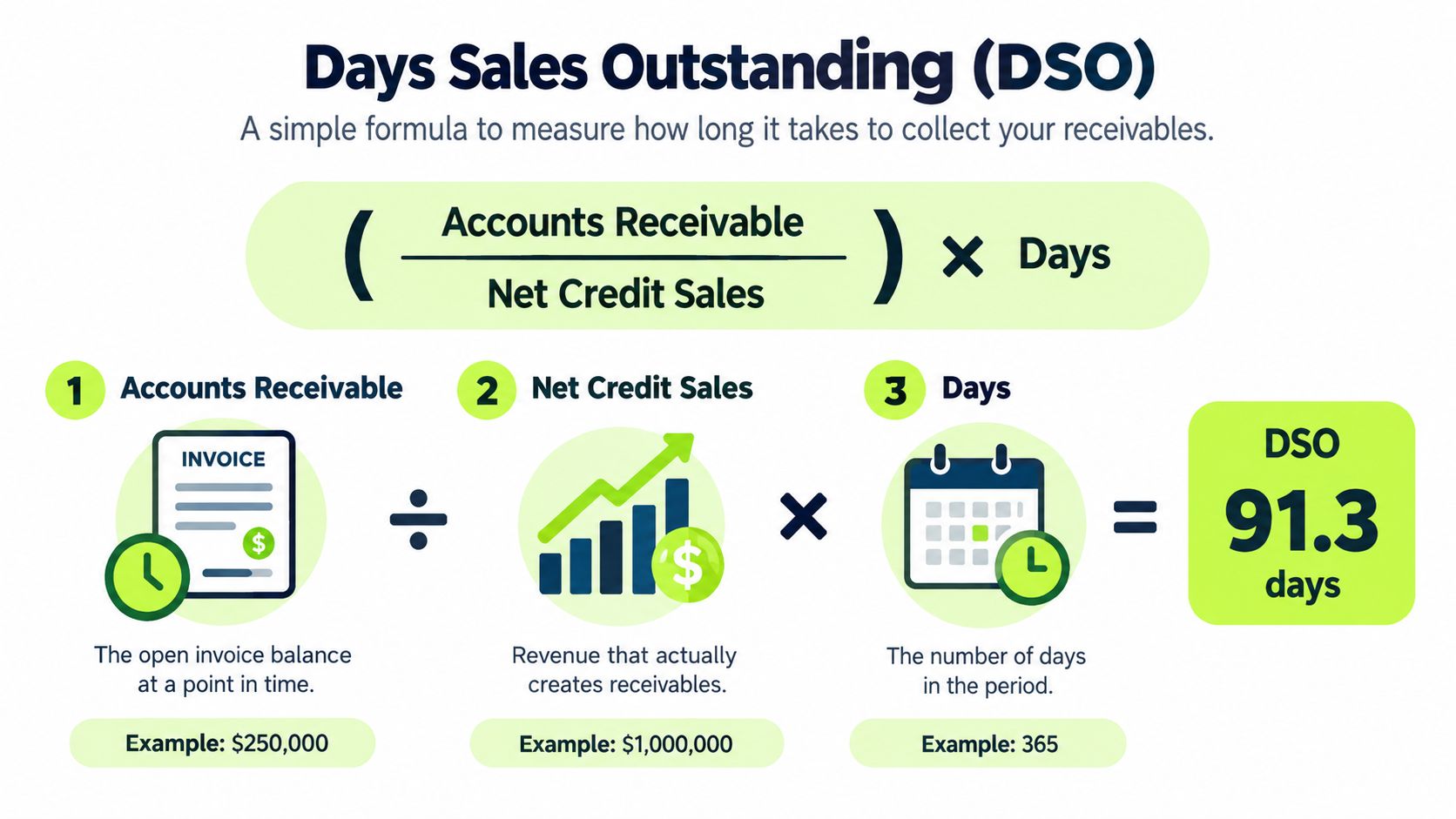
DSO = (Accounts Receivable ÷ Net Credit Sales) × Number of Days in the Measurement Period
The same relationship can be written as:
DSO = (Accounts Receivable × Days in Period) ÷ Net Credit Sales
The important issue isn't memorizing the notation. It's making sure every input describes the same business, currency, cutoff, and period.
Start with the three inputs
Accounts receivable is the open invoice balance at a point in time. For operational analysis, average AR is usually more representative than a single ending balance:
Average AR = (Beginning AR + Ending AR) ÷ 2
Net credit sales are sales that create receivables. Cash sales should be excluded because they don't create an outstanding customer balance. Including them in the denominator would artificially lower DSO.
The day count must match the sales period. Annual calculations generally use 365 days, quarterly calculations generally use 90 days, and monthly calculations use approximately 30 days, as outlined in Intuit's DSO calculation guide.
Work one example from start to finish
Suppose a company has $2.4 million in accounts receivable and $18 million in annual net credit sales. The annual calculation is:
($2.4 million ÷ $18 million) × 365 = 48.7 days
The result means the company holds receivables equivalent to about 48.7 days of sales. It doesn't mean every invoice takes exactly 48.7 days to pay. Some clients pay before the contractual due date, while others may remain open considerably longer.
For a quarterly calculation, use the same structure with quarterly credit sales and 90 days. For a monthly calculation, use monthly credit sales and approximately 30 days. The formula changes only because the measurement window changes.
A calculation is only as reliable as its alignment. Year-end receivables paired with full-year credit sales can be useful, while a month-end receivables balance paired with annual sales will produce a distorted result. The same applies when a consolidated AR balance is divided by sales from only one subsidiary or service line.
Five Mechanical Steps to Calculate DSO From QuickBooks
A controller should be able to hand this process to an AR clerk and get the same result each close. The workflow below uses average AR, because ending AR alone can make the metric overly sensitive to month-end billing.
1. Define one consistent measurement period
Choose a month, quarter, or year before pulling data. For recurring operational monitoring, rolling monthly or quarterly calculations are useful, but the numerator and denominator must use the same entity, currency, cutoff date, and revenue definition.
In QuickBooks, record the exact report dates and accounting basis used. If the firm closes on an accrual basis, don't switch the sales report to a cash basis for the denominator.
2. Pull beginning and ending AR
Run the balance sheet for the first and last dates of the period, then capture accounts receivable for the same entity and currency. Calculate:
Average AR = (Beginning AR + Ending AR) ÷ 2
Ending AR alone is tempting because it's easy to find. It's also a weak choice when the firm sends a large batch of invoices near month-end. Average AR smooths that timing effect and gives the numerator a closer relationship to sales earned during the period.
3. Isolate net credit sales
Use the QuickBooks income statement, sales journal, or general ledger detail to identify credit sales for the identical period. Remove cash sales from the denominator, and apply returns, allowances, or credits consistently according to the firm's revenue definition.
Many otherwise careful calculations fail at this point. Substituting total revenue for credit sales biases DSO when cash sales are material, because those transactions don't generate receivables. If QuickBooks doesn't clearly distinguish transaction types, document the limitation rather than presenting an approximation as precise.
For firms comparing accounting systems, the Xero versus QuickBooks comparison can help clarify where reporting fields and workflows differ.
4. Multiply average AR by the period length
Take the average AR balance and multiply it by the number of calendar days in the measurement period. Use 365 for an annual calculation, 90 for a quarterly calculation, or approximately 30 for a monthly calculation. The day count belongs to the sales window, not to the invoice due date.
5. Divide by credit sales and preserve the audit trail
Divide the result from step four by net credit sales:
DSO = (Average AR × Days in Period) ÷ Credit Sales
For example, average AR of $2.0 million, quarterly credit sales of $9.0 million, and a 90-day period produce:
($2.0 million × 90) ÷ $9.0 million = 20 days
Save the source reports, filters, period dates, and calculation in the close folder. A DSO number without a clear data trail isn't useful when the CFO asks why it changed next month.
Why a Single DSO Number Can Lie to You
Aggregate DSO is an average collection indicator, not a standalone measure of delinquency or collection effectiveness. The National Association of Credit Management's guidance on DSO highlights the impact of contractual payment terms, seasonality, sales volatility, customer mix, and promotional activity.
A firm with mostly net-60 contracts shouldn't judge performance against a net-30 firm. A consulting practice that bills heavily at quarter-end may also produce a volatile snapshot that says more about billing timing than customer behavior.
Use more than one calculation
Start with the conventional DSO, then add a terms-adjusted view. Compare actual DSO with the weighted-average contractual term for the receivables population. This separates a structurally longer collection cycle from customers paying later than agreed.
Then segment the balance. A professional services firm should usually examine:
- Client: Identify accounts that account for a disproportionate share of slow collections.
- Invoice age: Separate current work from balances that are materially overdue.
- Region and currency: Find process or payment-friction patterns by market.
- Risk class: Focus attention where collectability is less certain.
- Contractual terms: Distinguish net-30, net-60, milestone, and other arrangements.
The most useful control is invoice-level validation. For each open invoice, measure days from invoice date to the reporting date. For paid invoices, measure invoice-to-payment days. Compare that distribution with aggregate DSO.
Aggregate DSO can look acceptable while a smaller group of old invoices creates the real cash risk.
Choose the calculation for the question
Metric | Calculation | Best used for | Watch out for |
|---|---|---|---|
Conventional DSO | Average AR × period days ÷ credit sales | Consistent monthly, quarterly, or annual trend reporting | It's an average and can hide overdue concentrations |
Terms-adjusted DSO | Actual DSO compared with weighted-average contractual term | Testing whether collections are performing against agreed terms | Contract data must be current and tied to the right invoices |
Invoice-level days | Open invoice date to report date, or invoice date to payment date | Validating whether invoices are current, overdue, or paid slowly | Requires clean invoice and payment dates |
Segmented DSO | DSO grouped by client, age, region, currency, or risk | Assigning an operational owner and action | Small populations can create volatile results |
Reconcile credit sales to the general ledger and AR subledger. Exclude disputed or unapplied balances consistently, and use a rolling three-month view where seasonal billing makes individual snapshots difficult to interpret.
DSO Benchmarks by Industry and Where Professional Services Sit
Benchmarks help a finance leader ask better questions, but they shouldn't replace internal trend analysis. A firm's payment terms, billing model, customer concentration, and project structure can move DSO materially even when collections are healthy.
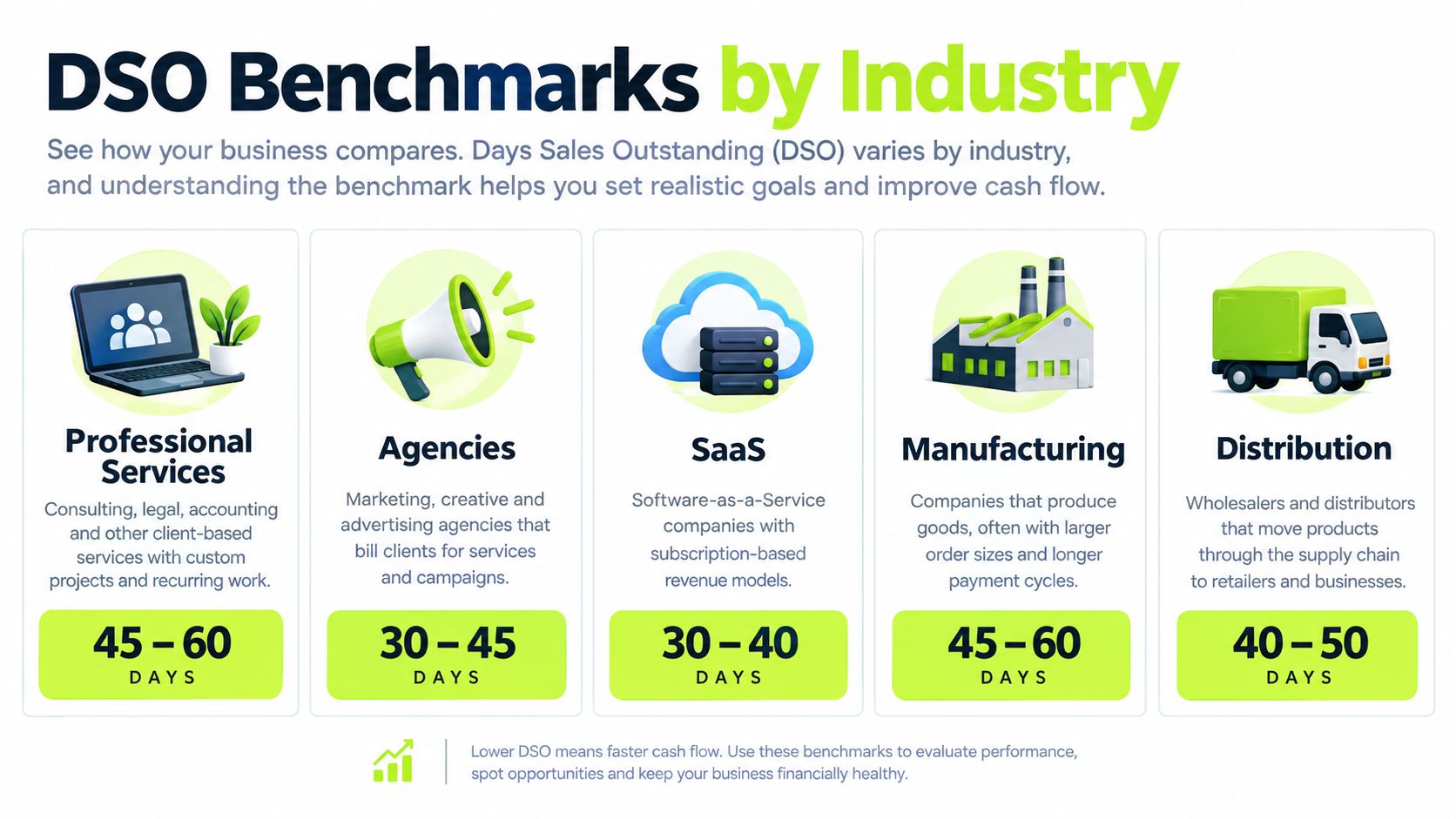
The benchmark ranges shown below are useful context for comparing business models:
- Professional services: 45 to 60 days
- Agencies: 30 to 45 days
- SaaS: 30 to 40 days
- Manufacturing: 45 to 60 days
- Distribution: 40 to 50 days
These ranges appear in the DSO benchmark comparison for different industries. Treat them as orientation, not a pass-fail test.
Why professional services varies
Legal, accounting, consulting, and creative firms often bill through a mix of time and materials, retainers, milestones, reimbursable expenses, and fixed-fee deliverables. A client may have net-30 terms, yet the invoice might spend time waiting for matter approval, procurement review, or a project manager's signoff before the payment process begins.
That's why net-30 contracts don't automatically produce a 30-day DSO. The relevant comparison is actual collection performance against the weighted contractual terms for the invoices included in the calculation.
Use the benchmark as a starting question
For a $3M to $50M professional services firm, a DSO in the professional services range may be reasonable if the segmented aging profile is controlled and the result is stable relative to contractual terms. A result outside that range isn't automatically unhealthy, but it deserves explanation.
A 95-day result shouldn't be accepted only because a firm has historically operated that way. Conversely, a 50-day result shouldn't trigger aggressive collection tactics if the client mix and contract terms support it and invoice-level payment behavior is current.
The practical target is a healthy operating band defined by your own terms, client portfolio, and cash requirements. Track the headline number, then explain its movement with the segments behind it.
What Actually Moves DSO in a Professional Services Firm
The fastest improvements usually come from removing delay before and after the invoice is issued. Collections outreach can't recover time lost because a consultant submitted hours late, a milestone wasn't approved, or the invoice went to the wrong accounts payable address.
Put the invoice clock under control
Send invoices as soon as the contractual milestone is complete, ideally within 24 hours of the milestone when the workflow allows. Require project leads to confirm billable work, reimbursables, purchase-order details, and supporting documentation before the billing run.
Next, make payment easy. Offer cards, ACH, and bank transfer where appropriate, and place the payment path directly on the invoice and client portal. Every unnecessary handoff gives a client another reason to postpone action.
Make follow-up predictable
A useful cadence includes a day-before reminder and a day-after reminder, followed by an escalation path for unresolved balances. The message should identify the invoice, amount, due date, payment options, and the person who can resolve a dispute.
Disputes need an owner and a deadline. Finance can't mark an invoice as “in discussion” and remove it from attention. Track the reason, responsible internal team, client contact, and next action until the balance is paid or formally adjusted.

A mid-sized agency, for example, could move from 68 days to 44 days over two quarters by combining faster milestone billing, clear payment options, scheduled reminders, and executive escalation for disputed invoices. The point isn't the sequence alone. It's assigning each step to a person and measuring whether the client receives an accurate invoice early enough to act.
Controller's test: If the same invoice delay appears in two consecutive closes, it's a process defect, not an isolated exception.
Prioritize changes in this order:
- Invoice timing: Recover days lost between delivery and invoice submission.
- Dispute resolution: Remove blockers that keep valid invoices from entering the payment queue.
- Payment access: Reduce friction with familiar electronic options.
- Follow-up ownership: Replace ad hoc reminders with scheduled, documented outreach.
- Escalation: Give account leaders a defined role when a client remains unresponsive.
That combination supports efforts to reduce DSO and improve cash flow without turning every client conversation into a collections confrontation.
Where AI AR Automation Fits Without Taking Over Your Client Relationships
Automation earns its place when it handles consistency, not judgment. An AI AR automation workflow can schedule on-brand reminders, segment outreach by risk, present flexible payment options through a client-friendly portal, and apply cash against open invoices. The finance team still decides when a relationship needs a personal call, a billing correction, or a commercial decision.
That division is especially useful for firms running QuickBooks. QuickBooks AR automation can take repetitive follow-up and cash-application work out of the close cycle while preserving human review for sensitive accounts. Autopilot handles predictable steps, while co-pilot workflows leave the final decision with the Controller or collections owner.
Payment design matters too. For firms collecting deposits or milestone payments, payment reminders that fit deposits provide useful context for timing outreach around the commercial arrangement rather than treating every invoice like a standard receivable.
Resolut automates AR for professional services by combining credit risk assessment, collections outreach, billing workflows, payment options, and cash application in one operating system. Its role is to make the agreed process repeatable, while the finance team keeps control of client-sensitive judgment, as described in Resolut's guide to protecting client relationships with modern AR automation.
A practical next step is to establish the baseline, segment the largest balances, fix invoice timing, and automate the reminders that shouldn't depend on memory. Then review DSO and invoice-level results at each close.
Resolut automates AR for professional services with consistent workflows, accurate follow-up, flexible payment options, and human oversight where judgment matters. If you're ready to turn DSO from a monthly number into a controlled operating process, visit Resolut to see how the platform can support your team.