
How to Calculate DSO and Reduce It Fast
Learn how to calculate DSO step by step with formulas, examples, and spreadsheet tips to reduce DSO and improve cash flow.
You finish a strong month, issue invoices for completed work, and still hesitate before approving hiring or a partner distribution. The income statement looks healthy, but too much of the firm's value is sitting in unpaid invoices. For CFOs, Controllers, and owners of $3M–$50M professional services firms, that gap between delivered work and collected cash is an operating problem, not just an accounting detail.
Days Sales Outstanding, or DSO, gives you a consistent way to measure that gap. It shows how quickly accounts receivable converts into cash relative to credit sales. The calculation is simple. The operating discipline behind the inputs is where firms usually lose accuracy.
Why DSO Matters for Professional Services Cash Flow
Professional services firms often bill after time, milestones, or deliverables have already created value for the client. A consulting team may complete a project phase in one month, submit a clean invoice later, and then wait through approval workflows, procurement reviews, or a client's scheduled payment run. Revenue has been earned, but cash hasn't arrived.
That timing affects payroll planning, contractor commitments, tax payments, debt decisions, and growth investments. A higher DSO means more cash remains tied up in receivables, while a lower DSO generally indicates that credit sales are converting into cash more efficiently. DSO became widely used as a working-capital metric because it standardizes receivables against both sales volume and time, making comparisons more useful than a raw AR balance alone. Chaser's DSO formula guide discusses that standardization and cites a global average DSO of about 62 days in 2024, up 2 days year over year.

DSO tells you more than an aging report
An aging report tells you how much is current, overdue, or seriously past due. It's essential for account-level action, but it doesn't normalize receivables against the amount of credit sales your firm generated. A growing firm can carry a larger AR balance without worsening collection performance, while a smaller balance can still represent a serious problem if sales have fallen.
DSO gives leadership a directional control measure. Track it consistently, then pair it with invoice status, disputed amounts, unbilled work, and payment behavior by client. That combination helps distinguish a billing-timing issue from a collections issue.
Operator view: DSO isn't a score to improve at any cost. It's a signal that helps you decide where cash is stuck and which process needs attention.
Why professional services firms need context
A project-based firm may experience lumpy billing. Large milestone invoices can push period-end AR higher even when the collection process is working as intended. A retainer-based firm may show a different pattern because clients prepay or pay on a recurring schedule.
That's why the calculation method matters. Period-end DSO is useful for a consistent management report, while rolling and countback approaches can give a clearer view when billing volume changes sharply. The sections below show how to calculate each method, validate the inputs, and turn the result into a practical plan to reduce DSO and improve cash flow.
How to Calculate DSO With the Right Formula
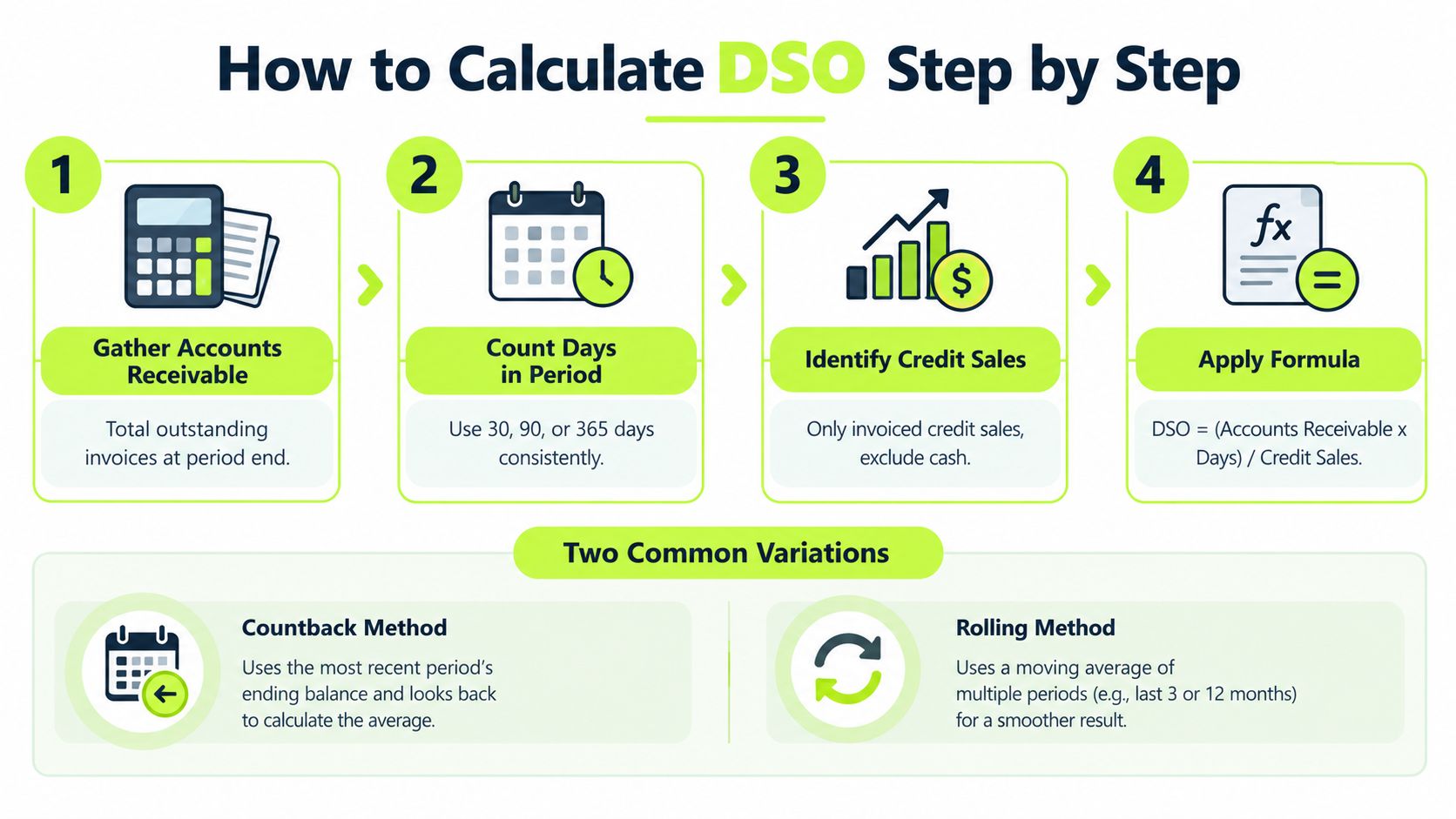
The standard formula is:
DSO = (Accounts Receivable × Number of Days in the Period) ÷ Total Credit Sales
The same formula can be written as:
DSO = (Accounts Receivable ÷ Total Credit Sales) × Number of Days
The Salesforce explanation of the DSO formula confirms this structure and notes that finance teams often use a 365-day year for annual analysis. Industry guidance commonly treats 30 to 45 days as a healthy benchmark in many sectors, although your payment terms, client mix, and billing model still matter.
Start with the correct receivables balance
For a straightforward monthly calculation, use ending accounts receivable at month-end. This works well when invoices are issued consistently and the month-end balance isn't unusually affected by a billing batch.
For quarterly or annual management reporting, average AR is often more representative:
Average AR = (Beginning AR + Ending AR) ÷ 2
You can use the average accounts receivable calculation when a period-end balance doesn't reflect the firm's typical receivables position. The key isn't choosing one method forever. The key is documenting the method and applying it consistently.
Match the day count to the reporting period
Use a day count that matches the sales period:
- Monthly: Use 30 days as a consistent management convention, or use the actual calendar days if your policy requires it.
- Quarterly: Use 90 days when your reporting convention treats the quarter consistently.
- Annual: Use 365 days for annual analysis.
Consistency matters more than false precision. If one month uses actual calendar days and another uses a fixed convention, trend comparisons become harder to interpret.
Use credit sales, not every revenue line
The denominator should represent credit sales for the same period as the AR balance. Exclude cash sales because those transactions don't create a collection waiting period. If your general ledger combines cash and credit revenue, separate the streams before calculating DSO or clearly label the result as an approximation.
For professional services, review how your system treats retainers, deposits, credits, refunds, and write-offs. A formula can be mathematically correct while still producing an operationally misleading result if the underlying sales and AR populations don't match.
Choose the method that fits your billing pattern
Period-end DSO is fast and easy to include in a monthly close package. It can be sensitive to invoice timing.
Average-AR DSO smooths the numerator and is generally more useful when billing is concentrated near the end of a reporting period.
Rolling DSO uses a moving window, such as the most recent quarter, to reduce the effect of one unusually large invoice cycle. It's useful for project-based firms that want a current operating signal.
Countback DSO works backward from ending AR through recent credit sales. It's more involved, but it better reflects collection timing when monthly billing is uneven. Use it when a single period's sales volume would otherwise distort the result.
Worked Examples and Spreadsheet Formulas You Can Copy
A useful DSO model should be reproducible by someone else on the finance team. Keep the inputs visible, name the reporting period, and show whether AR is ending or average. That makes the result easier to verify during close, lender reporting, or partner review.
Monthly period-end example
Assume a firm has:
- Ending AR: $620,000
- Monthly net credit sales: $480,000
- Days in period: 30
The calculation is:
DSO = ($620,000 × 30) ÷ $480,000
DSO = 38.75 days
In Excel or Google Sheets, if ending AR is in B2, credit sales are in B3, and days are in B4, use:
=(B2*B4)/B3
If you use actual calendar days, enter that day count in B4 rather than changing the formula. The formula should remain stable while the inputs change.
For a monthly average-AR method, assume beginning AR is $560,000 and ending AR is $620,000. First calculate average AR:
=AVERAGE(B2,B3)
If B2 contains beginning AR and B3 contains ending AR, then place credit sales in B4 and days in B5:
=(AVERAGE(B2,B3)*B5)/B4
This produces a smoother numerator when the firm sends a large batch of invoices late in the month.
Rolling 90-day example
Assume the most recent 90-day window contains:
- Beginning AR: $700,000
- Ending AR: $820,000
- Credit sales: $2,400,000
- Days in period: 90
Average AR is:
($700,000 + $820,000) ÷ 2 = $760,000
Rolling DSO is:
($760,000 × 90) ÷ $2,400,000 = 28.5 days
A spreadsheet formula using beginning AR in B2, ending AR in B3, credit sales in B4, and days in B5 is:
=(AVERAGE(B2,B3)*B5)/B4
For a rolling model, each month becomes a new row. Keep the latest 90-day credit sales total and the matching AR balances aligned. Don't compare a 90-day sales total to a single month's receivables balance without labeling the methodology, because that creates a timing mismatch.
Countback example for lumpy billing
Suppose ending AR is $212,000, and recent monthly credit sales are:
- Most recent month: $100,000
- Prior month: $80,000
- Earlier month: $70,000
Subtract the most recent month's sales from AR. The remaining balance is $112,000, so count one month. Subtract the prior month's $80,000, leaving $32,000, so count another month.
The remaining $32,000 is a portion of the earlier month's $70,000 in sales. The fraction is approximately 0.457, which represents approximately 13.7 days when using a 30-day month. Total countback DSO is therefore approximately 73.7 days.
A simple spreadsheet setup can calculate the fractional month with:
=(Remaining_AR/Month_Sales)*30
Then add the full-month values above it. Countback requires more rows and careful ordering, but it's often more informative than a simple formula when milestone invoices create sharp sales swings.
Method | Inputs Used | Formula | Result |
|---|---|---|---|
Monthly period-end | Ending AR $620,000, credit sales $480,000, 30 days | ($620,000 × 30) ÷ $480,000 | 38.75 days |
Rolling 90-day | Average AR $760,000, credit sales $2,400,000, 90 days | ($760,000 × 90) ÷ $2,400,000 | 28.5 days |
Countback | Ending AR $212,000 and recent monthly sales | Full months plus fractional month | Approximately 73.7 days |
For QuickBooks AR automation, export the open-invoice balance for the reporting date and a credit-sales report for the exact same period. Remove cash receipts, credits, and non-credit revenue according to your accounting policy before placing the values into the spreadsheet. If an AR software for professional services tool exports both balances, preserve the report filters with the calculation so another operator can reproduce the number.
Common Adjustments and Pitfalls That Skew Your DSO
Most DSO errors don't come from multiplying the wrong cells. They come from mixing populations that don't belong together. A firm may calculate the formula correctly while including cash revenue, unbilled work, or credits that don't represent collectible customer balances.
Validate the numerator
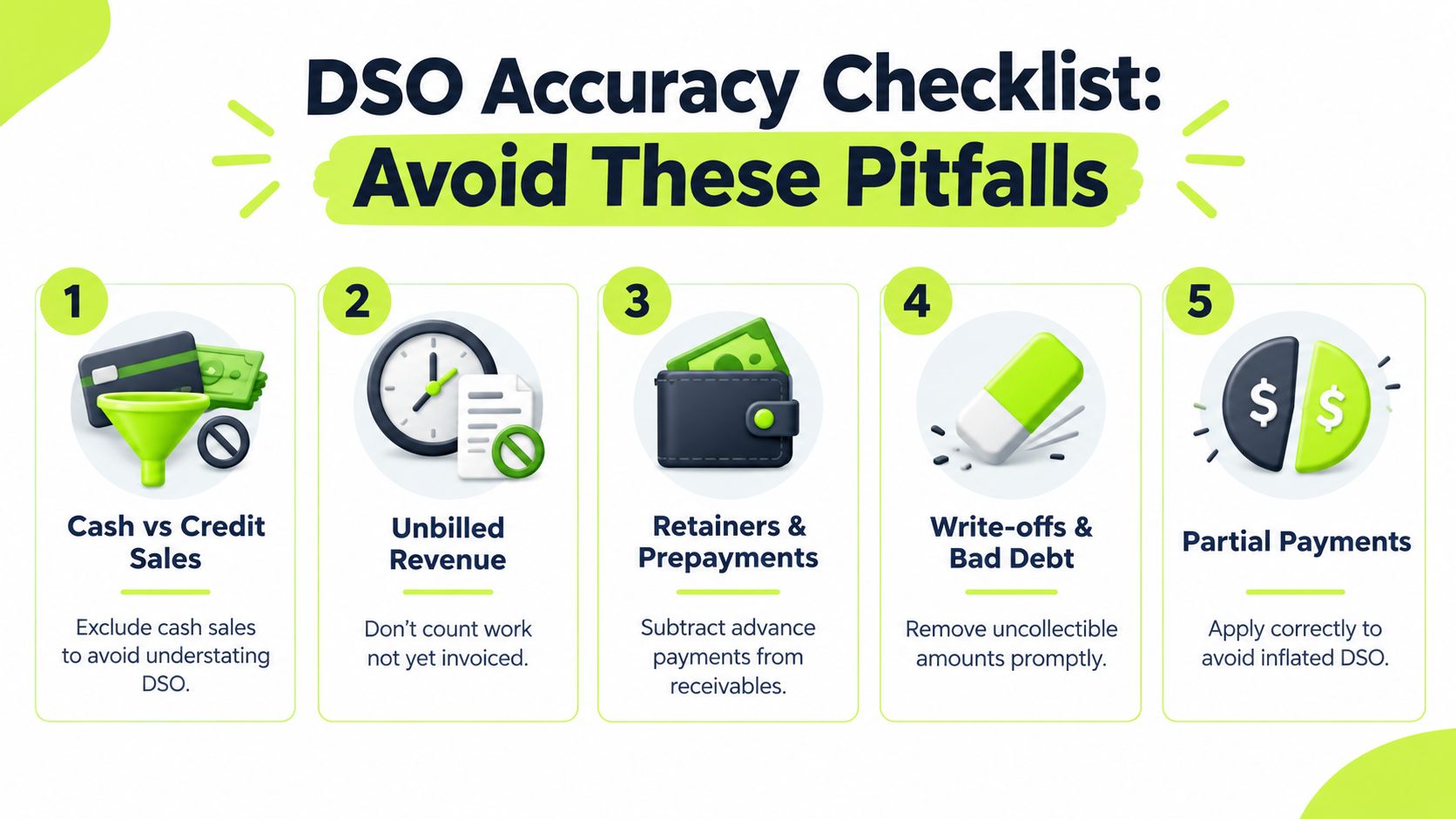
Use receivables that customers owe and that your ledger classifies as AR. Unbilled revenue isn't receivables yet, even if the firm has completed the work. Including it makes the balance appear larger than the invoices currently available for collection.
Retainers and prepayments need careful treatment. Advance cash may reduce the amount a client owes, but it isn't the same as collecting an issued invoice. Follow your accounting policy and apply the treatment consistently rather than making a one-off adjustment to improve the reported result.
Write-offs should leave the collectible AR population promptly. A balance that the firm has already determined won't be collected shouldn't remain in the operational DSO numerator.
Validate the denominator
Cash sales don't belong in credit sales. If you include them, the denominator grows without adding collection time, which can make DSO look lower than the credit-collection process really is.
Returns, allowances, and credits also require consistent treatment. If the sales figure is gross while AR reflects net collectible amounts, the numerator and denominator describe different economic populations.
Partial payments create another common problem. Apply them to the correct invoice, preserve the remaining balance, and check unapplied cash separately. A payment sitting in a suspense account can make AR look overdue even when the customer has paid.
Use the method that matches the billing pattern
Period-end AR can be distorted by a large project invoice posted just before close. Average AR reduces that timing effect, while a rolling window gives management a more current view than an annual result.
Countback is useful when monthly sales are uneven. It traces the outstanding balance through recent sales rather than assuming that revenue arrived evenly throughout the measurement period.
Before publishing DSO, run this control check:
- Period alignment: Confirm AR and credit sales cover the same dates.
- Revenue classification: Remove cash sales and non-credit revenue.
- Invoice status: Exclude unbilled work from AR.
- Credit treatment: Review returns, allowances, retainers, and prepayments.
- Cash application: Investigate unapplied and partially applied payments.
- Bad debt: Remove balances already written off under policy.
- Method consistency: Record whether the report uses ending AR, average AR, rolling, or countback.
A clean DSO report starts with a controlled data population, not a more complicated formula.
How to Benchmark and Interpret Your DSO Results
A DSO number only becomes useful when you compare it with the firm's payment terms, billing model, and own trend. A professional services firm that invoices monthly on short terms shouldn't interpret its result the same way as a project firm billing large milestones after acceptance.
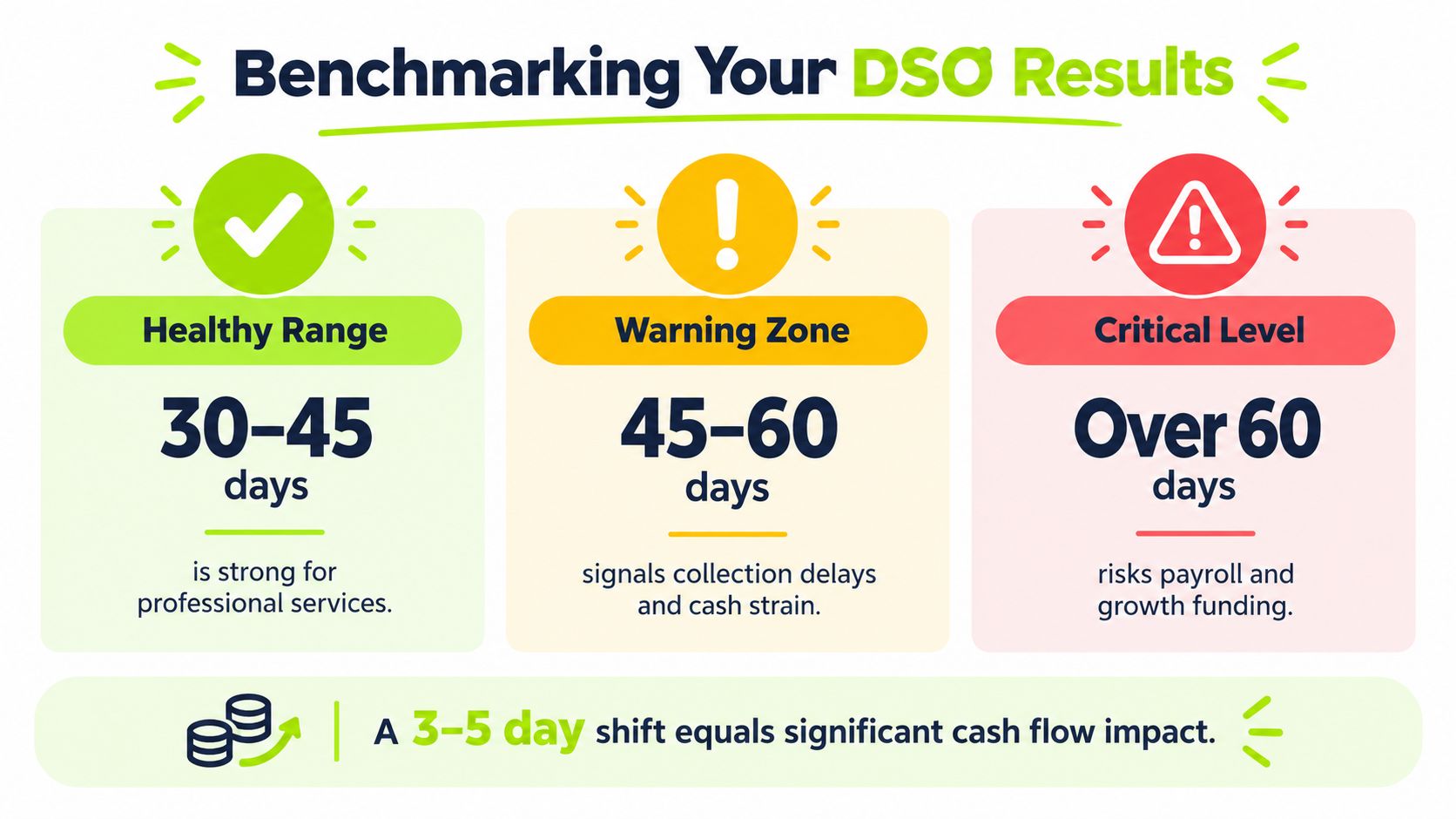
Industry guidance commonly places a healthy DSO range at 30 to 45 days in many sectors, according to Salesforce's DSO guidance. A separate benchmark cited by Chaser's global DSO analysis suggests targeting below 45 days, while its cited global average was about 62 days in 2024. These figures provide context, not a substitute for your own terms and client behavior.
Read movement, not just the current point
A single month can be noisy. A large billing run, a delayed client approval, or incomplete cash application can move DSO without showing a permanent change in collection performance.
Track the same method month over month. Display the current result, the prior result, invoice volume, disputed balance, unapplied cash, and the largest overdue accounts. If DSO rises by 3 to 5 days, treat that movement as operationally significant and investigate the cause rather than dismissing it as normal fluctuation. The benchmark context above shows why even a few days can matter for cash-flow efficiency.
For a broader comparison, the average DSO by industry discussion can help frame questions about sector norms. Still, your firm's own payment terms remain the first reference point.
Use a decision table for the next action
DSO pattern | Likely operating signal | First action |
|---|---|---|
Stable and aligned with terms | Collection process is broadly controlled | Maintain cadence and review exceptions |
Rising after billing changes | Invoice timing, accuracy, or client approval friction | Audit recent invoices and submission dates |
Rising with overdue concentration | Follow-up gaps or weak account ownership | Assign owners and prioritize material balances |
High with large disputes | Clients are withholding payment pending resolution | Separate disputed and undisputed amounts |
Volatile month to month | Lumpy project billing or period-end timing | Use average AR, rolling DSO, or countback |
DSO appears unusually low | Cash sales may be included or AR may be understated | Reconcile revenue classification and ledger balances |
The objective isn't to chase the lowest possible number. Overly aggressive collection behavior can damage valuable client relationships, while overly relaxed terms can create avoidable financing pressure. The right result is a repeatable collection process that supports cash predictability without creating unnecessary friction.
Practical Next Steps to Reduce DSO and Improve Cash Flow
Calculation diagnoses the constraint. Process changes release the cash.
Start with invoice timing. Send accurate invoices as soon as the contractual billing event occurs, include the required purchase-order or approval details, and make payment instructions visible. In professional services, many delays begin before the invoice reaches the client's accounts payable queue.
Set a clear cadence around due dates. Use reminders before an invoice becomes overdue, then escalate based on invoice age, balance, dispute status, and client importance. The message should be consistent and human, not a generic sequence that makes a long-term client feel treated like a collection account.
Remove avoidable payment friction
Offer payment methods that fit the client's process, including bank transfer and card options where appropriate. A payment portal can reduce email exchanges, while disciplined cash application keeps the AR ledger aligned with money already received.
Separate disputes from ordinary overdue invoices. Give each dispute an owner, a next action, and a resolution date. Don't let a small billing question hold an otherwise collectible balance indefinitely.
Automate coverage without losing judgment
Accounts receivable automation works best when it handles repeatable work and leaves exceptions with finance professionals. Automated reminders, account prioritization, payment matching, and status reporting can help a small team maintain consistent coverage across the portfolio.
AI AR automation can support timing and message personalization, but controls still matter. Define approval rules, protect client-specific tone, and make sure the Controller can review activity before a sensitive escalation. For firms using QuickBooks, QuickBooks AR automation should preserve invoice, payment, credit, and customer identifiers so the workflow doesn't create a second, disconnected ledger.
Research on DSO reduction in contact centers offers a useful reminder that payment readiness and method capture can influence downstream collection effort. The broader AR software for professional services workflow should connect billing, outreach, payment options, and cash application rather than automating only reminder emails.
A practical operating sequence is:
- Publish DSO using a documented method.
- Identify the invoices and process stage driving the movement.
- Correct billing, dispute, or application errors.
- Automate routine follow-up and payment collection.
- Review the trend and exceptions at the next close.
For a fuller process review, use this guide to optimize your accounts receivable process. Better DSO usually comes from system discipline, not from asking people to chase harder.
Control principle: Measure the right population, act on the cause, and automate the follow-up that should never depend on memory.
Resolut automates AR for professional services by coordinating consistent outreach, payment workflows, and cash application around the same receivables data used in your DSO reporting. Visit Resolut to see how a consistent, accurate, and human AR process can help your firm improve cash flow without adding manual collection work.