
How to Make Collection Calls That Get Paid
Master how to make collection calls that improve cash flow. Our guide for CFOs covers preparation, scripts, and automation to reduce DSO and get paid faster.
A successful collection call isn't about just picking up the phone and asking for money. It's a strategic conversation built on good data and a clear plan.
When you shift your mindset from reactive follow-up to proactive communication, you turn what feels like an awkward chore into a standard business process that safeguards your cash flow.
The Hidden Costs of Unpaid Invoices
For anyone overseeing the finances of a professional services firm, an overdue invoice is more than just a number on an aging report. It’s a drag on your operations.
The face value of that invoice is easy to see. The real, compounding costs are what truly impair your firm’s ability to invest, hire, and grow.

The older an invoice gets, the less likely you are to collect it. An invoice that’s 90 days past due is exponentially harder to collect than one at 30 days.
For a firm in the $3M–$50M revenue range, a handful of these aging accounts can freeze a significant amount of working capital, impacting your ability to improve cash flow.
Quantifying the Financial Drag
The scale of this problem is significant. In a single year, businesses sent over $150 billion to collections. The result was a dismal $40 billion, or just 26.7%, ever recovered.
These numbers prove that a systematic process for collection calls isn't just a good idea—it's essential. You can see how your own collections efforts stack up against benchmarks to get a better sense of where you stand.
A $10M firm with a Days Sales Outstanding (DSO) of 60 days can free up roughly $274,000 in cash by trimming just 10 days off that cycle. That’s capital you can put to work.
This financial drag creates a cascade of problems:
- Stalled Growth: Capital tied up in accounts receivable is capital you can't use for new hires, technology upgrades, or expansion.
- Higher Borrowing Costs: When cash flow is tight, you may have to lean on your line of credit, incurring interest expenses that erode profit margins.
- Wasted Resources: Your finance team's time is valuable. Every hour spent chasing payments is an hour not spent on high-value financial analysis.
Reframing the Collection Process
The goal is to move from chasing debt to managing a predictable payment cycle. This starts with seeing the collection call as an opportunity to reinforce payment expectations and gain intelligence.
This is where accounts receivable automation becomes a critical tool. By automating routine tasks and providing a complete picture of each client's history, you make every interaction more effective.
Many firms find success with tools that offer QuickBooks AR automation to unify their data. This data-first approach is key to helping you reduce DSO.
*Visual Idea: Cinematic shot of a person looking at a screen with client payment history and data charts, with a headset on, ready to make a call. *
The most critical part of a collection call happens before you pick up the phone. This isn’t about preparing for confrontation. It’s about being in control of the conversation.
Going into a call unprepared signals that your internal processes are disorganized and can damage the client relationship.
When your team has all the facts, the call shifts from a tense back-and-forth to a simple, professional problem-solving session.
Gathering the Core Facts
Before dialing, your collector needs a snapshot of the account. This is the bare minimum.
Core intelligence should include:
- Invoice Details: The exact invoice number, total amount due, and original due date.
- Contractual Terms: The payment terms agreed upon in the contract or SOW.
- Communication Log: A history of every email, call note, and previous conversation about any invoice.
Having this data ready is the foundation for a productive call. As many experts agree, arming yourself with facts is one of the most effective tips for making collection calls that get results.
Look for the Story in Their Payment History
The real insight comes from analyzing the client's payment behavior over time. Is this a one-off slip-up or a recurring pattern?
The answer dictates the tone and strategy of your call.
A single late payment from a client who always pays on day 28 is a customer service call. A pattern of payments stretching from 35 to 45 to 60 days is a financial risk management call.
When you spot these trends, you can move from reacting to anticipating. This insight is crucial for managing customer communication effectively.
This pre-call research is your most powerful tool. The more context your team has, the more confident and effective they will be.
Pre-Call Intelligence Checklist
Data Point | What It Tells You | Source (Manual vs. Automated) |
|---|---|---|
Invoice & Due Date | The specific debt being discussed. | Manual: ERP/Accounting Software<br>Automated: AR Platform |
Payment Terms | The client's contractual obligation. | Manual: Contract/CRM<br>Automated: AR Platform |
Payment History & Trends | Is this a one-time issue or a pattern? | Manual: ERP Reporting<br>Automated: AR Platform |
Communication Log | Who was spoken to, when, and what was said. | Manual: Email/Spreadsheets/CRM<br>Automated: AR Platform |
Key Contact Info | The right person to resolve the issue (AP vs. Buyer). | Manual: CRM<br>Automated: AR Platform |
Other Open Invoices | The total exposure and relationship health. | Manual: ERP/Accounting Software<br>Automated: AR Platform |
This checklist ensures a structured, data-informed discussion.
Stop the Manual Scramble with AR Automation
Pulling this information together by hand is a significant time sink. Your team bounces between accounting systems, email, and the CRM, trying to piece together a complete picture.
This is exactly where accounts receivable automation changes the game.
An AI AR automation platform like Resolut consolidates all of this data into a single view. Instead of spending 30 minutes digging for information, your collector gets everything they need instantly.
Firms using AR software for professional services have cut pre-call prep time by 30-40%. This reclaimed time means your team can make more calls and focus on high-value conversations.
This systematic preparation makes every call purposeful and professional, allowing you to collect what you're owed while maintaining strong client relationships.
Making the Call: How to Be Firm, Fair, and Effective
You’ve done your homework. Now it’s time to pick up the phone. A collection call isn’t a confrontation. It’s a business conversation about a commitment that hasn’t been met.
Your goal is to resolve the overdue payment while keeping the customer relationship intact. Project calm confidence. You’re not asking for a favor; you’re following up on agreed-upon terms.
A successful call has four parts: a direct opening, listening to understand, collaboratively finding a solution, and closing with a firm, documented commitment.
Starting the Call on the Right Foot
The first 30 seconds set the tone. Your team needs to sound organized and professional, not apologetic or demanding. The best approach is direct and straightforward.
First, identify yourself, your company, and confirm you’re speaking to the right person. Then, state the reason for your call plainly.
A simple, effective opening:"Hi, [Client Contact Name]. This is [Your Name] with [Your Company]. I’m calling about invoice [Invoice Number] for [$Amount], which was due on [Due Date]. I just wanted to check in and make sure there weren't any issues holding up the payment."
This phrasing is non-confrontational. It lays out the facts and opens the door for a conversation, not an argument. This consistency is a core principle in practices like call center quality assurance.
Listen, Then Solve the Problem
Once you’ve stated your reason for calling, listen. Their answer tells you everything you need to know.
This is where pre-call prep pays off. Having the customer’s history at your fingertips lets you shift from "collecting" to actively problem-solving.
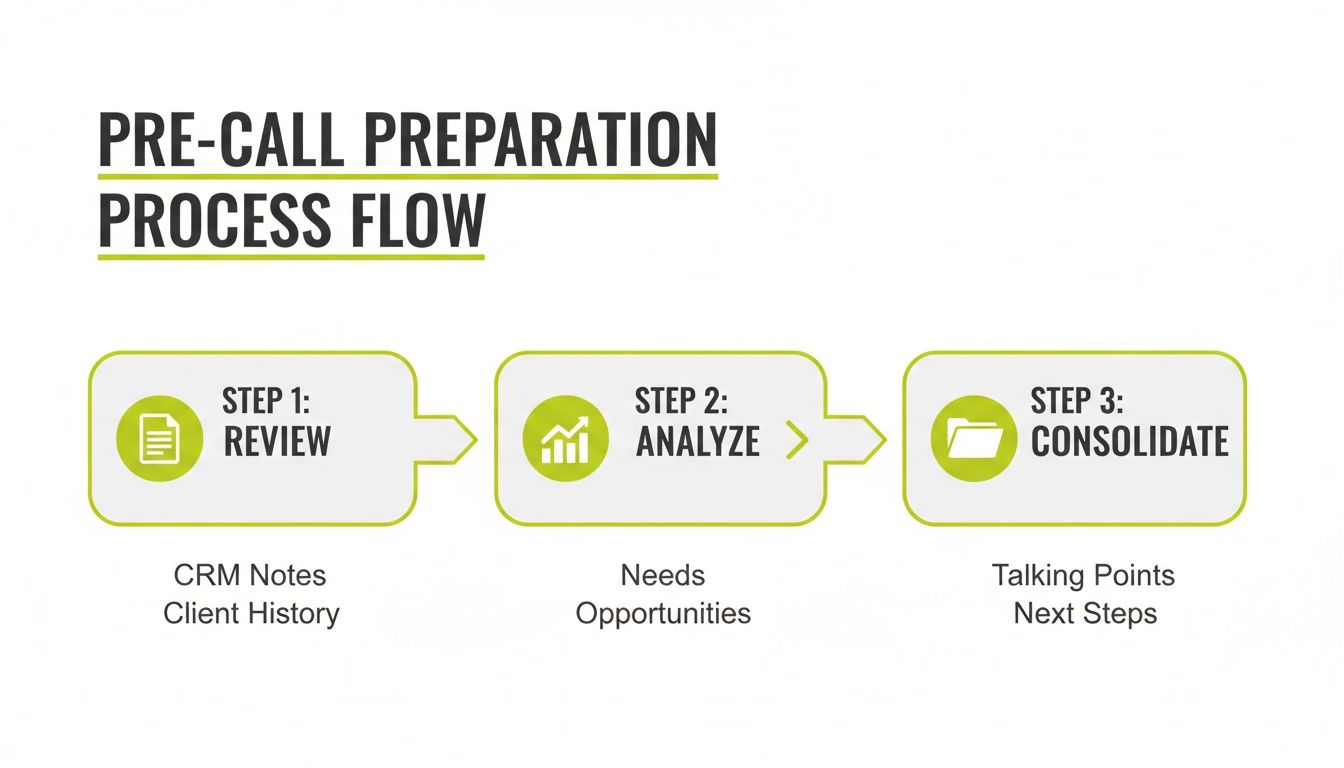
With those insights, you can navigate common roadblocks with confidence. Let’s walk through a couple of real-world scenarios.
- Scenario 1: The invoice fell through the cracks.
- They say: "I'm so sorry, I completely forgot," or "I don't think I ever saw that invoice."
- You say: "No problem. I can resend that invoice to you right now. Is [email.address@client.com] still the best address? Great. Once that comes through, are you in a position to take care of it today?"
- The goal: Make it easy for them to pay on the spot. By staying on the line, you remove friction and guide them to immediate action.
- Scenario 2: The client is facing financial difficulty.
- They say: "To be honest, cash flow is really tight right now."
- You say: "I appreciate you sharing that. We value our partnership. How about we set up a payment plan? Could you commit to a 50% payment this week and the remaining balance in two weeks?"
- The goal: Offer empathy, but stay in control. Propose a specific, structured plan instead of leaving it open-ended. It shows flexibility while treating the debt seriously. There's a real art to this, which we explore in our guide on how to ask for payment politely.
Having a complete customer history in one place is a game-changer. An AR platform can instantly show if a "cash flow issue" is a one-time event or a recurring pattern, allowing for a smarter response.
Lock In a Firm Commitment
A collection call without a concrete outcome is a wasted effort. "I'll look into it" is not a resolution. Your call must end with a specific Promise to Pay (PTP) that includes an exact date and amount.
Before you hang up, get verbal confirmation of the plan.
A strong closing statement:"Great, thank you. To confirm, I have a note that we can expect a payment of [$Amount] on [Specific Date]. I'll send a brief email to summarize. We appreciate your business."
This confirmation, followed by a written summary, creates a clear record and accountability. In an AR platform, this follow-up is automated, ensuring nothing is missed.
Executing calls this way turns a dreaded task into a powerful tool for financial health. You’ll not only reduce your DSO but also maintain control over your company's cash flow.
Dealing with Objections and Knowing When to Escalate
An objection is not a dead end. It’s a signpost, pointing toward the real reason you haven't been paid.
When you see objections as intel instead of arguments, everything changes. A team trained to anticipate excuses doesn't get flustered. They stay calm and guide the conversation to a resolution. For anyone looking to build this skill, frameworks for Mastering Objection Handling in Sales apply just as well here.
How to Handle Common Collection Call Objections
Your team needs a playbook for common objections. This isn’t about memorizing a script, but having a consistent strategy that gets you paid while preserving the client relationship.
- When they say: "The check is in the mail." You say: "Great. Could you provide the check number and the date it was sent? I'll make a note to watch for it." This politely asks for proof and moves a vague promise toward a trackable event.
- When they say: "I never got the invoice." You say: "I'm sorry to hear that. Is [email.address@client.com] still correct? I’ll email it over while we’re on the phone and confirm you receive it." This immediately removes the excuse and clears the roadblock.
- When they say: "We're disputing one of the charges." You say: "Thanks for bringing that to my attention. Let's separate that item. In the meantime, can we process payment for the undisputed amount of [$X] today? I'll have your account manager investigate the charge immediately." This secures cash on the undisputed portion while showing you’re responsive.
The best response to any objection is one that acknowledges their point, keeps you in control, and pivots back to a clear, actionable next step.
This is also where a smart AR platform makes a huge difference. By logging these objections, you start to see patterns and can get ahead of problems.
Setting Up Clear Escalation Triggers
Not every late payment can be solved with a single call. You need clear, non-negotiable triggers for when an account gets escalated.
*Visual Idea: A line chart showing a steady decline in Days Sales Outstanding (DSO) over four quarters, demonstrating the positive impact of a structured AR process. *
These triggers shouldn't be based on a collector's "gut feeling." They need to be rooted in hard data.
Key Escalation Triggers:
- Time: An invoice hitting 60 or 90 days past due should automatically land on a manager's or controller's desk.
- Behavior: A customer who breaks a Promise-to-Pay twice is a major red flag. Escalate immediately.
- Disputes: If a customer raises an invalid dispute and still refuses to pay, it's time to bring in senior management.
- Value: Any total balance over a set amount (e.g., $50,000) that goes more than 30 days past due should get an immediate senior-level review.
A disciplined escalation path is the backbone of a strong AR process. It empowers your team with clear rules of engagement and helps you consistently reduce DSO.
Automating Your Post-Call Workflow
Getting a verbal promise to pay is a start, but it’s only half the battle. The real work begins the moment you hang up. It’s all about turning that commitment into cash.

Think of your post-call workflow as the safety net that prevents good intentions from falling through the cracks. It ensures every promise is documented and every deadline is tracked.
The Makings of a Bulletproof Follow-Up
This is where many AR processes break down. A collector gets a promise, gets pulled into another task, and the follow-up email is forgotten. These small slip-ups compound quickly.
A solid follow-up workflow has three core parts:
- Immediate Confirmation: The second the call ends, send a quick email summarizing the conversation. This creates a paper trail and reinforces the client's commitment.
- Systematic Reminders: Schedule automated reminders leading up to the promised payment date. A simple reminder a day or two before can make the difference.
- Centralized Record-Keeping: Log the call outcome, promise-to-pay date, and notes in the client’s account file. This data is critical for tracking performance and spotting patterns.
A "promise-to-pay" without a documented follow-up is an operational liability. A documented promise with automated reminders is a predictable cash flow asset.
Backing up a phone call with an automated SMS or email follow-up has been shown to improve promise-to-pay rates by 18% compared to sticking to a single channel.
Swapping Manual Effort for Smart AR Automation
Expecting your team to manually execute this sequence perfectly for every call is a recipe for failure. This is exactly where AI AR automation comes in.
An AR software for professional services like Resolut takes this entire process off your team’s plate. It transforms a manual checklist into a reliable, hands-off system.
Instead of relying on sticky notes and memory, the platform handles the heavy lifting. Our guide on how to automate accounts receivable goes deeper into the mechanics.
The difference between a manual and automated approach is night and day.
Manual vs. Automated Post-Call Workflows
Task | Manual Process (High Risk of Failure) | Automated Process (High Reliability) |
|---|---|---|
Summary Email | Collector must remember to write and send it. Content can be inconsistent. | Sent automatically based on call outcome. Templated for consistency. |
Payment Reminders | Relies on manual calendar entries. Easily missed or forgotten. | Scheduled automatically based on the promise date. Multi-channel (email/SMS). |
Promise Tracking | Tracked in spreadsheets. Prone to data entry errors and hard to analyze. | Promise-to-pay and broken promise rates tracked automatically as KPIs. |
Flagging Broken Promises | Someone must manually check if payment arrived and flag the miss. | System auto-detects a broken promise and triggers an escalation workflow. |
Data Updates | Notes must be manually entered into CRM or accounting software. | All communications and outcomes logged automatically to the client record. |
This isn’t just about saving time; it's about building a fundamentally more dependable collections engine. With accounts receivable automation, you turn your AR function into a predictable system that helps reduce DSO.
Putting It All Together: From Calls to Consistent Cash Flow
Mastering the collection call isn’t about finding one perfect script. It's about building a reliable system—a consistent, data-driven process that your team can execute with confidence.
The real shift happens when you move from putting out fires to proactive management. By ditching reactive conversations for a structured playbook, you turn accounts receivable into a predictable source of cash flow.
The Payoff: Turning Process into Predictability
Once your team has a clear plan for every stage, the results become tangible. Firms implementing accounts receivable automation to support their collections process often achieve a 15-25% reduction in DSO within the first six months.
This is about gaining clarity to forecast accurately, invest in growth, and stop wasting your team's time on administrative work. Better cash flow funds the initiatives that drive your business forward.
Don’t think of a well-run collections process as a cost center. It’s a high-return investment in your firm's stability. The ROI is measured in lower DSO, a more efficient team, and stronger client relationships.
The Tech That Makes It Happen
For most professional services firms, a purely manual AR process is unsustainable. This is where dedicated AR software for professional services comes in.
Platforms that provide AI AR automation, especially those with seamless QuickBooks AR automation, are designed to handle tedious, repetitive work. They ensure no promise is forgotten and no follow-up is missed.
This frees your team for what really matters: navigating complex negotiations and strengthening client relationships. The right technology provides the operational backbone, allowing your people to bring their skill to the forefront.
With a platform like Resolut automating your AR, your collections process becomes what it was always meant to be: consistent, accurate, and human.
Your Top Collection Call Questions, Answered
Making effective collection calls is part art, part science. For finance leaders in professional services, getting this right is non-negotiable for healthy cash flow.
Here are the most common questions from CFOs and controllers, with straight-to-the-point answers based on what works in the real world.
What’s the Single Biggest Mistake Teams Make on Collection Calls?
Without a doubt, it’s getting the tone wrong. Most people are either too aggressive or far too apologetic.
An adversarial approach puts a client on the defensive. An overly apologetic tone suggests your payment terms are flexible suggestions, not firm agreements.
The right approach is calm, firm confidence. You're not calling to pick a fight; you're calling to resolve an administrative issue.
When Should We Actually Pick Up the Phone?
For a professional services firm, the sweet spot for a first call is 5 to 7 business days after an invoice becomes past due. Before that, automated email reminders are more efficient.
Early intervention is everything. It stops a small problem from becoming a big one. Once an invoice ages into the 60 or 90-day bucket, your chances of collecting it drop significantly.
Using accounts receivable automation helps set these timelines dynamically, so you’re always following up at the right moment.
How Does AR Automation Actually Help with the Calls Themselves?
An AI AR automation platform directly supports your team during the call process in three powerful ways.
First, it gives your collector a single source of truth. All invoice details, past communications, and payment history are on one screen, empowering smarter conversations.
Second, it handles all post-call work. When a promise-to-pay is logged, the system automatically sends a confirmation email and schedules reminders. This is what turns promises into cash.
Finally, AI can act as a strategist, prioritizing who to call first based on risk, invoice value, and past behavior. This focuses your team's limited time on the accounts that make the biggest impact.
What KPIs Should We Be Tracking for Call Effectiveness?
DSO is the headline metric, but it doesn't tell the whole story.
Monitoring only DSO is like trying to navigate with just a compass. You know the general direction, but you're missing the crucial details.
For a clearer picture, start tracking these three metrics:
- Promise-to-Pay (PTP) Rate: What percentage of calls end with a firm commitment to pay? This measures your team's ability to secure a resolution.
- Broken Promise Rate: Of all promises made, how many are broken? A high number may point to a weak follow-up process or a client in financial trouble.
- Collection Effectiveness Index (CEI): This formula measures how much you collected versus how much was available to collect, providing a more accurate gauge of performance than DSO.
Tracking these KPIs within an AR software for professional services helps you spot weaknesses in your process and systematically reduce DSO.
--- Resolut automates AR for professional services—consistent, accurate, and human. Learn more about our approach.