
How to Reduce Days Sales Outstanding: A CFO's Playbook
Learn how to reduce days sales outstanding with a step-by-step playbook for professional services firms. Tighten credit, automate AR, and improve cash flow.
A firm can be busy, profitable, and still feel cash poor. The work is complete, clients are satisfied, and revenue looks healthy, yet invoices sit past Net 30 while payroll, tax obligations, and new hiring continue on schedule. The CFO sees the pressure first in the cash forecast, then in the growing accounts receivable balance.
For professional services firms, reducing Days Sales Outstanding is rarely just a collections exercise. Billing lag, unclear project approvals, disputed scope, incomplete invoice data, and inconsistent outreach often create the delay long before an account becomes overdue. The practical question isn't how to pressure clients harder. It's how to remove the operational friction that keeps good invoices from becoming cash.
Why DSO Creeps Up in Professional Services Firms
A consulting firm may finish a milestone on Friday but wait until the following week to assemble time records, obtain partner approval, and issue the invoice. The client then routes it through procurement, asks for supporting detail, and pauses payment while the project manager investigates a scope question. By the time the collections team sends its first reminder, the invoice has already lost valuable time.
That pattern is common because professional services firms sell expertise, not inventory. The deliverable may be a recommendation, design, audit, legal work product, or implementation milestone. Billing depends on human judgment, client approval, and project data spread across systems. A small delay at each handoff can create a material cash-conversion problem without anyone consciously deciding to extend terms.
DSO is a timing metric, but its causes are operational. A rising number can reflect late time-sheet approval, invoices that lack purchase order details, inconsistent client contacts, or disputes that have no defined owner. Collections may receive an overdue balance without the context needed to resolve it, so the invoice moves between finance, delivery, sales, and the client's accounts payable team.
Operating principle: Treat every overdue invoice as a process signal. The balance matters, but the reason it remains unpaid tells you where to intervene.
Client relationships make the problem more delicate. Account leaders may hesitate to follow up because they don't want a valuable client to feel pressured. That restraint often produces inconsistent outreach, with one client receiving a courteous reminder and another receiving no contact until month-end. A professional, predictable process protects the relationship better than silence does.
The true cost of AR inefficiency in professional services is broader than delayed deposits. Higher DSO can weaken forecasting, increase reliance on financing, and limit the firm's ability to invest in people and growth. Allianz Trade reported that the global cash conversion cycle reached 67 days in 2025, 3 days above its 10-year average, while global payment terms were 56.5 days, indicating that working-capital design can constrain cash conversion beyond reminder activity alone (Allianz Trade's cash conversion cycle analysis).
The fix starts by treating AR as a connected operating cycle. Sales terms, project delivery, billing, dispute ownership, payment access, and cash application all influence how quickly revenue becomes usable cash.
Baseline Your Current DSO and Identify the Key Drivers
Before changing payment terms or buying AR software for professional services, establish a reliable baseline. DSO is commonly calculated as (Accounts Receivable ÷ Total Credit Sales) × Number of Days in the Period. For professional services, pair the AR aging report with the matching sales period so the calculation reflects the same operating window.
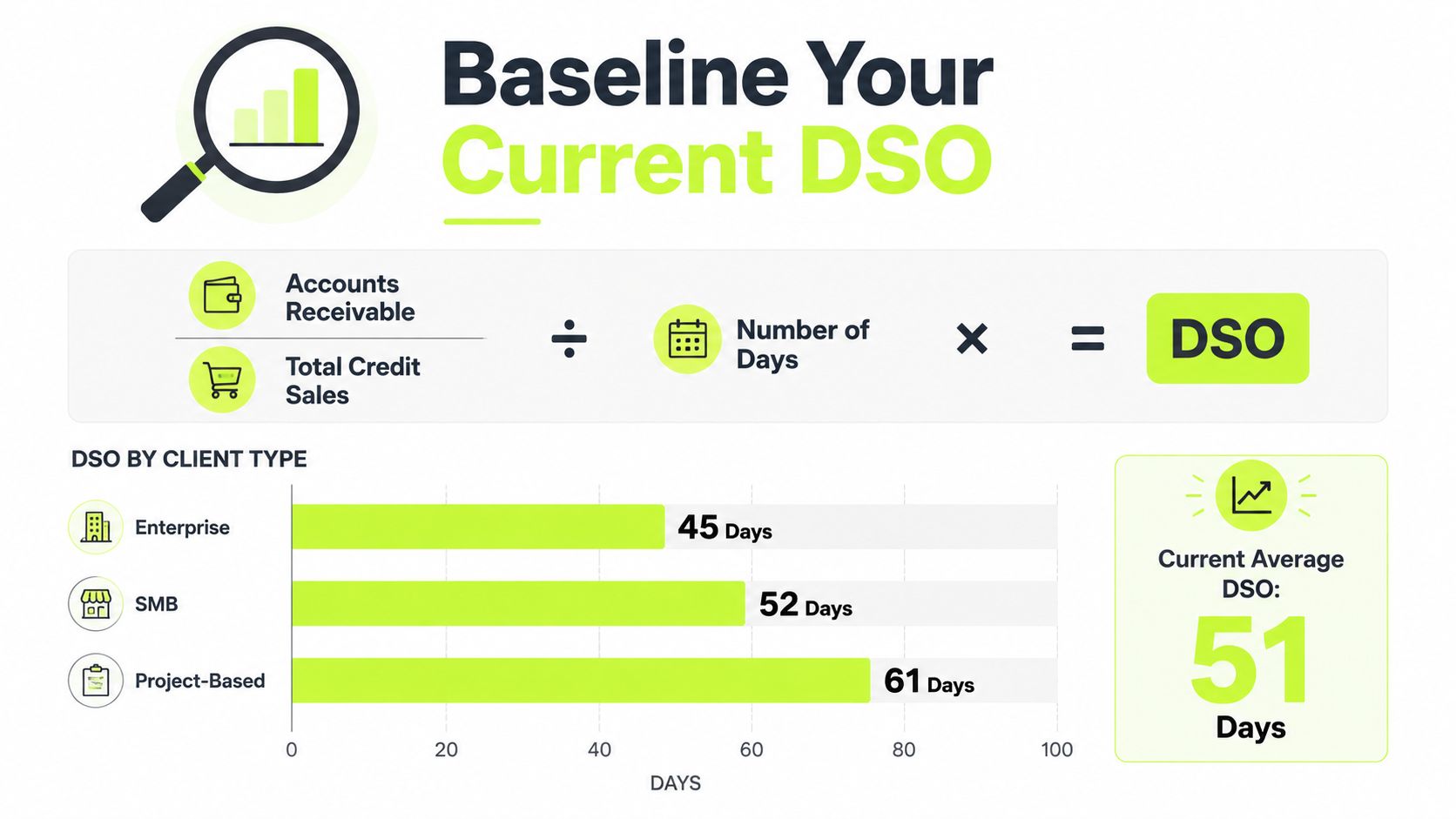
A firm-wide average can hide the accounts creating the delay. Segment DSO according to how your firm sells, delivers, and bills work:
- Client type: Compare enterprise, smaller business, nonprofit, public-sector, and other customer groups.
- Service line: Separate recurring retainers from milestone-based consulting, implementation, and project work.
- Project profile: Isolate large engagements, fixed-fee work, time-and-materials billing, and contracts requiring client acceptance.
- Region or account owner: Check whether procurement rules, local practices, or follow-up ownership produce different outcomes.
Sikich reports a cross-industry average DSO of 53 days, compared with 24.1 days for top-performing companies, a gap of roughly 29 days (Sikich's DSO and cash-flow guidance). Treat that comparison as a diagnostic, not a universal professional services target. The useful question is which part of your gap comes from billing lag, dispute routing, approval friction, or inconsistent outreach cadence.
Find the delay before setting the target
Review invoices by aging bucket, then classify the reason for delay. A current invoice missing a purchase order may deserve attention before an older balance in legal review. Route each issue to the person who can resolve it, and prioritize by the balance-to-effort ratio. A focused fix that releases meaningful cash is more valuable than a broad reminder campaign that consumes the team's week.
Track these operating indicators alongside DSO:
Indicator | What it reveals |
|---|---|
Billing lag | Time between milestone completion and invoice delivery |
Dispute backlog | Amount and age of invoices awaiting clarification |
Promise-to-pay performance | Whether agreed payment dates are being met |
Unapplied cash | Payments received but not matched to open invoices |
DSO by segment | Which customer or service groups drive the average |
A healthy DSO is often considered under 45 days, while a net-30 business may reasonably aim near 30 days. Use those figures as context, not as a substitute for examining your own contract terms and client mix. Sector conditions can differ substantially, so the target must reflect the work your firm can control.
Set a target with an owner, reporting cadence, and defined response when results regress. If invoices routinely go out several days after delivery, measure that lag separately and address its operational cause before setting a more aggressive collections goal. For a smaller firm, one delayed high-value project can move the average sharply. For a larger firm, segment-level patterns usually reveal the return on fixing a workflow before the overall DSO changes.
Tighten Credit Policies and Billing Accuracy
The fastest way to reduce DSO is often to prevent avoidable delay before collections begins. A client can't pay an invoice they haven't received, and many clients won't pay one that lacks the information their approval process requires.
Start in the contract. State payment terms, invoice requirements, milestone definitions, approval responsibilities, dispute procedures, and any applicable late-fee or early-payment provisions in language the client's finance team can use. Sales teams should understand those terms before work begins, especially when a strategic account requests exceptions.
Put risk controls before delivery
Credit policy doesn't need to be aggressive. It needs to be consistent. Assign clients risk tiers using payment history, contract structure, concentration exposure, and the level of administrative complexity involved in getting paid. Use those tiers to determine whether a new engagement requires a deposit, milestone billing, a credit limit, or senior approval for extended terms.
A practical pre-billing checklist includes:
- Confirm the commercial terms: Make sure the invoice reflects the signed agreement and approved payment conditions.
- Validate client data: Keep billing contacts, legal entities, purchase order details, and submission portals current.
- Define approval ownership: Identify the person responsible for confirming time, milestones, expenses, or deliverables.
- Set escalation rules: Decide when finance, the account lead, and executive sponsors become involved.
- Review exceptions: Track clients receiving special terms so exceptions don't become the hidden standard.
A detailed checklist from the Association for Financial Professionals recommends clear payment terms on invoices and contracts, regular reminders, updated customer contact data, credit limits, and early-payment discounts. These controls work because they remove ambiguity, not because they make the collections team more forceful.
Invoice accuracy deserves equal attention. Include the project name, billing period, responsible contact, purchase order reference, approved hours or milestone evidence, expense support, tax treatment, remittance instructions, and a direct payment path where appropriate. The billing information clients need should be gathered before the invoice is generated, not after the client rejects it.
Automation helps when it creates the invoice from approved project data and sends it immediately after the billing event. It doesn't help if it produces inaccurate invoices faster. A reliable QuickBooks AR automation workflow should connect project approval, invoice generation, delivery confirmation, reminders, and payment status so finance can see where the process stopped.
Early-payment discounts and late-fee clauses can influence behavior, but use them selectively. The trade-off is straightforward. A discount may accelerate cash, while a penalty can protect terms, yet both should fit the client relationship and contract language. The better first move is usually clear, timely, accurate billing.
Automate Collections Workflows and Cash Application
Manual follow-up creates two problems at once. It consumes finance capacity, and it makes the client experience depend on which person remembers to send the next message. A consistent workflow lets the team reserve judgment for exceptions while routine invoices follow an approved cadence.
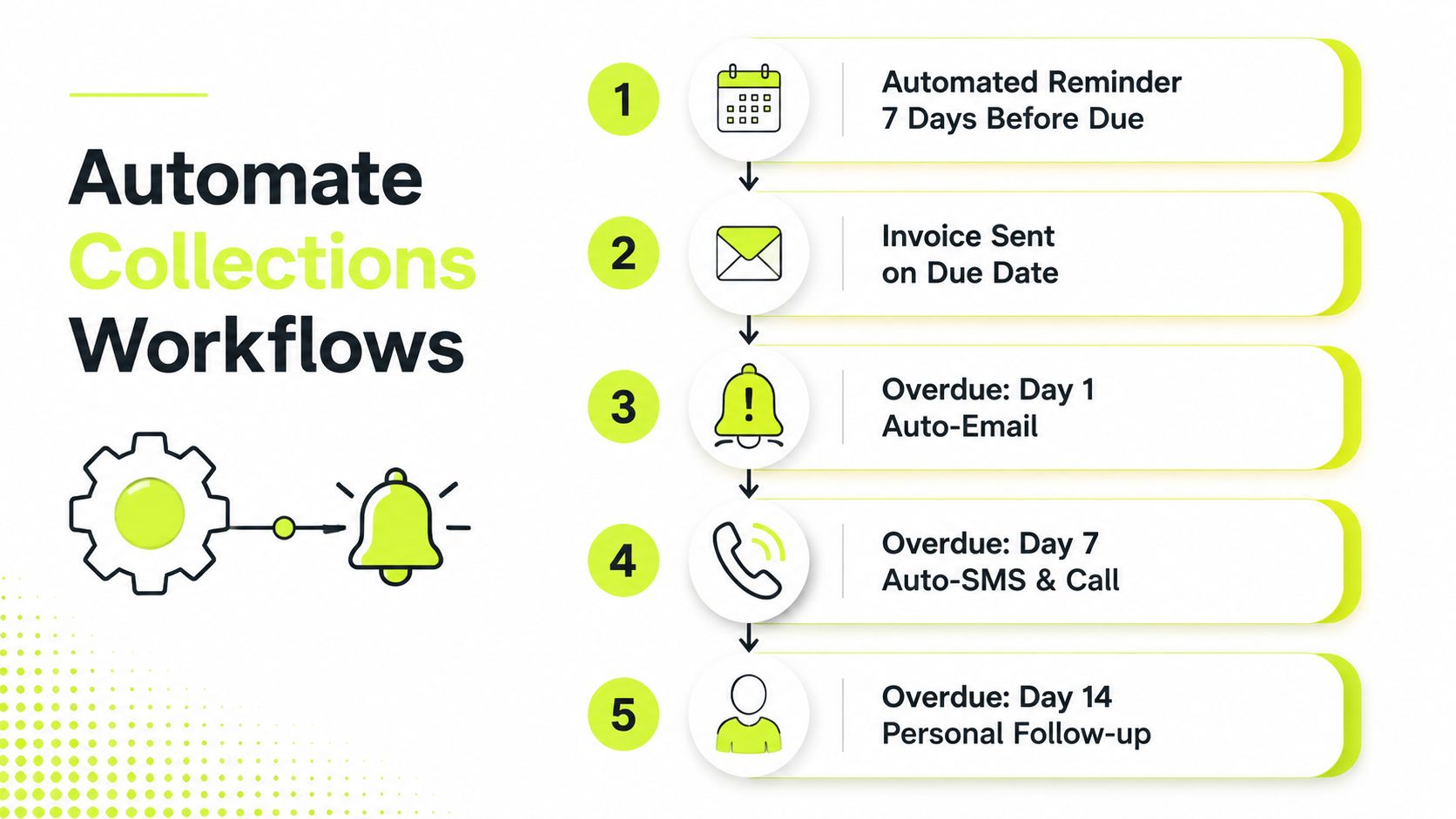
The workflow should begin before the due date. Confirm delivery, send a courteous reminder, and provide the invoice and payment instructions again. Once overdue, route the account according to balance, risk, customer preference, dispute status, and prior payment behavior. Don't send the same message to every client or treat a disputed milestone like a forgotten invoice.
Automate the handoffs, not just the emails
A useful accounts receivable automation design connects four activities:
- Reminder orchestration: Schedule pre-due and overdue communications with approved language and clear payment instructions.
- Exception routing: Send disputes to the person who can resolve scope, documentation, time, or approval questions.
- Risk-based prioritization: Rank work by customer risk and invoice aging so the oldest and riskiest balances receive attention first.
- Cash application: Match incoming payments to open invoices and surface exceptions for human review.
An AR automation survey found that prioritizing collections by customer risk or invoice aging was the top current action to reduce DSO, cited by 45% of respondents (BillingPlatform's AR Automation Survey Report). That approach is more disciplined than working the aging report from top to bottom or contacting whichever client is easiest to reach.
A reminder-only system won't solve a cash-application mismatch. If the client has paid but the receipt remains unapplied, the aging report may continue to show an open invoice, while the collections team sends an unnecessary escalation. Likewise, automating dispute notifications without assigning an owner only moves the delay into another queue.
Control point: Every automated collection event should answer three questions, who owns the next action, what information is missing, and when does the account escalate?
The measurable results come from orchestration across the process. One independent case study reported a 27% DSO reduction, from 80 to 58 days, after the organization automated collections workflows, enabled online payments, and improved cash application (Nucleus Research's HighRadius case study). The lesson isn't that every firm will achieve the same result. It's that removing connected handoffs matters more than digitizing one isolated task.
For firms using QuickBooks, evaluate whether the selected integration keeps customer, invoice, payment, dispute, and remittance data synchronized. A system that adds another inbox without updating the accounting record can increase reconciliation work instead of reducing it.
For a practical definition of AR automation and its operating components, focus on the workflow outcome. Finance should know what needs attention, delivery should know which disputes are blocking payment, and the ledger should reflect cash received without avoidable delay.
Optimize Payment Options and Outreach Cadence
Payment access and communication style work together. A client may be willing to pay today but lack the right remittance information, need a bank-transfer option, or prefer a payment method that isn't available on the invoice. Removing that friction can be more effective than sending another reminder.
Offer options that match your client base. ACH and bank transfers generally fit larger B2B payments and reduce card-related constraints. Credit cards can provide convenience for smaller invoices or clients that manage payments through card programs, although the firm should understand the applicable processing cost. Digital wallets can help where clients already use them, but they shouldn't replace the payment methods required by procurement teams.
Match the message to the situation
Email is the foundation because it carries the invoice, backup, payment link, and a written record. SMS can work for a short prompt when the client has opted into that channel and the message contains no sensitive detail. A phone call is better when approval is blocked, an invoice is disputed, or the account requires relationship judgment.
A measured cadence might look like this:
- Before the due date: Send a friendly confirmation with the invoice and payment instructions.
- At the due date: Restate the amount, due date, and available payment methods without implying misconduct.
- After the due date: Ask whether anything is blocking approval and request a specific payment date.
- For unresolved balances: Involve the account lead or senior finance owner, then apply the contractual escalation path.
The timing should be consistent, but the tone should reflect the client. A long-standing account with a clean record needs a different message from a high-risk customer with repeated late payments. Personalization should mean using accurate project context and the right contact, not writing theatrical copy.
The BillingPlatform survey's 45% finding on risk or aging prioritization is particularly useful here (AR Automation Survey Report). Prioritization determines who receives a call, who receives an automated reminder, and which account deserves executive involvement. It also prevents the team from spending disproportionate effort on low-value, low-risk balances while a large disputed invoice remains untouched.
Clients usually respond better to a clear question than a vague demand. Ask what is preventing approval, who owns the next step, and when payment will be released.
Escalation should be deliberate. For chronic late-payers, revisit terms, require milestone payments or deposits where contractually appropriate, and involve legal or executive leadership only when the account's behavior and exposure justify it. The objective is not to make every interaction adversarial. It's to make the firm's expectations predictable and protect the relationship through professional consistency.
Measure KPIs and Run Continuous Improvement
DSO improvement becomes durable when finance treats it as an operating rhythm rather than a month-end project. Review total DSO, segment DSO, aging movement, billing lag, dispute age, unapplied cash, and promise-to-pay performance together. A lower headline number means less if a key client segment is deteriorating underneath it.
Benchmarking should provide context. The reported healthy reference point of under 45 days, and the net-30 aspiration near 30 days, can help frame a target, but professional services firms still need to account for project structure and customer mix (Allianz Trade's DSO benchmark guidance). A firm serving construction clients may face a different payment profile from a firm selling recurring SaaS advisory work.
Tie the target to working capital
Moving DSO from 45 to 30 days shortens collection time by 15 days. The amount of cash recovered depends on the firm's credit sales during the period, so calculate it from your own ledger rather than using a generic estimate:
Recovered working capital is approximately average daily credit sales multiplied by the days removed from DSO.
For a professional services firm between $3M and $50M in annual revenue, this calculation belongs in the cash forecast and financing discussion. It shows owners and partners why billing discipline affects hiring capacity, debt reduction, distributions, and investment timing without pretending that every dollar of revenue is billed or collected evenly.
Run a monthly review with clear owners. Project leaders should explain billing lag and disputes. AR should report collection activity and promises. The Controller should validate cash application and data integrity. The CFO should decide whether terms, credit limits, or escalation policies need to change.
Measure automation by outcomes, not activity. More reminders sent don't necessarily mean faster cash. Look for cleaner invoice delivery, fewer unresolved disputes, faster payment reconciliation, better prioritization, and a sustained reduction in DSO by segment.
For firms that want one operating layer across these tasks, Resolut automates AR for professional services, consistent, accurate, and human, combining credit risk assessment, collections workflows, omnichannel outreach, billing coordination, and cash application so teams can reduce manual work while maintaining judgment where it matters.
Resolut connects invoice follow-up, client payment options, dispute routing, and cash application in a single AR workflow designed for professional services. Visit Resolut to see how your firm can build a more consistent path from completed work to collected cash.