
How to Reduce DSO Without Breaking Client Trust
A practical, operator-grade guide on how to reduce DSO at professional services firms, from diagnosis to automation and cross-functional alignment.
You're looking at a familiar month-end report. Revenue is healthy, the pipeline is full, and client work is getting delivered. Yet the accounts receivable aging report keeps getting heavier. A few invoices sit in approval. Others are waiting for purchase-order details, project sign-off, or a client response that nobody owns.
That's how DSO rises in a professional services firm. Not usually through one dramatic failure, but through small delays between delivery, billing, approval, dispute resolution, and payment application. The right answer isn't to make every client endure more aggressive collections. It's to engineer the portfolio and the workflow so invoices become payable sooner, exceptions receive the right intervention, and finance can see where cash is stuck.
The Quiet Drift You Stop Noticing
The first quarter, the change looked harmless. The aging report showed a little more weight in the 31–60 day bucket, but the partners had an explanation. A large client had changed its payment cycle. Another was waiting for a new procurement system. Nothing seemed urgent enough to challenge a relationship over.
By the second quarter, the pattern had become familiar. The 45-day bucket kept thickening, invoices that used to clear in the ordinary course were taking longer, and project managers were forwarding questions to finance after clients had already started withholding payment. The explanation remained the same: payment-cycle noise.
By the third quarter, the cash forecast missed. Payroll and tax obligations still had to be funded, so the firm tapped its line of credit while finance spent Friday afternoon chasing invoices that should have been resolved during delivery. The issue wasn't a lack of effort. The team had sent reminders, made calls, and updated spreadsheets. The effort arrived too late in the process.
Practical rule: A rising DSO is often a workflow signal before it becomes a collections problem.
For standard Net 30 terms, a foundational benchmark is to move toward the 30–45 day range. Organizations below 45 days are generally viewed as collecting efficiently, while DSO above 60 days often signals material billing or collections friction, as outlined in accounts receivable benchmark guidance. European payment practice shows why follow-up matters: 24% of invoices are paid late or not at all, and customers pay an average of 21 days after the due date in the cited research.
That doesn't justify brute-force calls, blanket term changes that alienate top clients, or early-payment tactics that trade margin for a better dashboard number. The practical question is where the portfolio and workflow are leaking days, then which intervention fixes that leak without damaging trust.
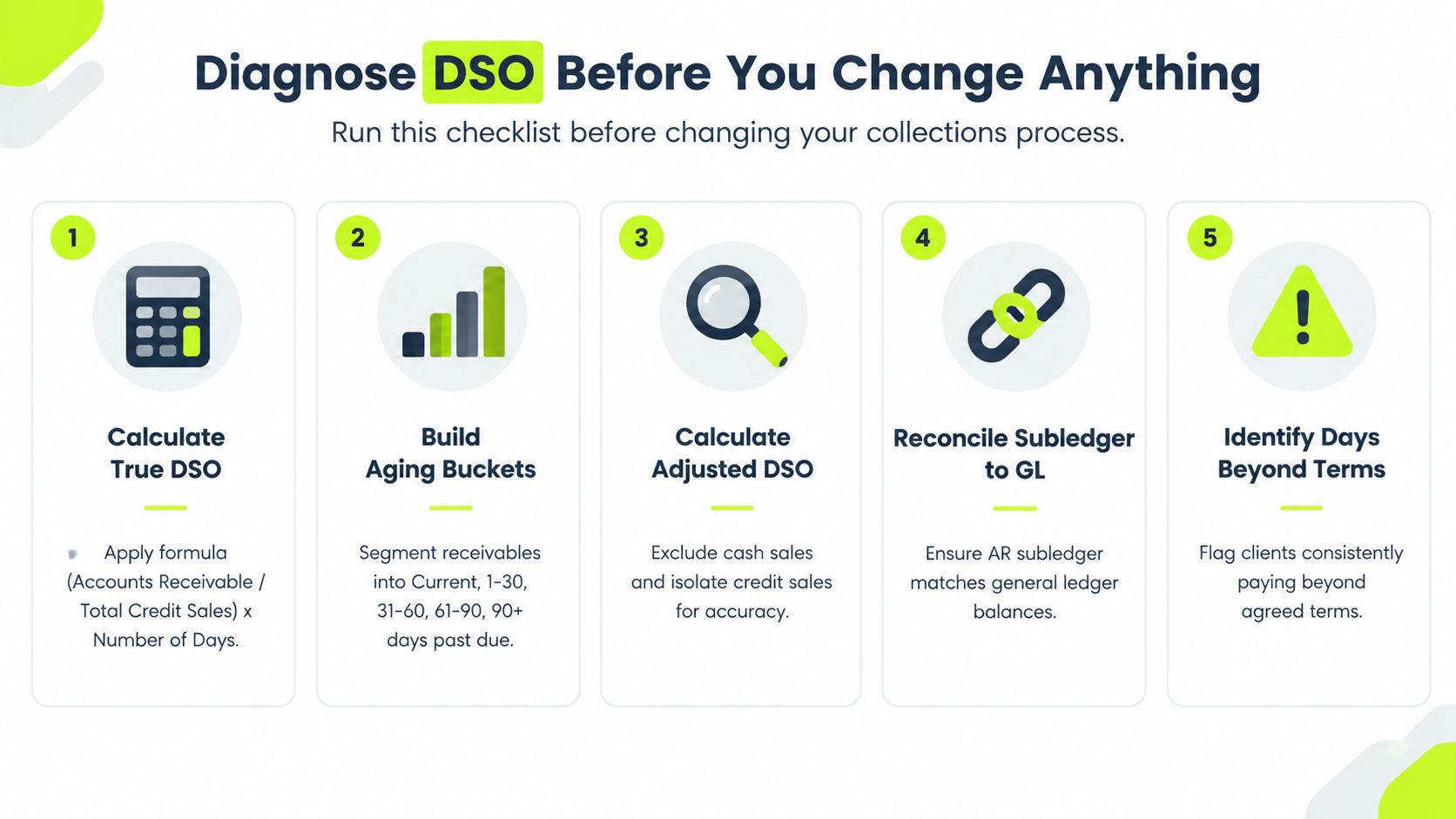
Diagnose DSO Before You Change Anything
Start with the measure, not the reminder sequence. DSO = (Accounts Receivable / Total Credit Sales) × Number of Days in the period. The formula is also documented in this DSO calculation resource from Nexist, which is useful when reconciling reporting logic across finance and leadership teams.
Use credit sales in the denominator. Cash sales can distort the result, especially when a firm has mixed billing models. For seasonal or uneven revenue, a simple period average may also hide the timing of collections, so controllers should document the method used and apply it consistently.
Build a portfolio view
Pull twelve months of DSO and compare the trend rather than reacting to one month-end result. Then slice receivables by:
- Client segment: Separate strategic accounts, standard commercial clients, and higher-risk accounts.
- Practice area: Compare consulting, managed services, agency, legal, or other service lines.
- Invoice owner: Identify whether delays cluster around particular project managers, partners, or billing teams.
- Aging bucket: Review current, 1–30, 31–60, 61–90, and 90+ balances, with special attention to the 31–60 bucket before balances roll further overdue.
- Terms: Compare actual payment behavior with contracted terms, not with an informal expectation.
Next, isolate the top decile of receivable dollars. A small number of clients often explains most of the working-capital pressure, but concentration can be missed when teams focus on invoice counts instead of balances.
A short worked example
Suppose a firm has $4.2 million in accounts receivable, $52 million in annualized revenue, and 45-day net terms. Its reported DSO has drifted to 58 days. That result doesn't prove the collections team is underperforming.
The controller should trace the balance by client, project, and reason code. If three clients account for the meaningful share of the excess days, the response may involve missing approvals, disputed scope, or terms exceptions rather than a broader dunning problem. The firm can then assign owners to those three accounts instead of subjecting every client to a harsher process.
Diagnosis comes before collections intensity because many DSO problems originate upstream. If invoices are issued late, contain errors, lack a purchase-order reference, or sit unapplied after payment, another reminder won't repair the cause.
Where DSO Actually Leaks in Professional Services
Professional services firms have a distinctive gap between work performed and cash received. A consultant can complete the work, a partner can approve the time, and the client can still lack a valid invoice because the billing package missed a required reference or milestone approval.
The four main leaks
Invoice cadence and WIP conversion usually offer the highest return. Every day between service completion and approved invoice gives the client another day before its internal approval process can begin. A faster invoice-delivery cadence can outperform a week of additional collection calls because it moves the starting point of the cash cycle.
Terms governance comes next. Sales and delivery teams may grant 60-day or 90-day exceptions verbally, while the accounting system continues to report a standard term. That creates a false delinquency signal, weakens escalation credibility, and makes it difficult to distinguish a late payer from a contract that was poorly governed.
Dispute leakage is often commercial, not administrative. Ambiguous scopes, incomplete change orders, unclear milestones, and inconsistent time records give clients legitimate reasons to hold payment. The longer the dispute remains mixed into ordinary collections, the less useful the aging report becomes.
Cash application friction can hide improvement. A payment may arrive, but if the remittance is in email, a portal, EDI, or a lockbox and the team can't match it quickly, open receivables remain inflated. Manual matching also prevents collectors from seeing which invoices need attention.
Driver | Estimated DSO-Day Impact | Implementation Effort | Typical Owner |
|---|---|---|---|
Invoice cadence and WIP-to-invoice lag | Not estimated without portfolio data | Medium | Billing and delivery |
Terms governance drift | Not estimated without contract analysis | Medium | Sales, finance, and legal |
Dispute leakage | Not estimated without dispute aging | High | Delivery and client service |
Cash application friction | Not estimated without unapplied-cash analysis | Medium to high | AR and accounting |
The table deliberately avoids a universal day estimate. The impact depends on invoice volume, client concentration, terms, project structure, and the size of the affected balance. A controller should rank the leaks using the firm's own aging, dispute, and cash-application data rather than borrow an attractive benchmark.
Fix the earliest preventable delay first. Collections can't recover time that billing never started counting.
A Collections Playbook That Preserves Relationships
A collections process should tell the team which account deserves which action. Segmenting only by days past due is too crude for professional services, where a first-time delay, a disputed deliverable, and a chronic nonpayer can appear in the same aging bucket.
Start with five signals: payment behavior, dispute status, billing friction, credit risk, and strategic value. Then assign the smallest effective intervention.
Low-balance, low-risk accounts generally need consistency, not a phone campaign. Send a concise invoice with the amount, due date, payment options, and any required reference information. Use predictable automated reminders before and after the due date, and stop the sequence as soon as payment posts.
Disputed invoices belong on a separate owner-led path. Acknowledge the issue, record the reason, name the person responsible for resolution, and set a resolution date. Don't send a standard delinquency notice while the client is contesting the deliverable or the agreed scope. That approach creates noise and can turn a fixable commercial issue into a relationship problem.
High-value or habitually late clients warrant a named contact and executive visibility near terms expiration. Escalation can include a service notice, late fees where the contract permits them, or a tighter credit limit. It shouldn't include public embarrassment, threats, or language that makes the account team defend finance instead of resolving the payment blocker.
Use disciplined communication
Every message should identify the invoice, amount, due date, purchase-order reference, current payment status, and next action. A useful risk-and-behavior matrix separates:
- First-time delay: Ask whether approval, documentation, or portal access is blocking payment.
- Chronic late payment: Review terms, deposits, credit limits, and the commercial cost of repeated follow-up.
- Operational issue: Route missing timesheets, acceptance records, or billing details to the responsible internal owner.
- Disputed deliverable: Suspend ordinary pressure and establish a documented resolution path.
Track promise reliability, dispute aging, response rate, and cash collected. Contacts sent are an activity measure, not an outcome. The finance and client-service teams can also use this guidance on managing customer communication to keep the tone clear when payment conversations become sensitive.
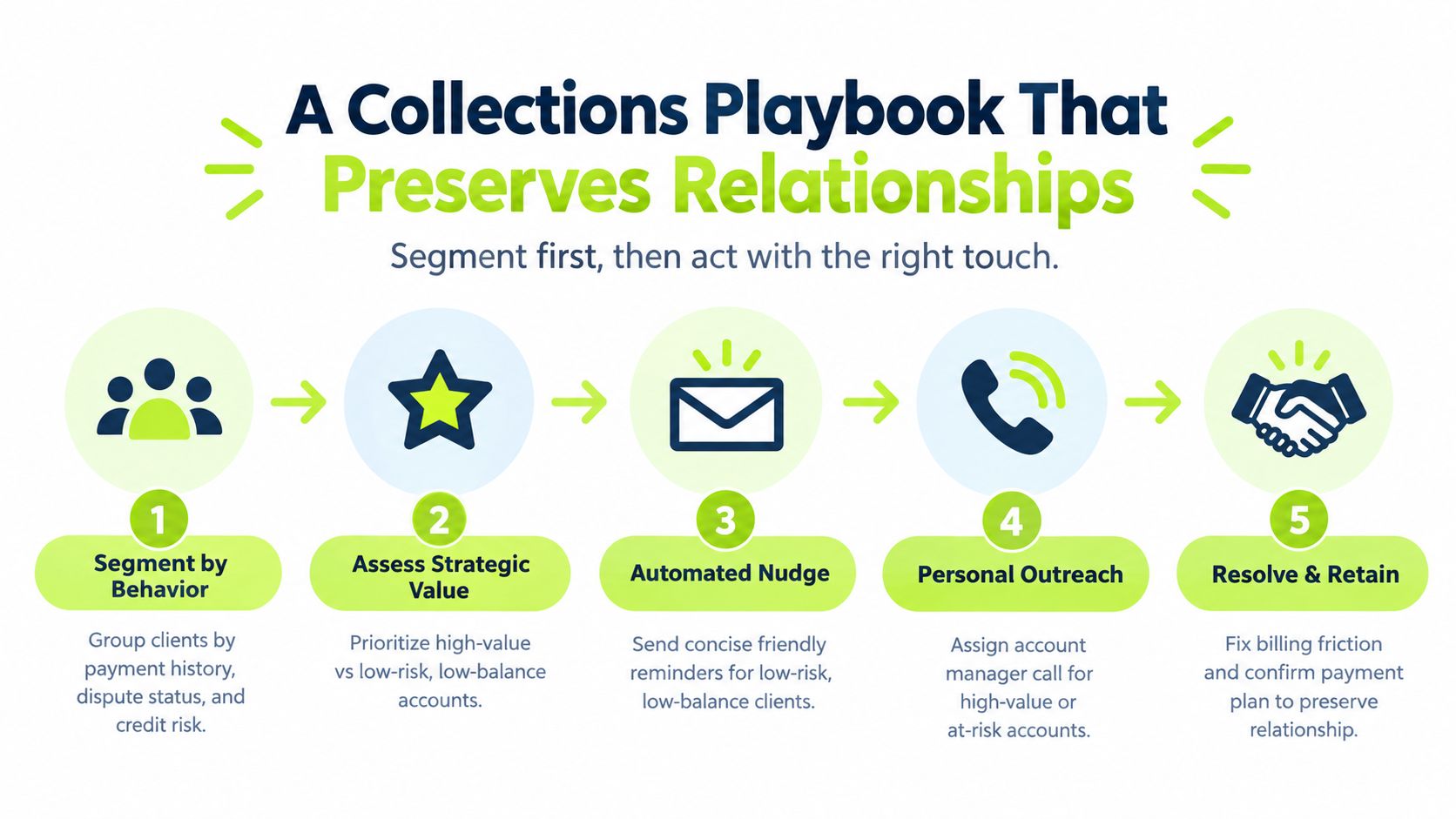
A short call from the right account owner often resolves an approval question faster than another generic email. The operating principle is selective pressure, early blocker resolution, and a clear stop condition once cash is posted.
DSO, ADD, or DBT and Which Metric to Target
DSO, average days delinquent, and days beyond terms describe different parts of the receivables portfolio. Treating them as interchangeable can send the team after the wrong problem.
DSO divides total receivables by period credit sales and multiplies by the days in that period. It answers how long cash remains tied up across the portfolio. Average days delinquent, or ADD, focuses on delinquent receivables and average daily credit sales, so it's more useful for understanding overdue exposure. Days beyond terms, or DBT, isolates payment behavior after the contractual due date.
A high DSO with low ADD may indicate slow invoicing, long negotiated terms, or delayed cash application rather than aggressive late payment. A low DSO with high ADD can still create serious risk when a small portfolio has one concentrated overdue account.
Metric | Primary Question | Best Use | Main Limitation |
|---|---|---|---|
DSO | How long is cash tied up overall? | Portfolio and month-end reporting | Distorted by terms, seasonality, and client mix |
ADD | How severe is the overdue balance? | Collections workload and overdue exposure | Doesn't explain all receivable timing |
DBT | How far beyond agreed terms are clients paying? | Account-level terms discipline | Depends on accurate contractual due dates |
Use DSO for the firm-wide view, ADD to allocate collections capacity, and DBT to manage account-level behavior. Segment each metric by client, business unit, invoice type, and dispute status. Review trends with invoice accuracy, dispute aging, and unapplied cash, not as isolated monthly scores.
A practical accounts receivable KPI framework can help finance teams connect these measures to operating decisions. The right target is the metric that exposes the constraint for that segment, not the one that produces the most flattering headline.
Where AI AR Automation Actually Moves the Needle
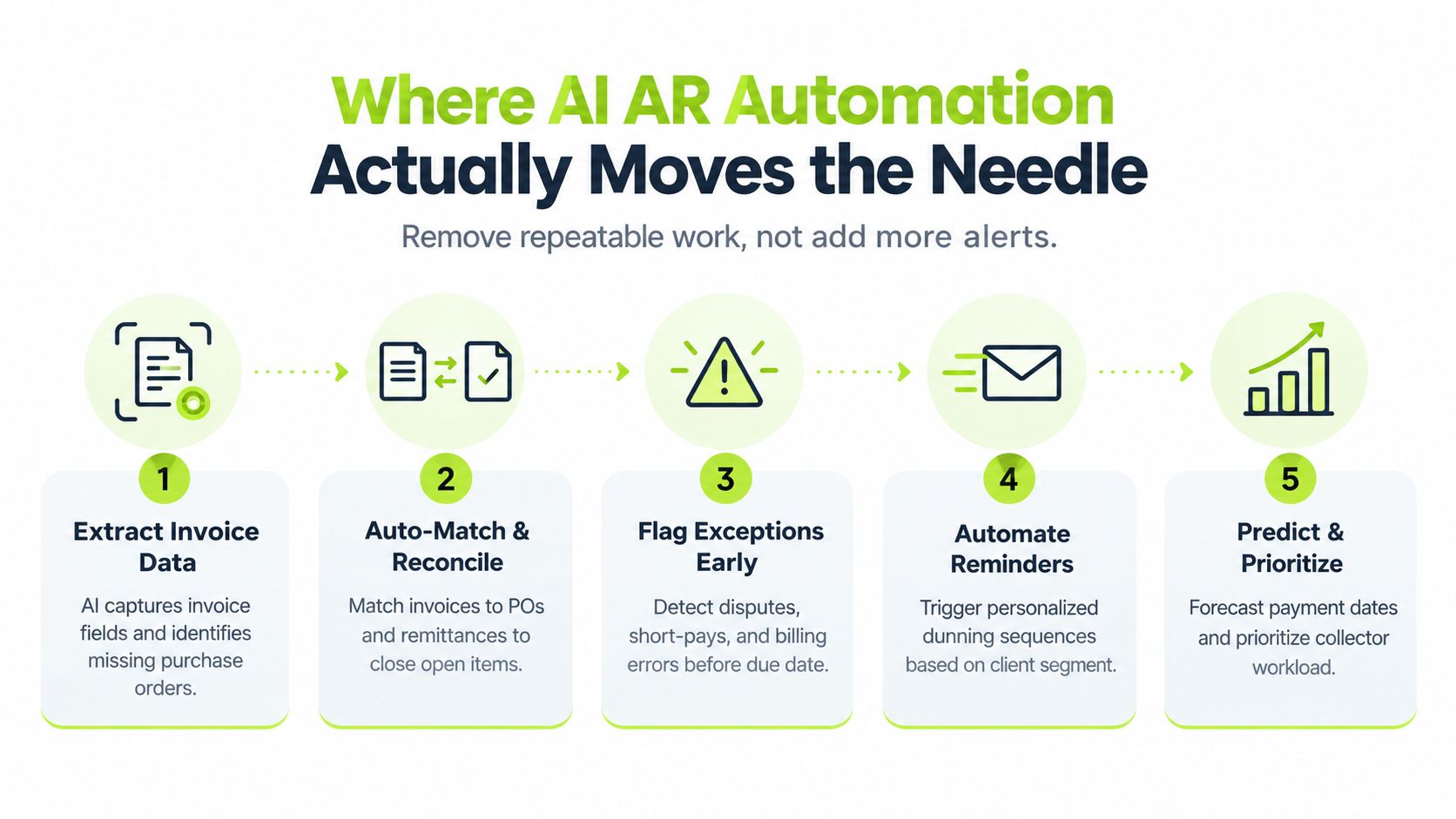
AI AR automation works when it removes repeatable work from a constrained workflow. It doesn't work when it adds another layer of alerts to a team that still lacks accurate invoices, reliable terms, or clear ownership.
The highest-value use case depends on the bottleneck. AI can extract invoice fields, identify missing purchase orders, match remittances, classify disputes, predict payment risk, recommend next actions, and trigger personalized outreach across email, portals, and phone. Those capabilities matter only when they connect to the firm's actual order-to-cash process.
Match automation to the constraint
Cash application often deserves the first test when remittance information arrives through multiple channels and unmatched payments create manual queues. Applying a payment quickly prevents collectors from contacting a client about an invoice that has already been paid, while also keeping the aging report credible.
Omnichannel outreach works best when a reminder reflects invoice history, the client's preferred channel, account owner, and dispute status. Predictive scoring can prioritize collector workload, but it shouldn't replace judgment. A strategic client with a legitimate billing dispute isn't equivalent to a smaller client that routinely ignores agreed terms.
Clean inputs come first:
- Invoice data: Required fields, purchase-order references, due dates, and approval status should be reliable.
- Customer records: Legal entities, contacts, payment methods, and account ownership must be current.
- Exception controls: Human review should remain available for disputes, short-pays, credit decisions, and sensitive escalations.
- System connections: ERP, CRM, billing, and project tools should share status changes with the teams creating revenue.
Measure cycle time from service completion to approved invoice, time spent applying cash, unapplied-cash aging, contact-to-payment rate, and DSO by cohort. Don't automate inaccurate invoices, aggressive language, or undocumented credit decisions. Automation scales defects as efficiently as it scales good controls.
For broader workflow design, Chatgrow's automation guide for businesses offers useful context on assigning repeatable customer communication to systems while preserving human handling for exceptions. In AR specifically, teams can also review AI for accounts receivable before selecting a pilot.
The practical sequence is simple: automate the bottleneck, test with one client segment, compare results, then expand only when controls and relationship safeguards hold.
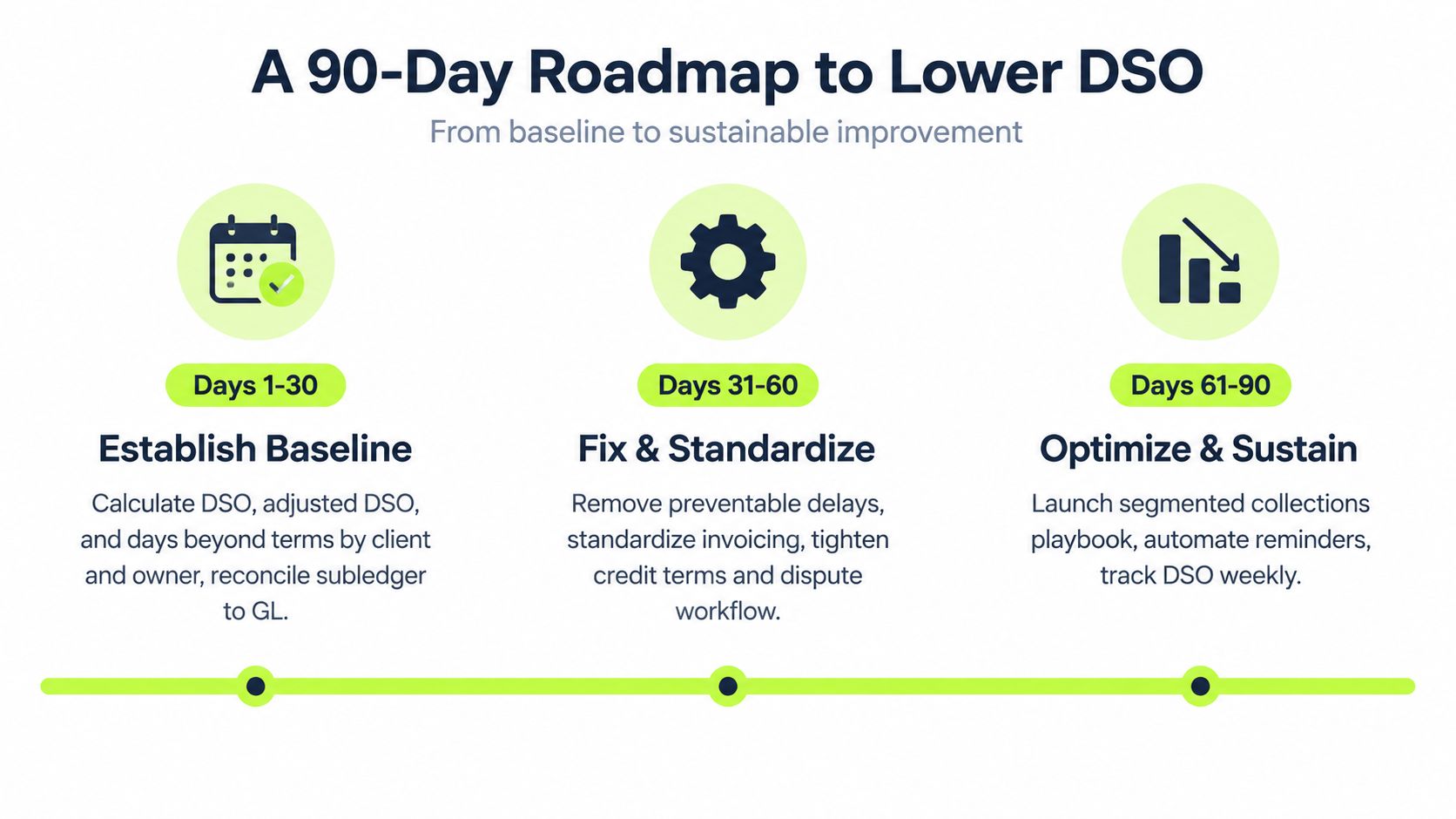
A 90-Day Roadmap to Lower DSO
A DSO program needs a sequence. Firms get into trouble when they buy software before they know whether the main constraint is invoice latency, terms governance, disputes, or cash application.
Days 1–30 establish the baseline
Calculate DSO, adjusted DSO, and DBT by client, service line, invoice owner, and payment terms. Reconcile the AR subledger to the general ledger, refresh aging, identify missing invoices, and document the main approval, dispute, remittance, and portal-friction drivers.
Assign an executive sponsor and one accountable AR owner. The first phase is complete only when the data is reconciled, owners are named, and the top ten overdue accounts have documented next actions.
Control point: Don't call the baseline complete while finance and the general ledger disagree about the receivable balance.
Days 31–60 repair the workflow
Set a clear timing standard for invoice delivery after service completion. Define billing service levels, approval rules for term exceptions, and a risk-based collections cadence. Pilot automated reminders and online payment options with one client group rather than changing the entire portfolio at once.
Train project managers to resolve billing issues during delivery. A missing approval record is easier to fix before the invoice reaches the client than after the due date has passed. Review invoice latency, dispute aging, response time, and promise-to-pay reliability every week.
Days 61–90 scale proven controls
Implement cash-application automation if remittance matching is a measurable constraint. Connect dashboards to escalation alerts, then review results with finance, delivery, sales, and client-service leaders.
Continue only when early improvements are stable, exceptions have owners, and DSO is declining without higher disputes, write-offs, or client escalations. A standardized AR workflow has been associated with an average 3-day DSO reduction, 59% better dispute resolution, and freeing up to 30% of working capital within weeks, according to accounts receivable best-practice guidance from Auxis. Treat those figures as a benchmark reference, not a promise for your firm.
Digitized invoicing can also compress the cycle. A European thematic report found that electronic invoices tend to settle 5 to 7 days earlier than paper invoices, as described in the European Commission's e-invoicing report. The decision should still follow the diagnosis. If disputes are the constraint, faster delivery alone won't solve the balance.
Preserve the roadmap as a recurring operating rhythm. Review portfolio DSO, ADD, DBT, dispute aging, unapplied cash, and client escalations regularly, then adjust ownership when the evidence changes.
Resolut automates AR for professional services through structured workflows, omnichannel outreach, payment handling, and cash application controls that keep finance and client-service teams aligned. If you're ready to reduce DSO without turning every late invoice into a client conflict, visit Resolut and assess where automation fits your receivables process.