
International Payments: CFO's Guide to Control & Cash Flow
CFOs, master international payments. Navigate costs, FX, & reconciliation to reduce DSO & boost cash flow with AR automation.
You win an international client. The engagement starts clean. The invoice goes out on time. Then the familiar mess begins.
A wire is “in process.” Your team can see that the client paid, but the funds haven't landed. The amount that finally arrives may be short. The remittance detail may be missing. Your controller is chasing the bank, your project lead is asking whether the client is late, and your cash forecast is already wrong.
That's the operational reality of international payments for many professional services firms. The issue isn't that global business is broken. It's that collection processes often stay local while the client base goes international.
That gap matters more than most firms realize. The global payments industry generated $2.5 trillion in revenue in 2024 from $2.0 quadrillion in value flows across 3.6 trillion transactions worldwide, according to McKinsey's Global Payments Report. For finance leaders, that scale makes one thing clear. Payments are not back-office plumbing. They're a working-capital system.
The Reality of Collecting International Payments
Selling abroad feels like growth. Collecting abroad feels like operations.
For a professional services firm, that difference shows up fast. Revenue is booked. Delivery starts. Payroll, contractor costs, and overhead continue on schedule. But the cash tied to that invoice often moves on a very different timeline, one you don't fully control unless you design for it.
A lot of firms still treat international collections as a one-off treasury task. That's too narrow. The payment method your client uses, the data attached to the transfer, the banks involved, and the way your team reconciles funds all affect cash flow, reporting accuracy, and your ability to reduce DSO.
What finance leaders usually notice first
The first sign is rarely a formal payment failure. It's noise.
- Forecast drift: Cash expected this week arrives later than planned.
- Manual follow-up: Finance staff spend time proving a payment was sent, received, or partially deducted.
- Aging distortion: An invoice can look open in the ledger even when money is somewhere in transit.
- Client friction: The client believes they paid. Your team believes they haven't. Both may be technically right.
International collections don't fail all at once. They fail through delay, ambiguity, and cleanup work.
That's why the firms that handle international payments well don't just “accept wires.” They set policy upfront. They standardize instructions. They control follow-up cadence. And they make reconciliation part of the collection design, not an afterthought.
The Anatomy of a Cross-Border Payment
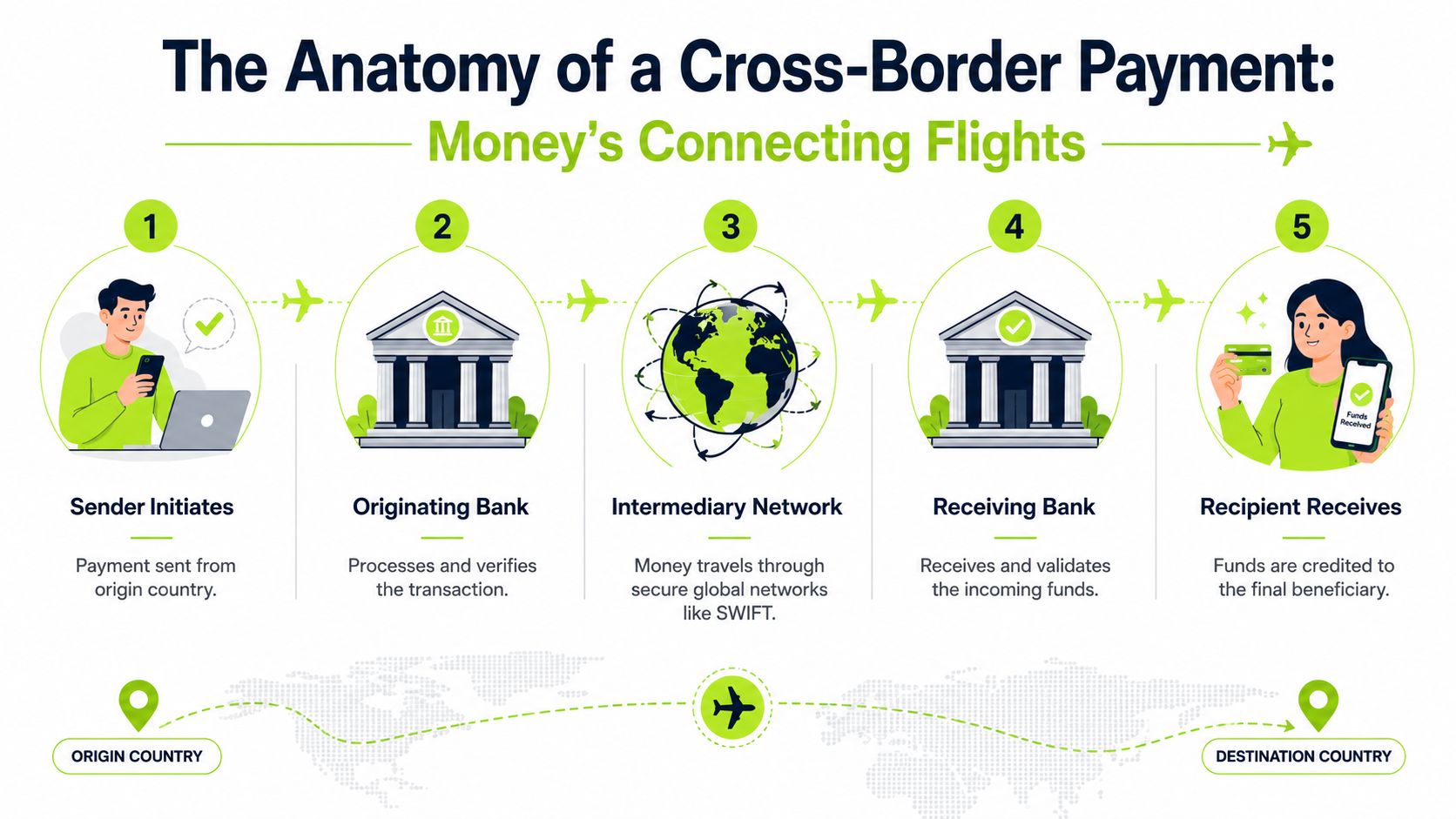
A cross-border payment often works like connecting flights for money. Your client sends funds from one country, but the payment may not travel directly from their bank to yours. It can pass through one or more institutions before it reaches your account.
That structure is still common at scale. Global cross-border payments are projected to exceed $250 trillion by 2027, up from more than $150 trillion in 2017, and most of that value still moves through correspondent banking chains with multiple intermediaries, according to ACI Worldwide's cross-border payments overview.
What actually happens
At a practical level, most finance teams only need to understand the flow well enough to diagnose delay and reduce preventable errors.
- The client initiates the payment from their bank using the beneficiary details you supplied.
- The originating bank reviews the instruction and checks whether the payment can move directly or needs an intermediary.
- The message moves through a network, often using SWIFT messaging standards, even though SWIFT itself is not the money.
- One or more intermediary banks may handle settlement if the two endpoint banks don't have a direct relationship.
- Your receiving bank credits the funds after its own checks and posting logic.
Why terms like SWIFT and IBAN matter
You don't need to become a bank operations specialist, but you do need to know what can break the chain.
A SWIFT instruction is the secure message that tells banks what to do. An IBAN is a standardized bank account identifier used in many countries. If the beneficiary name, account format, address, or bank code is incomplete or inconsistent, the payment may pause for review or arrive without enough context for clean posting.
A useful way to think about it is this:
Element | What it does | Why finance cares |
|---|---|---|
Payment message | Carries the instruction | Bad data creates delays and exceptions |
Bank relationships | Determine the route | More handoffs usually mean less visibility |
Intermediaries | Bridge banks without direct access | Fees and timing become harder to predict |
Beneficiary data | Identifies who gets paid | Errors turn a simple wire into investigation work |
For firms comparing providers or designing workflows, the routing layer matters as much as the collection policy. That's why payment teams often end up looking beyond bank portals and into broader payment orchestration models that standardize how instructions, rails, and reconciliation fit together.
The client sees one payment. Your finance team may be dealing with several institutions, multiple review points, and inconsistent data quality behind it.
Once you understand that, a five-day arrival window stops feeling random. It looks like what it is. A multi-step process with several places for friction to enter.
The Hidden Costs of International Collections
Most firms can see the explicit bank fee. That's the easy part.
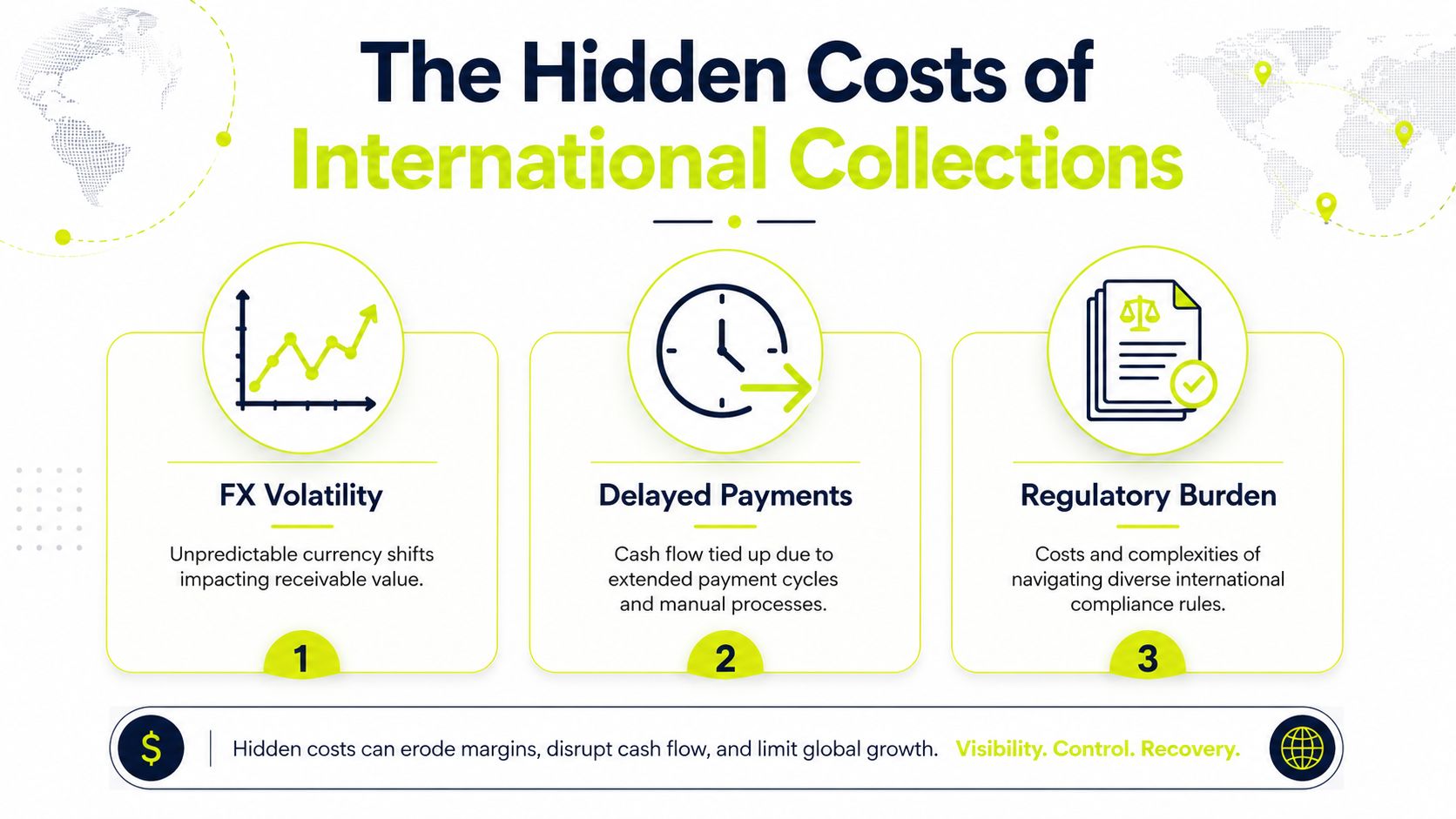
The harder problem is everything that sits around the payment. The uncertainty. The extra labor. The stalled close process. The hours your team burns on issues that never appear as a line item in the general ledger.
Cross-border retail payments still face four core problems: high costs, low speed, limited access, and insufficient transparency. The IMF also noted that payments remain slow and opaque, especially for SMEs, and correspondent banking relationships were 22% fewer than in 2011, according to the Financial Stability Board summary of cross-border payment frictions.
Cost one is forecast uncertainty
CFOs are the first to feel the impact. An invoice due at month-end doesn't behave like a domestic transfer. Cash may be sent on time and still arrive later than expected.
That creates a chain reaction:
- Collections reporting gets noisy: Your team debates whether an invoice is late or in transit.
- Cash positioning gets weaker: Planned disbursements sit against funds that haven't settled.
- DSO analysis gets less useful: Aging reports reflect process friction, not just customer behavior.
For firms trying to improve cash flow, that uncertainty matters as much as the direct fee. A payment that lands unpredictably is harder to manage than one that is expensive in isolation.
Cost two is compliance friction
International payments can stop for reasons your client doesn't understand and your accounting team didn't cause.
Additional documentation requests, sanctions screening, name checks, country-specific review, and beneficiary verification can all hold a payment midstream. The problem isn't just delay. It's that nobody on your team may have a clear answer while the hold is happening.
Operational truth: When a payment is under review, your client experience depends on how quickly your team can explain the hold and produce the right documentation.
That's one reason firms should audit collection methods by corridor and client type, not just by convenience. The cheapest-looking option can become the most expensive once manual exception work is included. If you're evaluating alternatives, it helps to compare the trade-offs across broader B2B online payment methods instead of treating every international payment like a standard wire.
Cost three is administrative drag
Here, margin often leaks imperceptibly.
An international payment that arrives short or unidentified usually triggers the same pattern. Finance checks the bank feed, searches the customer ledger, emails the client contact, asks for a remittance, checks whether fees were deducted, then decides whether to post a partial receipt or leave the invoice open.
None of that work is strategic. But it's real work. It pulls controllers into exception handling, keeps AR staff in detective mode, and slows down month-end cleanup.
A simple internal test helps expose the true burden:
Question | Why it matters |
|---|---|
How many incoming international payments arrive without clear invoice references? | This shows matching risk |
How often do amounts land short? | This reveals deduction and fee patterns |
How many emails or calls does each exception require? | This shows labor cost |
How long does the invoice stay open after funds arrive? | This captures reconciliation lag |
If you can't answer those questions cleanly, you probably have more AR friction than the bank fee report suggests.
Navigating Currencies Regulations and Risk
Controllers usually get pulled into international payments when something goes wrong. A payment is delayed. A client asks why the amount received doesn't match the invoice. A bank requests more support. By then, your choices are limited.
The better posture is to treat international collections as a risk management process. Not a treasury side topic. Not a one-time setup task.

Protect margin before the invoice goes out
FX exposure is often framed like a market decision. For most professional services firms, it isn't. It's a margin protection decision.
If you invoice in your home currency, the client carries the conversion burden. If you invoice in the client's currency, your firm takes on more exposure between invoice date and payment date. Neither option is universally right. The right choice depends on contract structure, client expectations, and how much rate movement your margin can absorb.
A practical policy usually covers:
- Which currencies you'll invoice in
- When rates are set for proposals and invoices
- Who absorbs transfer and conversion costs
- What happens when payment arrives short
Some finance leaders also watch market references during negotiation or billing review. If your team wants a simple external read on euro-denominated tokenized market activity, real-time Eurcv insights can be useful as context, especially when clients are increasingly aware of newer payment formats.
Know where compliance slows you down
Banks don't just move money. They also screen it.
That means a payment can be held because the beneficiary details don't line up cleanly, the supporting information is thin, or the destination triggers additional review. None of this is unusual. But many firms still operate as if a bank wire is automatic once the client hits send.
It isn't.
Ask your bank a plain question: what payment details and supporting documents most often trigger review for our client countries?
That one conversation is more useful than a generic compliance memo. It gives your team a checklist they can use before invoicing and before chasing “late” payments that are stuck in review.
A simple control framework works better than ad hoc fixes
The firms that manage this well don't overcomplicate it. They usually put a few controls in place and enforce them consistently.
- Standard payment instructions: One approved version, not custom details sent from individual inboxes.
- Country and client review: Flag jurisdictions or clients that regularly generate extra documentation requests.
- Invoice language: State currency, transfer responsibility, and required reference fields clearly.
- Escalation path: Decide who contacts the client, who contacts the bank, and when.
That's what control looks like in practice. Not perfect prediction. Fewer surprises, faster answers, and less preventable damage to cash flow.
The Reconciliation and Cash Application Nightmare
The wire hits your account on Thursday afternoon. Good news, at least at first.
Then your AR lead notices the amount is short. There's no clear invoice number in the bank memo. The client has two open invoices in a similar range. One project manager says the client mentioned paying “everything.” The client's AP contact is offline because of the time zone difference. Month-end is tomorrow.
That single payment can consume more time than sending the original invoice.
Why the last mile breaks down
Domestic bank transfers are usually easier to post because the data is cleaner and the payment path is simpler. International receipts are different. Fees may be deducted before funds arrive. Message fields may be incomplete. Naming conventions may not match your ERP or QuickBooks AR automation workflow. The result is that cash is in the bank, but not in the ledger where it needs to be.
That creates several problems at once:
- Open invoices stay open even though money has arrived.
- Collections outreach can fire at the wrong time because the system still sees a balance due.
- Aging reports lose credibility with leadership and client-facing teams.
- Month-end close slows down because staff must investigate exceptions manually.
Why data standards matter
Thus, payment data quality stops being a banking issue and becomes an AR issue.
The ISO 20022 global standard supports richer, more structured end-to-end payment data than legacy formats, which improves straight-through processing and data quality, according to SWIFT's overview of ISO 20022 for payments instructions. In plain terms, better structured payment data makes it easier to identify what the money is for and where it should be applied.
A payment isn't fully collected when it lands in the bank. It's collected when it's matched, posted, and no longer distorting your receivables.
That's exactly why many firms outgrow generic accounting workflows. QuickBooks is fine for recording transactions. It's not built to do deep investigative matching across messy inbound payment data at scale. When your team is spending too much time chasing remittances and clearing suspense items, the core issue isn't bookkeeping. It's the absence of an intelligent cash application process.
If that problem is familiar, it helps to look at dedicated approaches to automated payment reconciliation instead of expecting your GL to solve a bank-data problem by itself.
Automating AR to Improve International Cash Flow
Manual discipline still matters. Clean invoices, clear payment instructions, consistent follow-up, and documented escalation paths are the basics.
But once a firm is handling regular international payments, manual discipline stops being enough. The issue is scale. More clients, more currencies, more payment methods, more exceptions, and more chances for cash to go unapplied. That's where accounts receivable automation becomes less of a nice-to-have and more of an operating requirement.
Start with the client payment experience
A lot of AR pain begins before the money moves. The client gets an invoice with bank instructions, limited context, and no easy path to pay in the format they prefer. That increases delay before the payment is even initiated.
A better setup gives clients a controlled payment experience with clear references, approved methods, and fewer opportunities to submit incomplete information. For professional services firms, this matters because collections problems often begin as convenience problems.
The strongest setups usually include:
- Localized payment options: Clients can pay through methods they already trust.
- Clear reference capture: Invoice identifiers are attached at the moment of payment.
- Consistent communication: Reminders go out on schedule, not when someone remembers.
- Shared visibility: Finance can see what was sent, what was viewed, and what was paid.
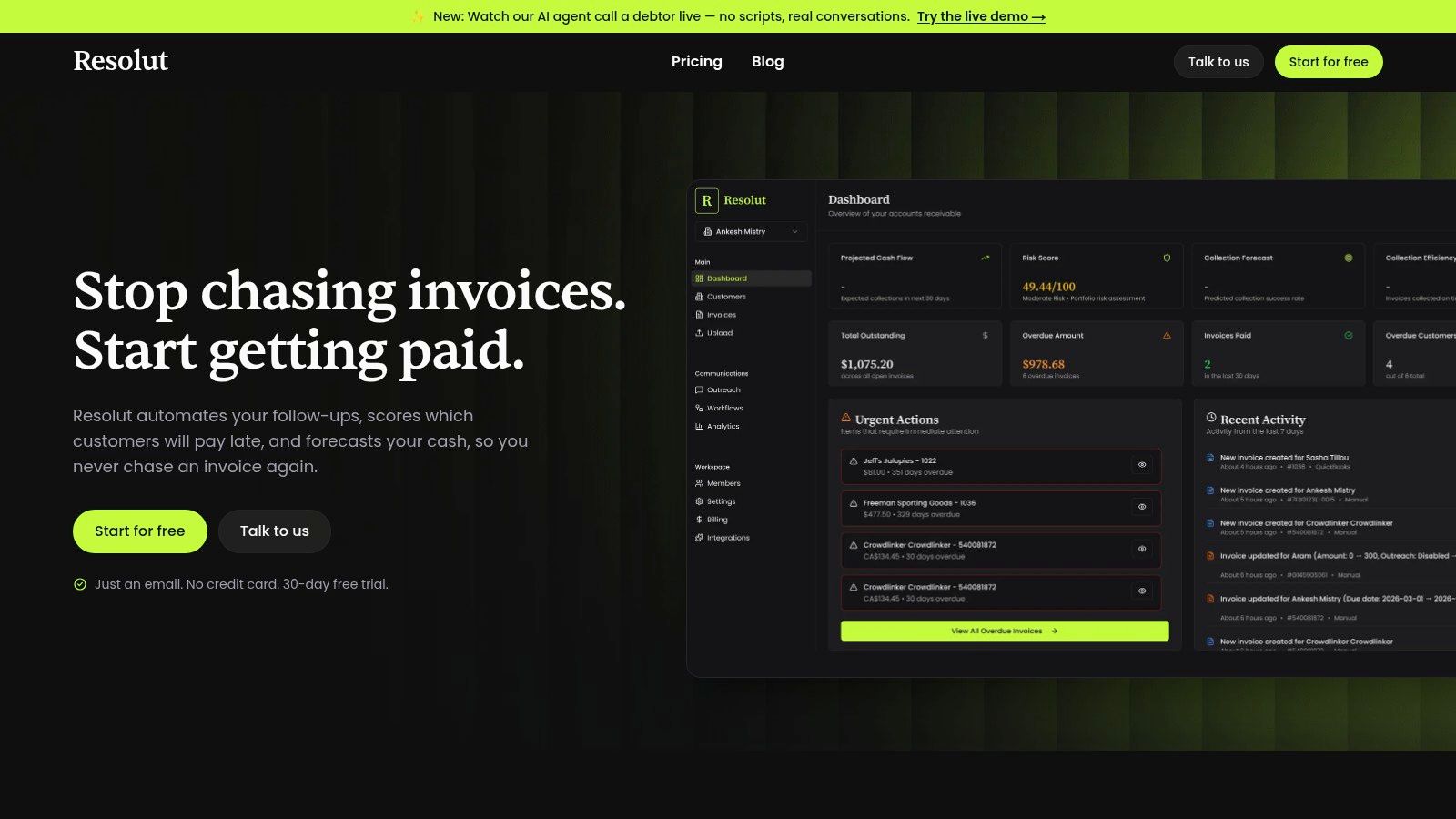
AR software for professional services offers an edge over patchwork workflows. It aligns invoicing, outreach, payment capture, and posting instead of splitting them across inboxes, spreadsheets, bank portals, and accounting records.
Use automation where humans are weakest
Finance teams are strong at judgment. They're not designed for repetitive timing and pattern recognition across hundreds of transactions.
That's why AI AR automation works best in the exact places international collections tend to break:
Workflow problem | What automation does better |
|---|---|
Follow-up inconsistency | Sends reminders and nudges on a defined cadence |
Missing remittance data | Pulls context from invoice, payer, and payment patterns |
Partial or short payments | Flags exceptions quickly and routes them for review |
Cross-system mismatch | Connects bank activity, invoice data, and ledger status |
The goal isn't to remove the finance team. It's to stop using skilled people as manual routers.
Build around settlement speed and data quality
Modern payment infrastructure shows what better operating conditions look like. The RTP network from The Clearing House provides instant final settlement, runs 24/7/365, supports transactions up to $10 million per payment, and is described as having zero scheduled downtime, according to The Clearing House RTP network overview.
For international collections, the lesson isn't that every cross-border payment now behaves like RTP. It doesn't. The lesson is that speed only helps when the data is strong enough to support it. Fast settlement with weak beneficiary and remittance data just creates faster exceptions.
Practical rule: Don't automate bad inputs. Standardize invoice data, beneficiary details, and payment references before you try to accelerate collections.
Some finance leaders also monitor emerging infrastructure providers when evaluating future-ready payment models. If you're surveying new rails or hybrid architectures, this web3 fintech development company offers a useful example of the kind of technical partner operating in that broader ecosystem.
A short demo helps make the shift concrete:
What good looks like in practice
The best international AR workflows don't feel dramatic. They feel quiet.
Invoices go out with the right data. Clients get predictable reminders. Payment methods are easy to use. Funds arrive with enough context to post quickly. Exceptions are routed instead of buried. Finance can see what is overdue versus what is in transit or under review.
That's how you reduce DSO without damaging the client relationship. Not through harder collection language. Through a system that removes ambiguity from the cash cycle.
For firms already trying to bolt reminders and bank matching onto accounting software, this is usually the turning point. QuickBooks AR automation by itself won't solve cross-border complexity unless it's paired with stronger workflow control, payment visibility, and automated cash application logic.
Taking Control of Your Global Cash Cycle
International payments create friction, but they aren't random. The delays, short pays, missing references, and reconciliation problems follow recognizable patterns.
That's good news for finance leaders, because recognizable patterns can be controlled.
The firms that do this well treat international collections as an operating system. They decide how clients should pay, what data must travel with the payment, who handles exceptions, and how the cash gets applied once it lands. They don't wait for the bank feed to tell them what happened.
For professional services firms, this matters beyond treasury. Collection quality affects client experience, reporting accuracy, and confidence in your cash forecast. It also shapes how much time your team spends on actual finance work instead of chasing proof, remittance, and posting detail.
You don't need perfect global payment infrastructure to run a disciplined process. You need cleaner inputs, better visibility, and automation in the parts of AR that break under manual load.
Resolut automates AR for professional services, helping firms reduce DSO, improve cash flow, and bring consistency to billing, follow-up, and cash application. It's a practical way to make collections more accurate, more predictable, and still human.