Journal Entries for Write Offs: A CFO's Guide to Control
Master journal entries for write offs with this guide for CFOs. Covers bad debt, inventory, and asset impairment with GAAP and tax-compliant examples.
You open the aging report expecting the usual mix of current, stretched, and uncomfortable. Then one invoice stops looking late and starts looking gone. Maybe the client is disputing work long after delivery. Maybe the contact left. Maybe legal escalation has gone quiet. Whatever the reason, the accounting question arrives before the cash does.
That's the moment journal entries for write offs stop being clerical. They become a test of control. For a CFO or controller in a professional services firm, a write-off tells you whether your credit process, collections cadence, and reporting discipline are working.
It also tells you where operations are leaking into finance. Slow approvals, weak follow-up, poor documentation, and fragmented systems usually show up in receivables before they show up anywhere else. If you're trying to reduce DSO, improve cash flow, or evaluate AR software for professional services, write-offs are one of the cleanest signals in the business.
Beyond the Ledger Write Offs as a Business Metric
The finance leader usually sees the problem before anyone says it out loud. The aging report stretches. Notes in the customer record get thinner. Promises to pay stop sounding credible. At that point, the write-off decision is no longer about optimism. It's about whether the balance sheet will continue carrying an asset the firm is unlikely to collect.

What a write-off is really telling you
A write-off isn't just an accounting cleanup. It's feedback from the operating model.
If the same client profile keeps appearing in write-offs, your intake standards may be loose. If write-offs cluster by partner, service line, or office, the issue may sit in billing discipline or collections follow-up. If disputes appear late in the cycle, engagement scoping may be weak.
Practical rule: Treat every write-off as a post-mortem on process, not just a loss entry.
That matters because bad debt rarely begins as bad debt. It usually begins as delayed invoicing, unclear billing support, weak follow-up, or a team that hesitates to escalate because they don't want to damage the client relationship.
Why CFOs should track the pattern, not just approve the entry
In professional services, receivables are a proxy for execution quality. When firms rely on manual reminders, inconsistent notes, or disconnected systems, the finance team loses visibility into which invoices are drifting from collectible to doubtful.
That's why accounts receivable automation and AI AR automation matter operationally, not just administratively. Better workflows don't change the journal mechanics. They reduce how often you need them. The strongest teams use write-off history to tighten approval rules, refine collection timing, and improve invoice quality upstream.
A write-off should close a file. It should also open a conversation.
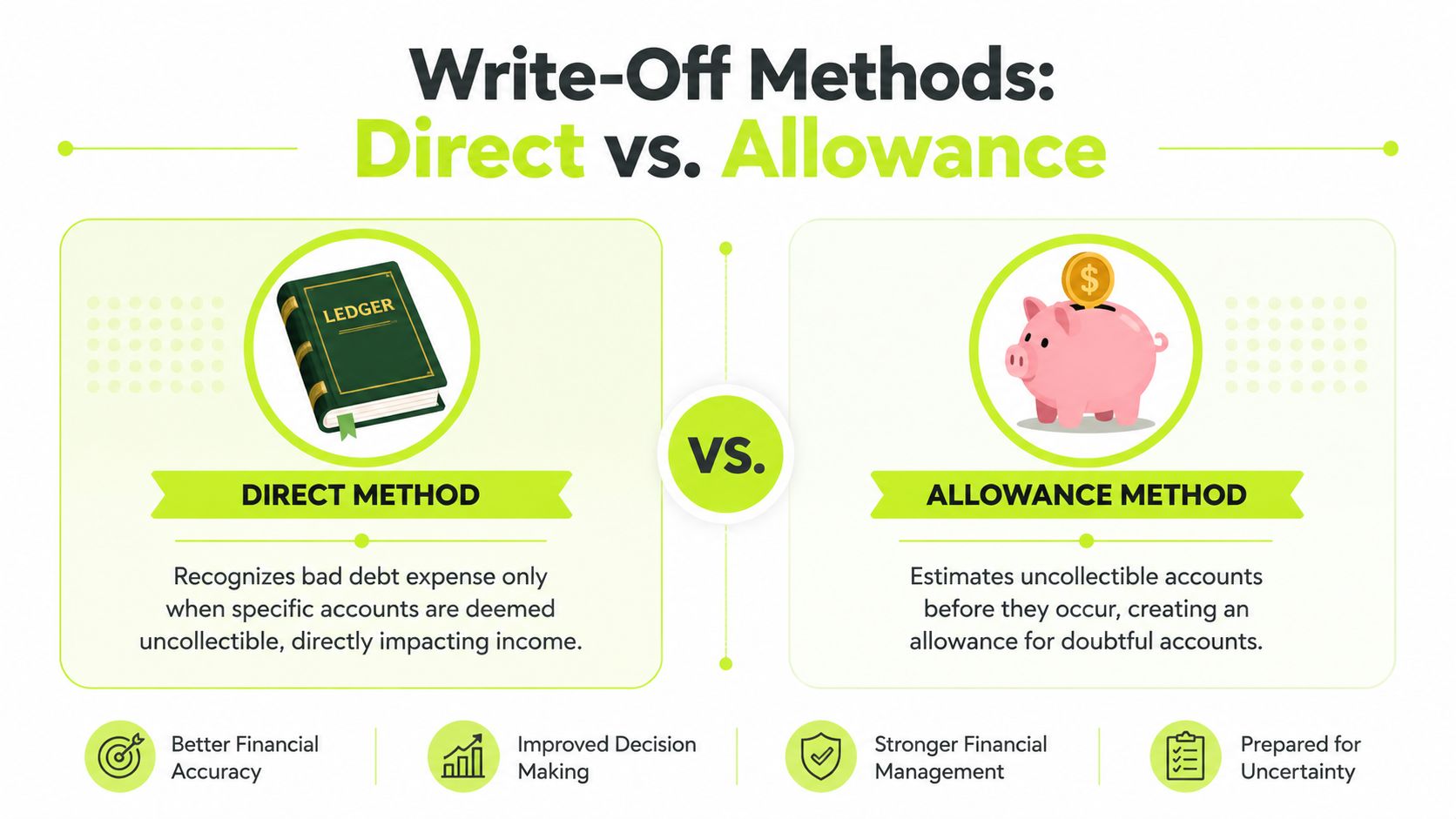
The Two Write Off Methods Direct vs Allowance
A controller usually sees the problem before the board does. AR aging starts to stretch, the collections notes get thinner, and then quarter-end arrives with a stack of accounts that need a decision. At that point, the method matters because it changes expense timing, balance sheet presentation, and how cleanly the team can support the entry in an audit file.
Side by side comparison
Method | Core entry at write-off | Primary use | What it means in practice |
|---|---|---|---|
Direct write-off | Debit Bad Debts Expense, credit Accounts Receivable | Tax reporting in many cases | Expense is recognized only after a specific balance is deemed uncollectible |
Allowance method | Debit Allowance for Doubtful Accounts, credit Accounts Receivable | GAAP and IFRS-based financial reporting | The receivable comes off the books without creating new bad debt expense on the write-off date |
The difference is not technical trivia. It affects how leadership reads earnings quality and how lenders, owners, and auditors assess receivables.
Under the direct write-off method, the loss hits the P&L only when a specific customer balance is written off. That makes the method easy to explain for tax purposes because the deduction is tied to an identified failed receivable. It also makes results uneven. A slow collections year can look fine until several old accounts are finally written off in the same period.
The allowance method solves a different problem. It records expected credit loss earlier through an estimate, then uses that reserve when a particular invoice is written off. The write-off entry clears the receivable against the allowance, so the expense was already recognized in an earlier close. That gives finance leaders a more disciplined view of net realizable AR and a cleaner period-to-period comparison.
What finance teams get wrong
The common failure is mixing the two models in one reporting book. A team carries an allowance all year, then someone posts a direct bad debt expense entry at write-off because that is the simplest journal they remember. The result is misstated expense, a reserve that no longer reconciles, and extra audit work during close review.
Three practical rules help avoid that:
- Use direct write-off where policy and tax treatment call for account-specific recognition.
- Use the allowance method for external financial statements that need expected loss recognition and a supportable reserve balance.
- Map each method to the correct ledger and approval path before close begins.
That last point is a control issue, not a preference.
The policy decision also has cash flow implications. Neither method changes the cash already lost on a bad invoice, but the allowance method gives earlier visibility into deterioration in the receivables pool. That helps a CFO adjust collection staffing, credit terms, and forecast assumptions before losses pile up. Direct write-off is simpler. Allowance is usually better for managing the business.
If your team needs a concise reference on the tax and reporting distinction, Allied Tax Advisors' bad debt accounting is a useful checkpoint.
Set the framework before the first write-off request
Do not leave this decision to whoever is booking journals at month-end.
Define which books use allowance accounting, where direct write-off is permitted, who approves customer-specific write-offs, and what documentation is required. Strong teams also tie that policy back to AR workflow data. If disputed invoices, broken promise dates, or repeat late payers are visible early through AR automation, the finance function can reduce future write-offs instead of just recording them accurately.
Executing Common Write Off Journal Entries
A write-off request at 4:45 p.m. on close day usually exposes the same weaknesses. The customer history is incomplete, the wrong account gets selected, or the support package cannot survive audit review. The journal entry itself is simple. The decision to post it, and the way it is documented, affects reporting quality, collection discipline, and how much avoidable cash leakage the business tolerates.
Bad debt under the direct method
Use the direct method when a specific receivable has been judged uncollectible and policy allows expense recognition at that point.
Entry
- Debit Bad Debts Expense
- Credit Accounts Receivable
If a $2,000 invoice is written off, the entry is Dr Bad Debts Expense $2,000 and Cr Accounts Receivable $2,000.
This posts cleanly, but it also pushes the loss into the current period. That matters in close review. If finance delays the decision for weeks, the P&L tells the story late and management loses time to react. The write-off file should show the customer, invoice, aging status, dispute notes if any, collection attempts, and the approval tied to policy.
Bad debt under the allowance method
Under the allowance method, the write-off clears a specific receivable against the reserve that was set up earlier.
Entry
- Debit Allowance for Doubtful Accounts
- Credit Accounts Receivable
Cornell's receivables write-off guidance reflects the core rule finance teams need to protect in close. Writing off a specific account under the allowance method does not create new bad debt expense in the period of the write-off.
If the team previously established an allowance and later identifies a $2,000 customer balance as uncollectible, the entry is Dr Allowance for Doubtful Accounts $2,000 and Cr Accounts Receivable $2,000. Gross receivables decline. The allowance declines by the same amount. Net realizable value stays the same.
If current-period bad debt expense moves when a single account is written off under the allowance method, review the entry before posting.
That mistake is common in decentralized environments where collectors, billing staff, and accounting each touch the account in different systems. It creates noise in the P&L and weakens reserve analysis. For a controller or CFO, that is not just a bookkeeping issue. It reduces confidence in forecast accuracy and makes quarter-end reserve discussions harder than they need to be.
Documentation that protects the entry
The journal is only half the work. The support package is what holds up in audit, in management review, and in any later recovery discussion.
A sound write-off package should include:
- Customer-level detail: Customer name, invoice number, original amount, remaining balance, and the exact amount being written off
- Collection record: Aging data, dunning history, internal notes, dispute status, and evidence of collection attempts
- Approval trail: Named approver, approval date, policy reference, and any threshold-based escalation
- Ledger traceability: Journal entry number, posting date, preparer, reviewer, and clear cross-reference to the subledger
Good documentation also improves cash decisions. Finance can separate a true credit loss from an invoice that stalled because of billing errors, weak follow-up, or an unresolved service issue. Teams trying to reduce those preventable losses usually get more value from better delinquent account handling processes than from arguing over the entry after the balance has already gone bad.
Other write-offs finance teams encounter
Receivables get most of the attention, but they are not the only balances that get written off. Controllers also deal with inventory that no longer has value, fixed assets that have been retired, and project-related balances that no longer meet capitalization criteria.
Here is the practical treatment:
Scenario | Typical accounting treatment | Operational trigger |
|---|---|---|
Obsolete inventory or materials | Remove the asset and recognize the loss in the expense account required by company policy | Items are unusable, unsellable, or no longer support current operations |
Impaired or retired fixed assets | Remove or reduce the carrying amount and record the related loss under company policy | Asset is retired, impaired, or no longer provides economic benefit |
The exact accounts depend on the chart of accounts, capitalization policy, and reporting framework. Copying a generic ERP entry is a control failure waiting to happen. The posting has to match the business event, the policy, and the documentation behind it.
What breaks the process
Three patterns create recurring problems.
- Writing off old balances without enough evidence. Age alone does not prove an invoice is uncollectible.
- Letting operating teams make the final call. Sales, delivery, and customer success can provide context. Finance should approve the accounting outcome.
- Using write-offs as a substitute for collections management. If the same customer profile, dispute type, or billing error keeps appearing, the entry is only recording the loss, not fixing the cause.
Strong AR automation helps on the prevention side. Centralized notes, dispute tracking, promise-to-pay monitoring, and structured follow-up give finance better evidence for write-off decisions and better visibility into which losses were avoidable. That improves audit readiness, supports cleaner reserve analysis, and protects cash before the journal entry is ever needed.
Advanced Scenarios Recoveries and Reversals
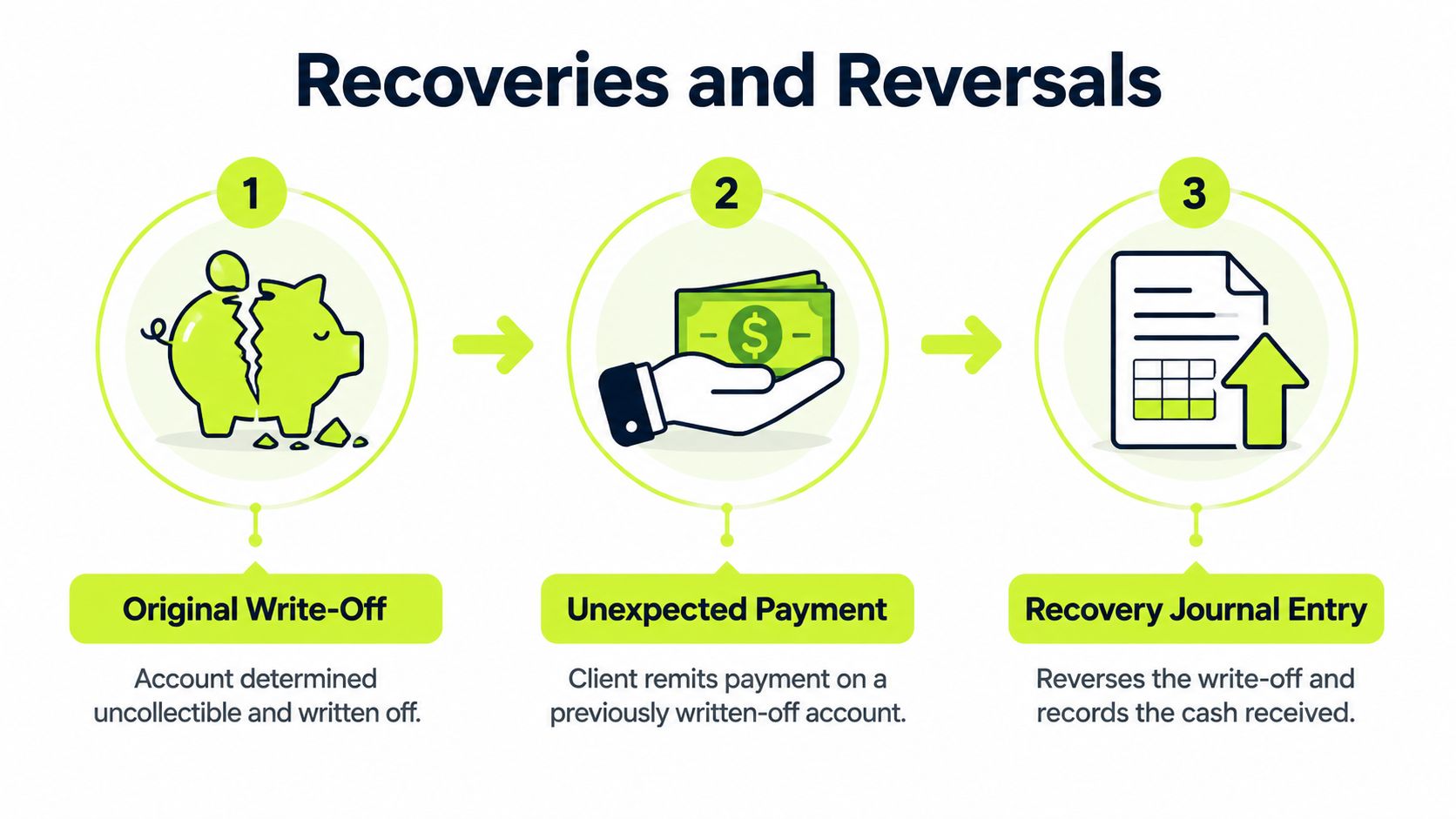
A write-off doesn't always end the story. Sometimes a client pays after legal pressure, after a new contact takes over, or after a dispute cools down. That's good news for cash. It also creates a point where sloppy accounting can distort results quickly.
Recoveries under the direct method and allowance method
At a basic level, teams often know the reversal pattern. The harder question is which path applies to which prior write-off.
Under the direct method, a common reversal approach is to reinstate the receivable before recording the cash receipt. In practice, teams often use a reversal entry that debits Accounts Receivable and credits Bad Debt Expense, then record cash collection separately. That keeps the audit trail visible and shows the original write-off was reversed before payment cleared.
Under the allowance method, the treatment should stay within the allowance structure rather than bypassing it. That preserves consistency with the original accounting.
Partial recoveries need more discipline
Tutorials often lack extensive detail on this point. Partial recoveries are common, especially after legal escalation or renewed contact with the client, but the accounting needs to stay tied to what was previously written off.
ASC 326-20-30-1 requires entities to include “expected recoveries of amounts previously written off” within the allowance valuation account, but these “shall not exceed the aggregate of amounts previously written off”, as noted in the discussion of bad debt recoveries and ASC 326 treatment.
That matters for controllers because a recovery shouldn't become a backdoor way to overstate the valuation account. Keep the recovery anchored to prior write-off history.
Recovered cash is good news. Overstated recovery accounting is not.
A workable process for finance teams
Use a disciplined flow:
- Confirm the original method: Check whether the debt was written off under direct write-off or through the allowance account.
- Reinstate only as needed: If your policy requires reinstatement before cash posting, reverse only the amount tied to the recovery.
- Record cash separately: Don't net cash directly into revenue. A recovery is not new revenue.
- Review partial recoveries carefully: Make sure the amount recognized does not exceed what was previously written off.
For teams tightening this process, it helps to pair accounting policy with collection workflow. A practical reference on escalation paths and account handling sits in Resolut's guide to handling delinquent accounts.
Where firms usually make the mistake
They credit revenue. Or they skip the reinstatement logic entirely. Or they recover part of a balance and fail to connect it to the prior write-off record.
All three create noise in reporting. The fix is simple: tie every recovery to the original write-off entry, original method, and client-level support. If your team can't trace those links quickly, the process isn't ready for audit.
Financial Statement Impact and Tax Strategy
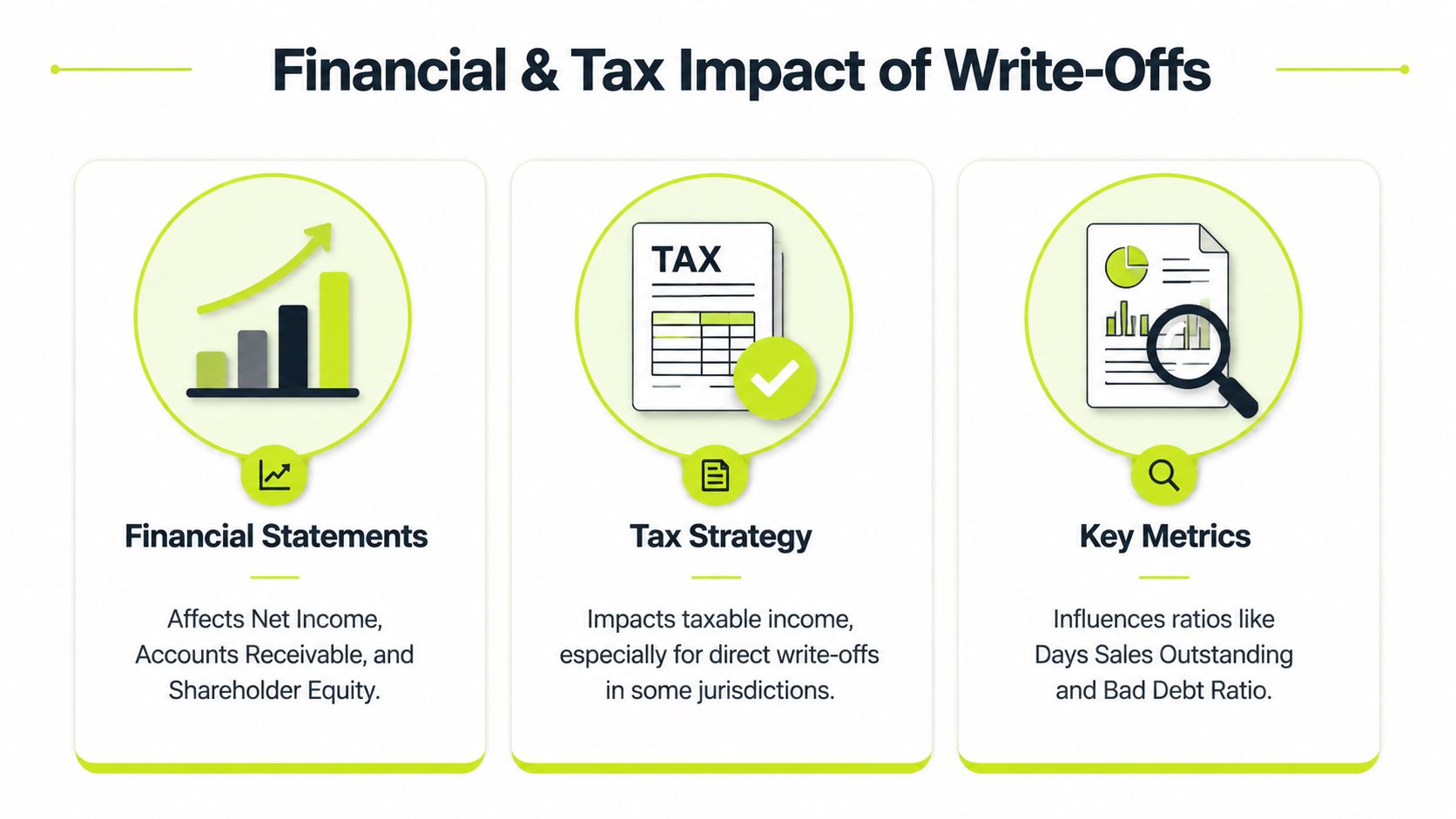
Month-end closes cleanly. The aging does not. A receivable sits on the balance sheet at full value, but collections have stalled, leadership is asking about cash conversion, and tax wants to know whether the loss is deductible now or later. That is where write-off accounting stops being a bookkeeping task and becomes a finance leadership issue.
What the write-off changes in reporting
The accounting entry is simple. The reporting consequences are not.
Statement | What changes | Why leadership should care |
|---|---|---|
Income statement | Bad debt expense is recognized, or an existing reserve is used | Affects margin quality, forecast accuracy, and period comparability |
Balance sheet | Accounts receivable drops, or receivables and allowance both decline | Sharpens the view of asset quality and working capital |
Cash flow statement | No operating cash is collected from that balance | Highlights the gap between reported revenue and actual cash conversion |
Under the direct method, the write-off hits expense when the account is judged uncollectible. Under the allowance method, the expense was recognized earlier through the reserve, so the later write-off usually clears the receivable against that reserve. Same customer outcome. Different timing in the financials.
That timing matters in board reporting. A team can appear to have stable margins under the allowance method while cash collections are weakening underneath. Gross AR can also overstate the picture if the reserve is thin or stale. For that reason, finance teams should tie write-off activity back to net collectible value, not just billed revenue. This explanation of net realizable value in accounts receivable is a useful reference if you need a concise framework for internal reporting.
Tax treatment needs planning, not assumptions
Book write-off and tax deduction are not always aligned. That gap creates timing questions that affect forecasts, effective tax rate discussions, and owner expectations.
The right tax treatment depends on jurisdiction, entity structure, and the nature of the item written off. Some write-offs are deductible when specific conditions are met. Others are limited, deferred, or handled differently for tax than for book purposes. Finance should not wait until return prep to sort that out. The cleaner approach is to tag write-offs by type, keep support with the entry, and review questionable balances with tax before year-end.
That discipline helps in two ways. It reduces rework during provision and return preparation, and it prevents management from treating every accounting write-off as an immediate tax benefit.
For firms that look at write-offs beyond receivables, examples from other asset categories can help frame the policy discussion. financial strategies for property investors is one example of how write-off treatment changes planning decisions when the asset base is different.
Audit readiness affects credibility
Auditors rarely focus on the debit and credit alone. They focus on judgment, timing, and support.
A write-off should tie back to aging detail, collection history, dispute notes if relevant, approval evidence, and a clear rationale for why recovery is no longer expected. If that support is scattered across inboxes and spreadsheets, the audit issue is not the journal entry. The issue is control failure.
This also affects cash flow management. If finance cannot explain why balances were written off, it usually cannot explain why those balances were allowed to age in the first place. That is the strategic angle many teams miss. Write-off analysis should feed credit policy, billing accuracy review, escalation timing, and AR automation priorities so the next quarter carries fewer losses.
A short explainer can help frame the issue internally:
What boards and owners actually need to hear
Boards do not need a walkthrough of the entry. They need the operating meaning behind it.
Use language like this:
- The write-off improves balance sheet accuracy: it removes an asset that is no longer expected to convert to cash.
- The write-off has a cash flow implication: revenue was booked earlier, but collection failed, so forecasted cash needs to be revisited.
- The write-off tests reserve quality: if write-offs are rising faster than the allowance, expected loss assumptions may be behind reality.
- The write-off points to a fixable process problem: weak onboarding, billing disputes, poor follow-up, or late escalation usually show up here before they show up anywhere else.
That is the board-level value of this analysis. It links accounting mechanics to audit readiness, reserve quality, tax planning, and the practical question every finance leader gets asked. How do we protect cash and reduce the next round of write-offs?
Controls Audits and Reducing Future Write Offs
The best write-off strategy is fewer write-offs. Not fewer approvals. Fewer failures upstream.
That starts with internal controls. Every firm should define who can recommend a write-off, who can approve it, what documentation is required, and how the entry is tracked in the ledger. If those rules are loose, teams start using write-offs as a convenience tool instead of a controlled accounting action.
The control stack that actually works
A practical write-off control environment usually includes:
- Segregated authority: Operations can explain the client situation. Finance approves the accounting.
- A documented threshold policy: Larger write-offs should require higher review.
- A complete support file: Aging detail, collection attempts, dispute notes, and approval evidence should live together.
- Post-write-off review: Periodically look for patterns by partner, client type, or service line.
For firms formalizing this structure, accounts receivable internal controls is a useful checklist.
Prevention is now a systems question
Most receivable losses don't begin with a failed journal entry. They begin with inconsistent outreach, late escalation, poor visibility, and manual workarounds. That's why finance teams increasingly evaluate accounts receivable automation, AI AR automation, and QuickBooks AR automation as control tools, not just efficiency tools.
The practical benefits are straightforward:
- Earlier intervention: At-risk invoices get flagged before they become stale.
- Consistent follow-up: Outreach happens on schedule, not when someone remembers.
- Cleaner notes and audit trails: Every touchpoint is easier to trace.
- Better cash discipline: Teams can improve cash flow by acting before balances drift into write-off territory.
Good automation doesn't replace accounting judgment. It gives the team better timing, cleaner evidence, and fewer preventable losses.
If you're evaluating AR software for professional services, that's the lens to use. Don't start with feature lists. Start with control outcomes. Can the system make collections more consistent, documentation more reliable, and write-offs less frequent? If the answer is no, it's not solving the finance problem.
Visual ideas that work well for this topic include a rolling aging waterfall by invoice status, a month-by-month write-off trend against collections actions, and a simple flow showing invoice issue, follow-up, escalation, and final accounting disposition.
Resolut automates AR for professional services, consistent, accurate, and human. If you're focused on tighter collections, cleaner support for write-offs, and better cash discipline, Resolut is worth a look.