Message Personalization for AR Collections That Works
A practical playbook for message personalization in AR and collections. Build segments, tone, and cadence that reduce DSO without losing client trust.
Tuesday morning, the collections queue is already crowded. There are 120 overdue invoices, six templates in rotation, and a “Friendly Reminder” queued for an account that is 90 days past due. The message is polite, accurate, and almost useless because it tells the client nothing about the specific file your team needs resolved.
That pattern is familiar at professional services firms between $3M and $50M in revenue. Finance teams know which invoices are late, but their systems often treat every late invoice as the same conversation. Effective message personalization changes that. It uses invoice facts, payment behavior, dispute status, contact history, and client preference to make outreach precise without making it intrusive.
The objective isn't to sound clever. It's to reduce DSO, improve cash flow, and protect the relationship while giving collectors a clear point to intervene.
Why Most AR Messages Sound Generic and What It Costs You
By Tuesday afternoon, the queue has become a production line. An invoice reaches a threshold, the system selects a template, and the same language goes out whether the client is usually dependable, has disputed the work, or has already promised to pay. The process feels controlled because every invoice receives attention. In practice, it often hides whether the attention is appropriate.
A generic reminder signals that nobody reviewed the account. “Please remit payment at your earliest convenience” might be reasonable for a recent missed payment, but it feels careless when the client has already explained a billing issue or committed to a payment date. The client has to repeat information your team should already have.
That creates more than irritation.
- Dispute handling gets weaker: If the message ignores a known question about scope, time entries, or approval, the recipient may reply by reopening the entire issue instead of confirming the undisputed balance.
- Payment conversations slow down: A reliable client may not know whether the message requires action, while a chronically late account receives the same low-pressure cadence.
- Collector judgment gets buried: When every reminder looks identical, the queue doesn't show which accounts need resolution, negotiation, or escalation.
- Trust deteriorates: Professional services clients expect their advisors to understand context. A message that overlooks the last conversation can make the finance function appear disconnected from the engagement team.
McKinsey's 2018 consumer survey remains a useful historical benchmark. More than 50% of respondents in every market surveyed frequently received personalized messages, including 62% in the U.S., 60% in France, 55% in Germany, and 53% in the UK. Yet only 40% of personalized messages felt personal, as summarized in this historical overview of personalization benchmarks. The lesson applies directly to collections: personalization became common before it became contextual.
Collections rule: A message feels personal when it proves the sender understands the account, not when it inserts the recipient's first name.
The cost also appears in operational drag. A uniform cadence sends the same number of touches to low-risk and high-risk accounts, so collectors spend time chasing the wrong invoices while urgent files wait. An account with a missed promise needs a different next action from one that crossed the due date.
Finance leaders looking for a broader relationship perspective can also review how modern AR automation protects client relationships. The practical starting point is diagnosis. Before changing copy, identify which account facts your current messages fail to acknowledge.
For visual inspiration, personalized mail creative examples show how content can adapt to recipient context. In AR, the equivalent isn't a more elaborate design. It's a message that references the correct invoice, status, commitment, and next step.
The Data That Makes a Message Feel Personal
A collector opens the account record and sees the invoice age, prior promises, and dispute status in separate places. The outbound message still says only “your balance is overdue.” That gap makes personalization fail in practice. The finance system already holds the useful inputs, but teams must connect them to the next action.
Start with the invoice age field, stored as a due date, aging bucket, or days-past-due value in the ERP or AR platform. A one-day delay calls for different language from an invoice that has passed several collection cycles. Age sets urgency and helps choose cadence, while the message still needs account-specific context.
Use the client's payment history, drawn from paid-date and invoice-status fields. If the client usually pays after an internal approval cycle, ask whether approval is complete and whether anything is missing. A pattern of late payment calls for a firmer request for confirmation and, where appropriate, human review.
The invoice amount relative to the client's average invoice adds another useful signal. Compare the current invoice record with prior invoices for that customer. An unusually large amount may require a supporting explanation, purchase order, or project reference before the payment request can succeed. That detail can prevent a collector from treating a processing question as resistance.
Strong signals and weak signals
An open dispute belongs in a dispute-status or case field. A prior promise-to-pay date belongs in the collections activity log with its outcome. The message should distinguish a kept promise from one that remains pending or has lapsed, because each state requires a different follow-up.
Channel history also affects message choice. CRM activity, email replies, SMS responses, and call outcomes show where a named contact engages. Contact stability comes from the customer master record and relationship history. If the billing contact changed recently, confirm ownership before discussing escalation or assuming the previous contact still controls payment.
The weak signals are familiar:
- First-name insertion:
Hi {{client_name}}identifies the recipient but supplies no account context. - Generic status language: “Valued customer” does not explain what requires action.
- Send-time optimization alone: A convenient delivery time cannot rescue irrelevant wording.
- Decorative personalization: An industry or company reference adds little while the invoice issue remains unclear.
A practical guide to managing customer communication can help teams connect these fields to a consistent operating process. Set a minimum data standard for every automated message: the correct invoice, current status, relevant commitment, and clear next step. Leave fields blank rather than inserting stale or uncertain information.
Marketing engagement benchmarks may suggest that personalization improves opens, clicks, and transaction activity, but collections teams should use those benchmarks directionally rather than treat them as targets. The finance measures are different: whether the client replies, pays, disputes the invoice, or makes a credible commitment. A message feels personal when its facts change the recipient's next action.
Building Segments That Drive Faster Payment
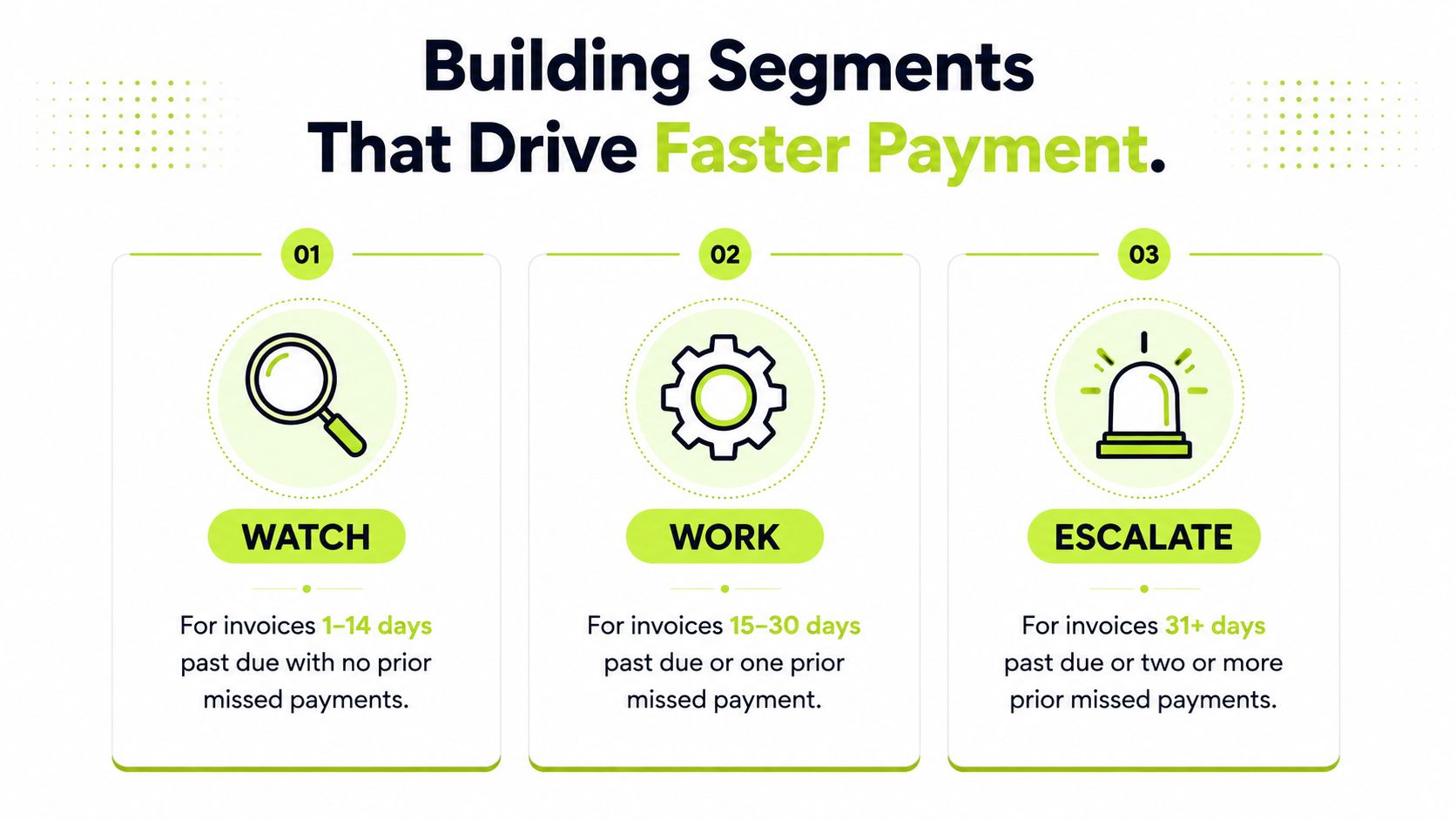
A useful AR segment is a living state, not a spreadsheet tab. It changes when an invoice crosses an aging boundary, a promise-to-pay date lapses, or a dispute gets logged. The following three-cohort structure gives a professional services firm a workable starting point.
Watch
Watch contains invoices 1 to 14 days past due with no prior broken promise-to-pay. The dominant treatment is a low-friction reminder that confirms receipt, states the invoice number and due date, and asks whether anything is blocking processing.
The expected response window is short and reasonable. Give the client enough time to check approval or accounts payable status before adding pressure. A human handoff should occur when the client replies with an issue, when the invoice becomes overdue beyond the cohort boundary, or when the contact says another person owns payment.
Work
Work contains invoices 15 to 45 days past due, plus any invoice with a prior broken promise-to-pay. This cohort needs stronger context and more active follow-up. Include the last contact outcome, the amount outstanding, and a clear request for either payment confirmation or a new date.
The handoff trigger is a failed promise, a repeated nonresponse, a new dispute, or a request that requires negotiation. A collector should see the complete interaction history before calling. That prevents the common failure where finance asks a client to provide information already supplied to another team member.
Escalate
Escalate contains invoices 46 or more days past due, invoices with an open dispute, or accounts with a written escalation request. The treatment is not harsher language. It's a controlled move to senior review, with the right owner deciding whether the next action is resolution, commercial intervention, payment planning, or pre-legal preparation.
An account with a logged dispute exits the ordinary cadence regardless of age. It belongs in a separate resolution track so automated reminders don't continue while the client is waiting for an answer.
Cohort | Treatment logic | Expected response | Human handoff |
|---|---|---|---|
Watch | Confirm receipt and remove friction | Confirm status or identify blocker | Reply, boundary crossing, or ownership change |
Work | Reference history and request a firm commitment | Payment confirmation or credible date | Broken promise, dispute, or repeated silence |
Escalate | Senior review with full account context | Resolution plan or payment action | Written escalation, legal review, or unresolved risk |
The segment should recompute automatically after every relevant event. A promise that lapses moves the invoice immediately. A payment removes it. A dispute pauses cadence and routes the file to its resolution owner.
This state-based approach is the foundation for follow-up automation. It keeps tone, channel, and cadence tied to account conditions rather than to a static campaign calendar.
Tone, Channel, and Cadence Across the Invoice Lifecycle
Collections language should become more direct as the invoice moves through its lifecycle, but it shouldn't become hostile. The message needs to preserve a simple distinction: early outreach confirms process, later outreach requests action, and escalation explains what happens next.
Pre-due reminder
Use email only before the due date. Send a confirmation the day before and again on the morning of the due date when the client relationship or billing arrangement warrants it.
A suitable message is:
“Invoice INV-1048 for the completed advisory work is due tomorrow. Please confirm that your team has the invoice and that no approval items remain.”
This wording gives the client a chance to surface a blocker before the payment date. It also avoids implying delinquency when the invoice isn't late.
Grace period
From 1 to 7 days past due, keep email as the primary channel and add a soft SMS opt-in line when the client has consented to that channel. Replace “please review” with “please confirm receipt,” because the operational question is now whether the invoice entered the payment process.
For example: “Invoice INV-1048 remains open after its due date. Please confirm receipt and let us know if approval or documentation is holding payment. If SMS is easier for status updates, reply to opt in.”
Post-due escalation
From 8 to 30 days past due, layer in a phone call. The opener should identify the invoice number, amount, and prior touchpoints before asking for a status.
“I'm calling about invoice INV-1048 for [amount]. We sent the reminder on [date] and haven't received payment confirmation. Has the invoice been approved, disputed, or scheduled for payment?”
Phase | Tone | Channel mix | Frequency |
|---|---|---|---|
Pre-due | Confirming and service-oriented | Email only | Day before and due-date morning |
Grace period | Clear and low-friction | Email, optional SMS | Controlled follow-up after the due date |
Post-due | Direct and accountable | Email plus phone | Escalate based on status, not habit |
Keep two cadence controls in every workflow. Never send more than two messages per channel in any 72-hour window, and hold outreach between 8 p.m. and 8 a.m. local time. After a promise-to-pay date, pause for two business days before restarting contact.
Deliverability still matters, particularly when finance teams increase message volume. A practical email deliverability guide from mailX can help teams review sending hygiene without confusing delivery with relevance. A message that reaches the inbox at the wrong moment, in the wrong tone, still damages the relationship.
The Automation Workflow From Invoice to Escalation
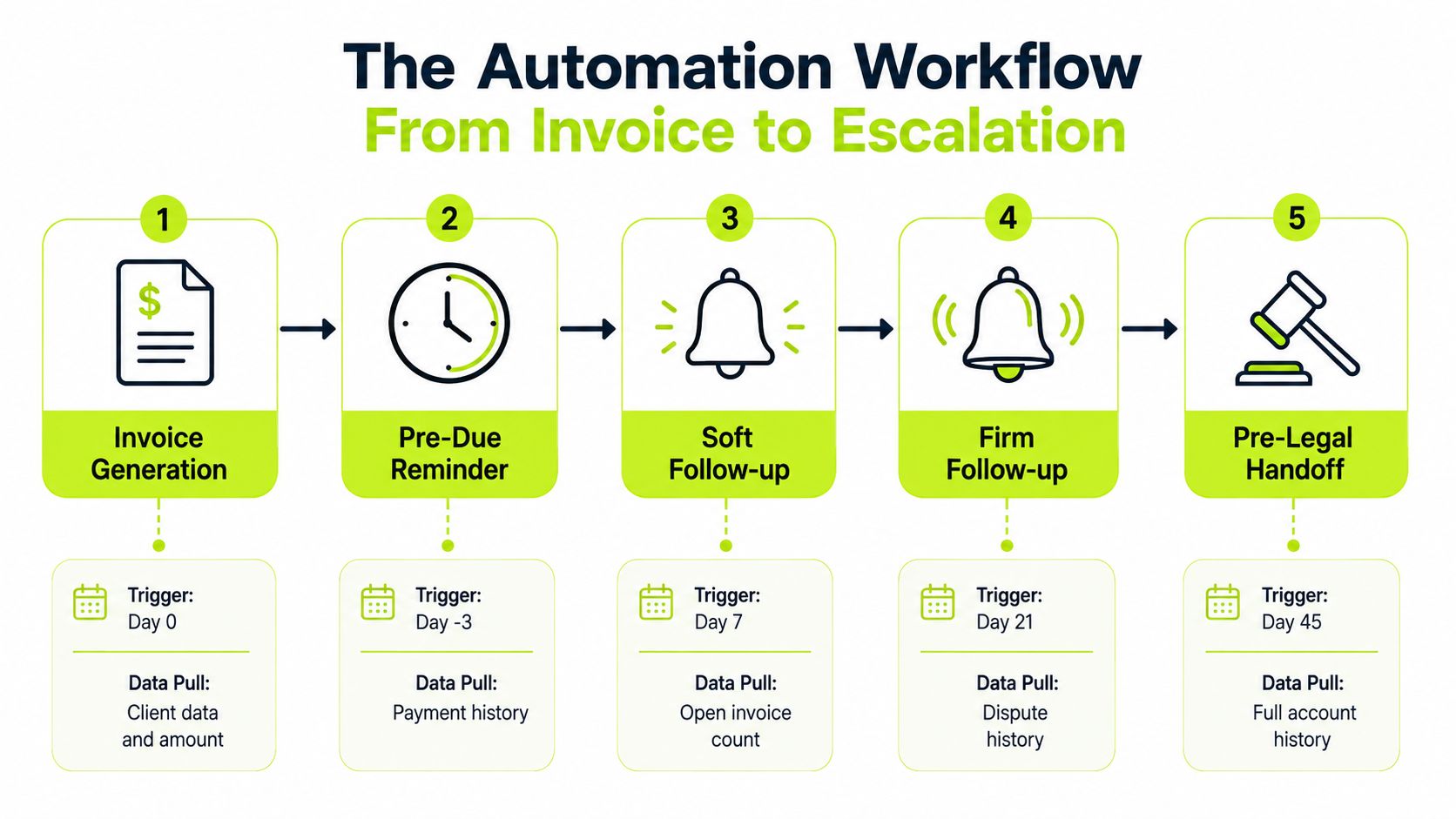
A dependable workflow has five stages. Each stage needs a trigger, a defined data pull, a decision branch, and an exit condition. Without those controls, automation repeats messages after payment, ignores disputes, or escalates an account that has already made a valid commitment.
The five operating stages
- Invoice generation: At Day 0, pull the client record, invoice number, amount, due date, project reference, billing contact, and approved communication channels. The exit condition is successful delivery and a valid payment record.
- Pre-due reminder: At Day -3, pull payment history, named contact stability, and any prior billing notes. If the client has a known approval cycle, use that context. If the invoice is already paid, suppress the message.
- Soft follow-up: At Day 7, pull the open invoice count, prior response, and current dispute status. A paid invoice exits. A reply routes to the appropriate owner. A promise moves to promise tracking. Silence advances the controlled sequence.
- Firm follow-up: At Day 21, pull dispute history, prior promises, and all recent channel activity. Ask for payment confirmation or a specific explanation. A new dispute stops automation and assigns a resolution owner.
- Pre-legal handoff: At Day 45, pull the full account history, including invoice documentation, communications, promises, disputes, and escalation reason. A silent account routes to a collector or senior reviewer with the context attached.
QuickBooks AR automation commonly starts by connecting an AR tool to QuickBooks Online, authorizing the connection, syncing customer records and open invoices, then configuring reminders, templates, and late-fee rules. The workflow should also sync payment status and activity outcomes back to the accounting record, so the collections queue doesn't operate from stale data.
A stale promise needs special handling. Don't resume the entire sequence as if no contact occurred. Send a one-touch restart that references the missed commitment, asks for an updated date, and routes the account to human review if there's no reply.
Guardrail: Automation should remove repetitive judgment, not remove accountability.
The controls are simple but essential:
- Do not loop: Every stage needs a maximum attempt count and an exit condition.
- Do not duplicate: Suppress another channel when a message has already gone out within the same 24-hour period.
- Log the reason code: Every escalation should state whether it resulted from age, silence, a broken promise, a dispute, or a written request.
- Preserve the record: Attach the data used to generate the message so a collector can explain why it was sent.
Teams designing AI workflows for complex tasks should apply the same principle. The system can select and assemble the next action, but finance owns the rules governing exceptions, client treatment, and escalation.
Measuring What Actually Matters and Iterating
Collections dashboards often reward activity because activity is easy to count. Messages sent, opens, and clicks can make a team look busy without showing whether cash arrived. A finance leader needs metrics that connect outreach to invoice movement.
Track DSO movement and promise-to-pay kept rate weekly by cohort. DSO tells you whether receivables are converting faster across the book. Kept-promise rate tests whether the language, timing, and follow-up process produce commitments clients honor.
Secondary measures add diagnostic value:
- Response within 48 hours: Shows whether the first reminder creates a workable conversation.
- Dispute rate by segment: Identifies cohorts where wording or documentation may be triggering avoidable friction.
- Opt-out or unsubscribe rate: Acts as an early warning that tone or channel frequency is becoming intrusive.
- Paid movement by cohort: Shows whether Watch, Work, and Escalate rules are separating risk effectively.
Open rate is a weak collections KPI because forwarding and scanning behavior can distort it. Click rate is also secondary because clicking a payment link doesn't necessarily mean the invoice was approved or paid. Total messages sent measures workload, not performance.
The broader personalization benchmarks reinforce that distinction. Industry summaries report 29% higher open rates, 41% higher click-through rates, and up to six times higher transaction rates for personalized email, but AR teams should judge their own workflow by payment outcomes and kept commitments, not marketing engagement alone. A separate benchmark summarized by MarTech found body-level contextualization outperforming subject-line-only personalization, which supports testing the actual payment request instead of relying on a first-name token. The cited benchmark reported 23.4% opens and 3.18% clicks for personalized body content versus 20.59% and 2.4% for generic text, while subject-line personalization underperformed generic subject lines in that study, at 18.79% versus 22.14% opens and 1.74% versus 2.74% clicks. See the source benchmark on contextual email personalization.
A practical review rhythm
Once a month, pull a four-week comparison for each cohort. Review the slowest-paying group for changes in project type, contact ownership, invoice size, disputes, and promise behavior. Then test one variable at a time, keeping tone constant while changing the subject line, send time, channel order, or escalation trigger.
Retire an experiment unless it moves DSO or kept-promise rate within two billing cycles. A variant wins only when it improves cash behavior, not because it produces a more attractive dashboard.
Resolut automates AR for professional services by coordinating invoice data, personalized email and SMS outreach, payment follow-up, promise tracking, and human escalation in one workflow. If you're ready to apply finance-grade message personalization to reduce DSO and improve cash flow, visit Resolut to review the platform.