
7 Payment Collection Email Templates That Get Paid
Use seven payment collection email templates for every AR stage, with subject lines, cadence tips, and A/B tests to reduce DSO and improve cash flow.
58% of invoices were paid after one reminder, and a second reminder recovered another 21%, so roughly 80% of paid invoices were collected by the second reminder email. Email remains the primary collection channel, appearing in 93.8% of reminder activity, while combining text with email increased the chance of payment within one week of the due date by 56%.Chaser's reminder data
The strongest payment collection email isn't the firmest one. It's the message matched to the invoice stage, the customer relationship, the likely payment friction, and the next action your team needs the client to take.
CFOs, Controllers, and firm owners at professional services firms don't need seven interchangeable scripts. They need a controlled operating sequence that sounds appropriate before a due date, after a missed payment, during a dispute, and before escalation. The templates below pair each message with a trigger, cadence decision, dispute path, and measurable AR outcome.
For a $3M–$50M professional services firm, the commercial objective is clear: reduce DSO, improve cash flow, and protect client relationships without making finance sound like a collections agency. Accounts receivable automation, AI AR automation, and QuickBooks AR automation can apply consistent judgment across large invoice volumes, while human review remains essential for disputed, strategic, or legally sensitive accounts.
Central principle: Send the message that fits the moment, then make the next action easy to complete.
[Process-flow visual: Invoice journey from pre-due reminder through resolution, payment plan, relationship rescue, or escalation.]
1. The Friendly Reminder
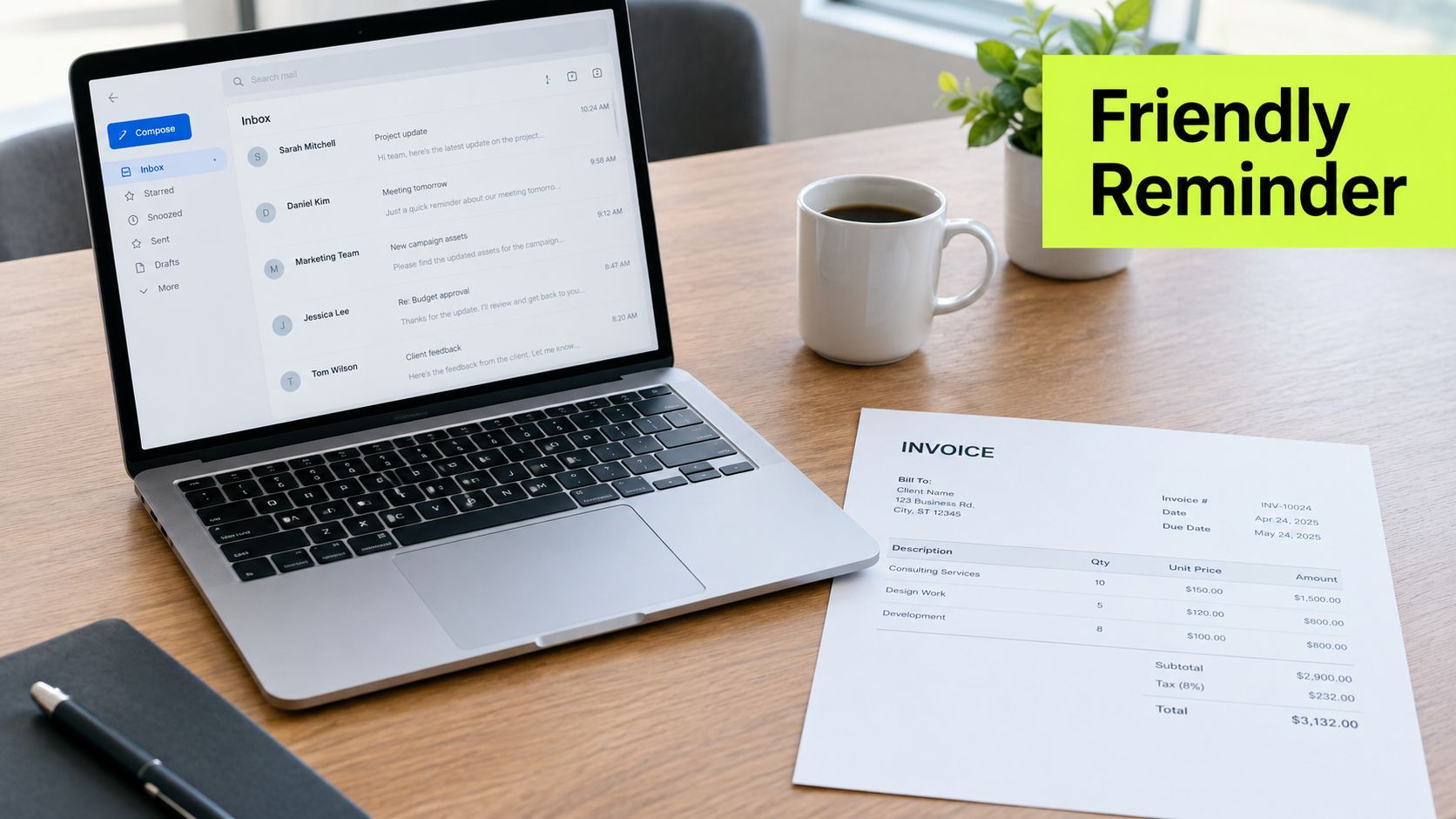
A pre-due email should make payment feel like the natural next step, not a response to a problem. Send it 3 to 5 days before the due date, using a professional, brief, and assumptive tone.
For example, an accounting firm can write to a client four days before payment is due:
Subject: Upcoming payment for invoice [invoice number]
Hi [First Name],
A quick reminder that invoice [invoice number] for [service or project] is due on [due date]. The balance is [amount due]. You can review the invoice and pay through [payment link].
Please reply if your AP team needs any supporting documentation.
Best, [Name]
The email should include the invoice number, amount due, due date, service line, and payment method. That gives the recipient enough context to act without logging into a portal just to identify the charge. A payment portal with cards, bank transfers, and digital wallets can remove additional friction, provided those methods fit your client base.
Don't treat timing advice as universal. Test send windows by segment, client time zone, AP process, and historical response. The workflow matters more than a supposedly perfect hour.
What to automate
An AR orchestration platform can trigger the notice from the invoice due date, skip it when payment has already arrived, and preserve the firm's preferred voice. QuickBooks AR automation is useful when invoice status, customer records, and reminders stay synchronized instead of requiring a Controller to maintain a separate spreadsheet.
Track delivery, payment before the due date, replies requesting documentation, and invoices that still become overdue. Those measures show whether the reminder prevents aging, not merely whether the email was sent.
2. The Payment Status Update
A status update belongs 2 to 3 days after the due date, when payment hasn't arrived but the account may still reflect an administrative delay rather than unwillingness to pay. The message should ask for information, not deliver a reprimand.
Subject: Payment status for invoice [invoice number]
Hi [First Name],
We're showing invoice [invoice number] for [amount due] as unpaid. Is payment already in process, or do you need anything from us to complete approval?
You can reply here, or pay through [payment link]. If payment has already been sent, please share the payment date and reference.
Best, [Name]
This short email can surface several legitimate explanations: the payment went to an incorrect account, the invoice was routed to the wrong AP mailbox, approval is pending, or the client believes the invoice was already paid. The finance team gets a chance to correct the issue before the invoice ages into a more difficult stage.
Keep the format disciplined. One paragraph, one question, and one action is usually enough. Include the portal link, but don't bury the question under payment instructions.
Build decision rules around it
Automation should suppress the status check when payment has arrived, the customer has an active dispute, or a recent conversation already explains the delay. It should also adapt to payment behavior. A reliable client with a normal processing lag may need a lighter touch than a new account with no established payment history.
Use replies to improve upstream controls. If clients repeatedly say they never received an invoice, review invoice delivery, contact records, and AP confirmation procedures. A payment collection email is also a diagnostic tool. It tells you whether the barrier is cash flow, approval, data quality, service dissatisfaction, or simple forgetfulness.
3. The Past-Due Notice
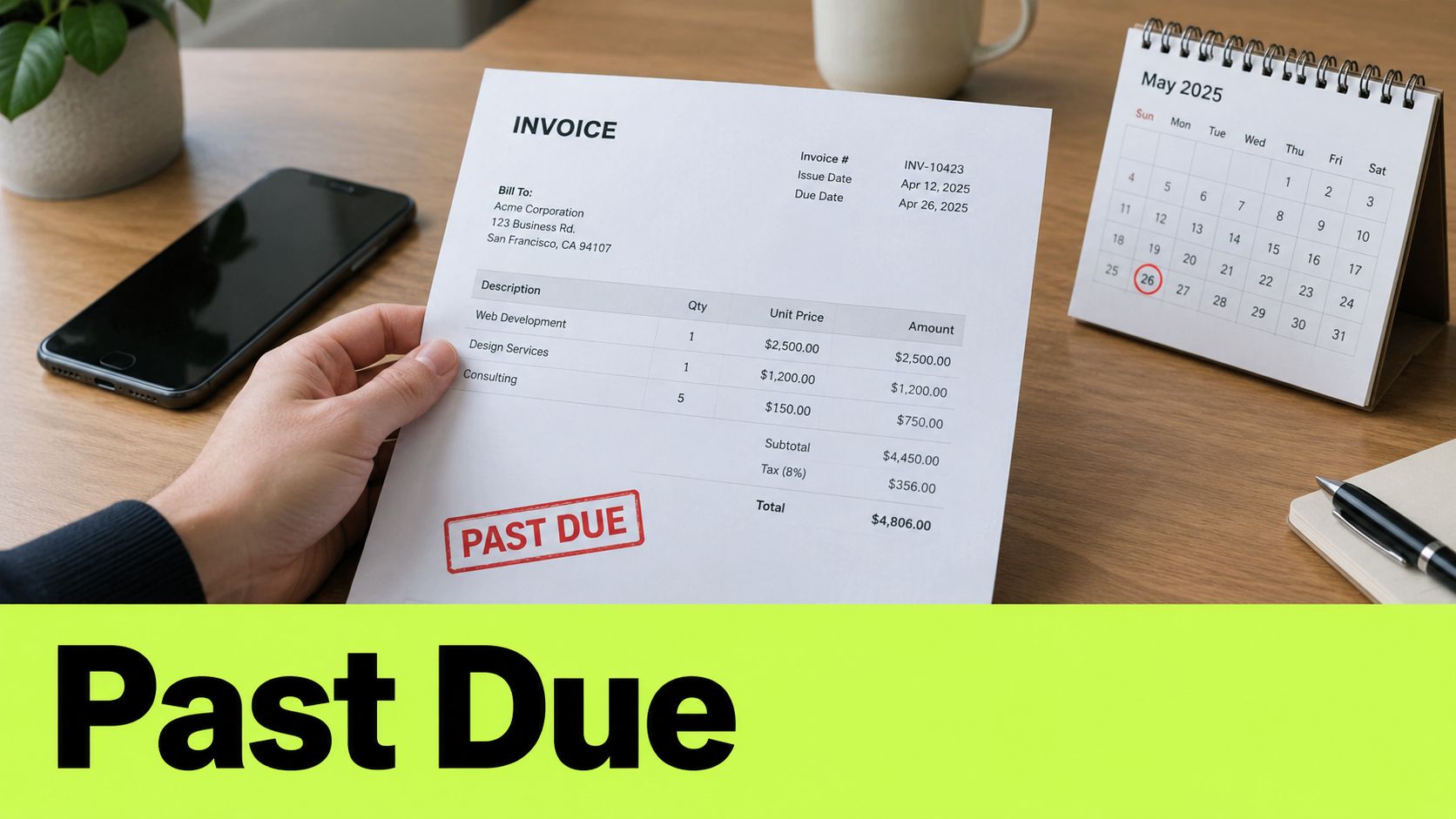
Once the due date has passed, the email needs more urgency, but urgency shouldn't become accusation. A notice sent 1 to 3 days after the due date should state the facts, provide a direct payment path, and invite the client to identify a problem.
Subject: Invoice [invoice number] requires attention
Hi [First Name],
Invoice [invoice number] for [amount due], originally due on [due date], remains outstanding. Please arrange payment through [payment link], or reply today if there's an approval issue, dispute, or payment already in process.
If the full balance isn't available this week, contact [name] at [phone or email] so we can discuss a practical next step.
Best, [Name]
The difference between this message and the earlier status update is accountability. You're no longer asking only what happened. You're asking the client to resolve the balance or explain the obstacle.
Use client context to set the tone. A long-standing enterprise client with a strong payment record deserves a warmer, solution-focused message. A new client with repeated missed commitments may require clearer language about consequences and ownership. The same template can support both, but the subject line, sender, CTA, and escalation path should change.
Define the dispute path
Never force a disputed invoice through a standard dunning sequence. Give the recipient a specific reply path, such as “Reply with the disputed line item and supporting detail.” Route that response to the engagement owner, project lead, or Controller, then pause automated escalation until someone reviews it.
For guidance on wording and structure, use this past-due invoice email template. The AR outcome to monitor is not just payment. Track days from first past-due notice to payment, dispute identification, promise-to-pay creation, and invoices transferred to senior review.
4. The Payment Plan Negotiation
A payment plan fits a client who acknowledges the debt but cannot pay the full balance immediately. Cadence should reflect invoice stage and escalation risk. For a net-30 account, Rex's collections guide recommends a pre-due reminder at day -3, a due-date notice at day 0, a firmer notice at day +7, a second notice with a phone call at day +14, and final escalation at day +30 with a credit-hold warning in a net-30 collections cadence with day-by-day escalation steps from Rex. Offer a plan after the early resolution window, commonly around 7 to 14 days overdue, while the relationship remains workable.
Subject: A structured plan for invoice [invoice number]
Hi [First Name],
We understand that paying the full balance of [amount due] immediately may not fit your current payment cycle. We can propose:
- Initial payment: [amount] by [date]
- Second payment: [amount] by [date]
- Final payment: [amount] by [date]
Please reply “Accept” to confirm, or contact [name] to discuss a different arrangement. Once confirmed, we'll send the written terms and reminders before each installment.
Best, [Name]
Set the first installment according to risk and relationship value. A larger initial payment limits exposure, while a smaller one may preserve cooperation for a credible client with a temporary cash-flow or approval delay. Record dates, amounts, and consequences in writing. A verbal promise gives the AR team little control if a milestone is missed.
Match flexibility to account value
A strategic client with a temporary AP-cycle problem may merit a documented plan. An account with weak payment history may need a larger initial payment, shorter terms, or credit restrictions. Flexibility should reflect expected recovery, not discomfort with a difficult conversation.
Use this payment plan agreement template as a starting point, then align the wording with the contract, fee policy, and counsel's advice. AR software for professional services should calculate milestones, send reminders, record acceptance, and pause escalation while the client complies.
Measure cash collected at plan acceptance, milestone adherence, broken promises, and remaining balance by plan type. A plan that produces paperwork while delaying cash is not working. If the client disputes the invoice, route the issue to the engagement owner or Controller instead of treating it as a payment-plan failure.
5. The Relationship Rescue
Some overdue invoices aren't collection problems at all. They're signals that the client is dissatisfied, the scope is disputed, the deliverable hasn't met expectations, or the buyer's internal process has changed.
For a high-value or long-term account that's ignored several collection attempts, stop sending standard dunning language. Have the relationship owner or a senior finance leader write instead.
Subject: Can we resolve the open invoice together?
Hi [First Name],
We've noticed that invoice [invoice number] remains unpaid, and I want to make sure we haven't missed an issue on our side. Is there a concern with the work delivered, the invoice detail, the approval process, or the payment terms?
Please reply with the issue you'd like us to address. We can review the invoice, discuss a service adjustment where appropriate, or agree on a payment schedule.
Best, [Relationship owner]
This message creates a legitimate dispute path without conceding that the invoice is invalid. The sender should be able to mobilize the project lead, review scope evidence, and approve a commercial remedy. Routing a strategic account to a junior collections queue often signals that the firm values the receivable more than the relationship.
Capture the root cause
Document whether the delay came from service quality, missing documentation, procurement, cash flow, or a genuine billing error. That information should feed contract terms, project sign-off, invoice detail, and client onboarding decisions.
Use a separate workflow for strategic accounts. The standard cadence can pause while the relationship owner investigates, then resume with a corrected invoice, credit, plan, or formal notice. That is where AI AR automation should support judgment, not replace it.
6. The Multi-Touch Sequence
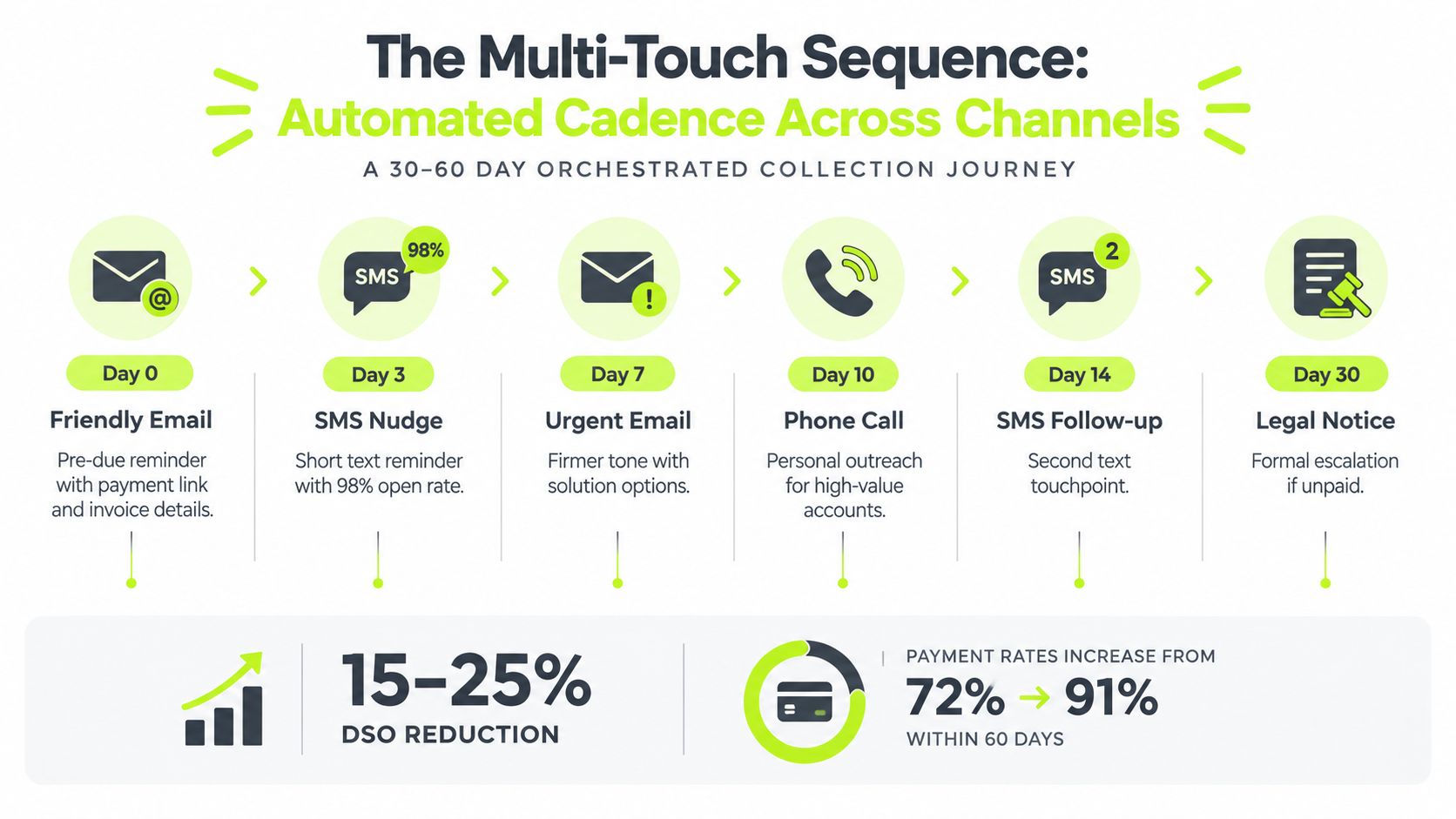
A multi-touch sequence works only when each contact has a defined job. For a professional services firm, the cadence should move from payment confirmation to friction diagnosis, then to human intervention or controlled escalation. Repeating the same reminder across channels creates activity without improving the receivable.
Use the sequence by invoice stage and response:
- Pre-due email: Confirm the invoice, amount, due date, and payment route.
- Due-date email: State that payment is due and make the payment link easy to use.
- Early overdue email: Ask for a status update and identify approval, documentation, or dispute friction.
- Phone outreach: Call when the account has not responded, a promise is at risk, or the balance warrants direct attention.
- Payment-plan email: Document agreed dates, amounts, and the consequence of a missed commitment.
- Formal escalation: Send only after reviewing the account history, dispute status, and approved next step.
Set a branching rule before the sequence starts. A client who opens the payment page but does not pay may need a short call about the payment process. A client who disputes one line item should be routed to the project or finance owner, while undisputed charges continue through collection. A partial payment calls for a balance confirmation and written commitment, not another generic overdue notice.
Phone outreach should resolve a specific uncertainty. Ask whether the invoice is approved, held for missing documentation, included in the next accounts-payable run, or disputed. Record the answer, owner, promised date, and next contact. Email then provides the audit trail.
Cadence should account for local time, AP batch cycles, contract terms, consent, and relationship risk. Keep email as the documented backbone, but use SMS or phone when the channel is permitted and the account justifies direct intervention. Learn how follow-up automation can support routing, channel selection, and human review.
Measure payment conversion by touch, channel, stage, reply type, promise-to-pay completion, and DSO movement. A useful sequence reduces irrelevant contacts and shows which intervention changes payment behavior.
7. The Legal Notice
A legal notice is the last internal step before external escalation. Use it when an invoice is 30 or more days overdue, when a documented payment plan has been broken, or when the account meets your firm's approved risk criteria. Counsel should draft or review the language, especially where interest, collection fees, credit holds, agency referral, or litigation may apply.
Subject: Formal notice regarding invoice [invoice number]
Hi [First Name],
This is a formal notice regarding invoice [invoice number], totaling [amount due], originally due on [due date]. Despite previous communications, the balance remains outstanding.
Please pay through [payment link] by [final date], or contact [name and contact details] immediately if the balance is disputed or payment has already been made. If payment isn't received by that date, we may proceed with the remedies available under the agreement and applicable law, including [approved consequence].
If you resolve the balance by [date], no further escalation will be taken in relation to this notice.
Regards, [Authorized sender]
Precision protects the firm's position. Include the invoice reference, original due date, amount, documented contacts, and approved consequences. Avoid threatening action that the firm isn't prepared or authorized to take.
Keep authority controlled
Don't send a legal notice automatically to every account at the same aging point. A client with a consistent history of paying during an AP batch may need a senior call first. A client that has ignored several notices and broken a written promise may warrant immediate counsel-reviewed escalation.
Your system should identify candidates, assemble the record, and route the notice for the right approval. It shouldn't invent legal language or override a live dispute. Measure recovery after formal notice, dispute rate, counsel review time, and external escalation outcomes.
7-Point Payment Collection Email Comparison
Template | Implementation Complexity 🔄 | Resource Requirements ⚡ | Expected outcomes 📊 | Ideal use cases 💡 | Key advantages ⭐ |
|---|---|---|---|---|---|
The Friendly Reminder: Early Payment Notice | Low, single automated pre‑due touch | Low, email template + payment link; optional AR automation | 25–35% payments within 48h; DSO −5–8 days | Pre‑due for repeat clients; prevent late payment | High response rate; preserves client relationship |
The Payment Status Update: Proactive Transparency and Status Confirmation | Low–Medium, requires accurate due‑date tracking | Low, automated status check with reply path | Resolves 15–20% of "lost" invoices; DSO −2–4 days | 2–3 days post‑due for high‑volume AR teams | Surfaces processing errors; opens two‑way dialogue |
The Past‑Due Notice: Urgent But Professional | Medium, tone management and escalation rules | Medium, automation + direct contact options | Converts 40–50% within 5 days; reduces aging into 30+ bucket | 1–3 days post‑due as second touch for recoverable invoices | Strong short‑term recovery; prevents compounding aging |
The Payment Plan Negotiation: Flexible Terms Offer | Medium–High, requires negotiation and written agreement | High, human negotiator, agreement docs; AR support recommended | 60–75% plan completion; recovery delayed 14–28 days but improves ultimate collection | 7–14 days overdue for clients with temporary cash constraints | Preserves high‑value relationships; documented commitments |
The Relationship Rescue: Re‑engagement and Root‑Cause Discovery | High, human, high‑touch judgment required | High, senior account manager time; CRM updates | Recovers 70–85% of at‑risk high‑value invoices; ROI 3–5x | Long‑ignored invoices for strategic/recurring clients | Reveals disputes/root causes; restores revenue and loyalty |
The Multi‑Touch Sequence: Automated Cadence Across Channels | High, orchestration across channels and logic rules | High, orchestration platform, SMS/phone integration, clean contact data | DSO −15–25%; payment rates ↑ to ~88–94% within 60 days; productivity +30–45% | Firms with high invoice volume needing scalable collections | Highest contact rate; automates routine touches and exceptions |
The Legal Notice: Escalation and Authority | Medium–High, legal accuracy and escalation policy required | Medium–High, counsel review or verified templates; proof of delivery | 60–80% pay within ~10 days of notice; faster recoveries with automated legal templates | 30+ days overdue, broken plans, or risk‑managed escalations | Strong psychological impact; creates formal legal trail |
Turn Templates Into a Controlled AR System
The seven messages work as an operating cadence, not as a folder of scripts. Start with the pre-due reminder, move to a payment-status check, issue a past-due notice, offer a payment-plan decision where appropriate, route strategic accounts to relationship rescue, orchestrate multiple channels, and reserve counsel-reviewed legal escalation for at-risk balances.
Set an owner and exit condition for every stage. Payment should stop the sequence. A documented dispute should pause dunning and create an investigation task. A promise to pay should create a dated commitment that the team can monitor. A broken promise should increase risk, not restart the same generic email.
Track results by stage and customer segment. At minimum, monitor delivery, reply, payment, dispute, promise-to-pay, recovery, and DSO outcomes. Test one variable at a time, such as subject line, send timing, CTA, sender, or tone. If you change the cadence, channel, and copy together, you won't know which decision affected cash collection.
Choose control over volume
Accounts receivable automation should reduce manual work without removing accountability. AR software for professional services should connect invoice records, QuickBooks AR automation, risk-based routing, omnichannel outreach, payment options, cash application, and human-in-the-loop approvals.
That matters because automation can scale a poor process just as efficiently as a good one. A system that sends more reminders without recognizing disputes, AP windows, partial payments, or strategic relationships can damage trust while creating more internal follow-up.
Consistency is the operating advantage: the right message, sent at the right stage, with a clear owner and an easy next action.
Resolut can support this model with invoice-triggered workflows, risk identification, payment links, channel orchestration, cash application, and autopilot or co-pilot controls. The practical standard remains simple. Finance should know which invoices need action, why they need it, who owns the next step, and whether the intervention improved cash flow without weakening the client relationship.
Resolut offers automated AR workflows for professional services, including invoice-triggered payment collection email sequences, omnichannel follow-up, payment portal options, and human review for sensitive accounts. Visit Resolut to see how a controlled AR process can help your firm reduce DSO, improve cash flow, and keep collections consistent, accurate, and human.