
What Is a Payment Invoice? A CFO's Guide to Cash Flow
What is a payment invoice? For CFOs, it's a key tool for cash flow. This guide covers components, best practices, AR metrics, and automation to reduce DSO.
TL;DR: A payment invoice is a legally binding demand for payment that formally triggers the accounts receivable cycle and acts as a primary control point in your cash conversion cycle. It itemizes what was delivered, what’s owed, and when it’s due. When firms manage invoices well, they create better conditions for timely collection, cleaner reconciliation, and tighter cash control.
For finance leaders, the phrase what is a payment invoice sounds basic until cash gets tight.
The invoice is where revenue leaves the comfort of the P&L and enters the uncertainty of collection. It’s the document that starts the clock on payment terms, gives the client something concrete to approve, and gives your team a basis for follow-up, reconciliation, and, if needed, escalation.
That’s why invoice quality matters more than most firms admit. More than 55% of all invoices issued in the U.S. are paid after their due date, according to DocuClipper’s accounts payable statistics roundup. In professional services, where labor is delivered before cash arrives, that delay isn’t an administrative nuisance. It’s a working capital problem.
A weak invoice creates friction. A strong invoice creates momentum.
The Anatomy of a Strategically Sound Invoice
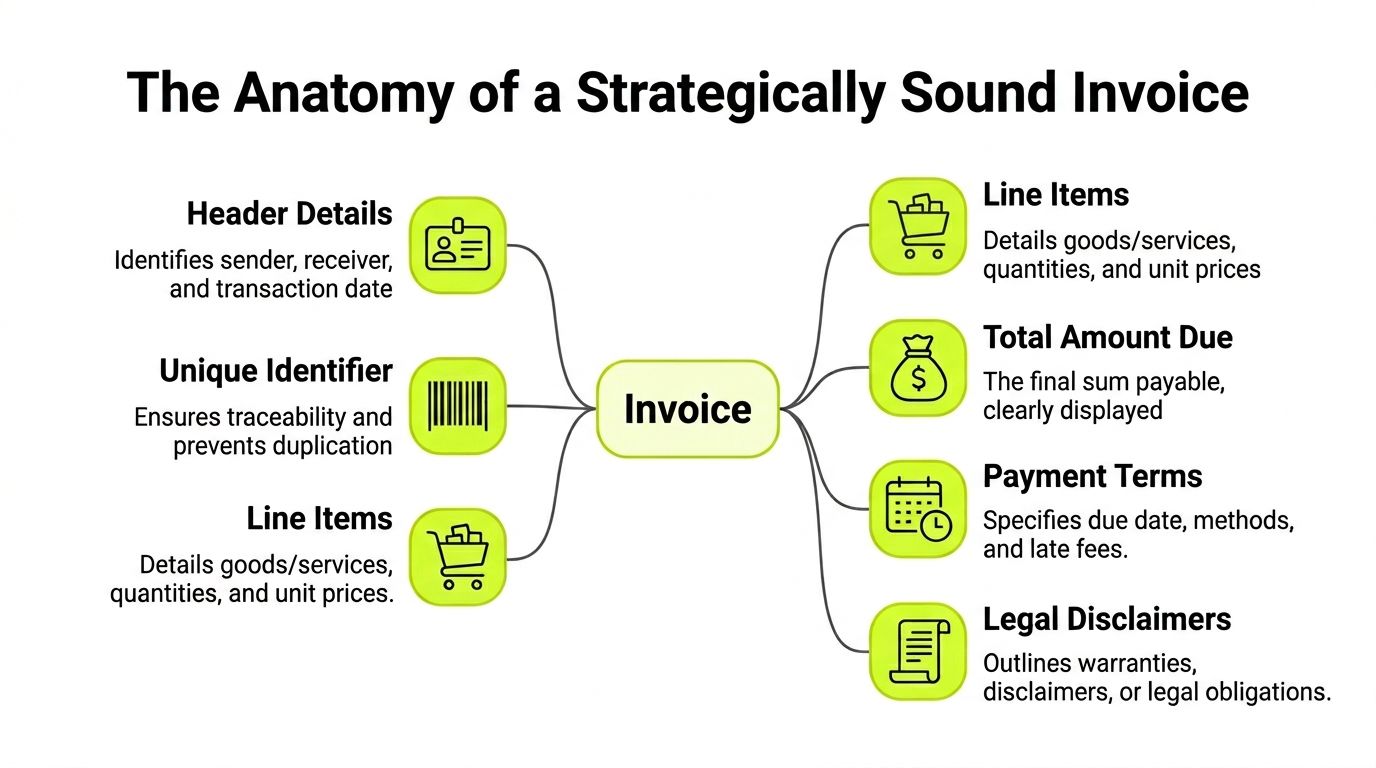
A payment invoice in B2B finance is a legally binding document that records a completed transaction and demands payment under stated terms. In practice, it’s also a control mechanism. Each field serves a purpose beyond presentation.
An invoice number isn’t there because accounting software expects one. It creates traceability across the ledger, the client record, and the payment trail. The issue date starts the payment clock. The line items define what the client is paying for and reduce room for disagreement later.
The fields that actually protect cash flow
The basic components are familiar. The strategic value is often missed.
- Header details: Legal entity name, client name, addresses, and issue date establish who owes whom and when the obligation began.
- Unique identifier: The invoice number supports audit trails, payment matching, and dispute handling.
- Line items: In professional services, many collection issues often begin or end within these entries. Vague descriptions invite pushback. Specific entries tied to milestones, hours, retainers, or deliverables create fewer openings for delay.
- Total amount due: The amount owed should be visible, not buried below narrative text or tax notes.
- Payment terms: Net terms, accepted payment methods, and remittance instructions answer the operational question every client AP team has: how do we clear this?
- Legal disclaimers and references: PO numbers, tax detail, and any required legal wording matter more than many service firms realize.
According to Enty’s explanation of invoice payments, missing elements like PO numbers or tax breakdowns cause 23% of invoice disputes and inflate DSO by 5 to 10 days. That’s a useful reminder that invoice design isn’t cosmetic. It directly affects collection timing.
Practical rule: If a client’s AP clerk has to ask a clarifying question, your invoice was incomplete for operational purposes, even if it looked polished.
What strong firms do differently
Controllers at professional services firms tend to get the best results when they treat the invoice as structured data, not a PDF artifact. That means standardizing templates, locking required fields, and making sure the format works for both humans and systems.
A good internal standard usually includes:
- Clear service descriptions tied to the signed scope or statement of work.
- Consistent client references such as matter number, engagement ID, or PO number.
- Explicit due dates rather than leaving clients to calculate from generic terms.
- Simple payment instructions that don’t force the buyer to hunt for bank or portal details.
If you need a stronger foundation for format and field discipline, this guide to legal invoice format is a practical reference point.
The main lesson is simple. A strategically sound invoice doesn’t just document completed work. It reduces ambiguity before ambiguity turns into ageing receivables.
Invoice vs Bill A Distinction with Financial Consequences
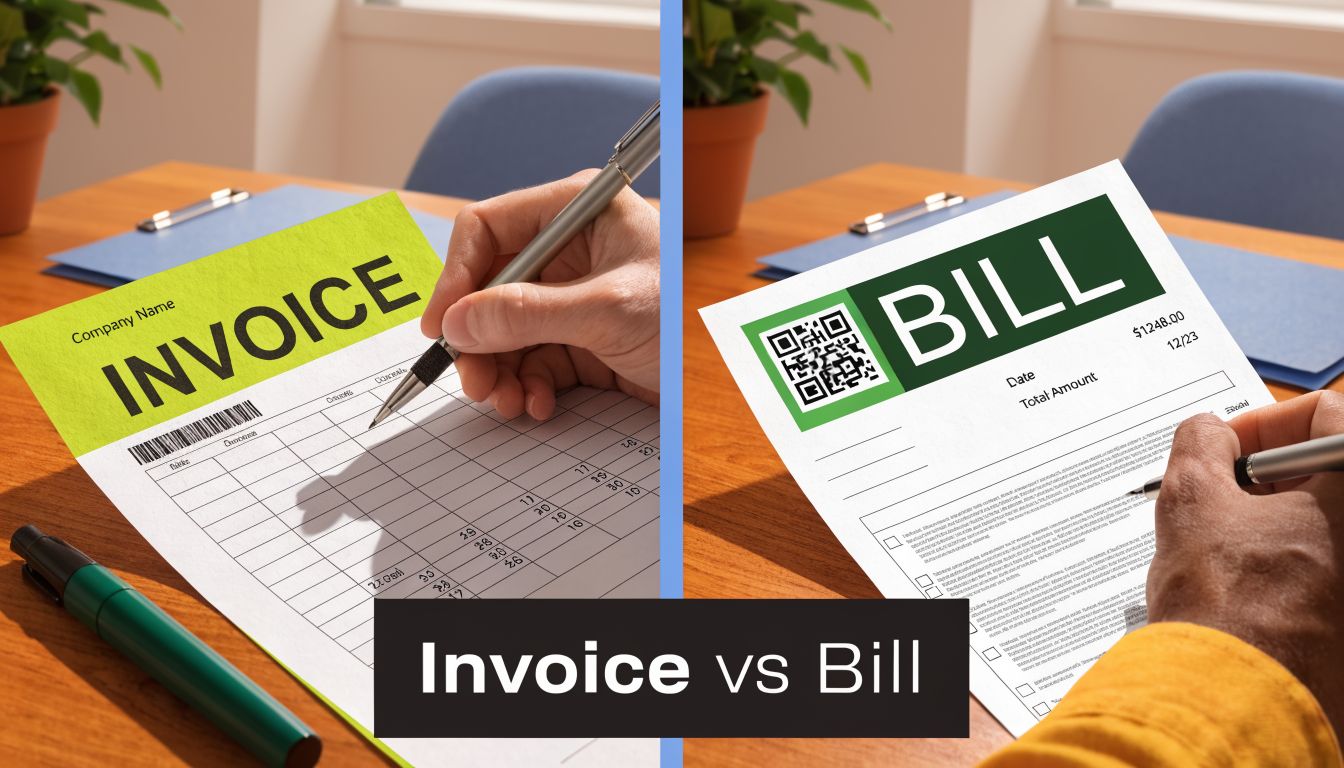
In everyday conversation, people use invoice and bill as if they mean the same thing. In finance operations, they don’t.
An invoice is what your firm sends to request payment. It creates or updates an accounts receivable balance. A bill is what your firm receives from a vendor and must pay through accounts payable.
Why the distinction matters
This isn’t just vocabulary. It shapes control.
When teams blur the terms, they often blur ownership too. AR follows issuance, delivery confirmation, collections, and cash application. AP follows intake, approval, coding, and payment. Those are different workflows, different risks, and different reporting outputs.
A simple comparison helps:
Perspective | Document | Ledger impact | Primary objective |
|---|---|---|---|
Seller | Invoice | Accounts receivable | Collect cash |
Buyer | Bill | Accounts payable | Control disbursements |
In professional services firms, this distinction matters most during close and cash forecasting. If someone says “that bill is still open” when they mean a client invoice, the team can misread whether the problem is incoming cash or outgoing cash.
A practical legal distinction
There’s a related document that people also confuse with invoices: the transfer record used in asset sales. If your team ever handles equipment disposals, vehicle transfers, or one-off asset transactions, a bill of sale template is the right tool for that legal purpose. It documents transfer of ownership. It doesn’t function like an AR invoice for services rendered.
The cleanest finance teams use precise language because precise language supports precise workflows.
That sounds small until reconciliation gets messy. Then it becomes obvious.
Common Invoice Types in Professional Services
Most professional services firms don’t need dozens of invoice types. They do need the right one at the right moment.
The standard invoice works well for discrete work. A litigation support project wraps. A design package is delivered. A tax engagement is completed. The invoice goes out with final services, fees, and due date.
That’s straightforward. The trouble starts when the engagement model changes and the invoicing model doesn’t.
The recurring invoice
Retainers, monthly advisory, managed bookkeeping, fractional CFO support, and ongoing agency work usually perform better with recurring invoices. The benefit isn’t just convenience. It creates rhythm.
Clients know when to expect the charge. Your team knows when to monitor payment. Forecasting becomes easier because billing dates are predictable and exceptions stand out faster.
The milestone invoice
For longer consulting or implementation engagements, milestone billing is often the most practical structure. Instead of waiting until final delivery, firms invoice at agreed stages such as discovery completed, draft delivered, or launch approved.
This is often the best compromise between client comfort and firm liquidity. It aligns payment with progress and limits how much unbilled work sits on the balance sheet.
A milestone invoice does more than pull cash forward. It tests whether the client’s approval process is working before the final invoice is at risk.
The pro forma invoice
A pro forma invoice is useful before work starts when the client needs a formal pricing document for approval. It helps frame scope, expected charges, and terms before the receivable exists.
Used well, it reduces surprise. Used poorly, it creates confusion if the final invoice doesn’t clearly map back to it.
The credit memo
Errors happen. Scope changes happen. Sometimes a client was overbilled, partially refunded, or granted a pricing adjustment.
That’s where the credit memo matters. It corrects the accounting trail without deleting history. Controllers should prefer credits over informal off-system fixes because they preserve a clean audit path and make the receivable movement understandable later.
A practical mix for many firms looks like this:
- Standard invoices for one-time projects
- Recurring invoices for retainers
- Milestone invoices for long engagements
- Pro forma invoices for pre-approval
- Credit memos for corrections and concessions
The right type doesn’t just match the engagement. It shapes how smoothly cash moves after the work is done.
Best Practices for Invoices That Get Paid Faster
Firms often blame slow payment on client behavior alone. That’s only part of the story.
The invoice itself can either lower friction or add to it. And once it’s sent, the follow-up process matters just as much as the document. Research summarized by Sage on invoice payment notes that 1 in 10 invoices go unpaid, with much of the friction tied to invoice visibility issues or internal approval bottlenecks on the buyer’s side.
That’s why “send invoice, wait, send reminder” isn’t enough.
Send at the point of completion
The most common operational mistake is timing. Firms finish the work, then hold invoices until the end of the week or month.
That delay weakens your position. The work is freshest in the client’s mind at completion or milestone acceptance. That’s when approvals are easiest to secure and questions are easiest to answer.
A better rhythm is simple:
- Invoice immediately after the trigger event: completed deliverable, approved milestone, or retainer renewal date.
- Confirm receipt early: especially for larger invoices or clients with layered approval workflows.
- Follow a schedule: not random chasing, but defined reminders tied to due date and ageing.
Remove avoidable friction
Clients don’t pay faster because your invoice sounds stern. They pay faster when the path to approval and payment is clear.
What works:
- Specific descriptions: These reduce back-and-forth with department heads who need to validate the charge.
- Visible due dates and terms: Don’t make the buyer calculate them.
- Straightforward payment options: ACH, card, and portal payments reduce handoffs and excuses.
- Client-specific references: If a client needs a PO, matter code, or project ID, include it every time.
What doesn’t work:
- Dense invoice narratives that hide the commercial point.
- Late reminders that begin after the invoice is already stale.
- Generic collection emails that ignore where the invoice is stuck.
- One-channel follow-up when the buyer’s process involves more than one approver.
Use terms intentionally
Payment terms aren’t boilerplate. They shape behavior.
In some cases, shortening terms helps. In others, the better move is to make the process easier rather than tighter. If a strategic client reliably pays once their internal workflow is triggered properly, operational clarity will outperform aggressive wording.
Dynamic terms can help as well. The classic example is 2/10 Net 30, which offers a discount for early payment. It won’t fit every firm, but the principle is sound: align incentives with cash timing when margin allows it.
The firms that collect well don’t just ask, “When is this due?” They ask, “What has to happen inside the client’s organization before this can be paid?”
That question changes the collection strategy. It shifts the focus from reminders to visibility.
How Invoices Directly Impact Key AR Metrics
For a CFO, invoice quality matters only if it changes cash timing, forecast accuracy, and collection cost. The invoice is the starting point for all three.
The AR metric that usually shows the effect first is DSO. The formula is straightforward, but the outcome depends on operations far more than math. A receivable balance rises or falls based on how quickly invoices get approved, whether they match the client’s buying process, and how often your team has to stop and clarify basic information.

Where invoice design shows up in AR performance
Analysts at HighRadius describe invoice payment as a workflow with multiple handoffs, from receipt through validation and approval to payment and reconciliation. In practice, that matters because every handoff creates another chance for delay, dispute, or silence. Professional services firms feel this quickly. The work is already complete, payroll has already been funded, and the receivable is now carrying the burden.
I see four invoice failures show up repeatedly in DSO reviews:
- Missing client controls, such as PO numbers, matter codes, or project IDs
- Descriptions that do not line up with the approved scope or statement of work
- Amounts that require manual explanation before approval can move
- Delivery to the wrong contact, which leaves the invoice sitting outside the client’s AP workflow
These are not formatting issues. They are collection delays built into the document itself.
A poor invoice also distorts other AR signals. Aging worsens. Collector workload rises because the team spends time resolving preventable exceptions instead of working real risk. Cash forecasting gets weaker because expected receipts depend on whether the client can process the invoice, not on the contractual due date.
DSO pressure usually starts upstream
Many finance teams treat DSO as a collections problem. In professional services, it often begins earlier, at invoice readiness.
A clean invoice shortens the time between service delivery and payment approval. A flawed one adds review cycles, internal client emails, and disputes that were avoidable. That difference matters because firms in this category carry a cost base that does not wait. Compensation, partner draws, contractor payments, and tax obligations all continue on schedule even when collections do not.
For a practical explanation of the metric itself, this guide to DSO in accounting is useful for finance teams building tighter reporting discipline.
The financial consequence is control
An invoice that gets stuck for ten extra days does more than delay cash. It changes how much working capital the firm has to carry. It can force leadership to postpone distributions, slow hiring, or rely on a credit line to cover routine obligations. Across a full client portfolio, those delays become a financing issue.
That is why strong AR teams build escalation paths around invoice quality as well as collection activity. Start with correction and approval support. Escalate based on age, exposure, and client behavior. In cross-border matters or difficult recoveries, firms may also need a framework for strategic debt collection as part of a broader receivables policy.
If DSO is running high, start by reviewing the invoice itself. In many firms, the fastest collection improvement comes from reducing preventable approval friction before the invoice ever reaches day 30.
Automating the Invoice Lifecycle for Control and Efficiency
Manual invoicing rarely fails all at once. It leaks cash in small, repeatable ways. A missing PO number triggers a client email. An approver never receives the PDF. A collector follows up without seeing that the invoice is already in dispute. Finance then spends time correcting avoidable process errors instead of protecting cash conversion.
For professional services firms, automation changes that operating model. It standardizes invoice creation, enforces timing, records delivery, and gives AR a current view of status across the full lifecycle. The result is fewer preventable delays and tighter control over when billed revenue turns into cash.

What automation actually changes
The value is not speed alone. Control matters more.
A well-run workflow usually improves performance in four places:
- Creation: Standard templates pull in the right client entity, billing terms, tax treatment, matter references, and supporting detail.
- Delivery: Invoices go out on schedule through the right channel, with a record of when they were sent and received.
- Follow-up: Reminder rules run consistently based on due date, invoice status, client behavior, or exception flags.
- Reconciliation: Payment data posts back faster, which reduces manual matching and gives finance cleaner ageing reports.
In practice, that means less dependence on inboxes, side spreadsheets, and individual memory. It also gives controllers and CFOs something more valuable than efficiency. They get auditability. If a client says the invoice was never received or was missing backup, the team can verify what happened quickly and decide whether the issue is process, data quality, or client delay.
Teams comparing tools usually start with billing features and end up caring more about workflow discipline, exception handling, and reporting. This guide to invoice automation software for accounts receivable teams is a useful starting point if you're evaluating fit.
How AI changes the collections workflow
Rules-based automation handles repeatable tasks. AI helps finance teams focus attention where judgment has the highest return.
That can mean identifying invoices with a higher risk of delay, flagging patterns that point to approval friction, or recommending follow-up timing based on prior client behavior. The operational benefit is straightforward. Collectors spend less time sending generic reminders and more time clearing the issues that hold cash back.
That matters in professional services because invoice risk is rarely uniform. A fixed-fee project, a monthly retainer, and a success-based matter do not stall for the same reasons. AI can help segment that risk earlier, but only if the underlying process is already clean. Firms that automate weak templates, inconsistent billing rules, or unclear ownership usually get faster confusion.
The operational shift is easier to see in motion:
What works and what doesn’t
The firms that get real value from automation usually make the same choices.
What works:
- Tight integration with accounting systems so invoice, payment, and client data stay aligned
- Standard workflows with defined exception paths for disputes, approvals, and client-specific requirements
- Shared visibility across finance, client service, and leadership
- Clear ownership for stalled or disputed invoices
- Reporting tied to action so teams can see which blockers are operational and which are collection issues
What doesn’t work:
- Automating weak invoice templates
- Keeping collections history in personal inboxes
- Adding software without changing accountability
- Applying the same reminder cadence to every client
- Treating automation as an IT project instead of a working capital project
The trade-off is real. More control usually means more standardization, and some partners or client teams will resist that at first. The firms that handle it well do not force every exception out of the process. They define which exceptions are commercially justified and which ones create avoidable delay. That is where automation starts to improve cash flow, not just administrative efficiency.
From Document to Asset Your Invoice as a Strategic Tool
A payment invoice starts as a request for payment. It becomes much more than that when finance leads it properly.
It establishes legal clarity. It anchors client accountability. It gives AR a clean starting point for collection, reconciliation, and reporting. Above all, it affects how quickly revenue becomes cash.
For professional services firms, that matters because the balance sheet absorbs every delay first. Payroll, partner draws, hiring plans, and tax obligations don’t wait for a client’s approval chain to sort itself out.
That’s why invoice discipline is a strategic issue, not an administrative one. More than 55% of invoices in the U.S. are paid after their due date, as noted earlier from DocuClipper. In that environment, firms that invoice clearly, send on time, and manage follow-up systematically have an advantage that shows up in cash position, not just process neatness.
The best finance teams don’t ask whether invoicing is important. They ask whether their invoice process gives them control.
If the answer is no, that’s usually where better cash flow work begins.
Resolut automates AR for professional services with a practical balance of consistency, accuracy, and human control. If you want a tighter invoicing and collections process without turning client communication into noise, Resolut is worth a look.