What Is Agentic AI: Automate AR & Boost Cash Flow
What is agentic AI? Discover how autonomous AI systems automate AR, reduce DSO, and improve cash flow for professional services firms. Learn more in 2026.
Agentic AI is autonomous software that can perceive context, plan multi-step actions, call external tools, and adapt based on outcomes with limited human supervision. It's a step beyond prompt-driven chatbots, because the system doesn't just return one answer, it keeps moving until the job is done.
If you run finance for a professional services firm, that distinction matters fast. Your AR team may already be buried in reminder emails, spreadsheet follow-ups, payment matching, and escalation decisions that stall when no one has time to re-enter another prompt. Agentic AI is the next stage because the defining change is workflow execution, not content generation, and that's exactly why finance leaders are paying attention. MIT Sloan's definition of AI agents as semi- or fully autonomous systems that integrate with other software to complete tasks independently fits this shift well, especially when the work spans tool use, decision-making, and action across connected systems (MIT Sloan's explanation of agentic AI).
That's the practical lens. If you've been looking at optimizing contract processes, the same logic applies here, the system has to move from reading to doing. In AR, that means chasing, matching, updating, and escalating without a person restarting the process every time.
The Shift From Prompt-Driven AI to Autonomous Agents
A controller knows the pattern. An invoice goes past due, the AR analyst drafts a follow-up, the client replies asking for backup, someone checks the billing system, and the thread sits until tomorrow because a manager has to approve the next step. Prompt-based AI helps draft the email, but it stops there.
Agentic AI changes the operating model. Instead of waiting for a new instruction at each step, it can perceive the situation, reason about the next move, take action through connected systems, and adjust based on what happens. AWS describes this as a loop of observing, reasoning, acting, and updating memory until the objective is reached, which is a very different structure from a stateless chatbot that answers one prompt at a time (AWS Prescriptive Guidance on agentic AI frameworks).
Why that matters in AR
For a professional services firm, the win isn't novelty, it's fewer handoffs. An agent can look at aging data, payment history, and client response patterns, then decide whether to send a reminder, escalate internally, or hold back because the account is tied to a strategic relationship. That's why the market discussion has shifted from experimentation to infrastructure, with one industry roundup describing agentic AI as moving into widespread deployment by 2025 to 2026 and another projecting rapid market expansion over the next decade (agentic AI market trajectory and adoption signals).
The simplest way to think about it is this. Traditional automation follows a script. Agentic AI follows a goal.
Practical rule: If the tool can draft but can't decide, route, or act, you're still in assistive AI territory.
For leaders comparing tools, the value is in closing the loop from insight to execution. That's also why the right vendor language should sound less like “it writes emails” and more like “it completes the collections workflow.” The difference shows up in cash flow, not slide decks.
You can find the same distinction in unlock growth with AI agents, where the useful systems are the ones that connect decisions to actions instead of stopping at recommendations. Finance needs that same discipline, only with tighter controls.
How Agentic AI Works
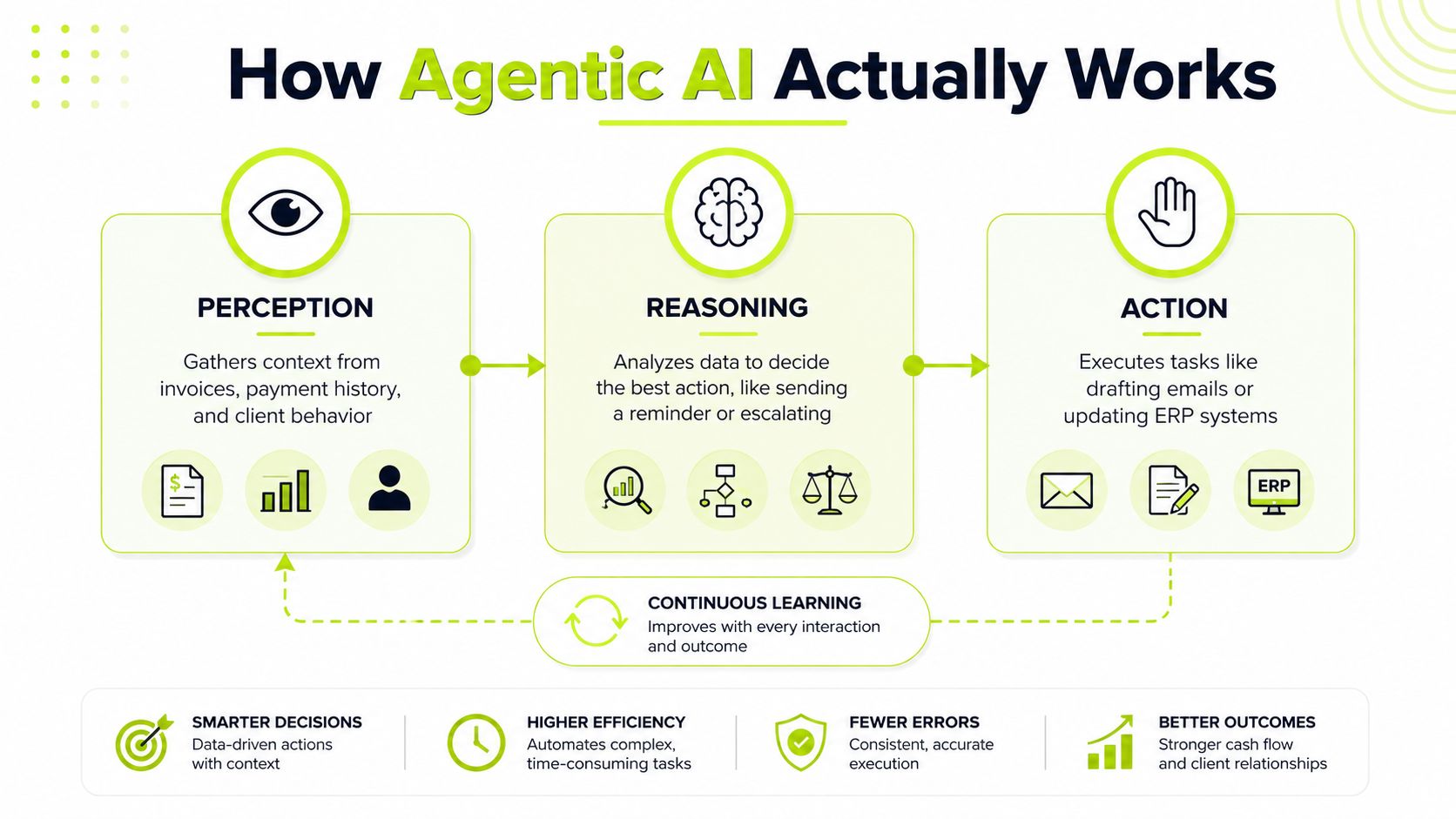
A controller reviewing a delinquent account does a few things in sequence. They check the balance, look at prior payment behavior, decide whether to send a reminder or escalate, and then adjust if the customer responds with a dispute or a partial payment. Agentic AI follows the same pattern across many accounts at once, while keeping state between steps and using connected systems without a human re-entering each instruction.
Perception, planning, and action
Perception is where the agent gathers context. In AR, that means invoice status, payment history, notes from the account team, and recent client communications. Planning is the decision layer, where the agent weighs the next move, a reminder, a second notice, an internal escalation, or a pause because the account is under dispute.
Action is the operational step. The system sends the email, updates the ledger, posts to the ERP, or triggers a collection task in another system. IBM describes this kind of setup as orchestration across multiple agents, where each agent handles a specific subtask and the workflow is coordinated end to end (IBM on agentic AI mechanics and orchestration).
Why the loop matters
The key point is iteration. Agentic AI does not stop after one action, it observes the result and decides what happens next. That is what lets it handle chains like find the overdue invoice, check the payment portal, draft a reminder, wait for a response, then escalate if needed, instead of ending after the first message. The UK government's AI Insights publication describes AI agents as small, specialised software pieces that can make decisions independently or cooperatively to achieve system objectives, which is a useful architecture lens for finance teams that need control as well as automation (UK Government AI Insights on agentic AI).
Operational takeaway: If a vendor cannot show the system's decision trail, it is not ready for finance work.
That same standard applies to document intake and collections workflows. The useful systems do not just ingest information, they route it, decide what to do with it, and complete the next task. The comparison in unlock growth with AI agents makes the point clearly, systems need to connect decisions to actions instead of stopping at recommendations. Finance teams need that discipline, with tighter controls around approvals, exceptions, and auditability.
Agentic AI Versus Predictive and Assistive AI
CFOs often get three things blended together in vendor pitches, and they're not the same. Predictive AI tells you what might happen. Assistive AI helps a human do the work faster. Agentic AI carries the workflow forward.
Capability | Predictive AI | Assistive AI | Agentic AI |
|---|---|---|---|
Primary role | Forecasts risk or likelihood | Drafts or suggests actions | Executes a goal across systems |
Human involvement | Reviews the output | Clicks to approve or send | Sets boundaries, then oversees exceptions |
Typical AR use | Flags invoices likely to age | Drafts a collection email | Monitors aging, chooses channel, sends, escalates |
Strength | Prioritization | Speed for humans | End-to-end workflow completion |
Limitation | No action | No autonomy | Requires governance and controls |
Predictive tools are useful when the problem is triage. If you want to know which invoices are likely to slip, forecasting helps. Assistive tools are useful when a collector already knows what to send and just wants the draft created faster.
Agentic AI matters when the bottleneck is execution, not drafting. The agent can monitor aging reports, choose which accounts need attention, pick the channel, adapt tone, and escalate if the client doesn't respond. It's built on the earlier layers, but it closes the loop.
That distinction keeps budgets honest. A firm with simple collections rules may only need assistive AI, especially if the team wants to keep approval tight. A firm with many recurring invoices, multiple stakeholders, and a long tail of overdue balances may need agentic AI because the manual coordination costs are the primary drag.
A good vendor conversation starts with one question, what does the system do without a human clicking the next step?
That question usually exposes whether the product is really autonomous or just wrapped in autonomy language. It also keeps you from paying agentic pricing for basic email automation.
Real-World Applications in Accounts Receivable
A collections manager looking at a long aging report rarely needs more dashboard noise. The core problem is deciding which account deserves attention first, what tone to use, and when a human should intervene. Agentic AI fits that operating problem because it can follow the same sequence an experienced AR team uses, while reducing the manual sorting that slows the work down.

Collections outreach that feels coordinated
The strongest use case is coordinated collections outreach. The agent reviews payment behavior, relationship value, and prior communication, then decides whether to send email, SMS, or a call sequence. That matters because a stale dunning cadence can annoy a good client, while a thoughtful one keeps the relationship intact.
The system also needs restraint. If a client has a short-term issue, it can soften the tone, route the account for human review, and avoid an unnecessary escalation. In practice, that is how AI AR automation supports both reduce DSO and client retention, because the collection effort becomes more consistent without turning mechanical.
Cash application without spreadsheet gymnastics
The second major use case is automated cash application. The agent matches incoming payments to open invoices, handles partial payments, and flags discrepancies before they become manual reconciliation work. For a controller, that means fewer late-night tie-outs and fewer unexplained unapplied cash items sitting in the ledger.
If you want a deeper finance-specific example, the internal guide on AI for accounts receivable workflows is a useful reference point for how these workflows come together in practice. The operational value is straightforward, cash gets applied faster, and the AR team spends less time searching for the right invoice.
Risk escalation with real judgment
The third use case is risk escalation. An agent can identify invoices at risk earlier, adjust outreach intensity based on response signals, and escalate with a firmer tone when the account warrants it. That is not just efficiency, it is discipline.
A strong system also routes edge cases to the right person. High-value accounts, disputes, or legal-sensitive balances should not move on autopilot. The software should know when to stop and ask.
For document-driven workflows, Head of Agents' document automation shows the same control pattern in another setting, and the same discipline applies in AR. Input, classification, action, and escalation need to stay connected, because in receivables the output affects cash and customer trust at the same time.
Governance Risks and Safe Implementation Boundaries
Autonomy is useful until it isn't. In finance, the failure mode is rarely dramatic at first, it usually starts with a small bad action, an aggressive email to the wrong contact, a payment posted to the wrong invoice, or an escalation sent before the dispute was fully understood.
The hard question is not whether an agent can act. It's how much it should be allowed to do on its own. Recent infrastructure guidance on agentic systems describes them as running a full operational loop, including policy controls and human escalation when needed, which is exactly the frame finance leaders should use (Mirantis on agentic AI infrastructure and governance gaps).
Guardrails that actually matter
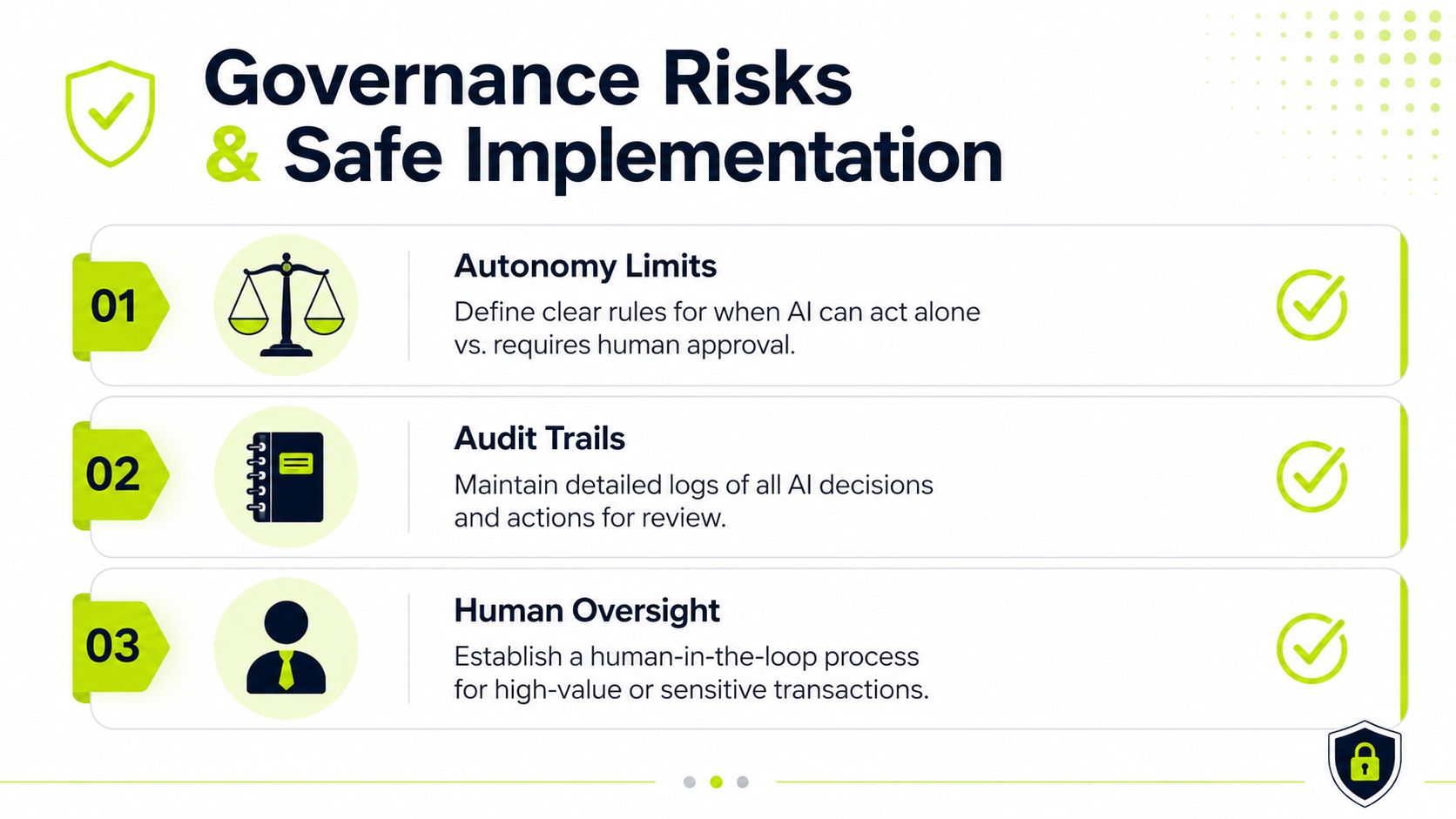
Human-in-the-loop checkpoints belong anywhere an action is irreversible or reputationally sensitive. That includes legal escalation, customer-facing language for strategic accounts, and payment application exceptions that could affect financial reporting. A good finance policy defines who approves what, at what dollar threshold or account class, and under which conditions the agent can proceed alone.
Audit trails matter just as much. Every decision should leave a record of what the agent saw, what it chose, and what action it took. MIT Sloan Review specifically argues that management frameworks should define human roles, escalation paths, and evaluation checkpoints so accountability stays with people, not software (MIT Sloan Management Review on agentic AI questions).
Autopilot and co-pilot aren't the same mode
Finance teams should separate autopilot from co-pilot mode. Autopilot means the agent can complete a workflow under defined rules. Co-pilot means the agent prepares the step and a person approves it before it goes out. The right mode depends on the account, the document type, and the risk tolerance of the firm.
If a process can create a customer dispute or financial misstatement, the approval boundary should be explicit before deployment.
That's also where implementation tends to fail. Teams try to automate too much too soon, then blame the model when the governance design was thin from the start. The technology is only part of the control system.
For a practical compliance lens, the internal guide on GDPR compliance is a useful reminder that finance data needs a control framework, not just a feature list. That applies whether the agent is sending an email, reading an invoice, or touching payment data.
Evaluating Agentic AI Vendors for Your AR Operations
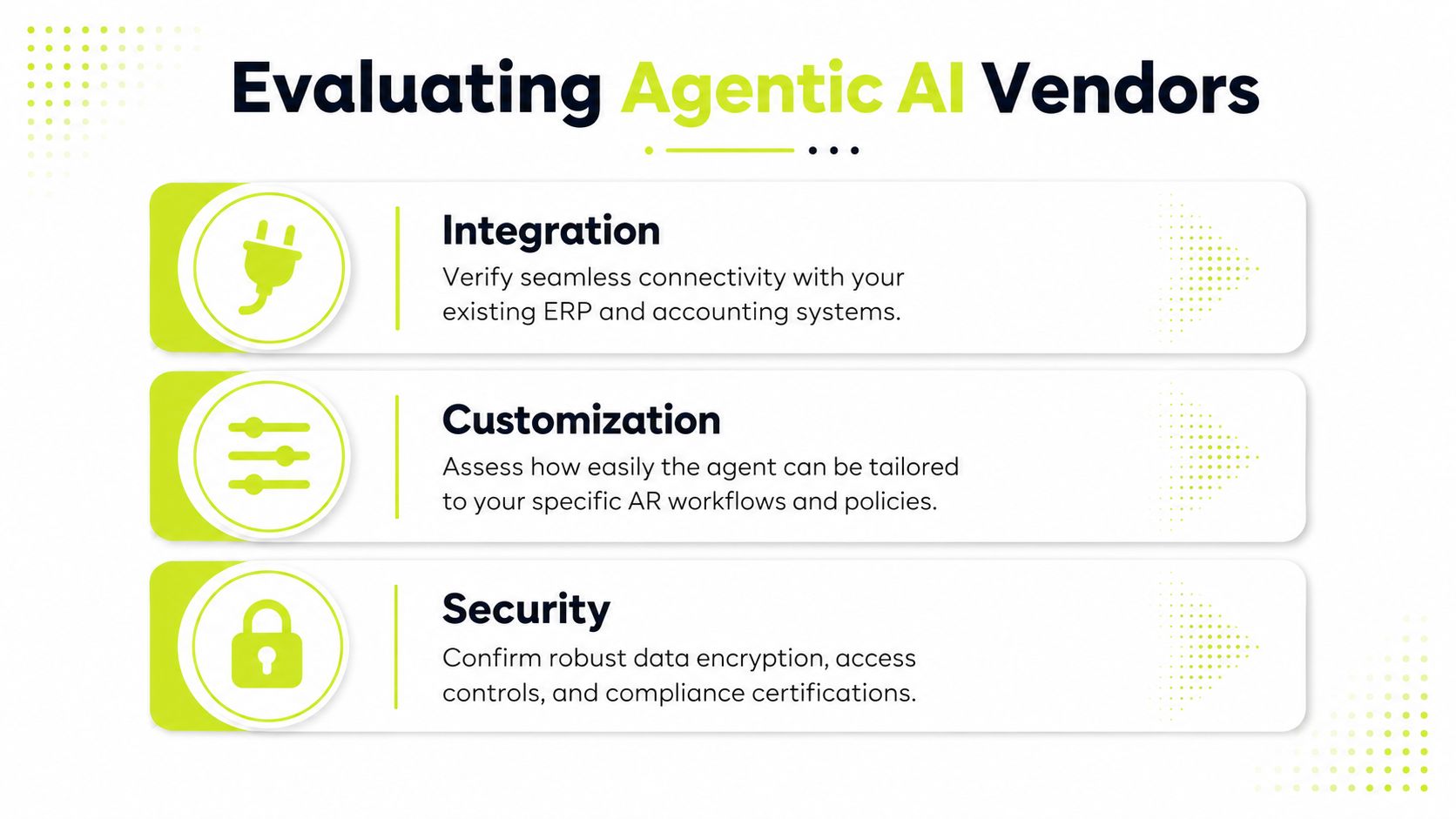
The cleanest vendor test is whether the system fits your accounting reality. If you run QuickBooks, an ERP, a payment portal, and a CRM, the software has to connect cleanly or the team will just recreate the same manual work in a new interface. That's why AR software for professional services should be evaluated as an operating layer, not a shiny add-on.
Questions to ask before you buy
- Integration depth: Can it connect to QuickBooks AR automation workflows, your ERP, and payment processors without custom scripts every time?
- Autonomy boundaries: What actions happen without human input, and what still requires approval?
- Security controls: How does the vendor protect client financial data, and how are access rights handled?
- Channel support: Does it handle email, SMS, phone, and payment portal interactions in one workflow?
- Exception handling: How does it treat disputes, partial payments, and high-risk accounts?
A system that can't explain its exception logic usually won't survive real AR volume. That matters more than a polished demo.
The internal guide on a guide to accounts receivable automation software is worth reviewing alongside vendor demos because the implementation details decide whether automation sticks. Training, role mapping, and exception rules are where projects either scale or stall.
What good implementation looks like
A credible rollout starts small. Pick one workflow, collections or cash application, define the approval paths, and test the handoffs before expanding. You should also ask how the vendor measures success inside your process, not in a generic benchmark.
Practical rule: If the vendor can't show how the system behaves on a partial payment, a disputed invoice, and a strategic client account, keep evaluating.
Resolut is one option in this category. It automates AR for professional services with collections orchestration, payment portal workflows, cash application, and escalation controls, so finance teams can decide where to automate fully and where to keep a human in the loop. That balance matters more than raw autonomy.
What This Means for Finance Leaders Moving Forward
Agentic AI is not a reason to automate recklessly. It's a reason to make the finance operating model more disciplined, because the firms that benefit most will be the ones that define boundaries before they expand autonomy.
For CFOs and controllers, the practical payoff is straightforward. Better collections discipline supports improved cash flow, tighter control can help reduce DSO, and more reliable cash application frees the team from repetitive reconciliation work. The bigger gain is less visible, because the AR team gets back time for exceptions, analysis, and relationship management instead of repetitive follow-ups.
The market is moving fast, but the operating lesson is simple. Don't buy the most autonomous system. Buy the one that fits your approval structure, your data controls, and your client relationships. In finance, trust is a feature.
If you're evaluating AR software for professional services, keep the lens narrow. Ask what the system does, what it logs, when it escalates, and how it behaves when the data isn't clean. That's where agentic AI proves its value.
If you're comparing AR workflows and want a more controlled way to automate collections, cash application, and escalation, visit Resolut. It's built for professional services teams that want consistent, accurate, human-controlled AR automation without losing sight of governance or cash discipline.