What Is Bad Debt and How to Prevent It
Learn what is bad debt, how it impacts cash flow and KPIs, and practical strategies for professional services firms to reduce DSO and prevent uncollectible
Bad debt is money owed to a business that's no longer expected to be collected, recognized as an expense rather than an asset. Under IFRS 9, expected credit loss can be recognized before default, including a 12-month expected credit loss measure in the early stages of an instrument.
A professional services controller usually sees the problem before the general ledger does. A consulting engagement was delivered, the invoice was issued, and the project team has moved on. Then the account reaches past due status, the client's AP team stops responding, and every follow-up becomes a manual exercise that competes with billing, payroll, and month-end close.
That's why bad debt isn't just an accounting afterthought. It's often the final symptom of weak credit decisions, unclear contracts, slow dispute resolution, or inconsistent collections workflows.
The Real Cost of Uncollected Invoices
Consider a consulting firm that completed a $120,000 engagement in Q3 and invoiced the client in October. The invoice is now more than 90 days past due. The AP contact says the invoice is “under review,” the project sponsor has stopped returning calls, and the client CFO hasn't responded to repeated emails.
At first, the balance is treated as temporarily overdue. The account manager expects payment after one more conversation. The controller leaves it in the aging report while the collections coordinator checks the inbox again. Meanwhile, the firm has already paid its consultants, covered subcontractor costs, and recognized the delivery work that produced the receivable.
After several unsuccessful attempts, the invoice changes operational category. It's no longer just late. The team now has to assess whether the client has a valid dispute, whether the contract supports enforcement, and whether collection remains probable. Staff time accumulates through status meetings, revised statements, internal approvals, and escalation decisions.
Practical rule: An invoice becomes a management problem well before it becomes a write-off.
Bad debt is money owed to a business that's no longer expected to be collected, recognized as an expense rather than an asset. Accounting guidance describes it as an amount determined to be uncollectible and recorded as an expense. That treatment turns booked revenue into a non-cash loss and reduces the value of accounts receivable.
The operational damage reaches beyond the income statement:
- Margin erosion: A professional services firm may have already incurred nearly all delivery costs before learning that the invoice won't produce cash.
- Management distraction: Senior staff spend time resolving preventable payment issues instead of managing utilization, delivery quality, or new business.
- Forecast distortion: A revenue forecast can look healthy while the cash forecast weakens because receivables aren't converting.
- Client relationship strain: Late-stage collections are more confrontational than early, clear payment follow-up.
In consulting, engineering, legal, and similar firms, labor is the dominant cost. A 2% bad debt ratio can therefore remove a meaningful share of net profit, particularly when the firm has limited pricing flexibility. The exact effect depends on the firm's gross margin, staffing model, and cost base, but the principle is consistent: an uncollected invoice carries the delivery cost without delivering the expected cash contribution.
The prevention work crosses functions. Partners need to approve commercially sound terms. Project leaders need to flag scope disputes early. Billing needs to issue accurate invoices promptly. Finance needs a consistent cadence, clear escalation rules, and reliable visibility into risk.
Manual spreadsheets can support a small ledger, but they rarely enforce those behaviors. A disciplined accounts receivable automation process connects credit policy, invoice delivery, reminders, disputes, and escalation before an aging balance becomes a probable loss.
How Bad Debt Is Recognized and Measured
The central accounting decision is whether the firm will estimate expected losses through an allowance or wait until a specific balance is clearly uncollectible. The allowance approach supports earlier recognition and better matching between revenue and expected credit losses. The direct write-off approach records the loss only when the firm identifies a specific receivable that won't be collected.
The post-crisis shift matters. After the 2008–2009 financial crisis, the IASB and FASB moved from an incurred-loss approach toward expected-loss models. Under IFRS 9, expected credit losses are a probability-weighted estimate of credit losses over the expected life of a financial instrument. The standard also includes a 12-month expected credit loss measure for early stages and illustrates a loan with a 0.5% 12-month probability of default and 25% loss given default.
That framework changes the controller's question from “Which invoices have failed?” to “What portion of this receivables portfolio is unlikely to convert, based on current evidence?”
The allowance method
Under an allowance method, the firm estimates uncollectible receivables and records a contra-asset called the allowance for doubtful accounts. Gross accounts receivable remains visible, while the allowance reduces it to expected collectible value or net realizable value.
A simplified period-end entry looks like this:
- Debit: Bad debt expense
- Credit: Allowance for doubtful accounts
When a specific invoice is later determined to be uncollectible, the firm removes it from both gross receivables and the allowance:
- Debit: Allowance for doubtful accounts
- Credit: Accounts receivable
The second entry doesn't create a new expense if the allowance was adequate. It applies the reserve to the identified balance. If actual losses exceed the estimate, the firm adjusts the allowance and recognizes the additional expense through the applicable accounting process.
The estimate should reflect historical loss experience, receivables aging, customer credit information, disputes, and forward-looking conditions. For professional services, segmentation often matters. A long-standing client with clean payment behavior shouldn't receive the same risk treatment as a new client with unresolved scope disputes and repeated late payments.
For a deeper treatment of bad debt estimation methods, finance teams can compare approaches to estimating uncollectible accounts and selecting a method that fits the ledger and reporting framework. The important operational point is that the estimate must inform action, not merely satisfy close procedures. An allowance that grows every quarter without triggering credit or collections changes is a measurement exercise without control value.
See also the mechanics in allowance for uncollectible accounts, particularly when designing the connection between the accounting estimate and the underlying AR workflow.
The direct write-off method
The direct write-off method records bad debt expense only when a specific receivable is judged uncollectible. The entry is straightforward:
- Debit: Bad debt expense
- Credit: Accounts receivable
This method is easy to understand, but it can delay recognition and weaken management visibility. A firm may report receivables at an amount that no longer reflects expected collection until the final write-off decision occurs. It may also mismatch the period of revenue with the period in which the loss is recorded.
For that reason, direct write-off treatment is generally associated with tax treatment or immaterial amounts rather than strong financial reporting. The applicable requirements depend on the reporting framework and materiality, so the controller should coordinate with the firm's accounting advisers.
Dimension | Allowance Method | Direct Write-Off Method |
|---|---|---|
Timing | Estimates expected losses before a specific invoice is fully confirmed as uncollectible | Records the loss when a specific balance is identified as uncollectible |
Balance sheet presentation | Shows gross receivables less an allowance for expected losses | Leaves receivables overstated until the write-off |
Management value | Highlights risk by customer, aging bucket, and portfolio | Provides limited early warning |
Expense matching | Connects expected credit loss with the period of revenue | Can record the loss later than the related revenue |
Best operational use | Ongoing financial reporting and credit control | Limited or immaterial balances, subject to applicable rules |
Better measurement creates earlier intervention. If the allowance rises because a customer segment is aging, the collections team should change prioritization, payment terms, or escalation. The accounting estimate is useful only when it changes behavior.
Bad Debt vs Doubtful Debt vs Write-Offs
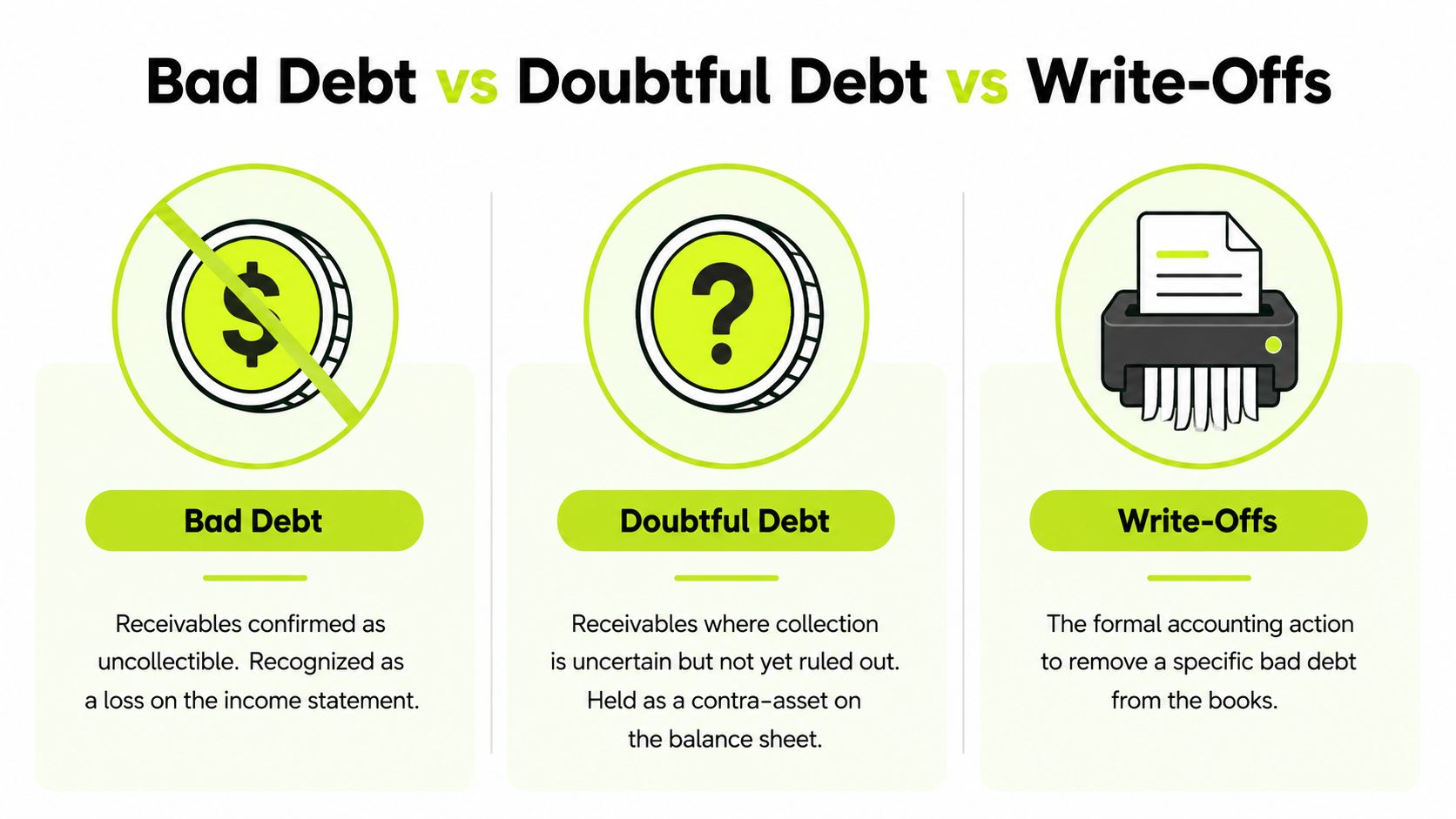
Finance teams often use bad debt, doubtful debt, and write-off as if they describe the same event. They don't.
Doubtful debt is a receivable where collection is uncertain but hasn't become improbable. The customer may be late, disputing part of the work, or showing deteriorating payment behavior. The balance remains an asset, but the firm records an allowance to reflect the expected loss.
Bad debt is the later classification. The firm has enough evidence to conclude that recovery is no longer likely, whether because of insolvency, bankruptcy proceedings, failed collection efforts, or another objective loss event. The receivable may already be fully reserved, or the firm may now need to remove it from the books.
A write-off is the accounting action. It removes a specific receivable from accounts receivable, usually against the allowance. It isn't a separate type of customer debt. It's the formal bookkeeping step taken after the firm decides that the balance should no longer remain as a collectible asset.
A decision framework for controllers
Use the evidence, not just the aging bucket, to determine the category.
Situation | Operational classification | Accounting response | Collections response |
|---|---|---|---|
Client is late but communicating and financially stable | Overdue receivable | Monitor and assess allowance impact | Maintain normal cadence |
Client disputes project scope but remains active | Doubtful debt risk | Reserve for expected loss where appropriate | Resolve the dispute and pursue the undisputed balance |
Client has entered bankruptcy proceedings | Bad debt | Recognize the expected loss and write off when appropriate | Coordinate with legal or insolvency processes |
Payment was received but not matched to an invoice | Unapplied cash, not bad debt | Reconcile before changing the allowance | Resolve cash application immediately |
A scope dispute doesn't automatically mean the invoice is bad. If the client is operating and willing to engage, the firm may still collect all or part of the balance. Reserving for the uncertain portion while continuing collection is more accurate than either ignoring the risk or writing off the entire amount.
The opposite error is equally damaging. Keeping a bankrupt client's balance in the “current collection” category makes the aging report look healthier than it is and delays decisions about reserves, legal escalation, and future credit exposure.
For businesses that also need to compare good and bad business debt, the distinction is useful because financing debt and customer receivables carry different risks. A loan can fund productive capacity. A receivable becomes bad debt when the firm has delivered value but can't convert the resulting claim into cash.
Controllers should also document the judgment. Record the customer signal, the disputed amount, collection history, expected recovery, and approval for the accounting treatment. That record supports consistency across month-end closes and prevents the same account from being reclassified differently by different team members.
Impact on Cash Flow and Financial KPIs
Bad debt affects cash flow before the income statement reflects the full loss. The firm has delivered work, recorded revenue, and incurred costs, but the expected cash never arrives. That gap forces management to fund operations from existing cash, a credit facility, partner capital, or delayed payments to vendors.
Days sales outstanding, or DSO, provides a practical view of how quickly receivables convert into cash. The standard formula is DSO = (Accounts Receivable ÷ Total Credit Sales) × Number of Days, as described in this DSO and bad debt provision guide. Another common variant uses average accounts receivable divided by net revenue, multiplied by 365 days, so the chosen formula and revenue base must remain consistent.
A balance that remains open because of a dispute, a missed reminder, or an unapplied payment can inflate DSO even before it becomes bad debt. That makes DSO a useful signal, but not a diagnosis. The controller needs to separate genuine collection delay from billing errors, credit notes, unresolved scope questions, and cash that arrived without a usable remittance reference.
Reading the aging report correctly
The aging report shows where risk is accumulating. Movement into older buckets, especially balances extending beyond 90 days, can indicate that collection probability is falling. It's a leading operational signal, not automatic proof that every balance will be written off.
A practical review asks:
- Which customers are aging: Is the risk concentrated in one account, industry, partner relationship, or project type?
- Why are balances aging: Are clients disputing scope, rejecting invoices, waiting for purchase orders, or ignoring reminders?
- What changed: Did payment behavior deteriorate, or did the firm change billing terms or invoice timing?
- What action is assigned: Does each material balance have an owner, next date, and escalation path?
The cash conversion effect can become severe. A professional services firm may need to draw on a facility to cover payroll while waiting for clients to pay completed work. If management responds by delaying vendors, reducing hiring, or accepting weaker client terms, the original collections failure spreads into operations.
KPI | Healthy Baseline | With 2% Bad Debt | With 5% Bad Debt | Operational Consequence |
|---|---|---|---|---|
Receivables quality | Most balances supported by a credible collection plan | A portion requires active reserve review | A larger share requires recovery decisions | Forecast confidence declines |
DSO | Stable and aligned with contractual terms | Aging pressure can push DSO upward | Persistent old balances can materially extend DSO | Cash arrives later than planned |
Working capital | Funds delivery, payroll, and growth | More cash remains tied up in receivables | Financing pressure increases | Credit facilities or payment timing may become necessary |
Aging profile | Older balances are isolated and explained | More accounts need escalation | Older buckets become a central management concern | Write-off risk becomes harder to contain |
Forecasting | Collections are predictable | Expected cash needs revision | Revenue and cash diverge sharply | Hiring and investment decisions become less reliable |
The table uses the stated bad debt levels as management scenarios, not universal benchmarks. There's no single “healthy” DSO for every professional services firm. Contract terms, billing model, client mix, and project structure determine the right baseline.
A controller should review DSO alongside aging migration, allowance coverage, disputed invoices, unapplied cash, and actual write-offs. One metric can tell you that cash conversion changed. The supporting detail tells you why.
Practical Strategies to Reduce Bad Debt
Prevention starts before the invoice exists. A firm that accepts every client, negotiates vague payment terms, bills only at project completion, and follows up manually has already created collection risk.
Set credit rules before delivery begins
Start with a documented credit policy. Review the client's payment history, financial information where available, ownership structure, industry exposure, and proposed engagement size. Then translate that assessment into practical terms such as credit limits, retainer requirements, milestone billing, or approval thresholds.
The policy only works if partners follow it when revenue pressure rises. A client shouldn't receive unlimited exposure because a partner wants to preserve the relationship. Commercial flexibility can exist, but an exception should have an owner, a limit, and an expiry or review date.
Contracts should also define the billing mechanics clearly. State when invoices are issued, who approves them, what constitutes a valid dispute, how quickly disputes must be raised, and what late-payment consequences apply. Retainers and milestone billing reduce the amount of unpaid delivery sitting at risk.
Use a cadence that starts early
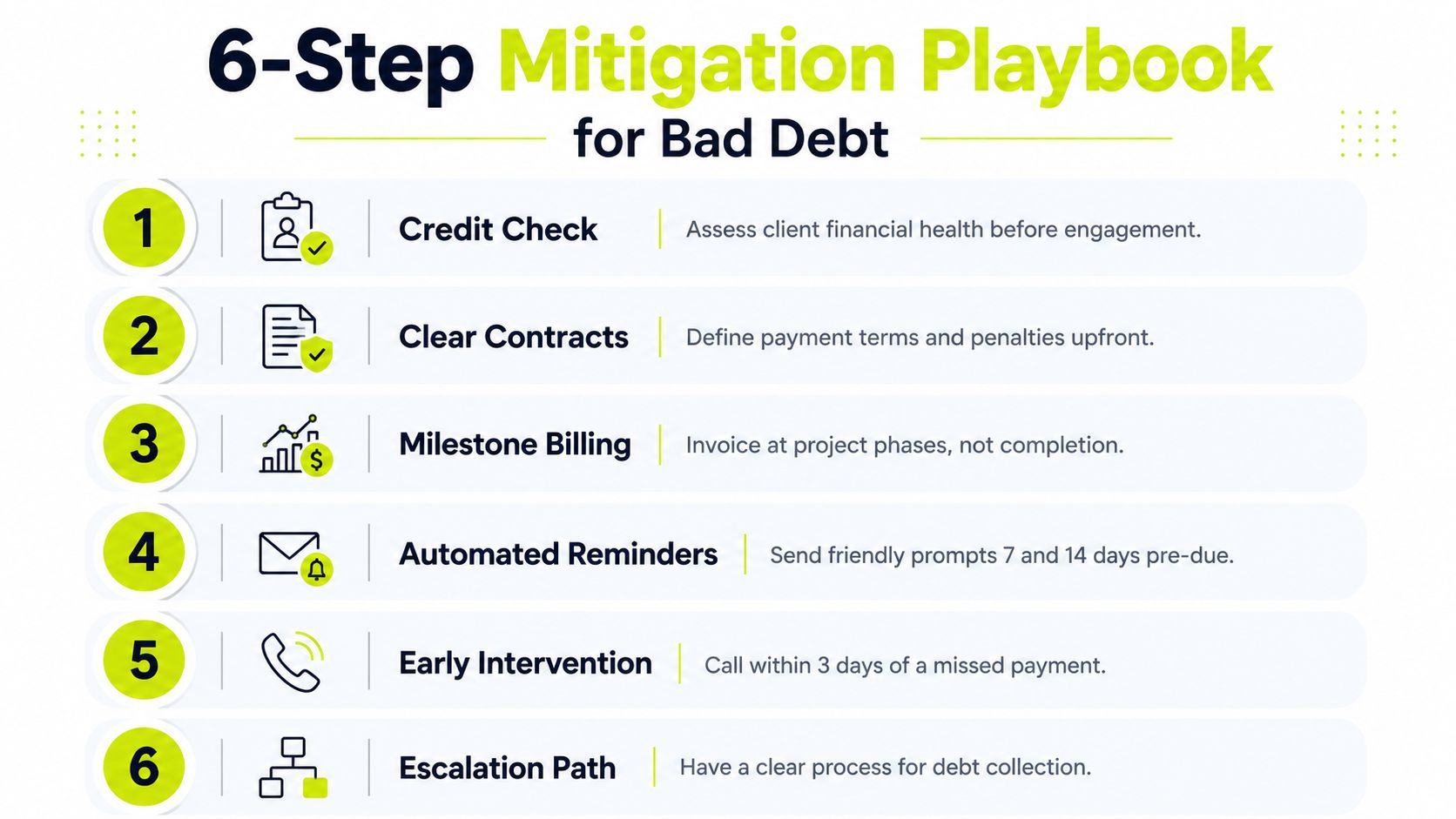
Collections should feel predictable, not punitive. Send accurate invoices promptly, provide a payment portal, and use scheduled reminders before and after the due date. A missed payment should trigger a human review within a few days, not disappear into a spreadsheet until month-end.
A workable cadence can include:
- Pre-due confirmation: Confirm the invoice reached the right AP contact and that required purchase order or project references are present.
- Early reminder: Send a concise reminder before the due date, with the invoice, payment instructions, and a clear contact for questions.
- Missed-payment outreach: Contact the client promptly after the missed date to identify whether the issue is administrative, financial, or commercial.
- Escalation: Move unresolved balances to a senior account owner, formal demand process, or legal review according to documented policy.
Flexible payment options can help a viable client resolve temporary pressure. Installment plans, ACH, card payments, and digital wallet options reduce friction. Early-payment discounts may work in selected situations, but they should be evaluated against the cost of capital and the value of accelerating cash.
Teams building a structured guide to dunning workflows for ecommerce can apply the same principles to professional services, while adapting the messages for longer engagements, project sponsors, and invoice disputes.
Manual processes break down when reminders depend on one coordinator remembering which client needs attention. AR software for professional services can apply rules consistently, preserve a contact history, and route exceptions to the right person. Resolut, for example, provides automated collections, payment follow-up, risk prioritization, and cash application workflows that can be configured around a firm's policies.
The goal isn't to remove judgment. It's to reserve human judgment for disputes, relationship decisions, and risky accounts rather than repetitive reminders and status checks.
How AR Automation Prevents Bad Debt Before It Starts
The strongest bad debt process acts while an invoice is still collectible. It prioritizes risk, sends consistent follow-up, and gives finance a reliable view of what has been paid, what is disputed, and what needs intervention.
AI AR automation can replace spreadsheet triage with risk-based work queues. A finance team can review invoices by age, client behavior, dispute status, and expected collectability instead of treating every overdue balance alike. A historically reliable client who misses one payment may receive a measured reminder. A chronically late payer may need earlier escalation and tighter terms.
Automation also protects the aging report from false positives. Cash application and reconciliation can match received payments to open invoices, preventing paid balances from appearing overdue because remittance information arrived separately. That reduces wasted collector time and improves the quality of the allowance and DSO analysis.
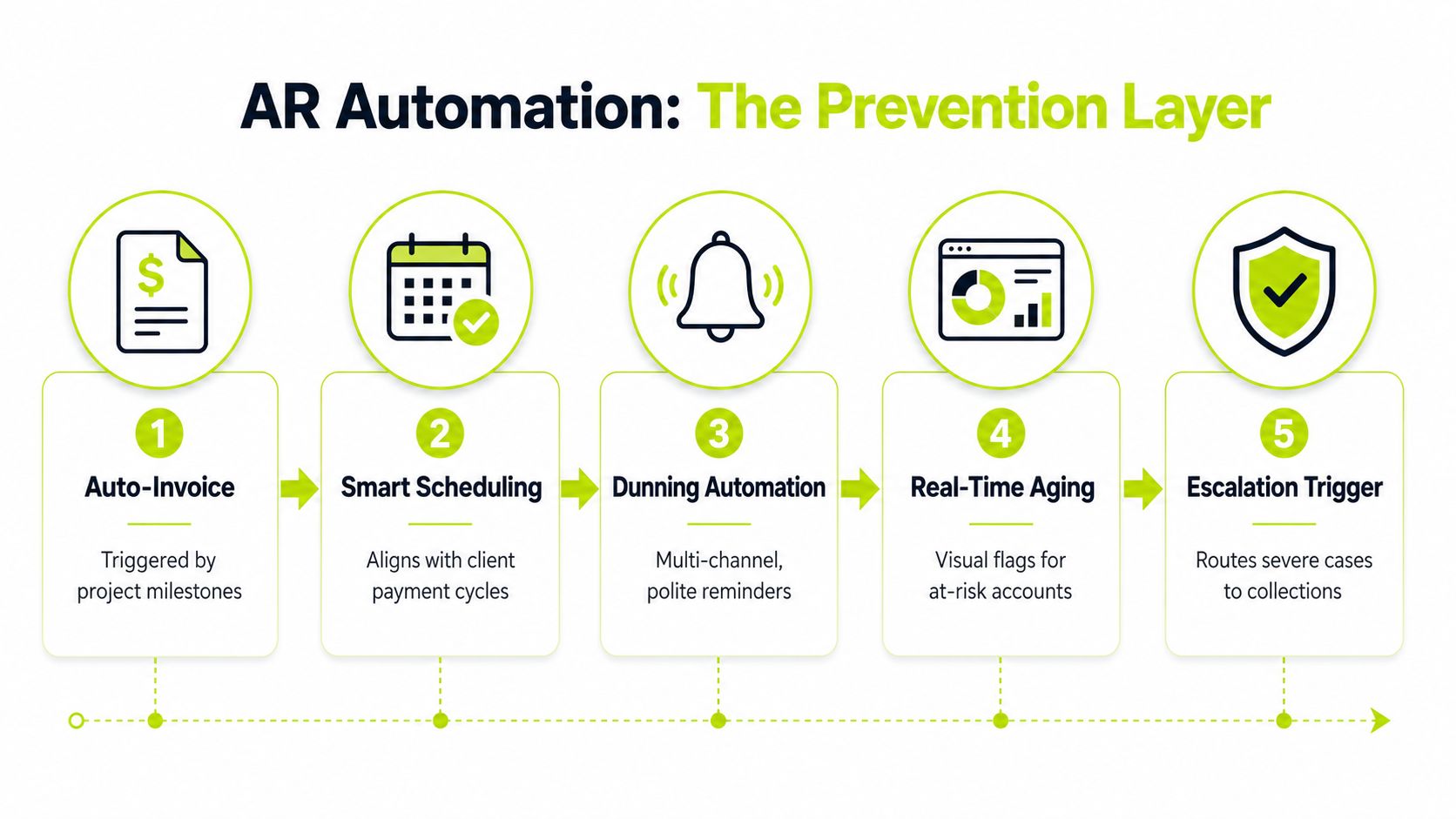
A useful QuickBooks AR automation workflow should connect invoice creation, client contacts, payment status, reminders, dispute handling, and reconciliation. The accounting system remains the financial record, while the automation layer coordinates the work required to turn receivables into cash. Teams can review what AR automation involves before deciding which processes should be automated and which should stay under human control.
The practical test is simple. Can the team identify an at-risk account before it reaches a late-stage aging bucket? Can it prove what communication occurred? Can it see whether the client's issue is inability to pay, unwillingness to pay, or an internal billing error?
Predictive models can improve that early warning as they use more payment and account behavior data. The accounting outcome still requires professional judgment, but the timing changes. Bad debt becomes a preventable operational risk rather than a surprise discovered during write-off review.
Resolut automates AR for professional services with consistent invoice follow-up, risk prioritization, payment workflows, and cash application support. If your firm needs to reduce DSO and improve cash flow without making collections feel impersonal, visit Resolut to see how the platform fits into your existing AR process.