
What Is Invoiced? A CFO's Guide to Cash Flow Control
Learn what is invoiced and how it impacts cash flow, DSO, and AR. A guide for CFOs on managing the invoice lifecycle and using automation to get paid faster.
Late payment is not a fringe issue. According to global invoicing statistics compiled by Billed, 35% of invoices are paid more than 30 days late, 1 in 4 bankruptcies are tied to late payment pressure, and 56% of U.S. small businesses report carrying unpaid invoices.
For a professional services firm, that makes "what is invoiced" an operating question with direct cash consequences.
Invoiced is the point where completed work turns into accounts receivable on the balance sheet. Until that happens, the work may be delivered and even recognized for revenue purposes, but it is not yet in the collection cycle. That gap matters more than many owners expect because it affects DSO, AR aging, short-term cash forecasting, and how much working capital the firm has to fund from its own pocket.
I see the same pattern in firms between $3 million and $50 million in revenue. Leadership tracks utilization, backlog, and margin closely. Invoicing gets treated as admin. The result is predictable: bills go out later than they should, aging reports understate the delay, and cash strain shows up weeks after the operational mistake that caused it.
Treat invoiced status as the handoff point between delivery and cash control. Once an invoice is out, finance can measure days outstanding, monitor aging buckets, and start collections with discipline. That is also where AR automation starts to produce a measurable return, because the gains come from faster invoice issuance, fewer billing errors, tighter follow-up, and quicker cash application.
The Critical Moment an Invoice Defines Your Cash Flow
A service business can look profitable on paper and still feel cash-starved in practice. The gap often opens at one specific moment. Not when the engagement letter is signed, and not when the work is completed. It opens when the work should have been invoiced but wasn’t.
“Invoiced” marks the handoff from operations to cash conversion. Before that moment, your team may have created value, but finance still can’t collect it.
That’s why late invoicing is more damaging than many owners realize. It doesn’t just delay payment. It pushes the entire collection cycle to the right. If your client pays on Net 30, but your team waits to send the invoice until a week after the milestone, you’ve effectively turned Net 30 into Net 37.
What owners usually miss
Three operational failures sit behind weak cash conversion in professional services:
- Delivery isn’t tied to billing: Project milestones close in Asana, Jira, Monday.com, or ClickUp, but no one triggers the invoice immediately.
- Approvals drift: Time entries, expense coding, or partner review sit in limbo while AR aging hasn’t even started.
- Collections start too late: Teams act as if follow-up begins after the due date, when in reality it starts with a clean invoice sent to the right contact on time.
Practical rule: If work is complete but not invoiced, it isn’t helping liquidity.
The firms that stay in control don’t treat invoicing as clerical output. They treat it as a financial event with an owner, a deadline, and an escalation path. That mindset changes reporting. It also changes behavior. Project leads become accountable for billing readiness, controllers gain visibility earlier, and the owner gets a cleaner picture of what cash is collectible now versus what is still trapped in WIP.
What Invoiced Means on Your Balance Sheet
When a sale is invoiced, it formally creates accounts receivable for the seller and accounts payable for the buyer, establishing a legal payment obligation and moving the transaction from completed delivery to pending cash conversion, as explained in this overview of what invoicing means in accounting terms. That’s the accounting hinge point. The work is no longer just delivered. It is now a booked claim on cash.

On the balance sheet, that means an asset appears. It may not feel like cash yet, but it now belongs in the asset section because the business has a contractual right to collect. If you advise multiple entity types, the same discipline applies whether you review a service firm’s AR rollforward or a nonprofit balance sheet. The structure changes, but the principle doesn’t. Recognition and collectibility still matter.
What counts as invoiced and what doesn’t
Finance teams get into trouble when they use “invoiced” loosely. These items are not the same:
- Quote or proposal: A commercial offer. No receivable exists.
- Pro forma invoice: A pre-billing document used for reference or approval. Usually not a booked receivable.
- Draft invoice: Prepared, but not yet final or sent.
- Issued invoice: This is the event that matters operationally and financially.
If you want better cash forecasting, your reporting should separate draft, approved, sent, and collectible statuses. Rolling them together makes AR look healthier than it is.
Why this matters for DSO and asset quality
The day an invoice is issued is the day DSO starts counting in practical terms. That date drives due dates, aging buckets, reminder timing, and management attention. If your team posts revenue but delays invoicing, your income statement may look current while your cash forecast lags behind reality.
That’s also where valuation discipline matters. AR isn’t just a gross number. Controllers need to understand what portion is likely collectible and what portion should be adjusted. A useful companion to this discussion is this guide on net realizable value in accounting, because booked receivables only help if they convert to cash.
A clean invoice creates a legal claim. A collectible invoice creates financial value.
The Lifecycle From Invoice Creation to Cash Application
In a professional services firm, the invoice-to-cash cycle usually starts long before accounting touches the receivable. It starts when a consultant finishes a milestone, a partner approves a retainer bill, or a project manager releases time for billing. Once an order or service is invoiced, the process tends to move faster. Data cited in this review of invoiced order status and downstream operations shows that 85% of invoiced orders proceed to the next stage within 24-48 hours, while pre-invoice stages face 40% delays, and that acceleration can improve the cash conversion cycle by 10-20 days in high-volume sectors such as professional services.
That operational lift matters because most AR problems are process problems before they become collection problems.
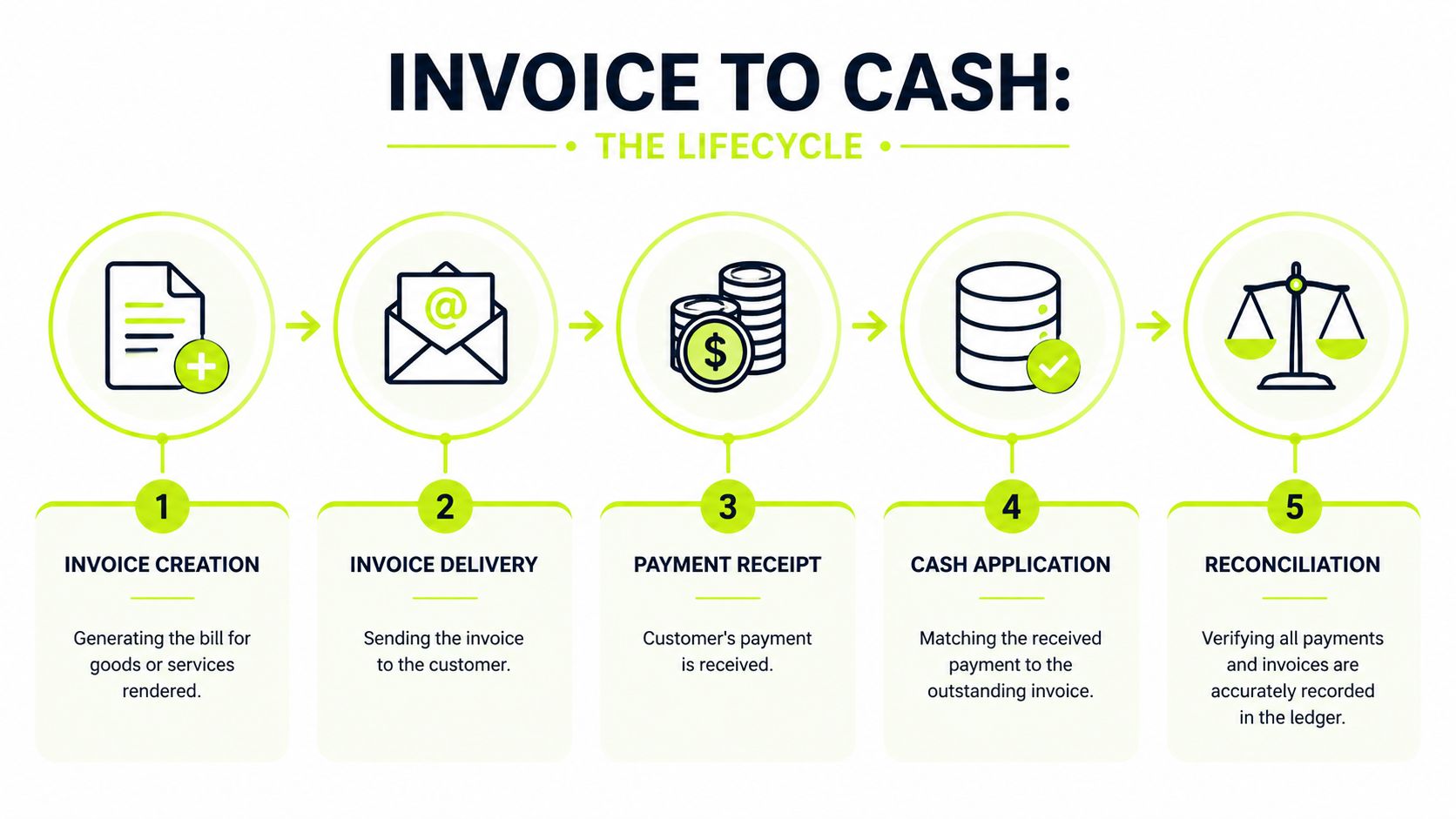
Where the cycle actually begins
A typical workflow looks simple on a whiteboard. In practice, each handoff can stall.
- Invoice creation Billing data comes from timekeeping, a PSA platform, a project system, or QuickBooks. For smaller operators comparing foundational tools, this roundup of bookkeeping software for freelancers is useful because it shows how early invoicing workflows often begin in lightweight accounting systems before firms outgrow them.
- Approval Someone confirms scope, rates, reimbursables, write-downs, and client coding. Firms often lose days during this step.
- Delivery The invoice has to reach the correct client contact. Sent isn’t the same as received, and received isn’t the same as accepted.
Where collection cycles get longer than they need to
The most common choke points aren’t dramatic. They’re routine.
- Manual data handoff: Time sits in spreadsheets or email threads.
- Late issuance: Teams batch invoices weekly or monthly when they should bill on milestone completion.
- Unclear invoice detail: The client can’t match the bill to the SOW, team members, or deliverables.
- Disconnected payment tracking: Finance sees an open invoice, but the customer already initiated payment.
- Slow reconciliation: Cash arrives, but no one applies it quickly to the right invoice.
Here’s a concise walkthrough of the back end of that process:
The step many firms underestimate
Cash application is where collection work becomes usable reporting. Until a payment is matched and reconciled, your aging can be wrong, your customer history can be misleading, and your collections team may chase balances that are already in motion. If your team wants a tighter explanation of that step, this article on cash application in accounting is worth reviewing.
Good AR teams don’t just send invoices fast. They close the loop fast.
The firms that reduce friction usually make two changes. They shorten the distance between delivery and billing, and they remove manual handoffs between payment receipt and ledger reconciliation. That’s where many DSO gains come from. Not heroic collections calls, but cleaner operating discipline.
Decoding AR Terminology Invoiced vs Billed vs Posted vs Paid
Many AR arguments are really language problems. Sales says the client was billed. Delivery says finance has it. Accounting says it’s posted. The owner asks why cash still hasn’t arrived.
The fix is to define each term precisely and use it the same way across finance, operations, and client service.
AR Status Terminology Breakdown
Term | Definition | Accounting Impact | Operational Status |
|---|---|---|---|
Invoiced | A formal invoice has been issued to the client for delivered goods or services | Creates or confirms a receivable to be collected | Collection clock starts |
Billed | A broad business term that often means the client has been charged, but may be used loosely | May or may not reflect a posted receivable yet | Can cause confusion if not tied to invoice status |
Posted | The transaction has been recorded in the accounting system or ledger | Financial records reflect the entry | Useful for reporting, but it doesn’t mean the client has seen the invoice |
Paid | Customer funds have been received and cleared | Receivable is reduced or closed after application | The invoice exits active collection work |
Where firms get tripped up
“Invoiced” and “billed” are often treated as synonyms. That’s fine in casual conversation, but not in reporting. If your dashboard says billed when it really means draft prepared, your AR forecast will be optimistic.
“Posted” also creates confusion. An invoice can be posted internally and still not be delivered to the client contact who can approve payment. Finance sees the receivable. The client sees nothing.
If teams use four words to mean four different things, collections get cleaner. If they use them interchangeably, aging reports become debates.
For professional services firms, I prefer status language that matches action. Draft. Approved. Sent. Seen. Disputed. Paid. Applied. That gives controllers, project leads, and owners a shared operating picture instead of a vague billing summary.
The Critical Gap Between Invoiced and Earned Revenue
A firm can invoice correctly and still misread its revenue story. The most common distortion comes from treating invoiced revenue and earned revenue as if they move together.
They don’t.
Recent PwC data cited in this explanation of what an invoice is and how it affects reporting shows 68% of finance leaders misalign earned and invoiced revenue, leading to inflated overdue reports by 15-20% in B2B firms. That’s not just an accounting nuance. It changes how leaders interpret AR performance.

A professional services example
Take a quarterly advisory retainer billed upfront. The invoice goes out at the start of the engagement period, but the work is performed over the following months.
From a cash and AR standpoint, the invoice is real and collectible now. From a revenue recognition standpoint, the service is earned over time. If leadership mixes those views, they tend to overreact or underreact in the wrong places.
That shows up in several ways:
- Forecasts look stronger than delivery supports
- AR aging appears worse or better than the underlying client behavior
- Project leaders assume billing progress equals operational progress
What to do with this distinction
Controllers should track billing cadence and delivery cadence separately. The owner needs both answers. What have we billed, and what have we earned?
For firms with retainers, milestone billing, or prepaid work, this separation improves cash forecasting and makes DSO analysis more useful. Otherwise, collections teams end up chasing narrative problems that are really reporting problems.
From Invoiced to Paid How to Shrink Your Collection Cycle
Manual invoice processing costs $15-$16 per invoice on average, while automation reduces that to $3-$5 per invoice, which is an 80% savings according to this review of manual versus automated invoice processing costs. The same source notes that 64% of finance teams still depend on manual tasks.
For a professional services firm, the larger cost sits in the days between sending the invoice and applying the cash. That gap drives DSO, distorts AR aging, and forces partners to spend time on collections instead of delivery and sales. I usually tell owners to watch one handoff more closely than anything else. The moment work becomes invoiced, collections needs to become a managed process, not an afterthought.
What works before you automate
Most firms should fix process before buying software. Better invoicing discipline improves cash flow fast, and it also gives automation clean inputs later.
- Send invoices immediately: Bill on milestone completion, retainer schedule, or approved time release. Do not wait for month-end if the work is already billable.
- Tighten invoice detail: Include the information clients need to approve quickly. In professional services, that often means team member, task, period, rate, and any agreed cap or milestone reference.
- Assign ownership: One person should own invoice issuance. One person should own collections cadence. Shared ownership usually produces gaps.
- Standardize follow-up: If your team needs a reference point, these Accounts Receivable Best Practices are a practical checklist for policy, cadence, and communication discipline.
Small delays stack up fast.
A draft invoice that sits for five days, a reminder that goes out a week late, or a cash receipt that stays unapplied until Friday all push DSO in the wrong direction. On an AR aging report, those failures look like slow-paying clients. In practice, many of them start as internal process failures.
What stops working at scale
Manual AR breaks in predictable places once volume rises or billing terms get more complex.
- invoices go out late
- collectors cannot see which accounts need escalation
- payment promises are buried in inboxes or call notes
- cash receipts are not applied quickly
- partner exceptions change timing without finance visibility
At that point, accounts receivable automation becomes part of financial control. The goal is not more software. The goal is fewer preventable days in receivables and a cleaner view of who owes what, why it is outstanding, and what should happen next.
What Automation Should Do
A good system for a services firm should connect billing, outreach, payment, and reconciliation in one operating flow. If you run QuickBooks, that often starts with QuickBooks AR automation so invoice status, reminder history, payment activity, and collections notes stay in the same record. This guide to invoice automation software gives a useful framework for evaluating that shift.
The gains usually come from a few specific capabilities:
- Automated invoice delivery: The system sends invoices on schedule instead of relying on manual batching.
- Structured reminder workflows: Email, SMS, and call tasks follow policy rather than memory.
- Payment visibility: Teams can see what is open, promised, disputed, or in transit.
- Faster reconciliation: Cash gets matched quickly, which keeps AR aging accurate and reduces duplicate follow-up.
AI AR automation is useful when it helps teams prioritize work. Risk-based follow-up, dispute detection, and customer-level escalation can improve collector productivity and keep senior finance attention on the accounts that affect DSO the most.
One option in that category is Resolut, which combines invoicing workflows, collections outreach, payment handling, and cash application for service businesses that want to reduce DSO and improve cash flow without running AR through disconnected tools.
The best collection process is timely, accurate, and repeatable.
Owners often worry that automation will make collections feel impersonal. In well-run firms, the opposite happens. Routine touches run on schedule, while finance and partners spend their time on exceptions that require judgment, such as disputed invoices, strategic clients, scope questions, or payment plans.
That is how firms shrink the collection cycle. They treat invoiced as the trigger for disciplined execution, then use process and automation to move each invoice to cash with fewer delays and fewer surprises.
Resolut automates AR for professional services with a practical focus on consistency, accuracy, and human follow-through. If your firm wants fewer manual handoffs and better control over collections, Resolut is built for that operating model.