
White Label Solutions for AR Automation: A CFO's Guide
White label solutions let firms launch branded AR automation fast. Learn the benefits, risks, pricing models, and evaluation checklist for finance teams.
You're probably already seeing it. A vendor walks into the room, the demo is polished, and the platform already looks like your firm, your colors, your logo, your client portal. Then someone in finance asks the main question, not whether it looks good, but whether you're buying software, reselling software, or becoming a product company.
That distinction matters. White label solutions are not a branding trick, they're a go-to-market decision with operational consequences. The European Banking Authority defines white labelling as a financial institution providing products or services that are distributed under another firm's brand, and its 2024 survey grouped European use cases into account and payment services, credit provisioning including BNPL and SME or corporate credit, and open banking services.EBA report
For CFOs, Controllers, and firm owners at professional services firms, the question is simple. If you already own the client relationship, can you turn that trust into a branded revenue line without taking on the full burden of building software from scratch? That's the lens to use, especially if you're looking at accounts receivable automation, AI AR automation, or QuickBooks AR automation as an external offer rather than only an internal efficiency tool.
What White Label Solutions Are in Finance
A controller spots the issue late. The client portal carries the firm's logo, the onboarding email comes from the practice, and the vendor is handling the support queue in the background. On paper, the firm looks like the provider. In practice, the economics and the technology stack sit with someone else.
That is the cleanest way to define white label solutions in finance. The EBA's definition is regulatory and precise, a financial institution distributes products or services under another firm's brand.EBA report The commercial version is simpler, one company builds the product, another rebrands and sells it, and in software the reseller owns the customer relationship while the vendor handles hosting, security, and development behind the scenes.Paycor white-label software explanation
What white label means and what it does not
A private label arrangement can give one buyer exclusivity without a fully embedded branded experience. A co-branding deal leaves both names visible on the interface, so the commercial split stays obvious to clients. In a true white label model, the client sees the reseller first.
For finance leaders evaluating AR software for professional services, that difference changes the go-to-market decision. If you want a branded portal for invoice follow-up, reminders, and cash application, white label can make sense. If your goal is only better internal collections, you do not need a resale model at all.
Practical rule: if the client pays your firm and the software sits behind your brand, you are operating a distribution channel, not just buying a tool.
That is where finance teams get tripped up. In a software resale model, the commercial layer and the operational layer are separated on purpose. You should be able to answer, in one sentence, who owns the customer, who owns the technology, and who owns the brand. If that sentence is fuzzy, the deal is fuzzy.
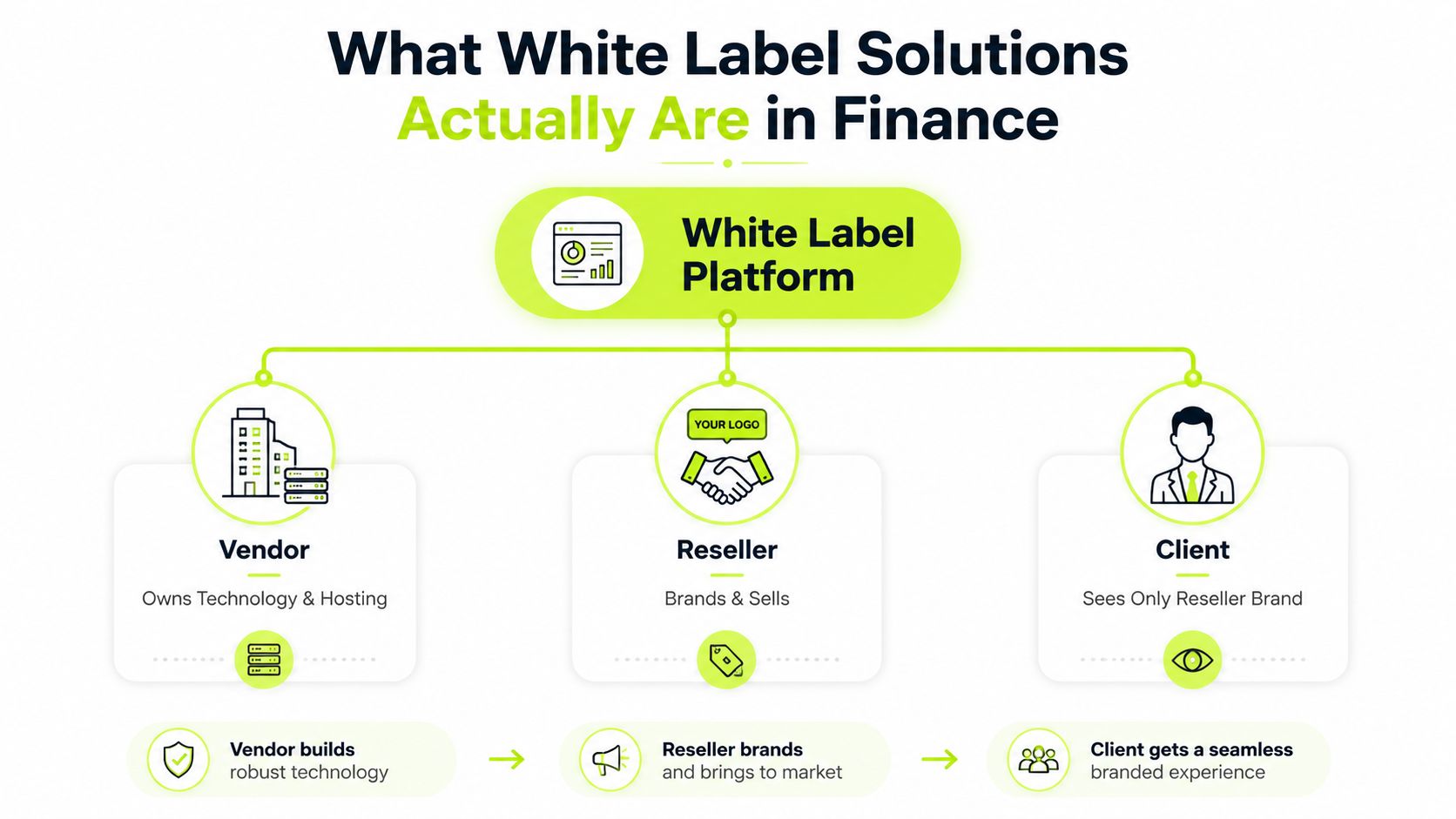
For teams exploring outsourced accounts receivable, the core question is whether you are buying a tool or building a branded revenue line. White labeling sits in the second category. That is why vendor selection belongs in the go-to-market discussion, not only in procurement.
The EBA survey matters for another reason. White labeling is no longer being treated as a side hustle. It is important enough to show up in national authority surveys, which tells you the model is mature enough to matter in regulated finance, not just in casual software resale.
Understanding the Vendor and Reseller Split
The operating split is where weak white-label deals fall apart. Vendors sell the platform, then the first real client question lands on uptime, security, data handling, or a feature request. If your firm is going to put its name on the product, you need a clean answer for where the vendor's job ends and where yours begins.
In a typical white-label software arrangement, the vendor handles backend infrastructure, maintenance, updates, and security controls, while the reseller controls branding, UI, and sometimes functionality.Zuar white-label analytics guide That split is not academic. It tells you who owns the roadmap, who carries the operational burden, and who gets blamed when the client experience breaks down.
The clean boundary line
The vendor runs the engine. They keep the platform alive, patch it, and protect it. The reseller owns the commercial layer. They shape the client experience, control the brand, and decide how the offer is positioned in market.
A mid-sized accounting firm reselling AR automation usually sees the same pattern. The firm sells the service, the vendor runs the core platform, and the support team becomes the first line for client questions. If a client asks for a dashboard change, the reseller routes the request. If a client asks whether data is secure, the answer needs to rest on the vendor's controls, not on polished marketing copy.
The cleanest deals are the ones where support responsibility is written down before the first client goes live.
That is why white label works best for firms that already have client relationships and want a branded revenue line, not just a software subscription. You are deciding whether your practice wants to operate a productized service. For a closer look at the operating model behind outsourced accounts receivable, the comparison is useful.

The split also explains the commercial upside. The reseller can package and price the offer without carrying the full cost of engineering, hosting, and maintenance. That is why the model can scale faster than an internal build, as long as the contract is tight and the vendor can support the client load you expect.
For a practical reference point on how the product layer is organized, compare it with accounts receivable automation software. The software category can look the same on paper, but the commercial role changes the economics, the support burden, and the control your firm has.
The Economic Case for Going to Market Faster
Most firms do not lose money because they picked the wrong software category. They lose money because they wait too long to turn a service into something the market can buy. White labeling makes sense when the primary goal is go-to-market speed, not procurement efficiency.
A Developex guide says organizations can avoid 18-to-24-month development cycles and launch enterprise-grade solutions in weeks.Developex guide That time gap is the point. If your firm is trying to launch a client-facing AR software for professional services offer, getting to market in weeks instead of years changes cash timing, lowers opportunity cost, and lets you test demand before you sink more capital into the model.
Why CFOs should care
The same source says agencies using rebrandable software were producing an average annual revenue of $789,000, with top operators bringing in more than $10,000 per week.Developex guide It also points to at least $10,000 in initial setup and marketing investment and roughly 12 months to reach sustainable revenue.Developex guide A separate Technioz software strategy guide makes the same basic point on decision logic, even if the operating model differs. The numbers are not a promise, but they show the trade-off clearly. You are buying speed and a chance at recurring revenue, not certainty.
For an AR-focused firm, the case is sharper because the pain already exists. 1 in 10 invoices go unpaid, and enterprises waste about $200B annually on AR inefficiency, which gives any new offer a problem clients already understand. If you can bundle collections, billing discipline, and cash application into a branded service, you are not creating demand from scratch. You are productizing a cash-flow problem that buyers already feel.
That is why the economics matter at the board level. A white label offer is not just another software line item. It is a revenue decision tied to client ownership, packaging, and how quickly the firm can turn an existing relationship into a sellable service.
What the return actually comes from
The return usually comes from three places.
- Faster launch: You get to market without carrying a long development cycle.
- Lower build risk: The vendor carries much of the technical burden.
- New revenue line: You charge for a branded service instead of only saving internal labor.
The model only works if the offer solves a problem the client will pay to fix. White labeling a generic dashboard is a weak bet. White labeling accounts receivable automation software, payment follow-up, and cash application is stronger because finance buyers already know what slow payment does to working capital.
That is the commercial test a CFO should use. If the service can be packaged, supported, and priced as a client-facing offer, white labeling can shorten the path to revenue without forcing your firm to build the whole stack first.
Build Versus Buy Versus White Label
Treat these as three different go-to-market choices, because that is what they are. The right move depends on whether you want to own the product, buy a tool for internal use, or sell a branded service through your firm. Finance leaders get this wrong when they frame white labeling as procurement. It is a distribution decision, and it changes the economics.
Path | Time to market | Capital required | Control | New revenue potential |
|---|---|---|---|---|
Build | Slow, because engineering and testing take time | High | High | High, but only after heavy investment |
Buy | Fast | Moderate | Limited | Low, if you only use it internally |
White label | Fast | Moderate | Shared | High, if you want to resell under your brand |
Build makes sense when the software itself is the core asset you intend to own. Buy makes sense when the goal is cleaner internal operations and tighter process control. White label makes sense when the firm already has the client relationship and wants to turn that trust into a sellable service.
The “buy” route is the clean answer for many finance teams. If the objective is to improve collections inside the firm, buying AR software is simpler than taking on a product business. If you want the broader decision framework, the Technioz software strategy guide is a useful reference, because the logic holds beyond one workflow.
When white label wins
White label wins when you can package the offer around an existing client problem and sell it under your own name. It also wins when the software sits inside advisory work, implementation support, or managed services. In that setup, the platform is the engine, but the service line is what clients buy.
It is the stronger play when you already control the relationship and can attach the offer to work the client trusts you to run. That is the point. You are not buying software for its own sake. You are creating a client-facing line that can carry margin and deepen account ownership.
When it does not
White label loses when the only goal is internal efficiency. It also loses when the vendor gives you weak branding control, thin support, or pricing that only works at a small scale. That is a bad trade for a finance team that wants to operate like a reseller or program owner.
The operating split matters because you are taking on a distribution commitment, not just a software contract. If the partner can change pricing or support terms without clear notice, treat that as a real deal risk. It hits service quality and margin at the same time.
A simple rule keeps the decision honest. Build when the software is your core IP. Buy when you want better internal operations. White label when you want to monetize a client relationship you already own.
If the question is whether the offer belongs inside your service model at all, compare it with arbitration-ready accounts receivable automation software. The fit is different, the contract shape is different, and the revenue model is different.
The Finance Team Evaluation Checklist
A glossy demo does not tell you whether a white-label program can carry a real go-to-market motion. The first mistake is treating the vendor as a software buyer. The second is treating the deal like a simple procurement exercise when you are really taking on a client-facing revenue line.
Scalability comes first. A partner that can support a small launch may fall apart when volume rises, and a partner that can handle a steady launch may still be a bad fit if your rollout needs branding control, support depth, or account isolation. That is why the evaluation has to start with operating capacity, not surface polish.
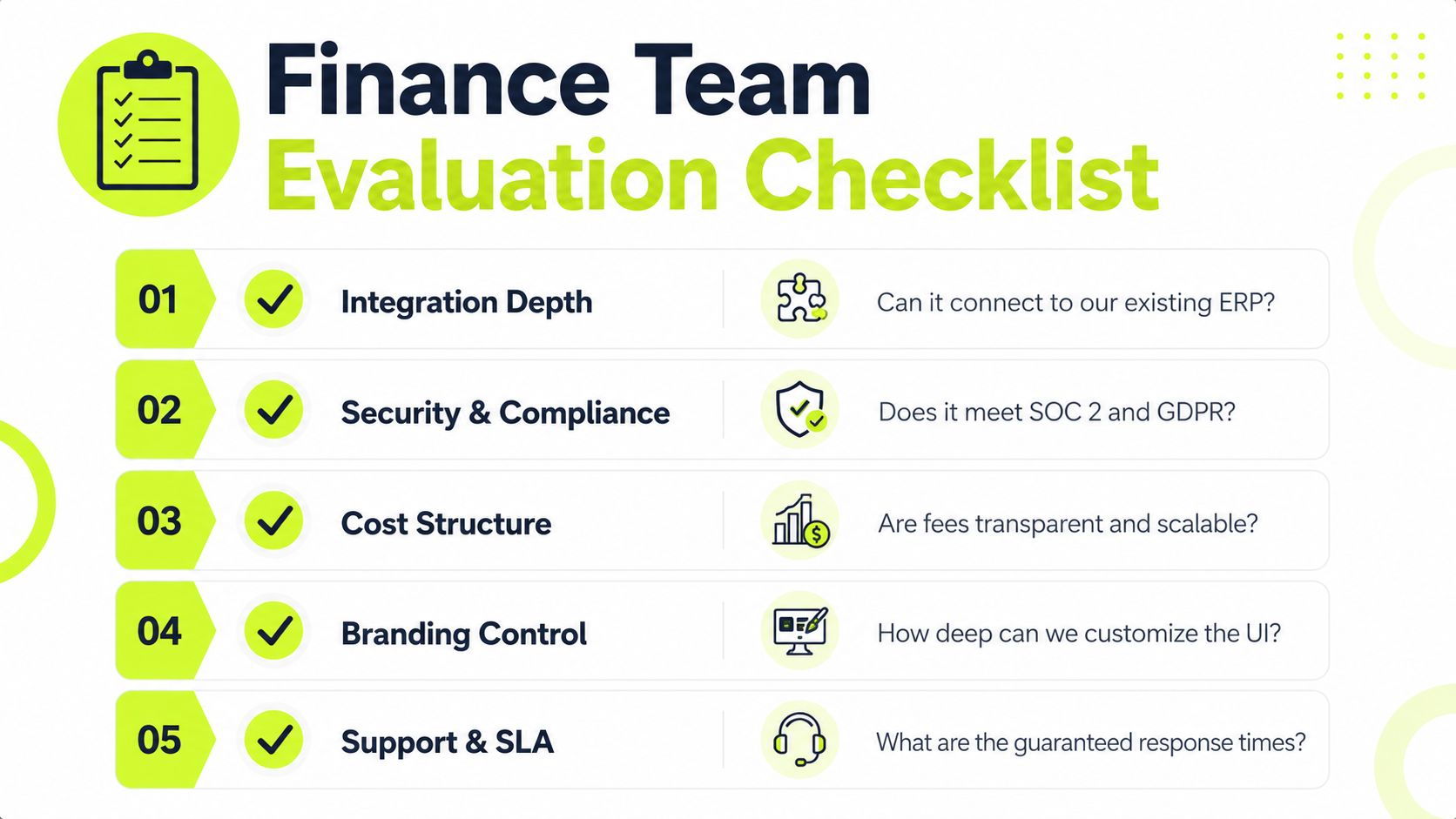
Questions to put on the call
- Who owns the backend? Ask who runs hosting, maintenance, updates, and security controls.
- How separate are the tenants? Ask how accounts are provisioned, how permissions are assigned, and how data is isolated.
- What can we brand? Ask whether you control the logo, domain, UI, workflows, and client-facing wording.
- What support obligations do we inherit? Ask who answers first-line issues and who escalates to engineering.
- What happens when we leave? Ask for the exit process, data handoff terms, and transition support.
A finance team should ask for evidence, not reassurance. If the vendor says the platform is scalable, ask how they have handled growth in live accounts, support load, and product changes. If the answer stays vague, the risk sits with you, and you should price it that way.
The three questions that catch most firms off guard are simple, who owns the client data, who handles support, and what happens if the platform changes under our brand?
Use the checklist to test whether the offer is built for resale or only for a pilot. A white-label program works only when the operating model is clear before launch, because volume spikes, security reviews, and product updates do not wait for a convenient time to expose weak terms.
Pricing Models and Contract Terms to Negotiate
White label deals either protect margin or hand it away. A polished pitch can hide a structure that pushes too much launch risk back onto the reseller, which is a bad trade if you are treating this as a go-to-market decision rather than a simple buy.
The pricing model has to match the role you want to play. Per-seat pricing works when usage stays stable and easy to forecast. Per-transaction pricing fits AR workflows that rise and fall with invoice volume. Revenue share can look attractive at first, but it gets messy fast if the economics are not transparent. Flat platform fees are easiest to budget, though they can be expensive if the program is still proving demand.
What belongs in the contract
The contract should spell out pricing changes, minimums, exclusivity, branding rights, service levels, support responsibilities, and exit terms. If those items are missing, you do not have a partnership. You have a verbal promise.
The same discipline applies to system dependencies. If your client experience depends on integrations, get the vendor to define how API connectivity works, what breaks first when an upstream system changes, and who owns the fix. That belongs in the paper, not in a sales call.
Use the deal terms to answer one question, who carries the downside if adoption is slower than expected? If the vendor can reprice quickly, if there are minimum commitments with no flexibility, or if branding approvals can be pulled later, the reseller takes on more risk than it should.
A simple negotiation lens
- Pricing change protections: Lock in notice periods and approval rights.
- Minimum commitments: Keep them aligned to realistic adoption, not aspirational forecasts.
- Exclusivity scope: Narrow it if the vendor wants it.
- Branding rights: Define what the client can see, and what the vendor can block.
- Service levels: Tie response expectations to the client experience you are selling.
- Support responsibilities: Separate first-line support from engineering support.
- Exit terms: Write down how client data, branding, and active workflows unwind.
If a vendor resists these terms, treat that as information. It usually means they are more comfortable selling software than enabling a partner-led business. A real white-label program should survive a redline.
The right contract does one more thing. It preserves margin. If the pricing structure is too rigid, your client-facing offer becomes hard to price, hard to support, and hard to scale. Finance should not accept that just because the demo looked clean.
Implementation Steps and Technical Guardrails
A white-label launch is not a logo swap. It's an operational rollout, and the implementation sequence matters because every shortcut turns into support debt later. For AR automation, the first rule is to keep the workflow boring and repeatable.
The practical sequence usually starts with connecting data sources and integrations, then building standardized templates, then applying branding and a custom domain, then scheduling automated delivery or refreshes, then duplicating the template for the next client.ClicData white-label reporting guide In AR terms, that means connecting the accounting system, mapping invoice and payment data, standardizing reminder and follow-up views, and then rolling the template out client by client.
The guardrails that matter
Tenant separation and release governance are essential. Vendors need clear controls for how accounts are provisioned, how permissions are assigned, how data moves between tenants, and how updates are tested, announced, and rolled back so a branded environment does not break when the core platform changes.Encelade white-label solutions
That is especially important when the platform touches billing workflows. A small release issue can become a client-facing incident fast if permissions, data sync, or refresh logic are not isolated properly. If the vendor cannot explain how they test changes before rollout, you should assume your client experience will become their experiment.
A practical AR rollout often starts with a small pilot group. Onboard the first clients, verify invoice visibility, check reminder timing, confirm payment status updates, and test how the branded portal behaves when a client logs in from day one. Then expand only after the support queue stays quiet.
You can also compare the technical stack with API connectivity guidance for AR systems. The integration layer is where many white-label programs succeed or fail, not in the design mockup.
AR Use Cases and the Go-To-Market Play
White label AR only makes sense if it helps you sell a clearer service. For a professional services firm, that can mean recurring AR automation for SMB clients, embedded collections workflows inside an accounting practice, or a fractional CFO package that includes billing discipline and cash application as a managed service. The software matters, but the offer design matters more.
The buyer is usually not the owner alone. It might be the controller, the operations lead, or the founder who is tired of late payments and messy follow-up. You position the service around fewer overdue invoices, cleaner cash visibility, and less manual chasing, not around software features. That is how you move from a product demo to a budget line.
What the go-to-market motion should look like
Lead with the client pain you already see. If you are advising businesses that live invoice to invoice, tie the offer to faster collections, cleaner billing handoffs, and fewer manual follow-ups. Then decide whether the white-labeled product sits inside a broader advisory engagement or stands as a standalone managed service.
Use the white-label program as a distribution wrapper, not as the headline. Clients do not care that the platform is rebranded. They care that the process is consistent, the information is accurate, and the collections workflow feels professional instead of chaotic. That is where a branded AR automation offer has a real chance to improve cash flow and reduce DSO in a way clients can understand.
Decision framework: white label only if you are willing to own the customer relationship, enforce the operating standards, and treat the software as part of a service line, not a side feature.
That is where a partner like Resolut fits naturally. Resolut automates AR for professional services, consistent, accurate, and human. If your firm wants a branded cash-collection motion that improves client experience instead of fighting it, visit Resolut and evaluate whether the model fits your practice.