
Accounts Receivable Cash Application: Finance Leader Guide
A practical guide to accounts receivable cash application for finance leaders, covering KPIs, automation benefits, and a clear implementation roadmap for 2026.
You know the scene. Bank files have landed, three remittance PDFs are buried in email, and a handful of checks show up with no advice at all. Month-end is already pressing, the controller wants clean AR, and the team is still trying to figure out which receipts can be posted and which ones will sit as unapplied cash.
That's the pressure point in accounts receivable cash application. It's not just the mechanical act of posting money, it's the control step that decides whether cash is recognized cleanly, aging is trustworthy, and collections can focus on the right accounts. For a practical cash-flow refresher that pairs well with this problem, browse the 2026 cash flow guide from Kons Law.
Why Cash Application Is Where Cash Flow Breaks
A controller at a $20 million professional services firm can have a solid collections team and still feel boxed in at month-end. ACH credits hit the bank, remittance comes in separately, and a few payments arrive with no usable reference at all. The money is there, but the books are not.

That is why cash application matters so much. JPMorgan describes it as the later-stage AR task that ensures every payment is matched to the correct invoice in the records, and Billtrust frames it as a KPI-driven automation discipline where faster application improves receivables visibility and DSO control in its 2026 accounts receivable benchmark report. In practice, this is the point where money turns into recognized receivables.
The problem starts before the ledger
When cash sits unapplied, aging stops telling the truth. A customer may have paid, but if the payment is not matched, collections still sees an overdue balance and may keep chasing the account. That creates avoidable friction for both sides.
Practical rule: If your bank balance says one thing and your AR subledger says another, treat cash application as a control failure, not a bookkeeping nuisance.
Professional services firms feel this sharply because project billing, retainers, milestone invoices, and partial payments often move on different timelines. One receipt can cover several invoices. Another may arrive before the invoice is even issued.
The messy part is not edge-case noise, it is the main workload. Fragmented remittance, deductions, short pays, and missing references are common enough that a team has to decide where judgment belongs and where automation can take over without creating audit headaches. That is also why it helps to browse the 2026 cash flow guide, especially if you want a practical view of how delayed application shows up in day-to-day cash management.
That is the job here. Control matching, exceptions, and reconciliation, not just post faster. Once you see the process that way, it stops looking like clerical cleanup and starts looking like finance operations.
What Accounts Receivable Cash Application Does
A payment hitting the bank is not the same as a payment being closed in AR. Cash application is the step where an incoming payment gets matched to the right open invoice, then posted in the AR system so the receivable is cleared correctly. JPMorgan's cash application guide says the core task is to use remittance data and reference keys such as invoice number, customer ID, amount, PO number, and deduction reason codes to get the match right. That is the job, not just recording that money arrived.
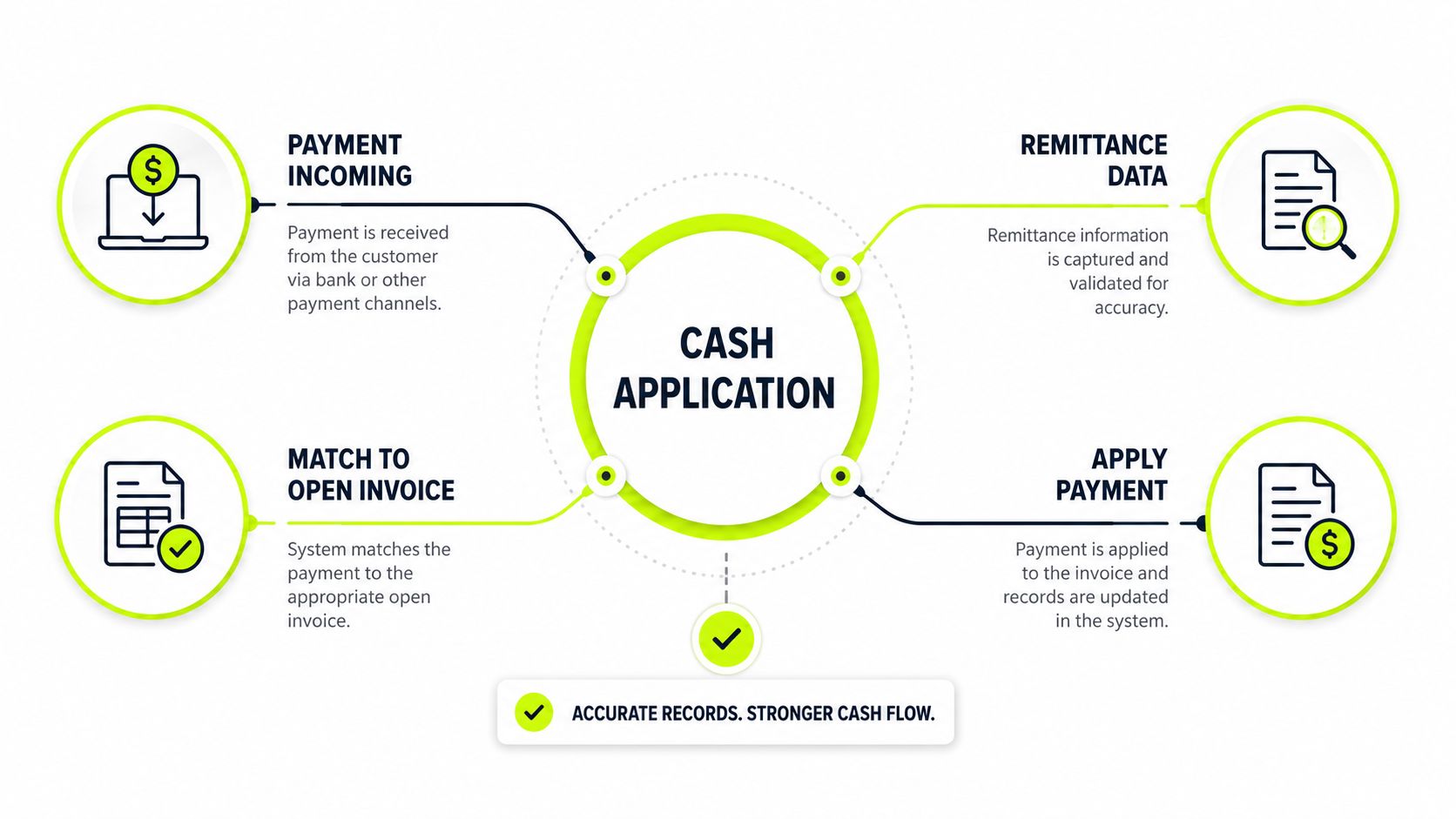
A payment can land on time and still create work if the remittance is incomplete, split across invoices, or tied to deductions. In practice, the AR team is not just posting cash. It is identifying what the customer intended, deciding how much of the payment belongs to each open item, and documenting the result so collections, dispute resolution, and reporting stay aligned. That is why the messy cases matter more than the clean ones.
Where it sits in the order-to-cash cycle
Cash application sits after invoicing and collections, then before aging and forecasting are trusted for management reporting. HighRadius places it inside the broader accounts receivable workflow alongside invoicing, collections, dispute resolution, and reconciliation. That placement matters because a payment is not operationally closed until it has been applied and reconciled.
The distinction between cash receipting, cash application, and reconciliation gets blurred in a lot of software pitches. Cash receipting records the bank credit. Cash application matches that credit to the invoice. Reconciliation ties the subledger back to the bank and GL.
Oracle's AR data model reinforces that this is a structured accounting event, not a loose journal entry. It stores each application as a discrete record with applied amount, status, and flexfield data in the receivables model, which is why downstream reporting depends on clean application records rather than manual patchwork. Oracle's receivable applications data model is a good reference if you want to see how seriously the system treats this step.
Cash application is the place where “we got paid” becomes “we can trust the books.”
For finance leaders, that is the test. If a system cannot show how it ingests remittance, matches across channels, and preserves traceability, it is not solving cash application. It is just moving the manual work around. And if your team is trying to find a startup CFO, this is one of the process areas that deserves a hard look before anyone claims the books are under control.
The KPIs That Tell You If Cash Application Is Healthy
A cash application process is healthy when it closes cash fast, keeps exceptions visible, and gives finance a balance it can trust without extra digging. If the team is only clearing the easy receipts, month-end will still be full of unapplied items, short pays, and manual research. That is the pattern to watch, not the glossy automation claim.
You also need the right benchmarks. A useful benchmark is the 2026 accounts receivable benchmark report, because it shows that even strong teams still live with exception work, and that gap between straight-through flow and messy receipts is normal.
The four numbers that matter
STP rate tells you how much of the flow posts without human touch. A higher rate usually means less manual handling and quicker visibility into cash, which is the direction most AR teams want. If automation only handles clean receipts, the labor burden stays high where the process gets messy.
Match rate shows how often the system correctly pairs payment and invoice. The envelope and line-item rates both matter, because one can look healthy while the other still leaves staff stuck on allocation work. A team can feel on track until a remittance packet arrives with split allocation, deductions, or a partial short pay.
Unapplied cash balance should stay near zero in a healthy process. It is not a place to park unresolved items for later. It means cash has not been fully closed and reported the way finance needs it.
Application latency measures how long it takes from bank receipt to invoice posting. Slow posting distorts aging, delays collections prioritization, and makes the cash position harder to trust. That is why CFOs care about it even when they never ask for the metric by name.
How these KPIs roll up to CFO concerns
The broader receivables picture matters too. Analysts at Grand View Research note in its receivables data that cash conversion cycle pressure and overdue invoices remain part of the operating backdrop for B2B teams. Those figures are not about cash application alone, but they explain why clean posting matters. If cash application lags, AR reporting loses clarity fast.
That is also why DSO belongs in the same conversation. If unapplied cash is sitting in the system, DSO looks worse than it really is, and cash forecast reviews become less useful. For a simple working definition and board-level framing, this DSO guide is a useful internal reference.
Operator's test: If a payment landed today, can a manager see the accurate customer balance by tomorrow morning without opening three inboxes?
If you need to find a startup CFO, this is one of the process areas that deserves a hard look before anyone says the books are under control.
Where Automation Pays You Back
Automation does not earn its keep on the easy receipts. It earns its keep on the messy 20%, where remittance is fragmented, deductions are buried in email threads, and someone has to decide whether a short pay is valid or just a mistake. That is the part most basic explainers skip, and it is where margin leaks.
The exception queue is the core workload
A payment may arrive through a bank file, while the remittance comes through a PDF, a portal, EDI, or a note attached to an email. Sometimes the invoice is not even issued yet. Sometimes the customer split one payment across several invoices, or paid less than expected because of a dispute, rebate, or timing issue.
That is where rules and AI help, but only if they are tied to the right controls. The value is not “full automation” in the abstract. It is shrinking the exception queue so people spend time on true disputes, not on routine detective work.
If you want a practical parallel outside finance, practical billing automation for hauliers shows the same pattern in another workflow, where messy documentation matters more than the clean invoice itself. The lesson carries over neatly to AR.
AI needs governance, not applause
AI AR automation can help and also create risk. If the system applies a partial payment incorrectly, or treats a composite payment as one invoice when it should have been split, the error can move fast and look clean on the surface. That is worse than a visible backlog because it damages trust in the subledger.
Control point: Ask every vendor how it sets confidence thresholds, how a match is explained, and what happens when a human rejects the recommendation.
Oracle's posting logic matters here because the total applied amount should equal the cash receipt amount, and each application should preserve a balancing unapplied record during the process, as described in Oracle's receivable application extract documentation. That structure is useful because it makes exception handling traceable. It also means automation should respect the accounting model, not bypass it.
For teams evaluating accounts receivable automation, the question is not whether AI exists. The question is whether the tool can explain itself well enough for a controller, an auditor, and a collections manager to trust the result. If it cannot, the time saved on matching may come back as review work later.
For a broader automation lens, this overview of AR automation is a useful internal companion piece.
An Implementation Roadmap That Respects Your Team
A good rollout doesn't start with software features. It starts with making sure payment data and remittance data can meet before posting. JPMorgan's process guide is clear that when remittance arrives separately from the money, teams have to aggregate both feeds before they can post to the ERP or AR subledger, and that's the right design choice when channels are fragmented.
Cash Application Implementation Roadmap | ||
|---|---|---|
Stage | Decision to Make | Typical Failure if Skipped |
Bank and remittance intake | Decide which channels are in scope first, bank feeds, email, portals, EDI | Teams keep chasing receipts across inboxes and logins |
Data aggregation | Decide how payment and remittance will be joined before matching | Matching happens too early and misses context |
Rules engine | Decide which metadata can drive matching, such as statement descriptor, payer name, and customer ID | Every exception becomes manual |
Exception queue | Decide who owns unresolved items and how fast they must respond | Payments sit in limbo and aging gets unreliable |
Pilot rollout | Decide which customer segment proves the process first | The launch is too broad and failure is hard to isolate |
Start with the channels you can control
Invoiced's cash application rules are a good example of how this can work in practice. Its documentation says rules can use metadata such as statement descriptor and payer name, and each rule can ignore a transaction, set the payment method, or select a customer before new bank-feed transactions are ingested in its rules guide. That's not flashy, but it's exactly the kind of logic finance teams need.
The trade-off is simple. Matching per channel is faster to launch, but it leaves you with fragmented logic and more exceptions later. Aggregating first is slower to design, but it gives you one place to control match quality and exception handling.
Keep ownership visible
An exception queue only works if it has a name next to every item. If nobody owns short pays, deductions, or mismatches, the queue becomes a parking lot. That's where a lot of automation projects fail, not because the engine is bad, but because the process around it is vague.
For teams that want a tighter process map, this guide to optimizing the AR process is a practical companion. It helps frame cash application as part of a larger operating rhythm, not a standalone tool purchase.
Pilot with one customer segment or one business unit first. That gives you a clean read on remittance quality, exception volume, and user behavior before the rollout touches every invoice stream. For a CFO, that's a more defensible path than promising full-scale transformation on day one.
What to Look for When You Pick an AR Vendor
For a firm in the $3 million to $50 million range, vendor selection should be about fit, not feature theater. A great demo can hide a weak implementation path. What matters is whether the tool works with your ERP, your payment channels, and your team's capacity.

ERP fit comes first
If your team lives in QuickBooks AR automation, the tool has to respect that reality. A QuickBooks-native option can reduce friction on posting and reconciliation, but it won't magically solve fragmented remittance if it can't ingest bank files, email attachments, and portal data together. The same logic applies if you run NetSuite, Sage Intacct, or Microsoft Dynamics.
What to ignore is just as important. Skip demos that only show the happy path. Skip vendors who can't explain how they handle exceptions. Skip tools that hide remittance ingestion behind a premium tier after the first call.
Ask harder questions about AI
A serious AI AR automation vendor should be able to explain how it sets confidence thresholds, how it surfaces partial and composite payments, and how a human reviewer sees the basis for the match. If the answer is vague, the automation is probably too fragile for real AP behavior. Professional services firms can't afford unexplained posting errors just because the interface looks modern.
You also want human-in-the-loop controls. Co-pilot mode matters because many firms need to trust the system before they let it run more freely. Autopilot is useful, but only after the review path is working.
Decision filter: If the vendor can't show you what happens on a short pay, an overpay, and a split remittance, keep looking.
For smaller firms that need a practical comparison point, find a startup CFO is a helpful resource for understanding how finance leadership often evaluates these tools before scale becomes messy. The right vendor should support that kind of operating discipline, not fight it.
One option in this space is Resolut, which offers cash application automation that captures payment and remittance data, matches it to open invoices, routes exceptions for review, and posts the result back to the accounting system. That's the kind of workflow fit to judge, regardless of brand.
ROI You Can Defend and Habits That Compound
A board-ready ROI case doesn't need inflated claims. It needs a few defensible levers. Faster application can improve the timing of cash visibility, reduce time spent on manual reconciliation, and lower the friction that keeps invoices open longer than they should be.
Keep the model simple
Start with DSO. If faster posting helps reduce it, even modestly, the working-capital effect can be meaningful for a professional services firm that bills on milestones and retainers. Add recovered AR hours, lower write-off pressure from cleaner exception handling, and the effect on cash forecasting.
That's the right lens because it reflects how the process behaves. The easy receipts post quickly. The exception queue is where staff time gets burned. The business value comes from shrinking the time spent on ambiguous items and improving the quality of the AR ledger.
Make the gains stick
The teams that hold their gains do a few things consistently.
- Review unapplied cash weekly: Keep it visible before it turns into a month-end cleanup project.
- Score remittance quality by customer: Bad remittance habits don't improve if nobody measures them.
- Document exception ownership: Every short pay, deduction, and partial payment needs a clear owner.
- Audit STP quarterly: If automation quality drifts, catch it early.
These habits matter more than a flashy launch. They turn cash application into a managed process instead of a recurring scramble.
For CFOs and controllers who want a calmer operating model, the right setup is the one that keeps posting accurate, traceable, and explainable. That's what supports better cash flow, cleaner reporting, and fewer avoidable collection calls to customers who already paid.
If your AR team is still spending too much time on remittance hunting, exception triage, and manual posting, Resolut can help bring order to that workflow. It automates AR for professional services with consistent, accurate, and human cash application, so your team can reduce DSO without losing control. Visit Resolut to see how the platform fits into a finance team's day-to-day process.