6 Accounts Receivable Collection Call Scripts
Use accounts receivable collection call scripts for reminders, disputes, escalation, and payment plans while protecting relationships and improving cash flow.
Every overdue invoice doesn't need a firmer collector. That popular advice treats a processing error, a genuine dispute, a temporary cash constraint, and a damaged relationship as if they were the same problem. They aren't, and using the wrong tone can delay payment while weakening a valuable client relationship.
Professional services firms need accounts receivable collection call scripts that function as decision tools. The collector should verify the facts, diagnose the blocker, choose the lowest necessary pressure, capture a specific commitment, and escalate only when the evidence supports it. A structured workflow commonly moves from identity verification to a neutral statement of balance, a listening pause, negotiation, commitment capture, documentation, and follow-up, as outlined in this published B2B collections call sequence.
The six scripts below match the conversation to invoice age, payment behavior, operational friction, dispute risk, and relationship value. They also address compliance, objection handling, role-play practice, and the way accounts receivable automation can help teams reduce DSO and improve cash flow without making outreach feel impersonal.
1. The Initial Soft Outreach Script for First Contact Within 5 Days
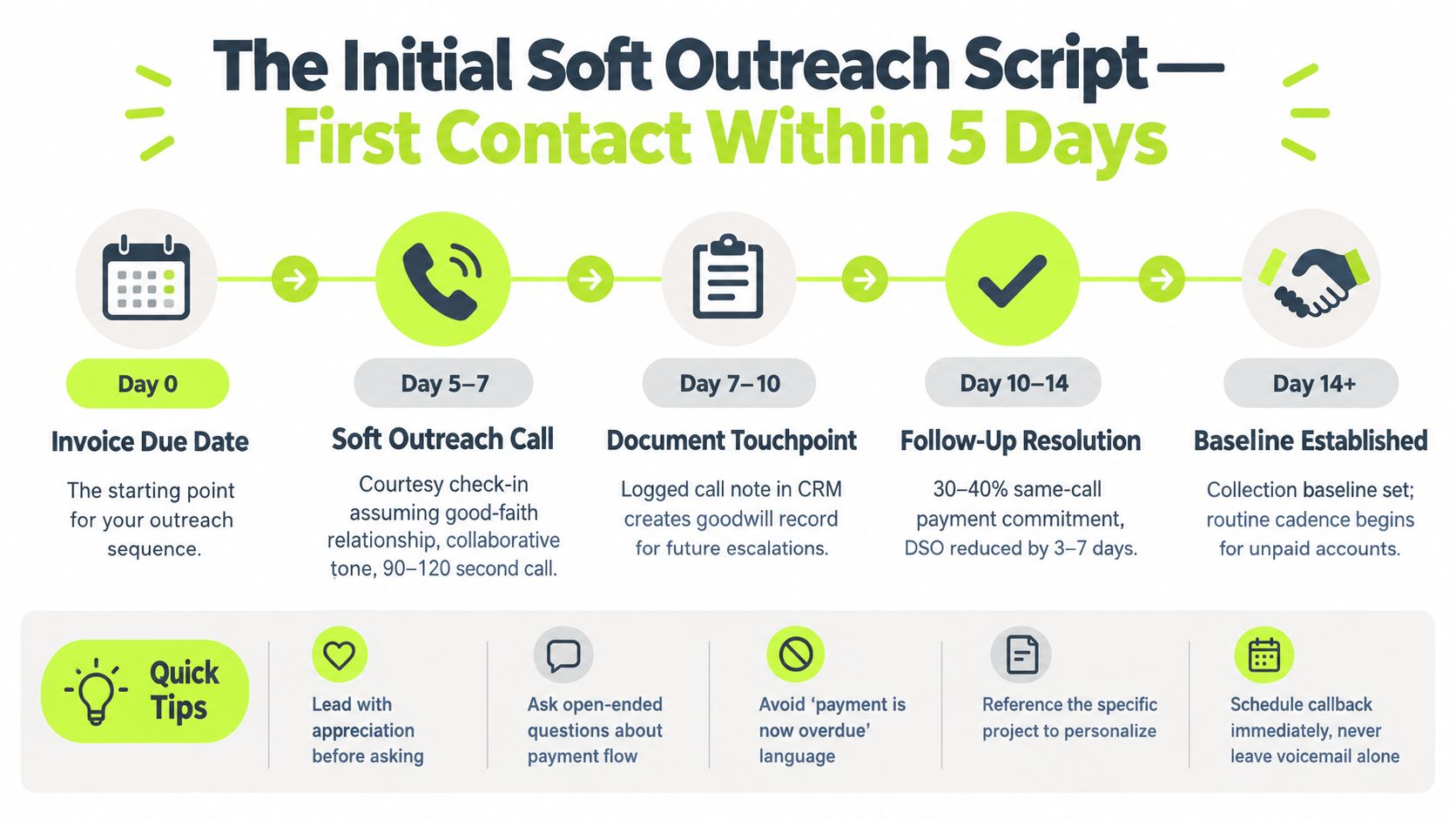
A recently overdue invoice usually calls for clarity before pressure. Within the first 5 days after the due date, contact the client as though a good-faith explanation is likely. The purpose isn't to accuse the buyer of withholding payment. It's to confirm receipt, identify the payment path, and establish a reliable baseline for future follow-up.
Prepare the invoice number, amount, original due date, engagement name, payment history, and the correct accounts payable contact. A practical collection framework recommends having these details, along with any disputes, partial payments, and decision-maker information, ready before dialing. You can review the collection call preparation framework for the full preparation logic.
A useful opening sounds like this:
“Thanks for being a great client. I'm calling about invoice #[number] for [amount], related to [engagement]. I wanted to check in on the status and make sure everything reached the right person on your side.”
Pause. Let the client explain. Ask, “How does payment typically flow through your team?” If the invoice went to the wrong department, resend it while you're on the call and confirm who owns the next step. If the decision-maker isn't available, schedule a callback immediately. A voicemail alone creates activity, not control.
What the collector should diagnose
- Receipt: Did the client receive the invoice and supporting documents?
- Routing: Is it with accounts payable, a project owner, procurement, or an executive approver?
- Timing: Has it entered a payment run, or is someone waiting to review it?
- Commitment: What date does the contact reasonably expect payment to be processed?
Avoid “Your payment is now overdue” as the first sentence. “I'm checking in on the status of invoice #[number]” keeps the conversation specific without creating unnecessary defensiveness.
The call should end with a date and a next action: “So you'll route this to AP today, and I should expect payment to clear by [date]. I'll send a short confirmation after we hang up.” Log the contact, explanation, commitment, and follow-up immediately in your CRM or AR system. This practical guide to making collection calls reinforces why immediate documentation matters.
2. The Process Problem-Solving Script for System or Workflow Blocks
Some clients intend to pay but can't move the invoice through an internal system. The cause may be a missing purchase order, an incorrect cost center, a vendor record mismatch, an invoice format rejection, or a payment gateway problem. Treating that account like a cash-risk customer wastes time and makes your firm look inattentive.
Open with diagnosis rather than a demand:
“Walk me through your payment process. Where does our invoice sit right now, and what's preventing it from moving today?”
Don't assume the problem. Ask whether the invoice is waiting for approval, rejected by an automated system, missing documentation, or held by procurement. Keep the invoice open during the call, with line items, PO references, engagement details, and coding information visible. If the buyer needs the data in a specific format, offer to send it immediately.
For example, an engineering firm might discover that its invoice was routed to the wrong cost center. A consulting firm might uncover an $8,000 discrepancy between the invoice and the original statement of work, while a staffing firm might find that the client's system rejected the vendor ID. Those situations call for correction and coordination, not stronger language.
Convert the blocker into an action
Use short, operational questions:
- Find the owner: “Who needs to approve or correct this from here?”
- Remove friction: “Would it help if I sent the invoice with the PO and cost-code details in your format?”
- Confirm the route: “Once I send that, does AP have everything required to release it?”
- Secure timing: “You'll process it by Tuesday. Should I expect it to clear by Thursday?”
The collector should document the exact cause and solution in the CRM. A note such as “invoice delayed” isn't reusable. “Rejected because vendor ID was outdated, portal record updated, revised invoice sent, AP processing Tuesday” gives the next collector a clear operating history.

The second half of this workflow is follow-through. Send the corrected document or secure payment link during the call when possible, then schedule the confirmation task. Guidance for financial institutions and B2B collections also places identity verification and required disclosure before debt discussion, followed by concise problem solving, documentation, and a follow-up message. Read the AR collection call compliance and execution guidance before standardizing language for your team.
3. The Payment Capacity Script for Cash-Flow Conversations
A client can be willing to pay and still lack the liquidity to settle an invoice in full. The collector's job is to distinguish a temporary capacity problem from indefinite avoidance, then turn the conversation into a documented plan.
Start without judgment:
“Help me understand what realistic payment timing looks like for your team. Is the constraint temporary, or are there approvals or incoming receipts we should account for?”
Listen for the cash event that affects payment. A professional services client may be waiting for its own customer to pay, working through a budget cycle, or managing a short-term downturn. The answer should shape the proposal, but it shouldn't produce an open-ended promise.
A payment arrangement might be structured as 50% today and 50% in 30 days, or as weekly installments tied to the client's cash inflow. If the client expects a project invoice to arrive later, align your schedule with that event while protecting your firm's position. Front-loading the larger payment is usually safer than postponing most of the balance.
A practical negotiation sequence
- Diagnose capacity: “What amount can you release now without creating another internal hold?”
- Propose a defined structure: “Would 50% today and the balance in 30 days work with your budget cycle?”
- Test the risk: “What could prevent the second payment from being made on that date?”
- Confirm every installment: Capture the amount, processing date, expected clearing date, and payment method.
- Create reminders: Follow up before each installment, not after a missed commitment.
Never accept “soon,” “after our next receipt,” or “when budget opens” as the final outcome. Ask for a specific date and amount, then send written confirmation immediately. The script is successful only when the agreement becomes a trackable promise to pay.
For a professional services firm, this is also a DSO decision. WIP days measure the time between performing work and sending the invoice, while AR days measure the time between invoicing and receiving payment. A useful framing is total accounts receivable divided by average daily revenue, so each day of DSO represents one day of revenue outside the bank account, as explained in this professional services DSO guide.
4. The Escalation Script for Authority and Urgency
Escalation isn't a mood. It's an operating decision based on age, prior commitments, exposure, and the consequences your firm is prepared to enforce. Use this script after soft outreach and process-solving have stalled, particularly when an invoice reaches 45 or more days past due and the account has ignored defined next steps.
The opening should be direct:
“Invoice #[number] for [amount] was due under our agreement on [date]. We've discussed the outstanding balance and the steps needed to resolve it. I need to agree on payment today or confirm the next formal action.”
Then state only consequences that exist in your policy and contract. That may include a credit hold, suspension of services, executive review, or referral to qualified legal counsel. Don't mention credit reporting or legal action unless your firm uses that process and has reviewed the account appropriately.
A marketing agency might pause new work for a media buyer with a 60-day-aged invoice. A technology services firm may need controller or CFO approval before discussing a $125,000 balance that has reached 90 days past due. The point isn't to imitate aggressive language. It's to make the decision path credible.
Authority requires internal alignment
Before calling, confirm:
- Approved consequence: What will happen if the client doesn't pay?
- Execution owner: Who will place the hold, suspend work, or refer the account?
- Resolution path: What payment method or arrangement will stop escalation?
- Written record: Who will send the recap and preserve the account history?
Use a measured close: “You can resolve this by sending payment today. If that doesn't happen, we'll proceed with the formal referral described in our agreement.” Send a written recap within 2 hours of the call, including the balance, due date, commitment, and next action.
This collections call script resource is useful for building a repeatable follow-up process, but leadership must approve the authority boundaries. A script can make language consistent. It can't authorize a threat your firm won't execute.
5. The Dispute Resolution Script for Quality, Billing, or Scope Objections
A disputed invoice shouldn't stay in a standard collections queue. The collector needs to determine whether the objection concerns billing accuracy, service quality, project scope, delivery, or a misunderstanding. Until that issue is isolated, pressure can make the dispute harder to resolve.
Begin with an open question:
“I see payment hasn't cleared. Help me understand what's blocking it from your end.”
Let the client explain without interruption. Then reflect the issue back in precise terms: “So the concern is the additional deliverables listed on line three, because your team believes they were included in the original scope. Is that accurate?” This prevents the project team from responding to a vague summary later.
The collector should capture invoice line items, deliverable names, dates, people involved, contract language, and the client's exact concern. Route the matter to the project or service lead quickly. A design agency may learn that two revisions were outside the statement of work, while a staffing firm may need its account manager to address performance concerns about a consultant. Those are operational decisions, not collection-agent decisions.
Separate resolution from recovery
Ask two questions:
- Resolution: “What specific evidence or correction would resolve this concern?”
- Payment condition: “If we address that issue, will you process the invoice?”
- Undisputed amount: “Is there a portion you can release while we investigate the disputed line?”
- Deadline: “Can we target a resolution by [date] and reconnect then?”
An invoice shouldn't be marked “in dispute” without an owner and deadline. The CRM record should show the issue, responsible service lead, documents requested, proposed resolution, and expected payment action. If the dispute is valid, correct or credit it promptly. If it isn't, respond with the statement of work, delivery evidence, approval trail, or other relevant documentation.
Use the firm's dispute resolution process to keep finance, delivery, sales, and leadership aligned. The best outcome isn't just collecting cash. It's resolving the objection without allowing an unresolved service issue to become a permanent reason for nonpayment.
6. The Win-Back Script for Legal Referral or Long-Term Aging
Long-aged receivables need a different objective. After 90 or more days, a legal referral, acquisition, leadership change, or prolonged silence may indicate a relationship breakdown rather than a simple missed payment. The first conversation should establish what happened and whether recovery, settlement, or relationship repair is realistic.
Contact the person with enough authority to explain the situation. If prior conversations stayed with AP, involve the client's controller or CFO. Open with curiosity:
“We haven't been able to resolve invoice #[number]. I'd like to understand what happened. Is this connected to something we did, a change inside your organization, or a cash-flow problem?”
Don't lead with blame. A former client may have changed finance systems, lost the original project owner, gone through an acquisition, or inherited an unresolved service dispute. A new CFO might discover that an invoice was stranded by an administrative failure. Once you know the cause, choose between recovery and relationship repair.
Make the outcome explicit
- Recover the balance: “What payment amount and date are realistic for resolving this invoice?”
- Discuss settlement: “If full payment isn't possible, what defined amount can you release now?”
- Repair the relationship: “What would a fair reset look like if we address the underlying issue?”
- Prevent recurrence: “Which approval, billing, or communication change should we document before future work?”
A partial recovery can be commercially sensible, but it needs executive approval and written terms. Don't rely on a verbal promise after this length of aging. Confirm the amount, due date, payment method, release terms, and consequences of another missed commitment.
One useful adjacent perspective is this soft decline recovery strategy, particularly for accounts where the payment problem reflects a broader relationship change. The collector should also distinguish recovery value from future account value. Some relationships deserve a carefully managed reset. Others should be closed professionally after the firm has pursued the most credible recovery path.
6-Point Accounts Receivable Call Scripts Comparison
Script | Implementation Complexity 🔄 | Resource Requirements ⚡ | Expected Outcomes ⭐ / 📊 | Ideal Use Cases 💡 | Key Advantages |
|---|---|---|---|---|---|
The Initial Soft Outreach Script, First Contact Within 5 Days | 🔄 Low, short, scripted (90–120s) call | ⚡ Low, junior AR, automated cadence | ⭐⭐⭐, 30–40% same-call resolution; reduces DSO 3–7 days 📊 | 💡 Day 5–7; new clients, high-value or relationship-critical accounts | Preserves relationships; catches processing errors early; lowers follow-up volume |
The Process Problem-Solving Script, Addressing System or Workflow Blocks | 🔄 Medium-High, diagnostic troubleshooting, longer calls (8–15m) | ⚡ Moderate, trained AR, invoice/PO access, AP contact involvement | ⭐⭐⭐⭐, 45–55% conversion; often moves stalled invoices to processing same/next day 📊 | 💡 Day 10–20; mid-market/enterprise with complex AP systems | Resolves operational blockers; reduces long aging; builds client trust |
The Payment Capacity Script, Navigating Cash-Flow Conversations | 🔄 Medium, negotiation + documented agreement; requires approvals | ⚡ Moderate, senior sign-off, documented payment plan, follow-up schedule | ⭐⭐⭐⭐, 70–85% agree to plan; 60–70% on-time execution; converts 60–90d receivables faster 📊 | 💡 Day 20–40; customers with temporary liquidity issues, seasonal or growth-stage clients | Recovers aging receivables; preserves client relationships; creates protective paper trail |
The Escalation Script, Invoking Authority and Urgency | 🔄 High, measured authoritative tone; legally defensible | ⚡ High, controller/CFO involvement, legal support, written records | ⭐⭐⭐, 35–50% payment within 3–5 days; creates path for legal referral if needed 📊 | 💡 Day 45–60 after due date; chronically late or low-relationship-value accounts | Triggers urgency; establishes credibility; protects company before legal action |
The Dispute Resolution Script, Handling Quality, Billing, or Scope Objections | 🔄 Medium-High, investigative, cross-team coordination | ⚡ Moderate-High, project/service leaders, CRM dispute tracking, documentation | ⭐⭐⭐⭐, 60–75% payment after resolution within ~15 days; 10–15% partial credits 📊 | 💡 At first sign of dispute; quality-sensitive or long-term engagement clients | Preserves relationships; uncovers service gaps; produces operational feedback |
The Win-Back Script, Reconnecting After Legal Referral or Long-Term Aging | 🔄 High, sensitive reconciliation, senior-led conversations | ⚡ High, senior staff (CFO), time-intensive outreach, possible legal coordination | ⭐⭐, 20–35% full recovery; 15–25% partial settlements; many no-recovery but provides clarity 📊 | 💡 Day 90–120+; formerly solid customers, post-legal or long-dormant accounts | Recovers some lost receivables; clarifies account status; can reset relationships |
Turn Better Conversations Into a Controlled AR Process
Six scripts only help when your team knows which one to use. Segment receivables by invoice age, payment behavior, operational blocker, dispute status, exposure, and relationship risk. An early-stage invoice with a routing issue belongs in a process queue. A repeated broken promise belongs with an escalation owner. A disputed invoice belongs with the person who can resolve the underlying delivery or scope question.
Set authority levels before a collector needs them. Define who may offer a payment plan, approve a credit, place a client on hold, suspend work, refer an account to counsel, or approve a settlement. This prevents inconsistent promises and keeps finance, sales, delivery, and leadership from sending conflicting signals to the same client.
Track outcomes beyond call volume. Useful measures include contact-to-commitment, promise-to-pay completion, dispute resolution time, follow-up completion, cash collected by invoice-age segment, and the effect on DSO. Review the account list and cash-flow impact weekly. A script should create a measurable stage in the workflow, not merely make the collector sound polished.
The broader market context supports earlier, more disciplined intervention. A global 2026 report found that 55% of suppliers worldwide reported late payments in 2025, up from 51% the year before, based on 10,854 suppliers across 129 countries. The same report says businesses in Europe wait an average of 60.3 days for B2B invoices to be paid, while government payers take 69.8 days, as reported in this global payment collection report. Payment terms also shape risk. QuickBooks' 2026 Small Business Late Payments Report found that 55% of businesses on net-30 terms have overdue invoices, compared with 26% on immediate terms, a distinction covered in its late payments report.
Compliance needs its own checkpoint. Verify identity and provide applicable disclosures before discussing sensitive debt details. Honor client communication preferences, avoid misleading threats, protect financial information, and route disputed or legally sensitive accounts for qualified review. A collector shouldn't improvise legal language, disclose account details to an unverified contact, or use pressure that conflicts with applicable collection laws or the firm's contract.
AR software for professional services can standardize this cadence without forcing every account into one script. QuickBooks AR automation can support invoice visibility and follow-up discipline, while AI AR automation can help surface at-risk invoices, recommend the next action, and preserve human approval for disputes, payment plans, and escalation. Omnichannel workflows matter too. Recent AR trend coverage points to AI adoption, digital-first payment experiences, real-time reconciliation, and communication across channels, so the right question may be, “Which channel and payment method will let you pay now?” rather than only, “When will you pay?” See these accounts receivable trends for the broader direction of the function.
For professional services firms, automation should support judgment, not erase it. The collector still decides whether a client needs empathy, diagnosis, authority, or senior intervention. The system should provide the context, trigger the task, send the approved message, record the promise, and alert the owner when the next action is due.
That combination is how teams reduce DSO, protect client relationships, and improve cash flow. Better scripts create better conversations. A controlled operating process turns those conversations into reliable receivables performance.
Resolut automates AR for professional services with structured workflows for outreach, follow-ups, payment commitments, disputes, and escalation. Visit Resolut to see how consistent, accurate, and human AR automation can help your team control collections without treating every client the same.