Accounts Receivable Days Calculation: A 2026 Guide
Master the accounts receivable days calculation to improve cash flow. Learn the formula, examples, and best practices for your business.
One day of DSO represents roughly $16,438 in working capital for a firm with $6 million in annual credit sales, and the standard annual DSO formula uses average accounts receivable divided by net credit sales, multiplied by 365. That calculation turns an accounting balance into an estimate of how long revenue remains tied up in unpaid invoices.
A client invoice can be accurate, approved, and long overdue at the same time. The work has been delivered, the team has moved on to the next engagement, and the cash still isn't in the bank. For professional services firms, that gap affects payroll planning, hiring decisions, distributions, and the confidence behind every forecast.
Why the Accounts Receivable Days Calculation Matters for Your Cash Flow
Most firms review receivables during month-end close, but the accounts receivable days calculation deserves more attention than a line on a dashboard. Accounts receivable days, commonly called Days Sales Outstanding or DSO, estimates the average number of days of credit revenue tied up in receivables.
It isn't an invoice-by-invoice stopwatch. The ratio connects a balance sheet figure, accounts receivable, with an income statement figure, sales over a defined period. The result provides an operating signal. A rising number can point to delayed billing, unresolved disputes, weak follow-up, or customers paying outside agreed terms.

Read the number as a cash control signal
A firm can report strong revenue and still experience cash pressure when receivables grow faster than collections. DSO helps the finance team connect those facts. If clients take longer to pay, the firm is effectively funding more of its customers' operating cycle.
The practical question isn't whether DSO is high or low. Ask whether it aligns with contractual terms, customer mix, billing cadence, and the firm's own history. A firm with Net-30 terms and a 47-day DSO has a 17-day collection gap, which gives management a concrete issue to investigate and quantify. Workday's explanation of accounts receivable calculations also emphasizes comparing the result with payment terms rather than treating one ratio as a complete diagnosis.
Practical rule: Treat DSO as an early warning system. A change in the number matters because it can reveal a change in billing or payment behavior before the cash forecast shows the full effect.
A useful review pairs DSO with the aging report, unapplied cash, disputed invoices, unbilled work, and recent billing activity. The calculation tells you that cash is delayed. The surrounding operational data tells you why.
The Standard Formula for DSO and What to Measure
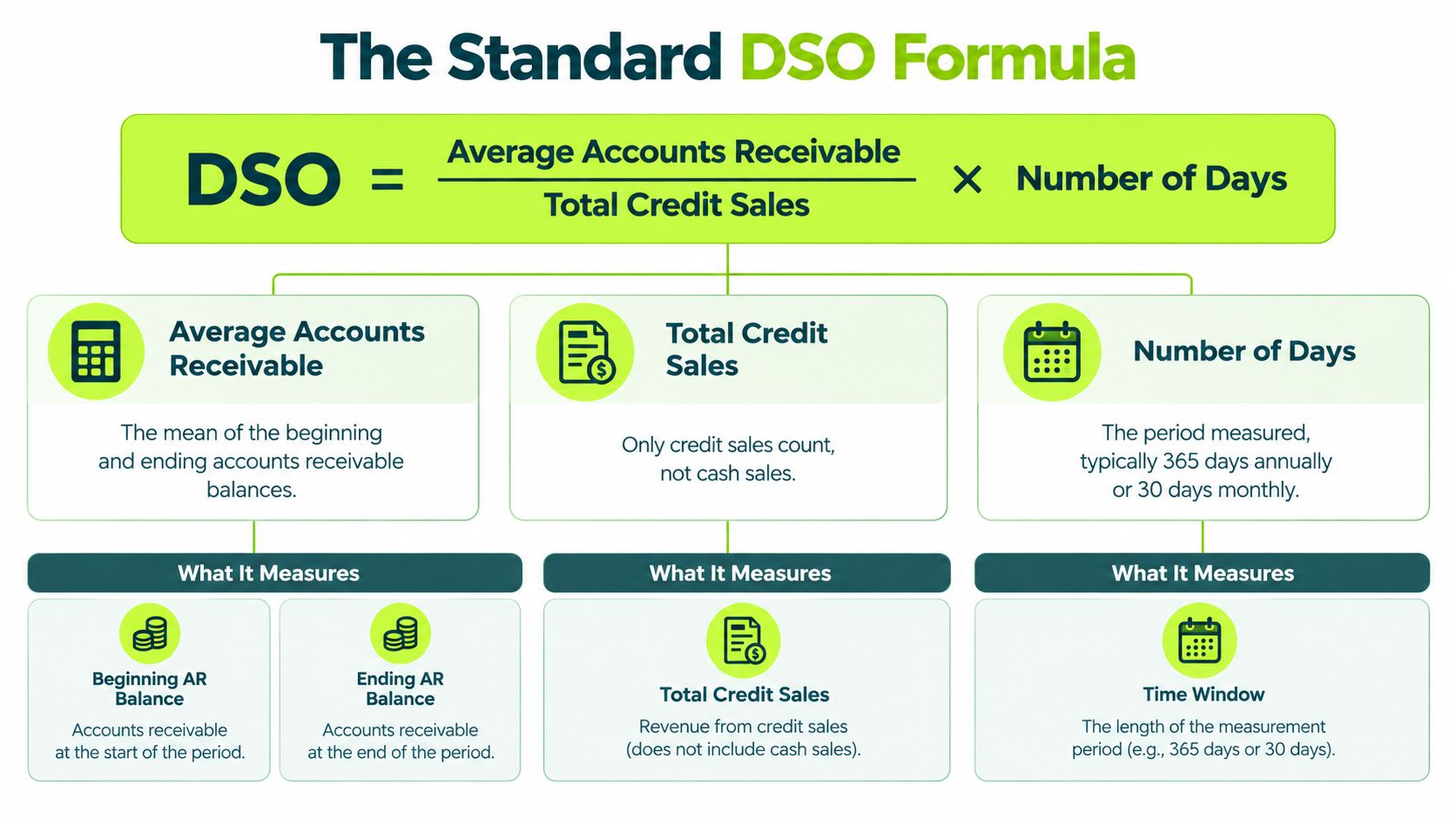
The standard formula is:
DSO = (Average Accounts Receivable ÷ Total Credit Sales) × Number of Days in the Measurement Period
For an annual calculation, the period commonly uses 365 days. A monthly version uses the number of days in that month, and a quarter-based version uses the days in that quarter. The numerator and denominator must describe the same measurement window.
For average accounts receivable, add the beginning and ending balances, then divide by two:
Average A/R = (Beginning A/R + Ending A/R) ÷ 2
Use net credit sales, not total revenue. Cash sales don't create receivables, so including them can make collection performance look better than it is. For professional services firms, total revenue may also include amounts that don't belong in the invoice population being analyzed. Net credit sales keep the ratio tied to transactions that require collection. A clear explanation of sales volume definition explained with examples can also help teams distinguish sales activity from the specific credit sales base used in the ratio.
Keep the accounting basis consistent
Controllers should document whether receivables are gross or net of the allowance for doubtful accounts and whether sales are gross or net of credits, returns, and allowances. A formula can be mathematically correct while still producing a poor management signal if the inputs change from one period to the next.
For a deeper treatment of the numerator, use this guide to calculate average accounts receivable. The choice between average and ending A/R should be deliberate. Average A/R generally smooths a month-end spike, while ending A/R can be useful for a quick period-end view when applied consistently.
The annual formula is also commonly written as DSO = Accounts Receivable ÷ (Net Sales ÷ 365). A company with $4.0 million of net accounts receivable and $36.5 million of annual net sales has a DSO of 40 days, calculated as $4.0 million divided by $36.5 million divided by 365. CFO.com's discussion of days of delinquency illustrates how this ratio has been used to track collection efficiency over time.
Worked Example Calculating DSO for a Professional Services Firm
Consider a consulting firm that closes its books monthly. Its beginning accounts receivable balance is $10,000, its ending balance is $12,000, and its net credit sales for a 31-day month are $8,000.
Start with the average receivables balance:
($10,000 + $12,000) ÷ 2 = $11,000
Then apply the monthly DSO formula:
($11,000 ÷ $8,000) × 31 = approximately 42.6 days
The result says the firm's receivables position represents about 42.6 days of credit sales on the selected measurement basis. It doesn't mean every invoice takes 42.6 days to settle. A few large project invoices, milestone billings, or disputed balances can influence the ratio.
What the example reveals operationally
If the firm's contractual terms are Net 30, the result deserves investigation. The team should separate timing effects from process problems:
- Billing cadence: Were invoices issued promptly after approved milestones?
- Disputes: Are clients holding invoices because of missing documentation or scope questions?
- Payment execution: Did the firm provide clear remittance instructions and convenient payment options?
- Customer mix: Did a small number of large accounts dominate the period?
For professional services teams, billing mechanics often matter as much as collection effort. A well-designed professional services billing process should make responsibility clear from time entry and approval through invoice delivery and payment application.
An annual roll-up uses the same logic with annual net credit sales and 365 days. The key is not choosing a single formula variation for all situations. The key is labeling the period, using matching inputs, and preserving the same method so the trend remains comparable.
Translating DSO into Cash Flow Impact
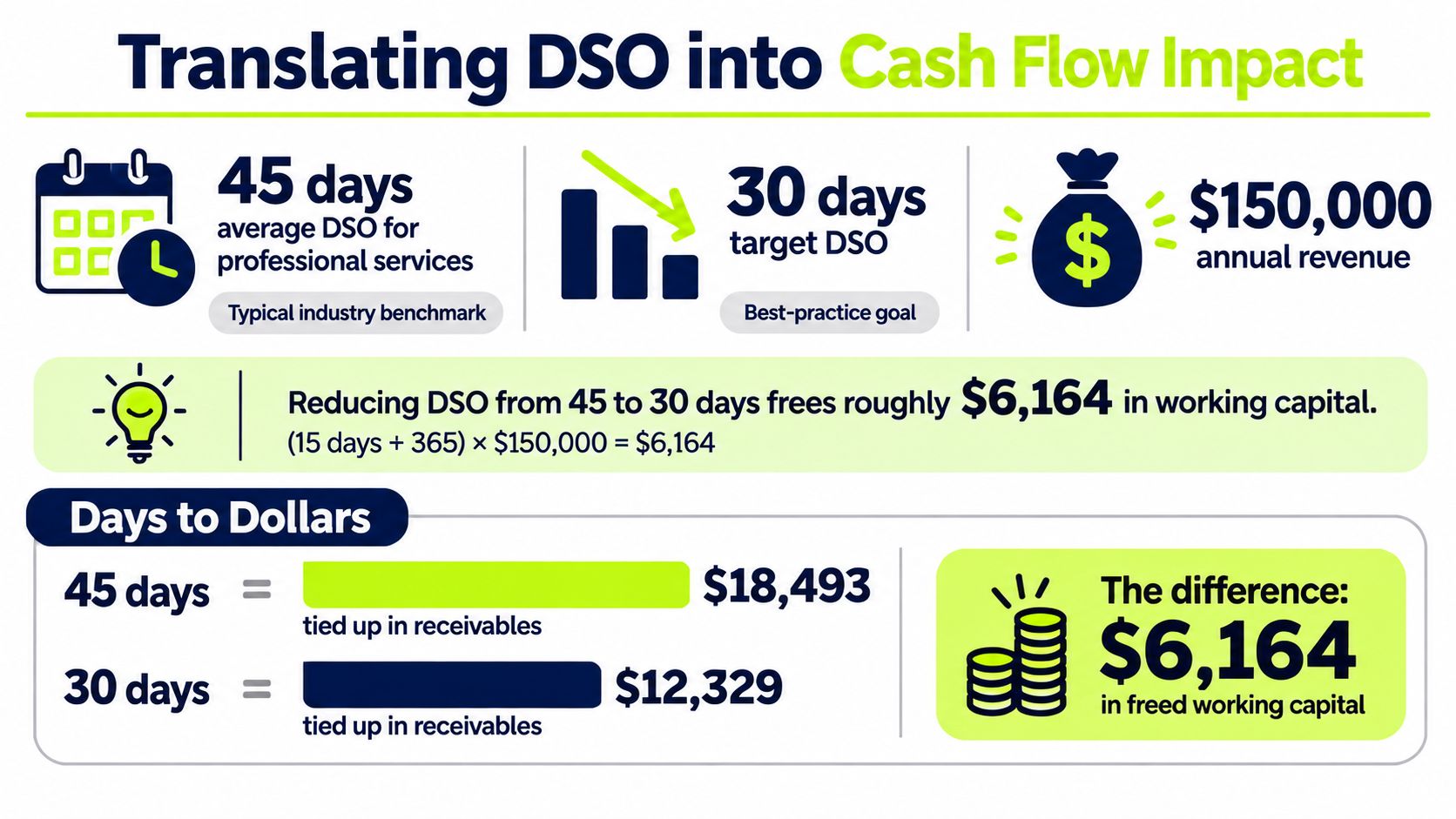
A DSO number becomes useful to owners and investors when finance translates days into dollars. For a firm with $6 million of annual credit sales, one day of DSO represents approximately $16,438 of sales value, calculated as $6 million divided by 365. Investopedia's DSO explanation provides the same working-capital framing.
A 10-day reduction would therefore represent roughly $164,384 released from receivables, assuming sales volume, credit quality, and write-offs remain constant. That figure is a planning estimate, not a promise that every dollar becomes immediately collectible. It gives the CFO a defensible way to connect process improvements with liquidity.
Use the translation to prioritize work
The calculation helps rank initiatives. If a firm can shorten invoice release, resolve approval disputes earlier, or improve payment execution, management can estimate the value of each day's improvement against implementation effort. This makes DSO a bridge between finance operations and cash planning, rather than a score owned only by accounting.
It also makes benchmark differences tangible. APQC benchmarking reported through CFO.com analyzed 5,204 participants and found that the fastest-collecting organizations averaged 30 days or less, median organizations required about 36 days, and the lowest-performing group took 48 days or longer. For a business with $100 million in annual sales, one DSO day represents approximately $273,973, so a 12-day gap corresponds to roughly $3.29 million tied up in receivables. The CFO.com benchmark analysis shows why comparable context matters.
DSO improvement is not an abstract efficiency project. It changes how much of the firm's own cash remains available for operations.
The size of the opportunity should guide the response. A small variance caused by billing seasonality may need monitoring. A persistent gap caused by preventable disputes may justify workflow redesign, better ownership, or accounts receivable automation. For a broader working-capital framework, see how to improve working capital.
Payment economics belong in the analysis too. When clients use cards or other payment channels, finance should understand how card settlement fees in Singapore and similar processing costs affect the net cash benefit of faster settlement.
Common Mistakes in DSO Calculation and Interpretation
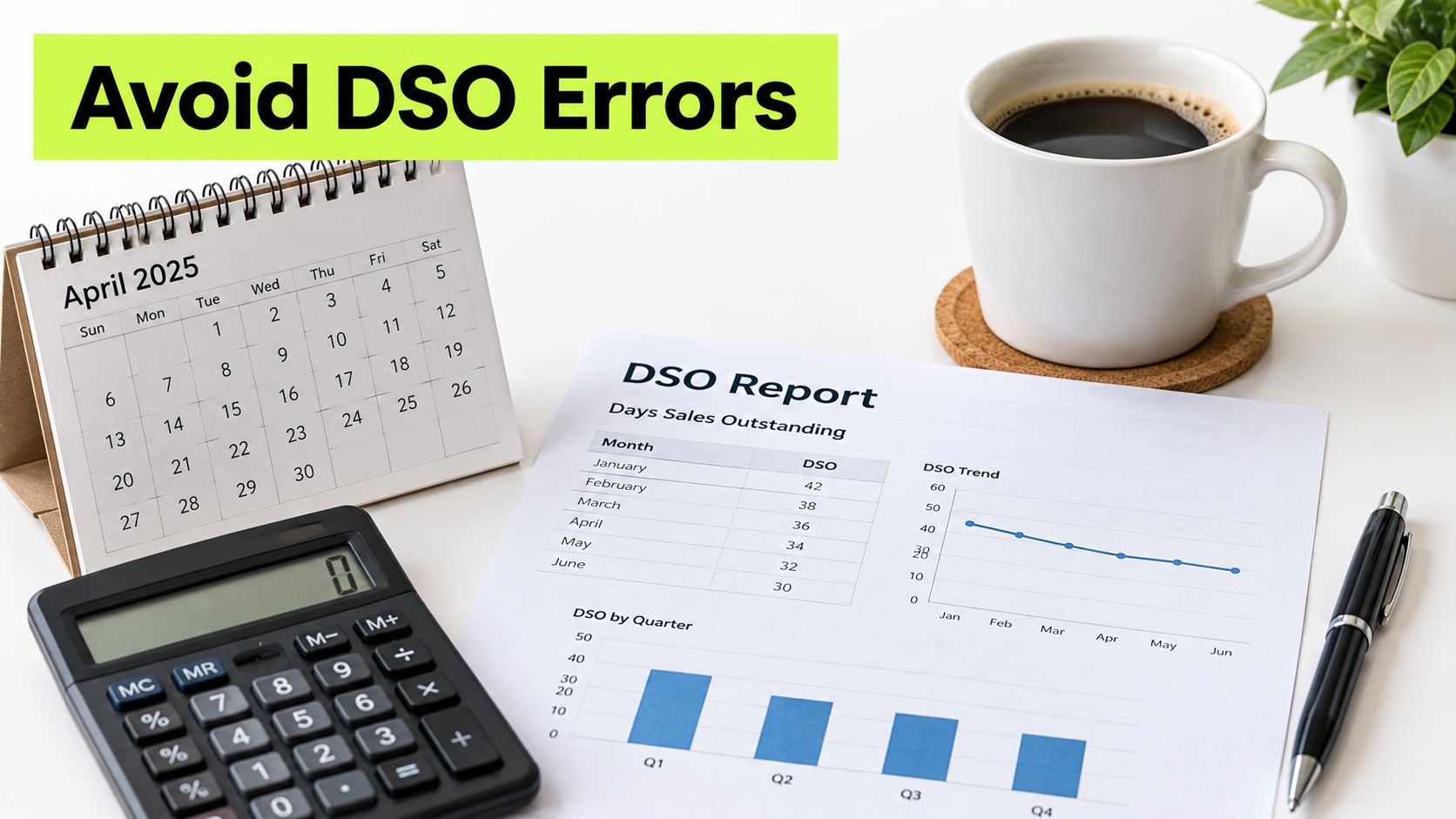
The most common DSO errors aren't arithmetic errors. They come from selecting the wrong population, mixing periods, or treating a context-dependent ratio as a universal score.
A single month can send the wrong signal. Month-end billing concentrations, milestone completions, seasonal client activity, and unusually large invoices can move both A/R and sales. A monthly view is valuable for spotting recent deterioration, but it should sit alongside a rolling 90-day or trailing-12-month view when management needs a steadier operating picture.
Three interpretation failures to avoid
- Using total revenue: Cash sales don't create receivables. Including them lowers the ratio artificially and weakens the connection between DSO and collection work.
- Mixing periods: A quarter-end A/R balance paired with annual sales produces a ratio with no reliable operating meaning. Match the numerator, denominator, and day count.
- Ignoring gross versus net balances: Decide whether A/R includes the allowance for doubtful accounts and whether sales reflect credits, returns, and allowances. Keep the treatment stable.
Benchmarking also requires care. APQC data reported through CFO.com placed the fastest-collecting group at 30 days or less and the lowest-performing group at 48 days or longer. Those figures aren't a universal target for a professional services firm. Payment terms, industry mix, customer concentration, billing structure, and seasonality all change what a reasonable DSO looks like.
A better review cadence
Use the monthly result as a diagnostic trigger, not a verdict. If DSO rises, compare the movement with invoice timing, aging buckets, disputes, unapplied cash, and client-level payment behavior. Then ask whether the change is concentrated in one account or reflects a process affecting the whole firm.
The same benchmark data reported that overall DSO for the 1,000 largest U.S. nonfinancial companies fell 1.1 days in 2021 to 40.6 days, while the median company stood at 48.7 days. 32 of 49 industries improved and 17 deteriorated, reinforcing that broad averages describe movement, not an appropriate target for every firm.
Moving Beyond Manual Tracking with AR Automation
A spreadsheet can calculate DSO. It can't reliably coordinate every invoice reminder, dispute owner, payment response, and cash application event as the receivables portfolio changes.
Manual tracking usually depends on an analyst exporting an aging report, updating formulas, identifying overdue accounts, and sending follow-ups. That process can work at modest volume, but it creates delays and makes execution dependent on individual memory. Periodic reviews also tend to focus on what is already overdue, rather than what is likely to become overdue.
Compare the operating models
Manual process | Automated operating layer |
|---|---|
Spreadsheet-based DSO updates | A current DSO dashboard tied to receivables data |
Calendar reminders for follow-up | Scheduled, rules-based outreach |
Manual account prioritization | Risk and aging signals that focus attention |
Separate payment and ledger checks | Faster cash application and reconciliation |
One-size-fits-all messages | Communication matched to customer context |
AI AR automation can help identify at-risk invoices, prioritize collection work, and adapt communication timing. It doesn't remove the need for judgment. A controller still decides when a strategic client needs a relationship-led conversation, whether a dispute is valid, and when commercial or legal escalation is appropriate.
Human judgment belongs at the exception points. Software should handle the repeatable coordination around them.
Consistency matters more than sending a burst of reminders at month-end. An effective AR software for professional services connects billing status, client communications, payment options, and cash application so the team can act before a small delay becomes an aging problem.
A QuickBooks AR automation workflow can be useful when QuickBooks remains the accounting system of record and the firm needs stronger collection orchestration around it. Tools should be assessed on integration quality, auditability, permissions, communication controls, and how clearly they distinguish automation from human approval.
For teams designing outbound sequences, this Mail Merge for Gmail guide offers useful context on structured email automation. The same principle applies to AR, but collection messages require stronger controls around accuracy, customer history, and escalation.
In this category, Resolut is one option that combines credit risk assessment, collections outreach, billing workflows, payment options, and cash application, with autopilot and co-pilot modes for different levels of human control. The system's relevance is operational: it supports a repeatable process around the DSO calculation rather than replacing the calculation itself.
Key Takeaways for Managing Accounts Receivable Days
The accounts receivable days calculation is simple only after the accounting basis is clear. Use average A/R where appropriate, divide it by net credit sales, and multiply by the number of days in the same measurement period. Document whether balances are gross or net, and keep the treatment consistent.
For a professional services firm, the number should answer an operational question: how much invoiced revenue remains tied up, and what is causing the delay? Review monthly for timely signals, then use a rolling view when seasonality or milestone billing makes a single period noisy.
A practical control routine includes these actions:
- Calculate consistently: Preserve the same numerator, sales basis, and period definition.
- Compare with terms: A DSO above contractual terms creates a measurable collection gap.
- Translate days into dollars: Use annual credit sales divided by 365 to estimate the value of one DSO day.
- Investigate causes: Separate billing delays, disputes, customer behavior, unapplied cash, and write-off risk.
- Automate repeatable work: Use software for reminders, prioritization, payment coordination, and reconciliation while retaining human review for exceptions.
The objective isn't the lowest possible DSO. Aggressive collection tactics can damage valuable client relationships, while loose processes can force the firm to finance its customers. The useful target is a controlled, explainable result that supports predictable cash flow and reflects the firm's commercial terms.
Resolut automates AR for professional services by coordinating billing workflows, client outreach, payment options, risk signals, and cash application around the receivables process. Visit Resolut to see how consistent, accurate, and human AR automation can support your DSO management.