
Professional Services Billing: The 2026 Operating Guide
Master professional services billing with models, KPIs, and AR automation tactics that cut DSO, reduce disputes, and protect client relationships.
Monday morning at a $10M services firm usually looks the same. The AR aging is open on one screen, two clients are past terms, and a partner has already told the account team an invoice would go out on Friday. Then the client disputes a line item, the controller starts reconciling time entries, and cash slips another week.
That's not a collections problem. It's a professional services billing problem, and it's really an operating problem. Billing, utilization, realization, approval flow, invoice cadence, and collections tone all sit on the same chain. When one link breaks, cash slows down.
The firms that treat billing as admin work end up spending their best finance time on follow-up. The firms that treat it as discipline manage it like any other operating system, with controls, cadence, and escalation rules.
Why Billing Quietly Runs the Firm
The invoice is the visible part. The work happens before and after it, in the habits that determine whether billable hours become cash or just another aged receivable.
A mid-sized firm can look healthy on the P&L and still be starved for cash because billing leaks in too many places. Manual follow-ups, spreadsheet reconciliation, write-offs, short-term financing, and discounts granted just to keep money moving all eat the same margin. SPI Research's benchmark shows billable utilization falling to 66.4% in 2025, down from 68.9% in 2024 and 73.2% in 2021, while revenue growth improved to 5.2% but still sat well below SPI's 10% healthy-growth benchmark, according to the professional services benchmarks. That's what weak operating discipline looks like in the numbers.
The Monday problem is usually a workflow problem
The AR aging doesn't create itself. Someone has to approve time, someone has to format the invoice, someone has to send it, and someone has to chase it when it goes quiet. If that chain is fragmented, the finance team ends up acting like a human router instead of a control function.
Practical rule: if billing touches three systems and two inboxes, you already have a collections delay baked in.
That's why billing belongs in the same conversation as utilization and realization. When staff capacity doesn't convert into billable work, or when billable work gets written down because the invoice wasn't tight, revenue quality drops before cash even has a chance to arrive. The internal reference on what billing information is is useful here because billing data is really the starting point for every downstream control.
What the finance leader is actually managing
You're not just sending invoices. You're managing the speed and certainty of conversion. A firm with decent demand can still feel cash-poor if billing cadence is sloppy, if partners approve too late, or if the collections tone changes from week to week.
The operating question is simple. How much of staff capacity becomes approved, billed, collected cash on a predictable timeline? Firms that answer that well don't need more headcount. They need a tighter operating rhythm.
What Professional Services Billing Covers
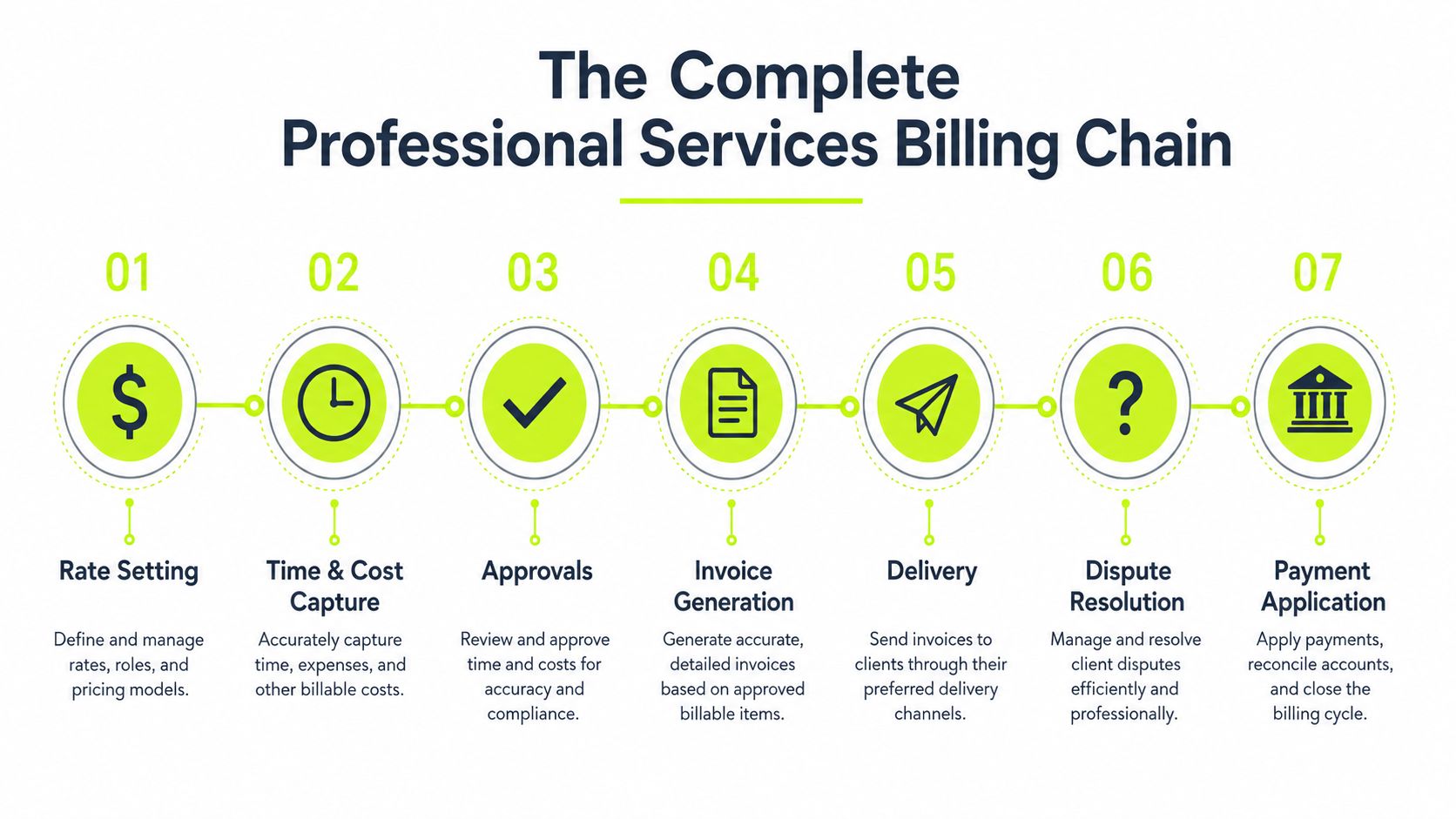
Billing is a chain, not a task. If you only focus on invoice formatting, you are looking at the middle of the process and ignoring the handoffs that decide whether cash comes in cleanly.
The workflow starts with rate setting, then moves through time and cost capture, approvals, invoice generation, delivery, dispute resolution, and finally payment application. NetSuite's billable-hours guidance is blunt about the control side, set rates before time is recorded, define payment schedules, and verify approved hours by client and project before you bill. That is not clerical detail, it is the structure of the cash cycle.
The model choice changes the risk
Time-and-materials, fixed-fee, retainer, milestone, and value-based billing are not just pricing styles. They decide who carries scope risk. NetSuite's project billing overview makes the trade-off clear, time-and-materials puts more variance on the client, while fixed-fee pushes scope risk back onto the firm and demands tighter change control.
That is why billing design and billing operations cannot be separated. If the contract pushes risk onto your firm, your WIP review, approval discipline, and change-order governance have to be stronger. If the contract shifts risk to the client, your invoice narrative and documentation have to be cleaner.
For a practical view of service packaging and billing structure, the Faberwork LLC service catalog is a useful reference because it shows how service scopes are presented to buyers when pricing needs to stay understandable.
Why every handoff matters
The billing process moves through several handoffs, rate setting to time capture, time capture to approvals, approvals to invoicing, invoicing to collections, and collections to cash application.
When the handoff is weak, cash slows down.
That is also why invoice quality and payment tracking both matter. A clean invoice that is not followed properly still ages out. A noisy collections process can damage trust even when the bill is technically correct. Billing is the whole chain, and the chain is only as strong as the weakest handoff.
Billing Models and Where Each One Breaks
The best billing model is the one that fits the work and the client's tolerance for uncertainty. The wrong model doesn't just hurt margin, it creates a specific operational failure that you'll end up paying for later.
A simple way to think about it is scope risk. Whoever absorbs scope risk also needs the tighter control system.
Billing Model Risk and Control Map | |||
|---|---|---|---|
Model | Scope Risk Holder | Common Failure Mode | Required Control |
Time and materials | Client | Volume variance surprises the buyer | Tight time capture and clear rate approvals |
Fixed-fee | Firm | Scope creep eats margin | Change-order governance and WIP review |
Retainer | Shared, but mostly the firm on delivery load | Unused capacity or vague expectations | Scope clauses and utilization tracking |
Milestone | Shared around deliverable timing | Late delivery delays cash | Milestone definitions and acceptance criteria |
Subscription | Firm | Capacity gets overcommitted | Continuous utilization discipline |
Time and materials and fixed-fee are not interchangeable
Time and materials is best when scope will move. The failure mode is obvious, the client sees a variable bill and questions the value if the work drifts. Fixed-fee works when scope is tight, but it punishes sloppy change control fast. If partners keep adding “small” asks without updating the agreement, the margin erosion shows up later in write-downs and delayed invoicing.
For a sharper look at how invoice structure can get unwieldy when billing gets too detailed, Querio's piece on the 785 line invoice is a useful reminder that complexity doesn't impress clients when it just makes review harder.
Retainers and milestones need different controls
Retainers buy predictability, but only if the scope is bounded. If the work keeps expanding without a reset, the firm ends up delivering more than it bills. The internal guide on retainer billing matters because retainers fail when leaders confuse recurring billing with recurring unlimited effort.
Milestone billing is good for work that has real checkpoints. The problem is timing, not just accuracy. If the milestone definition is fuzzy, cash gets stuck in acceptance conversations. Subscription billing looks stable on paper, but it makes utilization discipline essential. The firm still has to keep capacity aligned with demand.
The clean decision cue
Use time and materials when the scope will evolve and the client accepts variance. Use fixed-fee when the deliverable is defined and change control is strong. Use retainers for ongoing advisory relationships with bounded effort. Use milestones when progress is visible and acceptance can be documented. Use subscriptions only when you can manage capacity with discipline, not optimism.
The billing model should match the work, not the partner's comfort zone.
The Four KPIs That Predict Cash Flow
Most dashboards overstate revenue and understate conversion. Revenue is useful, but it does not tell you whether cash is getting stuck in the pipeline.
The four metrics that matter most are billable utilization, realization rate, days sales outstanding, and AR aging. eBillity's guidance on billing metrics for professional services firms treats these as the core stack because they connect labor capture to cash conversion, and weak time capture or write-downs reduce realization even when booked work looks fine.
What each metric tells you
Billable utilization shows how much available capacity turns into billable work. It is a direct read on whether the team is carrying enough client work to support the revenue plan. If utilization slips, cash pressure follows.
Realization rate tells you how much of the billed work survives into invoice value without being written down or written off. If realization slips, revenue quality drops before collections even start. That is where many firms leak margin and then wonder why cash feels tight.
Days sales outstanding measures how long it takes to collect. The whitepaper on key metrics for professional service organizations puts average professional services DSO around 45 days, with work type and client base pushing it around.
AR aging shows where the cash is stuck, current, 1 to 30, 31 to 60, 61 to 90, and older. Aging buckets make collections discipline visible. They also show whether the problem is a few slow accounts or a broader process failure.
Why a small realization leak matters
If realization falls, the invoice value falls with it. A firm that bills less than it should has less cash to collect, and that gap can stretch DSO because the same approval and follow-up work gets spread over a smaller revenue base. A realization problem also masks a utilization problem, since teams can look busy while the billed value keeps slipping.
The point is simple. Weak realization and slow collections usually travel together.
Controller's rule: review utilization, realization, DSO, and aging in one screen, once a week. If you need a separate meeting to explain the dashboard, the dashboard is too complicated.
The weekly review should be short and blunt
Keep the review to four questions. Which team or partner is dragging utilization? Which invoices got written down? Which accounts moved deeper into aging? Which clients need human follow-up before the month closes? That is enough to tell you where cash is leaking without turning the meeting into a reporting ritual.
Why More AR People Is Not the Answer
The default response to slow collections is usually headcount. Hire one more collector. Send more reminders. Escalate earlier. That approach feels active, but it usually just adds more manual effort to the same broken process.
The issue is cadence, visibility, and tone consistency. If the team can't see at-risk invoices early, if reminders go out late, and if every collector writes in a different voice, the client experience gets uneven fast. In professional services, that inconsistency matters because the billing touchpoint sits next to the relationship, not outside it.
Manual collections drift in predictable ways
Tone drift is the first sign. One collector sounds firm, another sounds apologetic, and the third sounds like they're chasing a favor. Late reminders are next, then duplicated emails, then manual cash application that forces the team to reconcile payments line by line.
Those are not personality problems. They're systems problems. If the AR team is switching between spreadsheets, email inboxes, and the accounting ledger, nobody has a clean view of what's open, what's overdue, and what should happen next.
The broader point was captured well in the discussion of how technology has underserved professional service organizations, where billing is still too often handled through fragmented workflows and limited visibility, from Has Technology Underserved Professional Service Organizations.
A relationship cracks faster than the invoice
Every overdue invoice is a small test of trust. If the client hears from finance only after the due date has passed, the message feels reactive. If the tone changes every time, the client starts treating collections like a negotiation instead of a process.
That's why more reminders alone don't fix anything. The system needs orchestration, not volume. The goal is consistent timing, consistent tone, and clean visibility into what's at risk before the due date becomes a problem.
Repeating the same manual reminder six times is not a process. It's just six interruptions.
An AR Automation Roadmap for Professional Services
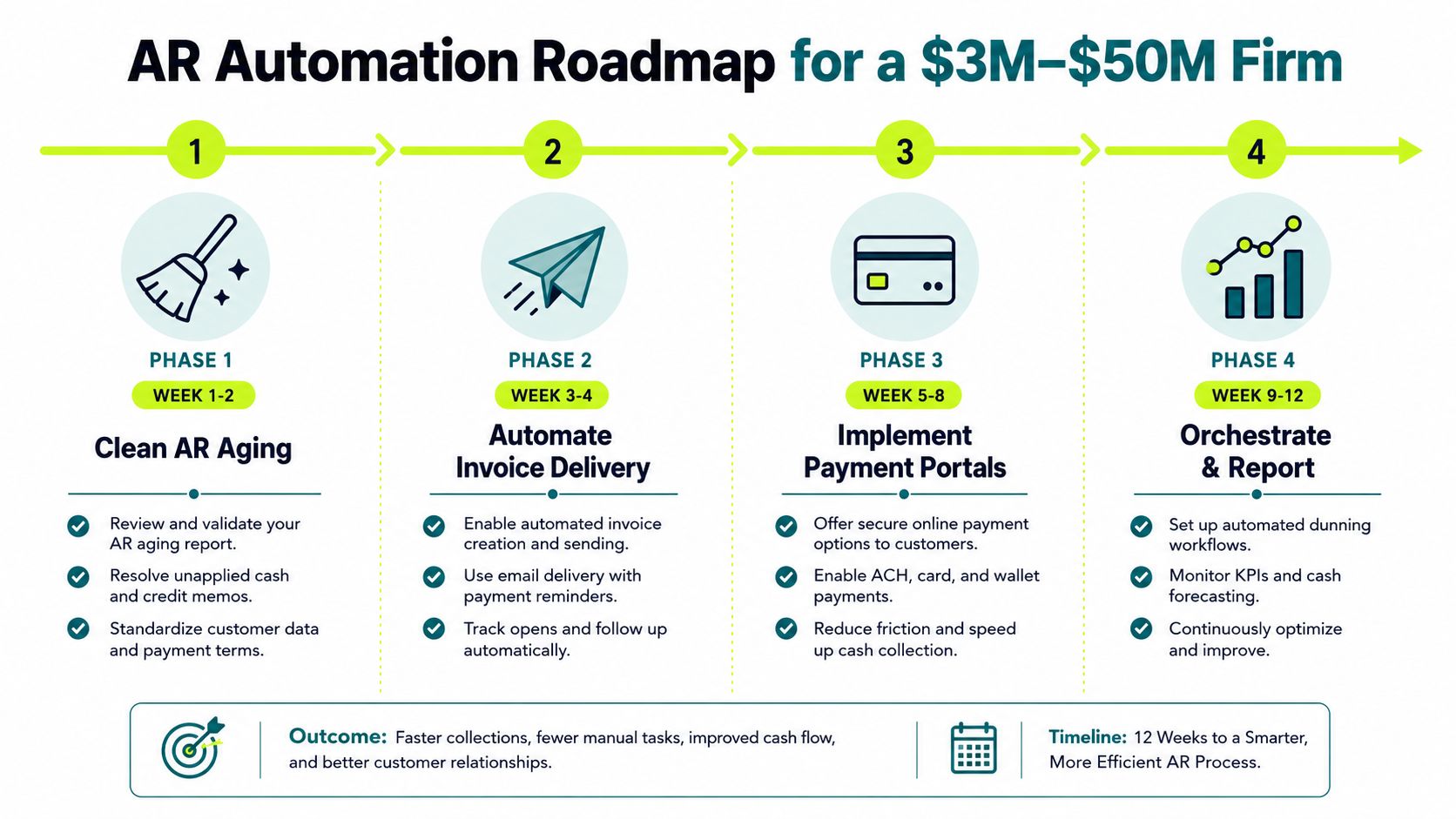
A $3M to $50M firm doesn't need a giant transformation program. It needs a controlled rollout that improves visibility first, then accelerates invoice delivery, then automates cash application without losing judgment on sensitive accounts.
If you're on QuickBooks or a similar core ledger, start there. The question is not whether to replace your accounting system on day one. The question is how to layer automation around it cleanly. For firms comparing systems, selecting ERP for your firm in 2026 is worth reading because the fit question matters before you add more tooling. The internal guide on what is AR automation is also a practical reference for the operating logic behind the rollout.
Weeks 1 to 2 clean the foundation
Start by cleaning the AR aging. Remove duplicates, confirm customer names, and standardize invoice templates so every bill looks the same. Then define the tone of voice for outreach, because automation without tone control just scales noise.
This phase is about data hygiene and consistency. If the open invoice list is messy, every downstream automation step will be messy too.
Weeks 3 to 4 connect the core workflow
Link the AR platform to QuickBooks, map payment terms, and configure the communication sequence across email, SMS, and phone. Accounts receivable automation starts to reduce manual chasing, because reminders move on schedule instead of waiting for someone to remember.
At this stage, you're not trying to automate everything. You're trying to make every open invoice visible and every follow-up repeatable.
Weeks 5 to 8 automate payment and reconciliation
Turn on dynamic invoicing where it fits, then add a consumer-grade payment portal with cards, ACH, and digital wallets. If you're evaluating AR software for professional services, this is the point where the product should make payment simple, not just send reminders. Then enable automated cash application so payments get matched against open invoices without a full manual search.
This is also where some teams test QuickBooks AR automation in a limited rollout, usually one client segment or one partner group, before they expand. That keeps the change manageable and shows whether the process improves collection behavior.
Weeks 9 to 12 layer in control and escalation
Add intelligent risk identification for at-risk invoices, legal escalation triggers, and a co-pilot mode for sensitive accounts. AI AR automation earns its keep, not by replacing judgment but by surfacing the right invoices early and giving finance leaders the final say on tone and escalation.
The right rollout keeps humans in control where the relationship matters. One option in this space is Resolut, which combines AR orchestration, invoicing, outreach, and cash application in one workflow.
What to watch in the first 90 days
Track DSO, the shift in AR aging, collector touches per invoice, and cash application match rate. If DSO doesn't move, the workflow still has friction. If aging shifts but match rate stays weak, you've only moved the problem. If collector touches fall and cash comes in faster, the operating model is working.
Templates and Checklists Your Finance Team Can Use Monday
A good billing process is easier to run when the team knows what “good” looks like at each step. The point of a checklist isn't bureaucracy. It's consistency.
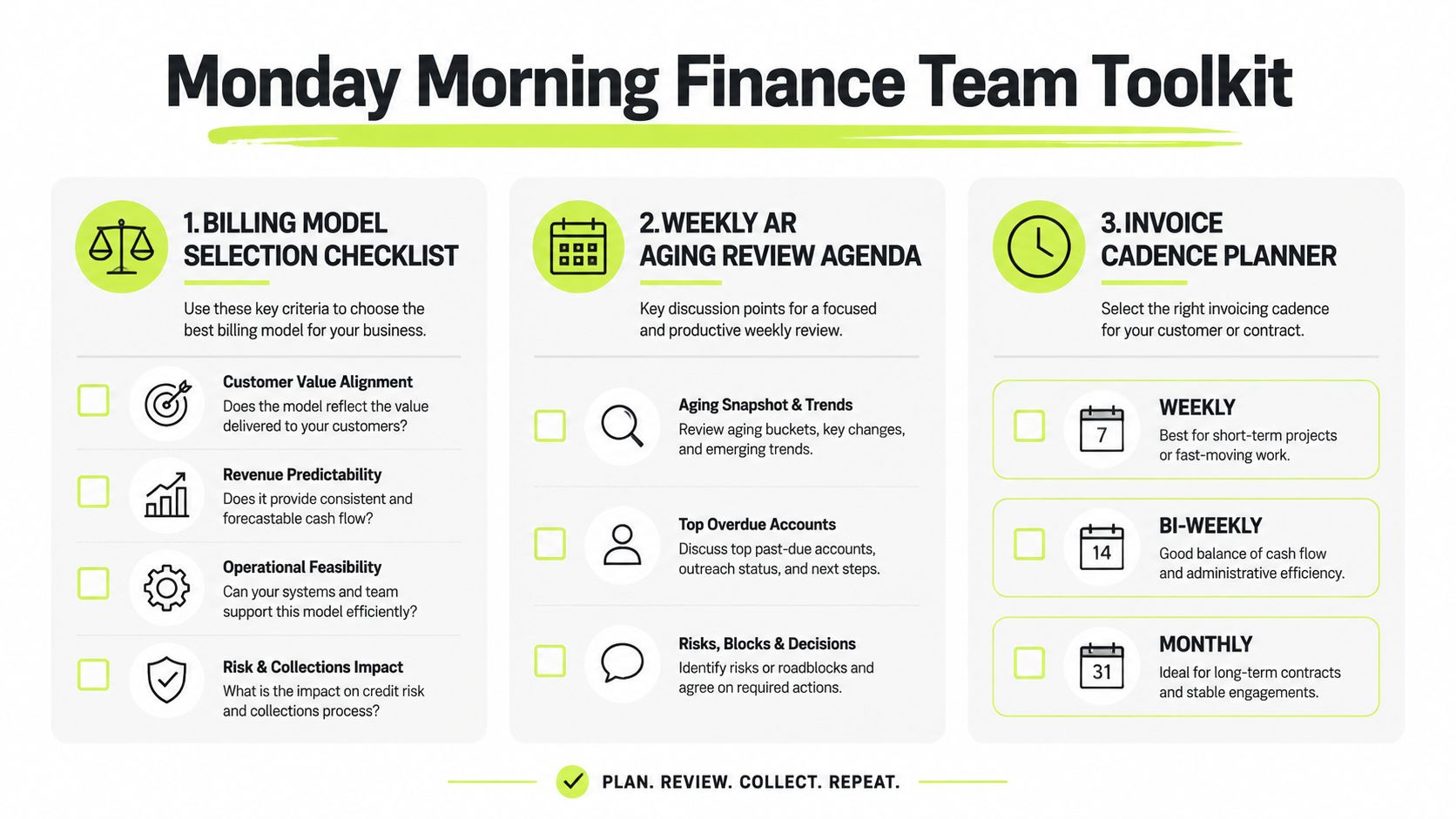
Billing model selection checklist
Use this before you lock a proposal:
- Scope certainty: the work is defined enough to bill cleanly without constant rework.
- Client tolerance for variance: the buyer can live with hourly or milestone variability.
- Change control: someone owns scope changes before they hit billing.
- Capacity fit: the team can deliver the model without starving utilization.
If one of those is weak, the model probably is too.
Weekly AR aging review agenda
Keep the meeting tight.
- Top overdue accounts: which invoices need a call, not an email.
- Invoice quality issues: which disputes came from unclear scope or missing backup.
- Cash actions for the week: who follows up, when, and in what tone.
That agenda protects DSO because it forces action, not commentary.
Invoice cadence planner
Use a repeatable sequence:
- Pre-due reminder: calm, factual, no pressure.
- Day of due date: clear, professional, and direct.
- Plus 3 days: polite follow-up with invoice and backup attached.
- Plus 10 days: firmer note, one owner, one next step.
- Plus 30 days: escalation with leadership visibility and a clear payment request.
The tone should get firmer only as the delay gets longer. If every message sounds urgent, none of them are.
QuickBooks integration checklist
Before you switch on automation, confirm these points:
- Customer and project mapping: every invoice lands in the right place.
- Terms sync: payment terms match the ledger.
- Invoice status sync: sent, viewed, disputed, paid.
- Cash application rules: payments match open items cleanly.
That's the minimum needed for reliable cash application and a cleaner AR aging.
If you run finance at a services firm, this is the stuff that moves the needle. Clean billing, disciplined follow-up, and automation that preserves judgment will do more for cash flow than another round of manual reminders.
Resolut automates AR for professional services firms with consistent cadence, accurate cash application, and a human in the loop when it matters. If you're trying to reduce DSO without damaging client relationships, visit Resolut and see how it fits into your billing workflow.