Accounts Receivable Management That Improves Cash Flow
Master accounts receivable management to reduce DSO, improve cash flow, and automate AR for professional services with proven processes and KPIs.
A familiar scene in professional services looks healthy on paper. Utilization is solid. Clients are active. The P&L says the firm is profitable.
Then payroll week arrives, partner draws are delayed, and the controller is still chasing invoices that should've been paid last month.
That gap is where accounts receivable management either protects the business or destabilizes it. For a services firm, cash rarely gets stuck in one place. It gets stuck across draft bills, approval queues, disputed invoices, missed follow-up, and payments that arrived but haven't been applied yet.
The firms that stay calm don't treat AR as a collections task. They treat it as a working-capital control system. That means managing work before invoicing, invoicing without friction, following up with consistency, and closing the loop through clean reconciliation.
Why Accounts Receivable Management Decides Your Cash Flow
A professional services firm can do excellent work and still create daily cash stress. The usual pattern is simple. Work is completed, time sits in WIP, invoices go out later than they should, and follow-up depends on whoever has the bandwidth that week.

For a CFO or owner, that doesn't show up as an AR problem first. It shows up as hesitation. Do we hire now or wait. Can we fund bonuses without leaning on the line. How much of next month's cash is real versus hoped for.
Profit doesn't pay payroll
Accounts receivable management is the discipline that turns booked revenue into usable cash. In practice, that means controlling how long money remains tied up after the work is done.
The standard AR health metric is Days Sales Outstanding, or DSO, calculated as (Accounts Receivable / Net Credit Sales) × Number of Days in the Period. Many B2B benchmarks treat under 30 days as excellent, 30 to 45 days as normal, 45 to 60 days as a warning zone, and above 60 days as poor because more cash stays trapped in open invoices, according to Emagia's DSO benchmark summary.
For firms that want to improve cash flow, AR is usually the fastest lever available because it changes timing, not just profitability.
Practical rule: If the firm is profitable but cash feels tight, look at the invoice-to-cash cycle before cutting spending.
Client trust is part of the equation
Weak AR control also affects the client experience. Late invoices create confusion. Inconsistent reminders create friction. A partner sends one tone, finance sends another, and the client has no clear path to resolution or payment.
That's why good AR management isn't aggressive. It's organized.
A strong system does three things well:
- Moves work to invoice quickly: Time entries, approvals, and billing drafts don't sit idle.
- Creates a predictable follow-up rhythm: Clients know what's due, when it's due, and how to pay.
- Gives finance visibility: The team can see what's in WIP, what's billed, what's overdue, and what needs escalation.
When those controls are in place, the business gets more than faster collections. It gets steadier decision-making.
How Accounts Receivable Management Works End to End
In a services firm, AR starts before the invoice exists. The process begins when you decide who gets credit, how work is documented, and what the client needs to approve payment. If any of that is unclear, the collection issue is already baked in.
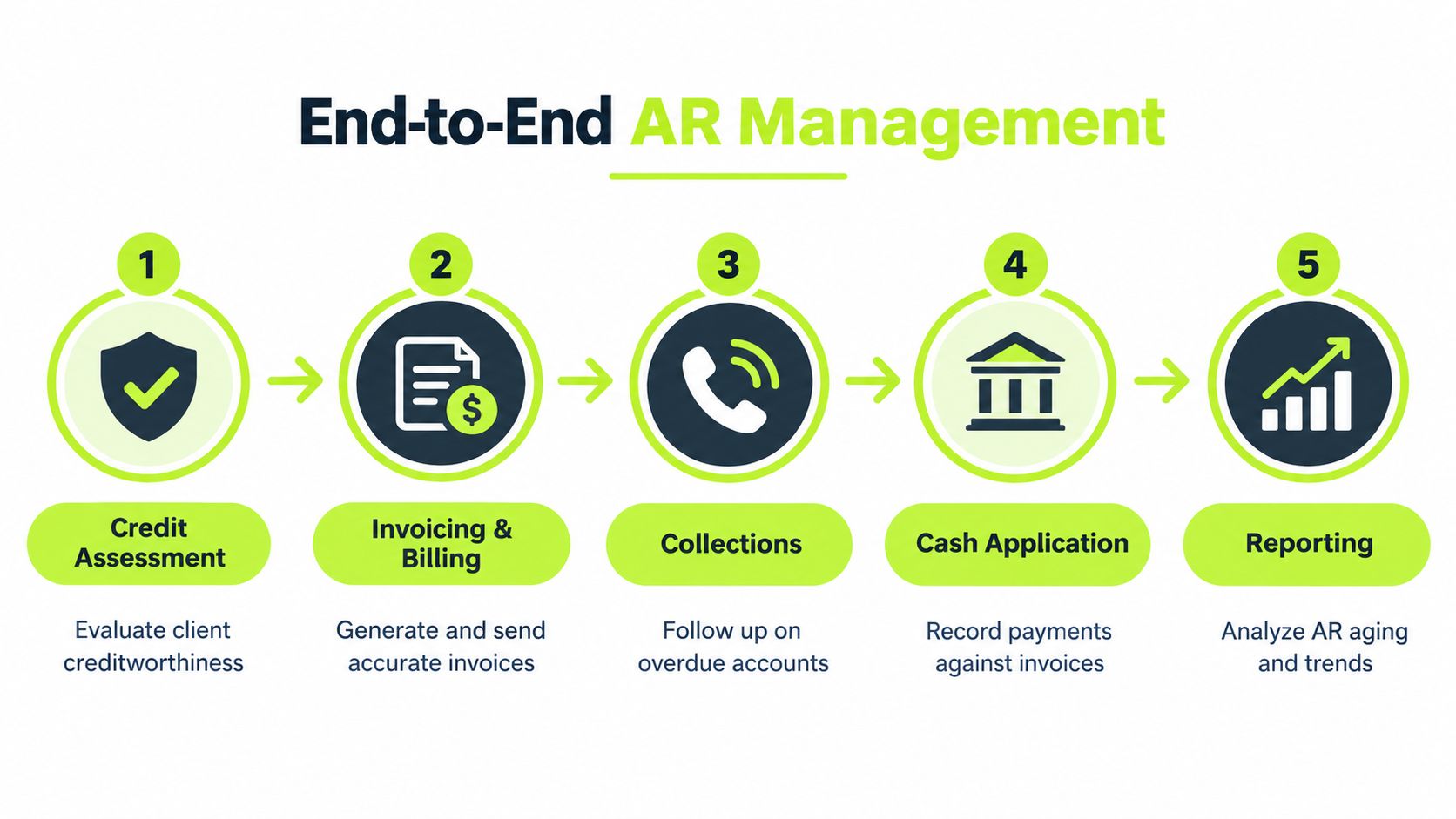
Think of the lifecycle as a handoff chain. Work becomes WIP. WIP becomes an invoice. The invoice becomes a receivable. The receivable becomes cash only after payment is posted correctly.
Five connected stages
- Credit assessment
Before you extend terms, someone should decide what those terms are and whether they fit the client. For many firms, this is informal. A partner says yes, finance inherits the risk, and no one defines escalation if invoices age.
For long-running engagements, this matters more than people expect. A client that pays slowly can consume a surprising amount of working capital even if the account remains profitable.
- Invoicing and billing
Many firms create avoidable delay. Draft invoices sit with project leads. Billing notes are incomplete. The invoice goes to the wrong contact, misses a PO number, or arrives after the client's approval run has already passed.
The invoice needs to be accurate, timely, and easy to process. In services, billing speed often has more impact than billing sophistication.
- Collections and outreach
Collections work best when it's planned before an invoice goes past due. Reminder timing, message tone, account ownership, and escalation rules should be defined in advance.
Some clients respond to a polite reminder. Others need a statement, a call, or coordination with the engagement lead. What fails is making every account follow the same generic script without context.
The best collection process feels routine to the client and highly visible to finance.
The final two steps that close the loop
- Cash application
A payment isn't fully useful until it's matched to the right invoice. Many teams lose visibility. Bank activity shows money came in, but the AR ledger still looks open because remittance details were incomplete or no one posted the receipt promptly.
That creates false noise in aging and makes the collections team chase balances that may already be paid.
- Reporting
The last stage is where the system becomes governable. Reporting should tell you more than what is overdue. It should show where the delay started.
A useful AR view for professional services includes:
- WIP bottlenecks: Which teams or partners hold draft bills too long.
- Billing quality issues: Which invoice types create disputes or rework.
- Collection patterns: Which clients pay late by habit versus due to a specific problem.
- Posting gaps: Which payments are received but not applied fast enough.
When finance sees the full chain, root causes become easier to fix.
Key Metrics That Show If Your AR Is Healthy
The quickest way to misread AR is to look only at total receivables. A large balance might be fine. A smaller balance might be dangerous. What matters is age, speed, and where the delay is occurring.
Start with DSO, but don't stop there
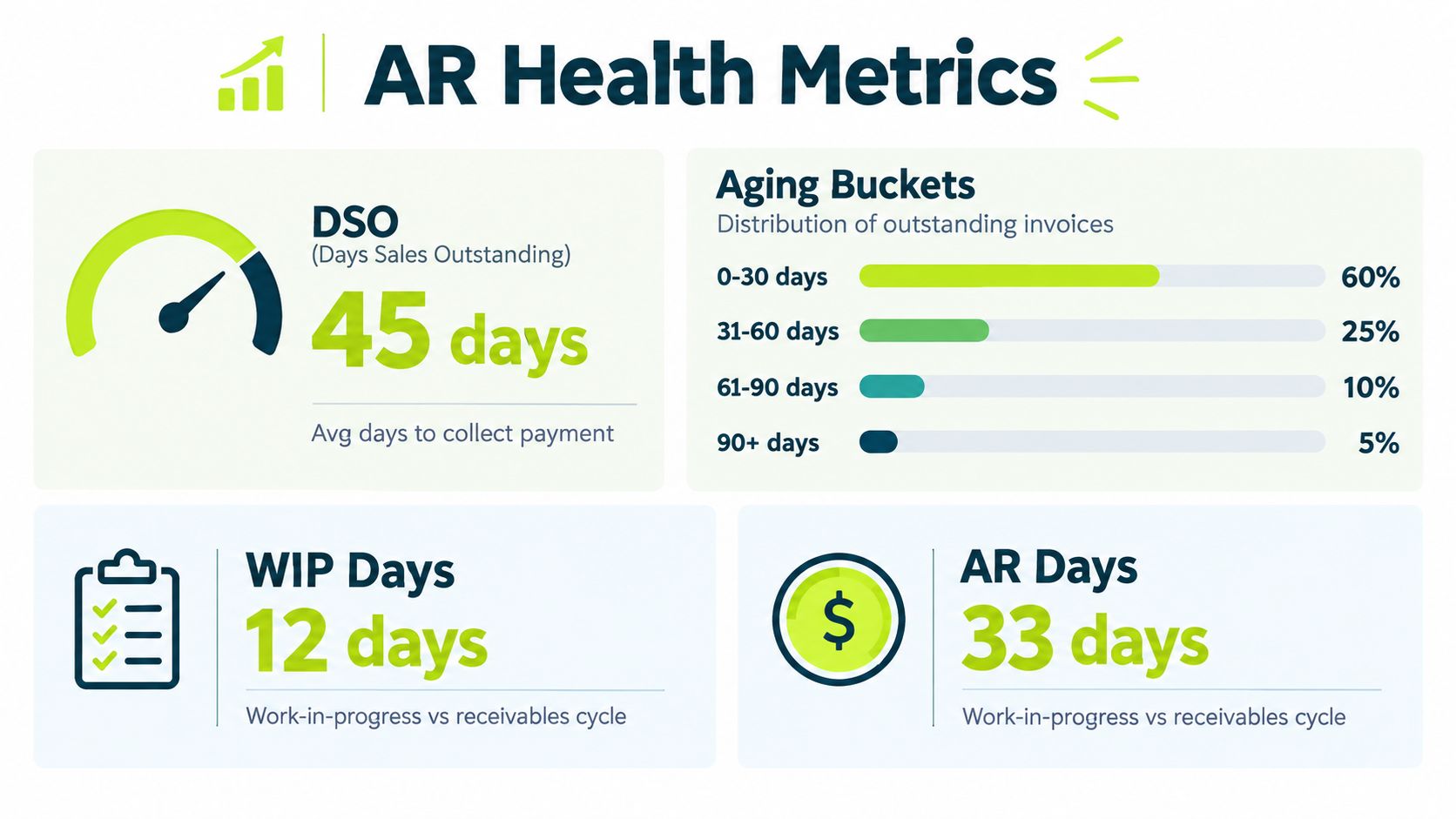
DSO remains the clearest top-line measure because it tells you how long cash stays tied up after invoicing. One standard formula expresses DSO as Total Accounts Receivable divided by average daily revenue, making it a direct measure of collection speed, and one benchmark source places professional services around roughly 40 days, with many firms drifting to 45 to 60 days when disputes and approval delays slow payment, according to Crunchspark's professional-services DSO overview.
For a more detailed breakdown of the metric itself, see what DSO means in practice.
Professional services firms should also use tighter service-line targets where relevant. Consulting firms often target 30 to 40 day DSO, AE firms 35 to 45 days, and law firms below 50 days, while also separating WIP days from AR days, according to NSTAR Finance's guidance for professional services DSO.
Separate WIP days from AR days
This distinction matters more than most dashboards show.
If WIP days are high, the collection problem starts before the invoice. The work is done, but it hasn't been converted into a bill. If AR days are high, the invoice is out, but payment isn't arriving fast enough.
That's why service firms need both views:
- WIP days measure the time from performing work to invoicing.
- AR days measure the time from invoicing to cash receipt.
- Combined lockup shows how long revenue stays trapped from delivery to cash.
A firm can have a decent DSO and still hold too much cash in WIP. It can also bill quickly and still struggle because follow-up and payment processing are weak.
A short explainer is worth watching if your team needs a common baseline before changing process:
Aging tells you where risk becomes structural
Aging reports show whether you have routine delay or deeper exposure. One useful industry summary notes an 18-day DSO gap between top and median companies and describes a $600 billion working-capital opportunity. The same summary cites D&B's Q1 2025 U.S. industry report showing 17 of 209 industry segments had 10% or more of aging dollars 91+ days past due, which is why segmentation and escalation policy matter more than blanket reminders, according to Billed's AR statistics summary.
Healthy AR is not just low average days. It's low exposure in the oldest buckets and a clear reason for every exception.
Why Most AR Processes Stay Manual and Inconsistent
Most finance teams don't struggle with AR because they don't care about collections. They struggle because the process is fragmented across email, spreadsheets, accounting software, partner follow-up, and manual posting.
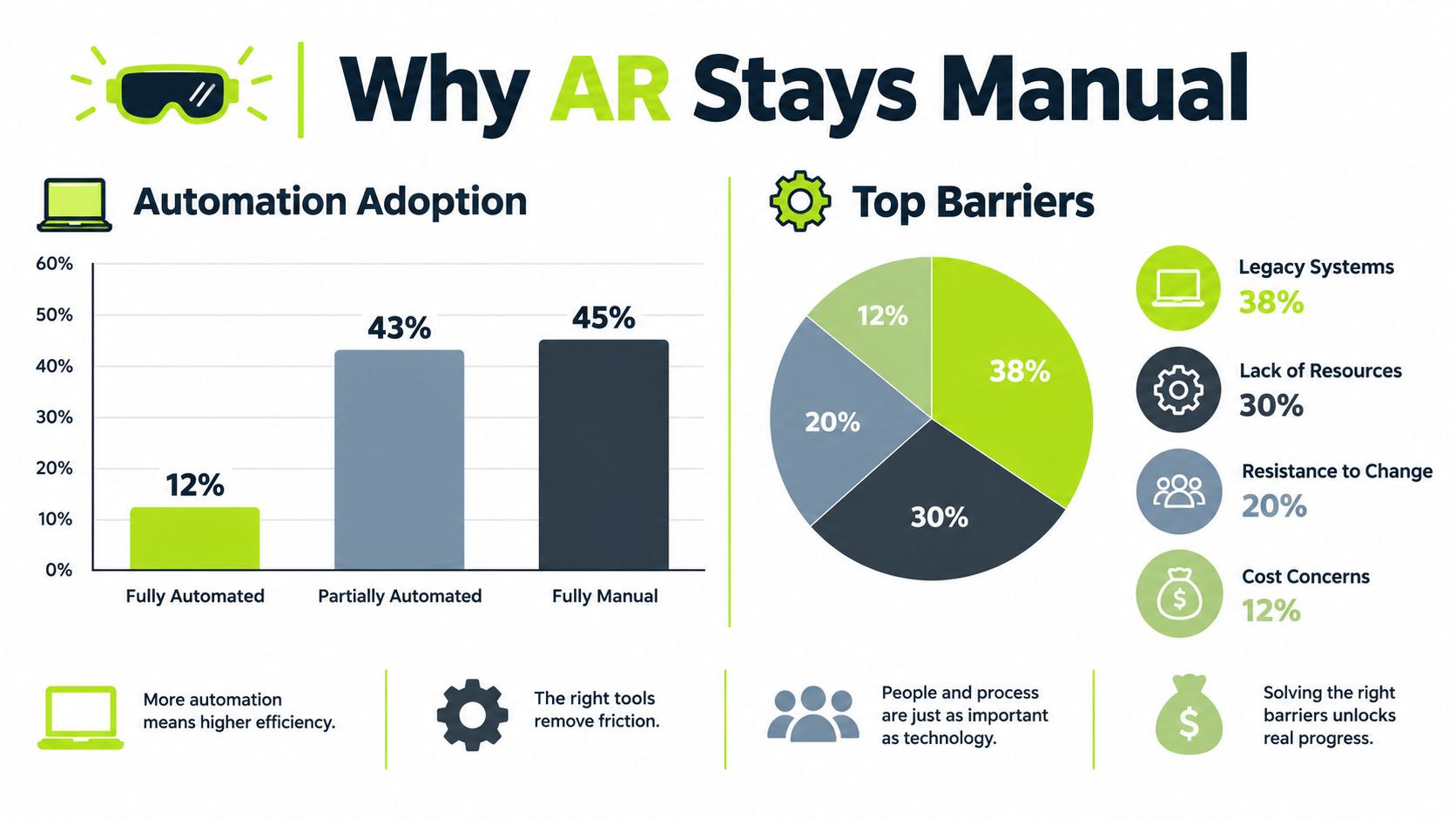
That creates a familiar pattern. Every invoice gets some attention, but not the right attention at the right time. High-risk accounts look similar to routine ones. Staff spend energy assembling facts instead of acting on them.
The real blockers aren't theoretical
Recent survey data shows 88% of organizations still rely on manual or semi-manual collections, only 1% have fully automated collections, and 77% report limited or moderate visibility into AR activity. The same survey found 57% cite manual or time-consuming workflows, 48% inconsistent follow-up, 41% invoice disputes, and 36% limited system integration as key blockers, according to the AR Automation Survey Report 2025 from BillingPlatform.
Those numbers match what operators see in the field. The obstacle usually isn't willingness. It's coordination.
Three failure points show up repeatedly:
- Ownership drift: Finance thinks the partner will call. The partner assumes finance already did.
- System gaps: The invoice sits in one system, communications sit in another, and payment status sits somewhere else.
- Exception overload: Disputes, partial payments, and client-specific rules overwhelm a process designed for clean invoices only.
Why more reminders don't fix the system
When AR is manual, teams often respond by sending more messages. That rarely solves the root problem. If the invoice is wrong, the payment method is cumbersome, or the wrong client contact received the bill, more reminders just add friction.
Phone outreach still has a place, especially on aging accounts, but it needs structure. Teams that want a tighter call framework can adapt effective debt collection scripts from Voicedial.ai into their own tone and escalation policy.
Manual AR usually fails quietly. The team works hard, but the process produces inconsistent action and weak visibility.
For CFOs, that distinction matters. If the problem is effort, add capacity. If the problem is orchestration, adding headcount only scales the disorder.
Best Practices That Reduce DSO and Protect Relationships
The strongest AR processes in professional services don't feel aggressive. They feel clear. Clients know what they owe, when it's due, and how to resolve an issue without a chain of internal emails.
Tighten the handoff from work to invoice
Start upstream. If project leads delay billing review, finance inherits the lag. Set a billing cadence that clients can recognize and your internal team can execute without exceptions every cycle.
Use a short pre-bill checklist:
- Confirm approvers early: Know who must review the invoice internally and on the client side.
- Check billing requirements: Include the right PO, matter code, project reference, or backup detail.
- Send on schedule: Don't let invoices wait for a “better time” if the work is complete.
- Standardize format: Clients pay faster when invoices are easy to process and consistent month to month.
Match follow-up to account risk
Not every receivable deserves the same treatment. A long-term client with one delayed invoice is different from a client that regularly drifts past terms or disputes line items after the fact.
Build a simple segmentation model around behavior, account value, and aging. Then align message tone and escalation accordingly. Early reminders should be clear and professional. Older balances should trigger tighter ownership and direct outreach.
What works well in practice:
- Send reminders before due dates, not just after.
- Assign named ownership for priority accounts.
- Escalate based on aging and client history, not frustration.
- Pull engagement leads in when the relationship matters to the outcome.
Remove payment friction
Some late payments are credit issues. Many are process issues.
Clients pay faster when the payment path is obvious. That means offering simple digital options, clear invoice visibility, and one place to see open balances. It also means avoiding avoidable confusion such as separate email threads for invoice copies, account statements, and remittance questions.
A client relationship is usually damaged by surprise, inconsistency, or confusion. It's rarely damaged by a clear and well-timed reminder.
Close the loop after payment arrives
A lot of firms improve billing and reminders, then ignore the back end. That's a mistake. If cash application is messy, your AR data stays noisy and the team loses trust in the aging report.
Make reconciliation part of AR discipline, not an accounting afterthought:
- Post receipts quickly: Don't leave paid invoices appearing open.
- Capture remittance details consistently: Partial and multi-invoice payments need rules.
- Resolve short pays fast: Don't let small deductions become old exceptions.
- Review unapplied cash regularly: Unapplied cash hides the truth about collections.
Accounts receivable automation starts to matter. Automation works best when the underlying policy is already clear.
How Automation and Orchestration Transform AR Performance
There's a big difference between adding isolated tools and building an orchestrated AR system. One gives you pockets of efficiency. The other gives finance control across billing, outreach, payment, and reconciliation.
Where fragmented setups break down
A common stack in smaller services firms looks workable at first. Invoices come from the accounting system. Reminders are sent manually or through templates. Notes live in email. Payment links sit in another tool. Cash application happens later.
The problem isn't that any single tool is bad. The problem is handoffs.
Independent reporting associates end-to-end order-to-cash automation with average DSO reductions of 8 to 12 days, while AI-powered AR automation is reported to reduce DSO by 20% to 30% within 12 months of deployment, according to Stealth Agents' AR automation statistics summary. For CFOs evaluating systems, that's the practical case for accounts receivable automation and AI AR automation.
Cash application is often the hidden bottleneck. One survey summary reports that 86% of respondents still describe cash application as fully manual, mostly manual, or partially automated, which matters because posting delays can make DSO look worse even after the customer has already paid, according to Zintego's cash application summary.
If you're evaluating process design first, F1Group automation insights offer a useful non-AR framing for thinking about where orchestration creates an advantage.
Manual AR versus orchestrated automation
For firms using accounting platforms like QuickBooks, the next step usually isn't replacing the ledger. It's adding QuickBooks AR automation that coordinates reminders, payment workflows, and posting logic around it. For a deeper look at the operating model, see how to automate accounts receivable.
Capability | Manual or Fragmented AR | Orchestrated Automation with Resolut |
|---|---|---|
Invoice follow-up | Depends on staff calendars and inbox discipline | Workflow-driven reminders and outreach across channels |
Prioritization | Aging report reviewed manually | Accounts routed by risk, timing, and status rules |
Client communication | Inconsistent tone across finance, partners, and collectors | Structured messaging with human review where needed |
Payment experience | Separate links, manual requests, limited visibility | Unified payment workflow with clearer path to settlement |
Cash application | Posted after the fact, often with exception queues | Automated matching and faster reconciliation support |
Visibility | Data split across accounting software, email, and spreadsheets | Centralized operating view for finance and collections |
What good AR software should actually do
For professional services, AR software for professional services should support policy, not just activity.
Look for systems that can:
- Work with your accounting stack: Especially if the firm already runs on QuickBooks.
- Segment outreach: Different clients need different cadence, tone, and escalation.
- Support autopilot and review modes: Full automation isn't right for every account.
- Handle disputes and payment exceptions: Clean invoices are only part of real AR work.
- Improve visibility: Finance should see what is due, what is blocked, and what has already been paid.
That's where orchestration changes AR from a chasing function into a control function.
Bringing Calm and Control to Your AR System
For a professional services firm, accounts receivable management is really about governing the time gap between doing the work and having usable cash in the bank.
That's why the best AR leaders don't isolate collections from billing, WIP, client communication, or reconciliation. They manage the full chain. They know whether cash is stuck before invoicing, after invoicing, or after payment has already arrived but hasn't been applied.
A practical reset usually starts with a short audit:
- Review WIP days by team or partner
- Review AR days by client segment
- Inspect aging for repeat offenders and repeat causes
- Map where reminders, disputes, and posting still depend on manual effort
- Decide which exceptions need human judgment and which should be automated
Clean AR doesn't mean every client pays early. It means finance always knows what is happening, who owns the next action, and how cash will move.
That's the objective. Better cash flow is the outcome, but control is the mechanism.
When firms tighten billing discipline, segment follow-up, and automate the repetitive parts, they usually don't just reduce DSO. They reduce noise. Controllers get better visibility. CFOs forecast with more confidence. Owners spend less time wondering when receivables will convert.
In professional services, that calm is worth a great deal.
Resolut automates AR for professional services with workflow-driven outreach, payment orchestration, and cash application that support consistent follow-up without losing the human tone clients expect. If you want a more controlled way to reduce DSO, improve cash flow, and add structure around QuickBooks-based AR operations, visit Resolut.