AI Collections Agent: What It Does and How It Cuts DSO
An AI collections agent explains how automated AR follow-up works, where people must still decide, and how it cuts DSO for professional services firms.
Your morning starts with an aging report. Say it holds 140 open invoices, three promises-to-pay that lapsed last week, and a reminder schedule that treats every client the same. Before you can chase anything, you have to determine which balances are collectible and which need a conversation.
For a professional services firm, that's the test of an AI collections agent. Can it choose the right next action, keep the accounting record accurate, and leave consequential decisions with the right person? Sending more reminders isn't enough.
What an AI Collections Agent Is and Isn't
An AI collections agent is software that reads invoice and payment history, chooses the next collections action, and carries it out within rules your firm sets. That action might be an email, a call, a delayed follow-up, or a handoff to your controller.
A fixed reminder schedule works like a clock. It ticks at the same intervals regardless of what's happening with the client. An agent should work more like a trained coordinator, reviewing the account before contacting anyone and applying that approach across a large book.

The difference is the decision
Consider an overdue consulting invoice. The client has already replied that its accounts-payable team needs a purchase-order reference. A scheduled reminder repeats the request for payment; a properly configured agent identifies the missing information and routes the question to the billing owner.
That doesn't make the agent your credit manager. It shouldn't invent revised terms, approve a write-off, or decide that a relationship is expendable.
Adoption remains early: 67% of finance teams were evaluating AI for accounts-receivable management in 2025, while 14% had deployed it, according to BillingPlatform's State of AR Automation Survey. Evaluation and operational readiness aren't the same thing.
Three ways to choose the next collections action
Approach | How the next action is chosen | Human effort per account | Best fit |
|---|---|---|---|
Manual collections | Collector reviews the aging report and decides | High, daily review of every overdue account | Very small books with few clients |
Rules-based workflow | Fixed reminder dates tied to days past due | Medium, setup plus manual handling of exceptions | Stable clients with predictable payment habits |
AI collections agent | Model weighs account history, channel and timing within firm policy | Low, mainly disputes and escalations | Larger books with mixed payment behavior |
The useful distinction isn't whether a system can write a convincing email. It's whether it can recognize that an email is the wrong next step.
Try this week: take ten overdue invoices as a small review sample. For each, write down the action a fixed schedule would take and the action you'd approve. The differences tell you whether you need better reminders, better billing discipline, or genuine decisioning.
How the Agent Reads, Decides and Reaches Out
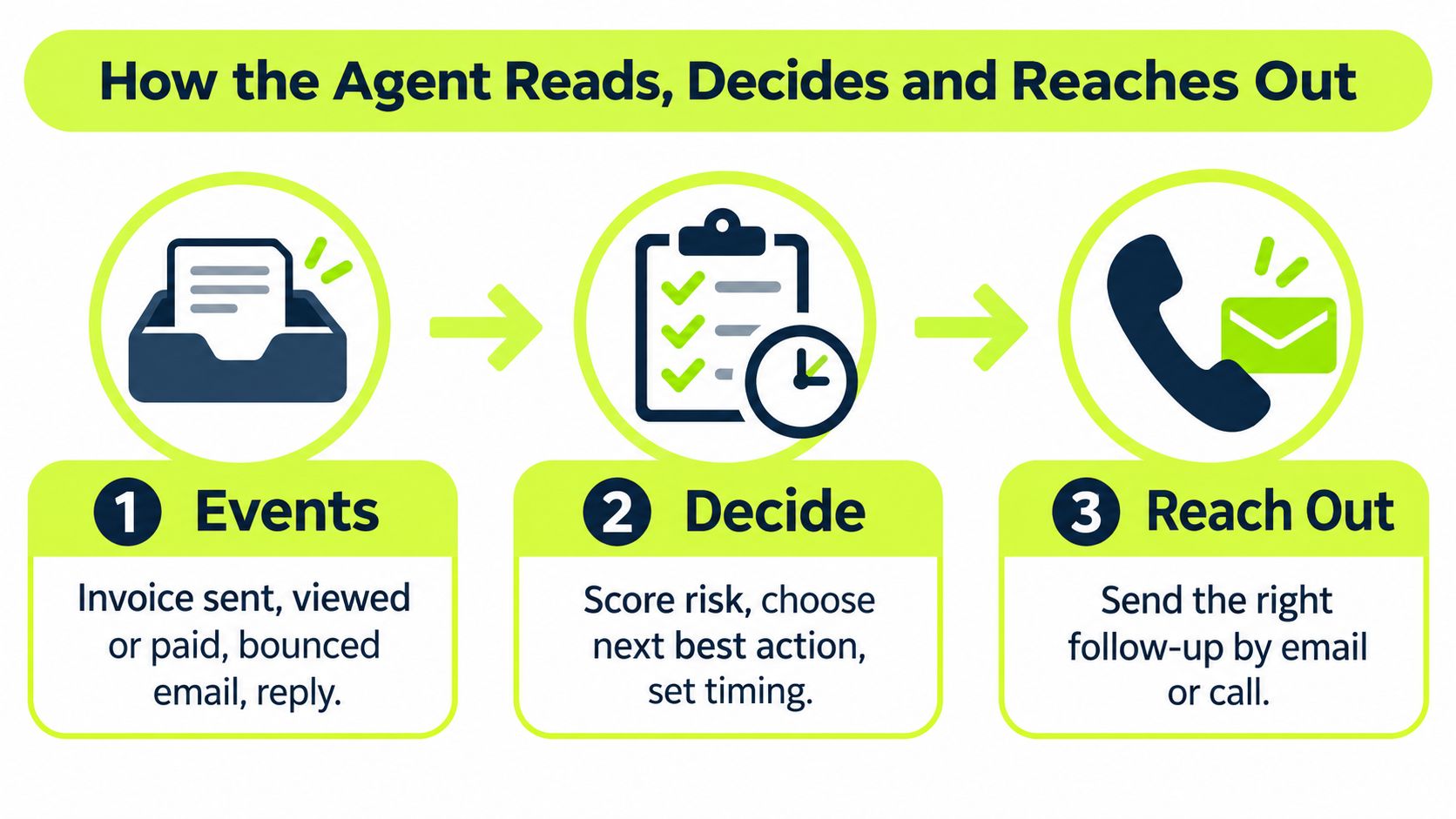
An overdue invoice can have several different stories behind it: the client may have paid, be waiting on a correction, or have missed a reminder. An AI collections agent needs a reliable record of those events before it can choose a useful next action.
A practical design separates three jobs: recording events, applying firm policy, and selecting among permitted actions. The event record tracks invoice delivery, payments, bounced emails, and replies. The policy defines what the agent may do. A model can then use account history to help choose the channel, timing, and tone.
Build the record before granting autonomy
The event layer should distinguish a partial payment from a full settlement and preserve the interaction history when someone corrects a classification. That record helps prevent a paid invoice from receiving another reminder.
The policy layer sets the firm's rules. For example, a firm might schedule a reminder before the due date and a phone call after it. The right cadence depends on the firm's workflow and client relationships.
The decision layer ranks permitted actions using account history. A risk score can inform outreach, but it should not override a dispute hold or an approval requirement. Resolut automates follow-ups, scores which customers are likely to pay late, and forecasts cash.
Turn replies into controlled actions
When a customer replies, the agent can classify the message as a promise to pay, dispute, question, or wrong contact, then extract a promised date and amount. A vague reply such as “payment soon” is not a dated commitment, so it should not count as dependable forecast cash. Ambiguous messages belong in a review queue.
A controlled workflow follows a clear sequence:
- Capture invoice and payment events.
- Classify each reply.
- Apply policy rules and confidence thresholds.
- Select a permitted channel, time, and tone.
- Send and log the interaction with a reason code.
- Route exceptions to a person.
Suppress reminders when payment is already scheduled. Otherwise, the agent may contradict a commitment the client has just made. For context on how these functions fit into the broader receivables process, see this guide to AI for accounts receivable.
Control test: Every action should show its supporting evidence, the policy applied, and the reason for the decision. If the team cannot reconstruct why a message went out, the system is not ready for unattended operation.
Review the log at the invoice level, not just against the account balance. A client may dispute one project's invoice while owing an undisputed balance on another.
Where a Person Still Has to Decide
A 2025 National Bureau of Economic Research working paper found that AI callers were substantially less effective than human callers at persuading delinquent consumer borrowers to repay; switching accounts to humans six days into delinquency closed much of the performance gap.
That study concerns consumer loans, not B2B invoices. It isn't a measured result for professional services receivables. It does challenge the assumption that maximum automation necessarily produces maximum recovery.
Assign authority, not just an inbox
Automation can provide coverage and consistency. People still have to establish credibility, negotiate workable commitments, and decide when preserving the client relationship matters more than following the standard cadence.
A handoff needs an owner with authority to act. Forwarding a difficult reply to an unmonitored shared mailbox isn't human oversight.
Handoff triggers and who acts
Trigger | What the agent does | What the person does |
|---|---|---|
Client disputes an invoice | Pauses reminders on that invoice | Account manager resolves the dispute |
Promise-to-pay missed | Sends one follow-up and logs the broken promise | Controller agrees a new date or terms |
Signs of hardship | Stops automated contact | Owner or senior manager decides on a plan |
Invoice above a set value | Prepares the next step without sending it | Finance lead approves the escalation |
Low model confidence | Routes the reply to a person | Collector reads and classifies the reply |
Repeat late payer after two cycles | Moves the account to phone-based outreach | Collector negotiates a payment plan |
Treat the repeat-cycle trigger as a proposed firm policy, not a research-derived threshold. Set the high-value approval limit according to your exposure and delegated authority.
Low confidence should mean less autonomy. If a reply mixes a scope complaint with a proposed payment date, the agent shouldn't classify it as an uncomplicated promise and continue chasing.
Our explanation of human-in-the-loop automation provides context for designing those approval boundaries.
Measure whether intervention works
Track cure rate, meaning accounts brought current, alongside repeat delinquency and dispute-resolution time. Also distinguish a promise recorded from a promise kept.
A collector who secures an unrealistic commitment hasn't solved the problem. The stronger outcome is an achievable agreement that the customer honors without another escalation.
Write three handoff rules for your firm and name the person who owns each. Include a backup owner and the information the agent must provide, so the collector doesn't have to reconstruct the case from scattered messages.
Benefits for AR Teams and Lower DSO
A client's invoice can sit unpaid because the billing contact changed, a supporting document is missing, or nobody followed up after a payment promise. An AI collections agent can help the AR team address those delays sooner, while leaving relationship-sensitive decisions with people.
Earlier action and less administrative work
Consistent reminders can reduce internal delays: invoices need not wait for someone to review an aging report before a follow-up begins. The team can request a missing document promptly or reach the right billing contact before an overdue balance becomes harder to resolve. That is one way receivables automation reduces DSO, although faster outreach cannot change a client's agreed terms or ability to pay.
Routine follow-ups, reply sorting, and matched-payment updates can also reduce manual work. The practical test is whether staff time shifts toward resolving exceptions and maintaining client relationships, rather than correcting classifications and reconciling errors. Track hours spent on those tasks, along with invoices that remain unresolved after a promise to pay.
Personalization needs evidence
A randomized Finnish debt-collection trial found that personalized messages improved repayment, while generic automated messages did not. The results support testing whether a message is relevant to the recipient, not maximizing the number of messages sent.
- Long-standing clients: Use relationship information already in the account record, without implying that a partner personally sent an automated message.
- Chronic late payers: Apply a firmer, approved cadence with clear next steps.
- Active payment plans: Suppress routine reminders that conflict with the agreed plan.
Segmentation can help tailor the request, but each group still needs to be evaluated against your own clients. A message that fits a chronic late payer may be inappropriate for a client waiting on a corrected invoice.
Better personalization means a more appropriate request, not merely a first name inserted into a template.
Judge the system by repeat payment and promises kept, not message volume alone. A recorded promise is only a useful signal if the payment arrives and the account does not return to delinquency.
What Lower DSO Is Worth in Cash
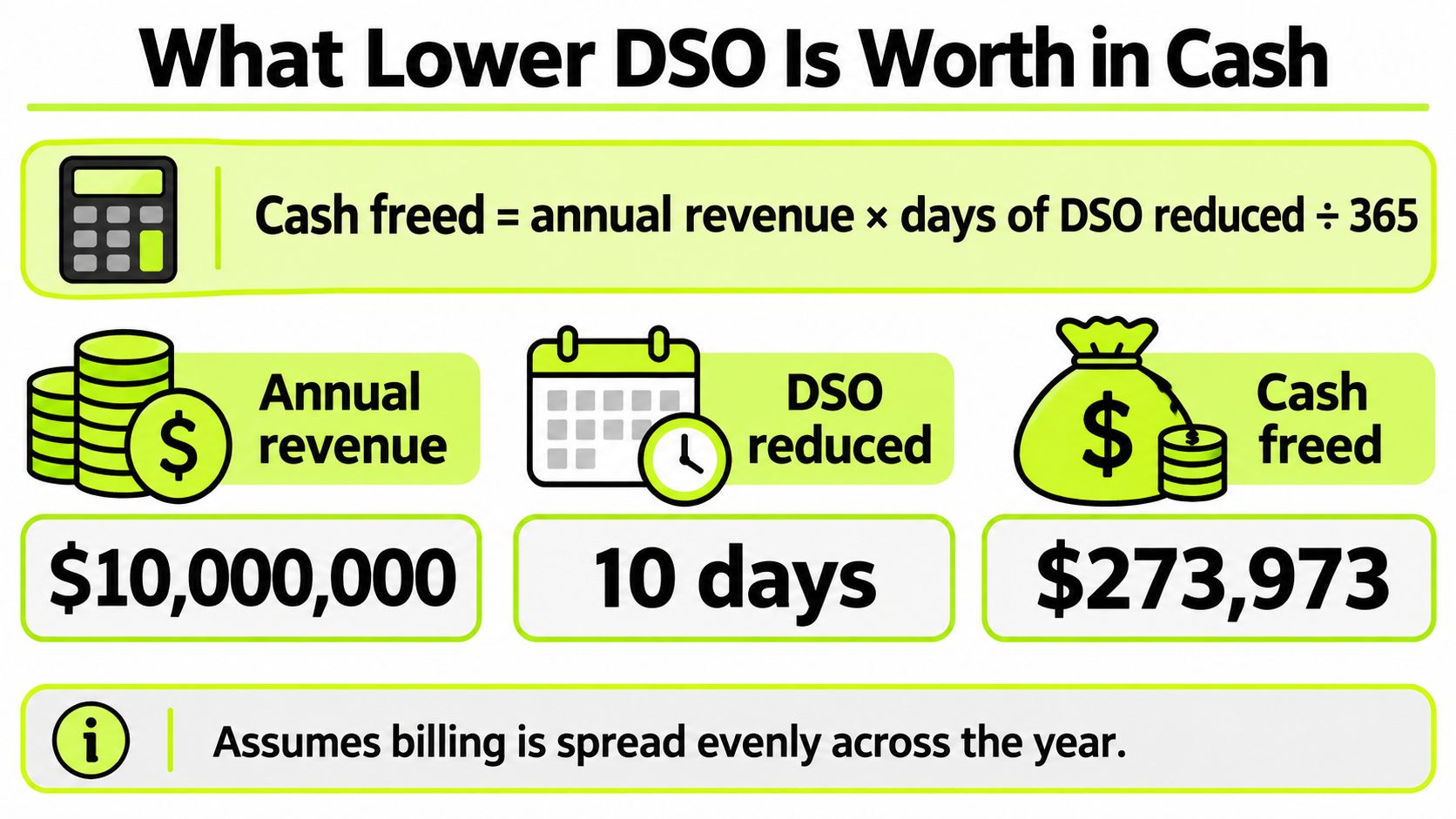
Cash freed = annual revenue × days of DSO reduced ÷ 365.
Use this as a planning estimate, not a recovery guarantee. It assumes billing is spread evenly across the year and that the revenue base reasonably represents invoiced credit sales.
For firms with substantial prepaid work, seasonal billing, or milestone invoices, use a comparable credit-sales base and inspect the actual collection schedule. Our guide to calculating days sales outstanding explains the underlying metric.
Translate the target into working capital
The following are hypothetical calculations, rounded to the nearest dollar. They show the working-capital effect of collecting the same sales sooner, not additional revenue.
Cash released by a DSO reduction
Annual revenue | Cash freed at 10 days | Cash freed at 15 days |
|---|---|---|
$5 million | $136,986 | $205,479 |
$10 million | $273,973 | $410,959 |
$50 million | $1,369,863 | $2,054,795 |
Say a firm has $20 million in annual revenue and achieves a 15-day DSO reduction. Under the same hypothetical assumptions, it releases approximately $822,000.
If that cash replaces borrowing at an assumed 8% annual line rate, the annualized interest avoided is roughly $66,000. That benefit requires the borrowing reduction to persist; a temporary release won't produce a full year's savings.
Forecast arrival, not intention
Payment method affects when you can use the money. QuickBooks states that standard ACH delivery can take three to five business days, while checks can take eight to ten business days.
A client's approval, payment initiation, and bank availability aren't the same event. Record them separately so a promise doesn't appear in the cash forecast as cleared funds.
The agent changes how quickly your firm follows up. It doesn't change the payment terms the client agreed to, eliminate banking delays, or make disputed revenue collectible.
Forecast discipline: Don't count released working capital as recurring income. It is existing cash arriving earlier.
Enter your revenue base, current DSO, and target DSO into the calculation. Then place the expected receipts into the cash forecast by likely arrival date, with a separate assumption for uncertain commitments. That's how a DSO target becomes a usable plan to improve cash flow.
Setting Up QuickBooks AR Automation Without Cleanup Work
Before the first reminder goes out, make sure the agent has a reliable billing record. QuickBooks AR automation can't compensate for a missing purchase order, an incorrect contact, or payment terms that differ between the engagement letter and the invoice.
Start with the customer master and open invoices. Confirm the billing contact, due date, agreed terms, outstanding amount, and a payment method the client can use.
Connect billing to payment and accounting
QuickBooks' invoicing workflow supports a Pay Now button and payment by credit card, debit card, ACH bank transfer, Apple Pay, PayPal, or Venmo, with invoice statuses including sent, viewed, paid, overdue, and voided. Unpaid invoices remain in Accounts Receivable on the balance sheet until payment is recorded.
Those mechanics matter when choosing AR software for professional services. Follow-up should operate from the same invoice state that finance uses for aging and reconciliation.
QuickBooks' payment-processing guidance describes automatic recording and matching for QuickBooks Payments and claims 100% matching accuracy for eligible Payments transactions. Test that narrowly scoped claim against your own payment mix and exception rate rather than treating it as a guarantee for every receipt.
Include these cases in acceptance testing:
- Partial payments: Confirm the remaining balance stays collectible without chasing the original amount.
- Combined receipts: Check how a payment covering multiple invoices is allocated.
- Unidentified transfers: Route the receipt for review before sending another demand.
- Credits and adjustments: Confirm approved changes reach both the ledger and the outreach queue.
Configure the workflow and stopping controls
Our setup has three steps: connect QuickBooks or drop PDFs, pick a workflow and adjust the cadence, then let us handle the chasing. Start with a controlled invoice group so you can inspect the results before expanding.
We detect paid stamps on uploaded PDFs and automatically turn off outreach for that invoice. Users can also mark any invoice paid manually in one click.
A manual collection status isn't a substitute for posting the accounting entry. Define who records the receipt, how exceptions are reconciled, and which record controls the next action.
Before go-live, document these safeguards:
- Stop behavior: Test that payment recognition stops further outreach.
- Manual control: Confirm staff can close an invoice when an exception requires intervention.
- Retention: When you send an invoice, email a link to it, or hand an invoice to us, we store its data for up to 30 days, then delete it.
Keep AR activity and the ledger coordinated through one orchestration layer. The controller should review genuine exceptions, not spend the morning correcting invoices that were paid but still look open to the collection system.
Confirm the Fit Before You Automate Collections
Move ahead when DSO sits above your target, staff spend meaningful time chasing invoices, and your book contains enough accounts for consistent rules to matter. The strongest candidate is a repeatable administrative problem with identifiable exceptions.
Hold off when disputes dominate the aging, one person can comfortably manage the book, or most invoices require personal negotiation. Fixing engagement terms, billing accuracy, or approval documentation may produce a better result than automating the chase.
Define the pilot before switching it on
A proposed 60-to-90-day pilot on one client segment gives you a bounded way to evaluate the operating model. Choose a segment with comparable terms and payment behavior, then retain a comparison group rather than judging performance against an unusually poor month.
Measure the outcomes that matter:
- DSO and recovered cash: Check whether receipts arrived sooner, not merely whether more messages were delivered.
- Promises kept: Compare commitments honored with commitments recorded.
- Complaint rate: Watch for duplicate contact, inappropriate tone, and confusion over balances.
- Recovery quality: Review cure rate, repeat delinquency, and dispute-resolution time.
Document exclusions, credits, and unusual large receipts. Otherwise, a single exceptional payment can make an ineffective workflow look successful.
Make ownership explicit
Before starting, decide the handoff owner, the escalation triggers, and the metrics-review date. Give the finance lead authority to pause the pilot if accounting exceptions or client complaints outweigh the benefit.
Resolut automates follow-ups, scores which customers will pay late, and forecasts cash. Our orchestration platform connects collections, cash application, and forecasting around a shared record; Orchestration adds credit bureau data and reporting, a usage-billed AI voice calling agent, automatic cash application, intelligent dispute resolution with legal escalation workflows, and priority support with a dedicated CSM.
Those capabilities should follow your control design, not dictate it. Legal escalation requires an authorized decision, and voice outreach should have a defined purpose rather than become another channel for repetitive contact.
The right result isn't the highest automation rate. It's earlier, accurately applied cash and more reliable future payment behavior, achieved without weakening client relationships.
Resolut automates AR for professional services, consistent, accurate, and human. Visit Resolut to explore how an AI collections agent can support your collections workflow with explicit human handoffs. Run the cash-freed calculation for your firm, then choose the client segment for a controlled pilot.