Approval Workflows for AR: A Practical 2026 Guide
Approval workflows that actually speed up AR. Learn patterns, decision rules, KPIs, and pitfalls for professional services finance teams in 2026.
The week usually starts with a clean invoice and ends with a stalled approval. A partner meant to sign off is out, a credit exception sits in someone's inbox, and the receivable ages while everyone assumes it will move tomorrow. In a professional services firm, that one delay is rarely about the invoice itself, it's about the approval workflow behind it.
When that happens once, it feels like a nuisance. When it happens every month, it becomes a control problem. Cash timing slips, the team loses visibility, and the people who need to answer for the balance sheet are left chasing email threads instead of managing working capital.
The Week an Approval Cost You
The most familiar AR failure isn't a bad customer or a disputed amount. It's the quiet pause between a request and the sign-off that should have moved it forward. A controller sees it as a small delay, then realizes the delay pushed a collection call, a cash application, or a release of funds into the next week.
That's why approval workflows matter in finance. Industry guidance describes the modern workflow as a rule-based process that routes requests through predefined approvers using automation logic, instead of ad hoc email routing, and Microsoft's workflow guidance reflects the same shift toward formalized enterprise software rather than informal handoffs (Cflow approval workflow overview). Once the process is inside software, the business can measure what happened, not just guess.
For AR, that matters more than many organizations acknowledge. A credit memo, a payment release, or a dispute resolution can all look “almost done” while the receivable ages. The workflow is the bottleneck, not the invoice.
Practical rule: If a request can sit in someone's inbox without a clear owner, it's not a control. It's a hope.
That's the difference between a neat process map and a working cash process. A firm can have good billing, clean contracts, and still miss collections because the approval path is undefined. Once the workflow is explicit, the finance team can stop managing exceptions by memory.
For a deeper operational lens on how AR automation fits around this control layer, the what is AR automation guide is useful context. It helps connect the workflow to the broader system, not just the approval step.
What an Approval Workflow Actually Is in Finance
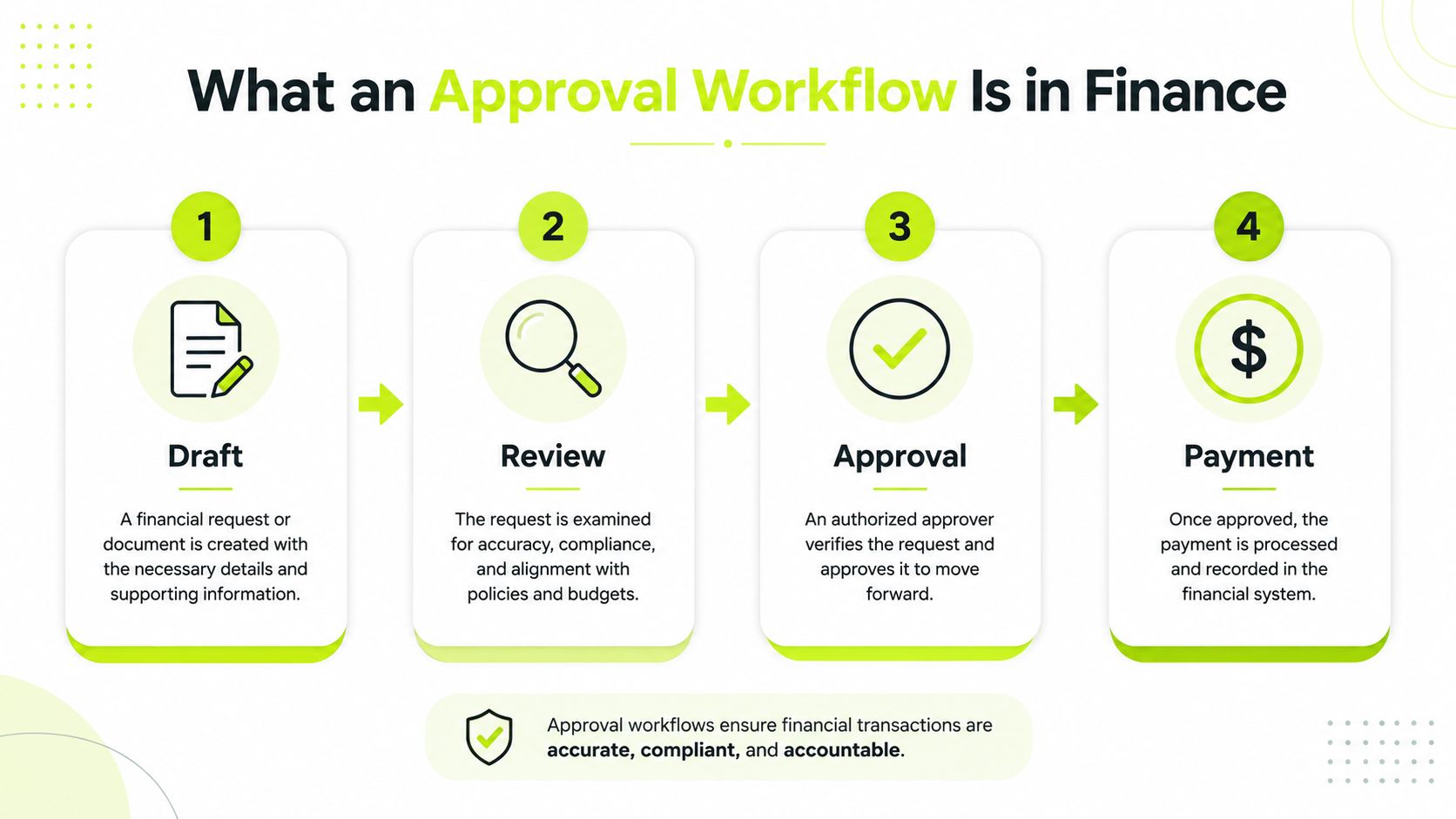
An approval workflow in finance is a software-enforced path that moves a request through specific states, with explicit rules for who can act, when they can act, and what happens next. It functions as a state machine for an invoice or credit request, where the system controls the transition instead of relying on someone to remember the next move.
The finance version of state control
A request usually starts in draft, then moves to submit, then review, then decide, and finally audit and notify. In a clean design, the backend rejects stale, duplicate, or out-of-order actions and keeps an immutable trail of every decision and notification attempt (Playcode approval workflow guide). That's what gives finance teams confidence that the record can survive review.
Email approvals don't give you that. They drift in tone, the timing is accidental, and the final decision often lives in a reply chain no one wants to reconstruct later. In a professional services firm, that's a bad fit for anything tied to billing, credit, or cash release.
The UI button is never the authority. The backend is.
That's why workflows are more than a convenience layer. In finance, they act as a control system for receivables, refunds, write-offs, and any action where a human decision changes cash timing. When the system owns the state, you can support retry logic, escalation, and recovery without corrupting the result.
A practical AR example
An invoice can be held in draft until the service lead confirms scope. It moves to review when the controller checks billing accuracy, then to approval when the client owner confirms release. From there, the record is auditable, and payment timing can be tracked against the actual approval path.
For firms that still rely on inbox threads, LifeBack Law's review-sign guide is a useful reminder that a sign-off only matters when it's tied to a defensible process. That same principle applies to AR, credit, and dispute handling.
The Four Approval Patterns Finance Teams Actually Run
Most firms don't run one approval process. They run four, and they behave differently.
The mistake is treating invoice sign-off, credit approval, payment release, and dispute approval as the same thing. They aren't. Each one has a different risk, a different owner, and a different reason to stall.
Pattern | Decision Rule | Approver Role | Primary Risk |
|---|---|---|---|
Invoice approval | Triggered by amount, client type, or new vendor | Billing lead, controller, or partner | Incorrect billing or premature release |
Credit approval | Based on customer risk data and exposure limits | Controller, finance lead, or credit owner | Overextension of receivables |
Payment release | Often requires dual control for larger amounts | AP or treasury reviewer plus secondary approver | Unauthorized cash movement |
Dispute approval | Requires independence from the original decision | Separate reviewer, often finance or operations | Biased resolution and audit weakness |
Invoice approval is about billing integrity
This is the one many teams know best. A new engagement, a threshold breach, or an unusual line item triggers review before the bill goes out. The right approver is usually the person who can verify scope and pricing, not the person who entered the invoice.
Credit approval is about exposure
Credit decisions should be tied to customer history, open balance, and policy limits. A controller doesn't need every detail, but they do need a workflow that prevents a rep from granting informal terms in a hallway conversation. That's where accounts receivable automation starts to protect cash flow.
Payment release is about control of cash
Payment release needs tighter permissioning than invoice approval because the risk sits on the disbursement side. A second reviewer matters when amounts rise or when a payment is outside the normal cadence. In practice, dual control reduces the chance that a single person can move money without oversight.
Dispute approval needs independence
A dispute should not be “reviewed” by the same person who approved the original terms. That creates a soft conflict, even if everyone acts in good faith. For professional services firms, that separation matters when a client questions scope, deliverables, or timing.
For a deeper look at routing and control logic, the approval workflow internal controls guide is a useful companion. It fits especially well when AR decisions touch collections, credits, and write-offs.
Why Approval Workflows Move Real Money
Finance leaders do not buy approval workflows to tidy up documentation. They buy them because approval timing affects cash, control, and the ability to explain decisions later.
The approval-workflow software category has become a multi-billion-dollar market, with one estimate valuing it at USD 9.8 billion in 2023 and projecting growth to USD 26.3 billion by 2033 at a 10.3% CAGR over 2025 to 2033, while another places it at USD 7.4 billion in 2025 with growth to USD 18.6 billion by 2034 at a 10.8% CAGR (market estimates). That scale points to a practical shift, companies are treating approvals as part of finance operations, not as clerical support.
Cycle time is the lever
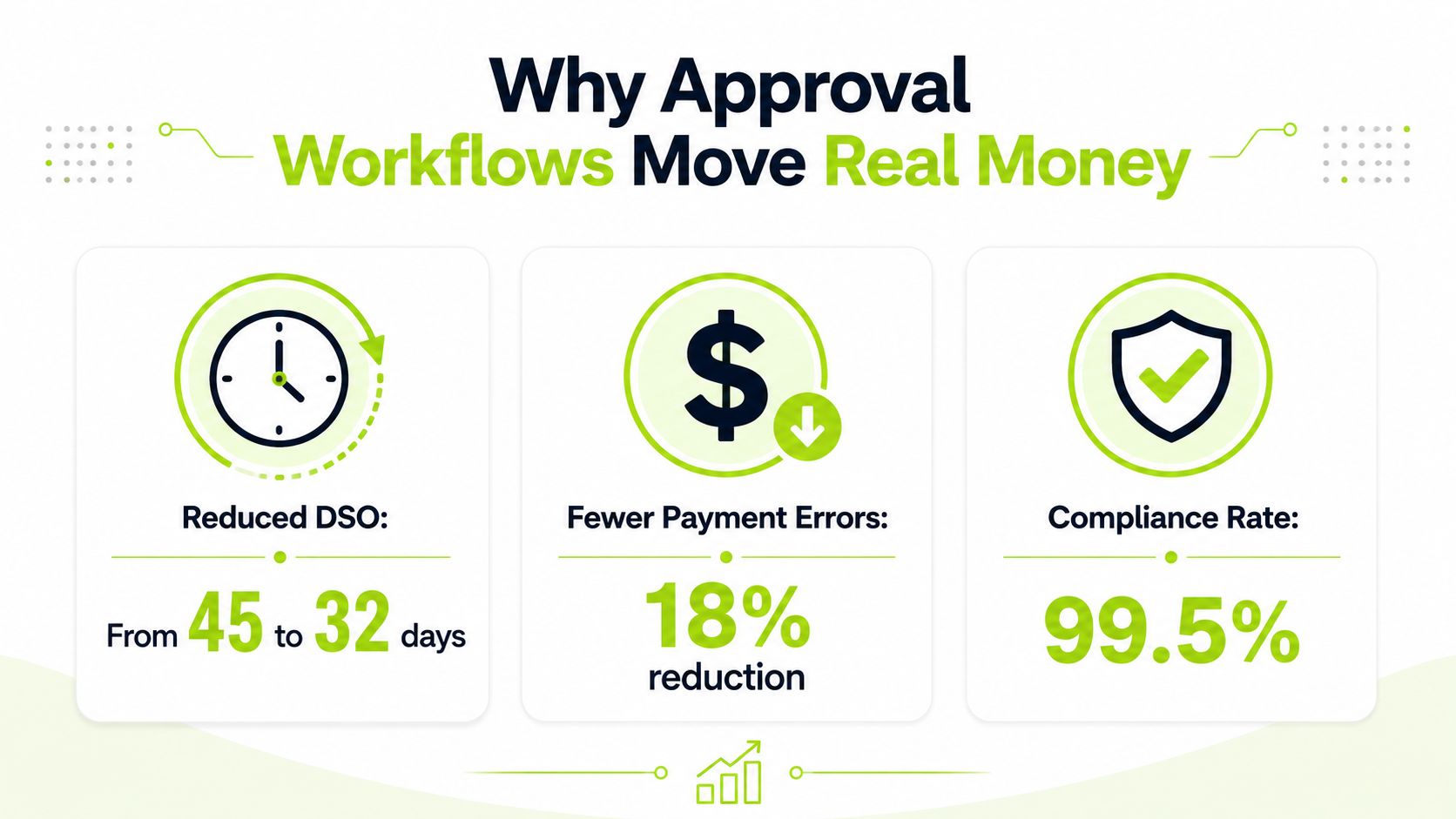
Every approval that sits unresolved delays either cash collection or payment release. In finance, that delay shows up in cycle time, SLA compliance, approval loops, and audit-trail completeness, which are the operational measures that tell you whether the workflow is helping or just adding a layer of review.
A controller reads that as working capital pressure. If the path from request to decision stalls, cash timing stalls with it. If the route is clear, exceptions move faster and fewer items sit in limbo.
Auditability is not a side benefit
Finance teams get asked who approved what, when they approved it, and what version of the request they saw. Approval workflows that use named roles and immutable records make that answer straightforward. That is better than reconstructing intent from forwarded emails, chat threads, and half-remembered calls.
Control is the point
The market size matters because it shows how widely this control pattern has been adopted. The operational value matters because the workflow now sits inside finance and operations control, not outside it. That is why approval design belongs on the CFO's desk.
If a workflow cannot be measured, it cannot be managed.
That standard matters more than how clean the process looks in a deck. The test is whether it shortens cash timing and leaves a trail you can defend.
For teams tightening AR control paths, escalation procedures for delayed approvals are part of the same cash discipline, because stalled approvals need a defined next step before they turn into overdue balances or missed release windows.
Decision Rules That Keep Approvals Moving
The approvals that survive contact with finance are rarely the prettiest. They are the ones with decision rules that do not depend on memory, goodwill, or one busy person answering email on time.
Route by metadata, not by habit
The stronger pattern is routing based on fields, thresholds, and policy. Workflow engines can attach definitions to object models, apply field-based constraints, and choose the highest-priority matching workflow when more than one rule could apply (Nautobot approval workflow docs). That is the right logic for AR because the request itself should drive the route.
A new customer, a high-value write-off, or an exception to standard terms should each trigger a different path. The system should know that before anyone opens the request. Otherwise the team ends up deciding the control after the fact, which is how delays and inconsistencies creep in.
Build the backup into the rule
A named approver without a backup is a future delay. Teamwork's best-practice guidance is direct on this point, it lists submission requirements, designated approvers with backups, escalation rules, and an audit trail as core elements (Teamwork approval workflow best practices). That is the difference between a workflow and a bottleneck.
Operational rule: No approval path should depend on one person being available every day.
SLA-based escalation matters for the same reason. If a request sits too long, it should move to a substitute owner or a higher authority automatically. That keeps the process moving without turning it into a free-for-all, and it gives finance a cleaner way to defend why one item moved faster than another.
Use control language, not vague policy language
In regulated or sensitive cases, the workflow should require evidence, independence rules, and electronic signatures that are bound to the record with time-stamped events (Nautobot approval workflow docs). That fits dispute handling and any write-off process that may later land in front of auditors.
For implementation detail, the escalation procedures guide is a practical companion. It helps translate policy into routing logic without leaving the finance team exposed to manual interpretation. If you want a parallel control example outside AR, the Lighthouse Consultants fraud guide shows how weak exception handling creates audit exposure in payment processes, and the same logic applies here when someone starts approving outside the rule.
Where Approval Workflows Fail
The obvious failure is a missing approval. The more damaging one is a workflow that looks active while the work sits untouched.
Single approvers become single points of failure
If one person owns a critical approval and no backup exists, vacation becomes a control risk. That sounds obvious until a month-end queue shows three approvals waiting on the same inbox. In AR, that can hold up invoice release, credit changes, or dispute closure long enough to affect collections timing and DSO.
Exception handling drifts into back channels
Teams usually handle urgent cases informally first. Someone pings a manager, a decision gets made in chat, and the workflow is updated later, if anyone remembers. That is where the audit trail starts to weaken, because the record no longer shows who approved what, or why.
A useful fraud-control reference is Lighthouse Consultants' AP fraud guide, especially for teams that want to see how informal exceptions create control exposure in payment processes. The same logic applies in AR when a shortcut starts to replace the rule.
Escalation is the part teams skip
The issue is rarely whether a workflow exists. It is whether someone knows what happens after the first reviewer disappears, the request goes out of policy, or the urgency changes midstream.
Backup approvers and exception logs stop the process from turning into a hidden queue of unresolved decisions. They also give finance a cleaner way to explain why one item moved faster than another, which matters when collections or dispute resolution is waiting on the answer.
Independence protects the record
If the same person who created the exception also signs it off, the workflow loses credibility fast. In approval-heavy AR processes, that is how disputes get messy and write-offs become harder to defend. The fix is simple, the person resolving the exception should not be the same person who created it.
For control design, the AR internal controls guide is worth using alongside this one. It connects escalation, backup ownership, and audit evidence into one operating model.
KPIs, Checklist, and How Resolut Fits
The right KPI set is small and unglamorous. That is usually the sign finance is measuring control, not vanity.
Track cycle time per approval stage, SLA compliance rate, approval-loop rate, audit-trail completeness, and the downstream DSO impact on the affected invoice cohort. Those measures show whether the workflow is moving decisions faster, reducing rework, and keeping the record clean enough for audit and dispute follow-up. If you are choosing which approval metrics matter most, the trade-offs in KPI choices that hurt quota attainment are a useful reminder that a metric can look active while still pushing the wrong behavior.
A checklist you can verify
- Named approvers with backups. Every critical step should have a primary owner and a substitute, so an approval does not stop when one person is out.
- Threshold rules documented. Amount, risk, client type, and exception logic should be visible, because hidden rules turn into inconsistent decisions.
- Escalation timers set. No approval should sit without a next step, especially when collections or a dispute response is waiting on the sign-off.
- Exception log reviewed monthly. If the same exceptions keep appearing, the rule probably needs to change instead of being worked around.
- Audit trail exportable. Finance should be able to hand the record to audit without rebuilding the chain of approval from inboxes and memory.
The mistake I see most often is measuring activity instead of outcome. A workflow can create more touches and still do nothing for approval time, rework, or cash collection.
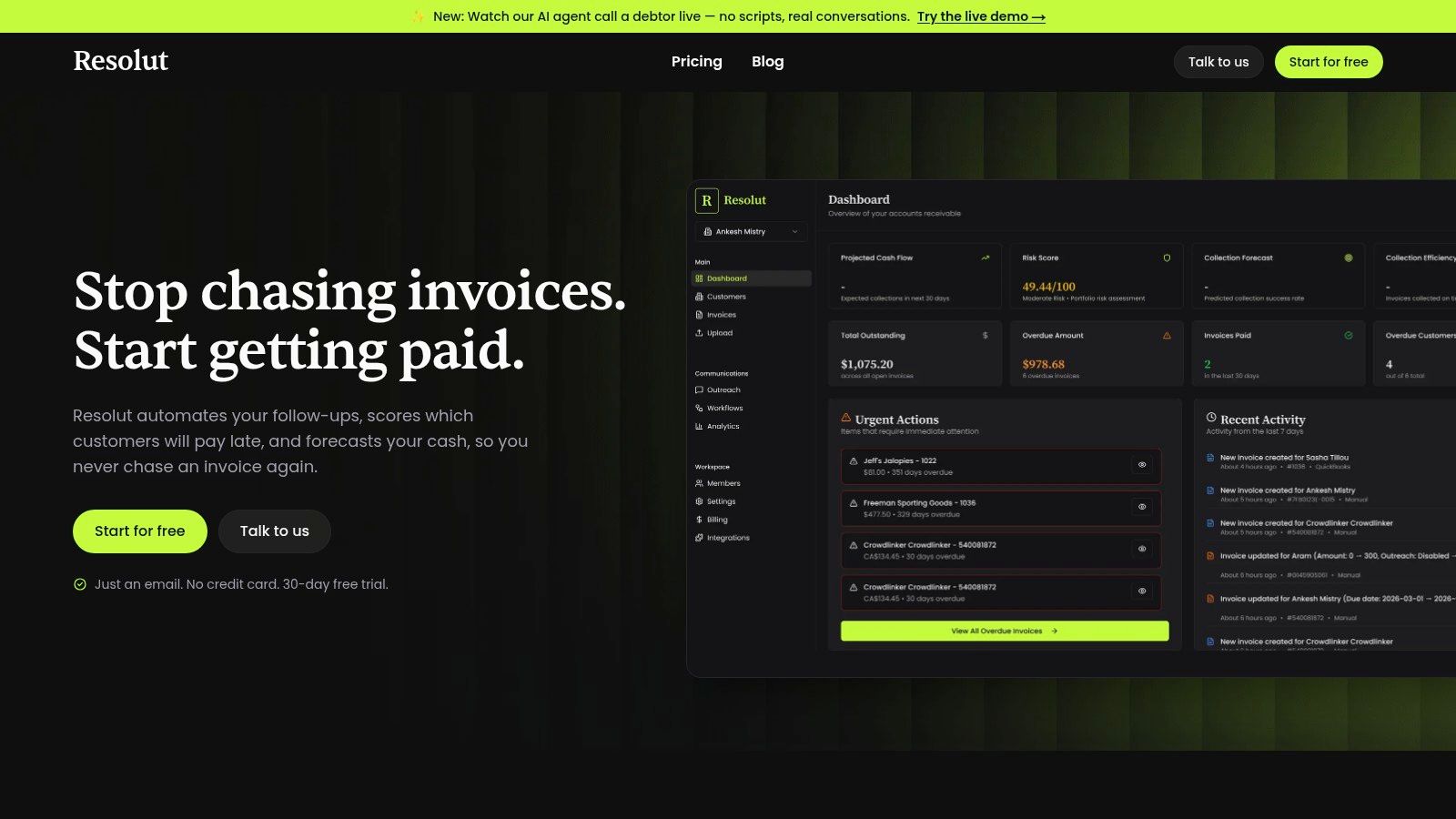
For teams running QuickBooks in the middle of the stack, Resolut is one option for keeping approval control tied to AR work instead of scattered across inboxes. It routes credit and dispute decisions to the right role, keeps QuickBooks as the system of record, and automates AR approval flows alongside collections and cash application. That matters when the goal is lower DSO without giving up traceability, because the control layer has to support the people who resolve exceptions, not just the people who open them.
If your approval path still depends on memory, forwarding, or one overworked approver, the control layer is too thin. Visit Resolut to see how AR approval workflows can stay consistent, accurate, and human.