
10 Cash Flow Forecasting Tools for Finance Teams
Compare 10 cash flow forecasting tools for finance teams, with features, pricing considerations, integrations, use cases, and buyer criteria.
A professional services firm can have a forecast that looks reasonable and still feel short of cash. The accounting system shows billed work, open receivables, and expected expenses, but it doesn't always show when a client will pay, whether an invoice is under dispute, or how quickly a payment will be matched to the right account. Manual cash application makes that gap wider.
For CFOs, Controllers, and firm owners, the best cash flow forecasting tools connect forecast methods to real payment behavior. They should support scenario planning, ERP and accounting integrations, current AR data, payment-data ingestion, variance tracking, and the actions finance teams can take to improve cash flow.
This ranking evaluates tools by the finance problem each one solves. Treasury platforms lead when bank connectivity and liquidity control matter most. FP&A systems are stronger for governed driver-based and three-statement planning. Focused forecasting tools can provide fast rolling visibility, while AR-led platforms address the uncertainty that often matters most to professional services firms, client payment timing.
A forecast is only as useful as the data and collection process behind it.
That means accounts receivable automation, AI AR automation, and workflows designed to reduce DSO belong in the evaluation. A firm using QuickBooks may need QuickBooks AR automation alongside its forecasting layer, not another disconnected spreadsheet. For broader guidance, see this overview of strategic cash flow forecasting.
1. Kyriba
Kyriba is the strongest choice when cash visibility is a treasury problem rather than a simple forecasting problem. Its cloud platform is designed to centralize bank connectivity, cash positioning, liquidity planning, payments, and forecasting across entities and accounts.
That architecture suits larger and upper-mid-market organizations with multiple banks, currencies, legal entities, and control requirements. Finance teams can bring bank data and ERP information into a shared operating view, then use scenario analysis and variance tracking to compare expected liquidity with actual movement.
Best for controlled, complex treasury operations
Kyriba's forecasting depth extends beyond a single rolling cash view. Treasury teams can evaluate short-term liquidity needs alongside longer-range planning, monitor cash positions across entities, and connect forecast decisions to payment workflows. Its AI features, including TAI, are positioned around anomaly detection and insights rather than replacing treasury judgment.
The platform's controls are also relevant for SOX-sensitive environments. Permissions, audit trails, payment approvals, and documented workflows matter when the forecast affects funding, investment, or intercompany decisions.
- Bank connectivity: A major strength for multi-bank and multi-entity environments.
- Forecasting: Suitable for short and longer horizons, with scenarios and variance analysis.
- AR connectivity: More dependent on ERP and treasury data than on invoice-level collection execution.
- Implementation: Expect substantial configuration, integration work, and change management.
- Pricing visibility: Custom and opaque, with scope and modules affecting the commercial model.
Kyriba makes sense when the firm needs a broad treasury suite, not just a better 13-week spreadsheet. A $3M–$50M professional services firm may find it difficult to justify unless its entities, banking structure, controls, or liquidity operations are unusually complex. Review the Kyriba treasury and liquidity platform directly before treating it as a forecasting-only purchase.

2. GTreasury
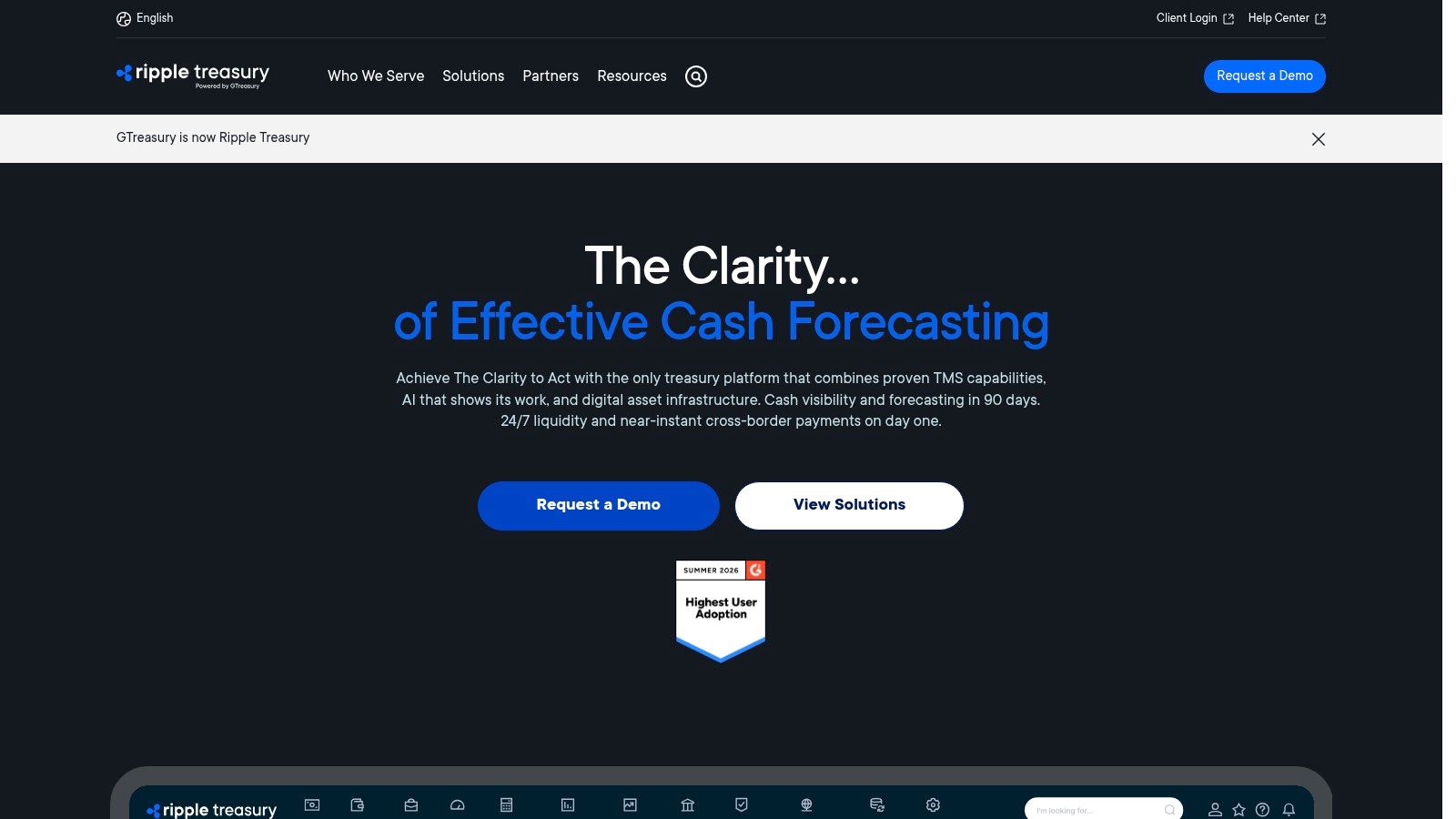
GTreasury fits firms whose cash problem has expanded beyond forecasting. It combines cash positioning, liquidity analytics, forecasting, scenario modeling, and payments in one treasury environment, with consolidated views across accounts and entities.
The operational benefit is a shared process for treasury and finance. ERP and bank data can feed liquidity reporting, while reporting packs and payment workflows connect forecast decisions to funding and disbursement activity. That breadth reduces the need to assemble separate tools, but it also increases implementation scope.
Best fit: treasury complexity, not collection control
For a finance team comparing enterprise treasury systems, GTreasury's interface may support adoption by controllers, regional finance staff, and operating teams as well as treasury users. The platform's value depends less on one forecasting feature than on bank coverage, services, support, workflow design, and the quality of the implementation.
Forecasting can cover a 13-week view and longer planning horizons, with scenario analysis. Bank, ERP, and account data can be consolidated for liquidity reporting. Receivables information can inform treasury decisions, but GTreasury is not primarily a collections execution system. A firm still needs dependable invoice, approval, and payment-status data upstream. Resolut can complement the forecasting layer by improving the quality and timing of receivables data reaching finance.
Buyers should test the workflow with real inputs, including unpaid invoices, expected client receipts, payment runs, and entity-level balances. They should also ask how integrations, permissions, reporting, and support are handled in the proposed scope.
For professional services firms in the $3M–$50M range, GTreasury is easier to justify when multiple entities, banking relationships, payment controls, or liquidity decisions create genuine treasury workload. If overdue client invoices are the main source of uncertainty, a collections-focused tool may address the cause more directly. Review the GTreasury treasury management platform against the weekly work the finance team needs to perform.
3. Trovata
For firms whose immediate problem is fragmented bank data, Trovata provides a focused cash visibility and forecasting layer without requiring a full treasury management system. Its bank-API model automates multi-bank ingestion and applies machine-learning models to historical cash behavior.
That focus matters for finance teams still gathering balances, normalizing account data, and rebuilding cash reports manually. Users can tag transactions, examine trends, and investigate why cash moved across accounts and entities. The trade-off is that bank history remains the starting point, so forecast quality depends on the operational detail connected to it.
Where Trovata fits in the cash workflow
Trovata is strongest as a bank-data foundation. A treasury or finance team can connect account history, review current liquidity, and build model-based forecasts without collecting information separately from each bank. This can reduce recurring reporting work and provide a consistent view for weekly cash reviews.
Forecast depth has limits when the main uncertainty sits in receivables. A bank-led model may not explain unpaid invoices, disputed bills, milestone approvals, or manual cash application unless those details enter the workflow. Resolut can complement Trovata by improving the quality and timing of receivables data reaching finance, helping the forecast reflect expected collections more accurately.
Use the platform to test whether the available inputs support the decisions the team needs to make:
- Forecasting method: Machine learning based on bank history and connected cash data.
- Scenario planning: Useful for examining cash trends and assumptions, while broader business planning may require another platform.
- ERP and AR connectivity: Confirm the detail, mapping, and refresh cadence available from accounting and ERP systems.
- Implementation: Often lighter than a broad TMS, subject to bank coverage and data requirements.
- Pricing visibility: Confirm commercial scope directly during evaluation.
For a professional services firm in the $3M–$50M range, Trovata fits when fragmented banking information is the primary cash problem. It does not replace FP&A or create an AR operating process that helps a firm reduce DSO. Test the Trovata cash visibility platform with actual bank, ERP, and receivables data before committing.

4. Tesorio
For a professional services firm, a forecast can miss even when the accounting data is accurate. Client approvals, invoice disputes, and inconsistent payment behavior can shift expected cash. Tesorio addresses that problem by linking receivables forecasting with collections activity, cash tracking, and variance analysis.
The platform is most useful when finance needs to decide which invoices deserve attention and how those actions may change near-term cash. Instead of treating outstanding AR as one balance, the team can assess expected payment timing by customer and compare projected collections with actual receipts.
Best for AR-led cash forecasting
Tesorio uses behavioral machine learning with ERP data and customer signals to forecast collections. Its collections workflows support outreach, while dashboards help finance review forecast variance. That combination suits B2B professional services firms where approval cycles and client payment patterns influence cash more than a high-level revenue assumption.
The operating benefit is the connection between prediction and follow-up. Finance can prioritize accounts, investigate exceptions, and check whether collection expectations were met.
- Forecasting depth: Strong for AR-driven cash forecasting and payment behavior.
- AR automation: Collections workflows and outreach are central to the platform.
- Scenario planning: Useful for testing changes in expected collections and payment timing.
- Payment-data ingestion: Evaluate how ERP and customer signals are mapped, refreshed, and used in the forecast.
- Broader planning: Workforce planning, annual budgeting, and three-statement models may require complementary software.
- Implementation: Typically depends on ERP connectivity, receivables data quality, and collection-process alignment.
- Pricing: Packaging is sales-led and not publicly listed.
The trade-off is scope. Tesorio is a focused receivables and cash tool rather than a broad corporate planning suite. For firms in the $3M–$50M range, it fits when delayed client payments are the main forecast problem. Resolut can complement it by improving the quality and timing of receivables data reaching finance. Review the Tesorio cash flow platform with actual ERP and AR data before committing.

5. Planful
Planful fits finance teams that need controlled FP&A processes for cash forecasting, scenario planning, reporting, and multi-entity planning. It supports direct and indirect cash-flow forecasts, AI-assisted projections, Office connectivity, and repeatable planning workflows.
Its practical value is governance. Controllers can replace a workbook understood by one person with controlled submissions, review cycles, reporting packs, and documented assumptions. That structure matters when forecast changes must be explained to the CFO or shared across entities.
Where Planful fits in the finance stack
Planful's AI features can assist with projections and analyst work, but finance still defines the drivers, mappings, and approval logic. That keeps the forecast tied to assumptions the team can review and defend.
The platform consumes accounting and operational data rather than managing payment execution. A professional services firm with inconsistent invoicing, disputed work, or slow collections may still feed weak receivables inputs into a well-governed model. Planful therefore suits firms seeking planning control, not a dedicated AR workflow.
Assess the platform across these operating questions:
- Forecasting depth: Direct and indirect cash methods, scenarios, and structured planning workflows.
- AR connectivity: Better at consuming receivables data than managing collections or payment follow-up.
- Payment-data ingestion: Excel and Office support, plus ERP and multi-entity data integration. Review how often source data refreshes and how mappings are maintained.
- Implementation effort: Often partner-led, particularly for complex planning models.
- Pricing visibility: Pricing is not publicly listed.
- Firm fit: A reasonable option for $3M–$50M professional services firms with a Controller who can own model maintenance.
Before selecting the FP&A layer, confirm who will maintain the forecast after implementation. Resolut can complement Planful by improving the quality and timing of receivables data reaching finance. Compare the planning architecture with cash flow management software, then review Planful for platform details.
6. Workday Adaptive Planning
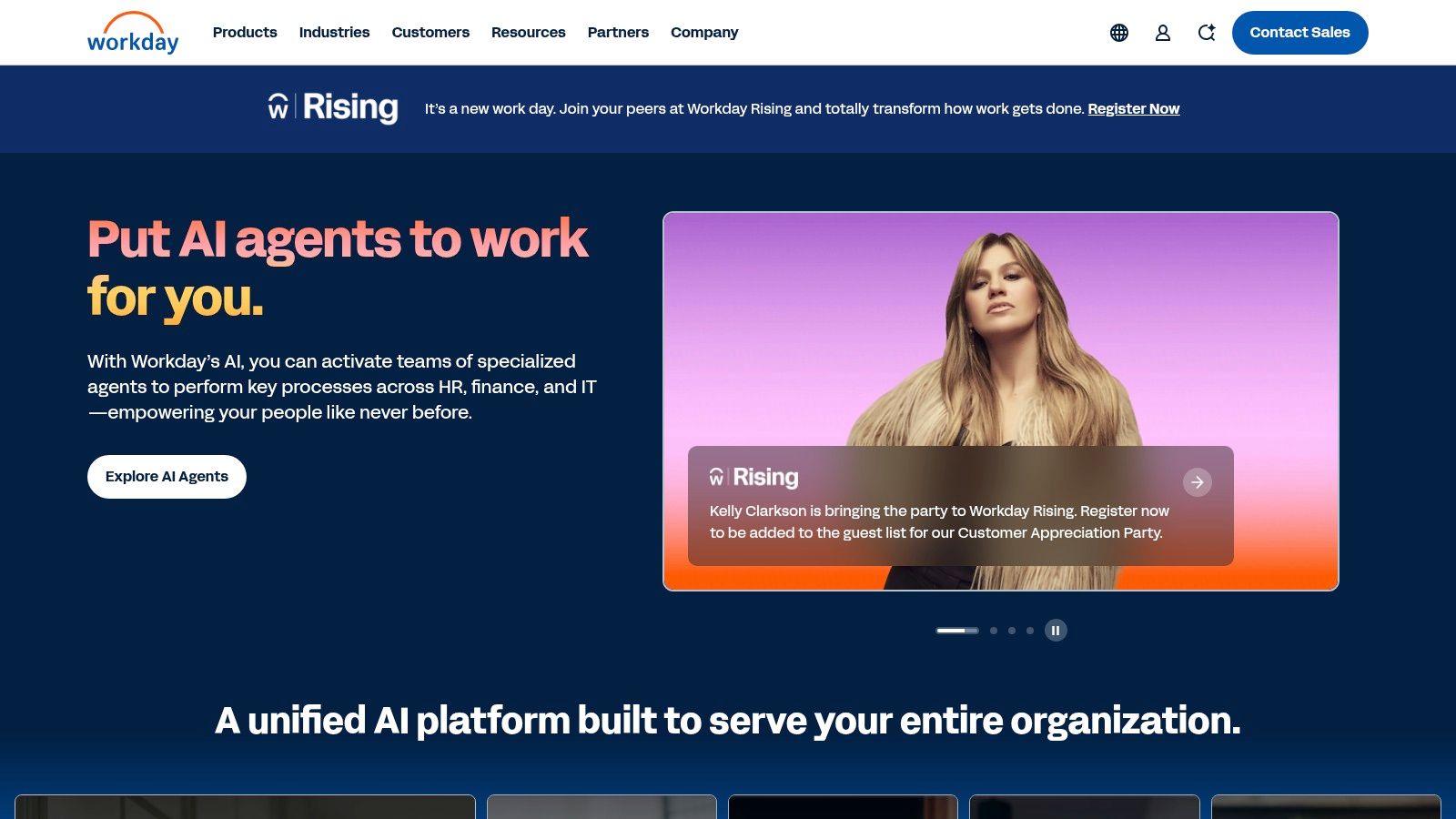
Workday Adaptive Planning fits finance teams that need governed, rolling FP&A and three-statement modeling across departments or entities. Its Predictive Forecast applies algorithmic time-series methods to selected drivers, which finance can use in cash-flow projections and scenario analysis.
The strongest fit is an organization already using Workday Financial Management or Workday HCM. Existing relationships between workforce, financial, and planning data can reduce integration work and make headcount-driven cash analysis easier to maintain.
For a professional services firm, the practical question is whether planning complexity or receivables timing creates the larger forecasting problem. Workday Adaptive Planning handles planning governance well. It does not replace collection operations, invoice follow-up, or payment execution.
Where the platform earns its place
Version control, permissions, reporting, and scenario management support a controlled forecast cycle. Department leaders can submit assumptions while the CFO retains visibility into the version used for a decision. Direct and indirect cash-flow models can incorporate headcount, revenue, expenses, and other operating drivers instead of treating cash as a separate worksheet.
The trade-off appears during implementation. Complex models may require services-led deployment and enablement before the finance team can manage them independently. Pricing is not publicly listed, so buyers should include configuration, training, integrations, and ongoing administration in the evaluation.
For $3M–$50M professional services firms, the platform is more suitable when a Controller can own model maintenance and the business has a mature Workday environment. It is less suitable when the primary uncertainty is invoice status or collection timing. AR connectivity generally depends on ERP and accounting integrations, and finance should confirm whether bank and payment data arrives at the detail and refresh frequency needed for short-term decisions.
Test the platform with a live receivables scenario through Workday Adaptive Planning, rather than reviewing only an annual budget demonstration. Resolut can complement the forecasting layer by improving the quality and timing of receivables data reaching finance.
7. Vena
Vena fits finance teams that need stronger control without abandoning Excel. Its Excel-centered design supports centralized data, workflows, approvals, and audit trails, which can help teams move three-statement models out of disconnected files while keeping a familiar working environment.
The main benefit is adoption. Finance professionals can continue using established spreadsheet skills, while the Controller can review submitted assumptions, approved versions, and model changes in one governed process.
Where Vena fits best
Vena works well when spreadsheet fragmentation is the primary cash-planning problem. It is less suited to firms that need a dedicated collections engine or highly detailed payment-data ingestion. Receivables data can feed the model through accounting and ERP connections, but buyers should verify the available detail, refresh timing, and ownership of data mappings.
Model design still determines the quality of the forecast. Complex dimensions, templates, and integrations may require consulting support. Without clear ownership of template changes and forecast-to-actual reviews, flexibility can recreate the control issues the platform was meant to address.
- Modeling: Governed Excel templates can support integrated income statement, balance sheet, and cash-flow planning.
- Workflow: Submissions, approvals, and audit trails provide control over forecast cycles.
- Integrations: ERP and GL connections can supply planning and reporting data.
- AR capability: Vena can use receivables data, but it does not replace collections or payment operations.
- Reporting: Centralized data supports detailed reporting across plans, submissions, and actuals.
- Pricing: Packaging is more visible than with many peers, though final pricing remains sales-led.
For $3M–$50M professional services firms, Vena is a practical choice when Excel adoption matters and a Controller can maintain the model. Confirm implementation effort, integration coverage, and ongoing administration before selecting it. Review the platform's Excel-centered approach through Vena Solutions, and consider whether Resolut can improve the quality and timing of receivables data reaching the forecast.

8. CashAnalytics
CashAnalytics fits finance teams that need to consolidate cash forecasts from several entities without managing separate workbooks. It supports web-based submissions, automated rollups, forecast-accuracy analysis, dashboards, bank and ERP integrations, multi-currency reporting, and liquidity visibility.
That workflow suits professional services groups with regional offices or operating entities. Finance can set one submission format, review assumptions centrally, and compare entity forecasts with actual cash instead of reconciling inconsistent files after submission.
CashAnalytics is most useful when the forecasting process already exists and the problem is execution. Variance reporting can show which entities regularly miss actual cash results, where assumptions need review, and which teams need better forecast discipline. The platform is narrower than an FP&A suite, so firms needing detailed headcount planning, revenue modeling, or annual budgeting may need another planning layer.
A 13-week cash process is a natural use case, particularly when forecast ownership is distributed. Bank and ERP connections should still be tested with the firm's systems, since payment-data coverage and data timing determine how current the forecast can be. Receivables data can support cash projections, while collections execution remains outside the platform's main scope. Resolut can complement it by improving the quality and timing of receivables data reaching the forecast.
Pricing is not published, so buyers should clarify licensing, implementation work, integration coverage, and ongoing administration early.
For $3M–$50M professional services firms, CashAnalytics becomes more relevant as entity count and forecast ownership grow. A firm with one Controller managing cash directly from its accounting system may find a lighter tool more efficient. Review the consolidation workflow at CashAnalytics using real entity submissions before selecting it.
9. Jirav
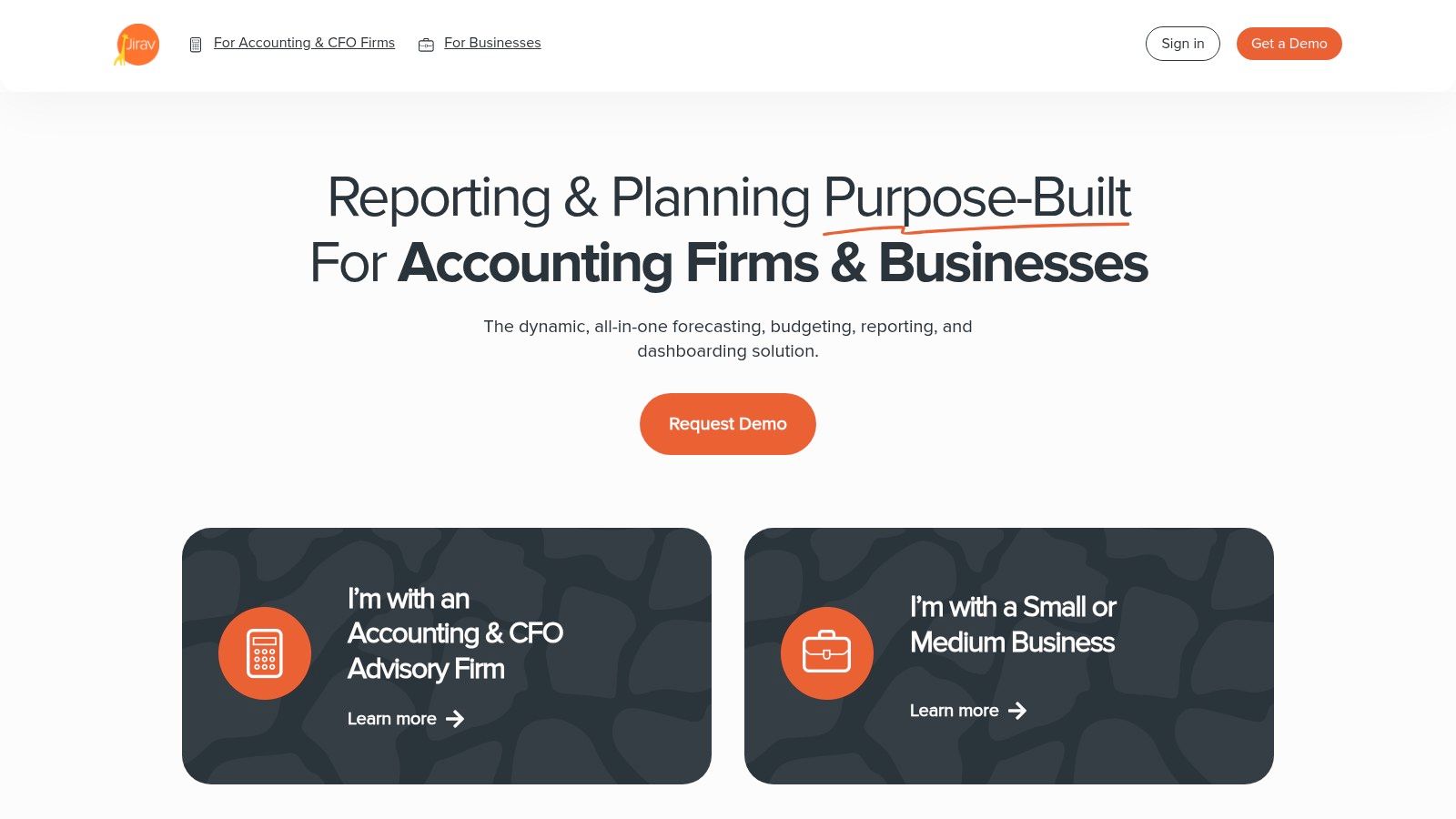
Jirav fits accounting-led finance teams that need connected P&L, balance-sheet, and cash-flow forecasting without adopting an enterprise EPM suite. Its driver-based models link accounting data with workforce planning, rolling forecasts, and financial reporting.
The strongest use case is a professional services firm or accounting practice managing several client environments. Connections to QuickBooks, Xero, NetSuite, and other systems let teams build forecasts from the GL instead of importing balances manually. That reduces spreadsheet work, although buyers should verify connector coverage, refresh timing, and the effort required to map their chart of accounts.
Jirav's value is planning consistency. Finance can connect revenue, expense, staffing, and cash assumptions, then see how a change affects the statements. This depth suits firms whose cash problem starts with weak forecasting discipline or disconnected operational assumptions.
The trade-off is treasury coverage. Dedicated bank connectivity, liquidity controls, payment workflows, and detailed cash positioning are less central than in Kyriba or GTreasury. Bespoke models may also require compromises, particularly if the firm needs customer-level payment predictions or detailed collections workflows.
For a $3M–$50M professional services firm, assess the problem before choosing the platform:
- Forecasting: Integrated, driver-based three-statement forecasting.
- Accounting connectivity: Relevant for QuickBooks, Xero, NetSuite, and similar systems.
- AR connectivity: Accounting data can feed projections, but Jirav does not replace collections outreach or automated cash application.
- Implementation and pricing: More approachable than enterprise EPM, while complex designs still require clear ownership. Buyers should confirm pricing and setup effort directly.
- Best fit: Firms and advisors forecasting from GL data and operational assumptions.
If late client payments drive the cash gap, improving receivables data may matter as much as refining the model. Review what is cash flow forecasting, then test Jirav using the firm's actual accounting structure and receivables workflow. Resolut can complement Jirav by improving the quality and timing of receivables data reaching the forecast.
10. Float
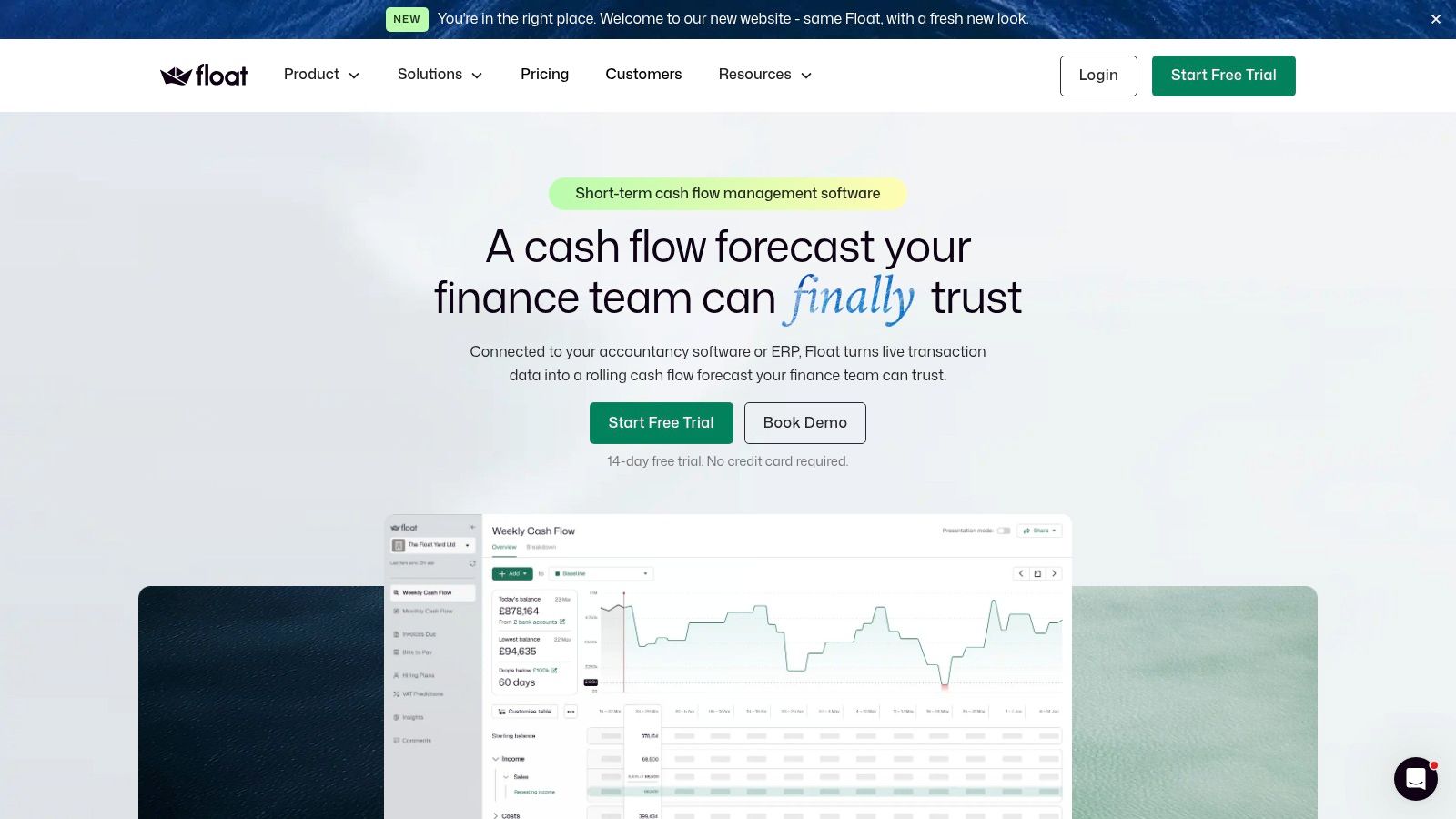
Float suits teams that need a clear rolling cash view from their accounting system, without adopting a full FP&A or treasury suite. It connects with QuickBooks Online and Xero, supports what-if scenarios, and presents inflows and outflows in a format that non-specialist users can review quickly.
For agencies and professional services firms, that simplicity can be valuable. A Controller or firm owner can update the forecast without turning each review into a modeling project. To understand the fundamentals behind the process, see our guide to what is cash forecasting.
A practical cash view, with defined limits
Float supports short rolling forecasts and longer planning periods, plus multi-company consolidation and currency conversion. Its design favors weekly cash management over complex enterprise governance, so implementation effort is generally easier to control for smaller finance teams.
The trade-off is narrower connectivity and forecasting depth. Float is not a full FP&A suite, and its integrations center on QuickBooks Online and Xero. A firm running NetSuite, or one that needs customer-level payment predictions and detailed collections workflows, should validate the integration layer before committing.
QuickBooks also offers an AI-assisted cash flow forecasting workflow in its Financial planning area. An independent implementation guide describes a process that uses live AR, AP, payroll, and GL data through the QuickBooks Online API to produce rolling 13-week cash projections without manual data pulls. The QuickBooks forecasting implementation guide provides context for that workflow.
For a $3M–$50M professional services firm, the buying decision comes down to operating scope:
- Time to value: Strong when the priority is a usable cash view quickly.
- Connectivity: Direct QuickBooks Online and Xero integrations are central to the product.
- AR depth: Accounting data can inform the forecast, but Float does not replace dedicated AR automation or collections execution.
- Governance: Lighter than enterprise FP&A tools, with fewer requirements for complex model administration.
- Best fit: Smaller and mid-market professional services teams that value cash clarity over extensive planning complexity.
Float works when the accounting system remains the operational center of forecasting. Review Float against the firm's weekly refresh process, scenario needs, and permission model. Its dashboard can support forecast review, while Resolut can complement it by improving the quality and timing of receivables data entering the forecast.
Top 10 Cash Flow Forecasting Tools Comparison
Product | Core features | Unique selling points | Target audience 👥 | UX ★ | Pricing / Value 💰 |
|---|---|---|---|---|---|
Kyriba | Cash positioning, forecasting, bank connectivity, payments, AI insights | 🏆 Global bank coverage; enterprise treasury breadth ✨ | Large & upper‑mid‑market, multi‑bank, SOX‑sensitive | ★★★★ | 💰 Enterprise / custom pricing |
GTreasury | Configurable forecasting, consolidation, bank connectivity, payments | ✨ Modern UI; strong enterprise challenger | US mid‑market & enterprise treasury teams | ★★★★ | 💰 Sales‑led / custom |
Trovata | Bank‑API cash visibility, ML forecasting, drill‑down analytics | ✨ Fast bank connectivity & quick time‑to‑value | Treasuries wanting rapid cash visibility (no full TMS) | ★★★★ | 💰 Mid‑tier / sales‑led |
Tesorio | AR forecasting, collections automation, cash application, ERP sync | 🏆 Purpose‑built AR → cash acceleration; collections workflows ✨ | B2B invoice‑driven companies; AR teams | ★★★★ | 💰 Sales‑led; ROI‑focused |
Planful | FP&A planning, scenario modeling, AI projections, reporting packs | ✨ Strong FP&A workflows; faster deployment vs legacy EPMs | Mid‑market → enterprise finance teams | ★★★★ | 💰 Sales‑led / custom |
Workday Adaptive Planning | Rolling forecasts, predictive ML, 3‑statement modeling, governance | 🏆 Enterprise governance & scale; Predictive Forecast ML ✨ | Large enterprises, Workday customers | ★★★★ | 💰 Enterprise pricing |
Vena | Excel‑native 3‑statement models, workflows, audit trails, integrations | ✨ Excel‑first experience with centralized control | Excel‑centric finance teams & controllers | ★★★★ | 💰 Tiered / consult‑assisted |
CashAnalytics | Entity submissions, consolidation, forecast accuracy analytics, integrations | 🏆 Specialized cash‑forecasting & accuracy tracking ✨ | Corporate treasury & multi‑entity organizations | ★★★★ | 💰 Sales‑led / custom |
Jirav | Driver‑based 3‑statement forecasting, workforce planning, GL integrations | ✨ Fast setup for SMBs; accountant/multi‑client use | SMBs, accounting firms, mid‑market finance | ★★★ | 💰 Transparent tiers for SMBs |
Float | Rolling cash forecasts, QBO/Xero integrations, scenario planning, consolidation | 🏆 Very approachable UI; public tiered pricing ✨ | Startups, SMBs, advisory firms | ★★★★★ | 💰 Public, affordable tiers |
Choose the Forecasting Layer That Matches the Cash Problem
The right choice depends less on the longest feature list and more on where cash uncertainty begins.
Choose treasury software when the priority is bank connectivity, cash positioning, liquidity control, payments, and multi-entity visibility. Kyriba and GTreasury are designed for organizations that need a treasury operating system. Trovata is a better fit when the immediate gap is fragmented bank data and the team wants faster visibility without adopting a full TMS.
Choose FP&A software when the finance team needs governed driver-based planning, three-statement models, workforce assumptions, budgeting, reporting packs, and controlled scenarios. Planful, Workday Adaptive Planning, Vena, and Jirav serve that planning layer in different ways. The practical distinction is ownership. A good FP&A platform should let the finance team explain the assumptions behind the forecast, not just display a number generated elsewhere.
Choose a focused forecasting tool when the immediate requirement is a rolling short-term cash view. CashAnalytics is suited to distributed forecast submissions and accuracy tracking. Float is more approachable for accounting-led firms using QuickBooks Online or Xero.
Choose an AR-led platform when payment timing is the main uncertainty. Professional services firms often invoice monthly on net-30 terms, and one industry benchmark places DSO for consulting, accounting, legal, and marketing agencies in the 35–55 day range because work is frequently invoiced in arrears. That collection-cycle context is documented in professional services DSO benchmarks.
Evaluate the operating connection, not just the model
A forecast should be tested across its horizon and method. Independent benchmark reporting places average 13-week forecasts at 87% accuracy, annual forecasts at 72%, and AI-assisted forecasts at 94%. The same reporting says weekly updates improve accuracy by 25% versus monthly updates. Those figures come from independent cash-flow forecasting accuracy benchmarks, and they support a practical evaluation method: test a 13-week rolling forecast, compare weekly recalibration with monthly refreshes, and inspect both directional and magnitude error.
AI adoption is also becoming a baseline consideration. A treasury benchmark reports that 64% of finance teams use AI or machine learning for at least one component of cash flow forecasting, up from 38% in 2023 and 51% in 2024. The survey covered 520 treasury and finance professionals and found adoption concentrated in companies above $500 million in revenue, as described in this 2026 AI cash-flow forecasting adoption report. For a $3M–$50M firm, the lesson isn't to buy the most advanced model. It's to ensure the chosen tool can connect clean, current data and support sensible automation.
Use this evaluation checklist:
- Invoice status: Confirm whether the tool receives invoice status, expected payment dates, approval information, and dispute details.
- Payment behavior: Test how partial payments, disputed invoices, credit notes, and unapplied cash change the forecast.
- Weekly control: Compare forecast with actual cash every week and document the cause of material variance.
- Collection action: Confirm whether the platform can trigger, coordinate, or inform collections activity.
- Data freshness: Ask when ERP, bank, AR, AP, payroll, and payment data refresh, and whether the process is automatic.
- Implementation ownership: Identify who maintains mappings, scenarios, permissions, integrations, and model changes after go-live.
- Pricing transparency: Separate subscription cost from implementation, bank connectivity, integrations, services, and support.
- Auditability: Review permissions, version history, approvals, and the evidence available for management review.
For professional services AR, the DSO formula is commonly expressed as Accounts Receivable ÷ Total Credit Sales × Number of Days, as explained in this guide to managing DSO. Track that metric alongside overdue balances, forecast variance, collection effectiveness, and manual reconciliation time.
Total lockup matters too. Independent professional services AR guidance defines it as the sum of WIP days and AR days, meaning cash can remain trapped before invoicing and after invoicing. The same guidance recommends billing on milestone acceptance, using a real due date rather than relying only on “Net 30,” and adding a direct payment link. Those controls are covered in this professional services accounts receivable guide.
Where AR automation complements forecasting
An FP&A or treasury platform can show the financial consequence of delayed collections. It won't necessarily send the right message, identify an at-risk invoice, offer a convenient payment method, or apply the incoming cash automatically. That gap is where AR-led automation complements the forecasting layer.
Resolut is designed around credit risk assessment, collections, omnichannel outreach, dynamic billing, payment options, and cash application. Its workflows can help identify receivables that threaten the forecast, coordinate personalized follow-up across email, SMS, phone, and other channels, and provide payment options such as cards, bank transfers, and digital wallets. Automated cash application then helps reconcile payments to invoices, improving the quality and timing of the AR data that feeds the forecast.
The operating model can be configured for autopilot or co-pilot use. That gives finance teams a choice between broader automation and human-in-the-loop control, which matters when client relationships and sensitive disputes require judgment.
A historical perspective helps explain why the category has changed. Cash-flow forecasts first appeared in the I/B/E/S Detail History US Edition database in 1993. By 1999, cash-flow forecasts appeared in 15% of earnings forecasts, compared with 1% in 1993. Across 1993–1999, 12% of 8,886 firms with earnings forecasts and 7% of 34,787 total earnings forecasts also included cash-flow forecasts, according to the historical account at Dynamic Business. The practice became formal before modern software became widespread. Today's tools automate it, but the quality of the result still depends on the quality of the operating data.
The software category is also expanding. One industry summary reported a global cash flow forecasting software market of $726 million in 2025, with a projected 7.4% compound annual growth rate through 2033. It also reported that cash flow and liquidity risk entered the top ten global business risks in Aon's 2025 Global Risk Management Survey for the first time and is expected to remain there through 2028. Those projections and risk references are detailed in this cash flow forecasting software market summary.
Select the forecast layer that matches the actual problem, then connect it to the AR process that produces the cash. A polished forecast without disciplined billing, collections, payment capture, and cash application is still a plan built on delayed information.
Forecast visibility becomes valuable when finance can act on the next receivable, not just explain the last variance.
Resolut automates AR for professional services, consistent, accurate, and human.
Resolut connects AR automation to the forecasting process with risk identification, personalized omnichannel outreach, payment options, and automated cash application. Visit Resolut to see how your firm can improve receivables data, reduce DSO, and turn forecast visibility into controlled cash execution.