
Collection Efficiency Ratio: Formula, Benchmarks, and Fixes
Learn the collection efficiency ratio formula, benchmark CEI in professional services, and practical steps to improve cash flow with AR automation.
A professional-services firm can have a full pipeline, strong billings, and a team that sends invoices on schedule, yet still feel short of cash. The problem often appears when payroll is due before a major client pays, or when a profitable month produces little movement in the bank account. Revenue tells you what you earned. It doesn't always tell you how effectively the firm converted receivables into cash.
That's why the collection efficiency ratio, commonly discussed as the Collection Effectiveness Index, or CEI, deserves a regular place in the CFO's operating review. It isolates collection execution from sales growth and gives finance leaders a clearer way to diagnose friction alongside DSO, aging, payment terms, and invoice mix.
The Quiet Cash-Flow Leak Most Firms Miss
The invoices went out. The consultants are busy. The revenue report looks healthy. Yet the cash forecast keeps sliding because several large clients haven't paid, a project invoice is being disputed, and nobody can say with confidence which follow-ups happened or who owns the next conversation.
That pattern is common in professional services because billing rarely moves evenly. A retainer may arrive on one schedule, a milestone invoice on another, and time-based work may accumulate until a partner approves it. A firm can grow while its collections process becomes less reliable. More billings can hide the fact that the team is collecting a smaller share of what was available to collect.
DSO can help describe the broad working-capital position, but it can blur the operational question: did the team collect the receivables that were due during the period? The collection efficiency ratio answers that question more directly by focusing on collection performance rather than billing volume alone.
Growth can disguise execution problems
Suppose a firm lands several large engagements and invoices aggressively. Accounts receivable rises, sales look excellent, and turnover may appear acceptable because the denominator has changed with growth. Meanwhile, a few dominant clients are paying later than agreed. The average conceals the concentration risk, and leadership reacts only when the cash forecast becomes uncomfortable.
A disciplined collections review separates three issues:
- Billing quality: Were invoices accurate, timely, and easy to approve?
- Client payment behavior: Are customers paying according to their agreed terms?
- Collection execution: Did the AR team follow up consistently and escalate appropriately?
These questions often require different fixes. An invoice dispute needs operational attention. A slow-paying strategic account may need an executive conversation. A missed reminder points to a process gap.
Practical rule: Don't treat a healthy revenue report as evidence of healthy collections.
A thoughtful commercial debt collection strategy can help firms define escalation paths without turning every late invoice into a relationship problem. The objective isn't aggressive contact. It's consistent ownership, clear documentation, and a proportionate response before overdue balances become normalized.
What the Collection Efficiency Ratio Actually Measures
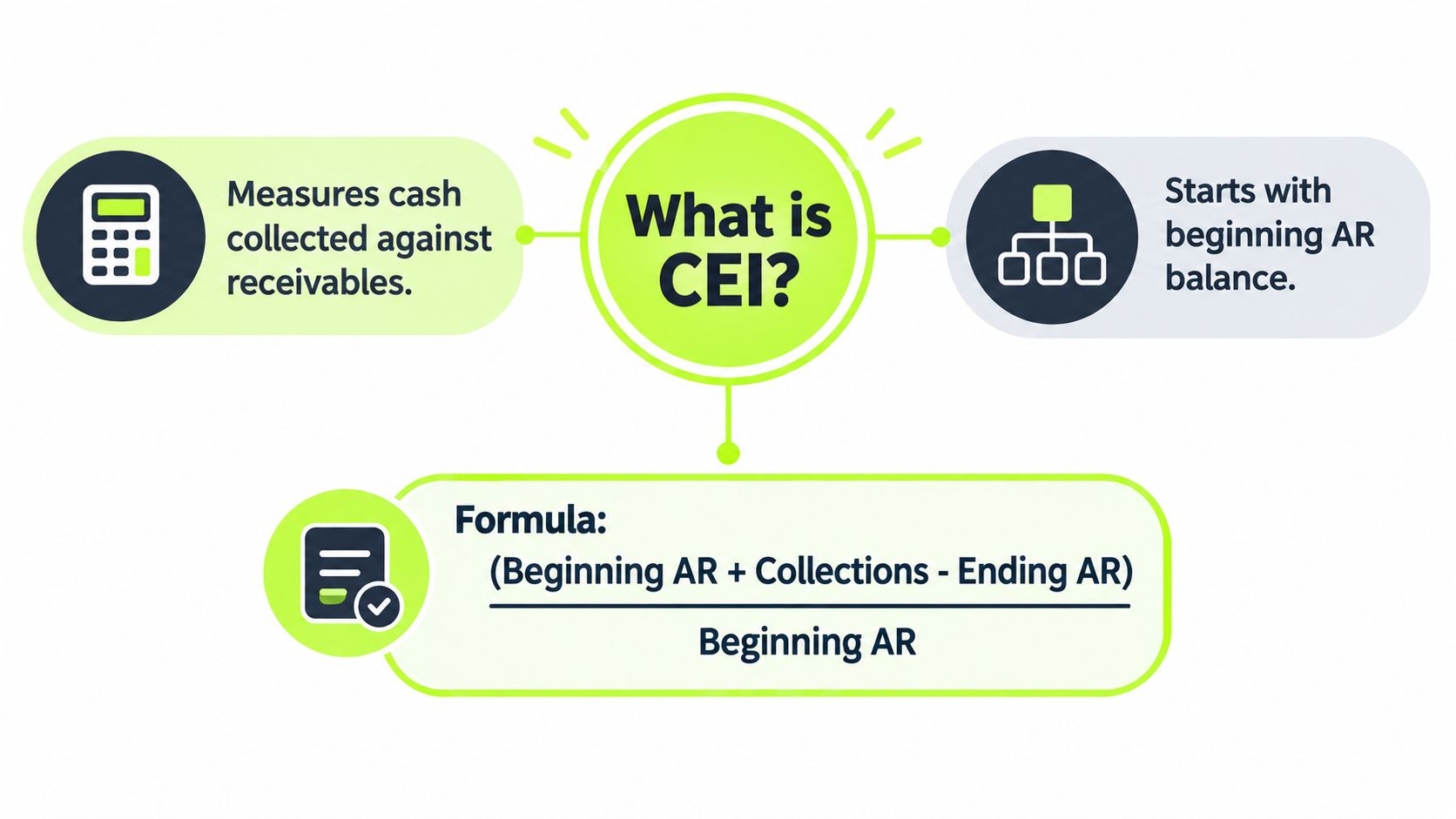
The collection efficiency ratio is often used interchangeably in practice with Collection Effectiveness Index, or CEI. It measures the share of receivables a company collected during a defined period. Unlike a revenue measure, it asks how much of the collectible balance moved into cash.
A commonly used formal presentation compares beginning receivables and credit sales with ending receivables. In simplified operational form, the calculation can be expressed as:
CEI = (Beginning AR + Collections − Ending AR) / Beginning AR
Some AR guides present a fuller version that adjusts the collectible base for payment terms. The accounting system and reporting policy should define the version used, then apply it consistently so month-to-month comparisons remain meaningful.
What the percentage tells you
The theoretical maximum is 100%, because the metric is framed as the share of invoices paid in the period. A neutral AR metrics guide describes 80% to 90% as strong performance and 95% or higher as excellent, while another industry source treats 85% or higher as generally good. Those ranges give finance leaders a useful operating frame, not a universal promise.
A CEI below 80% on a sustained basis suggests material collection leakage, but the cause still needs investigation. It might be delayed invoicing, unclear approval requirements, weak follow-up, payment disputes, or an invoice mix dominated by accounts that aren't yet due.
Consider a simple example. If the firm begins with receivables, collects cash during the month, and ends with a smaller balance, the formula captures the reduction attributable to collection. If credit sales surge but the team doesn't collect the new balances, the ratio can expose that gap more clearly than a turnover figure viewed in isolation.
Why the period matters
CEI is especially useful when revenue is seasonal or cyclical. It focuses on invoices presently due rather than treating every outstanding receivable as equally collectible. That distinction matters for firms with project billing, uneven client approvals, or a large mix of retainers and milestone invoices.
The metric only works when the finance team defines its population carefully. Exclude balances that aren't due from a collection-execution diagnosis, separate disputed invoices from ordinary delinquency, and document whether credits, write-offs, and unapplied cash are included.
Why CEI Beats DSO and Turnover for Collections Decisions
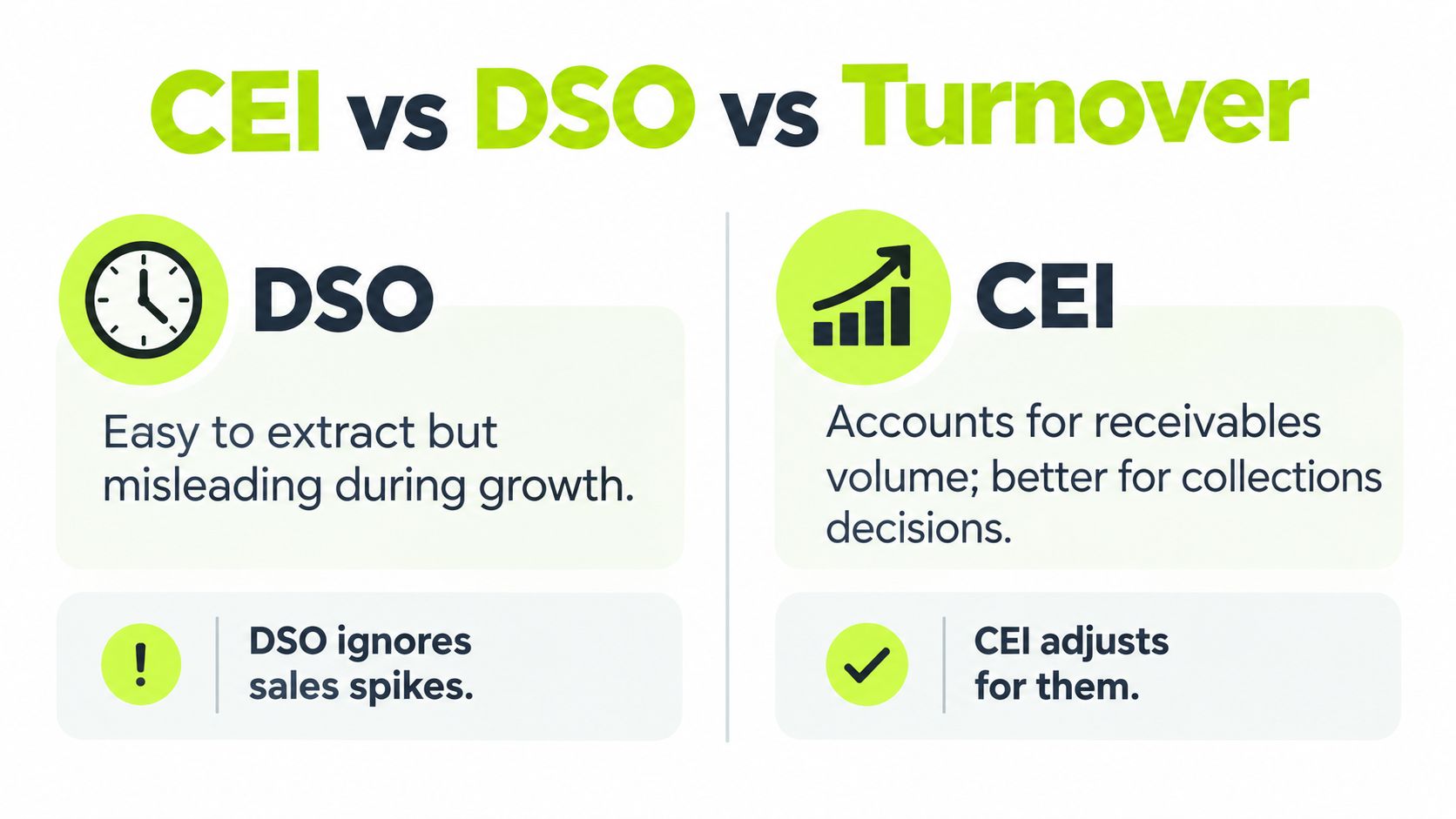
DSO measures time. CEI measures execution. Accounts receivable turnover measures velocity. Each has a legitimate use, but they answer different management questions.
DSO is useful for a high-level view of how long cash remains tied up after credit sales. It becomes less reliable as a standalone collections KPI when revenue changes sharply, payment terms lengthen, or a few large accounts dominate the balance. A growing professional-services firm may show a reasonable DSO even while newly billed work is aging because the sales denominator has expanded.
Turnover is calculated as net credit sales divided by average accounts receivable. The inverse maps to collection speed. A turnover of 12 implies receivables are collected about every 30 days, while a turnover of 8 implies roughly 45 days, as explained in this accounts receivable turnover ratio guide. Higher turnover usually supports faster cash conversion, but it may also result from tighter credit terms rather than better follow-up.
Use each metric for the question it can answer
Metric | Best management question | Main limitation |
|---|---|---|
CEI | Did we collect what was available to collect? | Needs a consistent collectible base |
DSO | How long is cash tied up in receivables? | Can be distorted by sales changes and concentration |
Turnover | How quickly does average AR convert relative to credit sales? | Can reflect terms, mix, or credit policy |
For a practical explanation of the time-based measure, see what DSO means for finance teams. The important point isn't to replace DSO. It's to stop asking one metric to explain every AR problem.
Decision rule: Use DSO for working-capital visibility, turnover for credit-policy sanity checks, and CEI when you need to evaluate collections execution.
A firm with uneven retainers and project milestones should also inspect aging by client, service line, invoice type, and responsible partner. If CEI falls while DSO stays stable, follow-up or invoice quality may be deteriorating. If both worsen, the firm may have a broader terms, concentration, or client-risk issue.
The embedded video below can provide another visual way to compare the metrics.
Benchmarks, Sector Gaps, and What a Strong CEI Looks Like
A benchmark is useful only when finance leaders understand what drives it. CEI varies by industry, payment structure, customer concentration, and invoice timing. Comparing a professional-services firm with a business that collects at the point of sale can create false confidence or unnecessary concern.
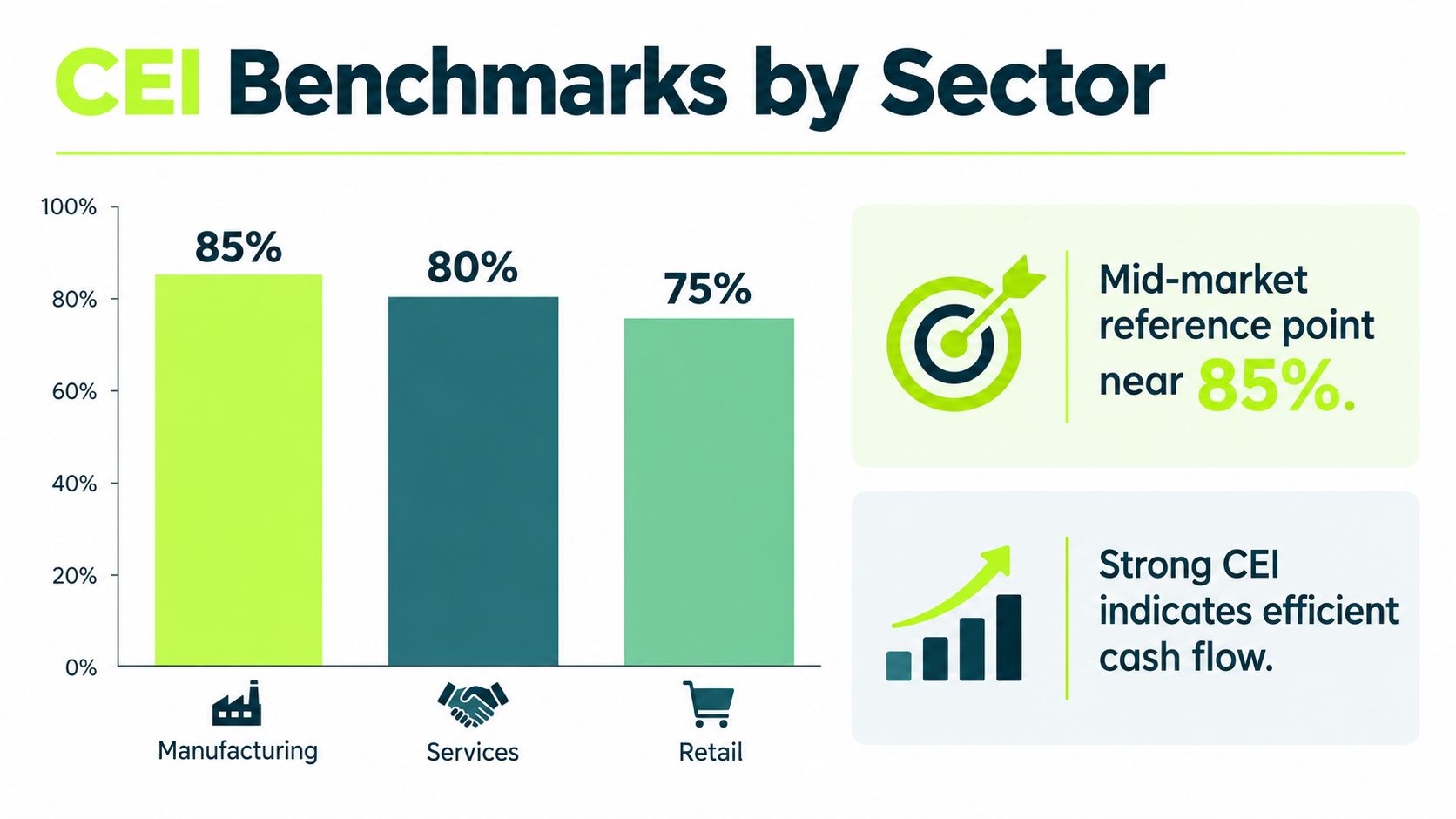
Credit Research Foundation data summarized in an AR benchmarks report places the cross-industry median near 85%. Transportation and fabricated metal were much lower, at roughly 55% to 65%, while food products, petroleum, coal, chemicals, and electrical products could reach 97% or more. The spread shows why a single target can't serve every business.
A practical interpretation for services firms
For a professional-services CFO, the cross-industry median near 85% is a useful mid-market reference point, not a contractual standard. Sustained performance above 90% can indicate competitive execution, while results consistently below 80% deserve a structured diagnostic.
The interpretation should account for the firm's invoice mix:
- Retainers: Regular billing can make due dates predictable, but approval failures still delay payment.
- Milestones: Project acceptance and sign-off may create legitimate timing differences.
- Hourly work: Late time approval or incomplete matter descriptions can hold up invoices.
- Large accounts: One client can move the monthly result enough to conceal portfolio-wide performance.
The benchmark report's sector differences make one point clear. A low CEI isn't automatically a weak collections team, and a high CEI isn't automatically proof of strong follow-up. The operating context determines what the number means.
Don't manage the average alone
A quarterly result can be distorted by macro stress, changes in payment terms, channel shifts, or an unusual invoice mix. Review the age of the balance, the stated terms, disputed amounts, and customer concentration before changing policy.
A CEI of 100% is theoretically perfect, but it's rare in normal operations. The right objective is a stable, explainable result that reflects the firm's commercial model and improves when teams remove avoidable friction.
Proven Tactics to Raise CEI Without Losing Clients
Higher CEI rarely comes from sending more forceful reminders. It comes from removing the reasons clients delay payment and making ownership visible from invoice creation through cash application.
Start before the invoice becomes overdue
Send a correct invoice promptly after the billable event, then confirm that it reached the right contact and approval queue. A reminder before the due date is a service touchpoint, not a demand for payment. It gives the client time to resolve a missing purchase order, incorrect matter code, or approval question.
Payment terms should be visible in the engagement letter, invoice, portal, and account-management process. If a client consistently pays late, decide whether the firm should change terms, require a deposit, introduce milestone billing, or accept the working-capital cost deliberately.
Remove payment friction
A payment portal should make the next action obvious. Offer the methods that fit the firm's client base, provide a direct payment path from the reminder, and show invoice details without forcing the client to search through email.
Cash application matters just as much. Unapplied receipts make the ledger look less settled than it is and can trigger unnecessary collection messages. Automating the match between payment, client, invoice, and remittance detail lets the AR team focus on exceptions.
Prioritize conversations intelligently
Not every late invoice deserves the same script. Segment accounts by balance, age, payment history, strategic importance, dispute status, and relationship owner. Then give the account manager enough context to have a useful conversation rather than asking the client to repeat information already held by finance.
Practical B2B collections best practices include documenting contact outcomes, assigning a next action, and escalating based on agreed thresholds. Personalization protects relationships because the firm can address the actual obstacle instead of issuing generic reminders.
- For clean overdue invoices: Make the payment request direct and easy to complete.
- For disputed invoices: Separate the disputed line from undisputed amounts and assign an owner.
- For recurring late payers: Review terms and commercial exposure with the account leader.
- For high-risk accounts: Escalate early, while the relationship still has room for a constructive solution.
The numerator improves when more collectible invoices are paid in the period. The denominator becomes more useful when the firm excludes balances that weren't genuinely available for collection or labels them clearly for review.
How Automation and Orchestration Lift CEI Consistently
Manual AR breaks down when follow-up depends on memory, workload, or the individual collector's judgment. A busy controller may handle a sensitive client carefully one week, then miss the next scheduled touch because a close deadline or partner request takes priority.
AR automation is valuable when it orchestrates the whole sequence, not when it merely sends reminders. Credit-risk screening can identify exposure before onboarding. Dynamic billing can adapt invoices to engagement structure. A payment portal can reduce the steps between approval and settlement. Automated cash application can reconcile receipts without forcing staff to match every payment by hand.
The operating benefit is consistency. A workflow can assign the right contact, select a suitable message, record the response, and create the next action across email, SMS, phone, and portal payments. Human judgment remains important for disputes, strategic accounts, and legal decisions, but the team doesn't have to remember every routine event.
Tools should reinforce the control system
A standalone reminder tool won't fix inaccurate invoices. A payment portal won't solve unclear ownership. An analytics dashboard won't improve CEI if nobody acts on its alerts.
The strongest design connects risk assessment, billing, outreach, payment, reconciliation, and escalation. For firms evaluating what AR automation includes, the key question is whether the system creates a controlled operating rhythm or only adds another screen.
Resolut is one example of an AR automation and orchestration platform. It combines credit-risk assessment, collections outreach, dynamic billing, payment options, cash application, and human-in-the-loop workflows in one operating environment. The appropriate setup depends on the firm's systems, client mix, privacy requirements, and tolerance for automation.
Measuring CEI Monthly and Reporting It with Confidence
CEI becomes useful when the controller can reproduce it, explain its movement, and connect it to an action. A number that appears once a year in a board pack won't change collections behavior.
Start with a written definition. State the period, opening receivables, eligible credit sales, collections, ending receivables, credits, write-offs, disputed balances, and treatment of unapplied cash. Use the same accounting cut-off each month, then record any policy change beside the result.
Build a compact operating view
A monthly dashboard doesn't need dozens of measures. It needs enough context to distinguish execution problems from portfolio changes.
View | What it reveals |
|---|---|
CEI trend | Whether collection execution is improving or weakening |
Aging by client and owner | Where overdue exposure is concentrated |
Terms versus payment behavior | Whether clients pay within agreed conditions |
Invoice mix | Whether retainers, milestones, or time billing are driving movement |
Customer concentration | Whether one account is distorting the average |
Dispute and unapplied cash status | Whether accounting friction is blocking settlement |
Review the result with the accounts receivable team, service-line leaders, and account owners. A falling CEI should produce a question such as, “Which invoices were collectible, and what prevented payment?” It shouldn't produce a general instruction to “collect harder.”
Set thresholds that lead to decisions
The benchmark guidance places 80% to 90% in the strong range and 95% or higher in the excellent range, while the wider industry reference point sits near 85%. Use those figures as context, then set internal thresholds around the firm's own history, terms, and invoice composition.
A practical policy might flag a sustained result below 80% for root-cause review, while a result above 95% receives confirmation that the collectible population hasn't been defined too narrowly. The threshold should trigger investigation, not automatic pressure on clients.
Independent guidance notes that CEI above about 80% is often considered strong, but a perfect 100% is rare, which reinforces the need for context. The same AR performance metrics guidance emphasizes reading CEI alongside aging, payment terms, and customer concentration, especially when terms lengthen or a few large accounts dominate receivables.
Report three things to owners or the board: the result, the reason for the change, and the action assigned. If the firm is implementing accounts receivable automation, connect the operating review to workflow coverage, invoice accuracy, follow-up completion, disputes, and cash application. That creates a management system designed to reduce DSO and improve cash flow without sacrificing client judgment.
Resolut automates AR for professional services with coordinated credit assessment, billing, collections outreach, payment options, and cash application. If you want a more consistent way to measure collection efficiency and act on overdue work, visit Resolut to review the platform.