8 Collection Process Steps for Better Cash Flow
Master 8 collection process steps to reduce DSO, improve cash flow, and build a consistent AR workflow for professional services firms.
Effective collections begin before an invoice is due and continue through measurement after payment is received. The core workflow has eight connected stages, from accurate billing and terms decisions to follow-up, dispute resolution, risk monitoring, escalation, cash application, and performance review.
Slow cash rarely comes from one cause. A client may be willing to pay, yet the invoice went to the wrong contact, the scope changed without a billing update, a project manager hasn't approved the work, or the payment arrived without a usable reference. Each gap creates delay between delivery, billing, communication, and reconciliation.
For a professional services firm, collections should operate as a controlled system rather than a series of overdue-invoice reminders. A monthly accounting invoice should move from approved time and expenses to the correct client contact, through pre-due communication and structured follow-up, then into dispute handling, payment application, and reporting.
Accounts receivable automation, AI AR automation, and AR software for professional services can create consistency across that workflow. They shouldn't remove judgment. They should make sure the right person sees the right information at the right time, while finance leaders retain control over exceptions, relationships, and enforcement.
The best collections process prevents avoidable friction before it becomes delinquency.
1. Invoice Generation and Delivery
An invoice can't be collected if it isn't accurate, complete, and visible to the person who controls payment. That sounds basic, but professional services billing often depends on handoffs between partners, project managers, timekeepers, finance staff, and a client's accounts payable team.
The invoice should reflect the signed agreement, approved scope, billable time, expenses, milestones, taxes, purchase order requirements, and supporting documentation. A missing PO or an unfamiliar billing contact can delay payment even when the client agrees with the amount.
Make the payment clock unambiguous
Send the invoice as soon as the contractual billing trigger occurs. For a recurring accounting engagement, that may be a scheduled monthly date. For consulting work, it may be a milestone approval. For legal services, it may follow a reviewed time report and expense summary.
Every invoice should make four details easy to find:
- Invoice identity: Show the invoice number and client account clearly.
- Payment deadline: State the due date, not only general terms such as Net 30.
- Amount due: Distinguish the current balance from prior balances or credits.
- Payment path: Include the preferred payment method and a direct payment option.
The automated invoice template should support consistent presentation without preventing a finance reviewer from checking unusual charges. Test delivery to client portals and email addresses, and confirm that messages aren't being filtered as spam.
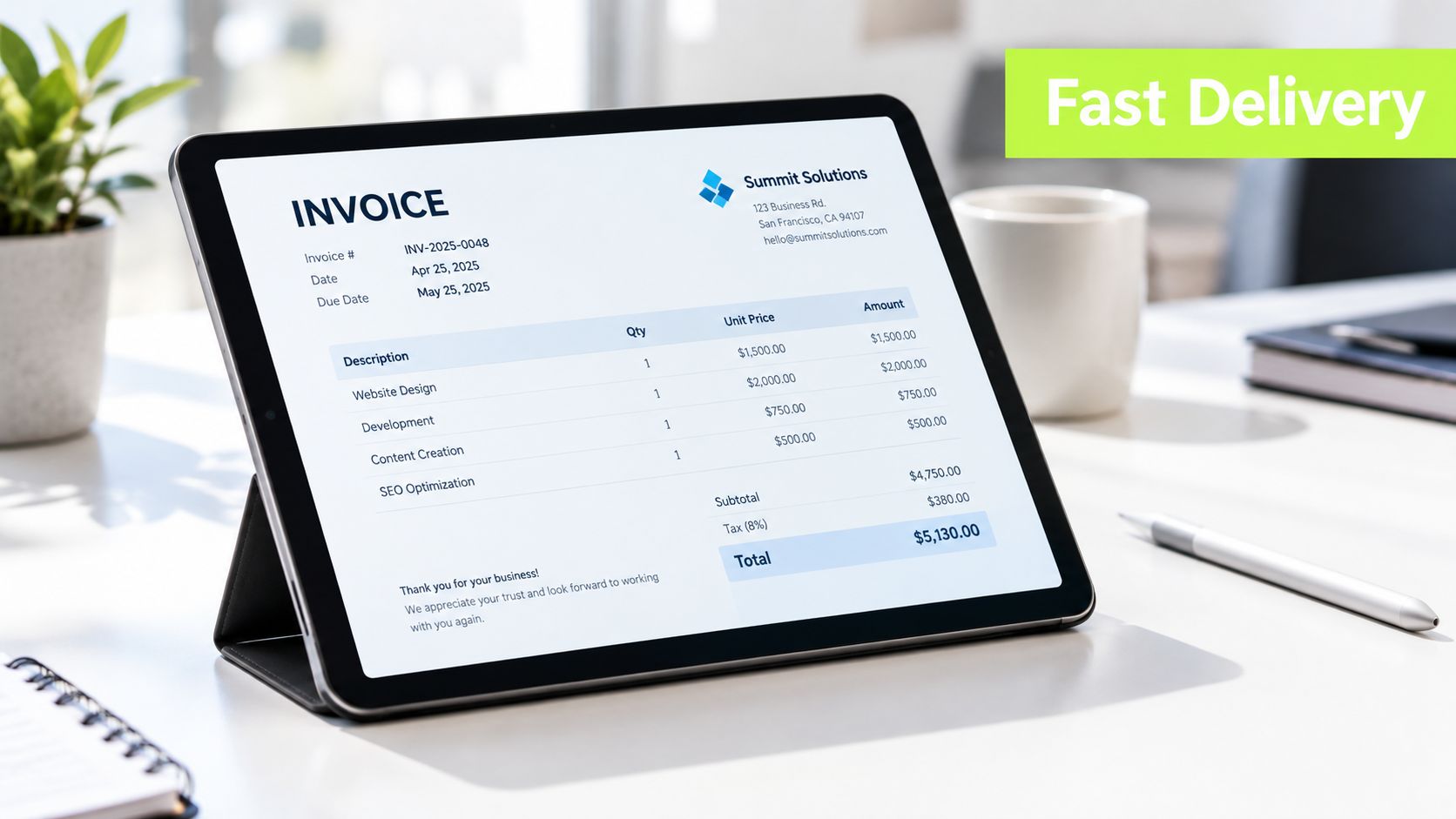
A practical example is a consulting invoice that includes the approved milestone, the relevant statement of work, the project lead's name, the PO reference, and a payment link. That package answers the client's likely questions before the invoice reaches an AP queue.
2. Early Payment Incentives and Terms Optimization
Payment terms are a commercial decision, not a default field in accounting software. A professional services firm that grants identical terms to every client may be giving unnecessary credit to some accounts while limiting flexibility for reliable strategic clients.
Start with the economics. A discount reduces revenue, so compare its cost with the value of receiving cash earlier and reducing collection effort. The right offer may be a modest early-payment discount, a deposit, milestone billing, a card option, or a shorter term for a client with a weak payment history.
Match terms to risk and delivery
Terms should reflect client risk, project structure, and negotiating position. A new client with limited payment history may require an upfront deposit or a first milestone payment before additional work begins. A long-standing client with predictable payment behavior may justify a different arrangement, provided the terms remain commercially sound.
Communicate the terms in three places:
- The contract: Define the due date, billing triggers, approval process, and consequences of late payment.
- The invoice: Display the due date and any early-payment option prominently.
- The client conversation: Explain who approves invoices and what documentation the client needs.
Don't offer a discount that the client can't calculate. State the qualifying date, eligible balance, and payment method. Otherwise, finance teams spend time disputing deductions instead of collecting cash.

A useful operating test is to pilot a term change with a defined customer segment and review adoption, margin impact, and payment timing. If clients ignore the incentive, the issue may be poor visibility or an unattractive offer. If clients consistently take it without paying materially earlier, the firm may be discounting payments it would have received anyway.
Terms optimization also means controlling exceptions. Sales shouldn't promise extended terms without finance approval, and project teams shouldn't allow work to continue indefinitely against an unpaid balance. Clear authority prevents one negotiated exception from becoming the firm's unofficial policy.
3. Automated Reminders and Follow-Up Workflows
A reminder workflow should feel predictable to the finance team and reasonable to the client. The accounts receivable collection process commonly uses six core stages, including invoice generation, pre-due reminders, due-date follow-up, post-due escalation, payment application, and aged-debt management, as described in this accounts receivable collection process guide.
Many teams begin proactive outreach 7 days before the due date, then escalate at 7, 14, and 21 days overdue, using progressively firmer channels such as email, SMS, and phone. Those timings aren't a script for every client. They're a useful operating framework that gives staff a consistent starting point.
Use automation for consistency, not pressure
The first message should be helpful. It can confirm that the invoice was received, provide a copy, restate the due date, and include a direct payment link. A simple message works well:
Subject: Invoice 12345 due on [date] Hi [name], I'm checking that invoice 12345 reached you and that you have everything needed for approval. The balance is [amount], due [date]. You can pay using this link: [link]. Please tell me if another contact handles approval.
After the due date, the message should become more direct without becoming hostile. Include the invoice number, balance, due date, supporting documents, and a named contact. Segment by relationship and risk. A strategic client may receive an earlier personal call, while a serial late payer may move into a tighter workflow.
The follow-up automation approach can schedule outreach across email, SMS, and assigned call tasks. That reduces the risk that an invoice disappears from a spreadsheet when the responsible employee is busy.
Measure responses, not just messages sent. Track whether the client opened the message, requested documentation, promised payment, raised a dispute, or gave no response. Automation should create a record that helps a Controller decide what happens next.
4. Payment Exception Handling and Dispute Resolution
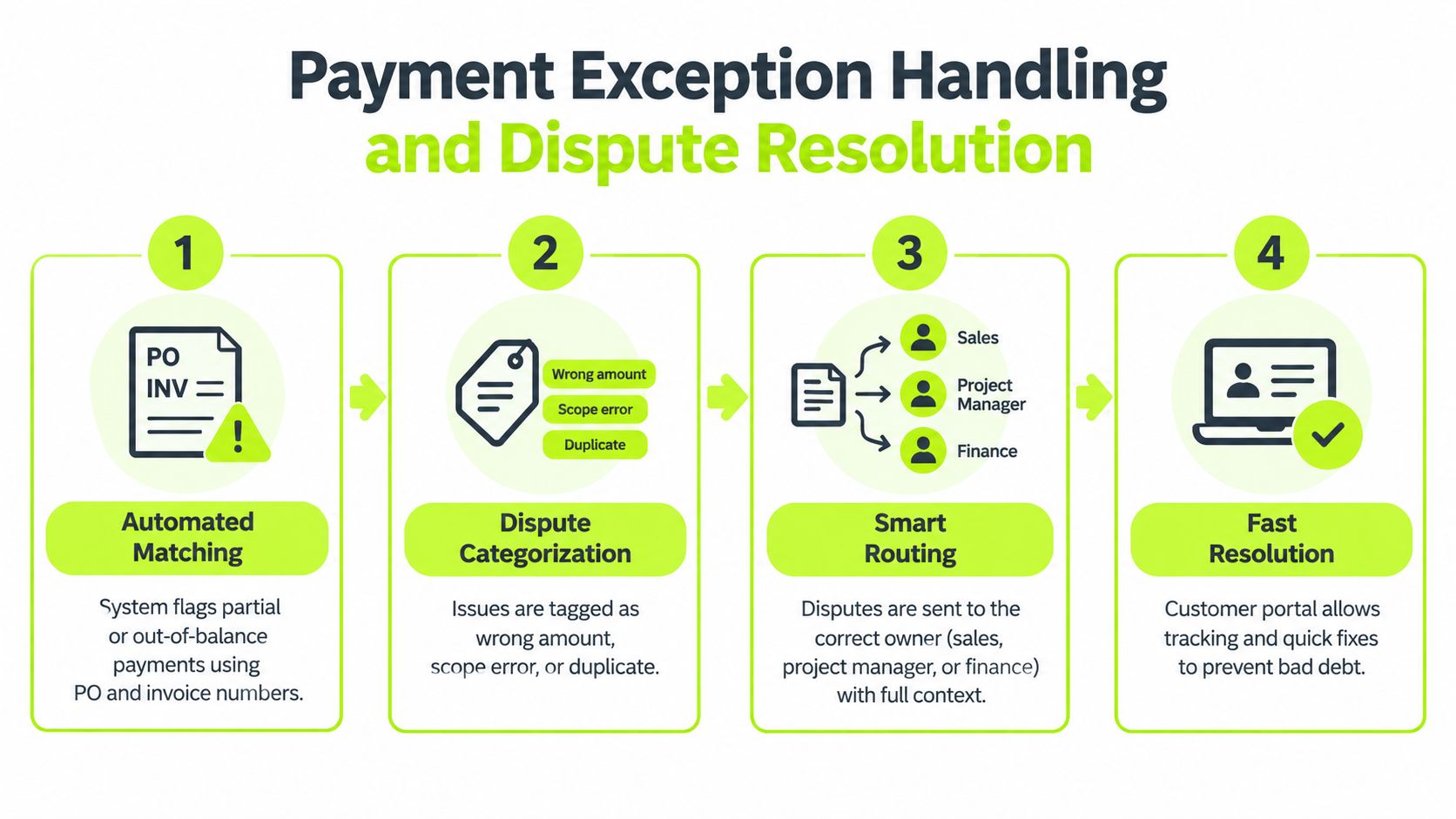
Disputes are not all the same. A client may challenge the scope, reject an expense, question a rate, report a duplicate invoice, make a partial payment, or send money without enough information to apply it. Treating every exception as a generic overdue balance slows resolution and frustrates both finance and the client.
The first control is classification. Use categories that sales, delivery, and finance understand in the same way. “Scope,” “rate,” “approval,” “tax,” “duplicate,” “missing PO,” and “payment allocation” are more actionable than a note saying “client issue.”
Route the exception to the person who can fix it
Finance should own the workflow, but it shouldn't own every answer. A project manager may need to confirm whether a milestone was accepted. A partner may need to approve a credit. Sales may need to clarify a commercial promise. The AR owner should set the deadline, preserve the evidence, and keep the client informed.
Set service levels that distinguish acknowledgement from resolution:
- Acknowledge quickly: Confirm receipt and identify the owner.
- Gather evidence: Attach the contract, approval, time record, or expense detail.
- Resolve or escalate: Agree on a credit, correct the invoice, or explain why the balance remains due.
- Close the record: Apply the adjustment and document the decision.
A useful client response is: “We've logged your question about the travel charge on invoice 12345. [Project manager] is reviewing the supporting detail, and I'll return with an answer by [date]. The undisputed balance remains payable under the agreed terms.”
Keep disputed and undisputed amounts separate. A client shouldn't be allowed to withhold an entire invoice because one line is under review, unless the contract or facts require that treatment. For additional perspective on how to collect on late payments, focus on preserving a documented trail rather than relying on informal messages.
Dispute data should change upstream behavior. Repeated missing POs point to a sales or onboarding failure. Recurring scope disputes point to weak change-order control. A collection process that only closes disputes without fixing their causes will keep producing the same delays.
5. Risk Identification and Credit Monitoring
Collections become expensive when the team learns about risk only after an invoice is seriously overdue. Credit approval and ongoing monitoring move the decision earlier, when the firm still has options.
Start with internal behavior. Payment history, broken promises, changes in remittance patterns, requests for unusual extensions, and growing unapplied cash may tell you more about a client relationship than a static external score. Combine those signals with appropriate external information and account context.
Connect each signal to an action
A risk flag has no value if nobody knows what to do with it. Define responses before the situation becomes urgent:
- Early concern: Contact the client to confirm the billing status and ask whether approval requirements have changed.
- Rising exposure: Require a deposit, shorten terms, or change the next billing milestone.
- Material risk: Limit additional work, obtain management approval, or agree on a documented payment plan.
- Severe risk: Escalate to senior leadership and legal counsel where appropriate.
For a firm providing ongoing advisory work, the decision may be whether to continue service while a prior balance remains unpaid. That shouldn't be an emotional debate between a partner and the Controller. Set a threshold, identify who can approve an exception, and document the commercial reason.
Review risk signals on a regular cadence. A client that has always paid consistently but suddenly changes its payment pattern deserves attention before the account reaches the oldest aging bucket. The conversation can be direct and respectful: “We've noticed the last payment followed a different timing pattern. Is there a change in your approval process or cash planning that we should account for?”
AI AR automation can help rank accounts and surface unusual behavior, but it shouldn't make a service-pause decision without human review. The system can identify the pattern. Finance leadership still weighs contract obligations, client importance, delivery commitments, and recovery options.
Risk monitoring also belongs in new-business decisions. If a proposed engagement requires substantial delivery before billing, the firm should price and structure that exposure deliberately. A deposit or milestone invoice may protect cash flow more effectively than a stronger reminder after the work is complete.
6. Legal Escalation and Enforcement
Legal escalation is a controlled change in posture. It should not be the first response to a normal approval delay, but it shouldn't remain an empty threat when a client repeatedly ignores documented requests and the balance is material.
Before escalation, confirm the record. Finance should have the signed agreement, invoice history, proof of delivery, approval evidence, communication log, credits, payments, and dispute status. A weak file makes a formal demand less effective and can undermine the firm's position if the client raises a legitimate contractual issue.
Define the decision before the emotion arrives
A written policy should state who approves escalation, which accounts qualify, and what happens at each stage. The policy may distinguish between:
- Commercial follow-up: A senior relationship owner contacts the client and confirms the payment plan.
- Formal notice: The firm sends a compliant demand that identifies the balance, basis, deadline, and consequences.
- External counsel: A lawyer reviews the file and advises on recovery options.
- Service controls: The firm pauses new work where the contract and relationship strategy permit.
The exact wording matters. Don't imply that litigation has begun if it hasn't. Don't make threats that the firm won't carry out. And don't use a legal template without checking the applicable contract, jurisdiction, and regulatory requirements.
A final notice should remain factual: “The balance on invoice 12345 remains unpaid despite prior follow-up. Please remit the outstanding amount or contact us by [date] to document a specific resolution. If we don't receive payment or a satisfactory response, we may refer the account for further review under the agreement.”
Use enforcement selectively. Over-escalation can damage a valuable relationship, while under-escalation teaches persistent non-payers that reminders have no consequence. The right approach depends on amount, age, evidence, client value, contractual rights, and the likelihood of recovery.
Track outcomes by escalation type. If formal notices generate no meaningful response, examine the threshold, documentation quality, and timing. If clients pay after senior intervention, make that intervention part of the documented workflow rather than an improvised rescue.
7. Cash Application and Reconciliation
Collections remain incomplete until every payment is correctly applied. An unmatched receipt can leave an invoice appearing overdue, trigger an unnecessary client reminder, and distort receivables reporting. Cash application therefore belongs inside the collection operating system, alongside billing, outreach, exception handling, and measurement.
Payment files rarely arrive in a perfect format. A professional services client may pay several invoices together, deduct a disputed amount, remit through a parent company, or provide a bank reference that differs from the invoice number. Set matching rules for these cases before they reach the ledger:
- Multiple invoices: Use remittance advice to allocate the payment across open invoices.
- Partial payment: Apply the received amount and keep the remaining balance visible.
- Overpayment: Record the credit, then determine whether a refund or future application fits the agreement.
- Short payment: Send the deduction for review instead of closing the invoice automatically.
- Unidentified payment: Assign an owner and an ageing deadline for investigation.
Require a unique invoice number or PO reference whenever the client's payment process allows it. The cash application process should connect bank activity, remittance details, invoice records, and the general ledger. Automated matching can handle routine payments, while exceptions remain with a finance reviewer who can assess the context and help teams automate revenue operations more reliably.
Review unmatched cash frequently enough to protect reporting. Daily visibility gives staff time to request missing remittance details or correct posting errors before the next reminder cycle. A weekly exception review can expose recurring causes, such as one client paying several projects without allocation detail.
A received payment that has not been applied is operationally incomplete.
For firms using QuickBooks, QuickBooks AR automation should keep the accounting system as the source of record while reducing duplicate entry in matching, reminders, and exception queues. Each automated match should show the basis for the match and identify items awaiting approval.
The outcome is control over collection data. Accurate application keeps ageing reports focused on genuine risk, makes client statements credible, and gives Controllers dependable information for forecasting and month-end close.
8. Performance Analytics and Process Optimization
A collections process needs a measurement loop. Without it, teams may send more reminders while the core constraint remains slow invoice approval, recurring scope disputes, weak terms, or unapplied cash.
Start with Days Sales Outstanding, or DSO. A standard formula is Accounts Receivable divided by Revenue, multiplied by the days in the period, while another common formulation uses Accounts Receivable divided by Total Credit Sales, multiplied by the number of days. These formulations and the value of using a rolling average are explained in this DSO benchmark guide.
Pair lagging results with leading signals
DSO tells you what happened. It doesn't tell you which handoff caused the delay. Review it alongside aging, overdue balance, dispute volume, unapplied cash, promise-to-pay performance, invoice delivery success, reminder activity, and response time.
For professional services, benchmark context matters. Sources place normal DSO roughly in the 30 to 60 day range, with one benchmark describing 35 to 45 days as a healthy target for consulting and professional services and another listing 43 days as a 2026 industry average with a 30 to 58 day range. See the professional services DSO benchmarks for the cited comparison.
Don't use one company-wide average to manage every segment. Break results down by client, partner, service line, payment terms, invoice size, dispute category, and billing contact. A firm may have acceptable overall DSO while one large account, one project type, or one client segment is consuming disproportionate working capital.
APQC's benchmarking framework tracks the cycle time for processing AR and managing collections, along with staffing intensity for AR activities. Its process grouping includes customer credit, invoicing, collections, and deductions or adjustments, which supports a broader view of capacity and automation opportunities. The APQC AR benchmarking resource is useful when comparing internal workload with organizations that have a similar operating model.
Review metrics weekly with clear owners. If DSO rises, ask whether invoices were sent late, approval contacts changed, disputes aged, terms expanded, or payments remained unapplied. The objective isn't to punish an employee. It's to change the process that produced the result.
Collection Process Steps Comparison Matrix
Collection Process | Implementation Complexity 🔄 | Resource Requirements | Expected Outcomes 📊 | Ideal Use Cases 💡 | Key Advantages ⭐ |
|---|---|---|---|---|---|
Invoice Generation and Delivery | Low–Medium 🔄<br>Requires billing-system integration, templates, delivery channels, and clean customer data. | Billing platform, customer records, delivery monitoring, payment integrations. | Faster invoice delivery; payment cycles may shorten by 5–10 days; improved auditability. | Recurring, milestone-based, or high-volume professional-services billing. | Reduces preparation errors, improves delivery speed ⚡, lowers paper costs, and provides delivery tracking. |
Early Payment Incentives and Terms Optimization | Medium–High 🔄<br>Needs pricing logic, customer segmentation, discount controls, and performance testing. | Credit data, financial modeling, discount governance, cash-flow analytics. | Potential DSO reduction of 5–15 days and improved working-capital efficiency. | Firms seeking faster cash while controlling discount costs and customer-specific terms. | Enables flexible terms, measurable ROI, and targeted cash acceleration ⭐. |
Automated Reminders and Follow-Up Workflows | Medium 🔄<br>Requires scheduling rules, message personalization, channel orchestration, and escalation logic. | Contact data, email/SMS/phone tools, workflow management, engagement analytics. | Potential DSO reduction of 7–12 days and earlier identification of payment issues. | Organizations with recurring overdue invoices or limited accounts-receivable capacity. | Delivers consistent outreach ⚡, reduces manual work, and supports relationship-sensitive communication. |
Payment Exception Handling and Dispute Resolution | High 🔄<br>Involves payment matching, categorization, cross-functional routing, and customer portals. | Finance, sales, project, and customer-support teams; accounting integration; dispute SLAs. | Faster dispute resolution, fewer payment delays, improved cash application, and lower bad debt risk. | Businesses with frequent partial payments, mismatches, scope disputes, or complex billing. | Resolves payment blockers quickly ⚡, improves accountability, and reveals recurring process defects. |
Risk Identification and Credit Monitoring | High 🔄<br>Requires external data integrations, predictive models, risk thresholds, and ongoing review. | Credit-bureau data, behavioral analytics, risk analysts, intervention workflows. | Potential bad-debt reduction of 15–30% through earlier intervention and prioritization. | Firms serving customers with variable credit quality or large contract values. | Enables proactive decisions, targeted collection effort, and improved credit-term management ⭐. |
Legal Escalation and Enforcement | Medium–High 🔄<br>Needs approval rules, compliant notices, attorney coordination, and case tracking. | Legal counsel, compliance expertise, escalation policies, documentation systems. | May recover 20–30% of accounts stalled beyond 60 days, depending on case quality. | High-value, serially delinquent, or long-overdue accounts where soft collections fail. | Adds formal pressure, strengthens documentation, and supports final-stage recovery. |
Cash Application and Reconciliation | Medium–High 🔄<br>Requires matching rules, accounting integration, exception handling, and reconciliation controls. | Bank and payment data, accounting systems, finance staff, audit controls. | Faster reconciliation, more accurate DSO, improved cash visibility, and quicker month-end close. | Organizations processing high payment volumes or managing multiple payment methods. | Reduces posting errors, exposes unapplied cash, and creates a reliable payment-to-revenue trail 📊. |
Performance Analytics and Process Optimization | Medium 🔄<br>Depends on consistent data, metric definitions, dashboards, and regular review routines. | Reporting infrastructure, clean operational data, analytics skills, leadership engagement. | Better forecasting, measurable process improvements, and earlier detection of collection deterioration. | Teams seeking continuous improvement across DSO, aging, recovery, and bad-debt performance. | Replaces intuition with evidence 📊, supports accountability, and identifies high-impact interventions 💡. |
Turn Eight Steps Into One Controlled AR Workflow
The eight collection process steps reinforce one another. Accurate billing reduces preventable disputes. Clear terms make payment expectations visible. Early risk signals help the team prioritize attention. Coordinated outreach creates consistency without forcing every client into the same tone. Fast exception handling protects relationships while separating valid issues from avoidance.
Escalation maintains authority when softer approaches fail. Cash application keeps the ledger honest. Performance analytics shows where the workflow is breaking, whether the problem sits in billing, delivery approval, client communication, dispute ownership, or reconciliation.
A professional services firm doesn't need to automate everything at once. Start with the handoffs that create the most delay and the most manual rework.
A practical implementation sequence
First, document the current workflow from engagement approval through payment application. Name the owner at each handoff, including who approves time, who validates expenses, who sends invoices, who handles disputes, and who posts cash. If ownership is unclear, software will only make an unclear process move faster.
Second, define service levels. Decide when invoices must be issued after the billing trigger, when pre-due reminders begin, how quickly disputes are acknowledged, how long exceptions can remain unresolved, and when a senior owner or legal adviser becomes involved.
Third, standardize the messages and evidence. Create templates for invoice delivery, pre-due confirmation, first overdue contact, payment-plan discussions, dispute acknowledgement, and formal escalation. Keep the language direct and respectful, and give finance staff room to adapt it when the relationship requires judgment.
Fourth, choose leading and lagging measures. Track DSO, aging, collection effectiveness, dispute ageing, unapplied cash, and write-offs alongside delivery success, contact response, promise-to-pay completion, and exception volume. Use segments that reflect how your firm sells and delivers work.
Finally, automate the highest-friction steps. Accounts receivable automation can handle invoice delivery, reminders, payment links, workflow assignments, and routine matching. AI AR automation can help identify unusual risk or recommend prioritization. Human approval should remain in place for credits, service pauses, sensitive client messages, disputed scope, and legal escalation.
The same principle applies to AR software for professional services and QuickBooks AR automation. The technology should improve control, create an audit trail, and reduce repetitive administration. It shouldn't hide decisions inside an opaque workflow or make accountability harder to find.
A disciplined process also supports different client environments. Teams working across regions should confirm invoice requirements, payment channels, approval contacts, and escalation practices before delivery begins. Guidance on UAE B2B payment best practices illustrates why local payment expectations and documentation can matter to collection outcomes.
For CFOs, Controllers, and firm owners, the desired result is straightforward: fewer avoidable delays, clearer ownership, more reliable cash forecasting, and a client experience that remains professional even when payment is late. The collection process becomes a managed operating system, not a month-end scramble.
Resolut automates AR for professional services, consistent, accurate, and human.
Resolut brings together invoice follow-up, risk signals, omnichannel outreach, dispute workflows, and cash application so your team can manage collections as one connected process. Visit Resolut to see how it can help your firm reduce DSO, improve cash flow, and keep human judgment in the decisions that matter.