8 Collections Letters Templates: Tone, Timing, and Risk
Eight collections letters templates for professional services firms, from friendly reminders to pre-legal notices, with usage notes and personalization tips.
It's day 45 on a $48,000 balance. The client hasn't replied to two reminders, the engagement partner expects the relationship to continue, and the controller needs to know whether the delay is administrative or a sign of financial strain. Another polite email won't answer that question unless it asks for something specific.
Eight letters, one escalation path gives finance a better operating model. Each message should confirm the balance, request a measurable action, and support a decision: keep following up, fix the invoice, agree terms, or refer the account for review.
For professional services firms with $3M–$50M in revenue, the relationship risk matters alongside the receivable. A billing problem shouldn't become a confrontation, but a valuable client shouldn't receive unlimited credit without approval.
- Routine delays: Ask who's approving payment and what's missing.
- Financial constraints: Request a credible payment schedule.
- Unresolved exposure: Assign an owner and approve the next step.
Use these collections letters templates as adaptable correspondence, not automatic legal notices. The timing below is a suggested internal policy, measured from the invoice due date, rather than a statutory schedule. Payment plans and dispute acknowledgments can interrupt the sequence whenever the facts warrant it.
A disciplined process to reduce bad debt from unpaid invoices starts with accurate invoices and clear ownership. Better wording helps, but it can't compensate for an incorrect balance or an escalation nobody has authorized.
1. Friendly Payment Reminder (Days 1 to 7 Past Due)
Start by assuming a processing issue, not unwillingness to pay. In the United States, payment-process delays were the leading cited cause of late payment at 45% in the Atradius 2025 Payment Practices Barometer.
Send the reminder from a named finance contact with a monitored inbox. Personalize the recipient, engagement name, invoice reference, and payment route rather than adding conversational filler.
Template
Subject: Invoice [number], due [date]
Hi [name],
Our records show an outstanding balance of [amount] on invoice [number] for [engagement], due [date]. I've attached the invoice, and you can arrange payment using [payment instructions or payment link].
If payment has already been sent, please reply with the remittance reference so we can match it. If approval or invoice information is missing, let me know what you need.
Thank you, [name and contact details]
Typical use: A consulting firm automates this reminder after the due date, but routes replies about purchase orders to its billing owner. Finance pauses further reminders while that owner corrects the missing information.
- Decision point: Has the client received a payable invoice, and is it in the approval queue?
- Legal and relationship risk: Low when accurate, but sending to the wrong recipient can disclose account information.
- DSO reporting effect: Track payment after the reminder and the amount recovered. Don't reclassify late payments as on-time or change the original due date.
The comparison below is useful when deciding which reminders can run automatically and which need review.
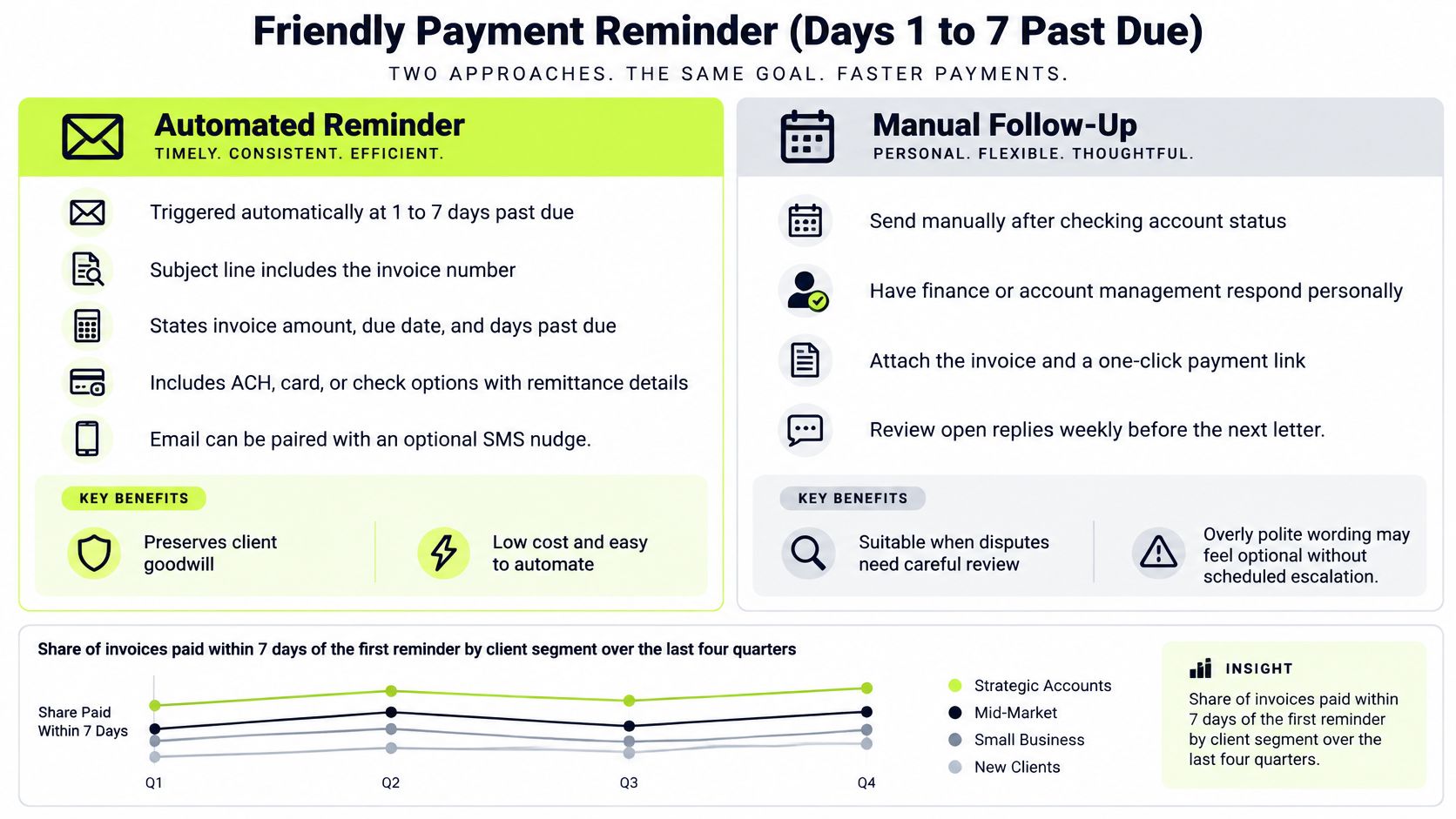
This letter stops being useful once the client identifies a specific obstacle. Resolve that obstacle instead of sending the same reminder again.
2. Past-Due Notice (Day 30)
A past-due notice replaces a general reminder with a request for a confirmed payment date. Before sending it, verify the purchase order, billing entity, approver, and remittance details.
Say a design firm is waiting on an engagement invoice. The project sponsor believes finance has approved it, while accounts payable is waiting for the sponsor's authorization. Addressing the notice to the correct AP contact, with the sponsor copied where appropriate, makes ownership explicit.
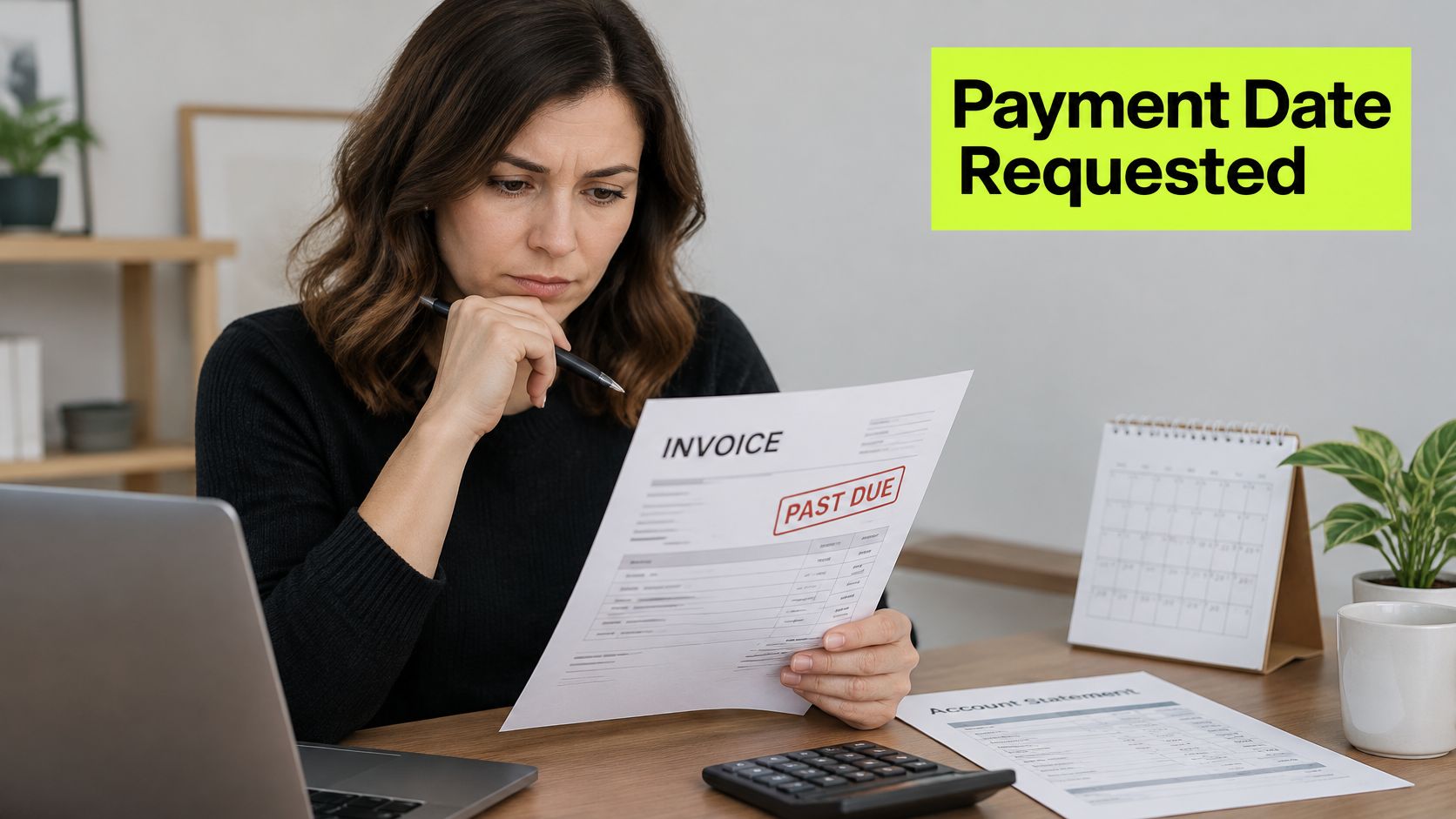
The image illustrates the practical task at this stage: review the invoice before asking the client to act.
Template
Subject: Payment date requested for invoice [number]
Hi [name],
Invoice [number] for [amount], due [date] under our agreed [payment terms], remains outstanding. Please arrange payment by [date], or confirm the scheduled payment date by [response date].
If a purchase order, approval, or invoice correction is preventing payment, please identify the requirement and its owner. Payment instructions and the invoice are attached.
Regards, [name and contact details]
Personalization should reflect the client's actual approval process. Don't copy a broad distribution list merely to increase pressure.
- Decision point: Is there a reliable payment commitment, an administrative blocker, or continued silence?
- Risk: Unsupported late fees create an avoidable argument. Include charges only after checking the engagement terms and applicable requirements.
- Reporting effect: Record the promised payment date and monitor movement into older aging buckets alongside DSO.
Practical rule: A promised payment date is useful forecast information, not collected cash.
If the commitment passes without payment, the next message should reference that commitment. Repeating a generic past-due notice loses the account history.
3. Second Notice with Account Statement (Day 45 to 60)
Reconcile before escalating. A statement with unapplied cash, duplicate invoices, or missing credits gives the client a valid reason to question the entire balance.
The need for a diagnostic approach isn't limited to one market. In Australia, temporary customer cash-flow issues accounted for 42% of cited reasons for late payment in the Atradius 2025 survey.
Template
Subject: Account statement and written payment confirmation requested
Hi [name],
Attached is your account statement as of [date], showing an outstanding balance of [amount]. It includes invoice references, due dates, credits, and payments applied.
Please confirm by [response date] which invoices are scheduled for payment and their payment dates. If any amount is disputed, identify the invoice, line item, and reason so we can review it separately.
If the balance is correct but payment timing is difficult, please contact [owner] to discuss a proposed schedule.
Regards, [name and contact details]
For a fractional CFO practice with several open engagement invoices, this letter gives the client a way to reconcile the account rather than respond to disconnected reminders. If the client identifies a duplicate entry, correct it and issue a revised statement before continuing.
Personalize the statement, not just the salutation. Include the relevant engagement references and prior payment commitments, and distinguish principal from any approved charges.
The decision point is whether to correct billing, arrange terms, or approve firmer action. Relationship risk increases if finance treats a reconciliation question as refusal to pay; legal exposure increases if it adds unsupported interest or fees.
For DSO reporting, retain the original aging and tag the blocker separately. Track reconciled balances, broken promises, and unresolved statement differences so a lower balance isn't mistaken for cash collection when it resulted from a credit.
4. Final Demand Letter (Day 60 to 90)
A final demand is an approved decision, not a stronger adjective. The controller or owner should know what happens after the deadline before the letter leaves the firm.
Review the balance, prior correspondence, contract, and dispute status with another person. If a service hold is contemplated, check contractual rights and professional obligations rather than assuming nonpayment permits an immediate suspension.
Template
Subject: Final demand for payment of [account reference]
Dear [name],
Our records show an outstanding balance of [amount] for the invoices listed in the attached statement. Previous payment requests were sent on [dates], and [accurate summary of any commitment].
Please arrange payment by [deadline], or contact [authorized owner] by that date to agree a documented resolution.
If we receive neither payment nor an agreed resolution, we will [specific approved next step]. If you believe the balance is incorrect, please identify the disputed amount and supporting reason.
Sincerely, [name, title, and contact details]
Typical use: A creative agency has completed its reconciliation and received no response. Its controller approves a final demand stating that new work will be reviewed for a hold under the engagement terms, rather than claiming legal action has already begun.
- Personalization: Reference actual contact dates and commitments.
- Risk: An inaccurate balance or unresolved dispute makes forceful language harder to defend.
- Reporting effect: Flag the balance as escalated and reassess expected receipt timing. Sending the letter doesn't itself reduce DSO.
If a UK debtor's location is uncertain, evaluate whether tracing agents UK services are appropriate before sending sensitive account information to an unverified address.
A deadline should correspond to an assigned review task.

5. Payment Plan Proposal Letter
A payment plan belongs wherever the client confirms that the balance is valid but immediate payment isn't feasible. It needn't wait until the end of the escalation sequence.
The trade-off is straightforward: the firm accepts slower recovery in exchange for a documented schedule. That agreement doesn't prove collectibility or eliminate the need to assess credit risk.
Template
Subject: Proposed payment schedule for [account reference]
Hi [name],
Following our discussion, we propose the attached schedule for the outstanding balance of [amount]. It lists each installment amount, due date, and payment method.
The arrangement takes effect after signed acceptance and receipt of the initial payment. Please return your acceptance by [date].
If an installment is missed, [agreed default process] will apply, subject to the agreement and applicable law. Future work will remain subject to [approved credit terms].
Regards, [name and contact details]
Use a payment plan agreement template to document the schedule, acceptance, default provisions, and treatment of ongoing services. Have counsel review acceleration language instead of inserting an automatic full-balance demand without considering enforceability.
A staffing consultancy could use this letter when a client has a temporary cash gap and can support a credible installment schedule. Finance should evaluate that schedule against expected cash availability, rather than accept a reassuring reply without review.
The conversation should end with documented terms.

Decision and risk: Approve terms only within delegated authority; avoid extending further unsecured exposure without review. Personalize the schedule to the client's proposed cash timing.
DSO reporting: Keep the original invoice aging visible, categorize payment-plan balances separately, and record installment performance. A rescheduled receivable isn't an on-time receipt.
6. Settlement Offer Letter
Settlement is a recovery decision, not a routine collections stage. Use it when the expected value of further collection, after cost and uncertainty, is less attractive than an authorized reduction.
An engineering practice with a genuine scope disagreement might exchange a concession for a signed resolution. That's different from discounting an undisputed invoice merely because the client ignored reminders.
Template
Subject: Proposed settlement of [account reference]
Dear [name],
Subject to the attached settlement terms, [firm] offers to accept [settlement amount] to resolve the outstanding balance of [original balance] relating to [specified invoices].
This offer expires on [date]. The agreed release will take effect only after acceptance in the required form and receipt of cleared funds.
Please contact [authorized owner] with questions or return the signed agreement using [instructions]. Until the settlement conditions are satisfied, the account will be treated as specified in the agreement.
Sincerely, [name and title]
Review letters for debt settlement when preparing the correspondence, but have the release and default terms checked for the specific matter. Don't assume a label on the letter creates legal protection.
- Personalization: Identify exactly which invoices and claims the settlement resolves.
- Decision point: Does the proposed net recovery justify the concession?
- Legal and relationship risk: An overly broad release can surrender unrelated rights, while inconsistent concessions can weaken future payment discipline.
- Reporting effect: Separate cash received from the amount forgiven and approve the accounting treatment.
A settlement can improve cash flow while reducing the receivable through a concession. Report both effects, not just the cleaner aging report.
CFO or controller approval should record the business rationale. Otherwise, the next collector may repeat the offer without understanding why it was exceptional.
7. Pre-Legal Notice of Intent to Refer to Counsel
Only send this notice when referral is authorized and credible. Counsel should review the contractual basis, evidence of performance, dispute history, recipient, and jurisdiction before finance communicates the next step.
Consumer debt collection and ordinary B2B invoice follow-up aren't interchangeable. For covered consumer collections, the Fair Debt Collection Practices Act establishes a 30-day dispute right and generally requires specified written information within five days of initial contact when it wasn't provided initially.
Template
Subject: Notice of intended referral regarding [account reference]
Dear [name],
The outstanding balance of [amount] relates to [specified invoices and contractual basis]. Our records show the payment requests and responses summarized in the attached account history.
Unless payment or an approved written resolution is received by [date], we intend to refer the matter to [counsel or authorized agency] for review and further action.
Please direct payment confirmation or supporting information about any disputed amount to [contact]. This notice describes the intended referral; it does not state that proceedings have been filed.
Sincerely, [authorized sender]
A consulting firm might use this notice after its final demand expires and counsel confirms the account is ready for referral. The decision is whether to transfer the file, not whether another forceful email might work.
Use the legal letter of demand for payment guidance to organize the file, and discuss collecting overdue invoices before time runs out with counsel where limitation periods may matter.
Risk is high if the notice misstates legal status, costs, or intended action. Personalize it from verified records, preserve delivery evidence, and report referred balances separately from ordinary collections forecasts while retaining their aging.
8. Invoice Dispute Acknowledgment and Verification Letter
A dispute acknowledgment interrupts escalation whenever the client raises a substantive billing issue. It doesn't erase the original due date or stop accounting aging.
In Asia, invoice disputes accounted for 27% of cited causes of delayed payment in the Atradius 2025 survey. For professional services, the practical response is to identify the disputed scope, rate, approval, or deliverable rather than debate the whole account.
Template
Subject: Dispute received for invoice [number]
Hi [name],
We've recorded your dispute concerning [specific amount or line item] on invoice [number]. [Review owner] will review the engagement terms, supporting records, and the issue you raised.
Please send [specific supporting information] by [date]. We'll provide an update by [date], even if the review is still underway.
The undisputed balance is [amount], with payment requested under the existing terms. We've paused routine escalation on the disputed portion while the review is active, subject to any applicable requirements.
Regards, [name and contact details]
Typical use: A marketing agency receives a challenge to a change-order charge. Finance assigns the account lead to locate approval evidence, separates the uncontested balance, and gives the client a review date.
- Personalization: Restate the actual disagreement without implying that either party has conceded.
- Decision point: Verify the charge, correct it, negotiate, or obtain legal review.
- Risk: Continuing generic demands can worsen a legitimate dispute; an acknowledgment shouldn't accidentally waive rights.
- Reporting effect: Track disputed value, reason codes, and resolution time alongside DSO. Preserve original aging.
Pause the inappropriate collection action, not the visibility of the receivable.
Use the video as an additional discussion resource when reviewing the correspondence process.
How each collections letter compares by timing, tone, sender, and purpose
Item | Typical Timing | Tone | Typical Sender | Best For |
|---|---|---|---|---|
Friendly Payment Reminder (Days 1 to 7 Past Due) | 1–7 days past due | Courteous and neutral | Finance or account management | Routine late payments and overlooked invoices |
Past-Due Notice (Day 30) | 30 days past due | Direct and professional | Accounts receivable or collections | Requesting a firm payment date and documenting follow-up |
Second Notice with Account Statement (Day 45 to 60) | 45–60 days past due | Firm and factual | Controller or account owner | Clarifying outstanding balances and surfacing disputes |
Final Demand Letter (Day 60 to 90) | 60–90 days past due | Formal and calm | Senior collector, controller, or owner | Setting a final payment deadline before further escalation |
Payment Plan Proposal Letter | When the client cannot pay the full balance at once | Cooperative and structured | Controller or finance team | Recovering a balance through scheduled installments |
Settlement Offer Letter | When full recovery is unlikely or uneconomical | Negotiated and conditional | CFO or controller | Resolving a balance for a reduced payment |
Pre-Legal Notice of Intent to Refer to Counsel | After a final demand goes unresolved | Formal and carefully factual | Firm, typically reviewed by counsel | Warning of referral to an attorney or collection agency |
Invoice Dispute Acknowledgment and Verification Letter | After the client disputes an invoice | Responsive and impartial | Accounts receivable or billing team | Acknowledging and investigating invoice disputes |
Consistency Is the Real Control
Most collections problems aren't caused by a lack of letters. They come from letters that arrive late, contradict each other, or escalate without a decision behind them.
Set the sequence, the owner for each stage, and the criteria for moving forward before an invoice becomes overdue. Keep exceptions explicit: an active dispute, a signed payment plan, or a pending legal review should change the workflow rather than disappear into someone's inbox.
Accounts receivable automation should enforce those controls, not merely increase message volume. In BillingPlatform's 2025 State of AR Automation Survey, 57% of finance organizations identified manual workflows as a major collections challenge, according to BillingPlatform.
Automate the record, retain the judgment
For AR software for professional services, prioritize accurate balances, engagement-level context, monitored replies, approval gates, and a complete correspondence history. When evaluating QuickBooks AR automation, test how payments, credits, disputes, and contact changes reach the collections workflow before enabling automatic sends.
AI AR automation should work within approved boundaries. Let it help select wording and surface exceptions, while authorized people approve concessions, service restrictions, settlements, and legal referrals.
- Before sending: Confirm the current balance, intended recipient, dispute state, and approved template.
- After a reply: Assign an owner, record the next action, and suppress contradictory messages.
- At escalation: Require approval and preserve the exact correspondence sent.
Channel controls matter too. The CFPB's Debt Collection Rule FAQs describe electronic opt-out and contact-channel requirements for covered consumer debt collection; don't assume the same permissions or disclosures apply to every B2B workflow.
Measure cash movement without hiding exceptions
Review DSO monthly alongside stage-level balances, payment commitments kept, dispute resolution time, settlements, and actual cash receipts. DSO is an overall measure, so use supporting metrics to understand which letters help and which merely generate activity.
Don't claim a workflow helped reduce DSO because finance reset due dates, issued credits, or wrote off balances. Explain those movements separately so management can distinguish collections performance from accounting adjustments.
The aim is to improve cash flow without making clients repeat information or receive contradictory demands. Consistent, accurate, and human communication gives finance control while preserving room for a commercial resolution.
Resolut automates AR for professional services, keeping collections consistent, accurate, and human. Visit Resolut to explore how coordinated outreach and approval-based workflows can support your firm's collections sequence.