Letters for Debt Settlement: Boost Cash Flow in 2026
CFO's guide to letters for debt settlement. Master B2B negotiation, use templates to improve cash flow & maintain client relationships in 2026.
A client you know well stops responding. The invoice is large enough to matter. Sales wants to preserve the relationship. Finance needs cash, not optimism. That's when letters for debt settlement move from an uncomfortable idea to a practical tool.
In professional services, overdue receivables are rarely just accounting entries. They sit inside client history, future pipeline, delivery disputes, and partner relationships. A settlement letter has to account for all of that. Done well, it can recover cash, close exposure, and keep the conversation professional. Done badly, it creates confusion, weakens your position, and drags the file out longer.
This is a control exercise. Not a collections script. Not a generic consumer template copied into a B2B workflow. If you're a CFO, Controller, or firm owner trying to reduce DSO, improve cash flow, and protect valuable accounts, the right settlement process starts with judgment and ends with tight documentation.
The Uncomfortable Reality of Valuable, Overdue Accounts
Every firm has one account that doesn't fit the standard collections sequence. The client is credible. The work was delivered. The balance is old enough to affect liquidity, but not old enough that anyone wants to admit it may never be collected in full.
That's where finance teams get trapped. They keep chasing for the original amount because backing off feels like surrender. Meanwhile, the cash remains unavailable, the aging report worsens, and no one makes an explicit decision.

The operating problem is usually upstream. Just 6% of finance teams prioritize gathering AR data, while 62% focus on actively engaging customers on payment, according to Sage's AR management findings. In practice, that means many teams are busy, but not always directed. They call, email, remind, and escalate without first deciding what outcome is economically best.
Why partial recovery can be the stronger decision
A discounted recovery isn't automatically a weak outcome. In some files, it's the cleanest path to cash. If the alternative is prolonged delay, internal labor, legal review, partner time, and a rising chance of full write-off, a structured settlement can be the more disciplined choice.
That matters in services businesses because margin is already compressed by delivery costs and payroll timing. You can't pay salaries with an aging receivable that nobody is actively resolving.
Practical rule: Treat settlement as a cash management decision, not a moral judgment about whether the client “should” pay in full.
The relationship tension is real
Finance leaders also have to manage optics. A hard collections posture can damage a good account. A passive posture damages your own working capital. The answer usually isn't aggression or avoidance. It's a deliberate reset of the conversation: confirm the facts, acknowledge the relationship, and offer a path to closure with clear terms.
That same tension shows up in adjacent risk-heavy payment environments. For a useful perspective on how digital finance providers think about delinquency exposure and operational control, see perspectiva de OneSafe sobre banca cripto.
When to Initiate a Debt Settlement Dialogue
The right time to open a settlement discussion isn't “when the invoice is late.” It's when the probability of full recovery has declined enough that waiting becomes a worse financial decision than negotiating.
A good finance operator doesn't ask, “Can we hold out for full payment?” The better question is, “What outcome creates the most value from here?”
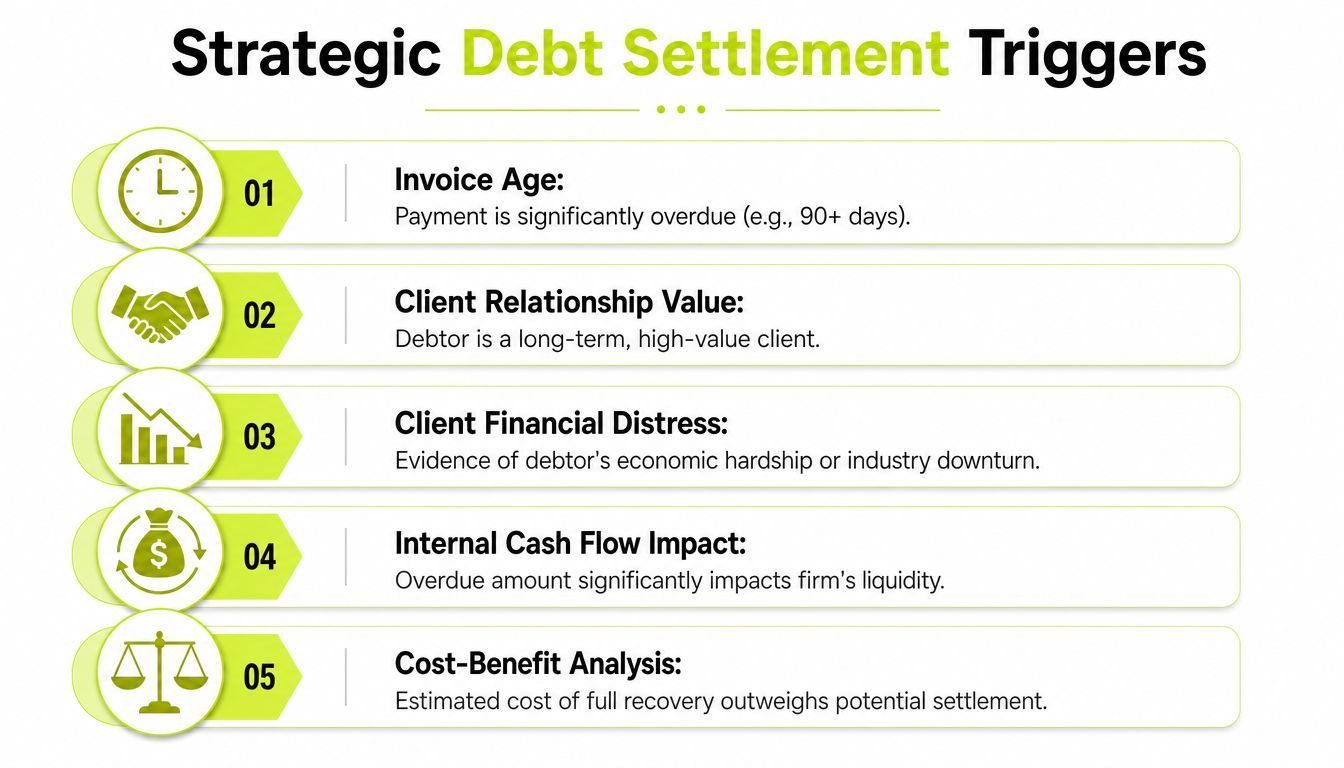
Use a decision screen, not instinct
I like to pressure test overdue accounts against a short set of commercial factors:
- Account quality: Was this client historically reliable, profitable, and straightforward to serve?
- Current friction: Is the nonpayment tied to a temporary squeeze, leadership change, project dispute, or broader distress?
- Recovery effort: How much more internal time will you spend if you continue chasing full payment?
- Cash urgency: Would immediate partial payment materially improve near-term liquidity?
- Future value: Is preserving the client relationship worth something real, or is that story covering for a deteriorated account?
If the answer set points toward uncertainty, delay, and rising effort, settlement is no longer a fallback. It's a financial option.
The threshold question that matters
In consumer debt research, the U.S. Department of Housing and Urban Development found that participants generally needed to settle at least two-thirds of their total debts to see a positive financial change after 36 months, and settling four out of six debts produced a positive financial position change of more than $1,350 compared with the debt load at enrollment, according to HUD's analysis. The context is different from B2B receivables, but the lesson is useful: partial resolution only works when it materially changes the outcome.
That's the standard to apply inside your firm. Don't send letters for debt settlement just to appear active. Use them when a negotiated result improves cash position, closes risk, or prevents a larger loss.
A settlement discussion should change the economics of the file. If it doesn't, keep working the account through your normal collections path.
A simple internal scorecard
A lightweight scorecard helps remove emotion from the decision:
Factor | Strong case for settlement | Weak case for settlement |
|---|---|---|
Client relationship | Valuable and worth preserving | Minimal strategic value |
Payment outlook | Signs of constrained ability to pay | Temporary delay with credible full-payment path |
Internal cost | Senior time already involved | Routine follow-up still sufficient |
Cash impact | Meaningful working capital benefit | Limited balance or low urgency |
Dispute risk | Settlement can close ambiguity | Full payment likely without concession |
This is also where AR software for professional services earns its keep. A controller with current aging, payment history, promise-to-pay notes, and dispute status can make this call faster and with less noise. If you're still exporting spreadsheets, forwarding email chains, and asking account leads for context, you're making a cash decision with incomplete information.
Structuring the Settlement Letter for a B2B Context
Consumer templates are usually the wrong model. A B2B settlement letter should sound like a finance professional wrote it for another business operator. No melodrama. No threats dressed up as formality. No vague language that lets both sides walk away with different interpretations.
The structure is simple. Open with the relationship. State the account facts. Put a clear proposal on the table with a deadline and documentation requirements.
What the letter must do
The letter has three jobs:
- Protect commercial tone
- Narrow ambiguity
- Create a decision point
A useful benchmark from Debt.org's DIY settlement guidance is that negotiations often start with a realistic proposal in the 25% to 50% range of the outstanding balance, while final settlements often land between 30% and 50% of the original debt. In B2B work, the exact figure depends on the relative negotiating power, account history, and whether you want a lump-sum close or a short payment plan.
If you need a clean starting point for formal language, teams sometimes use tools like the LegesGPT legal document generator to produce a first draft, then have finance and counsel tighten the business terms before sending.
Template for a valuable client under strain
Use this when you want to recover cash and keep the relationship intact.
[Date] [Client Name] [Company] We value the work our teams have completed together and appreciate the business relationship we've built. Our records show an outstanding balance of [amount] relating to [invoice numbers or project reference], which remains unpaid. We understand that businesses sometimes face short-term cash constraints or internal delays. To resolve the matter efficiently, we're prepared to accept payment of [settlement amount] as full and final settlement of the listed balance, provided payment is received by [date]. If this proposal is acceptable, please confirm in writing so we can issue a formal settlement agreement reflecting the amount, payment timing, and closure of the account upon receipt of funds. We'd prefer to resolve this directly and professionally, and we're available to discuss practical next steps promptly. [Name] [Title]
This version works because it stays factual and leaves room for the client to say yes without losing face.
Template for a deteriorated account
Use this when prior outreach has failed and you need sharper boundaries.
[Date] [Client Name] [Company] This letter concerns the unpaid balance of [amount] related to [invoice numbers or project reference]. Despite prior follow-up, the account remains unresolved. In an effort to close this matter without further escalation, we are willing to accept [settlement amount] as full and final settlement of the account, provided cleared payment is received no later than [date]. This offer is made solely to resolve the matter efficiently and does not waive any rights unless and until payment is received under a signed written agreement. If you wish to proceed, reply by [response date] so we can issue the settlement documentation. If we do not receive confirmation within that period, we will review the account for next-step recovery action. [Name] [Title]
This version changes the posture without becoming theatrical. It tells the client there is still a path to closure, but not an open-ended one.
Drafting points that matter
For teams refining outreach alongside existing dunning workflows, this guide on how to write a collection letter is useful because the discipline is similar: factual records, clear asks, and no unnecessary language.
Avoid these mistakes:
- Soft deadlines: “At your earliest convenience” is not a deadline.
- Conditional confusion: Don't imply the balance is settled before funds clear.
- Overexplaining: You don't need a long argument. You need clean terms.
- Mixed signals: Don't sound collaborative in one paragraph and vaguely threatening in the next.
The best settlement letters feel controlled. They don't chase. They frame a business decision.
Executing the Negotiation Strategy Beyond the Letter
A settlement letter is not the negotiation. It is the written record of a negotiation process that should already be in motion.
That distinction matters because many firms send the letter first, then wait. Waiting is where momentum dies. Decision-makers miss the email, delegate it, or deprioritize it. The file stalls again.
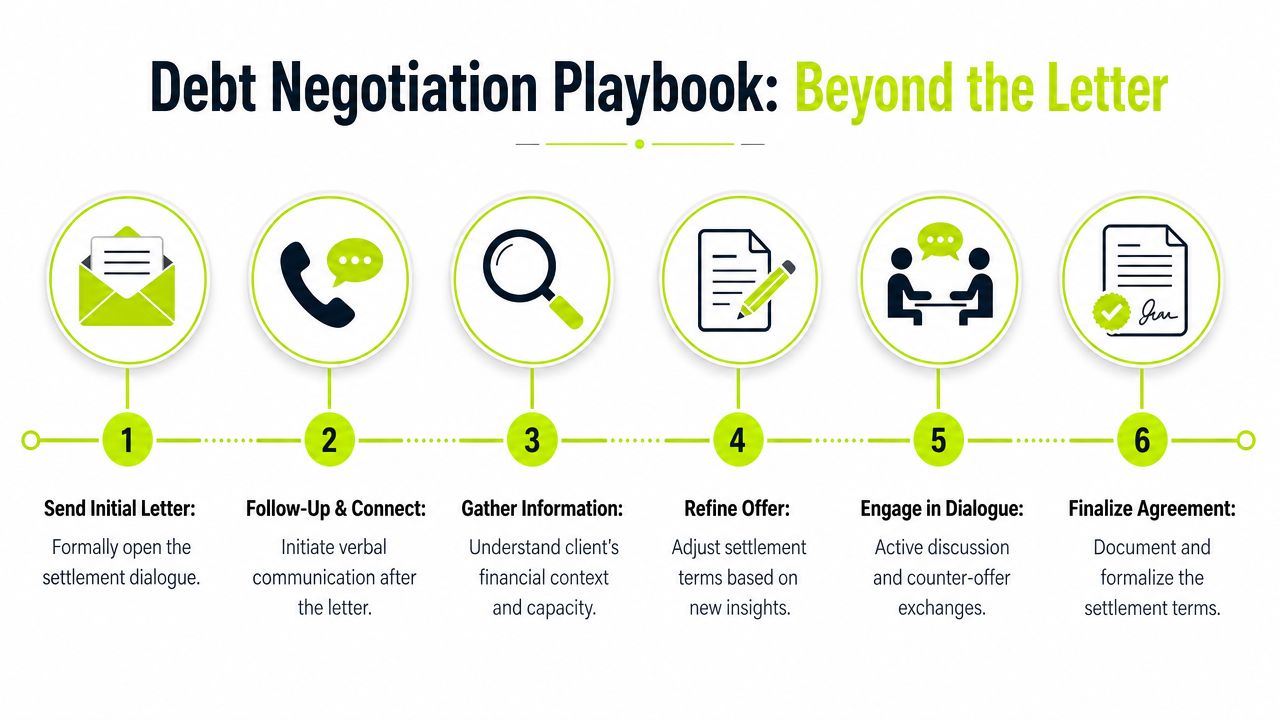
The stronger play is coordinated outreach. Debtors who combine a written offer with a prior phone call to confirm the recipient and intent have a 45% higher success rate in securing a full-and-final settlement compared to those who rely solely on letters, according to JG Wentworth's settlement guidance. The consumer context is different, but the operating lesson carries over cleanly to B2B collections: get the document to the right person, and don't let the letter do all the work.
The call that should happen first
Before the letter goes out, someone on the finance side should call and confirm three things:
- Decision-maker: Who can approve a settlement or payment arrangement?
- Channel: What email address or office contact should receive the formal proposal?
- Context: Is the issue cash timing, a disputed deliverable, or internal approvals?
That call is not the place to negotiate every term. It's to confirm that your letter won't disappear into a generic inbox or an AP queue with no authority to act.
Later in the process, if the client asks for installment terms rather than a lump sum, a formal payment plan agreement template can help convert a verbal concession into a documented commitment.
A practical follow-up cadence
After the letter is delivered, keep the cadence tight and professional:
- Same day: Confirm receipt with the intended contact.
- Next touch: Ask for a response date, not just “thoughts.”
- If there's hesitation: Request the client's proposed structure in writing.
- If there's no movement: Restate the offer window and next-step consequences.
Here's a useful explainer on negotiation framing:
Handling common responses
Clients usually come back with one of a few familiar positions.
Client response | Better reply |
|---|---|
“We need more time.” | “We can consider a short extension if we have a firm payment date and signed terms.” |
“We can't do that amount.” | “Send the amount you can fund now and the timing. We'll review a revised structure.” |
“We're waiting on our client.” | “Understood. We still need a direct commitment from your side to resolve the balance.” |
“Let's revisit next month.” | “We can't keep this open indefinitely. If you want the settlement option, we need a response by [date].” |
Operator's note: The goal of follow-up is not pressure for its own sake. It's to keep the file moving toward a documented decision.
A good negotiator stays calm, repeats the economic logic, and never improvises account terms without recording them immediately.
Finalizing the Settlement and Maintaining Clean Books
Agreement in principle is not enough. Until the terms are documented, signed where necessary, and paid, the account is still open risk.
At this point, many finance teams relax too early. They get the “yes” email, mark the file mentally as solved, and move on. Then the payment comes late, short, or tied to new conditions. Clean closure requires disciplined paperwork and system updates.
The non-negotiable agreement terms
The final settlement document should state, in plain business language:
- Parties and account reference: Identify the legal entities, invoice numbers, and total original balance.
- Settlement amount: State the exact amount to be paid.
- Payment timing: Include due date, method, and whether the agreement allows installments.
- Full and final settlement language: Make clear that the agreed payment resolves the listed claims once funds clear.
- No effectiveness before payment: The settlement isn't complete until payment is received.
- Default language: State what happens if the client misses the agreed payment terms.
- Authority: Confirm that the person signing has authority to bind the client.
If counsel needs to review edge cases, do that before the client signs. Don't retrofit legal precision after terms have already drifted in email.
A settlement that isn't documented with precision creates a second dispute while you're trying to close the first one.
Closing the file operationally
Once payment arrives, your team has to clean up the accounting trail. That means applying cash correctly, closing the invoice or invoices included in the agreement, and booking the unrecovered amount according to your accounting policy.
In firms using QuickBooks AR automation or adjacent workflow tools, this is where system discipline matters. The note history should show the approved settlement, the payment date, and the disposition of the remaining balance. If a partner asks six months later why a large invoice was written down, your records should answer the question immediately.
Digital process helps here. According to Thomson Reuters on AR automation, AR automation tools facilitate e-invoicing and digital documentation, which ensures compliance and reduces the collection cycle by an average of 5–7 days compared to manual processes. Even if the settlement itself is manually negotiated, the back-end documentation should still be tight, searchable, and auditable.
What clean books look like after settlement
A closed settlement file should include:
- The original invoice set
- All material correspondence
- The signed settlement agreement
- Proof of payment
- The accounting treatment of the remaining balance
- A CRM or client-service note for future commercial context
That final point matters more than is often realized. If business development re-engages the same client later, they need to know whether the previous issue was a one-time hardship, a process breakdown, or a pattern.
The Limits of Manual Settlement and the Case for Automation
The process works. It also consumes senior attention at every stage. Someone evaluates the account. Someone drafts the letter. Someone calls the client, manages objections, updates notes, coordinates documentation, applies cash, and explains the result internally.
That's manageable for occasional exceptions. It's a weak operating model when overdue accounts become routine.
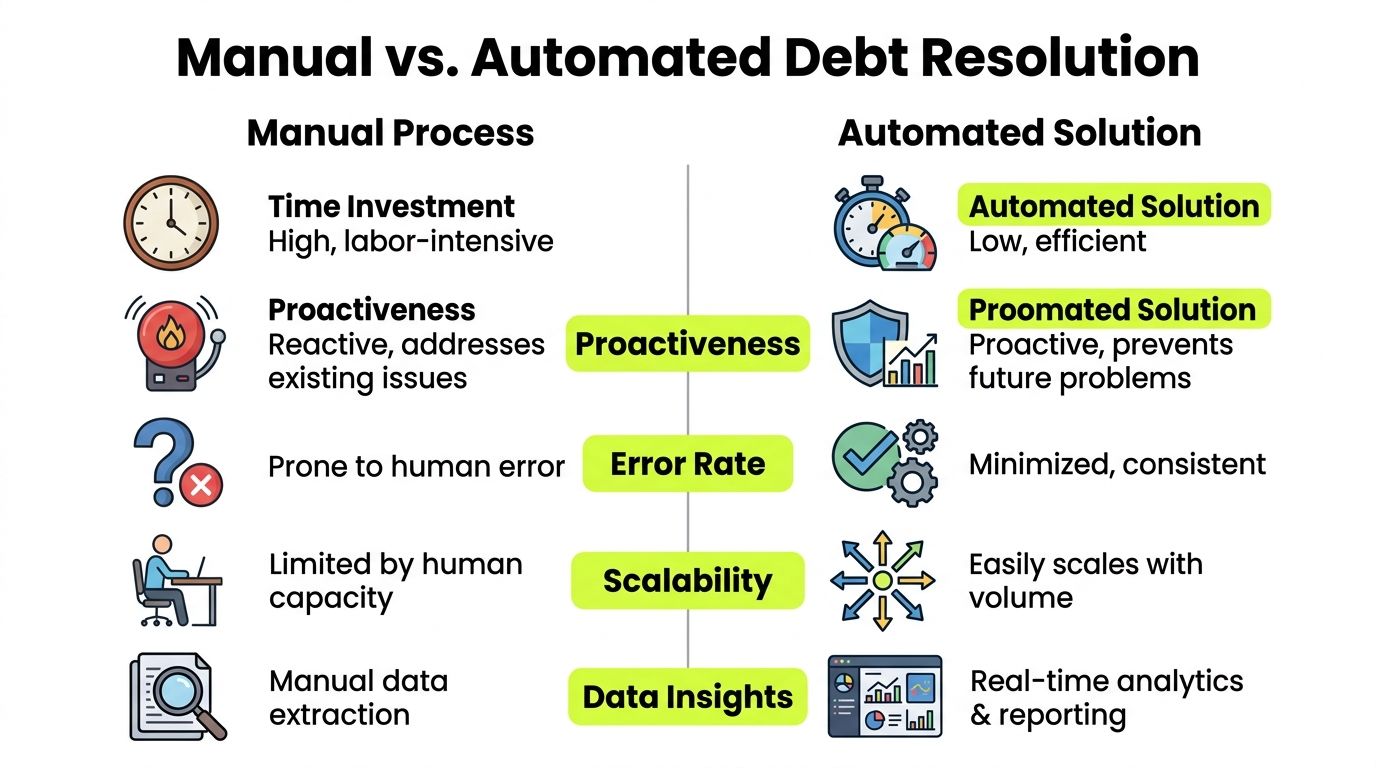
Manual recovery is reactive by design
Letters for debt settlement are useful because they help recover value from accounts that have already gone off track. They don't solve the earlier failures that created the delinquency in the first place. That's why firms looking to reduce DSO and improve cash flow eventually need to move upstream.
With accounts receivable automation, the question changes from “How do we negotiate this old balance?” to “How do we prevent more balances from aging into negotiation territory at all?” Better sequencing, real-time visibility, and disciplined follow-up reduce the number of files that require custom rescue work.
What automation changes inside finance
The measurable case is strong. Two out of three AR professionals using automation report a 50% increase in weekly productivity, according to a Vanson Bourne-conducted ROI study summarized by Billtrust. For a professional services finance team, that matters because the recovered time can move into dispute prevention, customer-specific outreach, and sharper forecasting.
The bigger gain is operational consistency. AI AR automation can trigger reminders, route exceptions, support digital payment options, and maintain a complete outreach trail without relying on one collector's inbox habits or one controller's memory. If you're evaluating workflow modernization more broadly, this overview of AgentStack's AI customer service platform is a useful companion read because it shows how AI systems can structure repetitive communications while preserving a human handoff for sensitive cases.
For firms comparing options, this guide to collections automation software is a practical place to start. The right AR software for professional services should support segmentation, payment orchestration, audit trails, and integrations clean enough that finance doesn't create more admin while trying to remove it.
Manual settlement is a good emergency tool. Automation is the steadier operating system.
Resolut automates AR for professional services, helping finance teams stay consistent, accurate, and human while they reduce DSO and improve cash flow. If your team is still managing overdue accounts with spreadsheets, inbox follow-ups, and one-off settlement letters, Resolut is built to bring control back into the process.