Controller Responsibilities for Modern Finance Teams
Controller responsibilities explained for modern finance teams. Core duties, workflows, KPIs, and how AR automation reduces DSO and improves cash flow.
Monday starts the same way in a lot of mid-sized professional services firms. The controller opens the aging report, checks cash, sees one large client still sitting in collections limbo, and gets an email from sales asking whether a contract can allow net 60 on a new engagement. Friday's close checklist is half done, so the week begins with clean-up before the first real decision of the day.
That's what controller responsibilities look like in practice. Not a back-office ledger job, not just month-end pressure, and not a narrow accounting function. It's the operating layer that keeps billing, collections, reporting, controls, and management decisions moving in the same direction.
A quick reference like the one in this tax resource from Blue Sage Tax & Accounting Inc. can be useful when you're explaining the role to a firm owner who still thinks of finance as “just bookkeeping.”
A Monday Morning in the Life of a Modern Controller
The morning usually starts before anyone says the word “strategy.” The controller checks cash first, because cash tells the truth faster than almost any report. Then comes the AR queue, where a few invoices need approval, one client disputes a line item, and collections is waiting on a promised payment that may or may not land today.
The real job is cross-functional
By midmorning, the controller is no longer working inside accounting only. Sales wants guidance on payment terms, operations wants to know why a job was billed differently than expected, and AP wants sign-off on a vendor batch that will affect the week's cash position. The same person is moving between contract language, invoice accuracy, and the practical question of whether the firm can keep paying people on time.
Practical rule: if a controller spends the morning only in the ledger, the rest of the business is probably making finance decisions without finance input.
That is why the role feels urgent in a $15 million firm. A missed collection update changes cash flow, but a poorly phrased sales promise can create the problem in the first place. The controller ends up translating between those worlds, not after the fact, but while the work is still moving.
The shift from “accounting owner” to “operating leader” is the central story. A controller who is only closing books is already behind. A controller who is watching billing, collections, approvals, and close status at the same time is the person keeping the firm from drifting into avoidable stress.
Defining Controller Responsibilities in Today's Finance Org
A controller is the senior finance leader who typically oversees the accounting department, financial reporting, budgets, internal controls, audits, and compliance, and often manages AP and AR plus forecasting as part of the back-office control function. In broader management-accounting practice, the role also carries responsibility for the integrity of financial records, the enforcement of policies and procedures, and the delivery of timely financial analysis for decision-making, as described in Accounting.com's overview of the controller role.
The cleanest way to think about it is this. The controller is both a custodian of the books and a management service function for the business. That split matters because the controller must protect the numbers and also make them useful.
Where the role starts and stops
The controller owns the accounting machinery. That includes the general ledger, reconciliations, reporting discipline, the close process, and the controls that keep misstated statements and delayed closes from becoming routine. Robert Half's controller overview also frames the role as the company's chief accounting leader, with responsibility for day-to-day accounting operations, reconciliations, audits, budgets, and common support functions like payroll and tax compliance.
A CFO owns broader financial direction. FP&A owns planning and scenario work. An AR manager owns receivables execution, but not the full control environment around them. That separation keeps the controller from becoming a catch-all and keeps accountability visible.
Role | Primary Owner | Main Deliverable |
|---|---|---|
Controller | Accounting operations, controls, reporting | Accurate, audit-ready financials |
CFO | Finance strategy, capital, planning | Decision support for leadership |
FP&A | Forecasting, budgeting, analysis | Management planning and scenarios |
AR Manager | Invoicing, collections, cash application | Receivables execution and follow-up |
The role evolved from the classic chief accountant into something broader. Modern controllers bridge transactional accounting and executive planning, which means they translate raw financial data into variance analysis, budget guidance, and control oversight. That bridge is the job.
The Daily, Weekly, and Monthly Rhythm of the Role
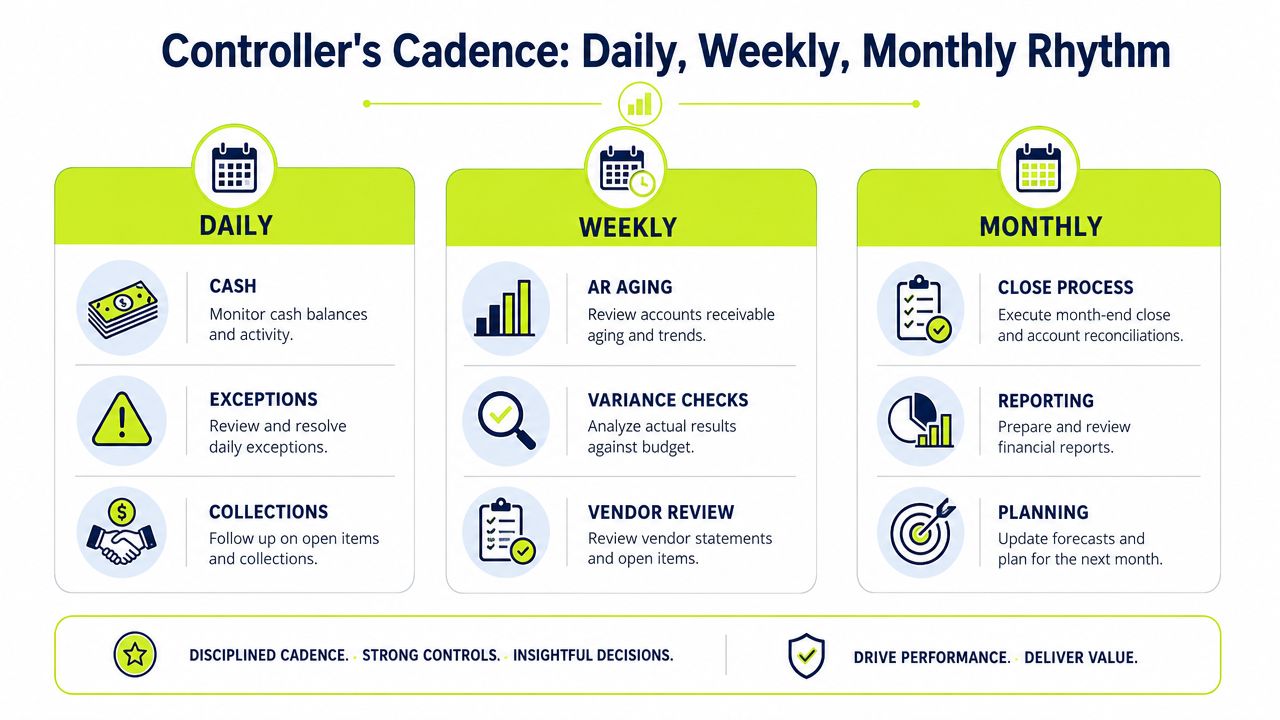
The controller's calendar tells you more than the org chart does. Daily work is about exceptions, cash, and escalation. Weekly work is about consistency. Monthly work is where the close either proves the process is sound or exposes every shortcut the team took earlier in the cycle.
Daily and weekly discipline
A typical day starts with cash position, unusual items, and AR exceptions. If a large customer hasn't paid, if a bill went out with the wrong backup, or if someone in sales promised a term that accounting can't support, the controller hears about it early. That early warning is what stops small problems from becoming stale invoices and bad assumptions.
Weekly, the controller reviews aging, variance trends, open approvals, and any task that could slow the close later. Vendor approvals and payroll review also sit here because they affect timing, controls, and trust. A weak weekly cadence usually shows up first as DSO drift, late invoices, or a surprise at month-end.
Monthly, quarterly, and annual work
Month-end is where the controller's planning discipline becomes visible. Close coordination, accruals, reconciliations, and management reporting all need to happen in sequence, not as disconnected chores. If the team is still hunting for backup on day four, the issue usually started much earlier.
For a practical close checklist, many teams pair their internal process with this month-end close guide from CEFCore, then adapt it to the firm's actual approval flow. If you want a separate process reference for internal use, this month-end close resource is also worth keeping on hand.
Quarterly and annual work shifts toward audit prep, tax coordination, policy updates, and controls testing. That's where control discipline gets tested against outside scrutiny.
If the cadence breaks, the symptoms show up fast. The books still close, but the reporting gets harder to trust, the team starts skipping reconciliations, and management gets updates later than it should.
Core Duties Every Controller Owns
The core of the role is steady, not glamorous. A controller has to make sure the firm's financial engine produces numbers leadership can use. In a $3 million to $50 million professional services firm, that usually comes down to reporting, close, reconciliations, controls, cash, audit coordination, tax coordination, and planning support.
The duties that matter most
Financial reporting is the public face of the accounting team internally. Good reporting is timely, clean, and consistent enough that leadership doesn't need a translation layer every month. If the report changes shape every cycle, confidence drops quickly.
Month-end close should be controlled, not heroic. The best close is the one where people know their lane, deadlines are clear, and late surprises are rare. When close turns into a fire drill, the controller is usually paying for weak upstream discipline.
Account reconciliations are where errors get contained before they spread. A healthy reconciliation process doesn't just check boxes, it proves that the ledger matches the supporting detail and that exceptions are resolved, not ignored.
Internal controls deserve extra weight because they are the guardrails for everything else. Modern role descriptions emphasize that controllers now design and monitor controls, not just maintain them, and that matters in firms where the same people often approve, bill, collect, and record the transaction LHH's controller description.
Cash management and AR oversight sit inside the controller's remit because billing accuracy and cash application affect reported cash and DSO. If receivables are messy, the controller will feel it in the close and the forecast.
Good controls don't slow the business down when they're designed correctly. They slow down the wrong transaction.
A controller also supports audit and tax work by keeping support organized, complete, and traceable. Planning support matters too, because the controller often supplies the actuals, accrual logic, and operating context that FP&A needs for a credible forecast.
KPIs and Metrics a Controller Watches Weekly
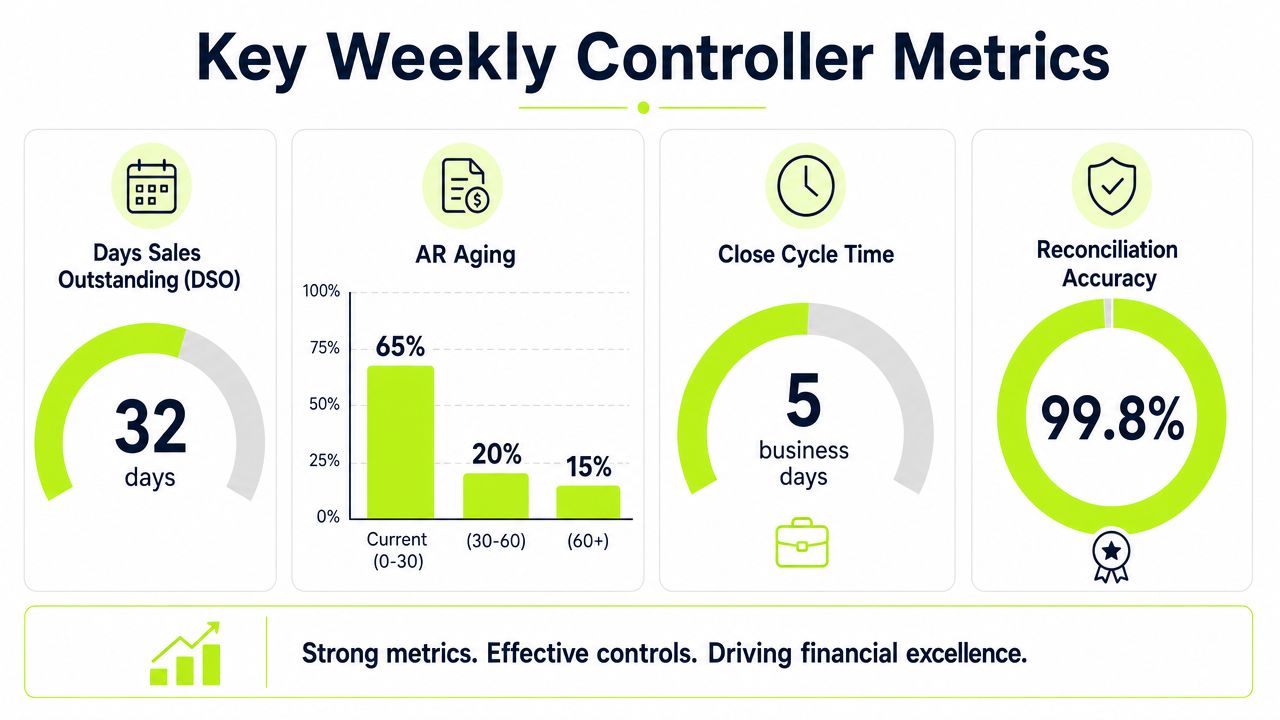
A controller does not need a giant dashboard. The useful one is tight, repeatable, and tied to decisions. The point isn't to admire the numbers, it's to spot where control or execution is slipping before leadership feels the pain.
The weekly set that actually matters
DSO and aging buckets show whether billing and collections are keeping pace with work delivered. If current invoices are healthy but older buckets are growing, the controller should look at credit, dispute handling, and follow-up discipline. For a deeper look at the mechanics, this DSO resource is a useful internal reference.
Close cycle time tells you whether the accounting process is stable. If the close keeps stretching, the issue is usually missing data, late approvals, or reconciliations that are being pushed into the next cycle.
Reconciliation completion rate matters because incomplete reconciliations are where misstatements hide. A high-level report that looks polished can still be weak if the underlying accounts aren't tied out.
Days to issue invoices affects cash before collections ever begins. In services firms, slow billing is often the quietest cause of cash strain.
Cash conversion cycle, bad debt write-off rate, open audit findings, and budget versus actual variance round out the view. Together they show whether the firm is collecting, controlling, and planning in a disciplined way.
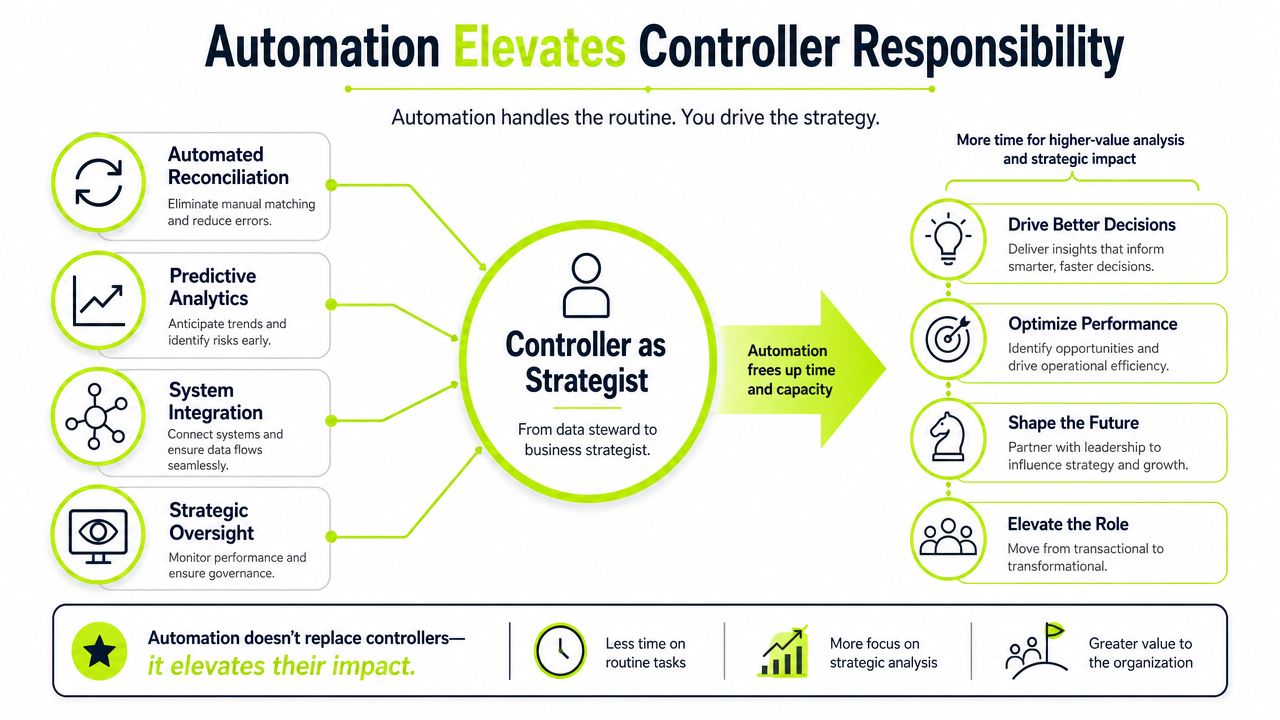
A contrarian truth holds up in practice. Automation doesn't reduce the controller's responsibility, it increases it. Once reconciliations, invoice routing, and collections workflows run through systems, the controller owns the control environment around those workflows, not just the manual execution. That means review logic, exception handling, and approval governance matter even more than they did before.
Where Automation Changes Controller Responsibilities
Automation is useful because it removes repetitive work, not because it removes accountability. In a mid-sized professional services firm, the controller can safely hand off a lot of receivables work to systems, but only if the control layer stays explicit and human-owned.
What can move to systems
Collections outreach, dunning sequences, cash application, invoice delivery, and routine reconciliation matching are all good candidates for automation. They're repetitive, rules-based, and easier to monitor than to do by hand every day. This AR automation overview is a practical reference if you're mapping out the workflow boundaries.
That shift changes the controller's day. Instead of manually chasing every exception, the controller reviews queues, approves edge cases, and watches whether the automation is behaving as intended.
What should stay human-owned
Control design stays with the controller. So does exception approval, policy interpretation, sign-off on the close, and escalation decisions involving fraud risk, disputed credits, or unusual payment behavior. Those tasks need judgment, not just workflow.
If a system recommends a write-off, a credit hold, or a billing adjustment, the controller still needs to know why. Audit teams care about the decision path, not just the outcome. So does anyone asking later why a disputed account was handled a certain way.
Practical rule: automate the movement of information, not the ownership of risk.
Governance is the layer many firms skip. Someone has to review automated decisions, log exceptions, and confirm that the process still matches policy. That's where controller responsibilities get sharper in an AI-assisted finance stack.
A useful process-oriented article on broader workflow design is Supercenter's process automation approach. The principle is simple, systems should reduce friction without turning human review into an afterthought.
How AR Orchestration Streamlines the Controller's Day
AR orchestration changes the controller's week in a very practical way. Before orchestration, a lot of time gets lost in manual follow-up, payment matching, and invoice corrections. After orchestration, the controller spends more time reviewing exceptions, tightening credit policy, and checking the quality of the workflow instead of doing the workflow by hand.
The before-and-after that matters
In a professional services firm, that shift usually starts with credit risk assessment, omnichannel collections outreach, dynamic billing, a better payment portal, and automated cash application. The controller no longer has to chase every payment thread manually because the system can route reminders, surface risk, and match incoming cash back to open invoices. That leaves the controller with the work that needs judgment.
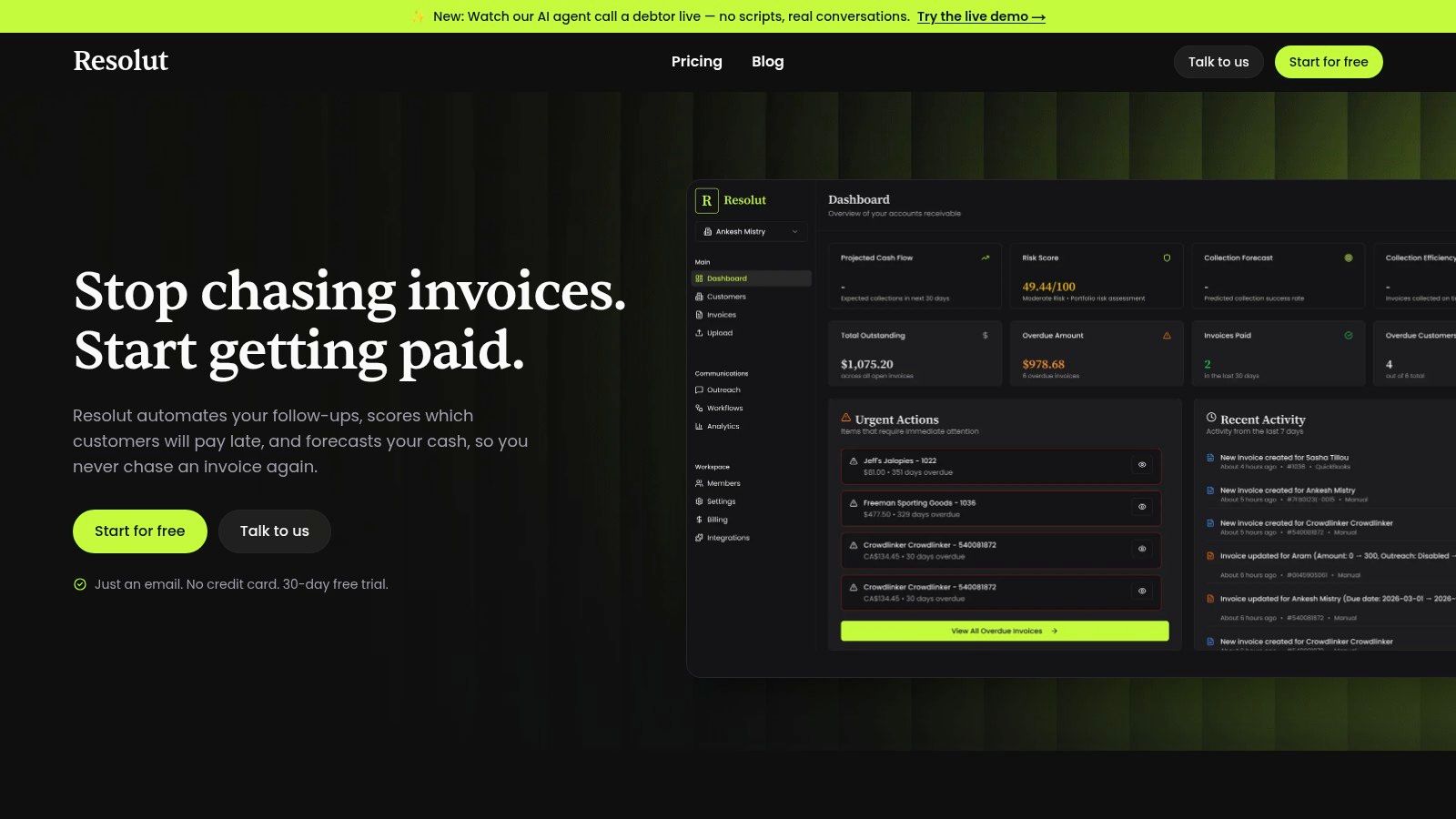
The day changes from transaction handling to oversight. A bill that used to take three people and a spreadsheet now shows up in a dashboard with the right context attached. The controller reviews the exceptions, not the entire batch.
What the controller still owns
The controller still has to validate disputed invoices, approve policy exceptions, and decide when a client should be escalated. That is not a technical limitation, it's a control decision. If the workflow creates a credit hold or a write-off recommendation, someone accountable has to review the reasoning and document the outcome.
That's where AR software for professional services starts to matter operationally. The controller gets better visibility into outstanding invoices, cash application becomes cleaner, and reporting gets less noisy. Those are the kinds of changes that can reduce DSO and improve cash flow without turning finance into a black box.
The best setup is usually human-in-the-loop. Systems handle the routing, reminders, and matching. The controller handles the judgment calls, audit trail, and policy changes. That balance is what keeps QuickBooks AR automation or more advanced AR software from becoming a loose set of shortcuts.
Skills, Org Relationships, and Common Pitfalls
A strong controller has three skill sets at once. Technical accounting, business communication, and operational leadership all matter. If one of those is missing, the role starts to wobble.
What the job actually demands
On the technical side, the controller needs GAAP fluency, control discipline, and enough systems literacy to work across ERP, billing, and reporting tools without slowing everyone else down. On the business side, the controller has to talk with sales about terms, with operations about billing accuracy, and with clients or vendors when a payment issue needs a calm, direct answer.
Leadership is the third leg. The controller has to hire, prioritize, set deadlines, and decide what gets escalated. Planning matters as much as technical skill because a finance team that is always reacting is usually under-managed, not just under-resourced.
The controller's relationship map is practical, not ceremonial.
- CFO: keeps the CFO informed on accuracy, timing, and risks in the books.
- FP&A: supplies real actuals, accrual logic, and explanations that make forecasts credible.
- AR and AP leads: sets process standards and resolves exceptions.
- Sales and operations: clarifies billing terms, job setup, and handoff points.
- External auditors: provides support, documentation, and control evidence.
Common mistakes that weaken the role
Treating AR as “just collections” is a common one. That ignores billing accuracy, cash application, and the control environment around receivables.
Underinvesting in controls until audit season is another. By then, the problem is already baked into the process.
Owning too much personally also hurts the team. If every exception ends up on the controller's desk, the role turns into bottleneck management instead of operating leadership.
Close speed matters, but close quality matters more. A fast bad close is still a bad close.
The final mistake is confusing activity with control. Busy isn't the same as reliable. The best controllers build systems that make the right work happen consistently, then step in where judgment and accountability can't be automated.
Resolut helps controllers and finance leaders bring structure to AR workflows, exception handling, and reporting without turning collections into a manual grind. If you're trying to reduce DSO, clean up cash application, and keep human review where audit and fraud risk demand it, visit Resolut and see how the workflow fits a professional services finance team.