Credit Risk Management Tools for Firms in 2026
A CFO-grade roundup of 10 credit risk management tools, with honest trade-offs, pricing guidance, and how they pair with AR automation.
75% of banks planned to increase investment in risk-technology infrastructure, according to a survey of senior risk leaders published by SAS. Professional services firms don't need a bank's technology budget, but they do need the same connection between identifying risk and acting on it.
For CFOs, Controllers, and owners of $3M–$50M professional services firms, credit risk belongs in the AR conversation. The decision to extend terms happens before the invoice. Collections teams inherit the consequences when nobody checks the customer, defines an exposure limit, or assigns responsibility for overdue balances.
Knowing a client might pay late isn't enough. Someone must change the deposit requirement, shorten the billing cycle, adjust follow-up, or involve the relationship owner. Whether you use an internal collector or bilingual nearshore support for receivables, that person needs clear instructions and current account information.
The operating test: When a customer's risk changes, can the team see what changed, understand why, and take the next action without rebuilding the account history?
The credit risk management tools below serve different needs. Credit bureaus supply external evidence. Monitoring platforms flag deterioration. Connected credit-to-cash platforms turn decisions into collections activity. Evaluate them on data quality, workflow fit, pricing transparency, and integration with accounts receivable automation, not the sophistication of their scores.
1. Resolut

For a $3M–$50M professional services firm, Resolut fits when the main challenge is turning credit signals into collection activity. The platform automates follow-ups, scores which customers are likely to pay late, and forecasts cash, so risk assessment sits inside the AR workflow instead of beside it.
Every customer gets a risk score, and every month gets a cash forecast. Teams can run autopilot or keep a co-pilot mode for human review, which matters when a disputed project invoice needs account-owner judgment while a chronic late payer gets firmer, segment-based outreach.
That distinction is the point for advisory firms and agencies. A reliable client with one contested milestone should not be chased like an account that misses every due date. Shared workspaces support that control with a live risk dashboard, permission choices over who sees what, and capacity that scales to thousands of invoices a month.
What works and what to verify
- Adoption path: Start with basic risk and segmentation in Kickstart, move to risk-based outreach in Accelerate, then use Orchestration for advanced risk with credit rating.
- Connected action: Accelerate adds multichannel outreach for VIPs and chronic late payers, a hosted payment portal with smart discounting and promises-to-pay, plus AI-assisted tone, timing, and cadence.
- Higher-tier controls: Orchestration adds credit bureau data and reporting, automatic cash application, intelligent dispute resolution with legal escalation workflows, priority support with a dedicated CSM, and an AI voice calling agent billed by usage.
- Commercial clarity: All plans include no revenue caps, unlimited invoices, unlimited seats, and unlimited workspaces. Confirm usage limits before relying on billed-by-usage features, since overages can trigger current usage fees after notice and a 30-day cure period.
I would treat Resolut as an AR execution layer with credit risk built in. Firms needing deep international entity investigations may still pair it with an outside intelligence provider. Judge it by fewer untouched overdue invoices, clearer ownership, and forecasts that hold up when cash is planned.
2. D&B Finance Analytics
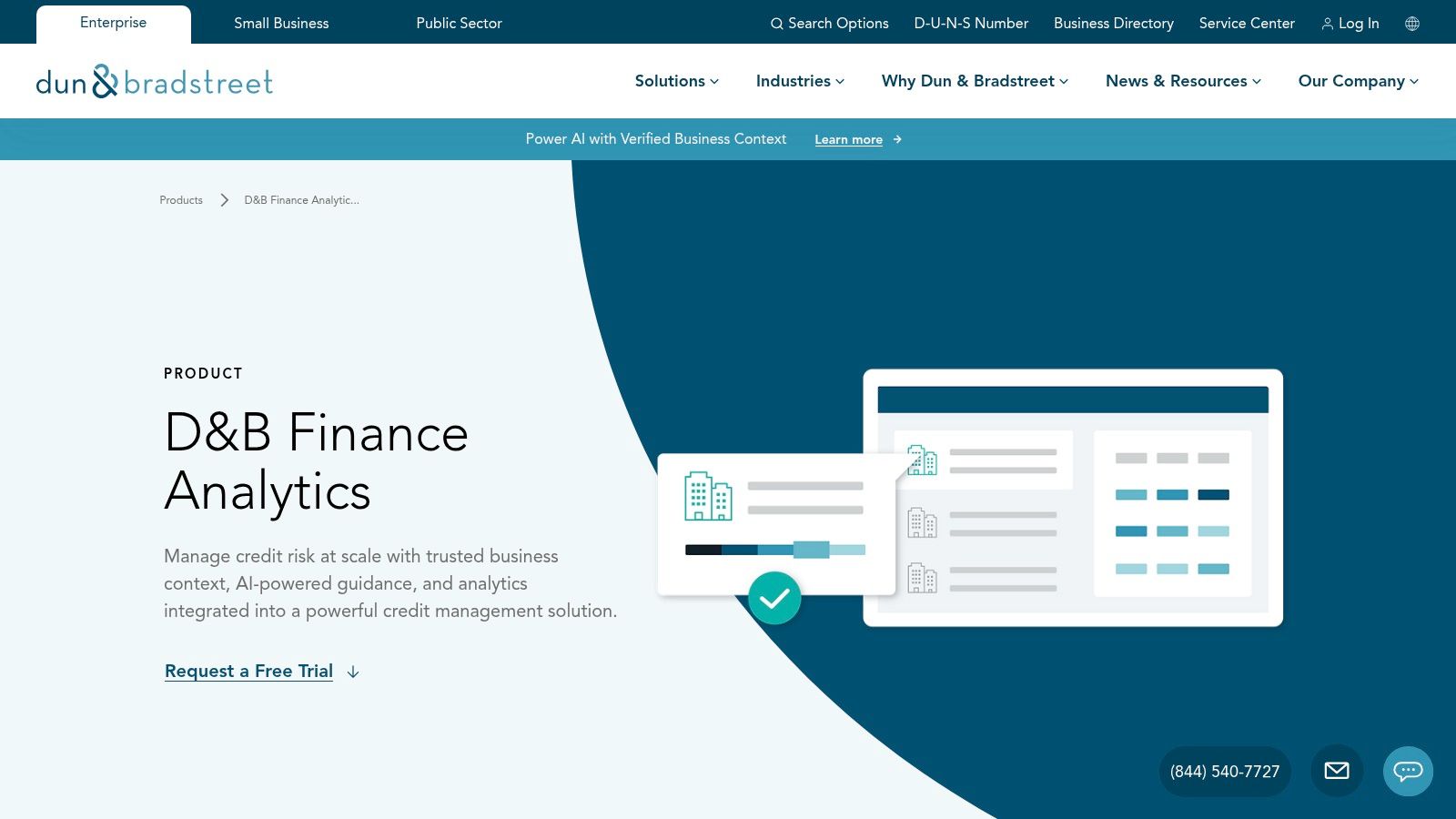
A new client can look commercially attractive while its legal entities, payment record, and existing obligations tell a more complicated story. D&B Finance Analytics is worth considering when external business intelligence is the missing input.
The platform combines business credit reports, predictive scores, payment information, and company-linkage data with configurable credit policies. It supports applicant assessment, account reviews, portfolio monitoring, and credit-limit recommendations.
Stronger assessment, with an operational handoff
The advantage is combining external evidence with your own approval rules. A Controller can establish who approves exceptions instead of allowing each partner to negotiate terms independently.
The limitation is that a bureau-informed decision doesn't automatically resolve invoice-level issues. Your collector still needs the contract, purchase order, dispute status, and responsible account owner.
- Pricing: Full-platform pricing is generally quote-based. Establish the cost of reports, monitoring, integrations, and additional users before committing.
- Data quality: Validate legal-entity matches and material adverse findings before changing a strategic client's terms.
- AR connection: Demonstrate how an alert reaches the collections queue and who owns the response.
Use the credit risk assessment tools guide to distinguish evidence gathering from decision execution. D&B is a stronger fit when onboarding checks and portfolio exposure need structure, not when the primary problem is inconsistent reminder sending.
3. Experian BusinessIQ and Intelliscore Plus

Choose the product depth you'll use. Experian's commercial-credit offering spans individual business checks through more structured portfolio management and decisioning.
Intelliscore Plus supplies a commercial risk score and related business information. BusinessIQ adds reporting, alerts, account management, and decision-oriented workflows, making it more relevant when customer reviews have become a recurring finance process.
Don't confuse sparse evidence with good credit
For a small consultancy taking on a new corporate client, an individual report may answer the immediate question. A firm managing a larger portfolio may need monitoring and account-level reviews rather than repeated manual purchases.
- Strength: Both individual checks and broader portfolio capabilities are available.
- Trade-off: Some report products offer self-serve pricing, while advanced capabilities are typically sales-led.
- Control: Review the factors behind a material decision, especially when the business record is incomplete or stale.
Separate risk level from confidence in the evidence. A customer with limited records isn't automatically high-risk, but limited evidence doesn't justify unrestricted exposure either.
The practical response may be a deposit, milestone billing, or an earlier review. That's more useful than forcing every thin-file customer into a binary approval or rejection, particularly when the firm has little collection history of its own.
4. Creditsafe

Creditsafe suits teams that need accessible business reports and ongoing monitoring across domestic and international counterparties. Its reports combine company details, payment information, risk scores, and credit-limit guidance.
For professional services firms, the useful application isn't just checking a prospect. It's noticing when an existing client's circumstances change while additional work continues to accumulate.
An alert should trigger an exposure review, not an automatic accusation that the client can't pay.
Where monitoring earns its place
Creditsafe offers monitoring, automated decisioning, and API or CRM/ERP integration options. Those capabilities can reduce manual rechecks, but integration must carry enough context to produce a sensible action.
For example, a risk alert on a client with no unpaid balance may justify reviewing the next engagement's deposit. The same alert on an overdue account may require account-owner involvement before more work is authorized.
- Buying advantage: A free business report provides a way to inspect the service before pursuing a subscription.
- Commercial limitation: Subscription pricing is customized, so compare monitoring coverage and integration costs, not just report access.
- Operational limitation: Check important company records against other evidence. A mismatched entity or incomplete record can produce an inappropriate decision.
Creditsafe is a useful data-and-monitoring layer. It's less compelling as a complete answer when your unresolved problem is dispute handling, collection ownership, or payment reconciliation.
5. HighRadius Credit Management
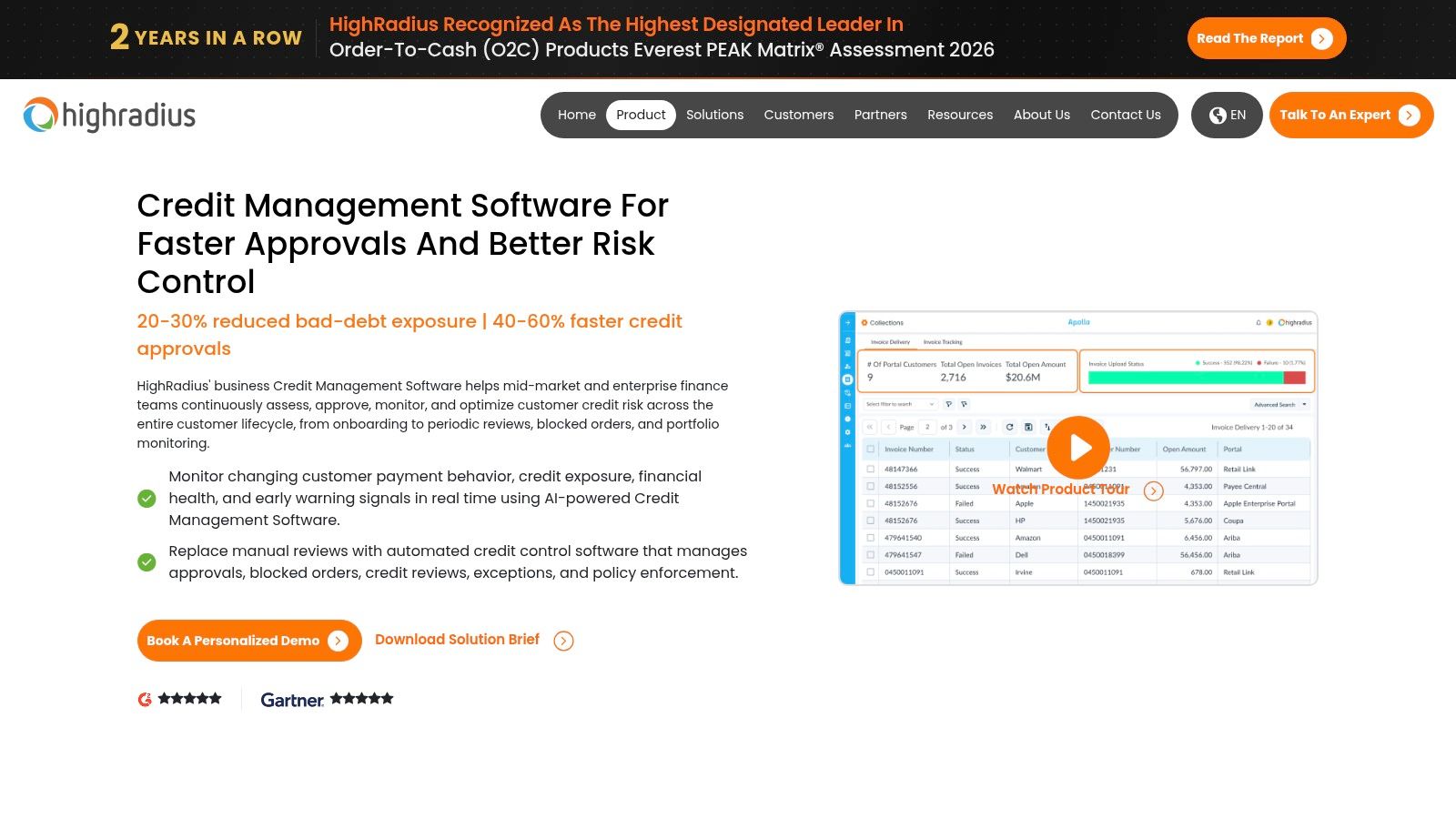
Complex approvals are a legitimate reason to buy a larger platform. HighRadius Credit Management combines online applications, scoring, decision rules, monitoring, and approval workflows within a broader order-to-cash environment.
Its fit improves when finance manages multiple approval levels, ERP connections, and external credit-data sources. For a lean services firm with straightforward billing, the implementation burden may outweigh the benefit.
Test governance alongside automation
A useful demonstration should show an application moving through approval, a payment-behavior change triggering review, and a collector receiving an actionable account update. Don't accept disconnected demonstrations of scoring and collections.
The EY and IIF global bank-risk survey found that 40% of participating chief risk officers identified credit risk as an AI priority. For an AR buyer, that makes explainability and human review relevant evaluation criteria, not proof of any vendor's performance.
- Strength: Structured workflows for larger, more complex portfolios.
- Cost consideration: Customized pricing includes implementation and recurring subscription considerations.
- Practical concern: Test configuration changes, system speed, and support escalation with your own account scenarios.
When evaluating credit risk analysis using machine learning, require decision history, override controls, and a workable manual fallback. Predictive sophistication won't compensate for a process your team can't operate.
6. Esker Credit Management

Esker Credit Management is most relevant when credit approvals and collections need to share the same customer context. It combines internal payment and receivables information with external credit and insurance data.
Customizable applications, approval workflows, scoring, alerts, and dashboards support the credit process. Integration with Esker's wider order-to-cash suite is the principal reason to consider it over a standalone reporting service.
Buy the connected workflow, not just the dashboard
Say a client requests a larger engagement while an earlier invoice remains disputed. Finance needs to see both the external risk assessment and the internal reason for nonpayment before deciding on terms.
That's the workflow to test. Confirm whether the collector, credit approver, and account owner can work from consistent information without copying notes between systems.
- Where it fits: Firms seeking a shared approach to onboarding, credit review, and AR operations.
- Where it can become excessive: Teams that only need occasional reports or simple approval routing.
- What to price: The required modules, active-customer assumptions, implementation work, and ongoing administration.
The broader platform may provide more value than a narrow deployment, but that also expands the buying decision. Evaluate dispute routing and collection handoffs with the same care as application processing.
A polished approval screen isn't enough if the collections team still has to reconstruct why terms were granted.
7. Gaviti Credit Management and Monitoring
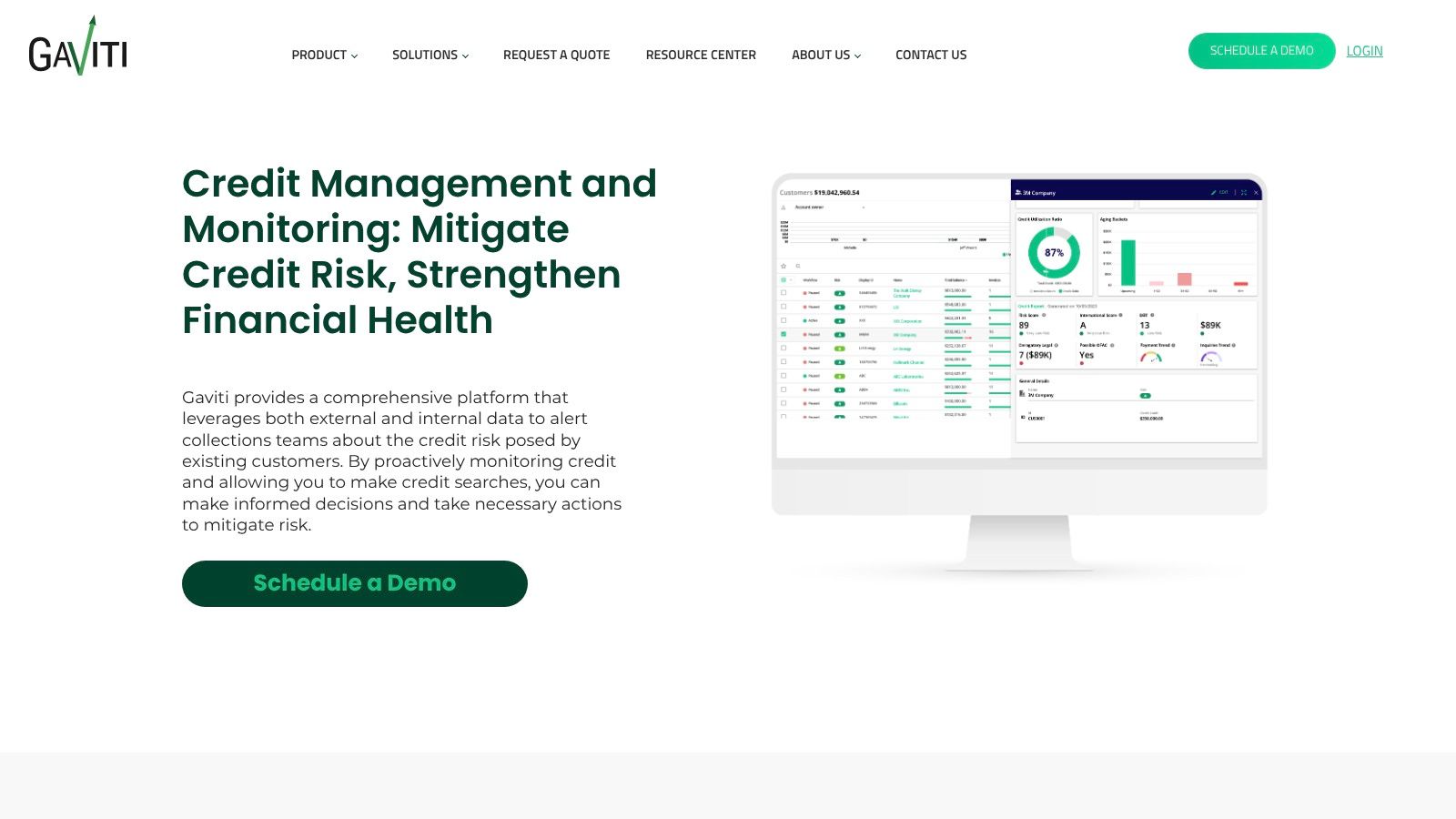
Start with the collector's working day when evaluating Gaviti Credit Management and Monitoring. Its proposition is connecting credit checks and changing risk signals with collections, disputes, cash application, and customer communications.
That connection matters when a customer's external profile deteriorates while its unpaid balance increases. The collector needs to know which invoices require attention and whether normal follow-up remains appropriate.
Compare it against your existing baseline
QuickBooks AR automation already provides a useful starting point: QuickBooks' invoice-reminder documentation supports up to three automatic reminder messages, sent only when an invoice has been emailed and remains unpaid.
An additional platform should therefore provide more than scheduled emails. Test risk-based prioritization, account visibility, dispute handling, and shared communications.
- Strength: Credit monitoring sits alongside operational AR workflows.
- Friction to test: Filtering, reporting, invoice-copy delivery, and the effort required to learn the interface.
- Buying question: Establish which modules and customer-volume assumptions determine the quote.
Don't use general platform satisfaction as a substitute for testing the credit module. Have the vendor demonstrate a real sequence: changed risk, assigned owner, appropriate outreach, customer response, and updated account status.
That sequence reveals whether the system reduces handoffs or merely centralizes more information.
8. Billtrust Credit and Collections
A connected platform makes sense when the handoff itself is the problem. Billtrust Credit and Collections links credit applications and reviews with customer payment history, collections, and dispute resolution.
It's worth evaluating when your team already wants a broader B2B receivables platform. It's harder to justify when all you need is an occasional business report.
Follow the account through the full process
Consider a client approved for terms that later begins paying inconsistently. Finance should be able to review its profile, reassess exposure, and adjust collection treatment without opening a parallel spreadsheet.
Billtrust's combination of credit profiles, external inputs, monitoring, and credit-limit recommendations is relevant to that operating model. The demonstration should establish what moves automatically and what requires configuration or manual approval.
Buying discipline: Evaluate the credit workflow separately from payments and general AR functionality. A strong payment experience doesn't prove strong credit controls.
- Best fit: Firms considering a wider credit-to-cash implementation.
- Main trade-off: Platform breadth may exceed the needs of a small finance team.
- Commercial consideration: Pricing is sales-led, so require a written scope covering implementation, modules, integrations, and support.
Use this comparison of credit risk management solutions to keep the decision anchored to the operational gap. The right purchase eliminates a specific failure point, such as inconsistent reviews or disconnected collection activity.
9. Coface Urba360

Cross-border receivables fail differently: the invoice can be clean while the buyer's jurisdiction, group structure, or payment culture is still unknown. Coface Urba360 fits that gap as risk intelligence, with business and portfolio views shaped by Coface's credit-risk and underwriting work.
For a $3M-$50M services firm, I would treat it as an input to exposure decisions, not the system that runs AR. Company information, credit opinions, monitoring, and API delivery can support a terms decision; invoicing, reminders, disputes, and account-owner escalation still need an owner elsewhere.
Keep the intelligence and collection roles distinct
Use Urba360 to decide whether to extend terms, ask for a deposit, cap exposure, or review a buyer more often. Then test the handoff in the demo: who receives the signal, what changes in the customer record, and which collection action follows.
- Advantage: Business information informed by a trade-credit insurer's perspective.
- Integration opportunity: API delivery can bring risk information into existing finance systems.
- Limitation: It does not replace collections automation, and public product-review depth is limited, so the demo has to prove workflow fit.
- Pricing: The U.S. business-information page does not publish a price, so define data coverage, users, and API needs through a quote.
For a thin-file international client, use staged exposure and revisit the evidence as invoices age. If the file improves, raise limits deliberately; if it deteriorates, slow new work before AR becomes the collection problem.
10. CreditRiskMonitor
CreditRiskMonitor deserves consideration when early warning of financial distress matters more than automating credit applications. It combines financial analysis, proprietary models, third-party ratings, trade-payment information, and alerts.
Its FRISK Score, PAYCE Score, and FAST Rating sit alongside company financials, peer comparisons, and portfolio dashboards. The operational question is whether your team can translate those signals into timely exposure decisions.
Strong intelligence needs an assigned responder
For a professional services firm with substantial exposure to a major corporate client, a deterioration alert may justify reviewing unbilled work as well as open invoices. Don't limit the review to balances already recorded in AR.
- Strength: Multiple financial and risk inputs support a broader assessment than a single isolated score.
- Budgeting advantage: Published subscription pricing makes the initial budget discussion more concrete.
- Coverage trade-off: North American and worldwide options require matching the subscription to the portfolio.
- Operational limitation: Credit applications, reminder cadence, and payment workflows aren't its central purpose.
Assign an owner before turning on alerts. Otherwise, the team may receive more warnings without changing terms, slowing new exposure, or contacting the client.
This tool category fits concentrated counterparty exposure and financially significant relationships. It's less direct for a firm whose cash problem mainly comes from missing purchase orders, unresolved scope disputes, or reminders that nobody sends consistently.
The 10 credit risk management tools at a glance
For a $3M-$50M professional services firm, the practical test is whether a score changes AR behavior: credit hold, outreach cadence, dispute handling, cash forecast, or escalation.
Tool | Best for | Credit data source | Pricing model | AR workflow integration |
|---|---|---|---|---|
Resolut | Firms that want late-payment risk tied directly to collections action | Internal invoice and payment data; Orchestration adds credit bureau data | Tiered plans (Kickstart, Accelerate, Orchestration); confirm current pricing for your volume | Automated follow-ups, customer risk scores, monthly cash forecast, live risk dashboard, cash application, dispute and legal escalation workflows |
D&B Finance Analytics | Credit teams needing business data and configurable decisions | Dun & Bradstreet business-credit data | Quote-based | Credit decisions, monitoring, and integrations with other systems |
Experian BusinessIQ and Intelliscore Plus | Businesses checking U.S. company credit and monitoring portfolios | Experian commercial-credit data and reports | Some reports offer self-serve pricing; advanced tools are sales-led | BusinessIQ supports decisioning and account management |
Creditsafe | Teams assessing and monitoring domestic or international counterparties | Creditsafe business reports, scores, and payment data | Customized subscription | API and CRM/ERP integrations; not a complete approval workflow |
HighRadius Credit Management | Mid-market and enterprise teams managing complex credit operations | External credit agencies and internal payment behavior | Customized pricing; setup and subscription fees | Embedded in order-to-cash and receivables processes |
Esker Credit Management | Teams linking credit reviews with collections and order-to-cash | Internal receivables data, external credit data, and insurance data | Unpublished; depends partly on customer volume | Integrated with collections and wider order-to-cash suite |
Gaviti Credit Management and Monitoring | B2B teams connecting customer risk signals to collections | Internal and external risk signals | Customized by modules and customer volume | Credit monitoring alongside collections and other AR tools |
Billtrust Credit and Collections | B2B suppliers connecting credit reviews to receivables activity | Customer-account activity and external data | Generally sales-led | Credit workflows connect with collections and dispute resolution |
Coface Urba360 | Businesses assessing international customers and suppliers | Coface business information and risk expertise | Quote or demo required | API integration; focused on risk intelligence, not full AR automation |
CreditRiskMonitor | Teams prioritizing early warning of financial distress | Financial data, proprietary models, other ratings, and trade-payment information | Published subscription plans; substantial annual commitment | Risk monitoring and dashboards rather than full AR automation |
Read the last column first. A strong score with no owner, cadence, or escalation path leaves exposure unchanged. A tool that routes risk into reminders, disputes, payment promises, and cash forecasting gives a lean finance team fewer decisions to remake every week.
Choosing a Tool That Actually Reduces Bad Debt
A $3M-$50M professional services firm rarely loses money because it lacked a score. It loses money when a warning has no owner, an approval limit ignores unbilled work, or an overdue account keeps getting polite reminders instead of a defined next step.
Match the tool category to the failure point. Use external data when onboarding decisions lack evidence. Use monitoring when customer deterioration goes unnoticed. Use a connected platform when the team already knows which accounts are risky but does not act consistently.
For services firms, measure exposure as unpaid invoices plus unbilled work and committed delivery. A customer can stay under an invoice-based limit while partners keep booking time that may never convert to cash.
Define the outcome before signing
- To improve onboarding: Measure decision turnaround, exception frequency, and the completeness of supporting evidence.
- To improve collections: Track untouched overdue balances, promises kept, dispute age, and time from risk alert to assigned action.
- To reduce DSO: Compare collection speed against contractual payment terms and changes in the customer mix.
- To improve cash flow: Compare forecast receipts with actual receipts, not just the number of automated messages.
The QuickBooks accounts receivable management guide defines DSO as average accounts receivable divided by net credit sales, multiplied by the number of days in the period. Use that measure alongside invoice-level controls, because a portfolio average can hide whether the broken step is approval, dispute handling, or follow-up.
Before committing, establish subscription scope, implementation costs, integration requirements, and any usage-based charges. Require a demonstration using your disputed invoices, strategic accounts, thin-file customers, and oldest overdue balances.
Resolut plans include no revenue caps, unlimited invoices, unlimited seats, and unlimited workspaces. Risk and segmentation is basic in Kickstart, risk-based outreach sits in Accelerate, and Orchestration adds credit rating, credit bureau data and reporting, an AI voice calling agent billed by usage, automatic cash application, intelligent dispute resolution with legal escalation workflows, and priority support with a dedicated CSM. Team workspaces include a live risk dashboard and let the user decide who sees what.
Make the operating model visible
Visual idea: Create a decision-tree infographic mapping firm size and problem type to tool category. Use branches for onboarding evidence, early warning, and connected collection action, with implementation capacity as a final decision point.
Visual idea: Use a cinematic image of a calm finance team reviewing a live risk dashboard. Show an account owner, next action, and payment status on screen rather than decorative charts.
AR software for professional services should turn changing customer behavior into a repeatable response: owner, decision rule, and collection action. Without those, a score sits in a dashboard nobody opens.
Resolut automates AR for professional services, consistent, accurate, and human. It connects customer risk scoring with personalized follow-up and cash forecasting, while keeping people involved where judgment matters. Visit Resolut to see how that workflow would run on your own receivables.