Improving Customer Payment Experience for Service Firms
Learn how to define and measure the customer payment experience to reduce DSO, lower AR costs, and cut churn. Practical KPIs and strategies for CFOs.
A finance team can feel this problem before it shows up in the numbers. Invoices go out on time, clients mean well, but payment confirmations lag, reminders become awkward, and the inbox fills with avoidable status checks. The result is a slower close, tighter working capital, and a payment journey that undermines trust with every extra step.
For CFOs, Controllers, and owners at professional services firms, the issue is not just whether clients can pay. It's whether the customer payment experience makes payment easy, clear, and recoverable when something goes wrong. That matters because customers still rely heavily on familiar methods, and payment workflows have to serve both legacy habits and digital expectations at once, not one at the expense of the other (Federal Reserve 2024 Consumer Payments Study).
Why Payment Experience Matters
A delayed payment rarely stays isolated in receivables. It pushes pressure into the rest of finance, from vendor timing to cash forecasting, and it also changes how clients feel about the firm. A clean service delivery can be undone by a clumsy billing moment, especially when the invoice is hard to understand or the payment path feels uncertain.
That puts payment experience in the same operating discussion as margin, collections, and client retention. When payment friction rises, the cost is not only internal. It shows up in more follow-ups, longer open-item lists, and extra time spent explaining what should have been clear the first time.
Practical rule: if a client needs to ask twice how to pay, the payment journey already has a design problem.
The stakes rise in firms that bill by project, milestone, or retainer. Those models depend on predictable cash timing, and payment uncertainty makes forecasting less reliable. In practice, a better workflow functions as a finance control, not just a user-experience upgrade.
The business case extends beyond convenience at the point of payment. The Federal Reserve's 2024 Consumer Payments Study shows that cash (78%) and credit cards (70%) remain the most frequently used payment methods in the U.S. That same study points to a market where finance teams still have to support familiar habits while also accommodating digital options. Federal Reserve 2024 Consumer Payments Study
For professional services firms, the operational implication is straightforward. Choice, clarity, and recovery need to work together, because a client may start with one method, pause midway, and need a clean path back to completion. A payment experience that handles recovery flows well reduces manual intervention, protects collections velocity, and limits the time finance spends rescuing transactions that should have cleared on the first pass.
Read more on how payment design fits into broader experience strategy in Resolut's digital customer experience perspective.
Defining the Customer Payment Experience
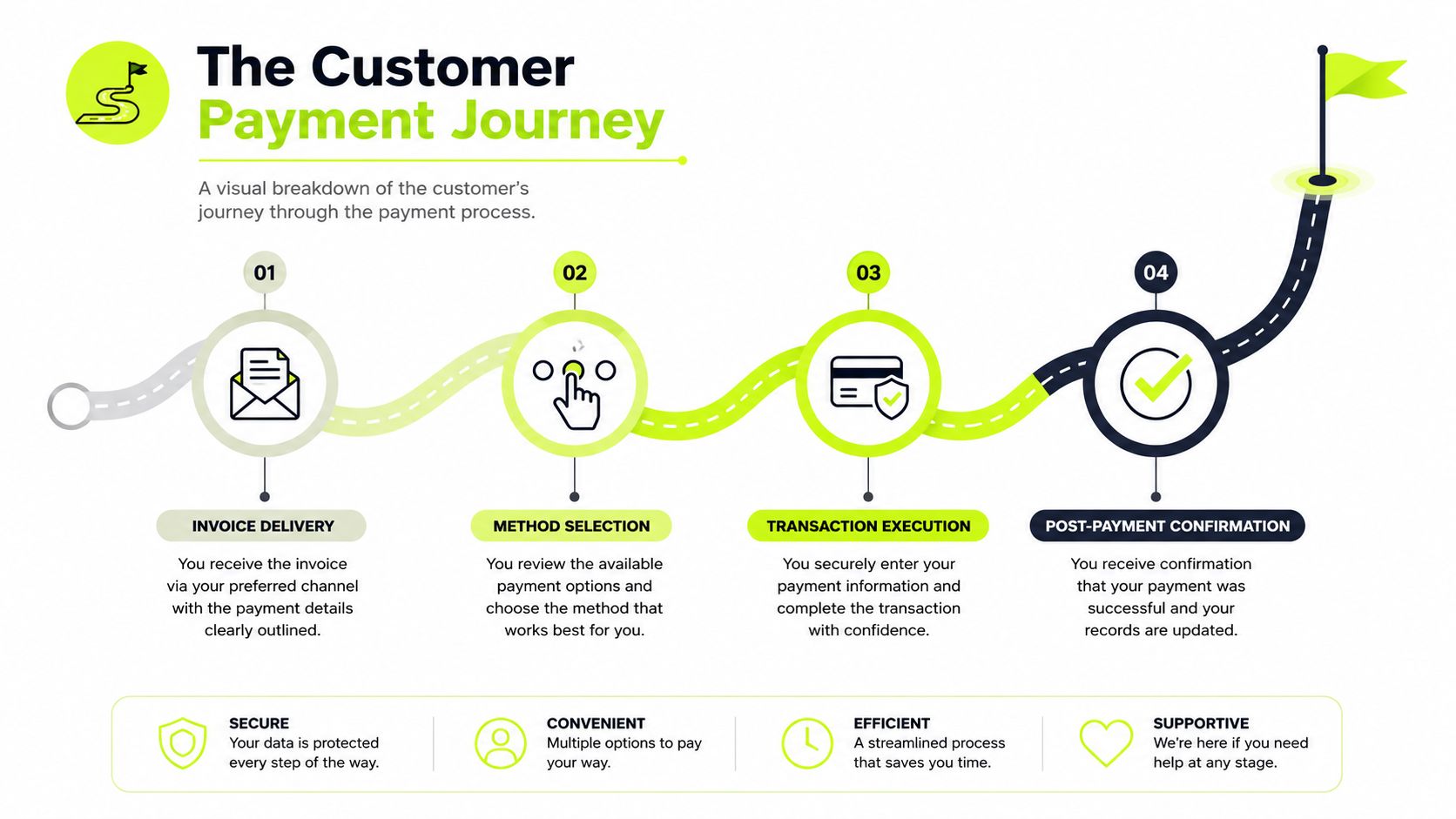
The customer payment experience is the full path from invoice delivery to final confirmation. It starts before a card is entered or a bank transfer is submitted, and it continues after the payment button is clicked. In practice, it runs through four stages, and each one affects whether the client feels in control or under pressure.
Invoice Delivery and Method Selection
The first touchpoint is the invoice itself. If the bill is vague, buried in jargon, or disconnected from the work delivered, the client starts with friction. If the invoice is clear and the payment options are obvious, the client moves faster and with less second-guessing.
Clear billing reduces avoidable back-and-forth. That matters in professional services, where clients often review an invoice against a project, milestone, or retainer agreement before they release funds.
A concierge-style comparison fits here. A good front desk does not make guests guess which line to stand in, and a good billing system should not make clients hunt for the right method. The Federal Reserve data mentioned earlier shows why this matters, since cash and credit cards still dominate everyday behavior even as digital rails expand.
Transaction Execution and Confirmation
The next stage is execution, where checkout design, authentication, and payment routing either fade into the background or create visible drag. Guidance from TrueLayer says auto-populating payment details and offering one-click or guest checkout reduce the number of steps a payer must complete, which lowers abandonment risk because payment happens faster and with less effort (TrueLayer Payments Experience Playbook).
Post-payment confirmation matters just as much. A client who does not know whether the payment posted, is pending, or failed will often escalate to email or phone. That uncertainty is a service issue and a finance issue at the same time.
A strong payment journey feels boring in the right way. The client knows what to do, what happened, and what comes next.
The Operational Definition
For finance teams, the practical definition is simple. A strong payment experience gives the payer clear instructions, relevant choice, low effort, and visible status. If any one of those is missing, the journey becomes fragile.
That definition aligns sales, service, and finance around the same outcome. It also gives controllers a sharper lens for reviewing AR software for professional services, because the question becomes whether the system helps the client finish the payment or only helps the team record the fact that it happened.
Business Impact and Key Performance Indicators
Payment experience has a direct effect on the AR engine, even when the invoice book looks healthy on paper. A slower payment journey stretches cash conversion, increases exception handling, and raises the chance that a recoverable invoice turns into a write-off or a relationship issue. For professional services firms, that's especially costly because client work often arrives before cash does.
The Metrics That Matter
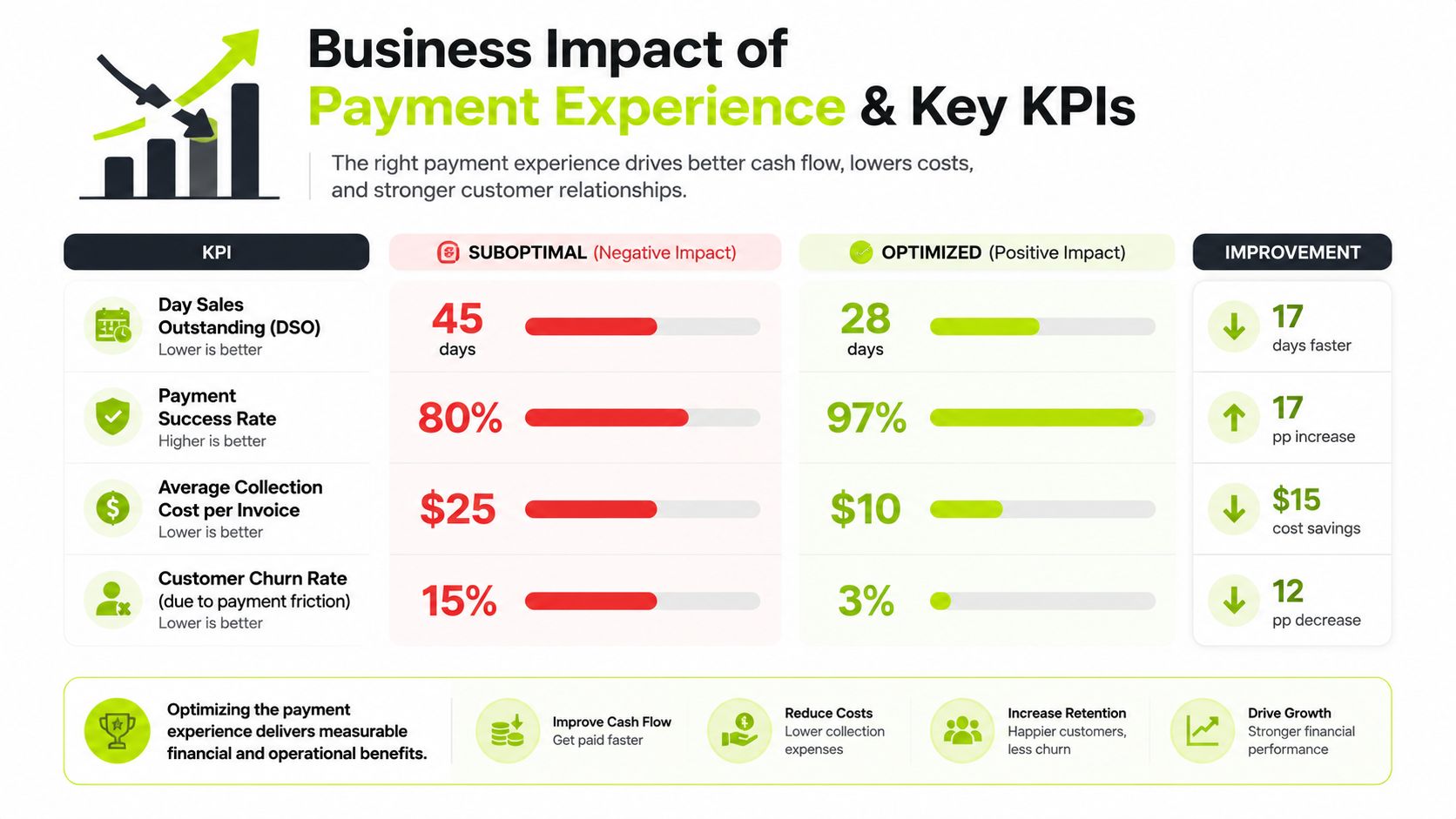
Four KPIs deserve attention in any service firm with recurring invoicing. DSO shows how long cash stays trapped after invoicing. Payment success rate shows whether the first attempt completes or fails. Average collection cost per invoice captures the labor spent chasing payment. Dispute rate signals how often the payment journey is confused enough to trigger intervention.
Those metrics work together. A firm can have a high invoice volume and still struggle if payment failures force manual recovery. The risk is not only slower cash, but more variance in forecast accuracy and more distractions for finance staff.
The industry data on payment failure is blunt. Payment failures average 5% to 10% worldwide, depending on region and payment method, and 40% of consumers abandon their purchase when a payment fails, while 33% won't try again (Testlio payment testing statistics). In a services context, that means a broken payment flow can turn one invoice into lost revenue and a strained client relationship.
What Better Looks Like
A suboptimal scenario often looks like this, a payment path that creates retries, follow-up emails, and reconciliation work. An optimized path looks like fewer exceptions, faster completion, and less manual handling. The comparison in the chart is useful because it turns an abstract experience problem into a CFO-level operating question.
The ROI lens should stay practical. If a firm lowers DSO, even modestly, it frees cash faster and reduces the need to bridge the gap with internal reserves or short-term financing. If collection cost falls, the same finance team can manage more receivables without adding headcount.
Finance operator lens: when the payment journey gets simpler, the AR team spends less time rescuing transactions and more time managing cash.
For leadership teams, the point isn't to chase every possible metric. It's to connect the ones that matter to working capital and service quality. Payment experience affects both, and it does so every time an invoice is sent.
Diagnosing Friction in Billing Outreach and Payments
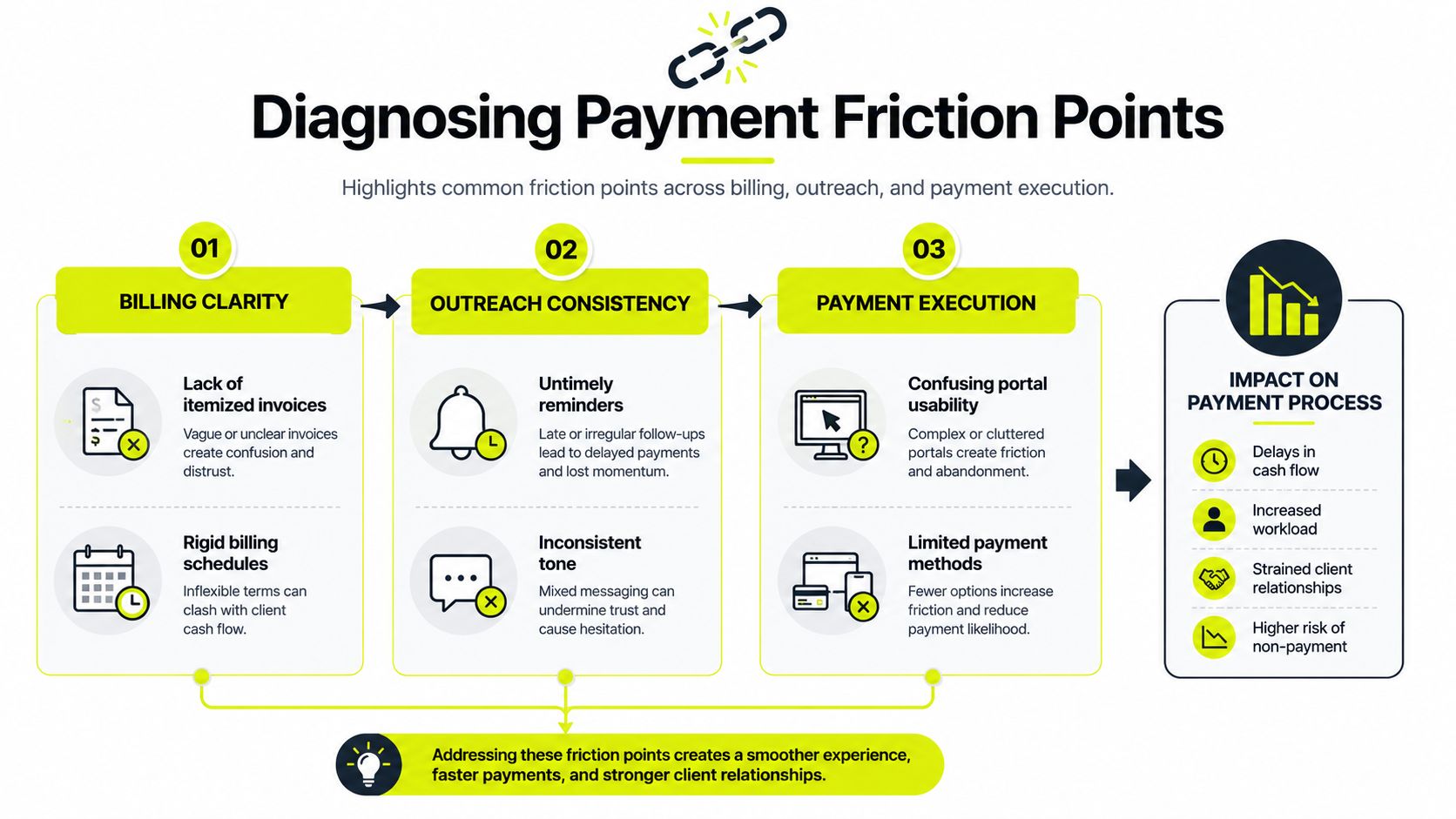
Most payment problems don't begin at the payment button. They start earlier, with unclear billing language, inconsistent outreach, or a portal that makes a simple action feel risky. In professional services, that shows up in aging reports, repeated “just checking on this” emails, and clients who delay payment because they're unsure what they owe or how to finish the transaction.
Billing Clarity and Outreach Consistency
Billing clarity is usually the first fault line. If an invoice doesn't break out work cleanly, reflects a rigid billing schedule that doesn't match the engagement, or arrives without enough context, the client's first instinct is often delay rather than payment. The problem isn't always disagreement. Sometimes it's uncertainty.
Outreach consistency matters just as much. A reminder sent too early can feel pushy, one sent too late can look like a mistake, and a message that changes tone from one touchpoint to the next can make the relationship feel unmanaged. That's especially important for agencies and consultancies, where the tone of the account often mirrors the tone of the billing process.
The hidden cost is trust erosion. A client who receives mixed signals about timing or amount is more likely to hesitate, and hesitation tends to show up first as a slower response, then as a delayed payment, then as a support thread that finance has to untangle.
Payment Execution and Recovery
Execution problems are easier to spot but just as damaging. Confusing portal usability, limited payment methods, or a checkout flow that asks for too much re-entry all raise abandonment risk. The payment itself may only take a minute, but if the path is clunky, clients stop and postpone.
The recovery step is the one often overlooked. A declined payment needs a clear next action, a calm explanation, and a path that lets the client fix the issue without starting over. That's where managing customer communication becomes part of payment design, not just support policy.
A useful framing is to ask three questions after any failure. What happened? What should the client do now? Who owns the next step if the client doesn't respond? If those answers aren't explicit, the workflow leaks trust.
Recovery rule: failed payments should feel guided, not punitive. The faster a client understands the next step, the less likely the relationship is to cool off.
Teams also benefit from understanding broader payment channel choice. A practical reference on B2B online payment methods can help finance leaders map which methods belong in a professional services context without overcomplicating the menu.
Strategies to Optimize Payments
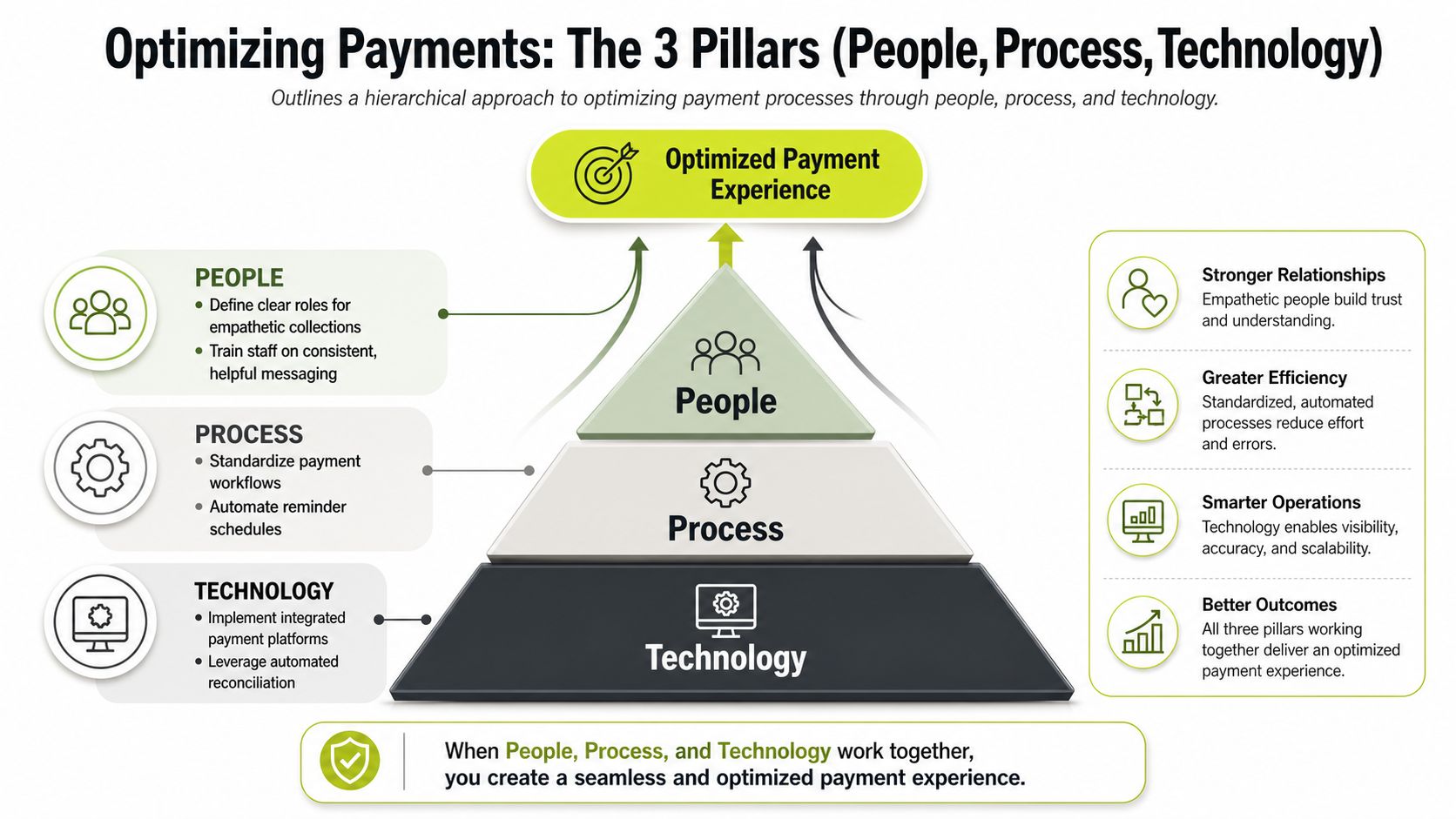
A payment program works best when collections, portals, reminders, and recovery are treated as one workflow. The key question is whether people, process, and technology are aligned enough to move an invoice from issue to cash without forcing the client to solve internal friction. A firm can buy software and still keep the same weak handoffs, or train staff well and still lose payments to a broken sequence of steps.
People and Process First
Collections improves when ownership is explicit. One person should own the first reminder, another should own escalation, and a third should handle exceptions that require judgment. That structure keeps the tone consistent and reduces the risk that two teams contact the same client with different messages.
Process design needs the same discipline. Standardize invoice timing, define recovery triggers, and document what happens after a failed payment, not only before it. Many firms still design the happy path first, then improvise when a payment is declined or delayed, which is usually where cash collection slows and staff time gets consumed.
A useful reference on conversational AI in banking CX shows how structured digital conversations can support customer interactions without turning them into scripted dead ends.
Technology That Supports the Workflow
Technology should cut rework, not add another administrative layer. For firms evaluating accounts receivable automation, AI AR automation, or QuickBooks AR automation, the most valuable functions are the ones that improve decisions and reduce handoffs. That includes intelligent risk scoring, omnichannel outreach, automated reconciliation, and a payment portal that is easy for the client to use.
Method choice still needs discipline. Too many options can create hesitation, and Trustly's guidance makes the point clearly by recommending three to five highly relevant methods suited to the customer segment and product type (Trustly payment UX best practices). In professional services, that usually means prioritizing the methods clients already use rather than building a menu that looks broad but slows the decision.
The same logic applies to the broader mix of B2B online payment methods. A tighter set of options usually improves completion rates, because the client spends less time choosing and more time paying.
Practical takeaway: the right stack does more than collect money. It routes the client to the simplest acceptable path for that invoice, that segment, and that moment.
For finance leaders comparing options, Resolut is one platform that combines AR workflow automation, payment collection, invoice management, and configurable payment portal setup in a single system. That kind of orchestration matters when the goal is to reduce DSO without adding more manual chasing.
Conclusion and Next Steps
Customer payment experience is not a front-end detail. It sits at the center of cash flow, AR workload, and client confidence. The firms that handle it well don't just make payment easier. They reduce uncertainty, improve collection consistency, and create a cleaner path from invoice to confirmed cash.
The strongest operators think in sequence. Define the payment journey clearly. Track the right KPIs. Diagnose where friction starts. Then tighten people, process, and technology so the client doesn't have to compensate for internal complexity. That's the difference between a billing function that reacts and one that supports working capital with discipline.
If your team is still spending too much time on failed payments, manual follow-up, or reconciliation cleanup, benchmark the current journey first. Then look at whether AR software for professional services can help reduce DSO, improve cash flow, and preserve client relationships without forcing a harder collections tone.
A CTA for Resolut. Resolut automates AR for professional services, delivering consistent, accurate, and human payment experiences.