Data Migration Strategy: The Finance Team Playbook
Master your data migration strategy with this step-by-step playbook for AR teams. Reduce risk, validate data, and protect cash flow during system changes.
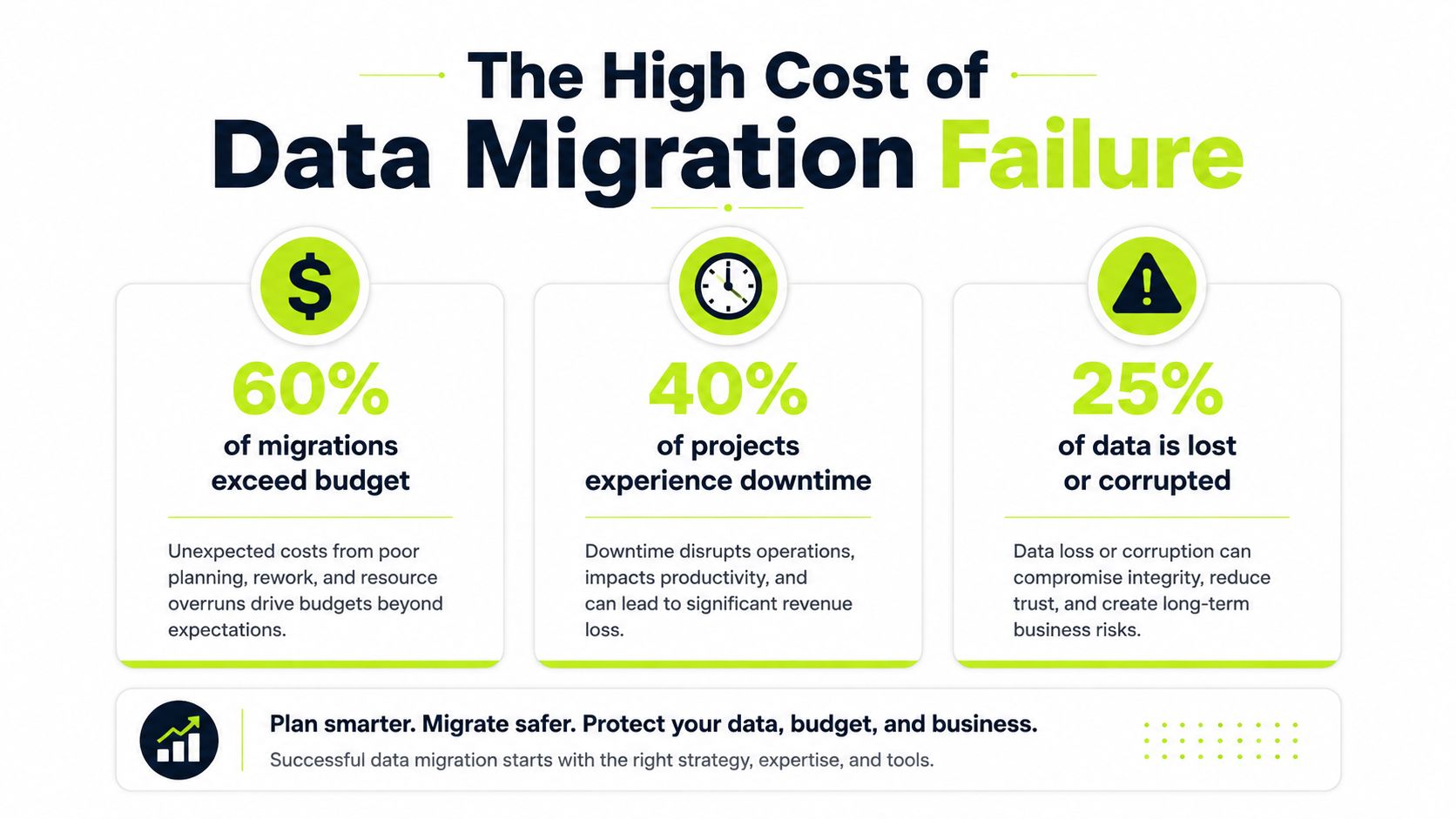
84% of data migration projects fail to meet their objectives or significantly overrun their original time and budget estimates. A sound data migration strategy treats that risk as a finance problem from the first planning meeting, not as an IT issue discovered during cutover.
That distinction matters for professional services firms managing billing, collections, client records, and cash application across systems that were never designed to work together. A migration can preserve every database row and still damage the business if invoice relationships break, payment records lose context, or the new AR workflow produces unreliable balances.
For a CFO or Controller, the question isn't whether data can move. The question is whether the firm can prove that the right data moved, that financial logic still works, and that cash flow won't become less predictable while the team learns the new platform.
The High Cost of Getting Data Migration Wrong
84% of data migration projects either failed to meet their objectives or significantly overran their original time and budget estimates, according to Bloor Research, with the pattern described as consistent across studies from 2011 through 2023 (Bloor migration statistics and industry analysis). Finance leaders should treat that finding as a cash-flow warning, not only a technology warning. Migration overruns often reach billing operations, collections, and reporting.
A professional services firm may move client master data, invoices, payment histories, engagement records, and credit notes into a new billing or AR platform. The technical team can report a successful load while the controller finds invoices tied to the wrong matter, remittance details placed in an unmapped field, or unapplied cash missing the identifiers needed for reconciliation.
The effects show up in the finance calendar. Billing takes longer. Collectors work from incomplete queues. Clients receive statements that do not match their records. Cash application becomes a manual investigation instead of a controlled process, and management reporting introduces uncertainty into cash forecasts and operating decisions.
Lift and shift is rarely a finance strategy
A lift-and-shift approach can shorten the route from legacy software to a modern environment. It can also move flawed structures without addressing the relationships finance relies on, including effective dates, account codes, invoice lines, payment references, approval status, and audit history.
A proper data migration strategy defines those financial controls before technical execution begins. The target must support validation, reconciliation, and evidence, not merely accept a file.
Practical rule: A migration is not complete when the target system accepts the file. It is complete when finance can reconcile the target to the source and explain every material difference.
Research on enterprise migrations reported that organizations using a three-phase migration strategy completed projects 40% faster than those using traditional approaches (enterprise data migration research). The result supports disciplined sequencing, but it does not make one method suitable for every firm.
Hybrid, batch, and stream approaches each carry different operational trade-offs. Hybrid orchestration may reduce downtime and failure exposure in large environments, while batch processing can be easier to control and stream processing can support fresher data. The choice should follow billing dependencies, reconciliation requirements, and the tolerance for interrupted cash application.
For a CFO or Controller, the preferred approach is the one that protects billing continuity and proves that the ledger, receivables subledger, and customer-facing records still agree.
Planning and Scoping Your Migration
The first planning document should resemble a financial control register as much as a technical design. Start by listing every system that creates, changes, stores, or consumes receivables data.
Build the inventory before choosing the method
Include the practice management system, CRM, billing platform, accounting software, payment processor, spreadsheet workbooks, reporting tools, and any integration that sends or receives invoice information. For each source, record the owner, purpose, data fields, refresh pattern, retention requirement, and downstream dependency.
Then trace a transaction from origin to reporting. A time entry may become a draft invoice, an approved invoice, an accounts receivable balance, a payment request, a remittance record, and a general ledger posting. If the team maps only the invoice table, it hasn't mapped the financial process.
A useful inventory separates:
- System of record: Identify which platform owns each customer, invoice, payment, credit memo, and account balance.
- Reference data: Document clients, matters, service codes, tax rules, currencies, payment terms, and account mappings.
- Dependencies: Note integrations, scheduled exports, API connections, approval workflows, and reports that rely on specific identifiers.
- Historical scope: Decide which transactions, statuses, notes, and attachments must remain searchable in the new environment.
- Control evidence: Preserve approval records, reconciliation outputs, exception logs, and audit history where the firm needs them.
Put finance in the design authority
IT can explain how data moves. Finance must define what “correct” means. Assign named owners from finance, operations, client service, and technology, then require sign-off on scope, mapping rules, test results, and cutover readiness.
The integration layer deserves particular scrutiny. A short primer on API connectivity and how systems exchange data can help nontechnical stakeholders understand why an apparently small field or identifier change may affect several workflows.
Don't approve a project with a vague objective such as “move AR to the new platform.” Write measurable acceptance conditions in business language: invoices must retain client and matter relationships, payment records must remain traceable, aging reports must reconcile, and users must know how to handle exceptions.
For infrastructure-heavy moves, teams may also benefit from reviewing compliant data center move strategies, particularly where physical environments, continuity planning, and governance requirements form part of the wider program. The same discipline applies to application migrations: define ownership, dependencies, recovery steps, and evidence before execution.
Data Mapping, Cleansing, and Enrichment
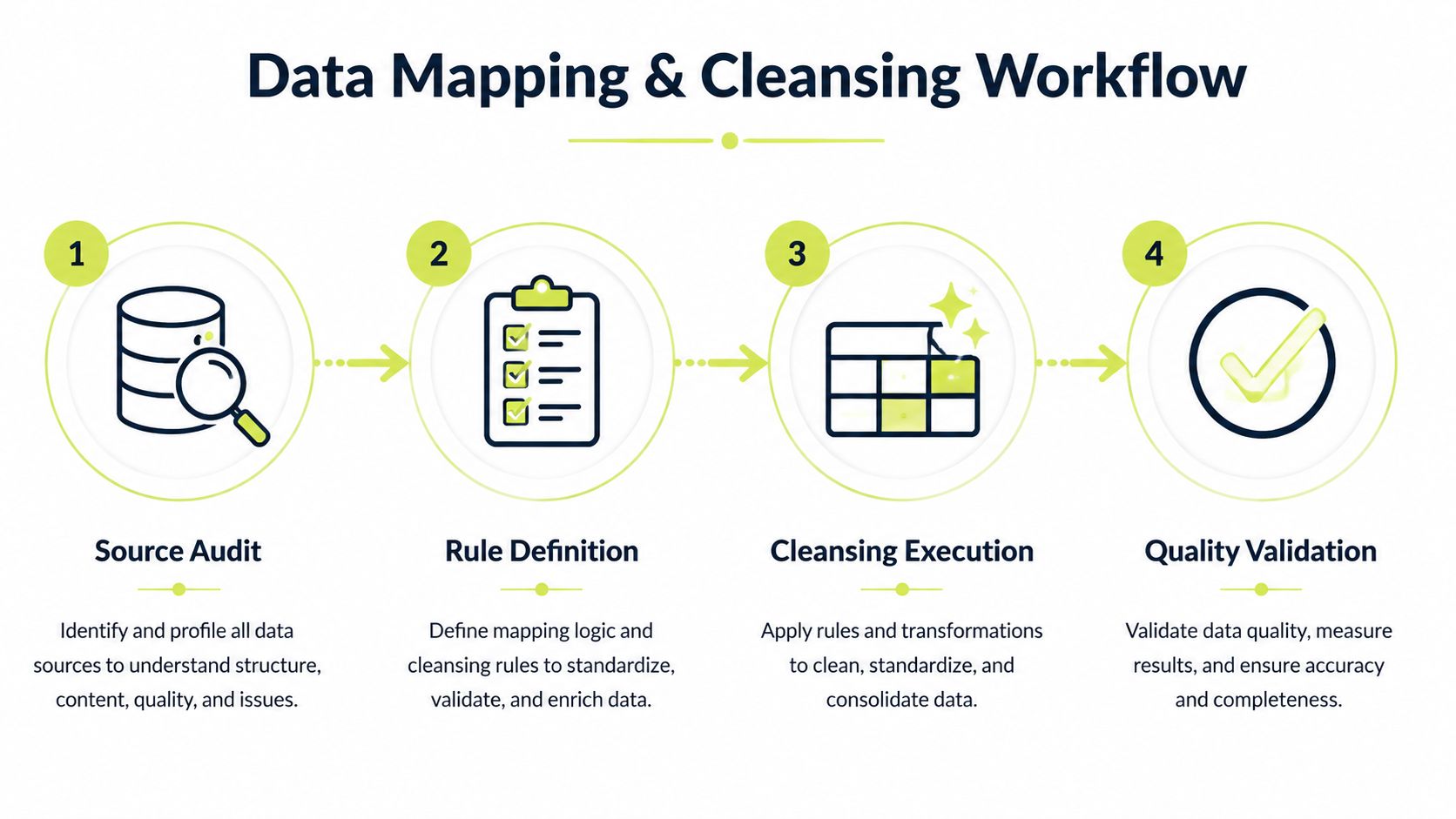
Data mapping is where finance discovers whether the legacy system and the target system describe the same business reality. Field names can appear similar while carrying different meanings. “Client” might mean a billing entity in one platform and a parent account in another. “Paid” might indicate a payment received, a batch posted, or a manually closed invoice.
Map business meaning, not just columns
Create a mapping specification that records the source field, target field, transformation rule, permitted values, owner, and validation test. Include examples for difficult records, not just standard invoices.
Pay close attention to:
- Identifiers: Preserve stable client, matter, invoice, and payment references so users can trace a transaction end to end.
- Dates: Align invoice date, due date, posting date, service period, and payment date. Different date conventions can distort aging and period reporting.
- Amounts: Define how tax, discounts, write-offs, credits, retainers, and partial payments are represented.
- Relationships: Test the links between client, engagement, invoice, line item, payment, and general ledger account.
- Statuses: Translate legacy values into target-state definitions rather than copying labels that users interpret differently.
- Notes and attachments: Decide which supporting records are required for collections, disputes, audits, or client inquiries.
A staging area should sit between extraction and loading. Never cleanse production data in place while the migration is underway. The staging process gives finance a repeatable record of what changed and why.
Clean the exceptions that affect cash
Duplicate clients may split credit exposure and cause collectors to contact the wrong entity. Inconsistent addresses can interfere with statements and legal notices. Missing account codes can push invoices into suspense or require manual journal work after go-live.
Use a controlled exception log. Each item should show the source record, issue, proposed correction, approving owner, and treatment if no correction is possible. Enrichment should add useful business context, such as standardized payment terms, normalized legal names, or a verified relationship between a parent client and its billing entities.
The receiving system shouldn't become a faster way to distribute bad data.
Before the transfer, reconcile source totals by client, invoice status, currency, and accounting period. Review a sample of complex transactions, including partial payments, credit notes, disputed invoices, and invoices with multiple line items. Then rerun the same checks after transformation and again after loading. This creates a chain of evidence rather than a single point-in-time spot check.
Security, Compliance, and Testing Protocols
Finance data migration carries two separate obligations. The team must protect sensitive information while it moves, and it must prove that the resulting records remain complete and trustworthy. A secure transfer that produces inaccurate receivables is still a control failure.
Define security controls before extraction
Limit access to the people who need it, separate development and production credentials, and document where extracts, staging files, backups, and logs will reside. Encrypt data during transfer and at rest, and establish retention and deletion rules for temporary files.
Review payment information, client tax details, bank data, personally identifiable information, and user permissions separately. A user who could view a legacy report may not need the same access in the new system. Migration is an opportunity to remove inherited access that no longer fits the firm's roles.
For an external perspective on control design, IT Experts Canada's security offerings provide useful context for evaluating security services around infrastructure and business systems. Finance should still own the business requirements, particularly around auditability, segregation of duties, and evidence retention.
The firm's data security measures for business systems should also align with the migration runbook. Don't create a temporary process that bypasses the controls expected in normal operations.
Test the logic that users rely on
A mock migration should exercise the complete path from source extraction through target reporting. Use representative records, including clean records and known problem records. The test isn't just “did the load finish?” It should answer whether the target system calculates, groups, filters, posts, and reconciles transactions correctly.
Run validation at several levels:
- Completeness: Compare source and target record populations, including active, closed, disputed, and partially paid invoices.
- Accuracy: Compare key values such as invoice totals, tax, due dates, payment amounts, and account assignments.
- Relationship integrity: Confirm that every invoice points to the intended client and engagement, and that every payment can be traced to its proper destination.
- Business logic: Rebuild aging, unapplied cash, collections queues, and management reports in the target environment.
- Audit continuity: Verify that approvals, adjustments, timestamps, users, and supporting evidence remain available.
A parallel run gives finance a controlled comparison between legacy and target outputs. Differences should enter a defect register with an owner, severity, root cause, and resolution decision. Don't accept “the numbers are close” as a control standard. A difference may be explainable, but it must be explained.
Cutover Planning and Risk Mitigation
Cutover is a controlled decision point, not a ceremony. The team freezes or limits changes in the legacy system, captures the final delta, loads it into the target, validates financial controls, and authorizes users to work in the new environment.

Choose timing around the cash cycle
Don't schedule the switch because the technology team has an open weekend. Schedule it around billing runs, payment files, collections commitments, month-end close, payroll dependencies, and client statement delivery.
The cutover plan should name each activity, its owner, start condition, completion evidence, and escalation path. Include the final source backup, delta extraction, target load, reconciliation, user access activation, payment processor checks, and communication to staff.
A phased approach can reduce exposure by moving a bounded group of clients, business units, or invoice workflows first. A hybrid approach can keep legacy and target environments synchronized while finance validates results. The trade-off is operational complexity. Running two systems requires disciplined ownership and clear rules about which system may receive each type of change.
Make rollback executable
A rollback plan isn't a sentence that says “restore the backup.” It defines the exact condition that stops the release, who has authority to make that call, how new transactions will be handled, and how the team will return users to the legacy workflow.
Set reconciliation gates before cutover. Examples include an agreed tolerance for record-count differences, confirmed invoice totals, verified payment references, and successful user acceptance testing. If a gate fails, the team pauses rather than improvises under pressure.
A rollback plan earns its value before anyone needs it.
Industry evidence shows why this discipline matters. Independent reporting found that only 6% of organizations completed their most challenging migrations on time and with zero downtime, while 46% experienced five or more hours of downtime during those migrations (database migration downtime analysis). Those findings make downtime a planning variable, not an afterthought.
Use the following video as a short visual prompt for thinking about the human and operational side of a system switch. The important lesson isn't the physical metaphor. It's that someone must own the decision to switch, pause, or reverse.
During the live transition, maintain a command log. Record timestamps, validation results, exceptions, decisions, and approvals. Keep a staffed exception channel open for billing and collections users, because they often identify relationship or workflow defects before a dashboard does.
Post-Migration Monitoring and KPI Validation
Go-live proves that the system can operate. It doesn't prove that the migration improved financial control. Post-migration monitoring should compare the new process with the baseline established during planning, with special attention to cash conversion and exception volume.
Watch the measures that reveal broken AR workflows
Days Sales Outstanding should be reviewed alongside invoice aging, billing timeliness, collection activity, and payment application. A change in DSO may reflect customer behavior, billing policy, timing, or a migration defect, so the metric needs supporting detail rather than a standalone interpretation.
Unapplied cash is especially useful because it exposes whether payment references, customer identities, and invoice relationships survived the move. Track the age and reason for unapplied items, then separate genuine customer ambiguity from system mapping errors.
Other practical checks include:
- Invoice population: Confirm that new invoices appear in the intended queues and reports.
- Payment matching: Review automatic matches and manual exceptions for recurring patterns.
- Collections worklists: Check that due dates, promises, disputes, and ownership remain visible.
- Client statements: Compare statements against source records before broad distribution.
- Integration health: Review failed messages, delayed synchronizations, and duplicate events.
- User adjustments: Monitor manual overrides because a sudden rise can signal weak mapping or unclear workflows.
The three-phase approach has been associated with system availability above 99.95% during migration windows and an 82% reduction in unplanned downtime, according to published research on staged migration execution (three-phase migration study). The practical implication is straightforward. Treat availability and downtime as control metrics during execution, then continue checking them after users return to normal work.
Automated comparisons should run on a defined schedule until exception levels stabilize. Finance leaders should receive a concise dashboard showing reconciliation status, unresolved defects, unapplied cash, DSO, billing output, and integration failures. For payment matching controls, automated payment reconciliation practices offer a useful reference point for reducing manual investigation and preserving traceability.
A migration has succeeded when the firm can trust its receivables data without maintaining a parallel spreadsheet as a private safety net. The target platform should make the financial position easier to verify, not harder to explain.
Resolut automates AR for professional services with consistent workflows, accurate reconciliation, and human oversight where judgment still matters. If your firm needs to protect cash flow while modernizing billing and collections, visit Resolut to see how the platform can support a controlled transition.