Data Security Measures for Financial Operations
A finance leader's guide to data security measures. Learn to protect AR systems, manage compliance (PCI, SOC 2), and measure your security posture.
Your client data probably lives in more places than you'd like. In the AR system. In emailed invoices. In the payment portal. In spreadsheets someone saved to a desktop and forgot about.
That's where data security measures stop being an IT phrase and become a finance issue. If a billing file, payment detail, or contact list leaks, the cost shows up in collections, client trust, and cleanup time. In professional services, those are not side effects. They're operating risk.
The hard part is that most firms treat security like a software setting. It isn't. It's a control system for cash flow, client confidentiality, and accountability. If you manage receivables, you already manage risk. Security is part of the same job.

Security as a Financial Control Not an IT Problem
A security lapse usually shows up in finance before it shows up in IT. The invoice file is exposed. The collections team loses time. A client asks hard questions about who saw what, and the answer is usually messy.
For CFOs and controllers, the right frame is straightforward. Client invoices, billing contacts, remittance details, and payment records are financial assets. Treat them with the same discipline you apply to segregation of duties, bank reconciliations, and approval limits. The systems that handle them should restrict access, create a clear audit trail, and keep the impact of any breach as small as possible.
Practical rule: if a user does not need a record to complete a task, that user does not need access to it.
That rule becomes even more important once security is tied to operational control. These principles are foundational to strong accounts receivable internal controls. They help prevent one person from seeing or changing more data than their job requires, which lowers the risk of fraud, errors, and slow dispute resolution.
Poor security does more than raise breach risk. It slows collections, creates audit work, and makes clients less willing to share sensitive payment data. That is why data security measures belong in finance leadership meetings, not only in vendor reviews.
The Three Pillars of Financial Data Defense
A collections manager sends an aging report to the wrong distribution list. A client portal export lands in a shared folder. A billing admin pulls a full contact file to answer one dispute and leaves it open on a laptop. In finance, those are security failures with direct operational cost.
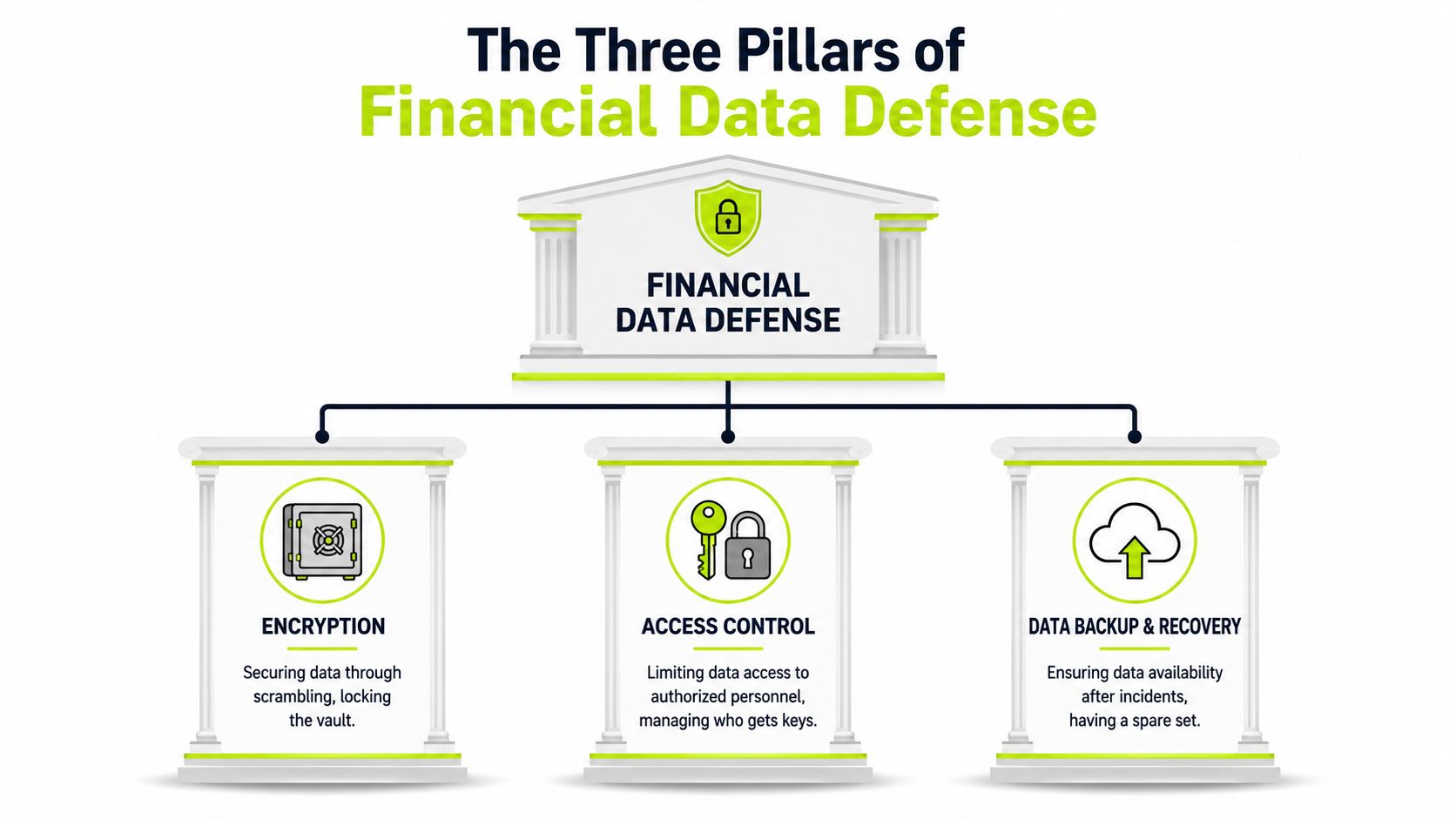
Strong security in finance usually comes down to three controls. Lock the data. Limit who can reach it. Watch what happens around it. Those are the controls that matter whether you're using an ERP, a billing platform, or AR software for professional services.
Encryption as the vault
Encryption is the vault around the file. If someone gets the file, they still can't read it without the key. For stored sensitive data, European data-protection guidance is specific. Password storage should use strong, irreversible cryptographic hashing with salting, and 256-bit whole-disk encryption is an acceptable standard for portable devices containing personal data (Data Protection Commission guidance).
In an AR process, that matters when laptops hold customer aging reports, remittance details, or exported invoices. A stolen device should not become a client data breach. That is the point of encryption. It reduces the damage when physical control fails.
The finance takeaway is simple. Encryption protects against theft after the fact. It does not stop an authorized user from exporting too much data. A collections lead can still copy a full debtor list if the permissions allow it, and that creates a different kind of exposure. So encryption is necessary, but it is not enough.
Access control as the key ring
Access control is who gets keys, and which doors they open. In accounting terms, this is like giving AP access to vendor bills, but not to every customer record in the system. The UK NCSC recommends protecting data at rest, using current standardized cryptographic algorithms, and limiting interfaces so they expose only necessary functionality (NCSC data security guidance).
That same discipline should shape an AR workflow. A billing analyst needs invoice status and payment history. That person does not need the full client master file, bank instructions, or admin rights to edit exports. Role design, least privilege, and API scoping keep the working set tight and reduce the chance that one account can expose too much.
The weak point is bulk access. If an admin panel or API can enumerate records in volume, encryption will not stop a user from pulling a large data set. In professional services firms, that can mean a staff member exporting every open receivable to build a local spreadsheet instead of working from the system of record. Access control should stop that by default, not after the fact.
Monitoring as the camera
Monitoring is the camera in the corridor. It does not prevent every incident, but it makes misuse visible. The same NCSC guidance recommends rate-limiting access to bulk datasets and logging accesses so teams can detect unusual queries or attempted exports.
For finance teams, that means spotting a pattern before it becomes a reconciliation problem or a client complaint. If a collections specialist exports the entire client contact list, that is outside normal daily activity. The alert should fire. If someone downloads an aging report at 2 a.m. or repeatedly opens records they do not manage, the log should show it without debate.
Security gets real when every sensitive action leaves a trail your team can review.
Applying Risk-Based Security to Your AR System
The finance question is not whether your vendor says “encrypted.” It's whether the right data is protected in the right way at the right point in the flow. In a receivables process, that means asking where invoice data is stored, who can export it, and whether payment credentials sit inside your core system or in a separate hosted payment flow. If you use a hosted payment layer, this hosted payment gateway overview is a useful lens for separating what your team should hold from what should be isolated.
Not every receivables record carries the same exposure. An invoice line item is sensitive. A payment portal carries more risk. Bank details and stored credentials sit at the top of the list. A sensible control model treats those layers differently, because one weak setting can turn a routine billing issue into a real cash and compliance problem.
For stored sensitive data, the standard should be layered protection. Passwords should be hashed with strong, irreversible methods and salting. Portable devices that hold personal data should use whole-disk encryption, and the guidance from Ireland's Data Protection Commission treats 256-bit whole-disk encryption as an acceptable standard.
Questions worth asking every AR vendor
- Where is data stored: Confirm whether invoice, customer, and payment records are stored separately or mixed into one broad repository.
- How are passwords handled: Look for strong hashing with salting, not reversible storage.
- Can permissions be narrowed: Check whether roles can be limited by task, region, or team.
- What gets logged: Ask whether exports, failed logins, and admin actions are captured.
- What happens on a device loss: Portable-device encryption should be part of the baseline, not an add-on.
The point is to reduce the number of places where a compromise can become a financial event. That matters in QuickBooks AR automation and similar setups, where convenience can push teams to overgrant access just to keep daily work moving.
A billing tool that makes access broad may feel easier at first. The control risk shows up later. A staff member with more access than they need can export account details, change payment instructions, or view records outside their lane. That creates audit work, collection delays, and avoidable exposure for client data.
The better test is practical. Can your AR process keep the payment step separate, limit who sees bank and credential data, and show exactly who touched a record? If the answer is unclear, the system is carrying more financial risk than it should.
A Practical Implementation Roadmap
The fastest way to improve security is to stop focusing only on production. Real firms leak data through copied files, test environments, and backups all the time. The Hong Kong PCPD explicitly calls out minimizing the use of real data for testing and separating database servers from web servers (PCPD guidance).
That matters because finance teams often assume the live system is the only system that counts. It isn't. A copied database used for testing can expose the same client records as production, just with weaker oversight. If you're reviewing a vendor, ask how they reduce real-data use in test environments and how they isolate server roles.
A short vendor checklist
- Real-data minimization Ask whether test and demo environments use masked or synthetic data.
- Environment separation Ask how web, database, and backup systems are segmented.
- Export controls Ask whether large downloads are restricted or flagged.
- Audit review Ask who reviews logs and how often.
- Credential discipline Ask whether credentials are rotated and access is reviewed regularly.
This is also where third-party tools deserve scrutiny. If you're evaluating accounts receivable automation, the security story should be part of the functional story, not separate from it. One option in the market, Resolut, positions AR automation around scoped access, auditability, and controlled workflows. That's the kind of design question finance leaders should probe in any vendor review.
The practical lesson is simple. Protect the live system, but don't stop there. Backups, demos, sandboxes, and copied files are part of the same risk surface.
Navigating Key Compliance Mandates
A client asks where their data lives. That is when compliance stops being abstract and becomes a control issue. For professional services firms, the primary job is not memorizing legal text. It is knowing which controls map to which data flows in accounts receivable and client records.
The broader regulatory picture is hard to ignore. Privacy laws now cover most of the global population across many countries, according to Usercentrics privacy statistics. Invoice handling, customer identities, and payment information now sit inside a wide legal perimeter. Security programs have to support operating continuity and privacy obligations at the same time.
What CFOs should be able to answer
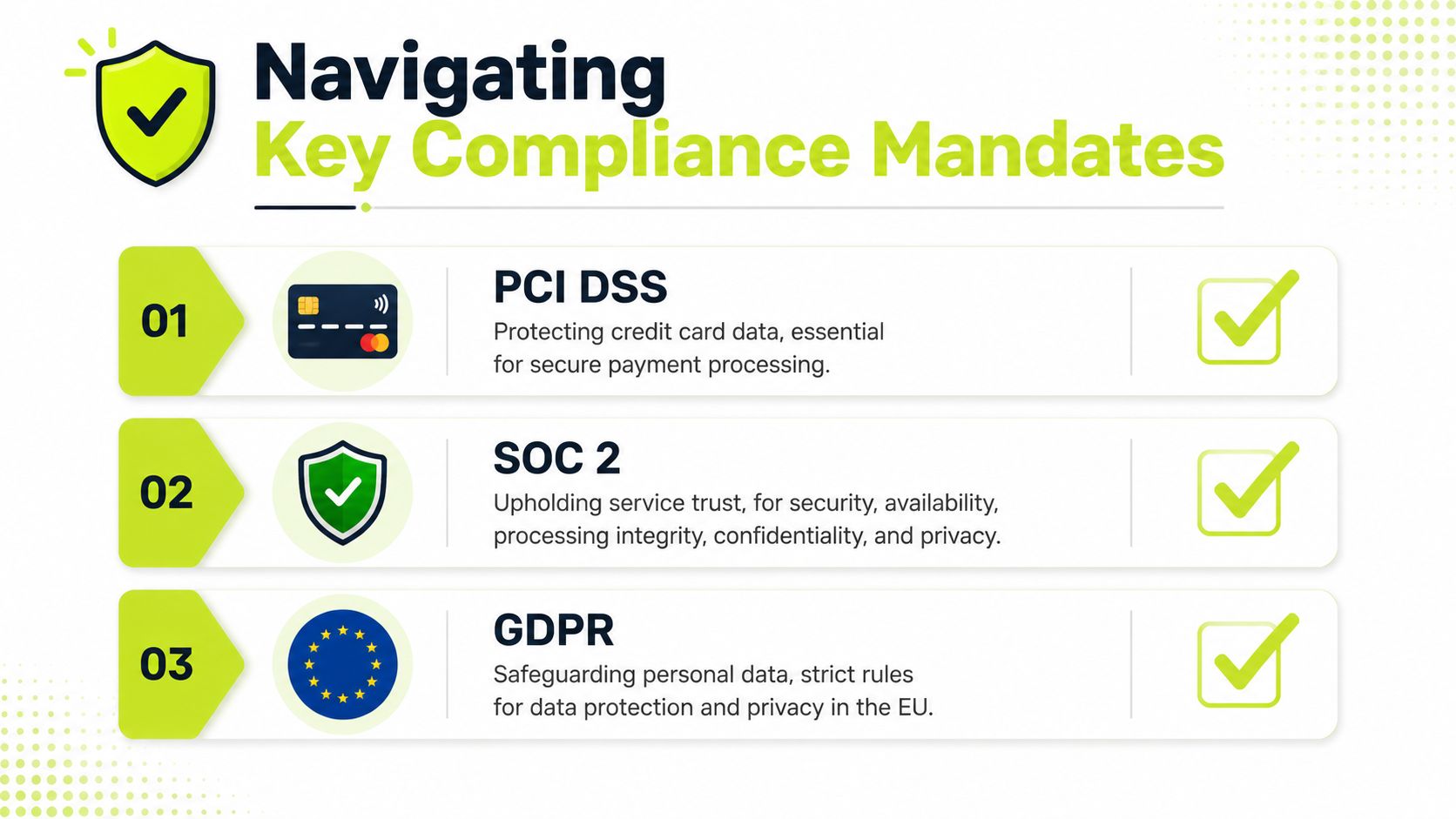
- PCI DSS: If your AR process accepts card payments, can a compliant payment vendor handle that card data instead of your core billing team?
- SOC 2: If your firm depends on a platform for billing and collections, does the vendor show disciplined control over security, availability, processing integrity, confidentiality, and privacy?
- GDPR: If you have EU clients, can you show how personal data is handled, limited, and retained?
Those are business questions first. Legal questions second. If the system design is sloppy, compliance work gets harder and more expensive. Data protection and process design belong together.
For a tighter operational view, the GDPR compliance guide is useful reading when your receivables workflow crosses borders.
Testing Your Defenses and Planning for an Incident
A security plan that only works on paper is not a plan. Finance teams need a response process that keeps collections moving if a system gets locked, a credential is stolen, or a client asks what happened. That is continuity planning, not panic management.
The best incident plans are plain. Who gets called first. Who talks to clients. Who preserves logs and evidence. Who decides whether invoicing moves to a fallback process. If your team can't answer those questions before an incident, it'll be improvising during one.
Test the weak points before someone else does
Phishing simulations matter because finance teams are frequent targets for credential misuse. Training should focus on real actions, not abstract warnings. People should know how to verify a request, how to report a suspicious link, and how to stop a payment change from becoming a fraud event.
AI-era exposure adds another layer. Attackers don't always need to steal one obvious record. They can reconstruct sensitive information from low-risk data. The 2025 Joint Cybersecurity Information guidance recommends provenance tracking, cryptographically signed hashes, anomaly detection, and regular training-data audits to address that risk (Palo Alto Networks data security best practices).
That's a different threat model from classic perimeter defense. It means the controls around your data lineage, auditability, and model inputs matter too. If your organization uses AI tools on billing or collections data, the question isn't just who can log in. It's what data went in, where it came from, and whether the system can prove it.
A calm response starts long before the incident. It starts with names, roles, logs, and a practiced sequence.
Measuring What Matters Your Security KPIs
Security gets better when it gets measured. Finance leaders already know this. If a control can't be tracked, it usually gets vague. The same logic applies to data security measures.
Start with a small set of KPIs that tell you whether the program is real:
- Vendor compliance coverage: How many critical vendors can show current security evidence.
- Time to patch critical systems: How long vulnerabilities stay open after they're identified.
- Log review timeliness: How quickly suspicious access gets reviewed.
- Access review completion: Whether user permissions are checked on schedule.
- Incident response readiness: Whether the response plan has been tested and updated.
These aren't vanity metrics. They tell you whether controls are being used, not just documented. They also help you speak to partners and the board in a language they understand, control quality, exposure, and accountability.
If you run receivables through AI AR automation, the same discipline should apply to the platform itself. The goal is not only to reduce DSO and improve cash flow, but to do it with tight permissions, clean audit trails, and fewer manual handoffs. That's how security becomes part of operating performance instead of a separate cost center.
For professional services firms, the standard should be straightforward. Sensitive billing data should be protected. Access should be narrow. Logs should be useful. And the people responsible for cash should be able to explain the control environment without translating from technical jargon.
If your firm wants receivables that are easier to control as well as easier to collect, review your AR workflow with the same discipline you'd use for cash and compliance. A practical next step is to map where invoice data, payment data, and client records live, then test whether your current system can support tighter permissions, better logging, and cleaner recovery. A CTA for Resolut.