Digital Wallet Integration for Professional Services Firms
Digital wallet integration reduces DSO and improves cash flow for professional services. Learn architectures, rollout steps, and KPIs finance leaders need.
A $45,000 consulting invoice has been outstanding for 38 days. The client's AP team is waiting for a check signature, while the same company just paid a $12,000 SaaS vendor in seconds through Apple Pay. Nothing is wrong with the engagement or the invoice. The payment process is creating avoidable delay.
That gap is now an accounts receivable operations problem, not a minor checkout inconvenience. For a professional services firm billing $3M–$50M, payment options influence how quickly invoices get approved, paid, identified, and posted to the ledger. Digital wallet integration can remove friction from the final mile, but only if the payment data reaches AR in a form the finance team can reconcile.
Why Your Clients Already Expect to Pay With a Digital Wallet
A client can approve a professional services invoice in the morning and still wait days for a check run or bank process to finish. The invoice is valid, the approval exists, and the delay comes from the payment path. Each manual handoff gives an otherwise payable invoice another place to stall.
Traditional B2B workflows often require someone to open a paper invoice or PDF, enter payment details, route the request for approval, wait for a check run, and depend on mail delivery or a separate bank process. Digital wallets remove several of those steps. From an invoice email, an authorized payer can open a payment link, select a saved card or wallet, authenticate on a familiar device, and complete the transaction without re-entering the full credential set.
The experience matches the consumer and software payments clients already use. That matters for mid-market companies and technology-focused enterprises, where AP policies may remain formal but the individual making the payment still expects a mobile-friendly, clear interface.
For the firm, the objective is operational. A faster payment path can reduce collection friction, but it also needs to return usable transaction data to AR. Otherwise, a quicker authorization creates more unidentified cash and manual reconciliation.
Practical rule: Offer a faster payment path without weakening approval controls. The client can preserve its internal authorization process while giving the authorized payer a simpler way to complete the transaction.
Market adoption supports that expectation. Digital wallets reached roughly 4.5 billion users in 2025, equivalent to 54.9% of the world's population, with projections for more than 5.2 billion users by 2026 and around 6 billion by 2029, according to digital wallet adoption data. Those figures do not mean every client will choose a wallet. They show that wallet acceptance extends beyond mobile-first consumers.
The practical test is straightforward. If a client can pay another software vendor from a saved wallet in a few taps, your firm should not force manual entry, a separate portal login, or a check signature unless policy requires it. The professional services payment experience guide also treats the payment experience as part of the collection process.
For a $3M–$50M firm, even a qualitative reduction in payment lag can improve working-capital control. The finance question is whether the firm can make payment easier while preserving approval evidence, invoice matching, and clean cash application.
The Business Case for Digital Wallet Integration in AR
For a professional services firm, a client may approve an invoice on Monday but leave the payment sitting in an internal workflow until Friday. A wallet option can shorten that lag, but the finance case depends on what happens after authorization. Payment speed matters only when settlement, matching, and posting keep pace.
A well-designed payment flow reduces collection touches, produces a cleaner payment record, and moves cash application closer to straight-through processing. That combination affects DSO, staff capacity, and the reliability of daily cash reporting.
Faster settlement changes the working-capital conversation
A five-day reduction in payment lag can be meaningful for a firm billing $3M–$50M annually. Payroll, contractor costs, and tax obligations continue regardless of when clients pay. The actual benefit depends on invoice volume, client mix, payment terms, and wallet usage, so finance teams should model it from their own aging report rather than accept a generic promise.
Compare wallet and non-wallet invoices across four measures:
- Invoice age at payment, measured from issue date to successful authorization.
- Collection effort, including reminders, calls, and escalation activity.
- Cash application time, from processor settlement to posted invoice.
- Net processing cost, after fees, refunds, disputes, and operational labor.
This comparison separates a faster payer experience from a measurable AR improvement. A wallet may reduce authorization time while leaving settlement delays, missing remittance data, or manual exception handling unchanged.
Market growth supports treating wallet connectivity as a payment-rail decision. One 2025 market view estimated global digital wallet revenue at USD 56.77 billion, while another projected the market to reach USD 145.35 billion by 2030, at a 20.9% CAGR, as reported in the digital wallet global market report. These figures describe infrastructure growth, not a guaranteed return for an individual firm. The investment still needs to pass the firm's own DSO, cash application, and cost analysis.
Cash application is where AR teams feel the difference
Wallet payments can carry structured references such as invoice IDs, client IDs, and payment amounts. If the processor passes those fields through reliably, the AR system can match the payment against an open receivable instead of sending a staff member to investigate an unidentified deposit.
That shortens the gap between client payment and an accurate ledger. Controllers can then distinguish genuine collection performance from a bank balance that has not yet been posted correctly. For a broader comparison of payment rails, review the methods covered in B2B online payment methods.
AR Metric | Before Integration | After Integration | Impact |
|---|---|---|---|
Payment initiation | Manual bank or check process | Direct link with wallet option | Less payer friction |
Payment identification | Remittance email or deposit research | Structured transaction reference | Faster matching |
Collection activity | Repeated reminders and status checks | Automated payment prompts | Fewer manual touches |
Cash visibility | Settlement and posting may be separated | Status updates can feed AR workflows | Better cash forecasting |
Cross-border payments require tighter controls. Wallets can simplify the client's payment experience, but they do not automatically resolve reconciliation, compliance, currency, or reporting requirements. Independent industry reporting describes digital wallets as a difficult endpoint for cross-border integration, with 8% of respondents calling them the easiest option to integrate. Security, payment tracking, and processing speed were among the leading challenges in that report, cross-border digital wallet integration coverage.
For firms with international clients, the business case should therefore include exception volume and close-cycle impact, not only authorization speed. A payment rail earns its place when it improves the full AR process, from client initiation through verified settlement and posted cash.
How Digital Wallet Integration Works Under the Hood
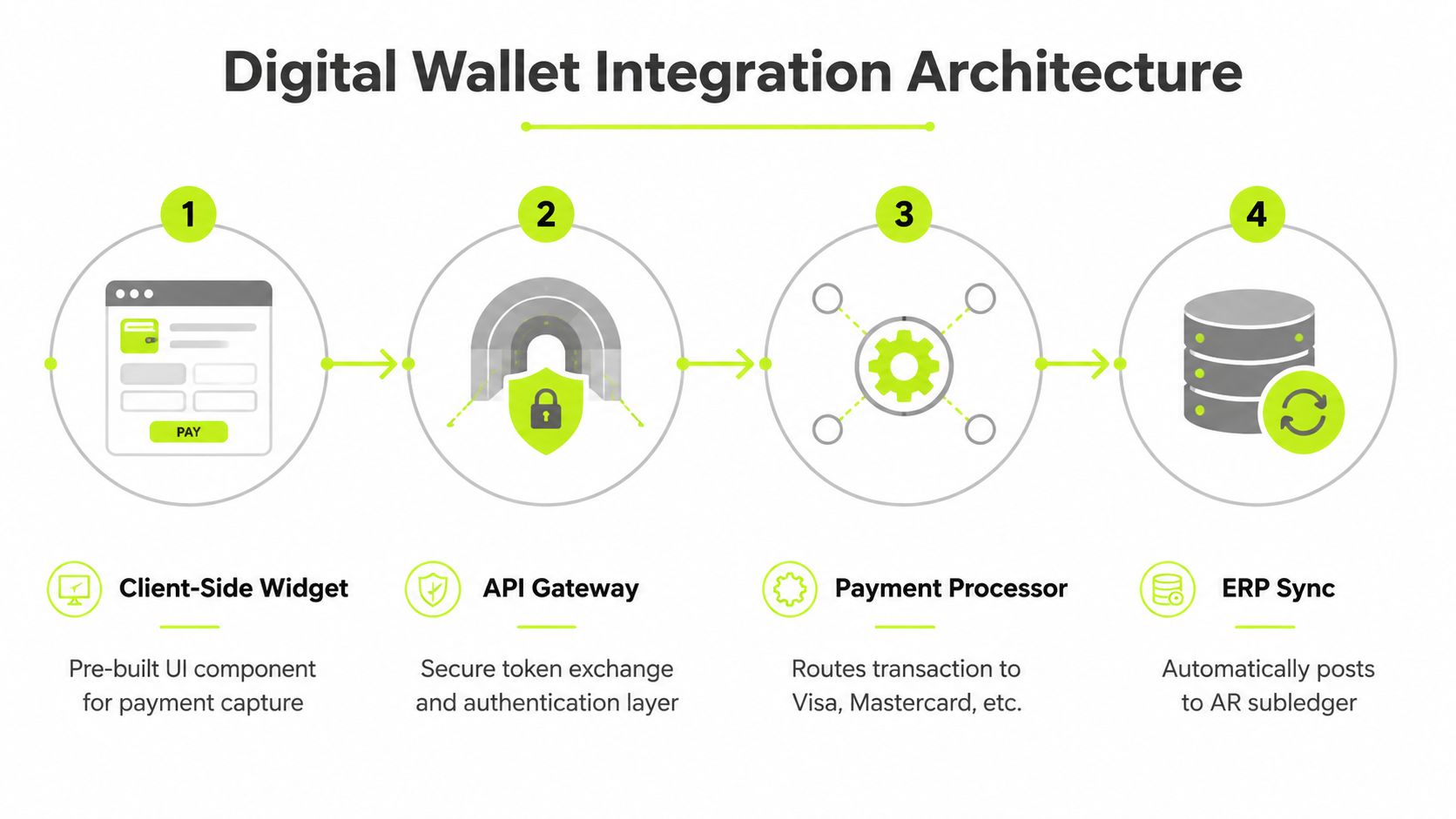
For a professional services firm, a wallet payment touches more than checkout. The architecture determines where invoice context is retained, who handles payment exceptions, how settlement data reaches the ERP, and how much reconciliation work remains for AR. Vendor proposals may use “wallet support” for very different designs, affecting implementation effort, PCI exposure, and failure handling.
Choose the payment surface first
A client-side widget is a pre-built payment component placed in an invoice email, customer portal, or billing page. The provider manages much of the wallet interaction, making this option practical for a lean finance team seeking a quick deployment with limited engineering involvement. The trade-off is less control over payment states and billing-specific behavior.
A server-to-server API requires more design work. The billing or AR system communicates with the provider to create payment requests, authorize transactions, capture funds, issue refunds, and receive status changes. Firms with multiple entities, complex billing rules, partial payments, or programmatic payment-state controls generally need this level of integration. Teams assessing API connectivity for finance systems should also examine how those events move into the ERP and cash-application workflow.
Vendor capabilities vary far more than many finance leaders assume. Focus on whether the integration preserves invoice context, exposes settlement data, and makes exceptions visible to the team that owns AR.
Understand tokenization and payment status
EMV payment tokenization replaces the primary account number with a unique payment token constrained to a merchant, device, or payment scenario. The Token Service Provider manages token creation, verification, lifecycle, and the mapping between the token and the underlying PAN, as described by EMVCo payment tokenization.
This design can keep the merchant from storing or handling PAN directly. For a professional services firm, that generally means a smaller PCI footprint and less responsibility for protecting raw card credentials. The provider should still identify which components remain in scope and explain wallet provisioning, issuer authentication, and card eligibility checks.
Webhooks perform the operational handoff. After a payment event occurs, the provider sends a notification to the AR platform. That event should update the invoice status, support cash application, record fees, and route exceptions for review. Confirm whether failed webhook events can be replayed, event order is preserved, and authorized, captured, settled, refunded, and disputed states remain distinct.
Security controls can include 3D Secure authentication, fraud scoring, encryption, device checks, and issuer validation of wallet-generated cryptograms. EMVCo describes mobile wallets as supporting secure contactless payments through NFC on smartphones, tablets, and wearables in its mobile wallet overview.
For teams reviewing developer workflows, the AgentStack Stripe integration shows how payment actions can be exposed through an integration layer. Finance should still ask whether invoice identity survives the handoff, settlement data is available for reconciliation, and failed payment events reach the correct owner.
Operational Trade-Offs Finance Teams Must Weigh
Digital wallet integration can shorten the path from invoice to payment, but it adds variables to the AR operating model. The most obvious is cost. Card and wallet transactions can carry percentage-based processing fees plus a fixed component, while ACH and wires follow different pricing and settlement conventions.
A fee that looks acceptable for a small invoice may be difficult to justify on a large professional services balance. A Controller should compare the net cost of funds with the cost of waiting, including collection labor, forecast uncertainty, borrowing needs, and the commercial value of a smoother client experience.
Compare the rails, not just the headline fee
Payment Method | Typical Fee | Settlement Time | Reconciliation Effort | Dispute Risk |
|---|---|---|---|---|
Digital wallet | Provider and card-network pricing varies | Depends on authorization and settlement arrangement | Low when invoice metadata passes through, higher when settlements are batched | Client disputes and chargebacks require evidence |
ACH | Bank or processor pricing varies | Bank and processor schedules apply | Moderate, especially with weak remittance data | Return and reversal rules apply |
Wire transfer | Bank and intermediary pricing varies | Often direct, but timing depends on bank processing | Moderate to high when references are incomplete | Less like a card chargeback, but recovery can be difficult |
Check | Processing and handling costs vary | Mail, deposit, and bank processing create delay | High when remittance is missing | Stop-payment and fraud concerns remain |
Wallet settlements may arrive as a lump sum rather than as one deposit per invoice. If a client pays several invoices together, the AR system needs matching rules that can allocate the total accurately. Without those rules, a faster payment creates a faster unidentified-cash problem.
Chargebacks deserve separate treatment. A wallet dispute can place funds on hold while the processor reviews the case, and the firm may need to produce the engagement record, invoice, authorization evidence, and delivery documentation. That burden is different from an ACH return and should be reflected in the firm's dispute workflow.
Set boundaries before clients use the option
Not every wallet belongs on every invoice. A firm might offer wallets for smaller, routine, or time-sensitive invoices while preserving ACH or wire instructions for large balances and clients with strict treasury policies. The policy should also address refunds, partial payments, credit memos, foreign currency, data residency, and the treatment of processing fees.
Finance decision: Approve a wallet method when the expected reduction in payment friction and AR effort outweighs its fee, dispute exposure, and reconciliation cost for that client segment.
A Practical Rollout Roadmap for AR and Finance Teams
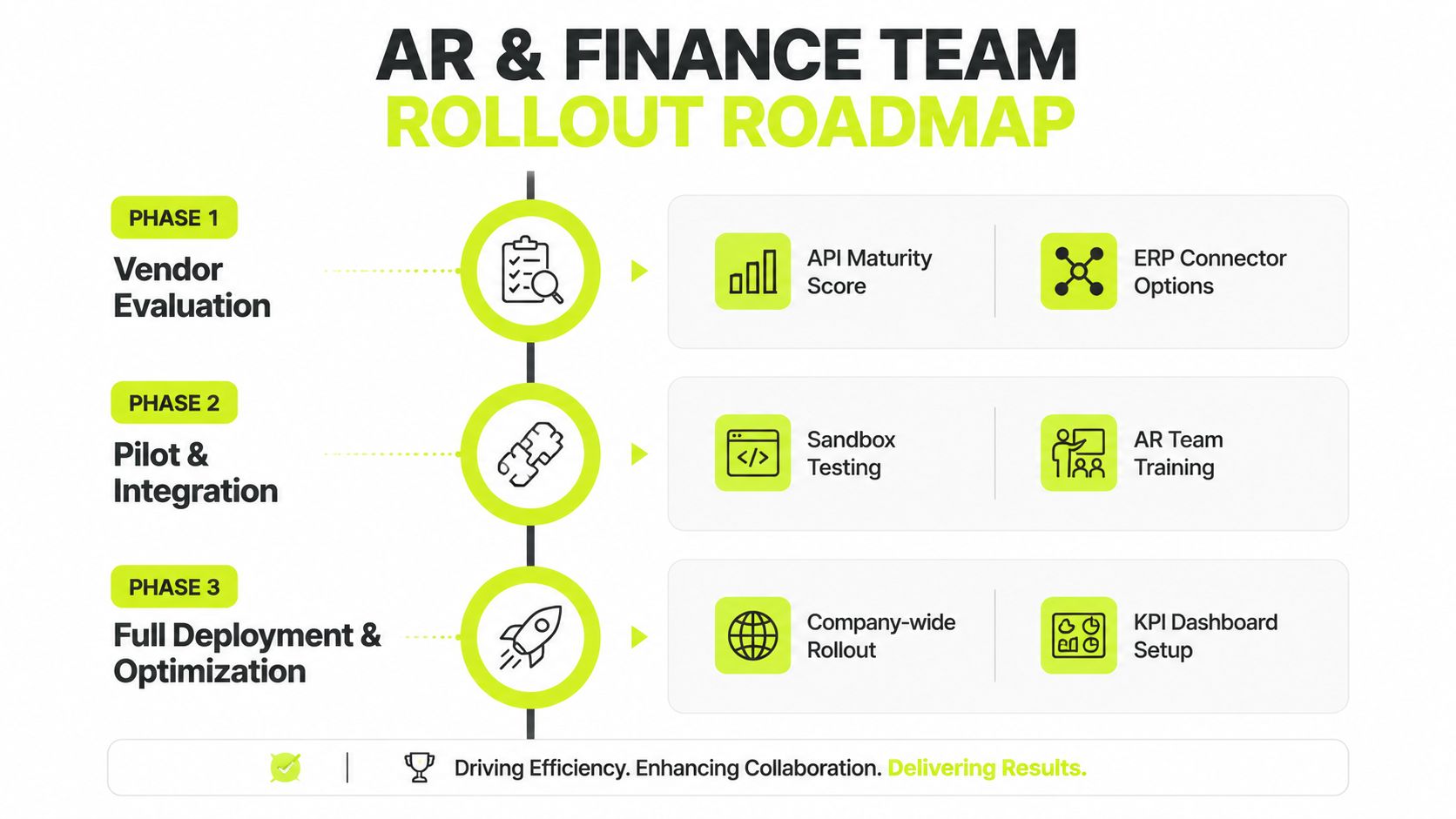
A controlled rollout is easier to govern than a firm-wide launch. The finance team should begin with a narrow use case, verify the data flow, and expand only after the ledger and settlement reports agree.
Phase one evaluates the vendor
The Controller, billing manager, and IT lead should jointly review:
- API maturity: Confirm that the provider supports authorization, capture, refund, dispute, and status events.
- ERP connectivity: Check whether the connector posts to the AR subledger or only exports a settlement file.
- Settlement detail: Require invoice-level references, fee lines, currency fields, and payout timing.
- Billing flexibility: Test partial payments, overpayments, credit memos, recurring invoices, and multi-entity account structures.
- Operational support: Clarify escalation paths, outage communication, webhook recovery, and chargeback evidence requirements.
The evaluation phase can fit into a short internal planning cycle when the vendor has a usable sandbox and an existing ERP connector. Don't advance on a polished demo alone. Require a transaction-level walkthrough from invoice creation to ledger posting.
Phase two pilots with a defined client group
Select 10 to 15 clients with outstanding balances for the pilot. Choose a mix of payment behaviors, invoice sizes, currencies, and client approval structures. Add the wallet option to invoice emails and the client portal, while keeping the existing payment methods available.
During the pilot, AR should reconcile wallet activity in parallel. Compare processor records, bank settlements, invoice statuses, fee entries, refunds, and exceptions each business day. Teams can then discover whether the promised metadata arrives in the format the ERP requires.
Phase three deploys and controls the process
Before full deployment, update billing templates, train AR staff on authentication failures and disputes, configure automated cash application rules, and document who owns unresolved transactions. The Controller should sign off on accounting treatment, the IT lead on security and integrations, and the billing manager on client communications.
The go-live checklist should include:
- Webhook endpoints: Test successful events, delayed events, duplicate events, and recovery after an outage.
- Refund workflows: Confirm approval, accounting entries, client notifications, and settlement impact.
- Processor economics: Negotiate available interchange or processing terms and document assumptions.
- Engagement terms: Update payment language, refund provisions, fee treatment, and accepted methods.
- Reporting: Build views for wallet volume, settlement status, fees, disputes, and unapplied cash.
The rollout video below can help finance and implementation teams visualize the sequence from evaluation through optimization.
KPIs to Track and Common Pitfalls to Avoid
Post-launch reporting should separate payment speed from accounting speed. A client may authorize a wallet payment quickly, while settlement or cash application remains delayed. If the dashboard shows only transaction volume, it can make an incomplete process look successful.
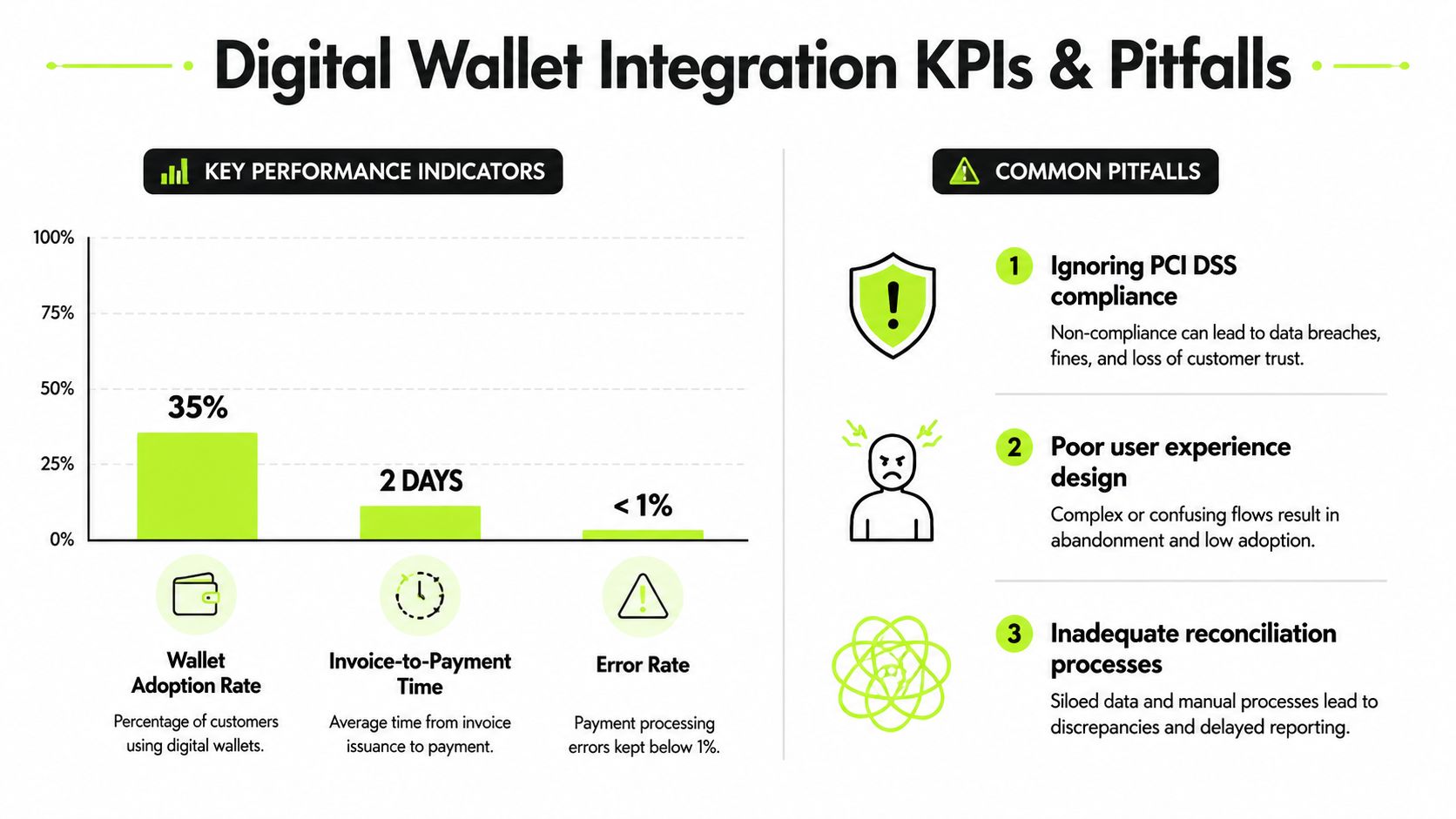
Track wallet adoption as a share of invoices paid, then compare average days-to-pay for wallet and non-wallet transactions. Add cash application accuracy, unapplied cash aging, refund turnaround, dispute rate by client segment, and net processing cost as a share of collected revenue.
Leading indicators help explain future adoption. Monitor payment-link clicks, portal activity, failed authentication attempts, and the proportion of clients who begin but don't complete payment. These signals identify user experience problems before they appear in overdue balances.
The failures usually happen outside the happy path
- Partial payments weren't tested: A client applies one payment across several invoices, and the system cannot allocate it correctly.
- Settlement lag was ignored: The wallet shows a successful payment, but the bank deposit arrives later, distorting short-term cash forecasts.
- Fees weren't reconciled: The processor deducts charges at settlement, but the AR ledger records only the gross invoice payment.
- Authentication friction was underestimated: Clients abandon the flow after a verification failure, then return to slower payment methods.
- Currency conversion lacked controls: Cross-border payments create differences between invoice currency, settlement currency, and ledger currency.
Run weekly comparisons between wallet and ACH performance, audit processor fees monthly, and review disputes quarterly by client segment. End-to-end testing should include successful payment, declined payment, refund, duplicate webhook, delayed webhook, partial payment, and international currency conversion. The operating standard is not “the client paid.” It is “the payment arrived, the status is reliable, the fee is posted, and the invoice is reconciled.”
Where Digital Wallets Fit in the Future of AR Automation
Digital wallets are one payment layer within a broader AR automation strategy. Their value depends on a connected sequence covering invoice delivery, reminders, payment collection, cash application, and ledger updates.
Sequence investment carefully. Stabilize invoice accuracy and delivery first. Resolve recurring disputes next, because faster payment options cannot fix an invoice the client cannot approve. Add wallet payments for defined client segments where they reduce payment friction and send transaction data into automated matching.
Regional payment preferences require a method strategy rather than one global rollout. Firms may need stored value, cards, account-to-account payments, staged payments, and other relevant rails. As noted earlier, regional market data shows why payment methods and client expectations vary by location.
For CFOs and Controllers, the durable objective is lower DSO, cleaner cash application, fewer manual exceptions, and better cash visibility across domestic and cross-border work. QuickBooks AR automation, AI AR automation, and payment connectivity should operate within the same control environment. That means finance teams should define ownership for settlement reconciliation, exception handling, and ledger posting before expanding wallet coverage.
Resolut automates AR for professional services with a payment portal supporting cards, bank transfers, and digital wallets. It connects payment activity with automated cash application and invoice workflows. Finance teams evaluating DSO reduction can review Resolut to assess whether the platform fits their controls, workflows, and exception process.