
6 Example of Dunning Letter Templates
Review 6 example of dunning letter templates for every AR stage, with channels, timing, personalization, and automation tactics for professional services firms.
The strongest example of a dunning letter isn't the harshest one. It's the notice matched to the invoice stage, client context, and next action, within a sequence that can move from a reminder before the due date to a final demand after 60+ days overdue.
Professional services firms need to reduce DSO and improve cash flow without damaging relationships built on trust and expertise. A client who misses an invoice may have overlooked it, questioned a deliverable, or be managing a temporary cash constraint. Treating every overdue account as deliberate nonpayment produces unnecessary friction.
A dunning letter is a formal written reminder for a past-due invoice, but effective dunning is broader than a single document. Oracle's receivables documentation describes structured letter sets, status tracking, and dunning-history reports that preserve correspondence, aging, balances, and finance charges for review and auditability. Oracle's dunning documentation also reflects the operational reality that dunning works as a sequence, not an isolated message.
The six examples below cover friendly, neutral, authoritative, payment-plan, dispute, and external-escalation scenarios. Accounts receivable automation applies timing, channel, personalization tokens, approvals, and payment options consistently across email, SMS, print, and phone.
The message should escalate only when the evidence does.
1. The Friendly Reminder, First Notice
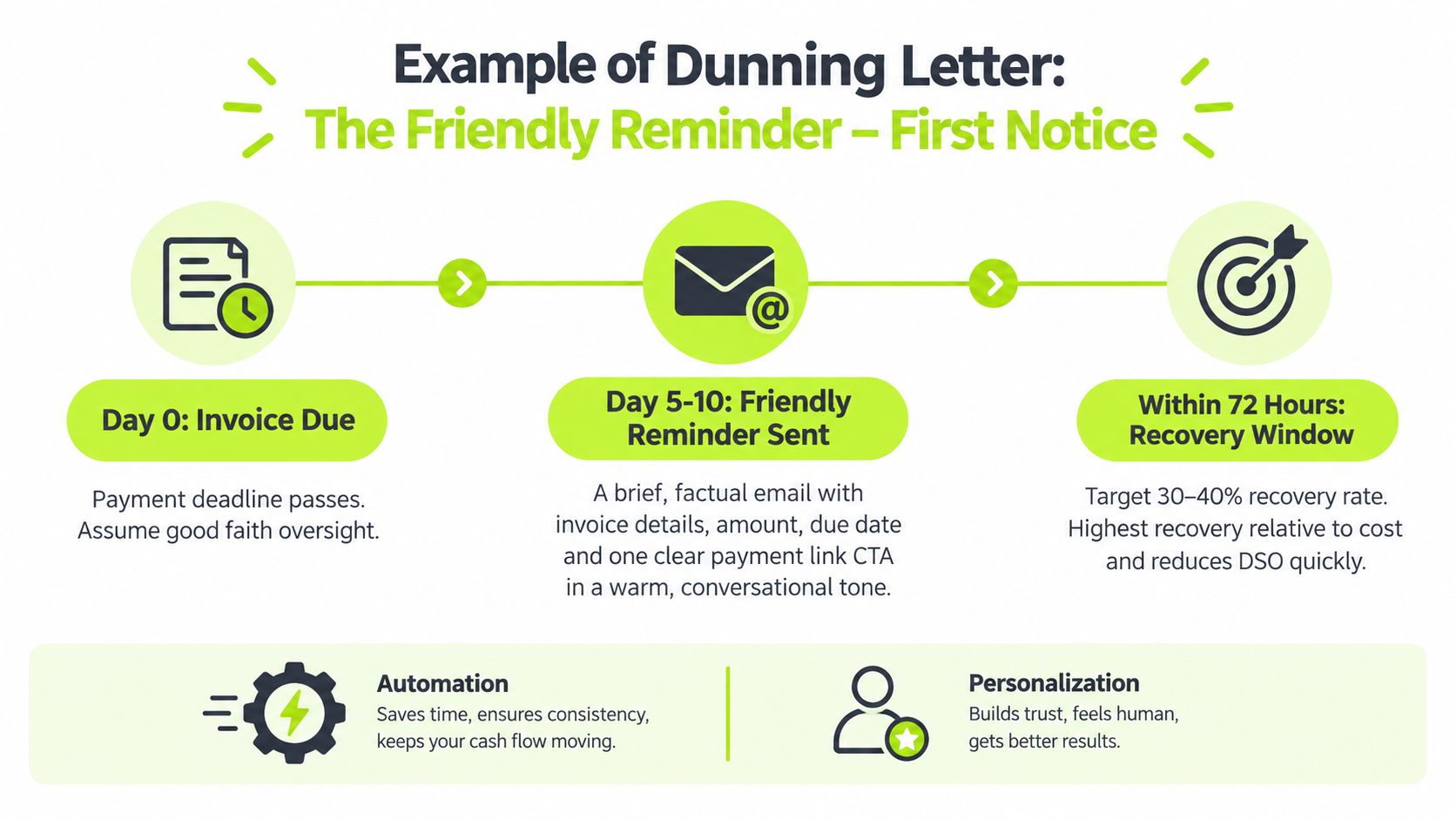
The first overdue notice should treat the delay as unresolved administration, not deliberate nonpayment. Send it soon after the due date, while the invoice and project context are still familiar and the client can correct the issue without a difficult conversation. A controlled cadence may include reminders before the due date, on the due date, and at staged overdue points. Oracle's receivables workflow supports this staged operating model.
For an accounting, consulting, or legal firm, identify the work behind the balance. “Invoice for Q4 tax planning services” gives the recipient more useful context than a bare invoice number. Include the client's name, invoice number, original due date, exact balance, approved payment methods, and a direct payment link.
A usable template can read:
Subject: Friendly reminder for invoice #[number] >Hi [client name], A quick reminder that invoice #[number] for [service or project] was due on [date]. The outstanding balance is [amount]. You can pay securely using [payment link]. If payment has already been sent, please disregard this note. If you have a question about the invoice, reply here or contact [name] at [phone]. Thank you, [sender]
Remove friction before adding pressure
The payment path should require little searching. Clients should not need to find an old email, confirm bank details, or ask where to pay. Offer the approved methods your firm supports, such as card or bank transfer, and make the next action clear.
The first notice also tests the account record. Confirm that the billing contact, project reference, balance, payment instructions, and delivery channel are correct before automation sends the message. A wrong recipient or missing reference can create a process problem that looks like client resistance.
Use automation for routine follow-up. QuickBooks AR automation can support invoice visibility and reminder workflows, while broader AR software for professional services can connect invoice status, client segmentation, correspondence, and payment activity. Keep exceptions, such as a known billing dispute or approval delay, out of the automatic sequence until an owner reviews them.
A short, specific reminder can recover payment while preserving the working relationship.
2. The Urgent Notice, Second Demand
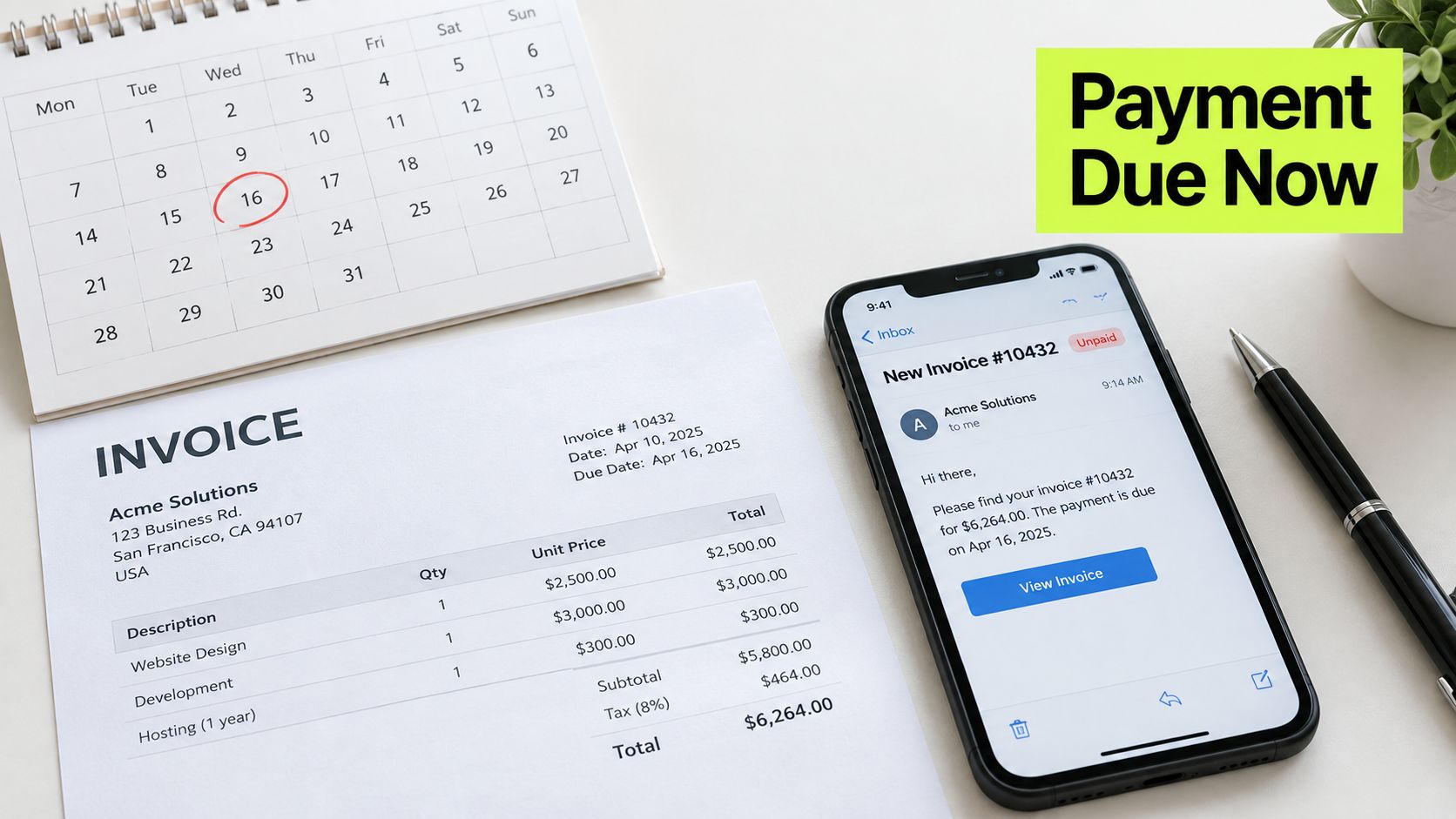
The second notice should create a clear decision point, not repeat the first reminder. Reference the earlier contact, restate the invoice and balance, and set a specific response or payment date. A staged approach often places this notice around 15 days past due, with formality increasing as delinquency continues. A staged dunning framework from Stuut uses this progression.
Keep the tone direct without damaging the client relationship:
Subject: Second notice, invoice #[number] remains unpaid >Hi [client name], >Following our reminder sent on [date], invoice #[number] for [amount] remains unpaid. The invoice was due on [original due date]. Please arrange payment by [deadline]. >If you're unable to pay in full or believe the invoice needs review, contact [name] at [direct email and phone] so we can address it promptly. >We value our work together and would like to resolve this without further escalation. >Regards, >[sender]
If the contract permits late fees, show each charge separately instead of folding it into a new total. Unexplained additions can prompt a dispute and delay the original payment. Reference the relevant agreement or payment term, then have finance or legal confirm that the language matches the contract.
Pair written notice with judgment
The account owner may need to join the written process. A strategic client with a strong payment history may respond better to a call alongside the notice, while repeated nonresponse calls for a defined escalation rule and less discretionary delay.
Record the workflow outcome, not just the send date. Capture delivery status, replies, promised payment dates, dispute flags, and requests for payment arrangements. Invoice-level fields such as days past due, balance due, and finance charges help controllers rank receivables and assign the next action. Oracle's dunning history reporting documents this type of dunning history information.
The notice should give the client three practical routes: pay, raise a legitimate issue, or request a documented arrangement. Each route should lead to an owner, deadline, and recorded outcome.
3. The Firm Demand, Legal or Final Notice
A firm demand marks the boundary between routine follow-up and formal collection control. The account may be 30 to 60 days overdue, but age alone shouldn't trigger legal language. Confirm that the invoice is valid, the work was delivered, the contract supports the proposed consequence, and no unresolved dispute is sitting in another team's inbox.
This notice should state the debt plainly. Identify the invoice, services, due date, amount, applicable contractual charges, and payment deadline. If the firm may suspend services, refer the client to the relevant agreement and make sure the business is prepared to follow through.
Practical rule: Never threaten a consequence that your firm isn't prepared and authorized to carry out.
A final notice might say:
Subject: Formal notice regarding overdue invoice #[number] >Dear [client name], Invoice #[number], for [service description], remains unpaid. The balance of [amount] was due on [date] and is now [days] days overdue. Under Section [number] of our services agreement, [contractual consequence] may apply if payment isn't received by [deadline]. Please pay through [payment link] or contact [named owner] at [direct details] to resolve the balance or discuss a documented arrangement. If the account remains unresolved after the deadline, we may suspend services or refer the balance for further recovery, subject to the agreement and applicable law. Sincerely, [authorized sender]
The legal effect of a dunning letter varies by jurisdiction. Stripe's guidance on writing a dunning letter explains that France permits an administrative dunning letter once an invoice is overdue, but doesn't generally make it mandatory, while UK business-to-business debt can involve statutory interest and fixed compensation after default. Consumer cases may require a final notice before collection fees. Cross-border firms should have counsel review language, especially where interest, compensation, service suspension, or legal referral is mentioned.
Preserve evidence and client judgment
For significant balances, use a delivery method that creates a reliable record, such as email with retained delivery evidence or a formal postal process recommended by counsel. Keep the invoice, contract, work acceptance, prior notices, call notes, and any client responses together.
The tone can be authoritative without being insulting. A high-value client may still need a direct conversation about cash flow before the formal notice is sent. The point isn't to sound like a lawyer. It's to establish that the firm has moved from informal reminders to a controlled decision.
4. The Payment Plan Proposal, Structured Settlement
Not every overdue account should move directly from final notice to write-off or litigation. When a client acknowledges the balance and can't pay it in full, a payment-plan proposal gives the firm a controlled recovery path. A practical plan should specify the installments, dates, payment method, consequences of default, and the person responsible for monitoring it.
Payment plans can be structured over 2–4 installments across 30–90 days, according to the operational framework in the supplied collections guidance. The commercial trade-off is straightforward. A firm may prefer a documented, monitored recovery over abandoning a collectible balance, but it shouldn't use payment plans to postpone an account that shows no credible ability or willingness to pay.
A proposal can include:
- Acknowledged balance: Confirm the invoices covered and the total amount due.
- Payment schedule: State each installment amount and exact due date.
- Payment method: Include the portal link or approved bank instructions.
- Default condition: Explain what happens if an installment is missed.
- Acceptance record: Require written confirmation from an authorized client contact.
Make the arrangement operational
The agreement should be easy to understand and difficult to misinterpret. Avoid vague language such as “pay when possible.” A stronger clause states that a missed installment may make the remaining balance immediately due, subject to the contract and applicable law. Legal review is appropriate for material balances or unusual security provisions.
Use automation to send reminders before each installment and alert the owner when a payment fails. Resolut's automated payment-plan workflow is relevant when finance teams need the plan, reminders, payment status, and follow-up ownership in one process.
A controller should also set approval rules. A trusted client with a clear dispute or temporary cash constraint may receive a plan quickly. A client that has broken prior arrangements may require a larger initial payment, executive approval, or a decision to escalate instead.
The plan isn't a concession without boundaries. It's a collection instrument with dates, evidence, and an owner.
5. The Collections Escalation Notice, Referral to a Third Party
External escalation should follow failed internal attempts, not replace them. When an account is 60+ days overdue and the client hasn't paid, engaged, or accepted a payment plan, the firm may notify the client that it intends to refer the balance to a collections agency or attorney. The notice is factual and final. It should not exaggerate what the third party can do.
A useful letter states the history, current balance, cure deadline, and planned referral:
Subject: Final internal notice before external recovery >Dear [client name], We have contacted you regarding invoice #[number], due on [date], and the outstanding balance of [amount]. We haven't received payment or a substantive response. Unless payment or a written resolution proposal is received by [deadline], we may refer the account to [agency or attorney] for further recovery. Please contact [named owner] immediately if you dispute the balance or need to discuss an arrangement. This notice doesn't change the underlying invoice or contractual rights. Sincerely, [authorized sender]
Decide whether escalation is economical
External recovery has a cost in money, time, and client relationship. Review the balance, documentation, jurisdiction, contract, likelihood of recovery, and agency terms. For a smaller invoice, the cost of referral may exceed the likely recovery. For a material account, an agency or counsel may be more appropriate than allowing internal follow-up to continue indefinitely.
This guide to working with an AR collection agency is useful when defining handoff records and escalation responsibilities. Before referral, assemble the contract, invoices, delivery evidence, correspondence, dispute history, call notes, and payment records.
Give the client a final cure window only if the firm will honor it. Then transfer the account cleanly and stop contradictory internal messages. The client should know who owns the next conversation, what amount is claimed, and how to raise a genuine dispute.
A third party can protect staff time, but it shouldn't become a substitute for credit discipline. Use the data from the handoff to identify recurring causes, such as weak scopes of work, missing purchase-order controls, or inconsistent invoice delivery.
6. The Dispute Resolution and Negotiation Template
A disputed invoice isn't the same as an ignored invoice. Chasing it with increasingly aggressive reminders can damage a valid client relationship and obscure the issue. The dispute notice should acknowledge the concern, separate facts from emotion, identify the contract or scope, and set a specific path to resolution.
Start with the client's stated objection. It may relate to the amount, a retainer scope, a deliverable, a time entry, or the agreed payment terms. Then provide the supporting record without turning the email into an argument.
Subject: Resolution plan for invoice #[number] >Hi [client name], We acknowledge your concern regarding [specific issue] on invoice #[number]. Our records show [concise factual summary], based on [statement of work, email, approval, or deliverable]. We propose a call on [date] to review the issue. We can discuss the specific charge, consider an appropriate credit where supported, or agree on corrective work if the deliverable fell short. Please confirm which option you'd prefer by [deadline]. We'll keep the disputed amount on hold while we review it and will continue to follow up on any undisputed balance. Regards, [sender]
Protect both recovery and the relationship
A marketing agency might respond to a scope dispute by listing the agreed strategy sessions, identifying what was delivered, and offering a limited corrective step if the record supports it. A CPA firm may use an independent review when the client challenges a technical calculation. These options are more productive than repeating the original invoice total.
Keep disputed invoices in a separate workflow. The finance team should distinguish blocked cash from ordinary slow payment, while the service team owns the underlying quality or scope question. Resolut's dispute-resolution process can support that separation by organizing disputes, owners, evidence, and next actions.
For cross-border matters, firms can also use this cross-border payment dispute resolution guide when jurisdiction, currency, or service-delivery questions complicate the conversation.
Escalate unresolved disputes when they stagnate, but don't send a final demand that ignores an open, documented objection. A clean resolution record helps the firm recover the undisputed amount, decide whether a credit is justified, and improve future scopes of work.
6 Dunning Letter Templates Comparison
Template | 🔄 Implementation Complexity | ⚡ Speed / Efficiency | 📊 Expected Outcomes / Impact | Ideal Use Cases | 💡 Key Tips |
|---|---|---|---|---|---|
The Friendly Reminder – First Notice | Low, simple email template, easy to automate | ⚡ Fast, targets quick payment within days | ⭐📊 Target 30–40% recovery within 72 hours; reduces DSO early | Early-stage dunning for likely oversight in professional services | Include direct payment link, personalize, send Tue/Wed 10am, A/B test subject lines |
The Urgent Notice – Second Demand (15–30 Days Past Due) | Low–Medium, templated escalation; may need sales coordination | ⚡ Moderate, actionable within ~10 days | ⭐📊 Target 20–30% recovery within 10 days; clarifies who is cash-constrained | When first notice is ignored to distinguish busy vs. reluctant payers | Reference prior notice, itemize late fees, offer phone contact, segment by client value |
The Firm Demand – Legal/Final Notice (30–60 Days Past Due) | Medium–High, formal letterhead, legal review, proof of delivery recommended | ⚡ Moderate impact but high leverage in short window (3–5 days) | ⭐📊 Target 40–50% pay within 5 days; 15–20% request plans; remainder → collections | Boundary-setting escalation for sustained nonpayment; CFO-level decision point | Get legal sign-off, use registered mail for large balances, assign single contact, enforce stated consequences |
The Payment Plan Proposal – Structured Settlement | Medium, requires negotiated terms and tracking automation | ⚡ Slower recovery (30–90 days) but high net recovery over time | ⭐📊 Target 70–80% plan completion; recovers majority vs. write-off | Clients who admit inability to pay in full but are willing to engage | Require written acceptance, automate installment reminders, set hard default clauses, limit frequency |
| The Collections Escalation Notice – Referral to Third Party | High, coordination with agency/attorney, full documentation required | ⚡ Slow and costlier, recovery over months with agency fees | ⭐📊 Expected recovery 20–35% after agency cut; timeline 90–180 days | Final step for 60+ days unpaid accounts or >$10K strategic balances | Pre-vet agencies, send registered notice with 10-day cure window, document all prior attempts | | The Dispute Resolution & Negotiation Template | Medium, cross-team coordination; needs accurate contract/scope records | ⚡ Often faster than legal escalation if handled promptly (target ~15 days) | ⭐📊 Target 90%+ of disputes resolved within 15 days when process is followed | When client raises substantive dispute (scope, quality, amount) rather than silent nonpayment | Restate scope/terms, offer 1–2 resolution options, assign single contact, track disputes separately
Turn Templates Into a Controlled AR Workflow
Six letters don't create control by themselves. Control comes from connecting each message to a trigger, an approved tone, a payment path, an owner, and a documented next decision. The firm should know why a notice was sent, what evidence supports it, and what happens if the client doesn't respond.
For each stage, define:
- Stage trigger: Use invoice age, promise-to-pay status, failed payment, dispute state, or account risk.
- Approved tone: Keep early reminders courteous, later notices direct, and legal language subject to review.
- Personalization tokens: Insert the client name, invoice number, service description, due date, balance, contract reference, and account owner.
- Payment channel: Provide the approved portal, bank-transfer instructions, card option, or other available method.
- Escalation threshold: State when the account receives a call, formal notice, payment-plan review, agency referral, or executive approval.
- Outcome owner: Assign responsibility to finance, the account lead, legal, or an external partner.
- Measurement: Track payment, response, dispute, promise-to-pay, and escalation outcomes.
A practical operating cadence can start before the due date and escalate through Day 1, Day 7, Day 14, Day 21, Day 30, and Day 45+. Catchpole's DSO-reduction cadence uses those points to connect courtesy reminders, calls, formal notices, escalation, and a decision about agency follow-up or write-off. The exact schedule should reflect contract terms, client behavior, service continuity, and jurisdiction.
Measure the sequence as a system. Review recovery rate, response time, dispute aging, payment-plan completion, and DSO by client segment, service line, and invoice source. A template may perform well for recurring retainers but poorly for project work where scope acceptance is unclear.
Accounts receivable automation supplies the repeatability that manual follow-up lacks. NetSuite describes automated dunning as a systematic process that tracks overdue invoices and sends payment letters through configured dunning procedures assigned to customers, invoices, or invoice groups. NetSuite's automated dunning documentation reinforces that this is rule-based account and invoice control, not a mass email campaign.
For professional services firms, AI AR automation can help identify at-risk invoices, suggest the right channel, and surface patterns across disputes and payment behavior. Human approval should remain in place for sensitive disputes, material credits, legal escalation, and exceptions to approved payment-plan policy. The best AR software for professional services supports that balance, automation for consistent execution and people for judgment.
Connect the workflow to your billing and accounting environment. QuickBooks AR automation can help teams coordinate invoice status and follow-up, while a broader orchestration layer can link outreach, payment options, cash application, and escalation records. Firms that want to get paid faster with invoices should also make the invoice itself clear, payable, and easy to reconcile.
Resolut can fit into this operating model as an accounts receivable automation and orchestration platform for collections workflows, payment-plan follow-up, dispute handling, and human-reviewed escalation. Resolut automates AR for professional services, consistent, accurate, and human.
Resolut helps professional services firms coordinate dunning stages, personalized outreach, payment plans, disputes, and escalation in one AR workflow. Visit Resolut to see how your finance team can apply consistent collection control while keeping human judgment where the client relationship matters.