Follow Up on Invoice Email: 7 Templates for Faster Payment
Seven follow up on invoice email templates with timing, subject lines, and tone guidance for professional services AR teams. Built for CFOs and controllers.
A $12,000 consulting invoice is five days overdue. The reminder gets a reply asking who owns approval, and three people end up on the thread. The wording was clear; the ledger status, decision-maker, and next action were not.
Late payment can point to an approval, documentation, or cash-flow issue, each of which calls for a different response. Intrum's European Payment Report reports that 55% of surveyed European firms experienced problems caused by late payments in 2024.
The seven follow-up email templates below form a dated sequence, not interchangeable reminders. Each pairs a subject line and adaptable message with a rule for sending, pausing, or escalating based on the invoice's ledger status, dispute state, and client risk.
A pre-due-date confirmation can clear an approval blocker. Sending that same message after the invoice has been disputed may delay resolution. Match each email to the account's current status and define the next step before sending.
1. Before the Due Date Confirm Receipt and Remove Payment Blockers
Send this message three to five business days before payment is due. You're not implying the client is late. You're confirming the invoice reached the right accounts payable contact with everything approval requires.
For professional services firms billing retainers, milestones, or time, that's the cheapest collection step you'll ever run. A missing purchase order number or a wrong contact costs nothing to fix this week and two additional weeks if you find it after the due date.
Template
Subject: Invoice [number] for [project], due [date]
Hi [name], confirming invoice [number] for [amount and currency], due [date] under our agreed terms. Please let me know if you need anything else for approval or payment. You can pay using the secure instructions on the invoice. Thanks, [your name].
Controls Before You Send
- Confirm the status first: Verify the invoice is open and the due date matches agreed terms, not the draft date.
- Include complete references: Invoice number, project reference, amount, currency, and secure payment instructions belong in every touch.
- Check deliverability: Review how to check if emails are going to spam before assuming silence means refusal.
Use accounts receivable automation to trigger this reminder from verified due dates and suppress it the moment payment lands. If you're evaluating QuickBooks AR automation, verify how the integration handles invoice edits, credits, partial payments, and synchronization delays, because a reminder sent on stale data undermines trust faster than no reminder at all.
Practical rule: If the client replies that approval sits with someone else, update the contact record that day. Don't keep emailing the person who just told you they can't release payment.

Stop this stage once receipt and approval are confirmed. There's no second pre-due nudge unless the approval owner changes.
2. On the Due Date Request Payment Without Suggesting Delinquency
On the contractual due date, the invoice is due, not delinquent. Your message should give the client a clear payment prompt while allowing that a transfer may already be scheduled.
Most firms either skip this step entirely or send language that reads like a late notice. Both cost you. Silence lets the invoice age unnoticed, and premature firmness makes a punctual client's accounts payable team defensive about the next invoice too.
Template
Subject: Invoice [number] due today, [amount]
Hi [name], invoice [number] for [amount] is due today, [date]. If payment is already scheduled, thank you, and please disregard this note. If not, the secure payment link is [link], and the original invoice is attached for reference. Best regards, [your name].
Checks That Protect the Relationship
Review settlement status and recent remittance advice before sending. A payment released this morning may not have cleared, and chasing it anyway tells the client your records lag theirs.
Send during the client's local business hours where practical. A reminder that arrives at 6 p.m. their time sits under a night of other mail.
Your choice of professional email sign-offs matters less than consistency. Use the same sender name and format across the sequence so the thread reads as one controlled process, not improvised messages from whoever was free.
Keep bank details identical to the original invoice. That consistency is a fraud control, not a formatting preference.
That caution is grounded in the 2024 AFP Payments Fraud and Control Survey, which found that 80% of organizations reported being targeted by payments fraud activity in 2023. Verify any requested change to remittance instructions through an established contact and approval process, never through the reminder thread itself.
If the client confirms a release date, record it and pause. You don't need another message until that date passes without settlement.
3. Three to Seven Days Overdue Ask for a Specific Payment Date
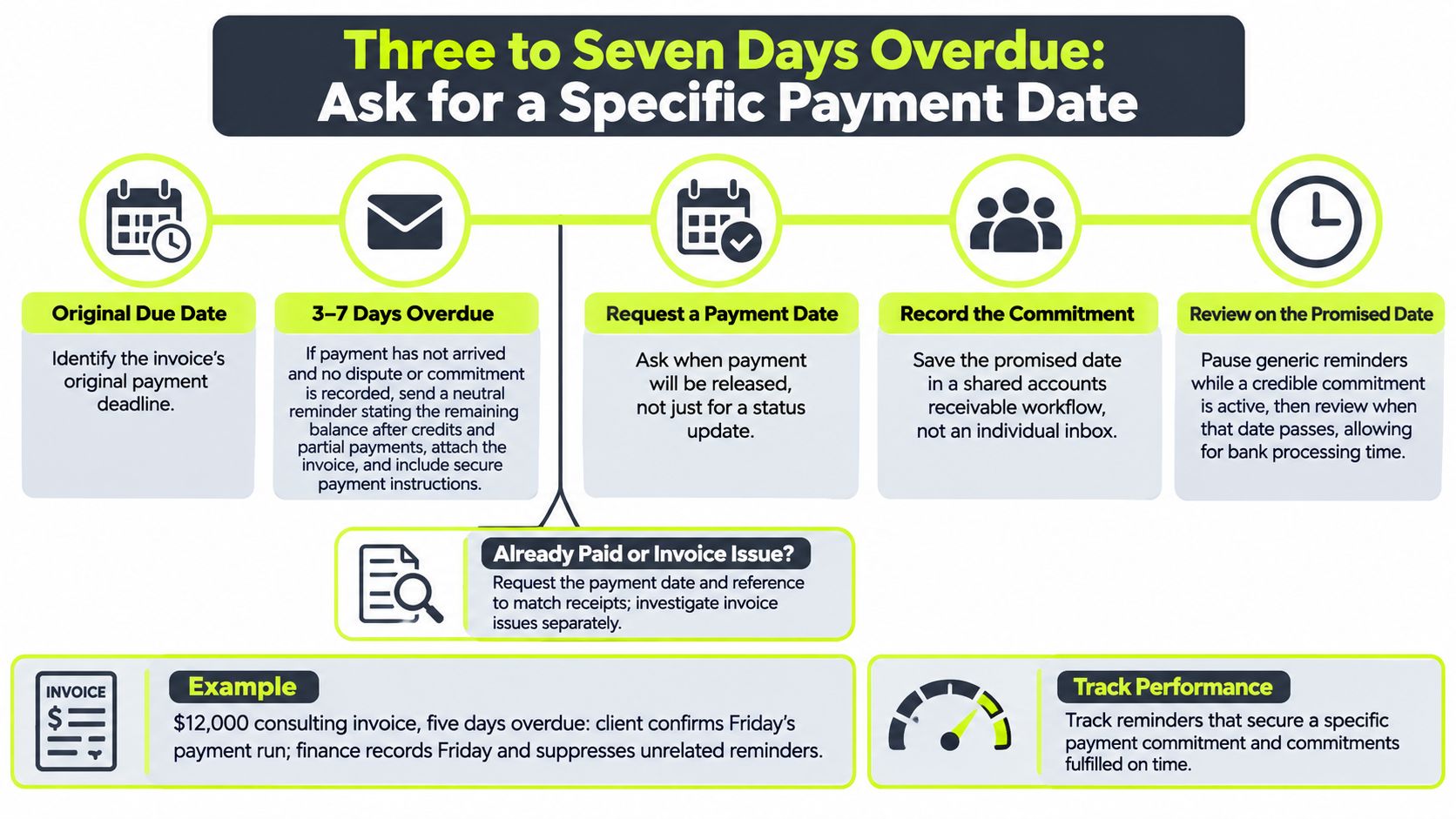
Three to seven days past due, the ledger should show whether the invoice is unpaid or held up by a dispute or an existing commitment. Ask for a release date only when there is no recorded dispute and no payment promise. Otherwise, follow the dispute or commitment already in progress. A mismatched email and ledger record weakens trust and creates duplicate work.
Template
Subject: Invoice [number] payment date needed
Hi [name], invoice [number] for [remaining balance] was due [date] and remains open. Could you confirm the specific date payment will be released? If something is holding approval, reply here and I'll route it today. Thanks, [your name].
For example, a $4,800 design invoice is six days overdue, with no dispute or prior commitment on file. The client confirms payment is scheduled for Friday. Record Friday as the promised release date, allow for bank processing, and pause unrelated reminders until that date passes. A promise to pay in an AR workflow gives the team a dated follow-up point rather than another generic message. If Friday passes without settlement, check the ledger before resuming contact.
What to Record
- Show the remaining balance: Apply credits and partial payments so the email matches the open ledger balance.
- Log the commitment centrally: Keep the promised date in the shared AR workflow, not just an individual inbox.
- Pause on a credible promise: Suppress generic reminders, then review the account if the promised date passes without payment.
Choose the channel based on the client's response history and the records available to your team. A vendor blog from Zintego reports that email is used in 93.8% of invoice follow-up activity and combining text and email increased the likelihood of payment within one week of the due date by 56%. Treat those figures as directional, not independently audited benchmarks. Email may be sufficient for a client who responds in the thread; a text can complement it when that channel is already appropriate for the relationship.
4. Fourteen to Thirty Days Overdue Escalate to the Right Approver
At two to four weeks overdue with no payment and no reliable commitment, the problem is usually not that your reminder was too polite. It's that the person receiving it can't release the funds.
Escalation means reaching the right approver with a defined response deadline. It doesn't mean a wider distribution list or a harsher tone. Copying six people who lack authority just creates six people who assume someone else is handling it.
Template
Subject: Invoice [number] requires approval confirmation by [date]
Hi [name], invoice [number] for [balance], due [date], remains unpaid after our messages on [dates]. Please confirm by [response date] who owns final approval and the expected release date. I've copied [approver or account owner] so we can resolve this in one thread. Regards, [your name].
If you're unsure what CC means in email practice for a sensitive escalation, the working rule is simple. Copy one named person for a stated reason, and say why in the body.
Escalation Discipline
- Set thresholds by risk: Use invoice value, client history, and prior behavior, not age alone.
- Brief your relationship owner first: Nobody on your side should learn about an escalation from the client's reply.
- Don't invent consequences: Introduce late fees or service restrictions only when the contract and applicable law support them.
AI AR automation earns its place here, prioritizing accounts by risk and drafting context-aware messages while a human approves anything sensitive. The context is sobering, since Atradius found that 47% of B2B invoices in Western Europe were overdue in 2025. At that scale, manual prioritization breaks down.

5. Disputed Invoice Separate Resolution From Collection
The moment a client questions scope, hours, rates, deliverables, or approval, the invoice leaves the collection sequence. Standard overdue reminders sent to a client with an open dispute don't accelerate payment. They convince the client you aren't listening.
Move the balance into a resolution workflow with a named owner and a target date. Then send a message that acknowledges the specific issue rather than restating the amount louder.
Template
Subject: Invoice [number] resolving [specific item]
Hi [name], thank you for flagging [item]. I've paused collection reminders on invoice [number] while [owner name] reviews [deliverable] against the agreed acceptance criteria. We'll respond by [date]. The undisputed balance of [amount] remains due under the contract, and we'd appreciate payment of that portion in the meantime. Regards, [your name].
Consider a client disputing $3,000 of a $15,000 milestone invoice. The project lead reviews the deliverable against written acceptance criteria while finance requests the undisputed $12,000, subject to the contract and the client's payment process. Both tracks move at once, neither blocks the other.
That distinction reflects how late payment happens. A 2025 study identified invoice errors, delayed claims, bureaucracy, outdated systems, multiple approval steps, and poor budgeting as key causes of late payment. Most nonpayment is operational, not intentional, so diagnose the blocker before you choose the message.
Resolution Hygiene
- Attach only relevant evidence: Approved change orders or time summaries, not the full project file.
- Keep the balance visible: Disputed amounts stay in receivables reporting even while reminders are paused.
- Code the reason: A dispute reason code surfaces recurring billing problems you'd otherwise treat as one-offs.
When evaluating AR software for professional services, check whether it supports dispute ownership, partial balances, audit history, and coordinated communication between finance and delivery.
6. Cash Constrained Client Document a Controlled Payment Plan
Sometimes the client tells you the truth. They can't pay in full right now. At that point an uncertain verbal promise helps neither side, so replace it with specific amounts, dates, and review conditions your finance lead has approved.
This template goes out after that approval, not before. Offering terms in an email and then retracting them internally creates a worse problem than the overdue balance.
Template
Subject: Invoice [number] agreed payment schedule
Hi [name], confirming our agreement for the [total balance] on invoice [number]. Payments of [installment amounts] are due on [dates] via [secure method]. Please reply to confirm. If a date will be missed, contact us before it passes so we can review the schedule together. Regards, [your name].
As an illustration, a $24,000 overdue balance might be divided into three approved $8,000 installments. Finance records that schedule separately from new invoices and reviews further credit exposure before additional work begins. Our payment plan agreement template for documenting installment terms gives you the structure, though material arrangements should be reviewed with counsel.
This situation is common rather than exceptional. QuickBooks research found that 56% of surveyed US small businesses reported having outstanding invoices, averaging $17,500 owed per business. Your client's constraint is a market condition, not necessarily a character signal.
Plan Controls
- Reconcile the math: Installments must add up to the agreed outstanding balance.
- Track each installment separately: Follow up promptly on a missed date, not at month end.
- Protect payment data: Never request card or bank credentials by email, use an approved secure payment process.
A documented plan with three met dates preserves the relationship and the cash. Repeated threats to a client who has already disclosed a constraint usually preserve neither.
7. Final Internal Notice State the Next Authorized Step
Use this only after earlier attempts have failed and the account reaches your firm's approved escalation threshold, often 45 to 60 days overdue. State the balance, the deadline, and the actual next step.
Don't imply a lawyer is involved or that proceedings have begun unless that's true. A bluff you won't execute teaches the client to discount every future message from your firm, including the routine ones.
Template
Subject: Final notice invoice [number], [balance] due
Dear [name], invoice [number] for [balance], due [date], remains unpaid after our contacts on [dates]. Please pay or contact us to agree terms by [deadline]. If we don't hear from you by that date, we will [specific authorized step]. If payment has been sent, please share the remittance details so we can reconcile. [Your name, title].
Before It Leaves Your Desk
- Reconcile everything first: Receipts, credits, disputes, and all correspondence, checked immediately before sending.
- Get the approvals: Finance, the relationship owner, and legal where your policy requires it.
- Avoid false authority: No legal letterhead, no lawyer impersonation, no unsupported claims about fees, litigation, or credit reporting.
Use human approval for final notices even when routine follow-ups run automatically. The US picture supports that restraint, since Atradius reports that overdue invoices affected 43% of credit based B2B sales in its 2025 US Payment Practices Barometer, yet most companies wrote off no more than 5% of sales as bad debt. Most balances eventually settle, which argues for firm and accurate rather than dramatic.
If internal escalation is exhausted, our overview of when an AR collection agency becomes the right step sets out the handoff criteria.

How the seven invoice follow-up stages differ by timing, goal, and escalation level
Item | Timing | Primary Goal | Escalation Level |
|---|---|---|---|
Before the Due Date: Confirm Receipt and Remove Payment Blockers | 3–5 business days before due date | Confirm receipt and resolve approval blockers | Preventive |
On the Due Date: Request Payment Without Suggesting Delinquency | On the contractual due date | Prompt payment or confirm its scheduled date | Routine |
Three to Seven Days Overdue: Ask for a Specific Payment Date | 3–7 days overdue | Obtain a specific payment commitment | Initial overdue follow-up |
Fourteen to Thirty Days Overdue: Escalate to the Right Approver | 14–30 days overdue | Set a response deadline and reach the payment approver | Targeted escalation |
Disputed Invoice: Separate Resolution From Collection | When a billing dispute is raised | Assign ownership and resolve the disputed amount | Resolution workflow |
Cash-Constrained Client: Document a Controlled Payment Plan | After a cash constraint is reported and a plan is approved | Agree on specific installment amounts and dates | Managed payment arrangement |
Final Internal Notice: State the Next Authorized Step | At the approved threshold, often 45–60 days overdue | Set a final deadline and state the authorized next step | Final internal notice |
Build the Sequence Then Measure It Against Your Own Baseline
A follow-up sequence is useful only when each message matches the invoice's ledger status and the client's situation. Start with pre-due confirmation and the due-date prompt. Add later steps only when owners, response deadlines, and pause rules are defined. That keeps a routine reminder from going out during a dispute or after a payment promise.
The client mix matters. The Federal Reserve's 2024 Small Business Credit Survey found that 38% of employer firms collected payment in full at the time of service or purchase, while 28% collected after delivery, such as by invoice. For upfront-pay clients, confirm the transaction and send receipts. For invoiced work, tie follow-ups to delivery, acceptance, approval, and the contract's payment terms.
Segment by industry and payment risk when your ledger supports it. UK official statistics report that 15% of invoices by number were paid late by large businesses in 2025, down from 25% in 2018. Payment patterns change over time and vary by client group, so compare like with like before changing cadence across the portfolio.
Measure Payment Not Engagement
Track message delivery, replies, promised payment dates, actual settlement, and days to payment by aging bucket. Opens show that a message was viewed. Settlement shows whether the account was paid.
A DSO waterfall can break the interval from invoice issuance to cash application into stages, making delays easier to locate. A calendar view of your follow-up cadence alongside median days to pay helps you check whether a timing change coincided with faster settlement. Use both as reporting frameworks, not as proof that an email alone caused the result.
Test changes against your own ledger with a controlled holdout. For a small, risk-bounded cohort, delay or suppress one reminder, then compare settlement rate, median days to pay, response rate, and complaints with a similar group. Published benchmark material reports first reminder click-through rates of 41% in B2B SaaS, 37% in IT services, and 31% in ecommerce, with payment time reductions from 18 to 12 days, 22 to 15 days, and 14 to 9 days respectively. Treat those figures as directional because the source does not establish a controlled, independently audited experiment.
Pause collection reminders when the ledger records a dispute, credit memo, payment promise, or unapplied cash. Check the status before each send. This prevents duplicate outreach and protects client confidence.
Review DSO, aging, and promised payments monthly. Record what changed in wording or timing and whether settlement moved, so the next adjustment has a clear basis. Applied with those checks, the sequence can help you reduce DSO and improve cash flow without treating every late payment as a relationship failure.
Resolut automates accounts receivable for professional services, including follow-up sequences, dispute pauses, and payment plan tracking, with human approval for sensitive escalations.
If your team manages the cadence across inboxes and spreadsheets, Resolut can automate the workflow from pre-due confirmation through dispute pauses and payment plan tracking. Human approval remains in place for sensitive escalations. Compare the workflow with your ledger process to identify where it could save time.