
Get Invoices Paid Faster: CFO Playbook for 2026
Get invoices paid faster! CFOs, reduce DSO & boost cash flow with AR automation, smart billing, & strategic outreach. Your playbook for 2026.
If you're running finance at a professional services firm, you probably know the pattern. The work is delivered, the invoice goes out, and then the actual waiting starts. Meanwhile payroll clears on time, partner draws don't wait, and project teams want to know whether a client is still healthy.
That tension is why teams keep looking for ways to get invoices paid faster. Not with louder reminders or awkward collection calls, but with more control. The firms that improve cash flow reliably usually do three things well. They set expectations before billing starts, they remove friction from the invoice itself, and they run collections with consistency instead of improvisation.
Start Before the First Invoice Is Sent
Most firms start thinking about collections when an invoice is already overdue. That's late. By then, you're negotiating from a weaker position because the client relationship has already defined payment as flexible.
The scale of the issue is bigger than most operators want to admit. Over half of all B2B invoiced sales in the U.S. are overdue, enterprises waste $200 billion annually managing receivables, and 1 in 10 invoices ultimately goes unpaid, according to Kaplan Collection Agency's payment delay data.
Put the payment terms in the deal, not in a follow-up email
A service agreement or SOW should answer payment questions before AP ever sees the invoice. If those details live in scattered email threads, you're creating avoidable delay.
Include these items as standard:
- Explicit terms: State the net terms clearly. If it's Net 15 or Net 30, write it the same way every time.
- Calendar due date: Add the actual due date, not just the term.
- Billing contact: Name the person, role, or team responsible for invoice receipt and approval.
- Accepted payment methods: Spell out whether you'll take ACH, card, wallet, or wire.
- Late fee language: If your contract allows a fee for late payment, document it cleanly and consistently.
- Dispute process: Define how invoice disputes are raised and by when.
For firms with milestone billing, deposit schedules matter just as much as final payment terms. If you bill around events, retainers, or phased delivery, a practical reference is this guide on how to automate deposit schedules for tours. The setting is different, but the operating principle is the same. When the schedule is predefined, collection friction drops.
Practical rule: If a client can honestly say, "I wasn't sure when this was due or who should process it," your process failed before collections began.
Use onboarding to remove future excuses
Controllers often focus on the contract language and skip the operational handoff. That's where delays creep in. The account team knows the scope, legal knows the paper is signed, but nobody confirms how the client pays.
A clean onboarding checklist should cover:
- Who receives invoices
- What reference fields their AP team requires
- Whether PO numbers are mandatory
- Which payment rail they prefer
- Who approves fees if scope expands
This doesn't make you rigid. It makes you predictable. Clients usually don't resist clarity. They resist surprise.
If your current terms are vague, tighten them before you scale your collections process. This walkthrough on how to define payment terms is a useful benchmark for standardizing language across proposals, MSAs, and invoices.
Build trust before money gets awkward
The most effective collections process still depends on relationship quality. In professional services, clients don't just pay a bill. They pay a firm they expect to work with again. That means finance and client service teams need to align on tone early.
A simple practice works well. Mention payment expectations during kickoff, in the same calm tone you'd use to discuss timelines or deliverables. Not as a warning. As part of how the firm operates.
That small move changes the psychology later. Payment becomes an agreed part of the engagement, not a favor you're chasing after delivery.
Engineer Invoices for Immediate Action
A slow invoice usually isn't a collections problem. It's a design problem. If the client has to open a PDF, forward it internally, ask for bank details, and decide how to pay, you've added delay at every step.
The operational target is simple. The invoice should answer every question and allow payment immediately.
What a high-velocity invoice looks like
Businesses that expand payment options across card, wallet, and bank transfer can increase invoice payment speed by up to 4x compared to paper invoices with limited options, based on Business Victoria's guidance on faster invoice payment.
That result makes intuitive sense. AP teams don't delay only because they want to. They delay because each missing detail creates another touchpoint.
A high-velocity invoice includes:
- A clear due date: Not buried in footer text.
- Specific service description: Enough detail to avoid internal approval confusion.
- Payment instructions in plain language: No scavenger hunt for bank details.
- A direct pay option: Card, ACH, wallet, or bank transfer on the invoice itself.
- The right metadata: Client entity name, PO number, matter code, project code, tax details if needed.
PDF attachment versus dynamic invoice
For many firms, QuickBooks AR automation starts with templated invoices and scheduled sends. That's useful, but it doesn't solve the full payment problem if you're still relying on static attachments.
Here's the practical difference:
Format | What happens next |
|---|---|
PDF attached to email | Client downloads it, routes it, retypes payment details, and often delays action |
Dynamic online invoice | Client opens one link, reviews details, chooses a payment method, and pays in-session |
A PDF still has a role for recordkeeping. It shouldn't be the only path to payment.
If you're redesigning your invoice flow, this guide to an automated invoice template is a useful starting point for structuring invoice fields around payment speed instead of simple document generation.
Remove friction your finance team stopped noticing
Teams get used to small obstacles because they've lived with them for years. Clients haven't. They feel every one.
Common friction points include:
- Missing remittance details
- Unclear contact for billing questions
- No option beyond check or bank transfer
- Subject lines that don't identify the invoice cleanly
- Invoice copies sent only to the project sponsor, not AP
You can also learn a lot by watching adjacent fintech workflows. This Visbanking on financial technology piece is worth a read because it shows how payment infrastructure is moving toward simpler, embedded experiences. The lesson for professional services is straightforward. The closer payment sits to the invoice, the faster cash moves.
A good invoice doesn't just document the work. It directs the next action with almost no thought required from the client.
Orchestrate Your Outreach Cadence
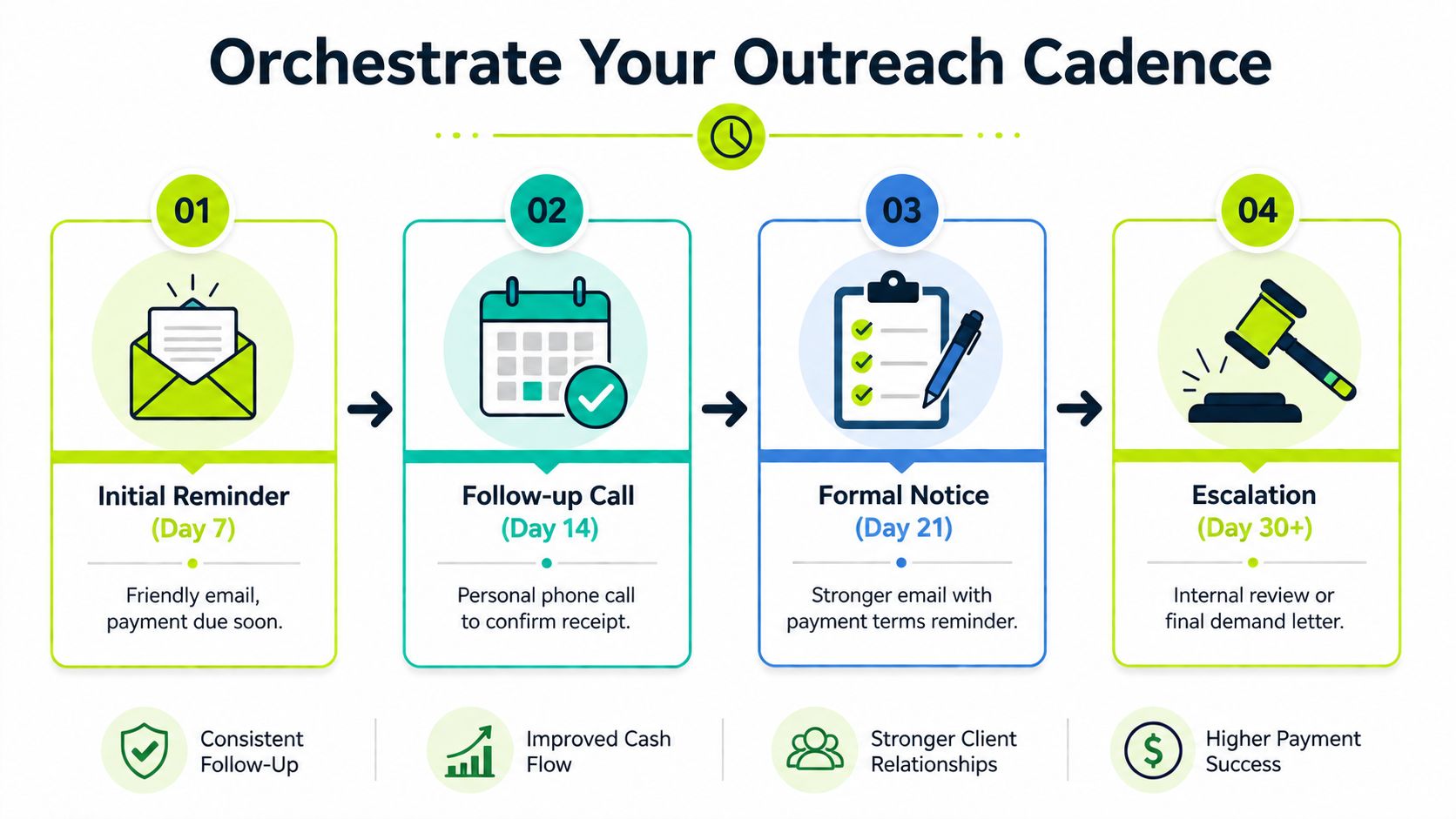
Most firms don't have a reminder strategy. They have a reminder mood. One collector follows up early, another waits. One partner sends a polite note, another forwards the invoice with "any update?" That inconsistency trains clients to treat your process as optional.
A disciplined outreach cadence changes that. It also takes pressure off your team, because the process decides the next step instead of someone's memory.
Use timing that matches how invoices actually get ignored
A structured, multi-touch reminder protocol that sends emails before and after the due date, then escalates to a phone call, produces a 35% faster collection rate than manual follow-up and reduces DSO by an average of 8 to 12 days, according to Fundible's invoice follow-up framework.
The useful part isn't just the lift. It's the sequence.
Fundible outlines a cadence built around:
- an automated email 15 days post-invoicing
- a second reminder the day before the due date
- past-due follow-ups at 1, 7, 10, and 14 days
- a direct phone call if the emails go unanswered after repeated attempts
That progression works because it separates oversight from avoidance. Some invoices are late because nobody saw them. Others are late because the client is choosing not to prioritize them. Your cadence should tell you which is which.
Automation should make outreach more human, not less
Teams hear "accounts receivable automation" and assume colder communication. In practice, the opposite is possible if the system is configured well.
The machine should handle the repeatable parts:
- sending reminders on time
- pulling the right invoice details
- choosing the correct channel
- logging every touchpoint
Your people should handle the judgment:
- whether the client needs a phone call
- whether a dispute is real
- whether a partner should intervene
- whether to hold future work
That split is where AI AR automation starts to matter. Not because it replaces the collector, but because it gives the collector a process they can trust.
A short explainer helps if you're evaluating cadence design and communication style in parallel:
Keep the tone steady as pressure rises
One mistake shows up often in professional services. The message tone changes too sharply once an invoice becomes overdue. Friendly at first, then suddenly legalistic. Clients notice. It signals panic, not control.
A better sequence sounds like this:
- Reminder before due date: Clear, brief, routine.
- First overdue notice: Assumes an oversight and includes a direct pay path.
- Second overdue notice: References prior outreach and asks for a payment date.
- Phone call: Confirms receipt, surfaces blockers, and tries to take payment immediately.
- Formal escalation: Reserved for accounts that are choosing not to engage.
Consistency is persuasive. A client who sees the same calm process every time learns that your firm means what it says.
Use Automation for Risk Scoring and Control
Not every overdue invoice deserves the same attention. If your team works oldest-to-newest without considering client behavior, invoice size, or dispute history, you're spending effort where it feels organized, not where it protects cash.
That's the limit of basic reminder software. It automates activity. It doesn't improve prioritization.
Move from queue-based collections to risk-based collections
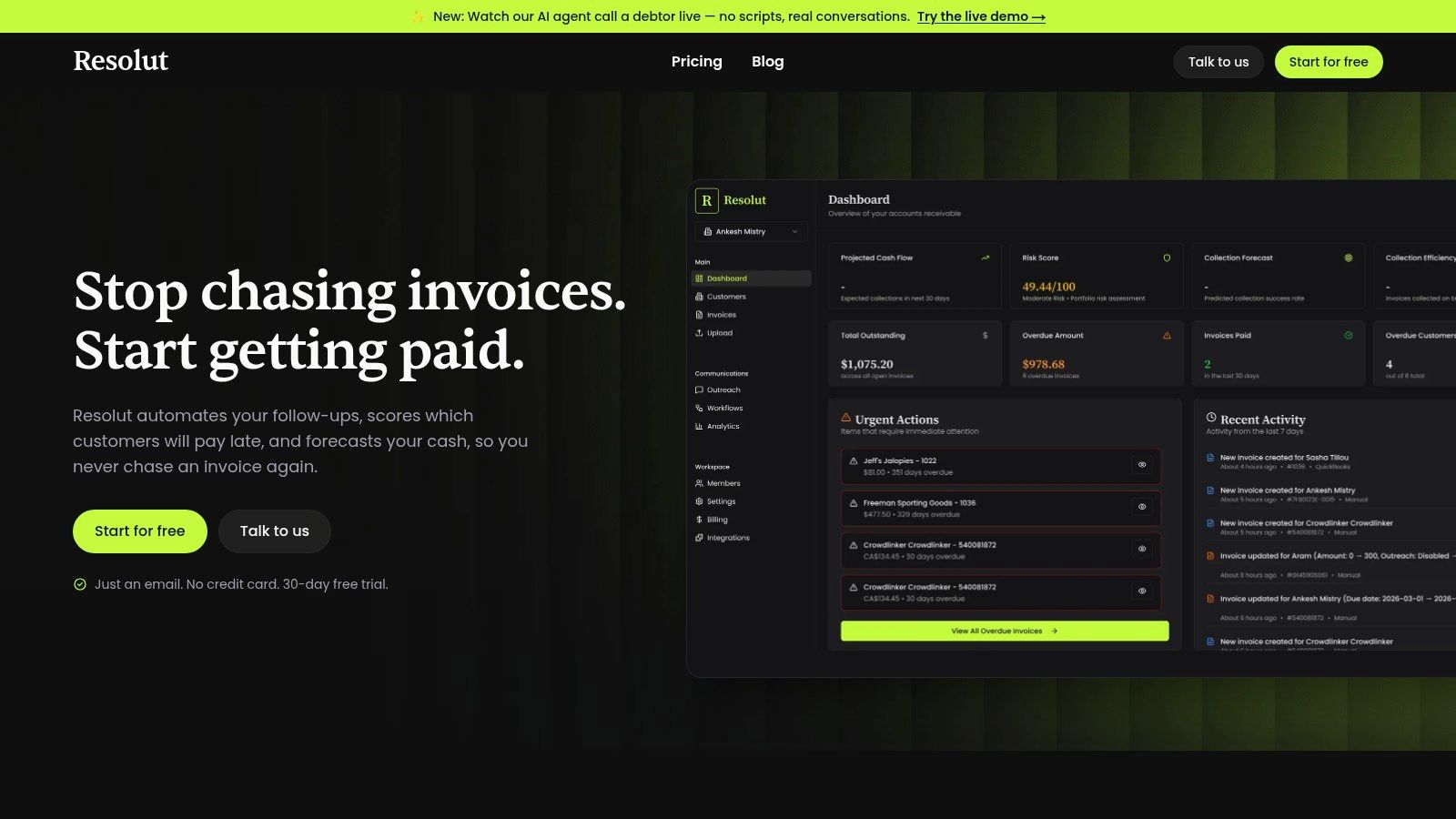
A modern AR stack should tell your team where risk sits now. That means looking beyond due date and amount. It should also factor in payment behavior, response patterns, open disputes, partial payments, and the commercial importance of the account.
When firms adopt accounts receivable automation, the biggest gain often isn't speed alone. It's control. The team can stop treating every account the same.
Think of it this way:
Approach | Team behavior | Likely result |
|---|---|---|
FIFO collections | Work the oldest items first | High effort, weak prioritization |
Rule-based automation | Trigger reminders by age bucket | Better consistency, limited judgment |
Risk-based orchestration | Prioritize by likelihood and consequence of nonpayment | Better focus on cash protection |
Autopilot for low-risk, co-pilot for high-stakes accounts
The practical model for AI AR automation is not full autonomy across the board. It is selective control.
Use autopilot when:
- the client usually pays
- the invoice is straightforward
- there is no dispute history
- reminders are likely enough
Use co-pilot when:
- the invoice is material
- the client has a pattern of stretching terms
- communication has gone quiet
- the account is strategically sensitive
AR software for professional services needs to reflect how firms truly work. A legal client, an agency retainer, and a consulting milestone invoice don't all behave the same way. The platform should support different paths without forcing the team into spreadsheet triage.
If you're assessing how machine learning fits into this operating model, this overview of credit risk analysis using machine learning is a relevant reference.
Use software to narrow judgment, not outsource it
The right system should narrow the decision set for your team. It shouldn't pretend collections is fully mechanical.
One useful pattern is to let software classify accounts into three practical buckets:
- Routine payers: Automate standard reminders and payment links.
- Watchlist accounts: Increase outreach frequency and surface them for review.
- Intervention accounts: Route to a finance lead, partner, or collector with context.
Resolut is one example of this category. It combines risk assessment, omnichannel outreach, payment options, and cash application in one workflow for firms that want AI AR automation without losing human oversight.
Operator's view: Good automation doesn't remove control. It gives finance a cleaner place to apply it.
Manage Escalation and Cash Application Intelligently
A rigid escalation ladder sounds disciplined. In practice, it can be expensive. Not every late payer should be pushed toward the same end state, and not every overdue balance is a collections failure. Sometimes it's a structure problem.
That distinction matters more in professional services, where the value of the client relationship can exceed the value of winning one payment dispute aggressively.
Know when firmness helps and when flexibility pays more
Most collection playbooks assume the answer to delay is escalation. That works for some accounts. It fails on others.
Data cited by Capstone Trade shows that offering payment plans can reduce total loss risk by up to 30% compared to strict enforcement, while also preserving future business. That's the right frame for a CFO. The question isn't whether you can be tough. It's whether toughness improves recovery.
Use stricter escalation when:
- the client is unresponsive
- prior commitments were broken repeatedly
- the dispute appears tactical rather than real
- future work is already unlikely
Use a structured payment plan when:
- the client is communicating
- the service relationship still matters
- cash constraints are temporary
- partial recovery now is better than a write-off later
Separate collection strategy from back-office drag
There's another problem that gets buried under the escalation discussion. Even when a client pays, many firms are slow to apply the cash accurately. The money hits the bank, then someone has to match remittance details, identify short pays, update QuickBooks, and clear exceptions.
That isn't just tedious. It distorts visibility.
For firms using QuickBooks AR automation, cash application should be part of the design, not a separate cleanup step. If your team still spends hours matching deposits to invoices, you don't have a complete AR process. You have faster billing and slower accounting.
A practical operating model looks like this:
- Collections path: Decide whether to remind, call, restructure, or escalate.
- Payment intake path: Make it easy for the client to pay through approved channels.
- Cash application path: Reconcile fast so aging reports reflect reality.
If the client paid but your aging still shows the invoice open, finance loses credibility with the business.
Measure What Matters and Drive Change
If you want sustained improvement, don't just ask whether invoices are getting collected. Ask whether the system is getting more predictable, less labor-intensive, and easier to manage across teams.
DSO matters. It isn't the whole picture.
Track the metrics that show operational quality
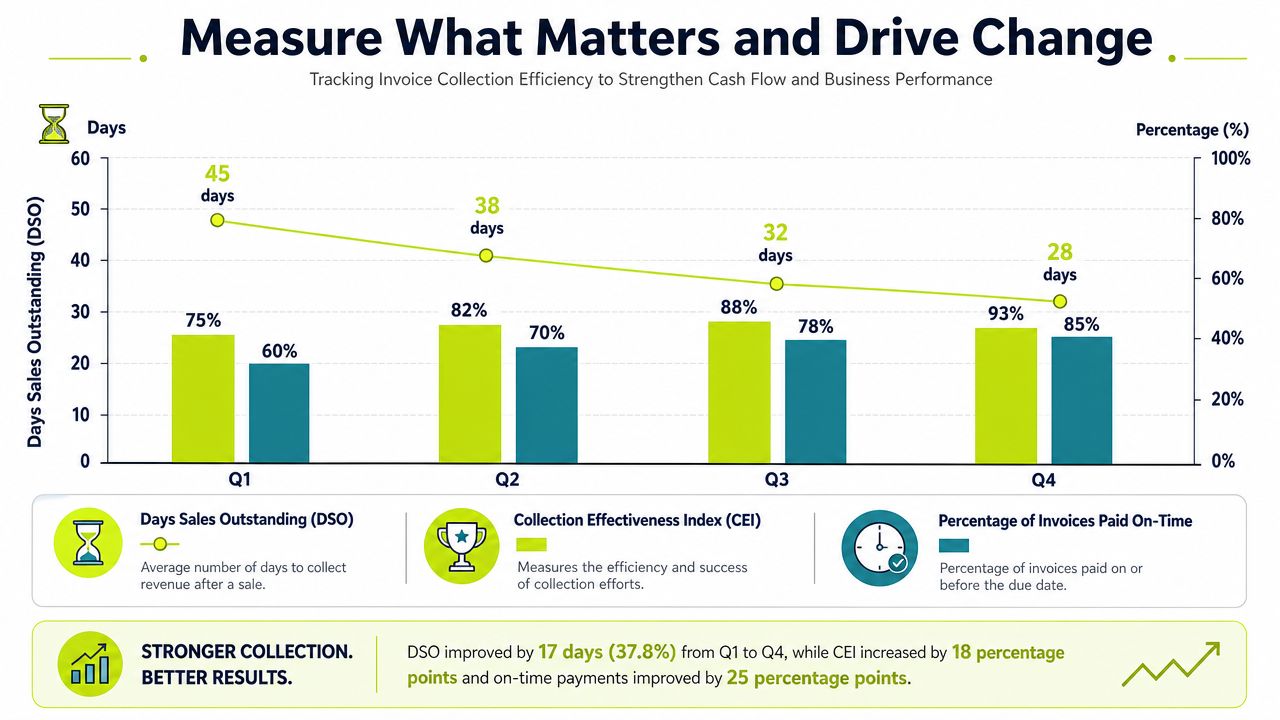
Most CFOs already watch DSO. Keep doing that, but pair it with at least two additional views:
- Collection Effectiveness Index: This shows how much of the receivables available for collection your team converts.
- On-time payment rate: This reveals whether upstream fixes are working, not just late-stage collections.
- Exception volume: Count how often invoices need manual correction, dispute handling, or custom follow-up.
- Cash application lag: Measure how long it takes from payment receipt to accurate posting.
This visual is a useful model for how to present trend movement to leadership:
One caution here. Don't treat every KPI as a finance-only number. If project leads submit billing late, or if account managers tolerate missing PO information, AR performance will suffer before collections ever begins.
Build the ROI case in plain operating terms
You don't need inflated math to justify AR software for professional services. The business case is usually visible in daily operations.
Look for value in four places:
Area | What improves |
|---|---|
Liquidity | Faster receipts reduce pressure on working capital |
Labor efficiency | Staff spend less time on reminders, status checks, and reconciliation |
Loss prevention | Better triage and structured outreach reduce avoidable write-offs |
Management visibility | Leaders get cleaner forecasts and fewer end-of-month surprises |
A useful benchmark for smaller teams is this playbook for small businesses from Business Loan Warrior. It's written for a different operating scale, but it reinforces the same point. Better receivables management isn't just about persistence. It's about system design.
Make change stick with ownership and review rhythm
The firms that reduce DSO and improve cash flow don't roll out automation and assume the job is done. They assign owners and review results on a cadence.
A simple governance rhythm works:
- Weekly: Review overdue tiers, disputed invoices, and blocked payments.
- Monthly: Look at DSO, CEI, on-time rate, and cash application issues.
- Quarterly: Revisit payment terms, invoice template quality, and client segmentation.
Keep the conversation grounded. The finance team doesn't need a lecture about digital transformation. They need fewer manual touches, cleaner workflows, and confidence that the process will hold up when volume rises.
Resolut automates AR for professional services, helping finance teams run collections with consistency, accuracy, and a human tone. If you're looking to get invoices paid faster without turning client communication into a blunt instrument, Resolut is built for that balance.