How to Balance Accounts Receivable: A Month-End Playbook
Learn how to balance accounts receivable with a month-end routine: tie the aging to the ledger, clear exceptions, and track DSO with confidence.
You're closing the month, the partners want a cash forecast, and someone has sent an aging report that doesn't match the ledger. Meanwhile, a client marked overdue says they've already paid. Before anyone sends another reminder, you need to establish which balances are real.
For CFOs, controllers, and owners of professional services firms with $3M–$50M in revenue, knowing how to balance accounts receivable means more than making reports agree. It means proving the accounting, separating exceptions from collection failures, and testing whether the remaining exposure is acceptable.
The Three Figures That Must Agree Every Month
Consider an illustrative close at a 40-person consulting firm: the aging shows $48,300, while the general ledger shows $47,950. The team spends two days investigating what turns out to be a posting-date difference. Nobody needed a more aggressive collection process. They needed consistent report dates.
Balancing accounts receivable means proving that invoices issued, open items in the aging, and cash posted to AR reconcile with the ledger and bank. Those figures won't all equal one another. They must explain the movement from opening receivables to closing receivables without an unexplained difference.
Five month-end tie-out checks
Pull the aging, AR control-account detail, trial balance, invoice register, and cash-receipt records before changing any invoice.
Check | What it compares | Typical cause of a gap | Where to look first |
|---|---|---|---|
Aging total vs GL accounts receivable | Open items against the AR control account | Aging run today instead of at period end | Aging Summary and trial balance |
GL AR vs trial balance | Control-account balance against the trial-balance line | Manual journals posted after the close extract | Journal entry listing for the period |
Cash receipts vs bank deposits | Payments posted in AR against bank deposits | Unapplied deposits or incorrect receipt dates | Bank reconciliation and receipts journal |
Invoices issued vs sales journal | Invoice register against recorded billing activity | Voided invoices left open or missing billing entries | Invoice register and sales journal |
Unapplied cash vs customer balances | Unapplied receipts against that customer's invoices | Payment received without an invoice reference | Unapplied cash report |
For professional services, don't force invoicing to equal recognized revenue without explaining the difference. Where billing and revenue recognition occur at different times, retain a documented bridge.
Close tolerance: The unexplained difference between the aging and AR control account must be zero. Genuine bank timing items belong on a variance list with an owner and clear-by date, not in an unsupported adjustment.
How to Reconcile the Ledger and Bank Deposits
Start with the reporting cutoff, not the oldest invoice. QuickBooks provides an Aging Summary showing outstanding balances by age and an Aging Detail identifying the underlying transactions and customers. Its guidance says the balance sheet, trial balance, and aging should match, and identifies the aging report's current-date default as a common cause of differences, according to QuickBooks' aging-report instructions.
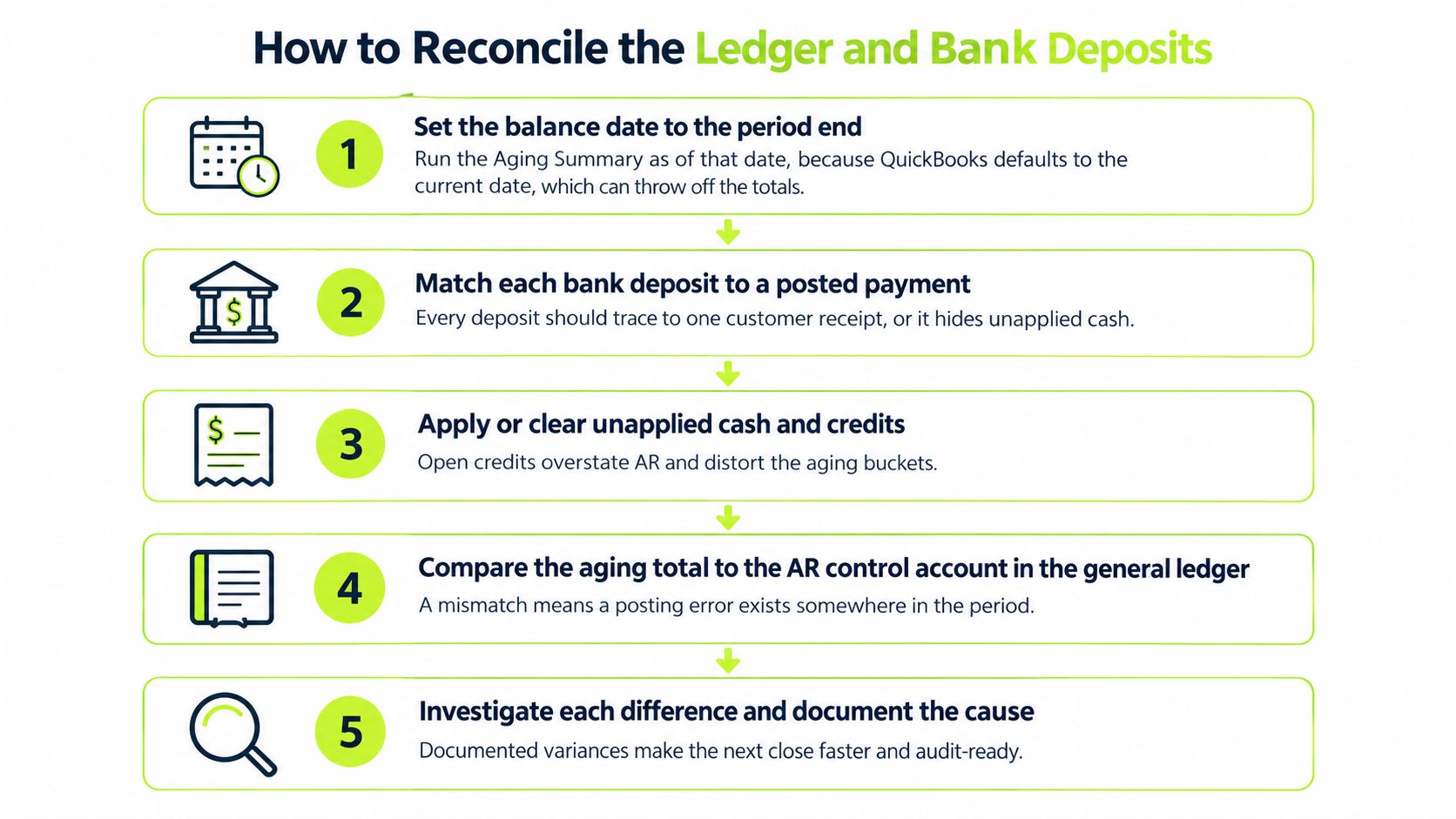
Use this process flow as a close-desk reference.
Follow the evidence in order
- Establish a common cutoff. Reports from different dates can disagree without either being wrong. Set the balance date to period end, run the Aging Summary, and save its reporting parameters.
- Find the transaction behind the difference. Aggregate totals identify a problem but don't explain it. Compare the aging with the balance-sheet control account and trial balance, then inspect Aging Detail by transaction date, including entries around the cutoff.
- Prove the cash movement. A posted customer payment isn't proof of a bank deposit. Match receipts line by line to bank activity, allowing for documented grouped deposits, and list deposits with no corresponding receipt.
- Apply cash only with support. Matching by amount alone can close the wrong invoice. Use remittance evidence to apply the receipt; otherwise retain it as unapplied with a reason code and assigned investigator.
- Document what remains. An unexplained difference isn't a timing item merely because someone expects it to disappear. Record the amount, transaction type, evidence, owner, and clear-by date before the reviewer signs off.
For the bank-side work, Everglow Prosperity's guide to reconciling bank feeds with accounting records provides a useful companion resource. Keep the supporting bank workpaper connected to your bank account reconciliation, rather than maintaining conflicting explanations in separate files.
Test the cutoff before correcting the books
In an illustrative example, a $350 difference traces to a credit memo entered two days after an earlier aging export. The credit carries a period-end posting date, so rerunning the aging at period end brings it into agreement with the updated ledger.
If the credit instead belongs to the following period, rerunning won't justify moving it backward. Investigate the effective posting date and accounting treatment before changing anything.
At sign-off, the control-account check should show no unexplained difference, supported by a short, dated list of genuine timing items. Never post a balancing journal just to finish the close.
Exceptions That Push Balances Out of Line
A paid invoice can still appear overdue when the receipt sits unapplied. A short payment can represent a legitimate billing dispute rather than an unwilling customer. Chasing either as routine debt creates unnecessary friction.
The operational burden is substantial: 27% of respondents said at least half their AR team's time went to invoice disputes, while more than 75% of SMBs handled collections or disputes manually through email, according to the June 2025 Friction to Flow AR Tracker.
Decide what the exception actually represents
Issue a credit memo when the firm billed incorrectly, such as using the wrong rate or failing to reflect an approved scope change. A commercial concession also needs approval and a documented reason. It shouldn't disappear into a generic billing-error code.
Retain a deposit or milestone payment according to the contract and applicable accounting treatment until there's evidence supporting application. As an internal policy, escalate disputes immediately when nobody owns them, and require controller review when they remain unresolved past 30 days.
Exception symptoms, causes and fixes
Symptom | Likely cause | Fix |
|---|---|---|
Invoice shows overdue but cash arrived | Payment sitting unapplied | Apply the supported receipt and rerun the aging |
Customer short-pays by 5–10%, for example | Disputed line or customer deduction | Log the dispute; credit a billing error only after validation |
Two open invoices for the same job | Invoice resent with a new number | Void the duplicate while preserving the original record and audit trail |
Aging differs from GL by a few hundred dollars | Credit note entered after the report extract | Rerun at period end and verify the credit's posting date |
Large balance stuck in the 30–44-day bucket | Missing PO or service-delivery evidence | Attach evidence, correct billing details, and resend |
Deposit with no matching invoice | Wire received without an invoice reference | Trace the remittance and identify the customer |
Keep the original invoice, supporting agreement, customer correspondence, and approved adjustment together. Track how long each exception remains open, not just whether someone sent an email.
A credit memo should explain a valid adjustment. It shouldn't conceal an unresolved collection problem.
How to Work the Aging Report Bucket by Bucket
Older debt deserves more scrutiny, but published recovery estimates aren't guarantees. One collectability schedule estimates recovery at 97.4% for current debt, 92.6% at 30 days, 83.4% at 60 days, 71.2% at 90 days, and 54.7% at six months, as reported in Blue Book Services' credit-to-cash process guidance.
Use the decline as a reason to intervene early, not as an automatic valuation for your own portfolio. A disputed consulting milestone and an undisputed invoice from a financially stressed client need different responses.
Turn age into an assigned action
- Segment consistently. Sort invoices into the buckets below using days past due, not days since issue. Keep the bucket definitions stable across reporting periods.
- Validate before contact. For balances past 30 days, check the contract, service acceptance, purchase-order data, tax details, and dispute status. Don't ask a client to solve an error your firm hasn't corrected.
- Assign ownership. Apply the action table, with authority limits for credits, payment plans, and work holds.
- Record commitments. Every promise to pay needs a confirmed date, amount, and customer contact.
- Measure resolution. Track cure rate by bucket monthly, alongside kept payment promises and dispute-resolution time.
Aging buckets, first checks and actions
Bucket | Validate first | Action | Owner |
|---|---|---|---|
Current | Invoice delivered; terms match contract | Pre-due reminder | AR clerk |
1–29 days | Service-delivery proof and PO details | Confirm payment date | AR clerk |
30–44 days | Dispute status and billing evidence | Statement plus call; confirm commitment | AR lead |
45–59 days | Contact history and unresolved disputes | Decide on credit memo or payment plan | Controller |
60–89 days | Customer liquidity and credit exposure | Consider holding new work or requiring a deposit | CFO |
90-plus days | Recovery estimate and legal options | Reserve review and legal referral where appropriate | CFO with counsel |
The 30–44-day window deserves concentrated attention because a direct conversation may still resolve an ordinary administrative delay. That doesn't mean ignoring a larger, riskier balance elsewhere.
Use an invoice-level accounts receivable aging review to distinguish work completed from work promised. An email sent is activity; a verified payment or resolved dispute is an outcome.
Calculating DSO and Judging It Against Terms
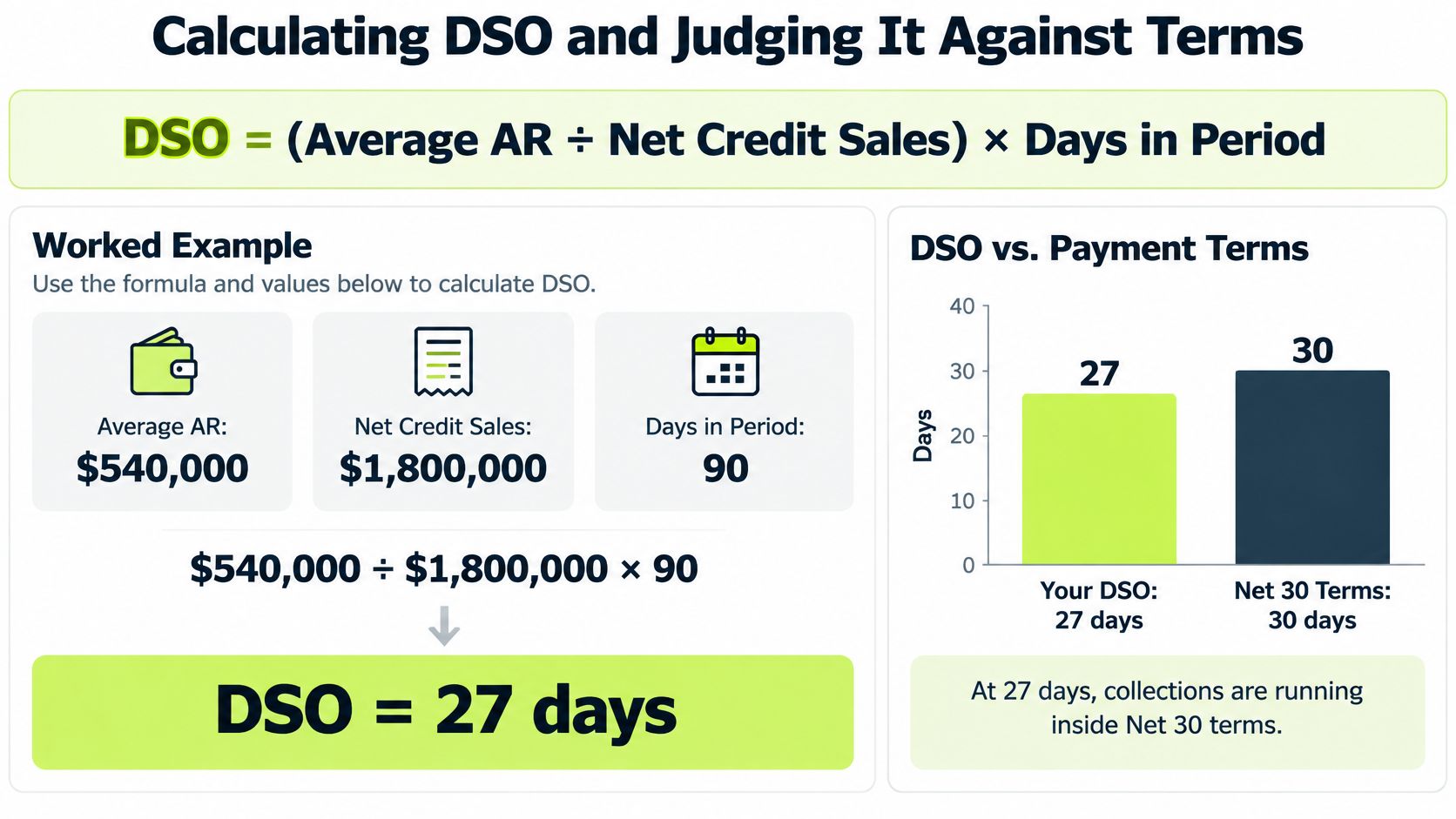
Run DSO only after the ledger agrees to the bank and subledger: DSO = Average AR ÷ Net Credit Sales × Days in Period. A rolling three-month period keeps one large billing run or delayed posting from looking like a collection failure.
Treat the output as a claim to test. Compare it with contractual terms and with the firm's own trend over recent quarters. Best Possible DSO, which counts only current receivables and excludes the overdue component, gives a cleaner ceiling for collection performance, as described in DualEntry's accounts receivable practices. If reported DSO sits near Best Possible while the aging keeps worsening, current invoices are propping up the average and the risk check is not finished.
Read the result against the contract
Example: average AR of $540,000, divided by $1,800,000 in net credit sales over 90 days, produces 27 days of DSO. Against Net 30 terms, the terms-relative result is 0.90.
That reading says aggregate collections are running inside standard terms. A ratio above 1.0 points to receivables exceeding the terms-based reference. Either figure can still hide one concentrated delinquent account.
- Keep the denominator clean. Use net credit sales, excluding cash sales and sales tax. Where receivables include tax, normalize both sides consistently.
- Account for mixed terms. A firm with different contractual terms needs a weighted terms comparison, not a single company-wide label.
- Inspect the underlying invoices. Strong aggregate DSO can coexist with a growing overdue balance in one customer.
For additional calculation context, use this video alongside the reconciliation workpaper.
Treat DSO in accounting as a trend measure; credit judgment still needs the aging and exposure review. To reduce DSO, fix the underlying cause rather than adjusting reporting assumptions. Reconciling only the ending balance and ignoring unapplied receipts can both distort the result.
Why a Balanced Ledger Can Still Hide Risk
A clean reconciliation proves recorded balances agree. It cannot prove customers can pay them. Every receipt can trace to the bank while the firm keeps extending credit to a client whose unpaid exposure keeps growing.
Payment strain is common enough that this check belongs in every close. In 2025, Western Europe reported 47% of B2B invoices overdue and bad debts averaging 6% of invoices, according to Atradius Collections' payment-practices reporting. Treat these figures as market context rather than loss assumptions for a specific firm.
Adopt triggers before relationships become difficult
Combine aging with payment behavior over the preceding six months, dispute frequency, customer concentration, currency exposure, and sector conditions. The following are example internal policies, not universal credit standards.
- Deteriorating behavior. Review terms after two consecutive months of growing balances more than 60 days overdue.
- Excess exposure. Require a deposit when unpaid fees exceed a firm-approved share of monthly billings or the customer's credit limit.
- Repeated broken commitments. Bring the engagement partner and CFO into the conversation before referring the matter for legal review.
- Material concentration. Revisit the cash forecast when a major client's expected payment moves, even if overall DSO looks stable.
A reconciled receivable is an accounting conclusion. Continuing to finance that customer is a separate management decision.
Some buyers delay payment to manage their own liquidity. Proportionate responses exist. Revised milestones, deposits, or a documented payment plan may protect a viable relationship better than an immediate work stoppage.
The close ends with exposure, not arithmetic. The last question is whether the firm understands what remains at risk and who can authorize more.
Lock Your Month-End Routine This Close
A close routine only works when the same checks run in the same order every period. Write it down, assign owners, and treat a skipped step as a variance in itself.
Run the checklist by cadence
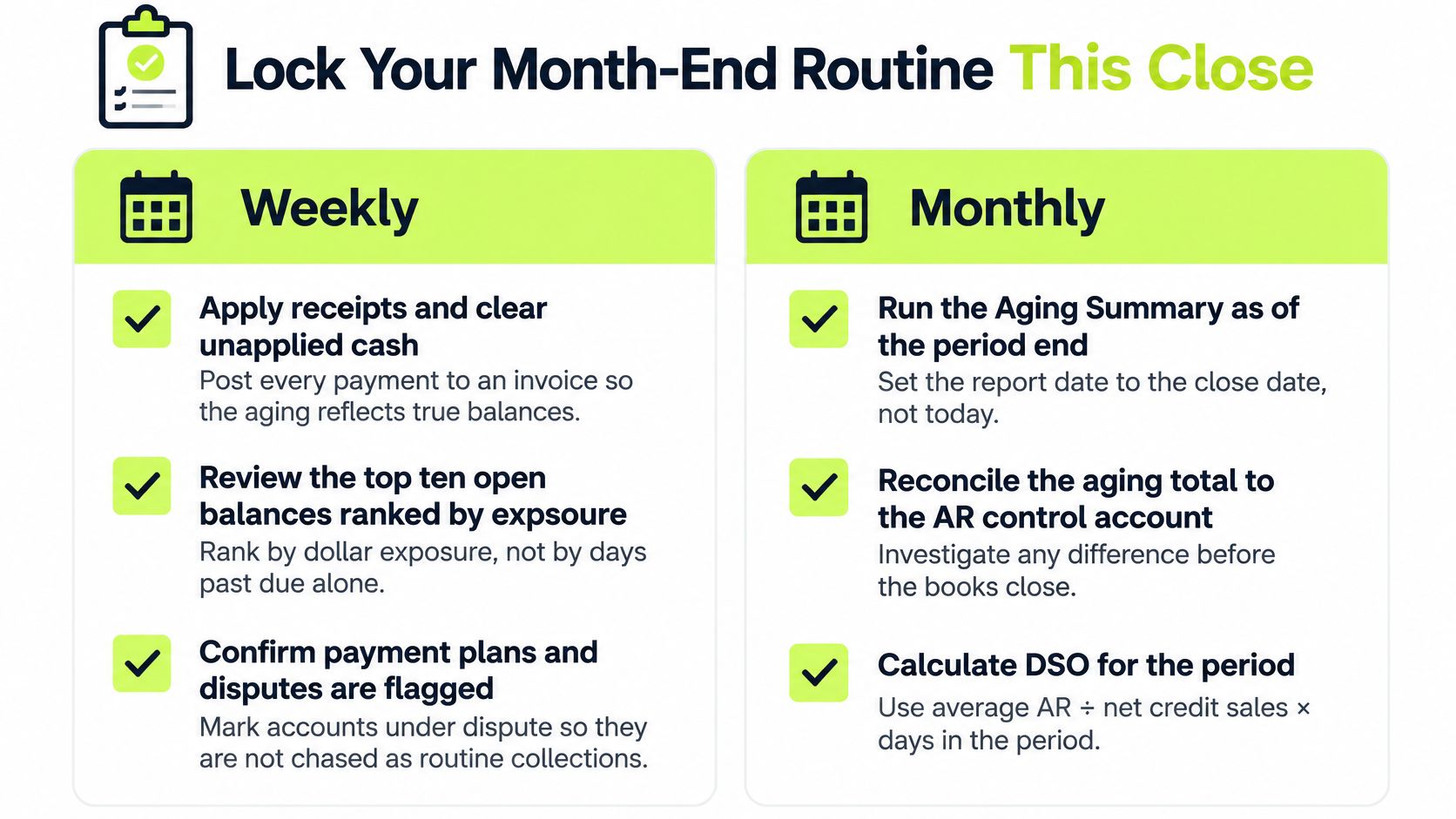
- Weekly. Apply supported receipts, investigate unapplied cash, and review the top ten open balances ranked by exposure rather than account count. Confirm that payment plans and disputes are flagged before routine reminders go out.
- Month-end. Complete the opening tie-out checklist, retain the period-end aging, and record each variance with an owner and clear-by date. Add rolling three-month DSO and the credit-risk review to the close package.
- Quarterly. Reassess customers with repeated balances more than 60 days overdue. Reset terms, limits, and approval requirements where the risk assessment supports a change.
Keep this checklist visible where the team prepares the close.
Automate repetition without removing judgment
Evaluate accounts receivable automation against specific controls. Receipt-to-invoice matching should use remittance data and flag missing references. Short-pays, disputed balances, and unapplied items above your approval threshold should route to a named reviewer.
For QuickBooks AR automation, require visible synchronization status and retained source references. An invoice marked paid in a connected tool is not proof that the accounting entry posted correctly.
When assessing AI AR automation, ask how uncertain matches are handled, how a reviewer reverses an incorrect application, and whether changes remain auditable. Good AR software for professional services should support the engagement team's context without letting relationship owners bypass credit policy.
Three habits stay fixed regardless of tooling: date-stamp every report, maintain one variance file per month, and run checks in the same order. Measure whether the workflow helps improve cash flow through fewer unresolved exceptions, more reliable payment commitments, and clearer exposure decisions.
If matching and reminders are where your team loses days, automate those repetitive steps and keep human review on the exceptions. The close ends when someone has looked at what remains open and decided the firm can carry it.
Resolut automates AR for professional services, consistent, accurate, and human, with payment matching, collections workflows, and exception review. Visit resolutai.com to see how those capabilities could support your month-end routine while your team retains control of credits, disputes, and customer risk.