How to Improve First Contact Resolution That Actually Sticks
Learn how to improve first contact resolution for AR and collections with a proven framework to cut callbacks, reduce DSO and improve cash flow.
You know the feeling. An invoice goes out cleanly, the customer calls with one question, and the team says, “We'll get back to you.” Two days later, someone is chasing the same issue again, cash is still sitting open, and nobody can tell whether the delay is a billing problem, a policy problem, or just a handoff that went nowhere.
In professional services, first contact resolution is not only a support metric. It's a cash-flow control. When the first interaction resolves the invoice question, dispute, credit request, or payment blocker without a callback, transfer, or re-open, you reduce repeat work, shorten the path to payment, and protect the relationship at the same time.
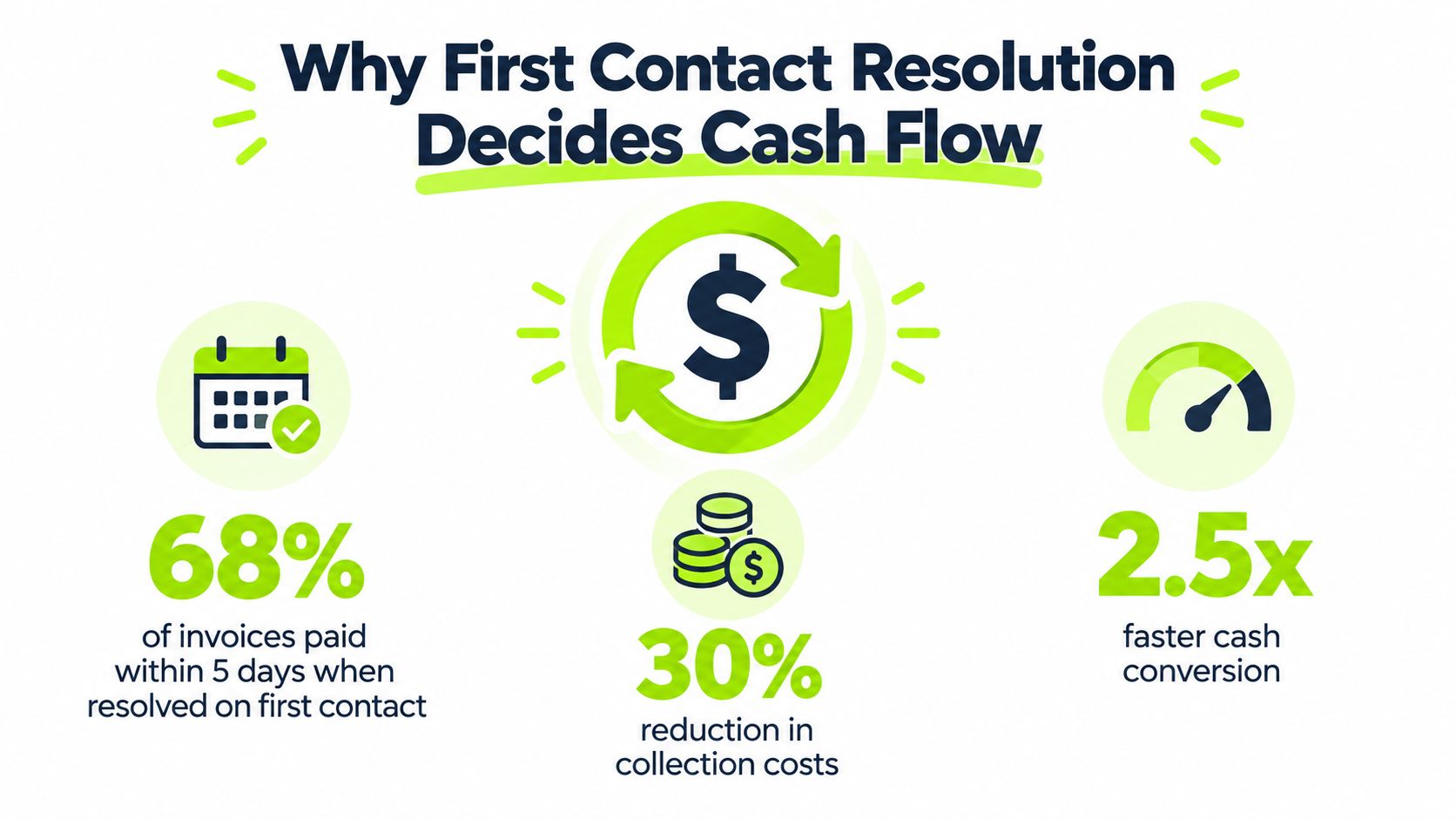
A useful way to think about it is this. If your team solves the issue on the first touch, the customer doesn't need to re-enter the queue, and your AR staff doesn't need to rebuild context. That matters in firms where billing accuracy, approvals, retainers, and milestone terms all shape when cash lands.
For a broader framing on customer-facing orchestration, the difference between human and automated front-line handling is worth reading in difference between AI and human receptionists. The operating lesson is simple, more friction at the first touch usually means slower money later.
If you want the digital side of the experience tied back to revenue operations, the related digital customer experience view is useful. In finance terms, the question is whether the customer can get a complete answer the first time, or whether every clarification becomes another day of DSO.
Why First Contact Resolution Decides Cash Flow in Professional Services
A consulting client calls about an invoice that does not match the approved milestone. If the first response explains the variance, supplies the supporting detail, and identifies the payment path, the account can keep moving. If the client must call again, the firm has added work and delayed cash without changing the underlying billing issue.
That is why first contact resolution belongs in the finance operating model. In AR, it means resolving the invoice question, payment blocker, or dispute during the first interaction, without a callback, transfer, or re-open within a defined recontact window. Each unresolved touch creates another task, another handoff, and another opportunity for payment to remain outstanding.
Why repeat contacts slow collections
Professional services firms depend on ongoing client relationships. A second or third billing contact can weaken confidence, particularly when the client believes the work has already been completed. Internally, AR staff repeat research, recreate context, and coordinate with delivery or finance teams instead of progressing other accounts.
Industry benchmarks place average FCR around 70% to 75%, with top-quartile teams at 85%+ and about 5% of contact centers reaching the world-class level of 80% or higher SQM benchmark summary. The operating implication is practical: improving resolution quality reduces avoidable workload and can support better cash efficiency.
Practical rule: a fast first reply is not a resolution if the customer must return with the same invoice question.
Billing structure adds another layer of friction. DSO in professional services often falls around 35 to 50 days, while consulting, accounting, and legal firms average roughly 40 to 45 days DSO by industry. Milestone billing, retainage, approval chains, and unclear supporting detail can extend that collection period. FCR therefore acts as a working-capital lever because it removes payment blockers before they become aging items.
The same principle applies across channels. A clear email, portal response, or phone conversation should leave the client with an answer, an owner, and a defined next action. Guidance on the difference between AI and human receptionists helps clarify which front-line tasks automation can handle and where judgment still belongs.
A strong digital customer experience supports that orchestration, but the finance test remains simple: did the interaction remove the reason payment was delayed? FCR connects service execution to improve cash flow without asking staff to chase the same issue repeatedly.
Diagnosing Your Current First Contact Resolution Performance
Before changing scripts or tooling, define FCR precisely. Count an issue as resolved only when the initial interaction settles it and the customer does not call back, transfer the case, or reopen it within the agreed recontact window. Many teams use a 24 to 72 hour window, which captures repeat contact without delaying operational reporting Sprinklr guidance.
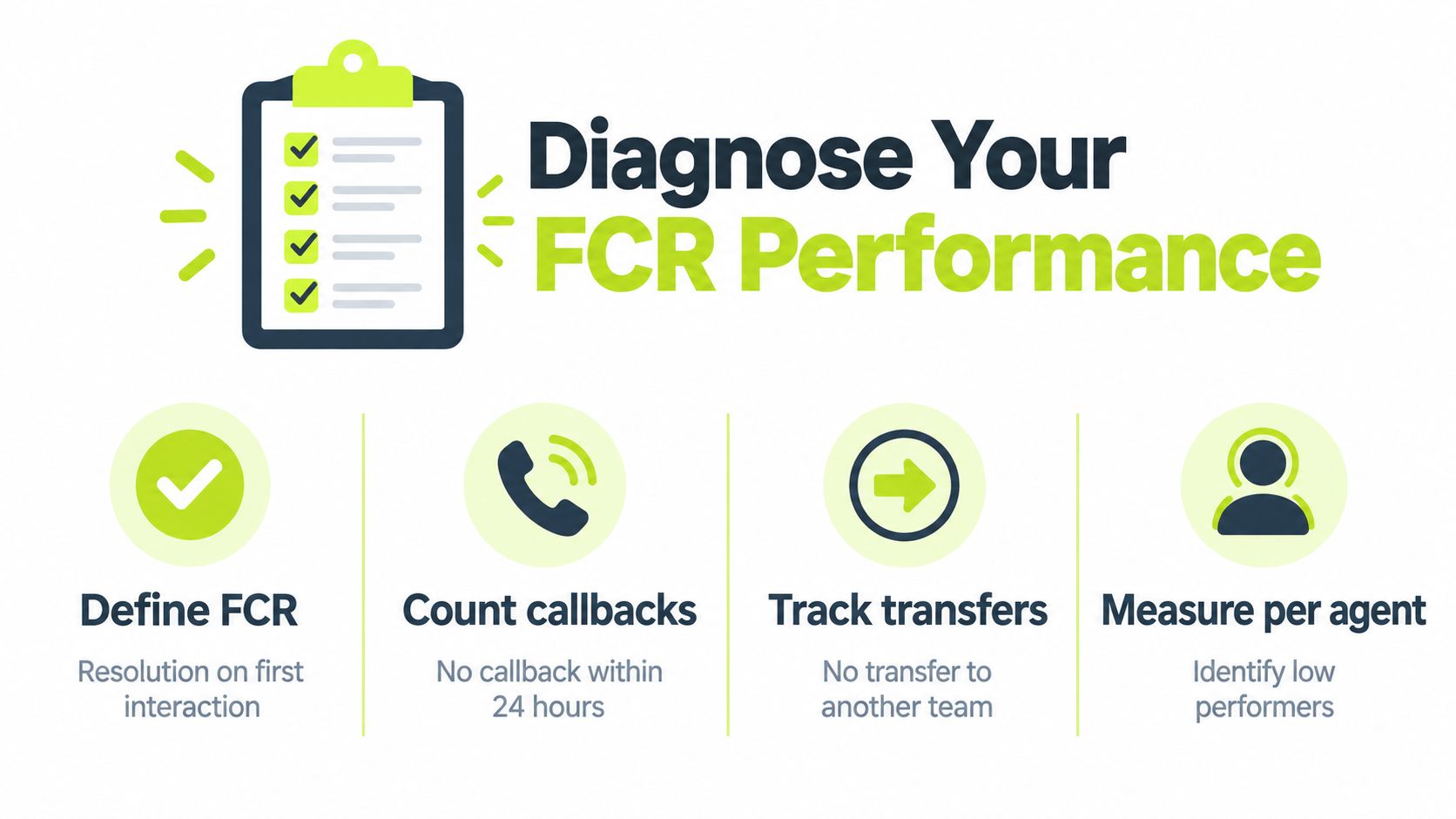
Measure unique issues, not raw contacts
Counting contacts instead of unique issues distorts the result. A client may send three emails about one invoice and receive a reply, yet the underlying issue remains open if the document still needs correction. For AR teams, the useful unit is the billing problem, not the number of messages exchanged.
Benchmark ranges provide context. Industry guidance commonly places strong FCR at 70% to 79%, with 80%+ treated as world-class and reached by only about 5% of contact centers Sprinklr guidance. A separate summary places good performance at roughly 70% and reports that about 30% of customers require a second contact Maven AGI summary. Use these figures as reference points, not as a substitute for a denominator that reflects your own invoice mix and case complexity.
Segment the metric where callbacks concentrate
One overall FCR number hides the operational cause. Segment it by channel, issue type, region, and team, then compare repeat contacts with aging, disputed balances, and payment-plan requests. This view shows whether a DSO problem starts with unclear invoice detail, a channel constraint, or a team that lacks the information needed to close the case.
Review four questions:
- Which issue types reappear? Identify recurring confusion around line items, retainers, or partial payments.
- Which channels underperform? Email may require a different resolution standard from voice.
- Which teams need more authority? Some can explain an invoice but cannot complete the correction.
- Which cases cannot be resolved on first touch? Exclude them from the standard denominator or report them separately.
If QA checks only whether the first reply was sent, it measures responsiveness, not resolution.
Channel comparisons also need a fair baseline. Guidance suggests voice FCR often falls around 70% to 75%, while email and other asynchronous channels may range from 55% to 70% Perspective AI guidance. Email can therefore appear slower while remaining the better route for a complex invoice question. Measure whether the channel removes the payment blocker, then connect the result to follow-up volume and DSO.
Redesigning Processes and Scripts That Resolve on First Touch
A professional-services client calls about an invoice, but the AR specialist cannot correct the document or confirm the payment route. The case moves to billing, then back to the client. Cash collection slows, DSO rises, and the firm has paid for several touches without removing the blocker.

Give the first responder enough authority to finish
An AR specialist needs accurate information, permission to act, and a workflow that does not send routine work to another team. If the person handling the invoice question cannot apply a credit, correct a document, or confirm a payment route, the first contact cannot resolve the account.
The best guidance on FCR points to removing blockers that force people back into the queue and warns against optimizing for speed instead of completeness. A quick closure with unresolved work is deferred rework, not resolution Firstsource glossary.
Set authority by issue type and billing structure. A specialist may resolve a missing purchase-order reference, explain a retainer balance, or resend an approved invoice. A pricing exception or contract change may still require escalation. The process should identify that boundary before the conversation starts, record the owner, and preserve the customer's context across channels.
Rewrite scripts for clarity, not pressure
A collections script should verify the facts, identify the payment blocker, choose the lowest necessary pressure, and capture a specific commitment. That sequence keeps the discussion tied to the account rather than turning it into a generic chase. The collections call script offers a practical structure for keeping the call focused on resolution.
Use the script to produce a clear end state. The customer should know what was corrected, what remains open, who owns the next action, and when that action will occur. Record those details in the AR system so an email, phone call, or portal visit continues the same case.
Operator's test: if the call ends with “I'll check and get back to you,” the process still depends on a second touch.
Keep the promise consistent across phone, email, and portal messages. Wording can vary by channel, but the invoice status, payment instructions, and ownership should match. Conflicting answers create another contact and can delay payment even when one response was technically correct.
Use the video as a process lens. Each interaction should be capable of producing a clean end state, with corrections recorded and follow-up work assigned rather than left hidden in an individual inbox. That control turns first-touch resolution into a cash-flow practice, not just a service metric.
Orchestrating Omnichannel Outreach and Automation for Faster Resolution
A billing question that starts by email, moves to a phone call, and ends in a payment portal should remain one case. If each channel creates a new record, the customer repeats the issue, AR staff reconstruct the history, and payment takes longer. Omnichannel orchestration protects first-contact resolution by keeping context, ownership, and next actions together.
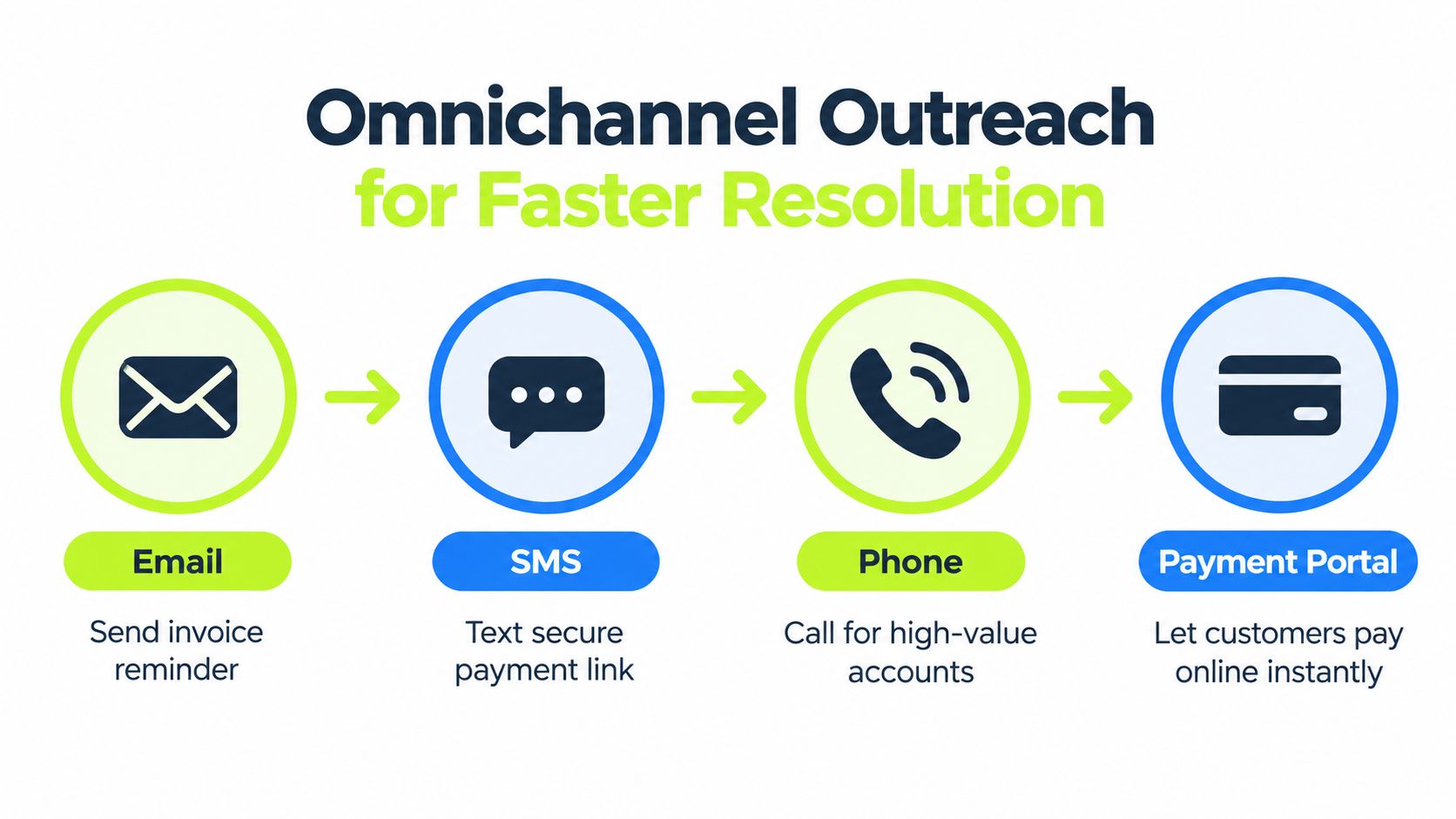
Match the channel to the task
Use email for invoice detail, documentation, and written confirmation. SMS suits short reminders and secure payment links. Phone remains appropriate for high-value accounts, disputed balances, or conversations where tone and nuance affect the outcome. A payment portal should let the customer review the balance and complete payment without another call. For always-on coverage of inbound questions outside business hours, a 24/7 AI lead capture tool can absorb first-touch requests so fewer become callbacks.
Channel choice should follow the customer's task and the account's risk. A reminder can be automated, while a disputed professional-services invoice may require a person who can explain time entries, approvals, or billing terms. The sequence also needs timing and personalization. Repeating the same message across every channel creates noise instead of resolution. A structured multi-channel outreach process treats the journey as one coordinated sequence.
Payment options complete the workflow. Card payments, bank transfers, and digital wallets reduce the chance that a customer needs another interaction merely to transact. In AR, convenience supports resolution because it removes an avoidable step between agreement and cash.
Use automation with human control where it matters
Automate repeated, low-variance work, including reminders, routing, status updates, and payment instructions. Keep human review for exceptions, high-balance accounts, and disputes with relationship risk. Autopilot fits a clear workflow with a standard outcome. Co-pilot control fits cases requiring judgment, negotiation, or escalation language.
Systems should surface at-risk invoices early, before a minor question becomes a stale receivable. AI AR automation and broader accounts receivable automation help maintain the workflow while staff concentrate on exceptions and client-specific decisions.
Resolut combines omnichannel outreach, payment routing, and cash-application workflows in one AR operating system, which is the setup professional services firms need to reduce DSO across channels. That connection matters because faster first-touch resolution improves both customer effort and the timing of collected cash.
Training Coaching and Quality Assurance That Protect True Resolution
Coaching should reward complete resolution, not a short interaction. A representative who closes an invoice question quickly, only for the client to return with the same issue, has created activity rather than progress. QA should confirm that the account can move to its next step without another queue entry, approval chase, or avoidable delay in payment.
Recurring contacts often expose an upstream control failure. A confusing invoice, unclear billing policy, missing approval authority, or weak handoff can generate callbacks even when the representative follows the script correctly. Helply notes that teams improve FCR by feeding recurring ticket patterns back into product processes and closing knowledge gaps Helply. For professional services firms, that feedback can lead to clearer billing structures and fewer interruptions to cash collection.
Compare two QA models
A handle-time model asks whether the interaction was short. A resolution model asks whether the account moved forward without another touch. The first is easy to report but can reward premature closure. The second requires reviewers to inspect the outcome, including whether the client received the information, authority, and payment path needed to act.
Classify callbacks by cause, then assign ownership. Finance may need to correct billing logic, operations may need to fix an approval route, and account leaders may need to clarify a commercial commitment. Coaching becomes specific when the QA record identifies the defect instead of labeling every failure as a representative performance issue.
Asynchronous work needs its own rubric. Score whether the written reply contained everything required to act, including the relevant invoice detail, requested decision, next step, and escalation route. Do not score email by how many threads the representative touched. A complete reply can resolve the matter in one message, while several fast replies can leave the client waiting for a usable answer.
Good QA asks one question: did the client's problem end, or did the representative only end the thread?
Contactability is part of control. If email supports invoice follow-up, test email deliverability before treating low response rates as a workflow failure. A message that never reaches the inbox cannot produce resolution, regardless of coaching quality.
Measuring Continuous Improvement and Scaling What Works
The scoreboard should connect first contact resolution to cash control. Pair FCR with DSO, repeat-contact rate, recovery rate, and cash conversion. Track your own DSO trend against the sector baseline established earlier, using DSO by industry and accounts receivable aging benchmarks as reference points rather than repeating their figures.
Build a weekly control loop
Review the measures every week. Ask which issues blocked resolution, which accounts needed another touch, and what must change in the script, system, routing, or billing structure. A month-over-month rise in DSO above two days should trigger that control loop.
If the same pattern appears twice, assign an owner and test a specific correction. An invoice type that repeatedly creates follow-up may need a clearer template, revised billing terms, or better supporting detail. A channel with high recontact rates may need different routing, response standards, or escalation rules.
Record the change, its owner, and the outcome. Keep effective changes in the playbook, and remove steps that do not improve resolution or cash timing.
Control point: do not wait for the monthly report to correct a problem visible every Friday.
Better FCR should reduce callbacks, clarify ownership, and shorten the path from invoice issue to payment. That is a cash-management result, not only a service metric.
Resolut helps finance teams automate AR workflows across outreach, resolution, and cash application while keeping control of the customer experience. See Resolut for a factual overview of its approach to consistent AR operations across channels.