Multi-Channel Outreach for B2B Accounts Receivable
Master multi-channel outreach for B2B accounts receivable. Learn which channels reduce DSO, how to sequence email, SMS, and phone, and how Resolut automates it.
The aging report is open, the reminders have gone out, and the same invoices are still sitting in the overdue column. Your team has sent polite emails, account managers have promised to check with the client, and nobody wants a routine payment issue to become a relationship problem.
That tension is familiar at professional services firms. Cash has to arrive on time, but collections can't sound hostile or disconnected from the client relationship. Multi-channel outreach gives finance teams a structured way to increase visibility without turning every overdue invoice into a manual escalation.
The Collections Problem Multi-Channel Outreach Solves
A professional services firm can deliver excellent work, issue a clear invoice, and still wait weeks for payment. The invoice may have reached the wrong contact, landed in an overloaded inbox, or been approved internally but stalled in a client's payment process. An email reminder alone rarely tells you which problem exists.
The operational cost appears in more than the aging report. Controllers spend time checking delivery, asking account managers for context, resending attachments, and deciding whether another reminder will help or irritate the client. Meanwhile, partners may continue approving new work for an account that has already become a cash-flow risk.
One 2023 AR and invoicing report for professional services firms recorded an average DSO of 47.6 days. The same report found that 32% waited 60 days or more to get paid, while 68% were usually paid within 45 days or less. The report's findings show why a firm can look broadly healthy while a meaningful part of its receivables remains slow.
Collections is different from sales prospecting
In sales, outreach tries to create interest where no commercial obligation exists. In collections, the client already received the service, the invoice represents an agreed obligation, and the objective is more specific: confirm receipt, resolve an exception, secure a payment commitment, and remove friction from settlement.
That distinction changes the sequence. A collections message should include the invoice reference, amount, due date, payment method, and a clear route to the right person. It shouldn't imitate a cold sales campaign or rely on artificial urgency.
A useful vocabulary distinction is between single-channel, multichannel, and omnichannel workflows. Finance leaders who want to clarify those terms can browse omnichannel terms before designing their process. The important operational point is simple: each channel must have a defined job, and the customer record must preserve the complete interaction history.
Practical rule: Use more than one way to reach a customer, but maintain one source of truth for the invoice, contact, promise date, and next action.
Email remains a sensible first touch because it creates a written record and gives the recipient the invoice context. It becomes less reliable when the invoice ages and the recipient hasn't acknowledged it. At that point, the finance team needs a deliberate escalation path instead of another identical message.
Why Multi-Channel Sequences Outperform Single-Channel Follow-Ups
The case for multi-channel outreach isn't that recipients want more messages. It's that channels differ in visibility, response speed, and suitability for a particular problem. An email may explain a disputed line item well, while a phone call can reveal within minutes that the invoice was never routed to accounts payable.
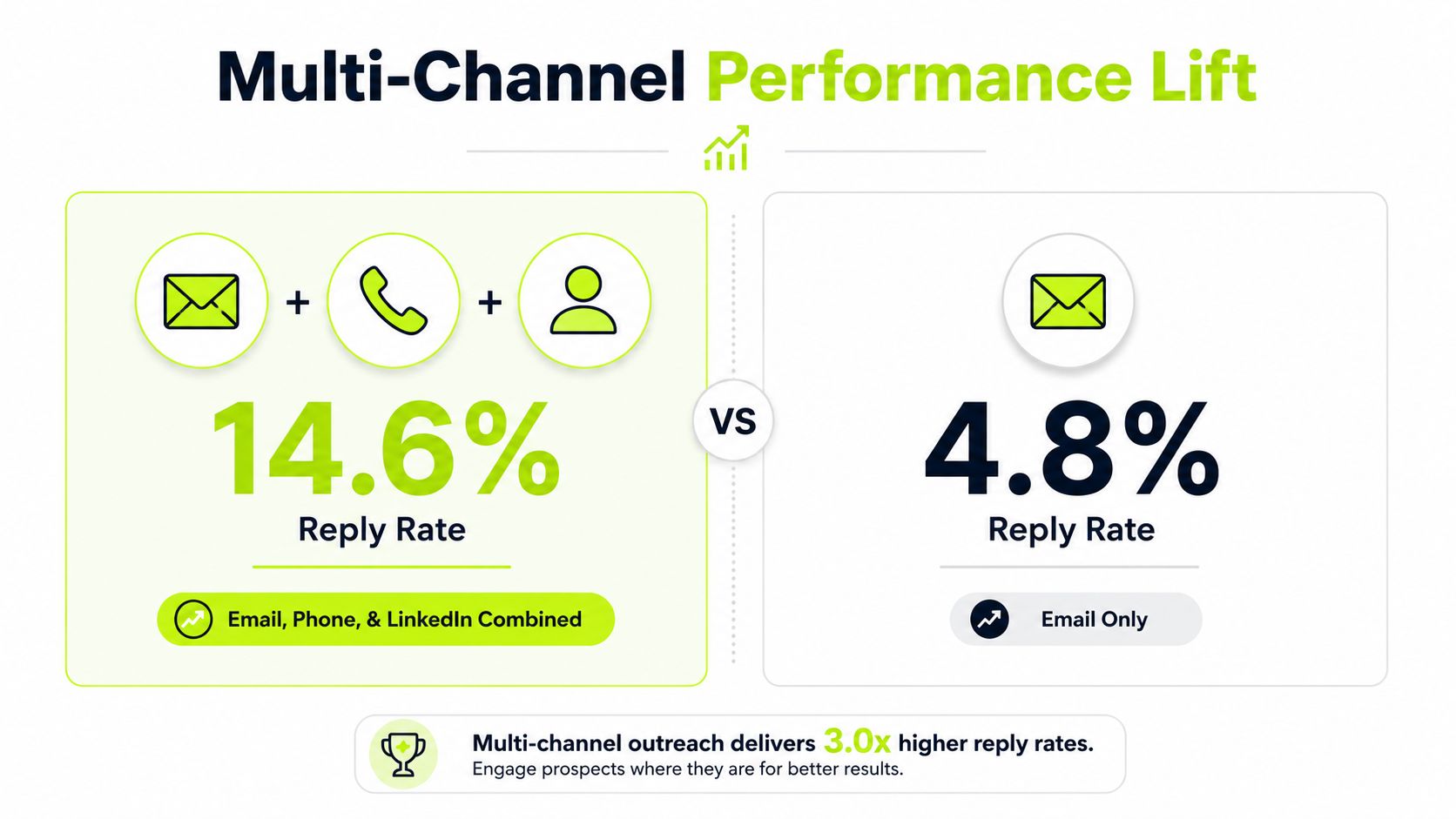
A widely cited B2B outreach benchmark reports that campaigns using three or more channels outperform single-channel outreach by 287% in purchase rates, with one summary citing a 10.3% LinkedIn response rate versus 5.1% for email alone. The same benchmark reports that sequences combining email, phone, and LinkedIn can raise meeting conversion by 55% to 65% compared with email-only sequences, with high-converting sequences commonly using 8 to 10 touches over 18 to 21 days. These figures come from a sales and prospecting context, so finance teams should treat them as directional evidence for channel visibility, not as a promise of equivalent payment results. The benchmark summary is useful because it separates coordinated sequencing from simple message volume.
Visibility matters more than channel count
Email is valuable when the recipient needs documentation. SMS is valuable when the recipient needs to notice an urgent reminder quickly. A phone call is valuable when the team needs an answer, not just an open. A payment portal matters when the customer has agreed to pay but encounters friction at checkout.
Channel benchmarks illustrate the difference. Cold email reply rates commonly sit around 2% to 5%, with top-quartile performance around 7% to 12%. LinkedIn connection acceptance can reach 25% to 35%, while SMS open rates are often cited above 90%. These are outreach benchmarks, not collections guarantees, and each denominator needs to remain separate. Channel performance research supports tracking response per touch by channel rather than hiding weak steps inside a blended average.
Timing and personalization contribute to the lift as well. A relevant SMS sent after an unanswered invoice email is different from sending the same payment request through every channel at once. The first approach creates a logical escalation. The second can feel like pressure.
Know when additional channels stop helping
More channels can create friction if they aren't coordinated. A client may receive an email from finance, a call from an account manager, and an SMS from an automated system without any shared context. That experience damages confidence even if the aggregate response rate improves.
The practical test is marginal value. Add a channel when it improves acknowledgement, identifies a blocker, or accelerates a commitment. Remove it when it merely repeats the same language, reaches a role that cannot act, or conflicts with a client's stated preference.
A clean cold email strategy can help teams think carefully about relevance and sequencing, but B2B collections requires different content and governance. For a related operational view, see follow-up automation. The standard should be payment progress, not activity volume.
Choosing the Right Channel for Each Collection Stage
A channel matrix keeps escalation consistent. It also prevents finance teams from treating an unread email, an unanswered call, and a disputed invoice as the same event.
Email is usually the right opening channel. It provides the invoice, statement, due date, remittance instructions, and a direct question such as whether the invoice is approved for payment. The message should be specific enough that the recipient can forward it internally without adding explanation.
SMS has a different role. It can bring a due or aging invoice to the recipient's attention quickly, but it should be used only where consent, customer preference, and local rules allow it. Keep the message short, identify the firm, reference the invoice, and direct the customer to a secure payment experience rather than placing sensitive details in the text.
Phone calls become more useful when the invoice remains unacknowledged or has crossed an internal aging threshold. A call can distinguish between an administrative delay, a procurement issue, a cash constraint, and a genuine dispute. It also gives the finance team an opportunity to coordinate with the account manager before the relationship becomes strained.
A payment portal should appear in every channel as the easiest next step. If the customer is ready to pay, unnecessary login friction, unclear bank details, or a missing copy of the invoice can delay settlement. A consumer-grade experience can support cards, bank transfers, or digital wallets where the firm's process and customer policies permit them.
Legal escalation voice is reserved for critical aging and unresolved commitments. It shouldn't be used as theatrical pressure. The message must reflect the firm's contractual rights, approval process, and applicable law, with human review for sensitive accounts.
Channel | Typical Open/Response Rate | Ideal Invoice Aging Stage | Primary Function |
|---|---|---|---|
Response rates commonly around 2% to 5% in cold outreach, with top-quartile results around 7% to 12%. Benchmark context | Invoice issue through early overdue | Document delivery, context, and audit trail | |
SMS | Open rates often cited above 90% in outreach benchmarks. Channel benchmark context | Due date through moderate aging, where permitted | Fast visibility and a concise payment prompt |
Phone | Performance depends on contact quality and connectability rather than an equivalent open-rate measure | Unacknowledged or materially overdue invoices | Diagnosis, commitment, and escalation |
Payment portal | No single open or response benchmark applies | Every stage | Remove payment friction and capture settlement |
Legal escalation voice | No general benchmark should be assumed | Critical aging after internal review | Formal seriousness and controlled recovery action |
The sequence should reflect the invoice, not a generic sales playbook. A strategic client may receive a finance email followed by account-manager coordination, while a routine account may move through an approved automated path. Global firms also need to respect channel preference and geography. One benchmark summary reports reply rates around 5% in North America, 7% to 10% in Europe, and 3% to 5% in APAC, while noting that WhatsApp can achieve very high opens but modest replies. The geographic benchmark summary reinforces the need to test locally rather than assume one channel works everywhere.
Building Collection Cadences That Match Invoice Aging
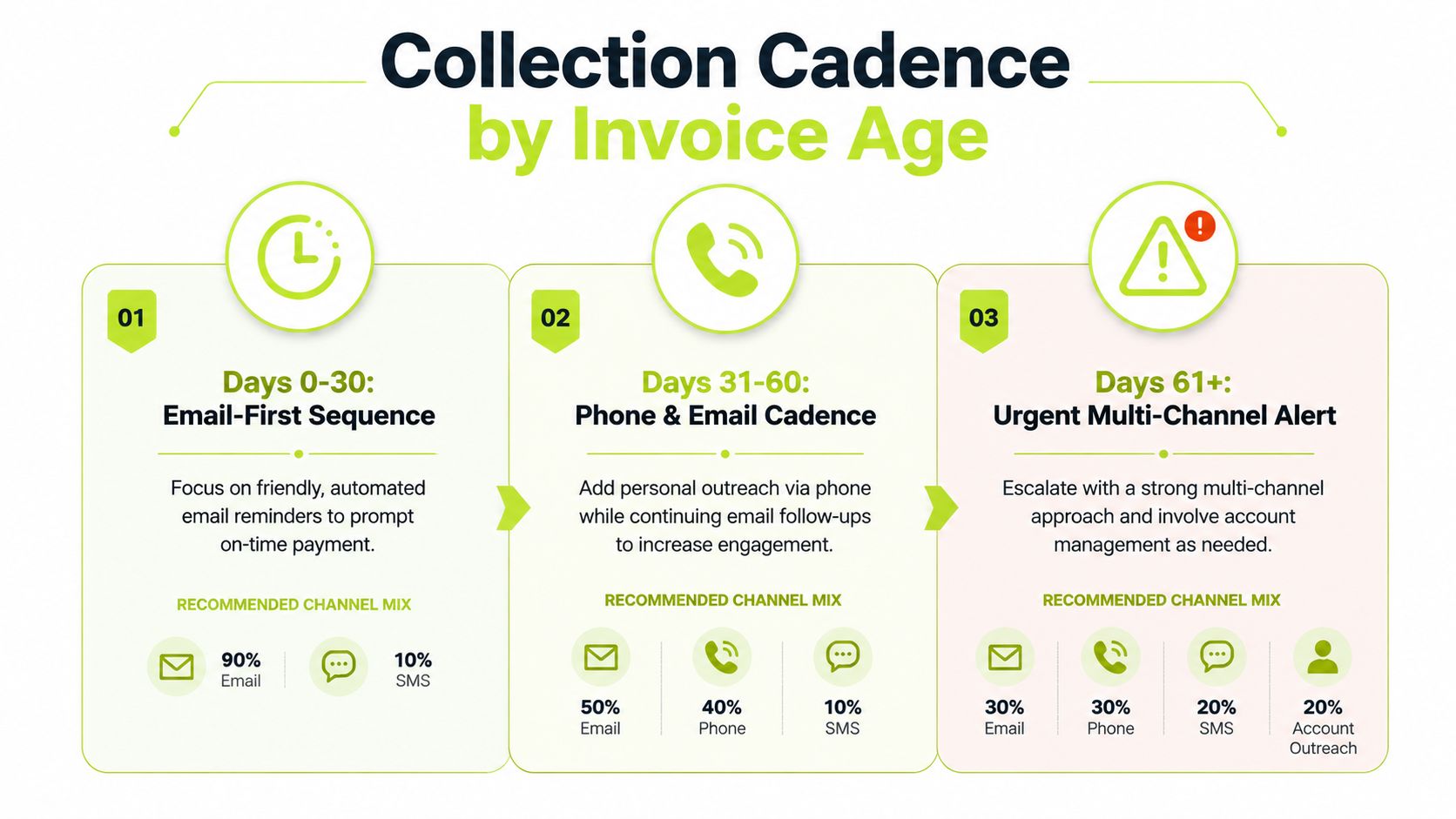
Aging should determine urgency, channel mix, and human involvement. The D&B industry DSO report separates receivables into current, up to 30 days late, 30 to 60 days late, 60 to 90 days late, and 91+ days late buckets. That structure gives finance teams a practical way to monitor severity instead of treating every overdue invoice as one undifferentiated queue. The D&B report provides the underlying aging logic.
Current through 30 days
Start with an invoice confirmation email before the due date or shortly afterward. Include the invoice, purchase order reference where applicable, payment instructions, and a question that exposes blockers early. If the customer hasn't acknowledged the message, send one approved SMS reminder or assign a low-friction call, depending on consent and account preference.
The purpose at this stage is acknowledgement, not confrontation. Stop the sequence when the customer confirms a payment date, reports a dispute, or identifies the correct AP contact. The system should record that outcome and suppress redundant reminders.
Days 31 through 60
At this point, move from email-first to a phone and email cadence. Send a concise email with the outstanding balance and a request for a specific resolution. Follow with a call that asks what is preventing payment and whether the invoice is approved.
For a high-value strategic client, involve the account owner before the call and agree on the language. For a transactional account, an automated email and SMS combination may be appropriate if the customer has consented. In either case, the next step should be a dated commitment, a documented dispute, or a controlled escalation.
Days 61 and beyond
Invoices in the 60 to 90 day and 91+ day buckets need senior review. Use email for the formal record, phone for direct resolution, and SMS only as a concise alert where appropriate. If prior commitments fail, route the account to the firm's approved escalation policy, which may include a lawyer-reviewed notice or a hold on new work.
The commonly cited sales benchmark for 8 to 10 touches over 18 to 21 days shouldn't be copied mechanically into collections. Payment recovery has different relationship and compliance risks. The right number of touches depends on invoice value, client history, dispute status, and whether each contact produces new information.
For a practical way to organize these categories, use accounts receivable aging as the operating view rather than relying on memory or separate spreadsheets.
Escalation principle: Increase the seriousness of the conversation as aging increases, but never increase message volume without increasing relevance.
Automating Outreach Without Losing the Human Touch
Manual collections fail through inconsistency. One customer receives a considerate reminder, another gets a copied template, and a third receives nothing because the owner has the relationship context but finance owns the invoice. Automation should standardize the mechanics while preserving decisions that require judgment.

An AI AR automation workflow can use invoice age, prior payment behavior, contact role, dispute history, and customer preference to select a message and a next action. The message should adapt to context. A first reminder can be neutral and administrative, while a later notice can state the missed commitment and request a resolution date.
Timing matters as much as wording. A system can avoid sending an SMS immediately after an email, wait for an acknowledgement window, and route an unanswered high-value account to a human. It can also stop a sequence when a payment arrives, a dispute is logged, or an account manager marks the client as sensitive.
Autopilot for routine work, co-pilot for judgment
Autopilot is appropriate for invoices with clean records, known contacts, standard terms, and no dispute indicators. Co-pilot control is more suitable for strategic accounts, complex project billing, executive relationships, and any situation where a legal or service-delivery issue may be involved.
The automation layer should also connect outreach to payment execution. A payment portal can present available methods, while automated cash application matches the incoming payment to the correct invoice and updates the customer record. That closes the loop that email sequencing alone cannot close.
A 2026 AR automation summary cited independent research reporting that 99% of companies using AI in accounts receivable reduced DSO, while 75% cut DSO by six days or more. The cited AR automation findings are evidence for automating repetitive receivables work, not a guarantee that every workflow will produce the same result.
Finance teams evaluating AI-driven follow-up for sales teams should apply the same discipline to collections: define consent, ownership, stop conditions, and escalation rules before activating a channel.
Resolut is one example of an AR orchestration platform that combines credit risk assessment, collections, omnichannel outreach, dynamic billing, and cash application. Its workflow can support email, SMS, and voice escalation, with autopilot and co-pilot modes for different levels of human control. For governance, see human-in-the-loop automation.
Measuring What Matters in Multi-Channel Collections
The number of emails sent is an activity measure, not a collections result. A finance leader needs to know whether the sequence produced acknowledgement, a payment commitment, a dispute resolution, or cash.
Track response per touch by channel. Keep email, SMS, and phone denominators separate so a strong SMS visibility rate doesn't hide weak email delivery or ineffective calls. Record the response type, not just whether a recipient replied.
The useful dashboard has a small set of operational measures:
- Time to acknowledgement: How long it takes the customer to confirm receipt or identify a blocker.
- Time to payment: How quickly cash arrives after each cadence pattern or escalation stage.
- Recovery by aging bucket: Compare outcomes for current, up to 30 days late, 30 to 60 days late, 60 to 90 days late, and 91+ days late accounts.
- Commitment reliability: Measure whether promised payment dates are met.
- Cost per collection: Include staff time, calling effort, platform costs, and escalation work.
- Relationship exceptions: Track complaints, opt-outs, disputes, and account-manager interventions.
A finance-leader study summarized by Billtrust associated high levels of AR automation with an average 41% reduction in DSO, while lower automation levels were associated with a 29% improvement. The Billtrust summary gives finance teams a useful benchmark for evaluating automation maturity, but internal baselines remain essential.
Review results by segment. A cadence that works for recurring retainers may not work for milestone billing, international clients, or accounts with frequent scope changes. The objective is not to maximize contact. It's to identify the least disruptive sequence that reliably moves an invoice toward payment.
Implementing Multi-Channel Outreach in Your Firm
Start with an audit of the last several months of collection activity. Identify which invoices received only email, where account managers had to intervene, which channels customers preferred, and where payment status failed to update promptly.
Next, segment the portfolio by client value, invoice complexity, payment behavior, dispute risk, and aging. Build a small number of approved cadences, then define ownership between finance, account management, and partners. Every sequence needs stop conditions for payment, dispute, opt-out, and human escalation.
Pilot the workflow on a controlled group before expanding it across the firm. Measure acknowledgement, payment timing, recovery by aging bucket, and exceptions from the start. That gives the Controller evidence to adjust tone and channel mix without disrupting established client relationships.
Resolut automates AR for professional services with consistent, accurate, and human multi-channel workflows across email, SMS, phone, payment collection, and cash application. Visit Resolut to see how your firm can orchestrate follow-ups, reduce DSO, and improve cash flow without asking finance staff to manage every reminder manually.